University of Pennsylvania
ScholarlyCommons
Publicly Accessible Penn Dissertations
1-1-2013
Study of Image Local Scale Structure Using
Nonlinear Diffusion
Yan Wang
University of Pennsylvania, [email protected]
Follow this and additional works at:http://repository.upenn.edu/edissertations Part of theApplied Mathematics Commons, and theRadiology Commons
This paper is posted at ScholarlyCommons.http://repository.upenn.edu/edissertations/719
For more information, please [email protected].
Recommended Citation
Wang, Yan, "Study of Image Local Scale Structure Using Nonlinear Diffusion" (2013).Publicly Accessible Penn Dissertations. 719.
Study of Image Local Scale Structure Using Nonlinear Diffusion
Abstract
Multi-scale representation and local scale extraction of images are important in computer vision research, as in general , structures within images are unknown. Traditionally, the multi-scale analysis is based on the linear diusion (i.e. heat diusion) with known limitation in edge distortions. In addition, the term scale which is used
widely in multi-scale and local scale analysis does not have a consistent denition and it can pose potential diculties in real image analysis, especially for the proper interpretation of scale as a geometric measure. In this study, in order to overcome
limitations of linear diusion, we focus on the multi-scale analysis based on total variation minimization model. This model has been used in image denoising with the power that it can preserve edge structures. Based on the total variation model, we construct the multi-scale space and propose a denition for image local scale. The
new denition of local scale incorporates both pixel-wise and orientation information.
This denition can be interpreted with a clear geometrical meaning and applied in general image analysis. The potential applications of total variation model in retinal fundus image analysis is explored. The existence of blood vessel and drusen structures within a single fundus image makes the image analysis a challenging problem.
A multi-scale model based on total variation is used, showing the capabilities in both drusen and blood vessel detections. The performance of vessel detection is compared with publicly available methods, showing the improvements both quantitatively and
qualitatively. This study provides a better insight into local scale study and shows the potentials of total variation model in medical image analysis.
Degree Type
Dissertation
Degree Name
Doctor of Philosophy (PhD)
Graduate Group
Applied Mathematics
First Advisor
James C. Gee
Subject Categories
STUDY OF IMAGE LOCAL SCALE STRUCTURE USING
NONLINEAR DIFFUSION
Yan Wang
A DISSERTATION
in
Applied Mathematics and Computational Science
Presented to the Faculties of the University of Pennsylvania
in
Partial Fulfillment of the Requirements for the
Degree of Doctor of Philosophy
2013
Supervisor of Dissertation
_____________________
James C. Gee
Associate Professor of Radiologic Science in Radiology
Graduate Group Chairperson
_____________________
Charles L. Epstein, Professor of Mathematics
Dissertation Committee
James C. Gee Associate Professor of Radiologic Science in Radiology
Charles L. Epstein Professor of Mathematic
Acknowledgments
This dissertation would not have been possible without the help, advice, and
encour-agement of a large group of people. To only some of whom, it is possible to give
particular mention here.
I would like to thank my advisor Dr. Gee. The most valuable lesson I have learnt
from him is the importance of independence in scientific research. Instead of giving
every detailed instructions on what we should follow, he provided us with insightful
big pictures, encouraged us and gave us the freedom to explore scientifically
interest-ing problems. The work would not be possible without his inspirations.
I would like to thank my committee chair and program chair Dr. Epstein. Thanks
for him to enroll us as the first year Applied mathematics and computational science
students. If I was not given this opportunity, it would be impossible for me to get
into the field of medical image analysis and participate in various projects. Thanks
to him for all of his help and support in the past five years. I would also like to thank
professors of all the courses that I took in graduate school.
projects in medical image analysis, machine learning with Yang Liu, Wei Han, who
are my AMCS classmates. Thanks to Gary, Phil, Jeff for their help during my first
summer in PICSL lab. It was for the first time that I learnt to use Linux and get
ex-posures to MRI brain imaging research. Thanks to Yuanjie for all the collaborations,
guidances and discussions in all different projects. Thanks to Dr. Le as his work
inspired my research in multi-scale image analysis. Thanks to all my lab members
and it is an honor to be a part of PICSL lab. I would also like to thank Dr. Kontos,
Dr. Keller and other lab members in CBIG lab that I have collaborated with before.
Thanks to Dr. Kontos for introducing me into the field of breast imaging research
and her patience in research guidance, helping me to improve my scientific writing
skills. Thanks to other CBIG members for all the discussions and help.
To all of my friends, especially Lily, Yelan, Bonna and Will, thank you for all your
understanding and encouragement when I am in difficult moments and I am glad to
have you all by my side. Last but not least, I want to thank my parents for giving me
their endless love and support and for having solid faith in me. To them, I dedicate
ABSTRACT
STUDY OF IMAGE LOCAL SCALE STRUCTURE USING NONLINEAR
DIFFUSION
Yan Wang
James C. Gee
Multi-scale representation and local scale extraction of images are important in
com-puter vision research, as in general, structures within images are unknown.
Tradi-tionally, the multi-scale analysis is based on the linear diffusion (i.e. heat diffusion)
with known limitation in edge distortions. In addition, the term scale which is used
widely in multi-scale and local scale analysis does not have a consistent definition
and it can pose potential difficulties in real image analysis, especially for the proper
interpretation of scale as a geometric measure. In this study, in order to overcome
limitations of linear diffusion, we focus on the multi-scale analysis based on total
variation minimization model. This model has been used in image denoising with the
power that it can preserve edge structures. Based on the total variation model, we
construct the multi-scale space and propose a definition for image local scale. The
new definition of local scale incorporates both pixel-wise and orientation information.
This definition can be interpreted with a clear geometrical meaning and applied in
general image analysis. The potential applications of total variation model in retinal
struc-tures within a single fundus image makes the image analysis a challenging problem.
A multi-scale model based on total variation is used, showing the capabilities in both
drusen and blood vessel detections. The performance of vessel detection is compared
with publicly available methods, showing the improvements both quantitatively and
qualitatively. This study provides a better insight into local scale study and shows
Contents
1 Introduction 1
1.1 Motivation . . . 1
1.2 Contribution . . . 4
1.3 Organization . . . 5
2 Image Diffusion 8 2.1 Physical Background . . . 8
2.2 Diffusion operator decomposition . . . 10
2.2.1 Linear Diffusion: Heat Equation . . . 11
2.2.2 Nonlinear Diffusion Equation . . . 19
2.3 Numerical implementations . . . 23
2.3.1 Linear Diffusion Equation . . . 23
2.3.2 Nonlinear Diffusion . . . 26
2.4 Interpretation of image diffusion . . . 30
3.1 What is scale? . . . 35
3.2 Review: Linear Scale space . . . 37
3.2.1 History of multi-scale analysis . . . 37
3.2.2 Linear multi-scale space . . . 38
3.2.3 Scale Selection . . . 40
3.2.4 Feature Detection: SIFT . . . 40
4 Total Variation model 46 4.1 Total Variation Flow Minimization . . . 46
4.1.1 Total Variation and Bounded Variation . . . 46
4.1.2 ROF Model . . . 47
4.1.3 T V /L1 Model . . . 49
4.2 Total Variation Flow Equation . . . 51
4.2.1 Well-posedness of the PDE . . . 52
4.2.2 Asymptotic behavior of solutions . . . 57
4.3 Applications . . . 59
4.4 Discussion . . . 60
5 Scale space: TV Flow (I) 61 5.1 Related Work . . . 61
5.1.1 Brox-Weickert Scale . . . 61
5.1.2 Strong-Chan Scale . . . 64
5.3 Experiments . . . 72
5.4 Discussion . . . 75
6 Scale space: TV Flow (II) 78 6.1 Revisit: What is local scale? . . . 78
6.1.1 Scale: pixel-wise . . . 79
6.1.2 Scale: Orientation . . . 81
6.2 Local Scale: pixel-wise and orientation . . . 81
6.2.1 General Framework . . . 81
6.2.2 Total Variation Flow in 1D . . . 87
6.2.3 Examples . . . 94
6.3 Applications . . . 95
6.3.1 Adaptive image diffusion . . . 95
6.3.2 Vessel Tracking . . . 97
6.4 Discussion . . . 102
7 Retina Fundus Image Analysis 104 7.1 Clinical Background . . . 104
7.1.1 ARMD . . . 104
7.1.2 Risk factors of ARMD . . . 105
7.1.3 Diagnosis of ARMD . . . 106
7.2 Related Work . . . 107
7.2.2 Blood vessel detection . . . 109
7.3 T V /L1: Blood Vessel and Drusen Detection . . . 112
7.3.1 Method . . . 112
7.3.2 Vessel Detection: I, Global Performance . . . 116
7.3.3 Vessel Detection: II, Local Performance . . . 122
7.3.4 Drusen Detection . . . 130
7.3.5 Discussion . . . 133
Chapter 1
Introduction
1.1
Motivation
This study is initially motivated by one application in medical image analysis. The
medical image used in the study is retinal fundus image, a type of image commonly
used in eye-disease diagnosis and screening program. With the increasing use of
digital images and the needs of computer aided diagnosis, the existence of limited
automatic methods makes retinal fundus image analysis an important image analysis
problem serving clinical needs. In addition, what makes this problem unique and
appealing are the structures of interest within the images. There are two types of
geometric structures within a single image, where one structure can be categorized
as blobs and the other are vessels. In the retinal fundus image, optic disk, fovea
region and lesions(e.g. drusen, exudate) can be considered as blob structures(i.e.
vessel structures are blood vessels(i.e arteries and veins). One typical example of
retinal fundus image for Age Related Macular Degeneration(ARMD) disease and its
geometric simplification is shown in Figure 1.1. For computer aided diagnosis, the
accurate detection of the location and size of both structures is crucial. For example,
in ARMD grading system, numbers of drusen of various sizes are used to grade the
severity of ARMD [1, 2] since the existence of drusen is a significant risk factor for
ARMD. The locations and widths of the vessels are also used widely in diagnosis for
diseases related to blood vessels[3, 4].
Figure 1.1: Typical example of retinal fundus image with ARMD disease. Left: color fundus image; Right: geometric simplification of eye structures
Since both types of structures exist in one image and each type of structure presents
with a variety of sizes as shown in Figure1.1, it makes the automatic detection of
structures a challenging but interesting problem suitable for multi-scale analysis.
The multi-scale analysis started from Witkin [5] based on gaussian smoothing(or
equivalently heat diffusion model), since then there have been tremendous researches
researches, the work of Lindeberg [6] was focused on blob detection and automatic
scale selection for structures, and the work of Lowe [7], based on [6], proposed the
Scale Invariant Feature Transform (SIFT). SIFT features have been used widely in
image feature analysis, especially image matching, feature detection etc. Most of
the multi-scale analysis on retinal fundus image is based on linear diffusion model.
However, the linear diffusion model is known to cause disadvantages blurring of edge
structures as the diffusion is isotropic (i.e. diffuse the image uniformly at each pixel
along each direction).
Blob and vessel structures have distinct geometric properties. Blob structures can
be approximated by disks, and edge information is not considered the dominating
structural features. This is the main reason that the linear diffusion model can be
efficient in detecting blobs. However, for vessels, the dominating structures are edges
and the blurring of edges means loss of the essential structure information. One
of the branches of image diffusion, based on nonlinear diffusion, makes multi-scale
study more appropriate. The nonlinear diffusion equation chooses the diffusivity
adaptively, i.e. to diffuse the image with different weights to preserve edges. The
uniqueness of the heat equation as a linear model makes any model that can preserve
edges a nonlinear problem. In general, the nonlinear diffusion equation uses the time
variable t as a scale parameter(i.e. ast increases, the image is smoothed (with edges
preserved/enhanced). However, compared to linear diffusion model, it is harder to
linear diffusion model, the time parameter t can be related to neighborhood size σ
simply as 2t=σ2 directly.
In summary, one medical image analysis problem motivated two interesting
mathe-matical problems: (1) How can we use nonlinear diffusion equations for multi-scale
analysis? What are the advantages of nonlinear diffusion models ? (2) What is the
meaning of scale for image structures? How can we define and interpret scale in a
proper way? As the linear diffusion model and its applications have been studied
extensively by various researchers, in this study we focus on the nonlinear diffusion
model limited within the total variation minimization framework, since this model
is known to be able to preserve edge structures. Based on this model, we will focus
on the proper construction of a multi-scale and local scale study. Finally, as one
example, we will show how the model can be used in retina fundus image analysis.
1.2
Contribution
Total variation minimization model has been known to have advantages in preserving
edge structures. The weight between the regularization and fidelity terms in the
variational optimization function indicate that the model is related to multi-scale
properties of images. However, due to the nonlinearity of the problem, the study
of multi-scale properties in this model are limited and not well investigated. In this
study, we address the problem of extracting image local scale information based on the
and numerical analysis.
The multi-scale study also motivated us to revisit the real meaning of the termscale.
Using total variation model for 1D signal filtering, a definition of local scale which uses
both the spatial and directional information is proposed. Compared to definitions
of scale which appeared in earlier literatures, this definition can be related to the
geometric measure in an intuitive way and has potential in general image analysis
applications.
The main contribution of this study can be summarized as the set up of bridges
between the mathematical theory, computer vision and medical image analysis for
nonlinear diffusion theory. One application on retina fundus image analysis is used
to demonstrate the potential of total variation models for further applications.
1.3
Organization
In Chapter 2, we provide a general introduction to diffusion equations used in image
analysis. In particular, based on the decomposition of diffusion operators along
tan-gential and normal directions of the level sets, we are able to provide a clear way to
interpret the meaning of image diffusion.
InChapter 3, we give an overview of multi-scale study based on linear diffusion
equa-tion. Especially, applications of multi-scale space on image analysis will be shown. As
one example related to the ultimate clinical application, advantages and limitations
In Chapter 4, this chapter is the theoretical background of models we study. The
notion of total variation, total variation minimization and related nonlinear
diffu-sion equation is introduced. In particular, for TV flow equation, we will discuss the
wellposed-ness of the equation, regularity and asymptotic property of the solution.
Chapter 5 and Chapter 6 are the main contributions to the theoretical part of
multi-scale and local multi-scale study. Chapter 5 is focused on the extraction of local scale
based on the TV flow equation; this work is a natural extension of the work in linear
diffusion research. Previous work related to local scale extraction will be discussed
and compared with the proposed definition of local scale. Applications of this model
in structure detection are shown with examples. Based on the limitations of previous
methods and the general lack of definition of the term local scale, Chapter 6 gives
a reformulation of local scale. The TV flow equation is used as the image filter to
extract the local scale. In particular, we show the applications of the new definition
on some of the general image analysis tasks.
Chapter 7 is on applications of multi-scale and local scale analysis on medical image
analysis. This chapter is the main motivation for the whole research. The
segmen-tation of blood vessels and drusen structures are compared with some state-of-art
algorithms, advantages and limitations of the proposed methods are both discussed.
When readers finished reading this paper, it is expected that readers can get a better
idea of how nonlinear diffusion models can be used in multi-scale analysis, and how
research, bridging gaps between different research areas is never a trivial task, and
gaps in our study can be summarized in Figure 1.2. Our study is focused on total
variation model, and it can be considered one example of how to use a mathematical
model in a proper way to bridge these gaps.
Chapter 2
Image Diffusion
2.1
Physical Background
In physics, the diffusion process will equilibrate concentration differences without
creating or destroying mass. By Fick’s law[8], the equilibration is driven by:
j =−D· ∇u(x) (2.1.1)
wherex∈Rn,∇= (∂/∂x
1,· · · , ∂/∂xn),jis a flux compensating for the concentration
gradient ∇u. If j is parallel to ∇u, the diffusion process is called isotropic diffusion,
and D is a positive scalar called diffusivity. If instead, j is not parallel to ∇u, it is
called anisotropic diffusion. Based on the conservation of mass, the following equation
can be constructed:
If we plug (2.1.1) in (2.1.2), the diffusion equation becomes
∂tu=div(D· ∇u) (2.1.3)
This equation appears in many physical transport process. For heat transfer,
Equa-tion (2.1.2) is called heat equaEqua-tion written as
∂tu(t, x) = D4u(t, x) (2.1.4)
In image processing, image intensity at each location(or pixel) can be considered the
concentration of mass. Given the initial condition u(0, x) = f(x), the solution of
Equation (2.1.2) is proven to be the convolution of initial condition f(x) with the
gaussian kernel with kernel size √2t. As the kernel size σ =√2t increases (i.e. the
time variablet increases), the image will be smoothed and evolve towards a constant
image(shown in Figure 2.1). This can be considered as a physical explanation of
image diffusion process, however compared to heat(or mass) transportation which
may not have important underlying geometric structures, in image processing, we are
more interested to study how image structures evolve with the force of diffusion. In
Section 2.2, we will have a closer look at the diffusion operators, and interpret image
2.2
Diffusion operator decomposition
In image analysis, a 2D image can be analyzed from three different perspectives
1. Level set: 1D curves with the same intensity level fL={(x, y)|f(x, y) =L}
2. 2D Image Matrix: {f(x, y)|(x, y)∈Ω⊆R2}
3. 2D image embedded in 3D space: {(x, y, f(x, y))|(x, y)∈Ω⊆R2}
Edges(or level sets) are considered the most important and interesting features in
images, as they are stable under geometric transformations(e.g. translation, dilation,
rotation). To understand effects of physical diffusion process on images, it is
impor-tant to understand how curves, edges are changed locally under the diffusion force.
In fact, the image diffusion operator can be decomposed with respect to local image
structures(e.g. the tangential and normal vectors of level sets).
2.2.1
Linear Diffusion: Heat Equation
Heat equation is considered the typical and the simplest linear parabolic equation.
In image processing, the heat equation or gaussian smoothing is commonly used in
preprocessing. The PDE problem for the 2D image is shown as below:
∂u
∂t =4u t >0, x∈Ω⊆R
2
u(0, x) = f(x) t= 0, x∈Ω
(2.2.1)
The solution to Problem (2.2.1) is
u(t, x) = G(t,·)∗f(x), t >0 (2.2.2)
where G(t, x) is the 2D-Gaussian kernel,
G(t, x) = 1 4πte
−xTx/4t
, t >0 (2.2.3)
In order to understand the heat diffusion process using a local frame(i.e.the tangential
and normal vectors of level sets), we have the following proposition.
Proposition 2.2.1. Given imagef(x, y),(x, y)∈Ω⊆R2.∀(x, y), s.t.|∇f| 6= 0,denote
N(x, y) = |∇∇ff| and T(x, y) s.t.|T|= 1, N ·T = 0, then the Laplacian operator 4 can
be decomposed along the two directions N(x, y), T(x, y), i.e.
Proof.
N(x, y) = (fx, fy)
|∇f| = (N1, N2), T(x, y) =
(fy,−fx)
|∇f| = (T1, T2)
Denote n, t as the coordinates of point (x, y) along N, T direction respectively.
Ac-cording to the definition of directional derivative,
g(n) = f((x, y) +nN) =f(x+n fx
|∇f|, y+n
fy
|∇f|) =f(x+nN1, y+nN2)
g0(n) = lim
t→0
g(n+t)−g(n)
t
= lim
t→0
f(x+ (n+t)N1, y+ (n+t)N2)−f(x, y)
t
= lim
t→0
f(x+ (n+t)N1, y+ (n+t)N2)−f(x+ (n+t)N1, y+nN2)
t +
f(x+ (n+t)N1, y+nN2)−f(x+nN1, y+nN2)
t
=fy(x+nN1, y+nN2)N2(x, y) +fx(x+nN1, y +nN2)N1(x, y)
For the second order directional derivative,
g00(n) = lim
t→0
g0(n+t)−g0(n)
t
=(fyy(x+nN1, y+nN2)N2+fxy(x+nN1, y+nN2)N1)N2
+ (fxy(x+nN1, y+nN2)N2+fxx(x+nN1, y+nN2)N1)N1
=fyy(x+nN1, y+nN2)N22
+ 2fxy(x+nN1, y+nN2)N1N2+fxx(x+nN1, y+nN2)N12
∴g00(0) = f
2
xfxx+ 2fxfyfxy +fy2fyy
|∇f|2 (x, y) =
∂2g
∂n2(0) =fN N
Based on the new coordinates (n, t) with respect to the local system (N, T), the
directional derivative along normal direction N can be written as:
fN(x, y) =|∇f(x, y)|, fN N(x, y) = f2
xfxx+ 2fxfyfxy+fy2fyy
|∇f|2 (x, y) (2.2.5)
Similarly, along the tangential direction of level set curves,
T = (fy,−fx)
|∇f| = (T1, T2), g(n) =f(x+nT1, y+nT2)
g0(n) =fy(x+nT1, y+nT2)T2+fx(x+nT1, y+nT2)T1
g0(0) =fy
−fx
|∇f|+fx
fy
|∇f| = 0
g00(0) = fyyf
2
x −2fxyfxfy +fxxfy2
|∇f|2
∴fT(x, y) = 0, fT T(x, y) =
fyyfx2−2fxyfxfy+fxxfy2
|∇f|2 (2.2.6)
Using Equation (2.2.5) and (2.2.6), the Laplacian operator can be decomposed as
4f(x, y) =fN N(x, y) +fT T(x, y) (2.2.7)
In addition to Proposition 2.2.1, the other decomposition of the Laplacian operator
based on the geometric property of level set curves will be introduced. Before that,
a property related to level set curvature will be discussed.
Proposition 2.2.2. If we denoteκ(x, y)as the signed curvature of the level set curve
at point (x,y) in image f(x, y), with |∇f(x, y)| 6= 0, then
κ(x, y) = ∇ ·( ∇f
|∇f|)
Proof. Given
N = ∇f
|∇f| = (N1, N2), T =
(fy,−fx)
|∇f| = (T1, T2), κ=
dN ds ·T
(xs, ys) = T,
κ= dN
ds ·T = (
∂N ∂x dx ds + ∂N ∂y dy ds)·T
κ=(∂xN1xs+∂yN1ys, ∂xN2xs+∂yN2ys)·(T1, T2)
=(∂xN1T1+∂yN1T2, ∂xN2T1+∂yN2T2)·(T1, T2)
=(T1, T2)
∂xN1 ∂xN2
∂yN1 ∂yN2 T1 T2
=T∇N TT
=fxxf
2
y +fyyfx2−2fxfyfxy
|∇f|3 =∇ ·(
∇f
|∇f|)
Signed curvature v.s. unsigned curvature
Remark 2.2.3. Curvature of a curve or surface has been used widely in image analysis,
and it is crucial to use the proper definition of curvature in numeric implementations.
In fact, curvature of a curve can be defined as a unsigned(i.e. nonnegative), or
signed(i.e. positive or negative) scalar. The notion of unsigned curvature is
consis-tent with the intuition, as curvature describes how fast the tangential direction of a
curve changes. However, as curve can only be studied meaningfully with a certain
parameterization, it is expected the sign of the curvature should also depend on the
parametrization, and can possibly have changing signs.
On one hand, curvature is merely a descriptor about changes of tangential direction,
a positive scalar is preferred. However, there are also many examples using the signed
curvature definition, for example the mean curvature diffusion introduced later in this
section. A simple example below will be used to illustrate the reason that in image
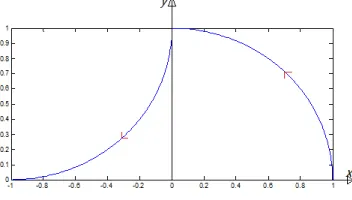
analysis, the signed curvature definition is preferred. Given a curve Γ shown in Figure
2.2, parametrized with Equation (2.2.8),
Figure 2.2: Parametrized Curve Γ
r(t) =
(cost,sint) 0≤t ≤ π 2,
(−1 + sint,1 + cost) π2 ≤t ≤π
(2.2.8)
1, For unsigned curvature,
κ(t) = |r
0(t)×r00 (t)|
|r0(t)|3 = 1, T(t) =r 0
(t), T0(t) =k(t)N(t)
T(t) =
(−sint,cost) 0≤t ≤ π 2,
(cost,−sint) π
2 ≤t ≤π
, N(t) =
(−cost,−sint) 0≤t≤ π 2,
(−sint,−cost) π
2, For signed curvature,
κ(t) = r
0(t)×r00 (t)
|r0(t)|3 =
1 0≤t≤ π 2,
−1 π2 ≤t≤π
T(t) =
(−sint,cost) 0≤t ≤ π 2,
(cost,−sint) π2 ≤t ≤π
, N(t) =
(−cost,−sint) 0≤t≤ π 2,
(sint,cost) π2 ≤t≤π
In Figure 2.2, starting from point (1,0), and travel to (−1,0) along Γ, it can be
Figure 2.3: (N, T): Left: Unsigned curvature; Right: Signed curvature
observed that traveling from (1,0) to (0,1), the angle between tangential direction
and x axis is increasing with rate 1, and starting from (0,1) to (−1,0), the angle is
decreasing with rate 1, consistent with the calculation for signed curvature. With a
simple rotation, the two segment of curves i.e. (1,0) to (0,1) and (0,1) to (−1,0) can
be considered as the same based on the shape. However, under a certain
parametriza-tion, it would be better if the curvature can characterize the difference between the
two segments. It is preferred to use the definition of signed curvature. In addition,
orien-tation between (N, T) is consistent for signed curvature and changes(or inconsistent)
for unsigned curvature. It can also support the usage of signed curvature framework,
using (N, T) as local coordinate system is more appropriate. In the following study,
curvature will mean signed curvature.
Proposition 2.2.4. Given image f(x), x ∈ Ω ⊆ R2. ∀x, s.t.|∇f(x)| 6= 0,we denote
N(x) = |∇∇ff((xx))| and the Laplacian operator 4 can be decomposed as
4f(x, y) :fxx+fyy =fN N +κ(x, y)|∇f(x, y)| (2.2.9)
Proof. By direct calculation,
(∇ · ∇f
|∇f|)|∇f|=(∂x(
∂xf
|∇f|) +∂y(
∂yf
|∇f|))|∇f|
=( 4f
|∇f|−
f2
xfxx+ 2fxfyfxy +fy2fyy
|∇f|3 )|∇f|
=4f− f
2
xfxx+ 2fxfyfxy+fy2fyy
|∇f|2
=4f−fN N
Using Proposition 2.2.2
4f =fN N + (∇ ·
∇f
Remark 2.2.5. One of the reasons that motivated us to discuss about signed and
unsigned curvature is [9]. This paper was published on the same journal of [10] as a
correction of the proof and conclusion of [10]. In [9], the author used the definition of
unsigned curvature, and claimed that the decomposition of Laplacian operator should
have the following form
4f =fN N ±κ|∇f|,|∇f| 6= 0 (2.2.10)
In fact, without further analysis, the existence of±signs in Equation 2.2.10 can pose
problems in real applications, as it does not indicate explicitly which sign should be
used in the decomposition formula in [9].
2.2.2
Nonlinear Diffusion Equation
Within the scope of research interests, in this part, discussions are focused on
nonlin-ear diffusion equations that have already been used widely in image analysis. Among
many equations [11, 12, 13, 14, 15], the Perona-Malik equation[11] is considered the
first nonlinear diffusion equation proposed to overcome the limitations of the linear
Perona-Malik Model
The general Perona-Malik model [11] is given below
∂u
∂t(t, x) = ∇ ·(g(|∇u(t, x)|
2)∇u(x, t)), t >0, x∈Ω⊆R2
u(0, x) =f(x) x∈Ω
(2.2.11)
where the diffusivity g : [0,+∞) → (0,+∞) is a smooth and decreasing function,
adaptive to the gradient of the image u(t, x). It is a direct improvement to preserve
the image structures, and reduce the blurring effects at edges. In [11], one example
of the diffusivity g(·) functions is given as
g(|∇u|2) = 1
1 +|∇u|2/λ2, λ >0 (2.2.12)
Diffusion operator decomposition
Similar to Laplacian operator, the nonlinear diffusion operators can also be
decom-posed with respect to the two local directions N, T. Recall that
uN N =
uxxu2y−2uxuyuxy +uyyu2x
|∇u|2 , uT T =
uxxu2x+ 2uxuyuxy +uyyu2y
|∇u|2
Proposition 2.2.6. The Perona-Malik diffusion operator can be decomposed as :
∇ ·(g(|∇u|2)∇u) =g(|∇u|2)u
Proof.
∇ ·(g(|∇u|2)∇u) =g(|∇u|2)4u+g0
(|∇u|2)(∂|∇u| 2
∂x ux+
∂|∇u|2
∂y uy)
=g(|∇u|2)4u+ 2g0
(|∇u|2)(u
xxu2x+ 2uxuyuxy +uyyu2y)
=g(|∇u|2)(u
T T +uN N) + 2g0(|∇u|2)|∇u|2uN N
=g(|∇u|2)uT T + (g(|∇u|2) + 2g0(|∇u|2)|∇u|2)uN N
=g(|∇u|2)uT T +h(|∇u|2)uN N
Remark 2.2.7. Functions g, h are considered as weight coefficients of image diffusion.
In order to smooth along tangential direction T instead of normal direction N(i.e.
avoid blurring edges), it is desirable that g(|∇u|2) > h(|∇u|2). Consider the g(s) as
shown in the example, h(s)−g(s) = 2sg0(s),
sg0(s) =− s
λ2(1 + s λ2)2
<0, s <0.∴g(|∇u|2)> h(|∇u|2)
It is also natural to require that the diffusivity along both directions to be positive
i.e. g(|∇u|2)>0, h(|∇u|2)>0, if g(s) is given as in Equation 2.2.12.
h(s) = g(s) +sg0(s) = 1 1 + λs2
− s
(1 + λs2)2λ2
= 1
(1 + λs2)2λ2
(λ2−s)>0
model is considered as forward parabolic type. Instead, if |∇u(t, x)| > λ, it is
con-sidered backward parabolic type which is closely related to an well known ill-posed
differential equation ut = − 4u. The detailed analysis of Perona-Malik model can
be found in [11, 16, 17, 18]
Mean curvature motion
In [19], authors proposed the Alvarez-Lions-Morel pure anisotropic diffusion, also
commonly known as mean curvature motion(MCM). The PDE is motivated by
Perona-Malik equation with slight differences:
∂u
∂t =|∇u|∇ ·(
∇u
|∇u|), u(0, x) =f(x), x∈Ω⊆R
2 (2.2.14)
According to Proposition 2.2.2, it is not difficult to conclude
|∇u|∇ ·( ∇u
|∇u|) =κ(x, y)|∇u|=uT T (2.2.15)
The mean curvature diffusion can than decomposed as
∂u
∂t =uT T + 0·uN N (2.2.16)
Authors [19] claimed that "it(Equation 2.2.15) represents a degenerated diffusion
term, which diffuses u in the direction orthogonal to its gradient ∇u, and doesn’t
to make u smooth on both sides of an edge with a minimal smoothing of edge itself.
This means that for such a theory, edges are nothing but the boundaries of the level
lines of the image".
Total Variation Flow Diffusion
In Chapter 4, we will present a detailed analysis of total variation flow diffusion, here
we include the diffusion equation as comparisons with other models.
∂u
∂t =∇ ·(
∇u
|∇u|), u(0, x) =f(x), x∈Ω⊆R
2 (2.2.17)
Based on the previous analysis, this equation can be written in the following two
forms, for x, s.t.|∇u(t, x)| 6= 0
∂u
∂t =κ(t, x) (2.2.18)
∂u
∂t =
1
|∇u|uT T (2.2.19)
The decomposition implies that the total variation flow diffusion of the image is
completely decided by the curvature property of the level set curves.
2.3
Numerical implementations
2.3.1
Linear Diffusion Equation
Notations: δ−1 x , δ
−1
dim = 1, ut=uxx, umn(t, x) =u(nh, mk)
1, Explicit Scheme: uni+1 =uni + hk2(u n
i+1−2uni +uni−1)
2, Implicit Scheme: uni+1 =un
i +
k h2(u
n+1 i+1 −2u
n+1
i +u
n+1 i−1)
Using the stability analysis,
g = 1
1 + 4hk2sin2 θ 2
⇒ |g| ≤1
If the 1D signal has length N, then at each iteration, we need to solve the following
linear system
1 +λ −λ 0
−λ 1 + 2λ . ..
. .. . .. −λ
−λ 1 +λ
un1+1
un2+1
.. .
unN+1
= un 1
un2
.. . un N
, k/h2 =λ (2.3.1)
The implicit scheme for this parabolic equation is unconditionally stable, and in
general, it is true for parabolic equation. Explicit scheme is easy to evolve at each
iteration, however restricted by the small time step size, and it can be time consuming.
Implicit scheme has no restriction on time step size, however at each step, it needs
to solve a linear system even a nonlinear system for nonlinear differential equation.
It is needed to balance the cons/pros when choosing a numerical scheme. 3,
two: uni+1=uin+12hk2(u n+1 i+1 −2u
n+1
i +u
n+1 i−1 +u
n
i+1−2uni +uni−1) This scheme is called
Crank-Nicholson scheme, the growth factor
g = 1−2
k h2sin2
θ 2
1 + 2hk2sin2 θ 2
⇒ |g| ≤1
dim = 2, ut=4u, uni,j =u(nk, ih, jh)
1, Explicit Scheme: uni,j+1 =un i,j+k[δ
±
x(δ
±
xuni,j) +δ
±
y(δ
±
yuni,j)]
There are 24different choices of combination of backward or forward difference schemes,
and the scheme we choose to use is:
uni,j+1−un i,j
k =
δx+uni,j −δ+xuni−1,j
h +
δy+uni,j−δy+uni,j−1
h (2.3.2)
The stability condition for this scheme is hk2 ≤1/4. This stability condition depends
on the dimension of spacial variable, and can be generalized to hk2 ≤1/(2 dim(x))
2, Rotation invariant scheme: Different from 1D operator, the above schemes don’t
take 2D property into consideration. As we know that4 operator is rotation
invari-ant, to use this property, instead we use the following scheme
4uni,j =λui+1,j+ui−1,j+ui,j+1+ui,j−1−4ui,j h2
λis the coefficient needs to be decided by enforcing the ”rotation invariant” property,
and in [2], λ is chosen to be 13. Compared to previous schemes, this approximation
uses the 3×3 neighborhood of each pixel. The advantages are (1) it becomes rotation
invariant; (2) it will be less sensitive to noise.
2.3.2
Nonlinear Diffusion
For nonlinear diffusion equations, there are numerous numerical methods studied.
For example, finite difference, finite element, neural network approximate etc. [16].
However, among different methods, finite difference scheme is preferred by many
re-searchers. One of the reasons is that the discrete representation of the image provides
a natural structure for a finite difference scheme.
The first numerical scheme for total variation model was explicit([20],[21]). Later,
many studies found faster and more accurate schemes, for example [22, 23, 24]. For
the model in our study, there are two important aspects in numerical implementation
to be aware of when using the finite difference scheme.
1, Singularity: The curvature term κ is replaced with a regularized version to avoid
the singularity at x, s.t.|∇f|= 0, >0 can be chosen arbitrarily small:
κ(t, x) = ∇ ·( ∇f
|∇f|)⇒ ∇ ·(
∇f
p
|∇f|2+2)
2, Stability: The stability condition in finite difference scheme is considered
numer-ical solution can be highly oscillated. In 2D image analysis, the stability condition
can be summarized as
4t
4x4y ≤
4 (2.3.3)
To make the numerical solution close to the true solution of the original equation,
should be chosen close to 0, and the step size 4t should be small enough
accord-ingly, making the diffusion process very slow. In general, there should be a balance
between speed and accuracy of the numerical simulation. Taking Equation 2.2.17 as
an example for both 1D and 2D cases:
1D Explicit Scheme
∂tu(x, t) =∂x( ∂xu
|∂xu|
), u(x,0) = f(x) (2.3.4)
Using regularization, we will solve the following problem
∂tu(x, t) = ∂x(
∂xu p
|∂xu|2+2
), u(x,0) =f(x) (2.3.5)
Denote un
m =u(mh, nk)
δt−(+)unm = u
n(n+1)
m −unm−1(n)
k , δ
−(+)
x u
n
m =
un
m(m+1)−u n m−1(m)
h
unm+1−unm
k =
1
h(
un
m+1−unm p
(un
m+1−unm)2+2h2
− u
n
m−unm−1 p
(un
m−unm−1))2+2h2
) (2.3.6)
2D Explicit Scheme
un+1−un
k =∇ ·(
5un
p
The finite difference scheme is
un+1 =un+k[δx−( δ
+ xu q
δ+
xu2+m(δy−u, δy+u)2+2
+δy−( δ
+ y u q
δ+
yu2+m(δx−u, δ+xu)2+2
)]
m(a, b) = minmod(a, b) = min(|a|,|b|)(sign a+ sign b)/2, the reason minmod used
here is to balance the bias of using merely forward or backward difference.
The way we analyze the stability condition is based on discrete maximum-minimum
principle [25], it is closely related to the causality property when we define a scale
space, and it is a more restrictive stability than the von Neumann stability. The von
Neumann stability is necessary and sufficient for stability for linear PDE models. The
PDE must be constant-coefficient with periodic boundary conditions and have only
two independent variables, and the scheme must use no more than two time levels.
In a nonlinear problem, the maximum-minimum principle is more proper. According
to [25], the stability condition is k/h2 ≤ /(2N), x ∈ RN, for image processing,
N = 2, h = 1, k ≤ /4. As → 0, the time step size k is very small making the
iteration slow.
Implicit Scheme
un+1−un
k =∇ ·(
5un+1 p
2+| 5un+1|2)
At (n+ 1) th step of the diffusion process, givenun
un+1−k5 ·( 5u
n+1
p
Using the fixed point iteration method to solve the above equation for un+1 At kth
fixed point iteration , we solve for unk+1
unk+1+1−k5 ·( 5u
n+1 k+1 q
2+| 5un+1 k |2
) = un
It will result in solving a linear system for unk+1+1, the fixed point iteration will stop
when the difference between right and left hand side is within an error toleration.
If we denote w=unk+1+1, v =wkn+1, f =un,the finite difference scheme for 1D is:
w(i)−kδx−1( δ
+ xw(i) p
2+|∇v(i)|2) =f
V = k
h2(
1
p
2+|∇v(1)|2,· · · ,
1
p
2+|∇v(N)|2), i= 1, ..., N
1 +V1 −V1 0
−V1 1 +V1+V2 −V2
. .. . .. . ..
−VN−2 1 +VN−2+VN−1 −VN−1
−VN−1 1 +VN−1
w1 w2 .. . wN =
un1
un 2
.. .
unN
(2.3.7)
The finite difference scheme for 2D case is
w(i, j)−kδ−x1( δ
+ xw(i, j) p
2+|∇v(i, j)|2)−kδ −1
y (
δ+ yw(i, j) p
By vectorizing the matrix, we can get a similar coefficient matrix as in (2.3.7),
how-ever due to the vectorizing scheme, the matrix will not be tridiagonal.
For 1D case, we can solve forw,where the coefficient matrix is tridiagonal. This
com-putation is well defined because we know that strictly diagonally dominant matrices(A=
(aij),∀i,|aii|> P
j6=i|aij|) are invertible. In each iteration, we compare the difference
between two sides of the equality to check the stopping condition. However, for 2D
image, to treat 2D image as a vector, if image has sizeN×N, the matrix size would
be N2×N2, which can be a heavy memory load for Matlab,even ifN = 128. In our
study, we use explicit finite difference scheme for 2D problem.
2.4
Interpretation of image diffusion
With the introduction of diffusion equation, decomposition of diffusion operators and
basic numerical schemes, we can simulate the diffusion process for 1D signals and
2D images. Especially, we can simulate effects of diffusion operator along the local
tangential and normal directions of level sets. One important question is how we can
interpret the image diffusion process. The proper interpretation of the process will
help us to understand the diffusion better and be helpful for analysis in multi-scale
space. Before going directly to the construction of diffusion based multi-scale space,
we take a step back to interpret the diffusion process. Within the scope of our study,
t=0.05 t=0.50
t=0.05 t=0.50
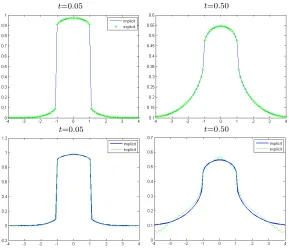
Figure 2.4: In this experiment, we use explicit and implicit difference schemes for 1D TV flow diffusion, with the initial condition x = −4 : 0.1 : 4,∆x = 0.1, f(x) = 1,|x| ≤
1; 0, else, = 0.1, in the four plots, explicit and implicit results are green and blue curves respectively. In the first row, ∆t= 0.25∆x2 satisfying the stability condition, we can see that the evolving results are very close between these two schemes; while in the second row, ∆t=∆x2 disobeys the stability condition, we can find for the explicit scheme, there are high oscillations, and implicit schemes are stable compared to both the explicit scheme and the first row.
1D Signal Diffusion
Diffusion for 1D signal can be formulated in a general form:
∂u
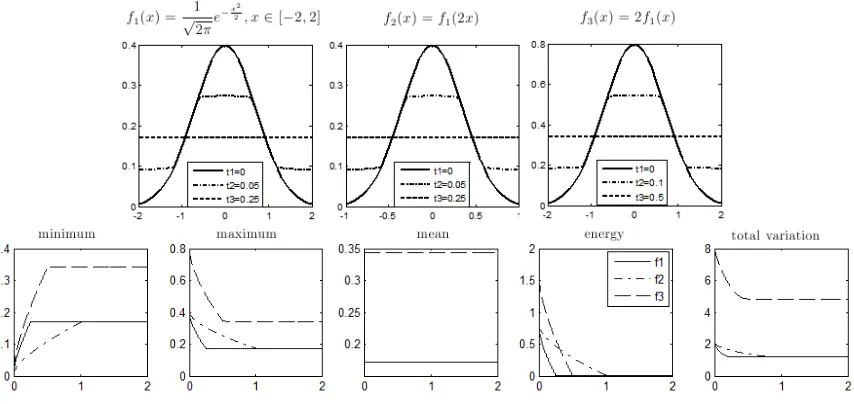
Figure 2.5: Heat diffusion for three types of 1D signal(i.e. a(t, x) = 1)
2D image diffusion
For 2D images, we are interested to study effects of diffusion along local directions
ξ, η (may not necessarily be the local tangential or normal directions),
∂u
∂t(t, x) =a(x, t, u)∂ξξu(x, t) +b(x, t)∂ηηu(x, t) (2.4.2)
We will start from the following diffusion process.
∂u
∂t =∂ξξu(x, t), u(0, x) =f(x), x∈Ω⊆R
2 (2.4.3)
The ξ used in the numerical experiments are N and T. Recall that
uN N =
uxxu2y−2uxuyuxy +uyyu2x
|∇u|2 , uT T =
uxxu2x+ 2uxuyuxy +uyyu2y
|∇u|2
In the example, we will compare the effects of the two diffusion equations.
(1)∂u
∂t =uN N; (2) ∂u
Figure 2.6: Image diffusion along directionN, T
Remark 2.4.1. Equation (2) in above is the mean curvature diffusion discussed in the
previous section. Compare (1) with (2) in Figure 2.6, it can be observed that the
diffusion force enforced by uN N tends to diffuse the image intensity along the normal
direction N of the level set. This force tends to distort the edge information, as
observed in Figure 2.6(1), edge structures are distorted to be round corners instead.
The diffusion along tangential direction tends to diffuse the image intensity along this
direction only, shown in Figure 2.6(2). In Figure 2.6, there are still slight blurring of
edges along N direction. It can be explained by the fact that a regularization term
1/p2+|∇u|2 was used in the numerical implementation to avoid the singularity for
1/|∇u| occurs as |∇u| →0.
Remark 2.4.2. From the two examples, it becomes clear that image diffusion that
is normally expressed using (x, y) coordinates can be better interpreted based on a
decomposition of diffusion operators, using a local coordinate system. In general, this
local coordinate system uses the natural tangential and normal vectors of the level
diffusion along tangential direction is preferred to the normal direction. This is the
reason why mean curvature diffusion, total variation flow attracts more interests in
Chapter 3
Scale: Linear Diffusion
3.1
What is scale?
In computer vision research, multi-scale analysis and texture analysis are two branches
of study that have overlaps and both attract researchers’ interests. In addition, there
are applications in medical image analysis using multi-scale analysis and texture
anal-ysis. For example, in [26], authors use multi-scale analysis for blood vessel detection
and drusen detection in retina fundus image analysis. In [27], texture features of
digital mammogram images are extracted for breast tumor study.
The two terms Scale and Texture haven been used widely in theory and
applica-tions, however, neither scale nor texture has a uniform definition across the research
community[28, 29]. It is important and natural that if a term needs to be studied
quantitatively, the term should be based on a well-founded definition.
texture is the description of geometric patterns within an image. For example, in
[30], authors define ”texture” as repetitive patterns within the image(though, may
not be true for most of natural images). It is important to give a definition for these
terms which are used repeatedly in the analysis, otherwise complicated features are
generated from natural images, which cannot be interpreted properly. In our study,
the focus is the term scale. Based on the established mathematical theory, we aim to
establish the definition for scale that has better geometric interpretations.
How to define the term Scale?
Proper definition of a term can be related and decided for the purpose of a certain
application. Considering the definition of scale, First, if scale is a term used to
describe the coarseness of an image, it can be any parameter monotonically changing.
For example,t, the time parameter used in the diffusion equation, is commonly treated
as a scale parameter. Given image f(x), the solution to the equation at time t is
denoted as{u(x, t)}t>0. However, in general, it is not easy to relatetto any geometric
measure, especially for a nonlinear diffusion equation. It can only be said that the
parameter t provides a general sense that, as t increases gradually(for example), the
image is smoothed or the details within the image are gradually removed. Second, if
scale is the term used in the definition of local scale, it would be natural to expect that
thisscale measure the height, width, length, etc. i.e. scale defined pixel-wisely should
have a direct geometric meaning. The usage of the first interpretation(coarseness)
second interpretation can be seen in the detection of interesting or dominate scale.
For example, Lindeberg [6], Lowe [7], it is defined as the local extreme of a certain
edge response functions. In order to study multi-scale analysis based on nonlinear
diffusion, we begin with spaces based on linear diffusion.
3.2
Review: Linear Scale space
3.2.1
History of multi-scale analysis
The idea of using multiple resolution or multiple scales in image analysis is motivated
by the underlying natural multi-level structures of images. The study of multi-scale
analysis based on diffusion equations can be traced back to the work of Witkin, 1983
[31]. However, the idea of multi-scale analysis in image analysis is not a completely
new idea. From the early days, the simplest, yet still challenging image analysis
task is edge detection. This task partly motivated the usage of multi-scale analysis.
Examples of these work, include 1) Rosenfeld and Thurston(1971) [32]. 2) Klinger
(1971) [33]. The author used the idea of quad tree. The image is recursively divided
into smaller regions with a ratio of 2. Given image with size 2N ×2N, N ∈ Z, and
defines a measure V to describe the gray level variation of the subregions. Denote
f0 = f, if at stage i, the image variation V(fi) is larger than certain threshold v,
the image fi will be divided into smaller region into fi+1. The process will ends
can be treated as ”merge and split” image segmentation task. The detailed example
is explained in [33]. 3) In the work of Burt(1981) [34] and Crowley(1991)[35], they
both proposed the pyramid representation of images. Instead of dividing the image
into subregions, the pyramid representation of an image of size 2N ×2N, N ∈ Z is
based on certain method of sub-sampling and smoothing. Naturally, from level fi to
fi+1, the image is represented at a coarser level. By representing the image in this
way, the size of the image decreases exponentially. 4) Wavelet theory is also widely
used in multi-resolution analysis, including the work of Mallat et.al.[36, 37, 38].
3.2.2
Linear multi-scale space
In 1983, Witkin proposed the multi-scale study based on gaussian smoothing in [31].
The basic idea is to embed the given imagef(x) into a family of solutions{u(t, x)}t>0
to the heat diffusion equation, parameter t is considered as the descriptor for scale.
Given f(x), x∈Ω⊆RN as the original image, the solution to the heat equation is
u(t, x) = G(t, x)? f(x), G(t, x) = 1 (4πt)N/2e
−P
x2
i/4t, t >0 (3.2.1)
When N = 1, the conventional representation of a gaussian kernel is
G(σ, x) = √1
2πσe
−x2
The kernel size σ is directly related to the neighborhood size of each pixel x, and
√
2t can be interpreted as the measure of neighborhood size. In order to construct
scale analysis in a systematic way, there is some research on axioms for
multi-scale spaces. In the work of Alvarez[19], the multi-multi-scale analysis based on the heat
diffusion is proven to satisfy one axiom system.
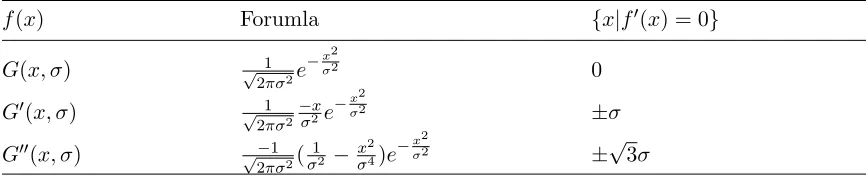
Gaussian kernel, Derivatives and Scale
Figure 3.1 visualizes the property of gaussian kernel and its derivatives, and the
an-alytical results are summarized in Table 3.1.
Figure 3.1: Gaussian, Derivatives and Local Extreme Points
Table 3.1: Gaussian Kernel and Derivatives
f(x) Forumla {x|f0(x) = 0}
G(x, σ) √1
2πσ2e −x2
σ2 0
G0(x, σ) √1
2πσ2 −x
σ2e −x2
σ2 ±σ
G00(x, σ) √−1 2πσ2(
1 σ2 − x
2 σ4)e
−x2
3.2.3
Scale Selection
Construction of multi-scale space enables the analysis of a given image at different
scales, however what is more important is how to choose the proper scale for analysis.
Questions may include if local scale should be chosen adaptively for each pixel and
what criteria should be set up in order to select a meaningful scale. Compared to
literatures on multi-scale representation, there is less work on the discussion of scale
selection. One approach proposed by Schiele (1997) [39] is to use all information from
a range of different scales. This approach hugely increases the requirement of data
storage. Here, instead, we will mention the seminal work of Lindeberg(1993, 1994)
[6, 40], Lindeberg suggested the following principle for the automatic scale selection:
In the absence of other evidence, assume that a scale level, at which
some (possibly non-linear) combination of normalized derivatives assumes
a local maximum over scales, can be treated as reflecting a characteristic
length of a corresponding structure in the data.
3.2.4
Feature Detection: SIFT
One of the most important applications of the idea of scale selection is the scale
invariant feature transform(SIFT). It is a family of features that are invariant under
Lowe in 1999 [41], and then it is extended in a more systematic way in 2004 [7].
Lowe’s work provided a method to extract and describe distinctive and stable image
features that can be used in object recognition, object matching etc. Steps in feature
extraction can be divided into four main steps.
1, Scale-space extrema detection
In [41], the difference-of-Gaussian function(DOG) convolved with the image is used
to detect the stable key-point locations in the scale space. For 2D image,
L(x, y, σ) = G(x, y, σ)? f(x, y), G(x, y, σ) = 1 2πσ2e
−(x2+y2)/2σ2
D(x, y, σ) =L(x, y, kσ)−L(x, y, σ) (3.2.3)
The idea of DOG is shown in the left plot of Figure 3.2. Local extrema of D(x, y, σ)
Figure 3.2: Left: Calculation of DOG; Right: Key-point Localization
are detected by comparing the eight neighborhood points in the current image and
nine neighbors in the scale above and below. (x, y, σ) will be selected if D(x, y, σ) is
2, Key-point localization
Given the local extrema point (x, y, σ) in Step 1, the next step is to perform a detailed
fit to the nearby data for location, scale, and ratio of principal curvatures. This step
can reject points with low contrast, sensitive to noise etc.
G(v) =D((x, y, σ) +v) =D(x, y, σ) + ∂G
∂vv+
1 2v
T∂2G ∂v2v
The local extrema of G(v) is
ˆ
v =−∂
2G
∂v
−1
∂G ∂v
ˆ
v is the offset with respect to (x, y, σ), if ˆv is larger than 0.5 in any dimension, the
sample point is changed and this step is performed again for the new sample point.
In addition, the response G(ˆv) is used to reject the unstable extrema point. In [41],
all extrema points with |G(ˆv)|<0.03 were discarded.
3, Orientation assignment
At each key point (x∗, y∗, σ∗) after Step 2, for each point (x, y) within the
neighbor-hood of the key-point,
m(x, y) =p(L(x+ 1, y)−L(x−1, y))2+ (L(x, y+ 1)−L(x, y−1))2
A histogram of θ(x, y) within this neighborhood(window size chosen to be 1.5σ) is
weighted by the gradient magnitude m(x, y). Peaks of this weighted histogram is
regarded as the dominant direction. The peak within 80% of the highest peak of the
histogram is used as the local orientation of the key-points.
4, Key-point descriptor
Key-point descriptor is composed of location (x, y), scale σ and local orientation θi.
Example
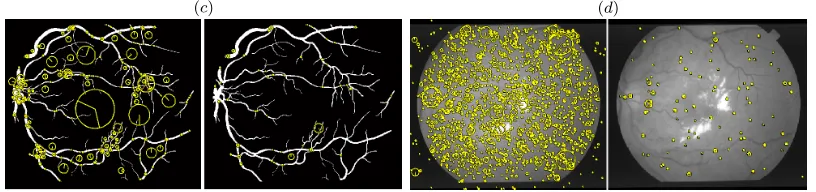
SIFT features have been used widely in image matching, feature analysis, since the
focus of our study is the image structure detection, it is better to start with analysis
on images containing simple shapes. In the following examples, we chose images with
typical blob(close to disk shape) and vessel(i.e. elongated shape) structures from both
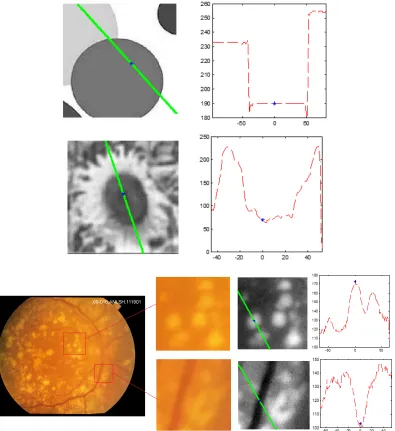
synthetic and real clinical images. Center of the yellow circle in the image indicates
the location of key-point (x, y) and the radius of the circle indicates the scale of the
key-point is denoted as σ.
(c) (d)
Figure 3.3: Examples of SIFT Detection: For (b), (c), (d), Left figure: All key-points; Right figure: Randomly selected key-points
Remark 3.2.1. Based on Figure (3.3), it can be observed that (1) SIFT features works
best for blob detection, shown in (a). This can be partly explained by the fact that
heat diffusion is an isotropic diffusion; (2) For elongated structures, only points at
the two ends are detected, right figure of (a); In (c), junction points along the vessels
are detected. The fact that large part of edge structures is not detected can be
partly explained by the fact that heat diffusion is known to blur edge structures;
(3) The detection of scale can represent the relative relationship between scales of
structures shown in (a), (b), however in general, it is not absolutely correct; (4) In
(b), besides the bright blobs, the dark regions between blobs are also detected as
key-points. This can be explained by the fact that the blob detection was defined as
regions brighter or darker than the surrounding regions[42]. Additionally, there are
many small spots detected that may be due to the existence of oscillations within the
image. These oscillations can be removed by different choices of threshold(e.g. some
response function), however, in automatic image analysis, the choice of parameters
public dataset STARE for retina image analysis), the existence of many key-points
can pose a problem for additional key-point selection. The remarks we made here
do not mean that SIFT features are not helpful, but that the theoretical basis of
SIFT features can limit SIFT in some image analysis tasks, especially for elongated
structures(i.e. vessel structures). It is a motivation for the intensive research on
Chapter 4
Total Variation model
4.1
Total Variation Flow Minimization
4.1.1
Total Variation and Bounded Variation
Images are usually considered in Lp(Ω) space, here Ω ⊆ Rn, however Lp(Ω) spaces
fail to capture the local oscillatory patterns within images. With the introduction of
Sobolev space W1,1(Ω), the irregularities of images are also taken into consideration.
One limitation is that W1,1(Ω) space does not allow edges within an image. In
computer vision, edges are considered crucial clues for object pattern recognition. In
between the Lp(Ω) and W1,1(Ω) spaces, there is one function space that can balance
the regularity characterization and accept edge structures at the same time. This
Definition 4.1.1. Given u∈L1(Ω),Ω⊆Rn,
kukT V(Ω) : Z
Ω
|Du|= sup{
Z
Ω
u∇ ·(~g)dx :g~∈C01(Ω;Rn),|~g(x)|l2 ≤1,∀x∈Ω}
kukBV(Ω) :=kukL1(Ω)+kukT V(Ω)
BV(Ω) ={u∈L1(Ω) :kukBV(Ω) <∞}
Here, for convenience, kukT V(Ω) is also denoted as kDuk(Ω). The total variation
normk · kT V is a semi-norm; (BV(Ω),k · kBV(Ω)) is a Banach space. The introduction
of BV spaces in imaging processing is in the work of Rudin, Osher and Fatemi [20,
21].The relationship between BV space and the two function spaces mentioned before
can be summarized as the following:
W1,1(Ω)⊆BV(Ω) ⊆L1(Ω)
4.1.2
ROF Model
The total variation minimization model appeared in the seminal work of
Rudin-Osher-Fatemi [20]. The model proposed for the image denoising problem as the following:
given an observed image u0(x, y) =u(x, y) +n(x, y),(x, y) ∈ Ω,where n(x, y) is the
additive noise, and u(x, y) is the original image that needs to be reconstructed.
Dif-ferent from previous researches [43, 44, 45] in which the least squares criteria (i.e. L2
mini-mizing the total variation norm of the image. It has been suggested in [46] that the
total variation norm(i.e. TV norm) is a better norm to describe an image than theL2
norm, especially for images with edges as discontinuities. The optimization problem
is proposed with constraints shown as follows
min
u∈BV(Ω) Z
Ω q
u2
x+u2ydxdy
subject to
Z
Ω
u(x, y)dxdy=
Z
Ω
u0(x, y)dxdy,
Z
Ω
1
2(u−u0)
2
dxdy=σ2, σ >0.
This model is proposed with the prior information that the noise n(x, y) has zero
mean and standard deviation σ. In [20], this optimization problem is solved using
the gradient descent method.
∂u ∂t = ∂ ∂x( ux p u2 x+u2y
) + ∂
∂y( uy p
u2 x+u2y
) (4.1.1)
−λ(u−u0), t >0,(x, y)∈Ω (4.1.2)
u(x, y,0) is given (4.1.3)
∂u
∂n = 0 on∂Ω (4.1.4)
The model can also be reformulated as an equivalent unconstrained optimization
problem, commonly knows as ROF Model:
min
u∈BV(Ω)λ Z
Ω
|Du|+
Z
Ω
Here, λ > 0 is the weight between regularity and the fidelity term. The numerical
experiments in [20] demonstrate the ROF model (4.1.5) can perform best in denoising
very noisy images, especially yielding sharp edges in images. However, there is one
important limitation of (4.1.5) that is the loss of contrast in solutions, even when the
image f(x) is noise-free. Detailed discussions on the limitations of the ROF model
are shown in [47].
4.1.3
T V /L
1Model
There have been many studies and variations of the ROF model (4.1.5), and T V /L1
is the model with special interests. In this model, the total variation norm is used in
the regularization term, and the fidelity term is replaced with L1 norm, the problem
is proposed as (see [47]):
min
u∈BV(Ω)
λ
Z
Ω
|Du|+|f−u|L1(Ω) (4.1.6)
here f(x) is the image within region Ω⊆R2, Ω is a rectangle,|u|T V(Ω) is the
regular-ization term, |f−u|L1(Ω) is the fidelity term, λ is the weight between regularity and
fidelity term. As λ increases, the minimizer of Problem (4.1.6) is a more regularized
version of the original image, and smaller feature including noise that has high
oscil-lation is gradually removed.
minimizer to Problem (4.1.6) is:
u(x, λ) =
k1Br(0)(x) λ <2r
{a1Br(0)(x)} λ= 2r,0< a < k,
0 λ >2r
(4.1.7)
In general, Problem (4.1.6) cannot be solved analytically and this simple example
demonstrates several important properties of T V /L1 model. First, the critical point
λ∗ = 2r at which the solution u(x, λ) changes from 0 to f depends on the radius of
the disk (i.e. the scale of geometric structure) only, and does not dependent on the
intensity level of the disk. It indicates thatT V /L1 model can maintain and reveal the
inherent geometric properties of the image. In image analysis, it is desired that image
structures be identified without any affects of the transformation of image intensity
values. Second, considering the solution to T V /L1, except at the point λ = 2r, the
solution is either 0 or f, and the general image contrast remains constant. On the
contrary, one of the known limitations of the ROF model is that the image contrast
will be decreased even for images without noise.
The effect of λ for ROF model and T V /L1 models are very different. For the ROF
model, objects of distinct scale with edges in the image gradually lose contrast and
merge with their neighbors as the parameter λ increases. In T V /L1 model, objects
can maintain their contrast with respect to their neighbors and their boundaries are