468 |
P a g e
A Comparative Study on Hollow Concrete Block &
Brick Masonry
Jetti shivashankar
Assistant Professor
1, Division of Structural Engineering, Civil Engineering Department
Dhruva Institute Of Engineering & Technology
ABSTRACT
Economy and stability are the prime requisites of any structure. Best designer is one who comes out with a
design which gives the stable and economic structure. In this paper an investigation on hollow concrete block
masonry is carried out and a comparative study is executed with respect to brick masonry construction and
strength parameter, economy, light weight character and insulation property are studied and compared. The
strength of hollow concrete block masonry wall is less than brick masonry wall but cost of construction of
former wall is very less.
Keywords: Brick Masonry, Compressive strength, Economy, Hollow concrete block and insulation
I. INTRODUCTION
One of the basic requirements of human being to sustain in the world is shelter. After the evolution of human being, the need of shelter meant for safety arises. In ancient times, man started taking shelter in caves, excavated below ground level and under hanging mountain cliffs and this type of shelter just provided safe place from environmental extremities .the concept of stability and safety as per structural features of shelter were completely out of mind. With the development and maturity of human mind, man began to modify the structural formation of shelter so as to address the increasing needs and facilities which an optimum shelter design possessed. After achieving a feat by the use of easily available material like mud in constructing walls and then the technique of burnt clay brick masonry to form structural part of shelter, there was still a long journey in coming out for the best possible structural material for construction of stable and safe structural units of shelter. The desire for search of safe and stable structural materials keeping in view the economy of whole structure, paved way for usage of hollow concrete blocks in masonry due to following advantages: 1. Thermal insulation (having dual character of keeping building cool in summer and warm in winter). 2. Sound insulation (to decrease disturbance due to external noise).
3. Adequate strength and structural stability. 4. Highly durable.
5. Fire resistant. 6. Economy.
7. Low maintenance (No efflorescence).
8. Environmentally Eco friendly (Constituents can be substituted by waste products like fly ash). 9. Reduction in mortar consumption.
469 |
P a g e
11. Better Architectural features.Hollow concrete block is an important addition to the types of masonry units available to designer and engineer and its use in masonry construction is constantly increasing due to the various advantages discussed above [1]. Since there is a lack of awareness regarding usage of hollow concrete blocks in masonry, this research will enable the engineers and builders to go for hollow concrete block masonry construction on a large scale where ever it is economical.
II. MATERIALS USED
2.1 Cement
Khyber ordinary Portland cement of 43 grade confining to IS 8112:1989 [2] was used throughout the work.
2.2 Sand
Sand used throughout the work comprised of plane river sand with maximum size 4.75mm confining to zone II as per IS 383- 1970 [3] with specific gravity of 2.6.
2.3 Hollow Concrete Blocks
Hollow concrete blocks of size (16x8x8) inch and (8x8x8) inch were used for making walls. Fig.1 shows hollow concrete block units.
2.4 Bricks
Class B Bricks were used of modular size (22.5x10x7.5) cm.
2.5 Mortar
1:4 cement sand mortar as used for wall masonry were made in the standard manner as prescribed by IS
: 3535-1986 [4].
III. EXPERIMENTAL INVESTIGATION
3.1 Testing of individual hollow concrete block and brick units
Individual hollow concrete blocks confining to IS : 2185-1984 (Part 3) [5] and class B brick units confining to IS : 1077- 1986[6], IS : 2180-1985[7] and IS : 2222-1979[8] were tested for compression using compressive testing machine.
3.2. Testing of mortar
Testing of mortar blocks of size (15x15)cm were made and tested after 28 days confirming with IS: 4031 (part 1)[9].
3.3. Procedure for construction of walls
Two girders were placed side by side such that their flanges would act as the base for the walls. These girders were place on the bottom member of the loading frame. A layer of mortar was placed on the girders to provide a uniform and levelled base for the wall. The walls were built on this levelled surface as per IS code recommendations with 1 cm thick mortar. A layer of mortar was also provided at the top so that load would be transmitted uniformly. A total of eight walls were constructed comprising of four hollow concrete block masonry walls and four brick masonry walls. Fig.2 shows brick wall constructed on a loading frame.
3.4 Testing of walls
470 |
P a g e
completely covered the top section of the wall was placed. The rail section was placed so that load from the jack would be uniformly distributed over the wall. The jack was placed centrally over the rail fixed to the upper member of the frame. The proving ring was placed under the jack for measurement of the load. The space if any was filled by plates of varying thickness as packing material. The testing was started by pumping the jack at a higher rate initially then lowering the rate as cracks appeared, in order to observe the modes of failure. Fig.7 and Fig.8 represents crack formation behaviour of brick wall and hollow concretblock wall respectively. Basic compressive strength for each wall was calculated under loading using jacks and permissible compressive strength was calculated using formula[10]:
Fca = Fc x Ka x Ku x Kse x Kl Where
Fca is the net allowable compressive stress Fc the basic compressive stress vide table
Ku is factor for shapes of masonry as given in table Kse slenderness-eccentricity factor vide table, and
Kl is theloadfactor =1.0 for axial, 1.25 for load causing bending and 1.5 for localised loads.
3.5 Factor of safety
Factor of safety for each wall sample was determined as FOS = Observed load/ Permissible load.
3.6 Light weight character
The average dry weight of hollow concrete block units were compared with dry weight of brick units confining in same volume and difference in weights was measured.
IV. RESULTS AND DISCUSSION
4.1 Testing of individual hollow concrete block and brick units
The individual hollow concrete block and brick units were tested for compression under Compressive Testing Machine [11] and strength values were obtained and compared and are represented in table x. The average compressive or crushing strength for hollow concrete blocks of size (16”x8x8”) and (8”x8x8”) came out to be
34.99 Kg/cm2and 28.05 Kg/cm2respectively. While as the average compressive or crushing strength of
individual brick units of size (22.5x10x7.5) cm comes out to be 113.33 Kg/cm2. Table 1 depicts the crushing strength values of individual block and brick units. Fig.3, Fig.4 and Fig. 5
471 |
P a g e
4.2 Testing of Mortar
Mortar of composition 1:4 (Cement : Sand) was prepared and specimens of size (15x15x15)cm were casted and tested for compression after 28 days of curing as per IS 4031 (Part I)[12] and the compressive strength values are represented in Table
4.3 Testing of Walls
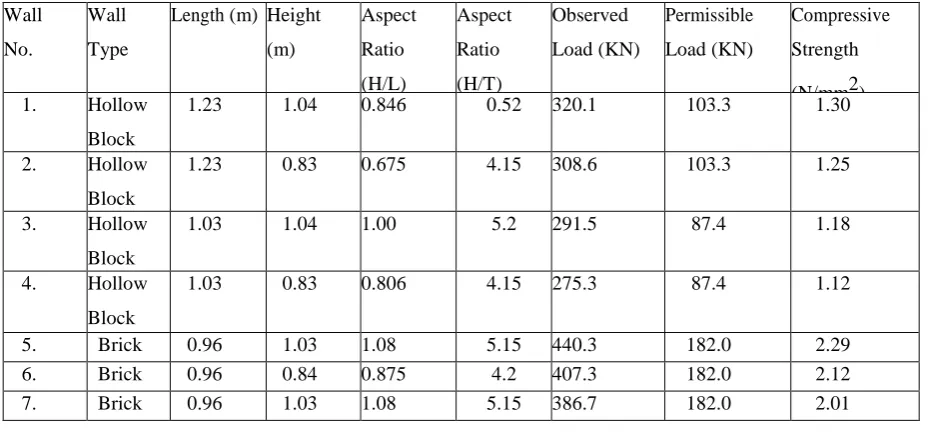
Four Hollow concrete block masonry walls and four brick masonry walls were constructed and tested after 28 days for compression and their strength values with geometrical parameters are represented in Table 3. Fig.6 represents permissible load values and observed load at failure for eight samples of walls.
4.4 Factor of Safety
Another way of comparing the walls is by comparing the factor of safety of these walls. FOS = Observed load/ Permissible load.
Wall1: 3.10 Wall2: 2.99 Wall3: 3.33 Wall4: 3.14
Wall5: 2.42 Wall6: 2.24
Wall7: 2.12 Wall8: 1.90
Here, it can be seen that block walls show highest factor of safety whereas brick walls with Flemish bond show the lowest. Hollow block wall higher factor of safety than brick wall. Hollow concrete block walls have high factor of safety. So at locations were supervision is deficient or the construction conditions are not standard, block walls are recommended
4.5 Economy
Cost per cubic metre of brick masonry comes out to be Rs.3875 and Cost per cubic metre of brick masonry
comes out to be Rs.3290. The cost of block walls per metre3 of hollow concrete masonry comes out to be 17.78%less than that of brick walls. So, block masonry is economical than brick masonry.
472 |
P a g e
4.6 Light weight character
The average mass of hollow concrete block of size (16x8x8) inch and (8x8x8) inch was found to be 22kg and
13kg respectively, and the value of mass density was calculated to be 1.37 g/cm3 and 1.60 g/cm3respectively. While as average mass of modular brick unit was found to be 1.8kg and mass density came out to be 1.06
g/cm3. Therefore the brick masonry construction is lighter than hollow concrete block masonry
TABLE 1. Compressive strength of individual block and brick units.
TABLE 2. Compressive strength of various wall types.
Wall No.
Wall Type
Length (m) Height (m) Aspect Ratio (H/L) Aspect Ratio (H/T) Observed Load (KN) Permissible Load (KN) Compressive Strength
(N/mm2) 1. Hollow
Block
1.23 1.04 0.846 0.52 320.1 103.3 1.30
2. Hollow Block
1.23 0.83 0.675 4.15 308.6 103.3 1.25
3. Hollow Block
1.03 1.04 1.00 5.2 291.5 87.4 1.18
4. Hollow Block
1.03 0.83 0.806 4.15 275.3 87.4 1.12
5. Brick 0.96 1.03 1.08 5.15 440.3 182.0 2.29
6. Brick 0.96 0.84 0.875 4.2 407.3 182.0 2.12
7. Brick 0.96 1.03 1.08 5.15 386.7 182.0 2.01
Sample No.
Compressive or crushing strength of individual hollow concrete block of
size (16”x8x8”) Kg/cm2
Compressive or crushing strength of individual hollow concrete block of
size (8”x8x8”)Kg/cm2
Compressive or crushing strength of individualbricks of
size (22.5x10x7.5) cmKg/cm2
1. 36.37 29.00 96.49
2. 35.87 27.75 86.40
3. 37.62 31.00 144.73
4. 35.00 28.25 112.28
5 30.12 24.25 126.75
Sample No. Compressive or Crushing Strength
(Kg/cm2)
1. 160.55
2. 165.88
473 |
P a g e
8. Brick 0.96 0.84 0.875 4.2 345.6 182.0 1.80
Fig.3 Compressive strength of individual hollow block of size (8x8x8) inches
Fig.4 Compressive strength of individual hollow block of size (16x8x8) inches.
474 |
P a g e
Fig.7 Crack in brick wall Fig.8 Crack in hollow concrete block wall.V. CONCLUSION
On the basis of results obtained, following conclusions can be drawn:
1.
Compressive strength of brick units and brick masonry wall came out to be more than
compressive strength of hollow concrete block units and hollow concrete wall masonry.
2.Sound insulation property of hollow concrete masonry is more than that of brick masonry.
3.Thermal insulation property of hollow concrete masonry is more than that of brick masonry due
to presence of air in hollow concrete units.
4.
The cost of block walls per metre3 of masonry comes out to be 17.78%less than that
of brick walls. So, block
masonry is economical than brick masonry.
5.
Maintenance cost of hollow concrete block masonry is less than brick masonry because of
efflorescence in brick masonry wall.
6.
Hollow concrete block masonry is environmentally eco friendly because in hollow concrete block
units constituents can be substituted by waste products like fly ash.
7.
Hollow concrete block masonry presents better architectural view as compared to brick masonry.
8.Hollow concrete masonry construction presents a faster construction system as compared to brick
masonry construction.
9.
Hollow concrete block masonry consumes less mortar than brick masonry because volume of
joints is less in hollow concrete block masonry.
475 |
P a g e
REFERENCES
[1] Mr. M K Maroliya, Load Carrying Capacity Of Hollow Concrete Block Masonry Wall, (IJERA) ISSN: 2248-9622 www.ijera.com Vol. 2, Issue 6, November- December 2012, pp.382-385.
[2] IS 8112:1989 43 Grade Ordinary Portland Cement – Specification. IS 8112:1989, Bureau of Indian Standards, New Delhi. [3]. IS 383-1970, Specification for Coarse and fine aggregates from Natural sources for concrete, BIS, New Delhi.
[3] IS 3535-1986, Methods of Sampling Hydraulic Cements, Bureau of Indian Standards, New Delhi.
[4] IS : 2185-1984 (Part 3), Concrete Masonry Units, Autoclaved Cellular Aerated Concrete Blocks, BIS, INDIA. IS : 1077-1986, Common burnt clay building brick Specification, BIS, New Delhi.
[5] IS : 2180-1985, Heavy Duty Burnt Clay Building Bricks, BIS, New Delhi.
[6] IS : 2222-1979, Specification for burnt clay perforated building bricks, BIS, New Delhi.
[7] IS: 4031 (part 1), Method of Physical Tests For Hydraulic Cement, BIS, New Delhi. [10]. Neville A.M., Properties of concrete, pitman publishing, 1973.
[8] Shetty M.S., Concrete Technology, S. Chand & Company Ltd., Ramnagar, New delhi, Second Edition, 1986.