https://doi.org/10.5194/soil-5-107-2019
© Author(s) 2019. This work is distributed under the Creative Commons Attribution 4.0 License.
SOIL
Multi-source data integration for soil
mapping using deep learning
Alexandre M. J.-C. Wadoux1, José Padarian2, and Budiman Minasny2
1Soil Geography and Landscape Group, Wageningen University & Research, Wageningen, the Netherlands
2Sydney Institute of Agriculture, the University of Sydney, Sydney, Australia
Correspondence:Alexandre M. J.-C. Wadoux ([email protected])
Received: 29 October 2018 – Discussion started: 16 November 2018 Revised: 8 February 2019 – Accepted: 7 March 2019 – Published: 22 March 2019
Abstract. With the advances of new proximal soil sensing technologies, soil properties can be inferred by a variety of sensors, each having its distinct level of accuracy. This measurement error affects subsequent mod-elling and therefore must be integrated when calibrating a spatial prediction model. This paper introduces a deep learning model for contextual digital soil mapping (DSM) using uncertain measurements of the soil property. The deep learning model, called the convolutional neural network (CNN), has the advantage that it uses as input a local representation of environmental covariates to leverage the spatial information contained in the vicinity of a location. Spatial non-linear relationships between measured soil properties and neighbouring covariate pixel values are found by optimizing an objective function, which can be weighted with respect to a measurement error of soil observations. In addition, a single model can be trained to predict a soil property at different soil depths. This method is tested in mapping top- and subsoil organic carbon using laboratory-analysed and spectroscopi-cally inferred measurements. Results show that the CNN significantly increased prediction accuracy as indicated by the coefficient of determination and concordance correlation coefficient, when compared to a conventional DSM technique. Deeper soil layer prediction error decreased, while preserving the interrelation between soil property and depths. The tests conducted suggest that the CNN benefits from using local contextual informa-tion up to 260 to 360 m. We conclude that the CNN is a flexible, effective and promising model to predict soil properties at multiple depths while accounting for contextual covariate information and measurement error.
1 Introduction
Digital soil mapping (DSM) techniques are commonly used to predict a soil property at unsampled locations using mea-surements at a finite number of spatial locations. Prediction is routinely done by exploiting the relationship between a soil property and one or several environmental covariates, which are assumed to represent soil forming factors. Exam-ples of covariates are the digital elevation model (DEM) or its derivatives (Moore et al., 1993). Demattê et al. (2018) used multi-temporal and multispectral remote sensing images to map soil spectral reflectance while Nussbaum et al. (2018) investigated the use of a large set of covariates for mapping eight soil properties at four soil depths. The choice of covari-ates is governed either by their availability, preselected using a priori pedological expertise, or based on the pedological
concepts whereby covariates must portray the factors of soil formation such as climate, organisms, relief, parent material and time (McBratney et al., 2018). In most cases, the relation between soil property and the chosen covariates is modelled by a regression model which relates either linearly (Wadoux et al., 2018) or non-linearly (Grimm et al., 2008) sampled (point) soil properties and a vector of covariate values ex-tracted at the same point location.
108 A. M. J.-C. Wadoux et al.: Multi-source data integration for soil mapping using deep learning a large part of the spatial contextual information is missing.
For example, soils on a gentle slope might have a great accu-mulation of soil organic matter, accuaccu-mulation which varies according to the surrounding slope gradients. Several studies have shown that incorporating covariate contextual informa-tion improves predicinforma-tion accuracy (Behrens et al., 2014; Gri-nand et al., 2008; Gallant and Dowling, 2003). Smith et al. (2006) tested different neighbouring size in computing ter-rain attributes for use in a soil survey. The authors showed that the amount of contextual information supplied to the model significantly impacts the output of the survey. In spite of these conclusions, contextual information surrounding a sampling location is usually disregarded in DSM studies.
Several attempts have been made to incorporate the spa-tial domain of the covariates into the analysis. Behrens et al. (2010a) developed ConMAP, which computes the elevation difference from the centre pixel to each pixel in a neighbour-hood, and ConStat (Behrens et al., 2014), which derives sta-tistical measures of elevation within a growing radius of the centre pixel. This generates a very large number of hyper-covariates, abstract representation of the context, which can be used as predictors in subsequent regression models. An-other approach uses spatial transformations such as wavelet transform to represent the covariate as a function of various local spatial supports (e.g. Lark and Webster, 2001). Alterna-tively, one may account for contextual information by simply using covariates aggregated at larger support than their orig-inal resolution (Miller et al., 2015). This technique, referred to as the multi-scale approach, provides a surprisingly large increase in prediction accuracy. It is now acknowledged that using covariates with coarse spatial resolution can provide satisfactory prediction (Samuel-Rosa et al., 2015).
However, while these approaches enable us to contextu-alize the spatial information supplied to the regression, they rely either on heavy covariate preprocessing (Behrens et al., 2014), subjective decisions based on the resolution to which covariates must be treated as input to the model (Miller et al., 2015) or the modeller’s choice regarding neighbouring size (Behrens et al., 2010b). In light of these drawbacks, we pro-pose the use of the convolutional neural network (CNN) as an alternative tool for mapping while explicitly account-ing for local contextual information contained in covariates. Recently, Padarian et al. (2019) have shown that it is pos-sible to use the CNN for soil mapping while accounting for contextual covariate information, whereas Behrens et al. (2018) compared the deep neural network to the random for-est model for mapping and found that the former model pro-vides more accurate predictions. In Behrens et al. (2018), the covariates must still be preprocessed. The authors used a deep learning architecture which uses a vector as input. The CNN proposed here has the advantage that it relies on the lo-cal representation of covariates so as to leverage the spatial information contained in the vicinity of a sampled point. The CNN uses an image as input, does not require any prepro-cessing of the input covariates and performs a multi-scaling
analysis directly on the image (Padarian et al., 2019). As for other regression methods, the CNN is trained using measured soil properties at the point location.
Measured soil properties are never error-free. Soil mea-surements can be best performed under controlled conditions in the laboratory. In the latter case, the error of those mea-surements is small and their impact on prediction is safely ignored. With the advent of new technology, soil measure-ments are often inferred using sensors such as spectrometers. The result is the creation of databases of soil properties mea-sured or inferred using several sensors which predicted soil properties with different accuracy levels. Recently, Ramirez-Lopez et al. (2019) and Somarathna et al. (2018) have shown that measurement error may have a significant impact in sub-sequent spatial analysis. For example, Ramirez-Lopez et al. (2019) estimated a measurement error of about 50 % for top-and subsoil Ca++ inferred using near-infrared (NIR) spec-troscopy. In most cases, measurement error can be quanti-fied and must therefore be accounted for when calibrating a spatial model using uncertain measurements. While Padarian et al. (2019) demonstrated the use of the CNN for mapping at a country scale, we further advanced this concept for map-ping soil properties at a landscape scale, which considers the measurement error of soil measurements.
The objectives of this study are to (i) develop the frame-work of the convolutional neural netframe-work for contextual spa-tial modelling at a regional scale, (ii) develop a methodol-ogy for multi-source data integration by accounting for the soil property measurement error in the CNN model calibra-tion, and (iii) demonstrate the usefulness of the CNN to map top- and subsoil organic carbon in a potential application sce-nario.
2 Methodology
2.1 Artificial neural network
We first describe the principle of an artificial neural network (ANN), which is the basis of the CNN. A measured soil prop-erty of interestzsi at location si(i=1, . . ., n;si∈A) in the
study areaAis modelled by a regression model:
zsi=f(Xsi;θ)+εsi, (1)
whereX is either ac×(w×h) 2-D matrix or a 3-D input matrix of sizec×w×hwhich containscenvironmental co-variates of size w×h pixels centred at spatial location si. The vectorθrepresents model parameters used by the neural network regression modelf to map non-linearlyX→zand leave room for a zero mean random errorε. Note that, unlike geostatistics, measurements of the soil property are assumed to be spatially independent and identically distributed.
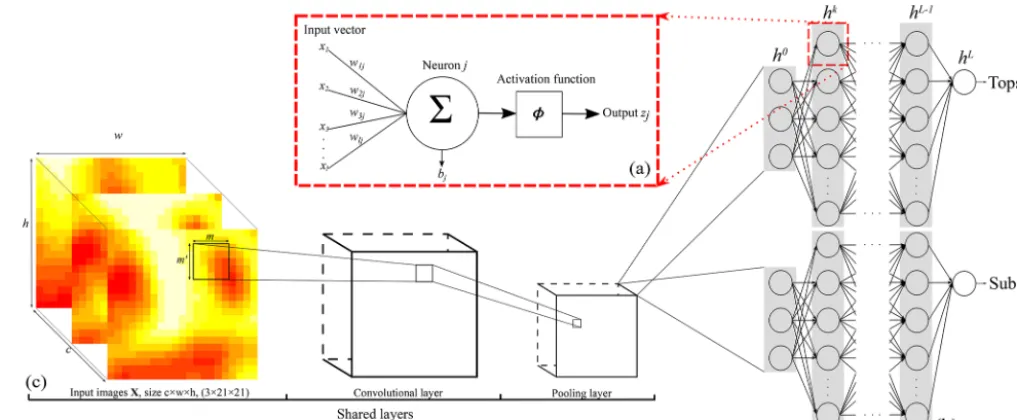
to an output layer (hLin Fig. 1b), which outputs the predic-tions of interest zsi. Each layer contains units called nodes
for the input layer (as no computation occurs at their level) and neurons for the hidden and output layers (Fig. 1a). The behaviour of the neurons depends on the activity of the pre-vious layer neurons and the connection weights between the previous and next layer neurons (LeCun et al., 2015). The parameters of the models defined by Eq. (1) are thus the con-nection weights to the neuronj,wj =(wj,1, . . ., wj,l), and a bias component per neuronbj. They are associated with an activation functionφwhich gives outputzjby
zj=φ(hwj,xi +bj), (2)
whereh·,·iis the dot product andxis a vector of inputs from previous layer neuron output. A graphical representation is provided in Fig. 1a. In this study we use the rectified linear unit (ReLU) activation functionφ(x)=max(0, x) while the output layer for regression uses the linear activation func-tionφ0(x)=x. Equation (2) shows that the activation func-tion determines the output of a neuron by applying a linear or non-linear transform on the input.
Our neural network will contain more than one single hid-den layer. Fork=1, . . ., Lhidden layershand an input layer h0where no processing occurs (Fig. 1b):
h0(x)=x, (3)
hk=ReLU(Wkhk−1(x)), for k=1, . . ., L−1, (4)
hL=WLhL−1(x). (5)
For each layer,Wis a matrix of sizeJk×Jk−1, i.e. the num-ber of neurons in the current layer by the numnum-ber of neu-rons in the previous layer. Therefore the model parameters θ=(W1, b1, . . .,WL, bL).
2.2 Convolutional neural network
In this paper we use the vicinity information of the mea-sured soil property by including the covariate pixel values surrounding a sampling location. In this case, an ANN is not well adapted because it uses vectors as input data, while (cor-related) spatial information is better represented as images. In the convolutional neural network, at least one layer is a convolution (Goodfellow et al., 2016), i.e. an element-wise product and sum between two matrices. Let there be an in-put image matrix X, e.g. a digital elevation model cropped for sizew×hpixels surrounding a measured soil property at locationsi. We apply a 2-D convolution using the filterF of sizempixels×m0pixels to the input imageXsuch that
(F∗X)(w,h)= X
m,m0
F(m,m0)X(w+m0,h+m), (6)
which can be rewritten with little modification to include the case where we havec=3 environmental covariates (Good-fellow et al., 2016, Eq. 9.4). Equation (6) shows that each
element in (F∗X) is calculated as the sum of the products of one element inXand one element inF. In other words, the elements of (F∗X) are the sum of the element-wise mul-tiplication ofF byX. The size of the output image from a convolution is thus smaller than that of its input image (see Fig. 1c).
Filters detect features (e.g. edges) related in the vicinity of a sampling location and leverage the spatial structure of the covariates. In practice, the original covariate image goes through several filters, each exploiting an abstract represen-tation of the image features. Similar to the ANN, the CNN has a number of hidden layers, called convolutional layers. The convolutions are combined with an activation function at the end of each neuron, obtained by
zj(X)=φ(FL∗hL−1+bj). (7)
In addition to the convolutional layers, another set of oper-ations consists of pooling layers. Pooling reduce the spatial size of the images by down-sampling along the spatial di-mension. Several types of pooling operations exist, such as minimum, maximum or average pooling. The most common is the max-pooling operation, which consists in selecting the maximum value in the convoluted image using a given filter size. Each convolution accepts one input image of a given size and number of channels, i.e. covariates, and returns an-other image of possibly a different size and number of chan-nels. Usually, one wants to reduce the size of each image at each convolution while augmenting the number of channels. Then, the last convolution returns an image of size 1×1 and with a number of channels. This operation is named “flat-tening”, as it converts the matrices into a vector which can pass to a fully connected layer. A fully connected layer is an ANN layer, as noted in Fig. 1b. The large number of connec-tions between neurons generates a high number of param-eters which can provoke overfitting. This can be restrained by introducing dropout layers which randomly disconnect a number of neurons. Usually, the dropout rate is no greater than 0.5.
2.3 Parameter estimation
The CNN model is trained on dataset D= {(Xsi, zsi). . .(Xsn, zsn)}, that is, a 4-D matrix of size
n×c×w×h. The datasetDis used to derive an optimized value of the parameters θˆ for θ by minimizing the mean squared error (MSE) as the objective function, given by
MSE=1
n
n
X
i=1
δi(zsi− ˆf(Xsi; ˆθ))
2, (8)
110 A. M. J.-C. Wadoux et al.: Multi-source data integration for soil mapping using deep learning
Figure 1.Representation of the CNN architecture developed in this study for(a)a neuron,(b)the ANN architecture or fully connected layer, and(c)the convolutional and pooling layers. Note thatP
= hwj,xi. The size of the output from a convolutional or pooling layer(c) is smaller than that of its input. Panel(c)is the shared structure to extract common features between the two depths which is then separated into two branches (one per soil depth) in(b).
update its value. This process is called backpropagation (Le-Cun et al., 1989). The optimization process runs for a number of epochs. An epoch describes the number of times the net-work sees the entire input dataset. During each epoch, the entire dataset is shown to the network in small subsets shuf-fled at random, called “minibatches”. The number of epochs must be chosen, as well as the batch size. In addition, one must choose the learning rate of the optimizer, i.e. how fast the optimizer moves the connection weights in the opposite direction of the gradient after each update. A too-small learn-ing rate increases the computation time to find the optimum of the objective function because the steps are small. If the learning rate is too large, training may not converge because the connection weights oscillate. The learning rate can be tuned as other model architecture hyperparameters. This is explained in the next sections.
2.4 Multi-source data integration
The values of the soil property zsi used to train the CNN
model might be uncertain. For example, they are derived us-ing an infrared spectroscopy model. This uncertainty must be accounted for when calibrating the CNN model. A solu-tion is to assign a measurement error weight to each value of the soil property, depending of its relative error compared to a “true” measurement of the soil property at the same loca-tion. We refer to the “true” measurement of a soil property as a measurement made using a standard laboratory technique which has a small error. Meanwhile the spectroscopically in-ferred property is the value predicted using measurements from an infrared spectrometer. The prediction is based on
a calibration model that relates observations of spectra and their true measurement values. For a vector of a soil property inferred using a spectroscopic modelzIR, one can assign a measurement error weight by comparing the variance of the predicted soil property by the infrared model to the variance of the measurements used for the infrared model calibration. The measurement error weightδis given by
δ=1−var(zIR)
var(z) , (9)
which can then be applied to weight the importance of the values of the soil property inferred by the infrared model, at locations where the true soil property is unknown. Note that while all measurements have a measurement error weight, the same value of measurement error is used for a given spec-troscopic model (NIR or MIR) and soil depth. In this work, a true value of a soil property is measured in the laboratory, with assigned measurement error weight of 1. The measure-ment error weights for each observation are used in model calibration, by updating the objective function to minimize in Eq. (8).
2.5 Quality of predictions
Once model parameter vectorθvalues have been estimated, they are used to predict at a new, unobserved locations0by
ˆ
zs0= ˆf(Xs0; ˆθ), (10)
si, i=(N−n), . . ., N) whereN is the total number of mea-surements and n is the set of samples used for calibration, generally 80 % of the measured values. We quantify the qual-ity of predictions by the root mean squared error (RMSE) and theR2. The bias is assessed by the mean error (ME),
ME= N−n
P
i=1
(zsi− ˆzsi)
N−n , (11)
and the agreement of the predictions to the measurements with respect to the 1:1 line is assessed by the concordance correlation coefficient (ρ) (Lawrence and Lin, 1989):
ρ= 2ρ
0σ
zσˆz
σ2
z+σˆz2+(µz−µˆz)2
, (12)
whereµandσ2are mean and variance for either the vector of true measurementszor the vector of predicted valueszˆ. The valueρ0represents the correlation betweenµzandµˆz.
3 Case study
3.1 Study area and data
We tested the methodology in a 220 km2area located in the lower Hunter valley area, Australia. Elevation ranges from 27 to 322 m above sea level with a pronounced slope ascending in the south-west direction. Measurements of the total soil carbon (TC) expressed in g 100 g−1are available for topsoil (0–10 cm) and subsoil (40–50 cm). There was inorganic car-bon in the measurements of the TC. Especially in the sec-ond depth, some of the large TC values are due to inorganic carbon. The lower Hunter area measurements were surveyed along several years, which yielded the use of three TC mea-surement methods, referred to as CNS, NIR and MIR here-after.
– Laboratory analysis (CNS). Soil samples were anal-ysed for TC using the dry combustion method, i.e. by determining the loss on ignition at 400◦C under controlled conditions. This was done by an Elementar Vario Max CNS analyser (Elementar Analysensysteme GmbH, Hanau, Germany). The standard deviation of the TC values inferred by the latter device is small (less than 0.004 g 100 g−1).
– Inferred using near-infrared (NIR) spectroscopy. Soil samples were scanned in the NIR range using an AgriSpec portable spectrophotometer with a contact probe attachment (Analytical Spectral Devices, Boul-der, Colorado). TC values were inferred using a spec-troscopic model calibrated by the cubist regression tree method, using the spectral library of 316 soil samples from Geeves et al. (1995).
– Inferred using mid-infrared (MIR) spectroscopy. Soil samples were scanned in the MIR region using a Bruker Tensor 37 Fourier transform spectrometer. TC values were inferred using the MIR calibration model defined by Minasny et al. (2008).
A large number of locations contain more than one single measurement of TC. This is particularly visible in the west-ern part of the area, where many samples have been anal-ysed using the two or three methods, and with a replication (Fig. 2). In total, 2388 measurements of TC are available for the first depth, among which 645 are from the CNS meth-ods, 923 are from the NIR method and 820 are from the MIR method. In the second depth, there are 2058 measurements of the TC: 187 using the CNS method, 999 using the NIR method and 872 using the MIR method. They are shown in Fig. 2.
In addition to the TC measurements, three covariates from the study of Somarathna et al. (2018) at 25 m×25 m resolu-tion were used:
– A digital elevation model from the SRTM (Shuttle Radar Topography Mission) (Fig. 3a); see Farr et al. (2007).
– A map of the Landsat 5 ETM band 5 (Fig. 3b), which corresponds to the shortwave infrared (SWIR) band for the wavelength 1.55–1.75 µm.
– A map of the normalized difference vegetation index (NDVI) (Fig. 3c), derived from the NIR (band 4) and red (band 3) of the Landsat 5 ETM sensor.
3.2 Practical implementation 3.2.1 Model definition
112 A. M. J.-C. Wadoux et al.: Multi-source data integration for soil mapping using deep learning
Figure 2.Spatial distribution of the observations for each measurement type(a)for the 0–10 cm topsoil and(b)number of measurements recorded per sampling location for the 0–10 cm topsoil. The subsoil (40–50 cm) map is not shown but closely resembles the topsoil in both number of sampling locations and number of measurements per location.
Figure 3.Standardized covariates used in model calibration(a)DEM,(b)Landsat 5 ETM band 5 and(c)NDVI.
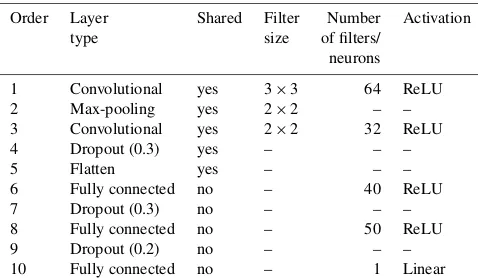
A sequential multitask (top- and subsoil) CNN model was built. The CNN is composed of a common architecture for the two soil depths (shared layers) followed by two separate sets of fully connected layers, one for each soil depth. An il-lustration of the model is provided in Fig. 1b–c. The model specifications are reported in Table 1. Note that for the con-volutional layers, zero padding is always applied to the orig-inal input image before the dot product with the filters. This operation keeps the original size of the input image and
pre-serves its information at an early stage of the model. We use the max-pooling operator; i.e. we select the maximum value in the convoluted image using a given filter size, in our case a filter of size 2 pixels×2 pixels.
Table 1.Layers used in the sequential model built for topsoil and subsoil TC prediction.
Order Layer Shared Filter Number Activation
type size of filters/
neurons
1 Convolutional yes 3×3 64 ReLU
2 Max-pooling yes 2×2 – –
3 Convolutional yes 2×2 32 ReLU
4 Dropout (0.3) yes – – –
5 Flatten yes – – –
6 Fully connected no – 40 ReLU
7 Dropout (0.3) no – – –
8 Fully connected no – 50 ReLU
9 Dropout (0.2) no – – –
10 Fully connected no – 1 Linear
Hengl et al. (2018). For a fair comparison between the CNN and RF models, we used the same calibration and test sets, with normalized TC measurements and standardized covari-ates as input. A RF model is calibrated for each soil depth, using depth-specific fine-tuned parameter values.
3.2.2 Parameter estimation
Once the sequential CNN model was specified, the param-eters were estimated by minimizing the MSE as the objec-tive function (Eq. 8), for which we used the Adam opti-mizer. Overfitting was carefully checked by (i) modifying the dropout rate in the model and (ii) ensuring that the model does not provide a considerably larger objective function on an independent dataset. Since the test set was used solely to validate the predictions, it could not be used for this purpose. We therefore randomly split the calibration set into two sets, referred to as the calibration and validation sets hereafter. The calibration set (90 %, 3201 measurements) was used to calibrate the model, and the validation set (10 %, 356 mea-surements) was used to tune the parameters and prevent over-fitting.
The model was trained using different window sizes of the input images. We compared a model with a window size (w×h) of 3, 5, 9, 15, 21, 29 and 35 covariate pixels for the input. The comparisons were made based on the average be-tween the two depths’ RMSE of the predictions, made on the validation set. Optimization of the parameter of a single model (Table 1) using three covariates, an input window size of 21×21 and 3557 TC measurements took approximately 1 h in parallel on a standard four-core laptop. All processing was done in R 3.5.1 (R Core Team, 2018), using the keras package (Allaire and Chollet, 2018) and tensorflow (Abadi et al., 2016) backend.
Once the input window size was selected, the hyperpa-rameters of the model architecture were optimized using Bayesian optimization (Snoek et al., 2012). Note that this is different from the optimization of the objective function
Table 2.Weights given to the measurements.
CNS NIR MIR
Topsoil 1 0.43 0.62 Subsoil 1 0.52 0.61
using the Adam optimizer. In Bayesian optimization, the ob-jective function is treated as a random function character-ized by a prior probability distribution. Each function evalu-ation is treated as data, which enables updating the objective function posterior distribution. The latter is used to determine where to evaluate next. The process is repeated until reaching a stopping criteria. Bayesian optimization enables us to find optimized values of machine learning hyperparameters with commonly less iteration than when using a random search. In this work, we optimized the filter number, the neuron num-ber, the batch size and the learning rate using 50 iterations.
4 Results
Based on the procedure detailed in Sect. 2.4, measurements of TC inferred from NIR spectra were assigned a measure-ment error weight of 0.43 and 0.52 for topsoil and subsoil, respectively. The MIR-inferred TC measurements had a mea-surement error weight of 0.62 for topsoil and 0.61 for subsoil. This suggests that the MIR range of the spectra is more accu-rate in predicting TC. Recall that all CNS-inferred measure-ments had a measurement error weight of 1, as explained in the previous section.
Figure 4 shows the RMSE of topsoil and subsoil TC for different vicinity size of the input images. Contextual in-formation is accounted for by representing the input data as images of a square format surrounding a soil measure-ment. Each pixel has a resolution of 25 m×25 m so that a window of size 3×3 includes contextual information up to 3/2×25=37.5 m. For both soil depths, Fig. 4 shows a sim-ilar pattern with increasing size of the window. The RMSE becomes significantly smaller when using a larger window of size 5×5. The lowest averaged (topsoil and subsoil) RMSE is found for a window size of 21×21 (radius of about 262 m). It seems that model calibration does not benefit from using a larger window size as the RMSE increases for a window size of 29×29 and 35×35. From now on, all the results presented come from using an input window size of 21 pixels×21 pix-els.
114 A. M. J.-C. Wadoux et al.: Multi-source data integration for soil mapping using deep learning
Figure 4.Effect of the vicinity size of input images. The RMSE (in g 100 g−1) corresponds to the error between the predictions and measured values in the test set.
is a high density of predicted values close to the 1:1 line. In contrast to the CNN model, the predictions using the RF model are more dispersed, with several over-predicted values for the low range of the measured TC values. Visual inspec-tion of Fig. 5 suggests that the CNN model predicts more accurately than the RF model.
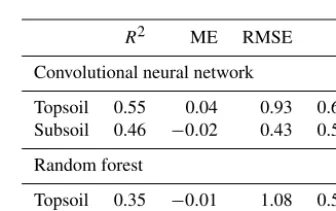
This is confirmed by the quantitative assessments of the predictions shown in Table 3. Correlation between predicted and measured TC, as measured by theR2, is stronger for the CNN (R2=0.55 for topsoil andR2=0.46 for subsoil) than for the RF model (R2=0.35 for topsoil andR2=0.21 for subsoil). The ME (in g 100 g−1) shows that predictions for both models are relatively unbiased (ME close to zero in all cases). The CNN model provides a significantly smaller ac-curacy measure (topsoil RMSE of 0.93 against 1.08 for the RF model) while providing as well a larger degree of predic-tion falling on the 45◦ line through the origin (about 15 % higher for both topsoil and subsoil), as already noticed visu-ally in Fig. 5.
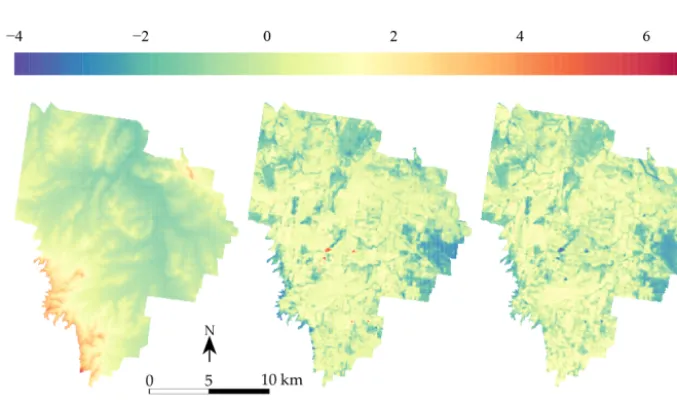
The maps produced using the CNN are shown in Fig. 6 for topsoil (left) and subsoil (right) soil organic carbon. Both maps have a relatively smooth pattern. The topsoil map of TC shows the highest concentrations in the south-east border of the area (>8 g 100 g−1), with a relatively large concentra-tion in the centre of the area (5 g 100 g−1). There seems to be more TC in areas where the NDVI has large values, but this pattern is not obvious. The subsoil maps of TC have a very different pattern than the topsoil map. There seems to be a uniform distribution of TC around 1 g 100 g−1for most of the area. High concentrations of TC (>5 g 100 g−1) are seen in a patch in the centre of the catchment and in a large area in the south.
Table 3. Evaluation of prediction accuracy on the independent test set (R2 – coefficient of determination; ME – mean error, in g 100 g−1; RMSE – root mean square error, in g 100 g−1;ρ– Lin’s concordance coefficient).
R2 ME RMSE ρ
Convolutional neural network
Topsoil 0.55 0.04 0.93 0.68 Subsoil 0.46 −0.02 0.43 0.59
Random forest
Topsoil 0.35 −0.01 1.08 0.56 Subsoil 0.21 −0.01 0.54 0.40
5 Discussion
Figure 5.Scatterplot of the measured against predicted topsoil and subsoil TC for the CNN and RF models, along with the 1:1 line. Values are expressed in g 100 g−1.
larger than the sampling error. To the best of our knowledge, our study is one of the first to account for measurement error for mapping using machine learning. We note the contribu-tion of Hengl et al. (2018), who used the measurement error to change the probability of a measurement to be selected in the bootstrap sample to calibrate a RF model.
The window size of the input images had a significant im-pact on the model’s accuracy measure, as tested on an inde-pendent test set. This is because the size of the input image is closely related to the amount of contextual information we supply to our model. The CNN integrates spatial context by using the pixels of covariates surrounding a sampling loca-tion. In our regional-scale case study of TC mapping, a win-dow size of 21 pixels×21 pixels and 29 pixels×29 pixels provided the lowest prediction error, but larger window size worsened the prediction accuracy. In a similar context, this confirms the results found by Behrens et al. (2010b). The au-thors showed that prediction accuracy of topsoil silt content increased remarkably by using larger neighbourhood size. However, our results also clearly indicated that including larger-scale contextual information (larger input image
win-dow size) is not always better. This is similar to the results of Smith et al. (2006), who noted that the windows size greatly varies between landscapes and concluded that the appropri-ate size is case-dependent.
auto-116 A. M. J.-C. Wadoux et al.: Multi-source data integration for soil mapping using deep learning
Figure 6. Maps of the prediction of organic carbon for(a)topsoil (0–10 cm) and(b)subsoil (40–50 cm). The values are expressed in g 100 g−1.
correlation range of a soil property and window size deserves further investigation so as to generate rules.
Our approach predicts TC for both topsoil and subsoil us-ing a sus-ingle model. The predictions benefit from usus-ing a com-mon architecture for the two soil depths. When compared to predicting each depth separately using the random forest model, our method reduced the mean squared error by 15 % and 25 % for topsoil and subsoil, respectively. Other stud-ies reported similar results to those produced by the random forest model. For example Kempen et al. (2011) reported an R2of 0.23 for the 30–60 cm depth range. Brus et al. (2016) also noticed a significant increase in the error for predicting organic carbon at deeper soil layers. Our results confirm the recent study of Padarian et al. (2019), who showed a sub-stantial decrease in the error associated with the prediction of the deeper soil layer using the CNN. The authors showed that the CNN generates a representation of the vertical dis-tribution of the soil profile, which reproduced closely the ob-served vertical distribution. Following Angelini et al. (2017) we also tested this by assessing the interrelation between top-soil and subtop-soil for the measured TC, for the TC predicted by the CNN or for the TC predicted using the RF model (Ta-ble 4). The CNN maintains the correlation between depths much better than the RF model, as shown by the value of the Pearsonrcorrelation coefficient. This is an important finding
which needs to be confirmed in further studies. Soil proper-ties are often predicted depth by depth, which can result in predicting physically unrealistic soil profiles. In this study we showed that the deterministic behaviour of a depth func-tion can be partly reproduced by the CNN.
We used three covariates to calibrate the CNN model. This might be a surprisingly small number compared to other studies on mapping with machine learning techniques (e.g. Nussbaum et al., 2018). However, this is a similar number compared to Padarian et al. (2019), who used four covariates for mapping organic carbon at a large scale. Further research will test the effect of the number of covariates on the CNN model calibration. We foresee a large increase in the com-putational load when using more covariates. This is because, in most studies on deep learning, only three colour channels are used. In this study we showed that only a small number of covariates was sufficient to provide satisfactory prediction accuracy.
Adapting the CNN for soil mapping poses some practical problems. We mention two of them along with our solution for future research.
Table 4.Pearson’srcorrelation coefficient between the topsoil and subsoil TC for the original measurements of the test set, the pre-dicted TC by the CNN and the prepre-dicted TC by the RF model.
Original CNN RF
Pearson’sr 0.20 0.27 0.39
their corresponding covariate images contain missing values and (ii) prediction will suffer from an edge ef-fect; i.e. pixels at the edge of the area will not be pre-dicted. This is a common problem when using a moving window operation in GIS. In our study, we padded the rows and columns of the covariates with −1, so as to avoid providing missing values to the model. The CNN is capable of predicting TC while learning that values containing−1 are missing values so that the subsequent prediction does not acknowledge an edge effect. We note that padding a value of−1 is an arbitrary choice which might not be right in another case study.
– A CNN model takes more time to train and predict than a RF one. In our case study, it took 5 s to fit the RF model and about 30 s to predict about 600 000 centre of grid cells, using a standard four-core laptop. The CNN took 15 min to fit and 30 s to predict but requires prepar-ing a 4-D matrix of sizen×c×w×hfor the training (n is the number of sampling locations) and for pre-dicting (nis the number of prediction locations). This is tractable when the study area is small or for pre-dicting on a coarse grid but becomes quickly computa-tionally cumbersome for large-scale or high-resolution mapping. This is a new problem arising from using mul-tiple covariates when image recognition problems com-monly use three channels (colour channels RGB). A straightforward solution is to increase the number of cores available. Most available software implementa-tions of deep learning models already support the use of parallel computing solutions.
Finally, we note that, in spite of its predictive power, the CNN has the major disadvantage of being a “black box” ma-chine learning model, where results provide little knowledge, if any, on soil processes. In fact, many authors have noted that machine learning models are difficult to interpret. Re-cent publications (e.g. Angelini et al., 2017) have take a step toward “conscious” digital soil mapping where cause–effect relationships are adjusted with pedological knowledge. Solu-tions to interpret the CNN or more common ANN models ex-ist but they have been unexplored in digital soil mapping, for example automated sensitivity analysis (Tickle et al., 1998) which consists in keeping track of the error computed during back propagation to measure the degree to which each co-variate contributes to the prediction error. The larger the con-tribution, the larger the influence of the covariate. Another
solution is to extract set of rules (Andrews et al., 1995) for each hidden layer based on the connection weight vector and associated bias of each neuron. Taking these methods into account would certainly make a valuable extension to future CNN studies.
6 Conclusions
We have shown how to train a deep learning model to pre-dict total organic carbon at two soil depths using uncertain measurement of the soil property. The results and discussion bring us to the following conclusions.
– The uncertainty of the organic carbon values inferred by NIR spectroscopy was larger than those inferred by MIR. The uncertainty of the NIR-inferred soil carbon measurement was large. Ignoring the latter uncertainty during model calibration results in a substantial part of the uncertainty being ignored, which can potentially lead to biased parameter estimates.
– A known measurement error can easily be accounted for when calibrating a CNN model, by weighting the objective function to be optimized.
– The CNN can be used for soil mapping using contextual covariate information. However the amount of contex-tual information we supply to the model, as represented by the window size of the input covariates, must be cho-sen with attention. In our case study a radius of 262 to 360 m provided the best results. This is closely related to the range of the soil organic carbon spatial autocor-relation. Future studies may show whether this is a con-sistent finding or case-dependent.
– In our case study, the CNN outperforms the RF model as assessed by several prediction accuracy measures.
– A single CNN model can be used to predict multiple outputs. In our case study, we predicted simultaneously at two soil depths. Deeper depth was much better pre-dicted by the CNN than the RF model. In addition, the reported predictions preserve the interrelation between depths. The CNN is more suited for predicting corre-lated outputs. This also needs to be further investigated so as to generate rules.
118 A. M. J.-C. Wadoux et al.: Multi-source data integration for soil mapping using deep learning Data availability. The point data used in this study are the
prop-erty of the University of Sydney and are not publicly available. The data may be requested from Budiman Minasny at the University of Sydney.
Competing interests. The authors declare that they have no con-flict of interest.
Acknowledgements. Alexandre M. J.-C. Wadoux received fund-ing from the European Union’s Seventh Framework Programme for research, technological development and demonstration under grant agreement no. 607000. We thank David Lopez-Paz, Facebook AI Research, for valuable comments.
Review statement. This paper was edited by Axel Don and re-viewed by Tomislav Hengl and Thorsten Behrens.
References
Abadi, M., Barham, P., Chen, J., Chen, Z., Davis, A., Dean, J., Devin, M., Ghemawat, S., Irving, G., Isard, M., Kudlur, M., Lev-enberg, J., Monga, R., Moore, S., Murray, D. G., Steiner, B., Tucker, P., Vasudevan, V., Warden, P., Wicke, M., Yu, Y., and Zheng, X.: Tensorflow: a system for large-scale machine learn-ing, in: 12th USENIX Symposium on Operating Systems Design and Implementation, Vol. 16, 265–283, 2016.
Allaire, J. and Chollet, F.: keras: R Interface to “Keras”, avail-able at: https://CRAN.R-project.org/package=keras (last access: 1 March 2019), R package version 2.2.0, 2018.
Andrews, R., Diederich, J., and Tickle, A. B.: Survey and critique of techniques for extracting rules from trained artificial neural networks, Knowl.-Based Syst., 8, 373–389, 1995.
Angelini, M. E., Heuvelink, G., and Kempen, B.: Multivariate map-ping of soil with structural equation modelling, Eur. J. Soil Sci., 68, 575–591, 2017.
Behrens, T., Schmidt, K., Zhu, A.-X., and Scholten, T.: The Con-Map approach for terrain-based digital soil mapping, Eur. J. Soil Sci., 61, 133–143, 2010a.
Behrens, T., Zhu, A.-X., Schmidt, K., and Scholten, T.: Multi-scale digital terrain analysis and feature selection for digital soil map-ping, Geoderma, 155, 175–185, 2010b.
Behrens, T., Schmidt, K., Ramirez-Lopez, L., Gallant, J., Zhu, A.-X., and Scholten, T.: Hyper-scale digital soil mapping and soil formation analysis, Geoderma, 213, 578–588, 2014.
Behrens, T., Schmidt, K., MacMillan, R. A., and Viscarra Rossel, R. A.: Multi-scale digital soil mapping with deep learning, Sci. Rep.-UK, 8, 15244–15244, 2018.
Brus, D. J., Yang, R.-M., and Zhang, G.-L.: Three-dimensional geo-statistical modeling of soil organic carbon: A case study in the Qilian Mountains, China, Catena, 141, 46–55, 2016.
Demattê, J. A. M., Fongaro, C. T., Rizzo, R., and Safanelli, J. L.: Geospatial Soil Sensing System (GEOS3): A powerful data min-ing procedure to retrieve soil spectral reflectance from satellite images, Remote Sens. Environ., 212, 161–175, 2018.
Farr, T. G., Rosen, P. A., Caro, E., Crippen, R., Duren, R., Hensley, S., Kobrick, M., Paller, M., Rodriguez, E., Roth, L., Seal, D., Shaffer, S., Shimada, J., Umland, J., Werner, M., Oskin, M., Burbank, D., and Alsdorf, D.: The shut-tle radar topography mission, Rev. Geophys., 45, RG2004, https://doi.org/10.1029/2005RG000183, 2007.
Gallant, J. C. and Dowling, T. I.: A multiresolution index of valley bottom flatness for mapping depositional areas, Water Resour. Res., 39, 4.1–4.13, 2003.
Geeves, G., Cresswell, H., Murphy, B., Gessler, P., Chartres, C., Lit-tle, I., and Bowman, G.: The physical, chemical and morpholog-ical properties of soils in the wheat-belt of southern New South wales and northern Victoria, Aust. Division of Soils Occasional Report, CSIRO, Australia, 1995.
Goodfellow, I., Bengio, Y., Courville, A., and Bengio, Y.: Deep learning, Vol. 1, MIT press, Cambridge, 2016.
Grimm, R., Behrens, T., Märker, M., and Elsenbeer, H.: Soil organic carbon concentrations and stocks on Barro Colorado Island-Digital soil mapping using Random Forests analysis, Geoderma, 146, 102–113, 2008.
Grinand, C., Arrouays, D., Laroche, B., and Martin, M. P.: Extrap-olating regional soil landscapes from an existing soil map: sam-pling intensity, validation procedures, and integration of spatial context, Geoderma, 143, 180–190, 2008.
Hengl, T., Nussbaum, M., Wright, M. N., Heuvelink, G. B., and Gräler, B.: Random forest as a generic framework for predic-tive modeling of spatial and spatio-temporal variables, PeerJ, 6, e5518, https://doi.org/10.7717/peerj.5518, 2018.
Jian-Bing, W., Du-Ning, X., Xing-Yi, Z., Xiu-Zhen, L., and Xiao-Yu, L.: Spatial variability of soil organic carbon in relation to environmental factors of a typical small watershed in the black soil region, northeast China, Environ. Monit. Assess., 121, 597– 613, 2006.
Kempen, B., Brus, D., and Stoorvogel, J.: Three-dimensional map-ping of soil organic matter content using soil type–specific depth functions, Geoderma, 162, 107–123, 2011.
Kingma, D. P. and Ba, J.: Adam: A method for stochastic optimiza-tion, conference paper, 3rd International Conference for Learn-ing Representations, San Diego, 2015.
Kumhálová, J., Kumhála, F., Kroulík, M., and Matˇejková, Š.: The impact of topography on soil properties and yield and the effects of weather conditions, Precis. Agric., 12, 813–830, 2011. Lark, R. and Webster, R.: Changes in variance and correlation of
soil properties with scale and location: analysis using an adapted maximal overlap discrete wavelet transform, Eur. J. Soil Sci., 52, 547–562, 2001.
Lawrence, I. and Lin, K.: A concordance correlation coefficient to evaluate reproducibility, Biometrics, 45, 255–268, 1989. LeCun, Y., Boser, B., Denker, J. S., Henderson, D., Howard, R. E.,
Hubbard, W., and Jackel, L. D.: Backpropagation applied to handwritten zip code recognition, Neural Comput., 1, 541–551, 1989.
LeCun, Y., Bengio, Y., and Hinton, G.: Deep learning, Nature, 521, 436–444, 2015.
McBratney, A. B., Minasny, B., and Stockmann, U.: Pedometrics, Springer International Publishing, 2018.
Minasny, B., McBratney, A. B., and Salvador-Blanes, S.: Quantita-tive models for pedogenesis – A review, Geoderma, 144, 140– 157, 2008.
Moore, I. D., Gessler, P., Nielsen, G., and Peterson, G.: Soil attribute prediction using terrain analysis, Soil Sci. Soc. Am. J., 57, 443– 452, 1993.
Moran, C. J. and Bui, E. N.: Spatial data mining for enhanced soil map modelling, Int. J. Geogr. Inf. Sci., 16, 533–549, 2002. Nussbaum, M., Spiess, K., Baltensweiler, A., Grob, U., Keller, A.,
Greiner, L., Schaepman, M. E., and Papritz, A.: Evaluation of digital soil mapping approaches with large sets of environmental covariates, Soil, 4, 1–22, 2018.
Padarian, J., Minasny, B., and McBratney, A. B.: Using deep learning for digital soil mapping, SOIL, 5, 79–89, https://doi.org/10.5194/soil-5-79-2019, 2019.
Ramirez-Lopez, L., Wadoux, A. M. J.-C., Franceschini, M., Terra, F., Marques, K., Sayao, V. M., and Demattê, J.: Robust soil map-ping at farm scale with vis-NIR spectroscopy, Eur. J. Soil Sci., in press, 2019.
R Core Team: R: A Language and Environment for Statistical Computing, R Foundation for Statistical Computing, Vienna, Austria, available at: https://www.R-project.org/ (last access: 1 March 2019), 2018.
Rossel, R. V., Walvoort, D., McBratney, A., Janik, L. J., and Skjem-stad, J.: Visible, near infrared, mid infrared or combined diffuse reflectance spectroscopy for simultaneous assessment of various soil properties, Geoderma, 131, 59–75, 2006.
Samuel-Rosa, A., Heuvelink, G., Vasques, G., and Anjos, L.: Do more detailed environmental covariates deliver more accurate soil maps?, Geoderma, 243, 214–227, 2015.
Smith, M. P., Zhu, A.-X., Burt, J. E., and Stiles, C.: The effects of DEM resolution and neighborhood size on digital soil survey, Geoderma, 137, 58–69, 2006.
Snoek, J., Larochelle, H., and Adams, R. P.: Practical bayesian op-timization of machine learning algorithms, in: Advances in neu-ral information processing systems, Curran Associates, Inc., New York, 2951–2959, 2012.
Somarathna, P., Minasny, B., Malone, B. P., Stockmann, U., and McBratney, A. B.: Accounting for the measurement error of spectroscopically inferred soil carbon data for improved preci-sion of spatial predictions, Sci. Total Environ., 631, 377–389, 2018.
Tickle, A. B., Andrews, R., Golea, M., and Diederich, J.: The truth will come to light: Directions and challenges in extracting the knowledge embedded within trained artificial neural networks, IEEE T. Neural Networ., 9, 1057–1068, 1998.