THE EFFECTIVENESS OF CORPORATE TRAINING IN BUSINESS COMMUNICATION Jelena Malesko, Olga Tjurdju
Riseba, 3 Meza Str., Riga, Latvia
Abstract
Business Communication training contributes to company overall effectiveness (improved services/product quality, personality development, shortened decision making period), provided that traditional teaching methods are complemented by specifically devised, customised training activities and methods ,e.g. on the bases of London Chamber of Commerce and Industry Spoken English For Industry and Commerce level 3 papers. Research unit-groups are intermediate and above level of English employees of two companies representing different scope, profile and needs. Evaluation methods-progress tests, feedback (self & peer), supervisors’, department managers’, feedback, gathered through personal talks, observations, questioners. Findings–being flexible, customer-focused and integrative, methodology works irrespective of company size, profile or environment; Recommends expansion of teaching methods and tasks applied, suggests the necessity of aggregative training.
This paper is aimed to provide an approach to selecting teaching methods and tasks when designing the course in oral business communication; when planning particular unit sessions; as well as each particular session delivery methods.
Key words: Business Communication, Methodology, Assessment, Evaluation, Effectiveness
Literature review
There are various definitions and explanations of business communication and its forming elements, starting with Latin (“communicare”) which means to impart, participate, share or make common, further to examining the explanations given by several authors (Gibson and Hodgetts, 1990; Kaul, 2003; Hargie and Dickson, 2004, Bisem and Priya, 2009) who agree that business communication is an exchange (verbal or written) of information from one person to another person or a group of people. Some authors (Andrews and Andrews, 1988; Mitra, 2006; Andersen, 2007) argue that communication is a two-fold process of transmitting an idea and comprehending the conveyed message where sometimes a gap is created in between what is meant and what is perceived, while certain authors ( Burnett and Dollar, 1989; Bovee and Thill, 1992; Poe and Fruehlini, 2000; Ramesh and Pattanshetti, 2001) complement the definition by adding another dimension such as inference – understanding more than what was said or written, through a thorough analysis of all elements that are included in communication. Turning to a more detailed business communication description Reevers (2014) mentions that business communication is comprised of the following elements: clarity (getting right to the point), structure (logical structure with beginning, culmination and conclusion), audience (adapting the style to suit the target recipient), consistency (tone and style as well as message) and medium(the right choice of channel). Lesikar and Pettit (1989) followed by Bisem and Priya (2009) define the elements of communication together with the process of communication: sender (conveys the message), message (subject matter), encoding (series of symbols / words), communication channel (way of passing the message), receiver (designated target of communication). Finally, William et al (2011) defines business communication as the process of establishing a common understanding between or among people within a business environment.
The importance of business communication has been widely recognized by different authors ( Bisem and Priya, 2009; Padmashree and Anjum, 2011) who emphasise its being a mortar that holds the organization together and allows it to exist within an environment comprised of other organizations and individuals. Moreover, communication creates a healthy organizational environment, manages employee relations, helps develop an internal and external network, etc. Not only do academics praise
business communication and its benefits, employers too, as described by Nielsen (2012) and later on ascertained by Leigh (2013), admit that exercising a correct form of business communication can spell failure or success in certain enterprises. Employers unanimously agree that effective business communication means motivated employees, better customer service, enhanced employer brand, process and product improvement.
Following the above stated, business communication plays a vital role in organizational development, therefore methods and approaches to its teaching should be addressed. Opinions regarding the most effective approaches differ from author to author, though having certain degree of similarity. For example, Devimeenakshi and Sarika (2013) list four essential communication areas to be trained – Listening, Speaking, Reading and Writing representing the basics for any communication training be it professional or academic. Burkill (2010) adds that customization of teaching methods is a key to success within different classrooms, though highlights that irrespective of study setting the essential components are still verbal and printed comprehension as well as oral and written expression.
Teaching outcome evaluation can be done using numerous approaches, starting with the standard classical ones and going into more innovative. Presented further is a summary of certain authors’ concepts on the possibilities to evaluate business communication teaching effectiveness. Darling-Hammond (2012), states that evaluations should be multi-levelled including not only the student and teacher, but also reaching out to other, third party stakeholders – peers and colleagues, current and potential employers, external bodies that assess and certify knowledge of certain subjects, state institutions, etc. Cashin (1989) introduced and Burns (2010) ascertained the concept of action research which is often referred to as “reflective practice” i.e. engaging in self-evaluation in a critical and systematic way (planning, executing, observing and analysing the results, reflecting and introducing changes). Centra (1993) says that when performing self- evaluation a teaching dossier needs to be developed, as defined by Seldin (1991) “factual description of a professor's major strengths and teaching achievements. It describes documents and materials which collectively suggest the scope and quality of a professor's teaching performance”. Centre for Research on Learning and Teaching (2014) supports self-evaluation as one of the methods to evaluate teaching effectiveness, also adding that peer and colleague assessment is critical, if possible to be collected. Centra,(1993) mentions as well that peer review is one of the most valuable ones and can be achieved through evaluation of classroom teaching by visiting, through evaluation of course material such as syllabus, books, handouts, etc., through evaluation of instructional contributions – teaching related activities as curriculum development, supervision of students and alumni, consultations, etc.). Furthermore, some authors consider that certain teaching effectiveness evidence can be collected from students, such as feedback and ratings, test results (for better comparison should be collected pre and post training), Cross (1993) mentions that end-of-course rating forms and written comments should be collected, alumni letters and surveys, focus group interview, exit interviews at the end of the course and surveys of students, as well as mid-course and periodic student feedback collection, evaluation of student progress through tracking their awards, diplomas and certificates. Darling-Hammond (2012) recommends that evaluations should be performed with a determined frequency and overseen by other bodies to ensure the assessment result applicability over time. Braskamp et al (1984) mentions that when evaluating teaching the following elements can be assessed: quality, amount, and level of classroom instruction (including shared instruction); development of curricula, new courses, and classroom materials; supervision and mentoring of graduate students, including chairing of dissertations; service on graduate examination and dissertation committees; one-on-one consultation with students, including supervision of independent study and readings courses; supervision of teaching assistants in undergraduate courses; conduct and supervision of laboratory instruction; supervision of undergraduate and graduate research; advising students in the major; supervision of field work; supervision of clinical and practicum experiences, within a business environment certain evaluation criteria are either disregarded or customized to fit the organisational needs.
Applied research
Effective business communication has been recognized one of the company’s competitive advantages fostering its overall effectiveness and is ensured by the employees’ personality and communication skills representing the integral part of their professional expertise and corporate culture in general. This course isconfined to spoken English. Essence of methodology can be conventionally presented as the integration of 3 components:
1. Traditional teaching methods aimed at developing 4 language skills - Listening, Speaking, Reading, Writing and using them as tools for general and more specific/customised business communication skills development.
2. Communication training activities developed by the researchers on the basis of SEFIC*, level 3 sample examination papers from LCCI* which areincorporated into the course as its integral part and are aimed to enhance the customisation focus.
3. Methodology design based on the adaptation and customer tailored approach by developing specific topic/task- based sets of teaching/learning activities against the following criteria:
• company scope (profile, size, depts., core activities, markets served etc.); • group diversity (professional);
• business needs analysis (short/mid/long-term; individual/shared/corporate); • level of business competences;
• level of language competences;
• communication characteristics (i.e. scope, functions, types, forms, levels, channels).
Aims of methodology /learning outcomes are set to develop: the overall awareness and understanding of business functions and practices in the framework of a particular company and its interaction with the stakeholders; extensive range of communication skills (face-to face, presentations, negotiations, telephoning, brainstorming, etc.) with the emphasis of those specifically relevant for a particular company/culture/department/function/task; interactive skills for both, a range of familiar work-related and international multicultural business and social environment with relative degree of spontaneity and ability to shift those; expand: linguistic competences in terms of structures, concepts, vocabulary; stylistic competencies (formal/informal); apply: oral business communication skills of a more general professional scope (idea generating, reasoning, evaluation, problem resolution, multi-tasking etc.) into more specific professional tasks; specific communication skills (accuracy, conciseness, relevance, clarity, etc.) into variety of business situations; facilitate: personal development; trust and relationship; healthy environment; team spirit. Thus, methodology challenges teacher’s insightful, critical and creative learner-centred approach.
The rationale for this methodology design and aims lies in modern business tendencies, e.g. globalisation and internationalisation, innovation, theory to practice based work, individual to team/project-based work, paradigm shift generalist to specialist, single focus to multi-tasking, life-long learning, generalization to customization, popularity of participative management style, customer-need oriented communication which in turn put emphasis on the corporate communication culture reinforced by the employees’ communication skills as the integral constituency of their professional expertise and personal profile.
Approach
The most essential criteria for methodology design are learning outcomes or aims set, wherein teaching methods are the tools to achieve them. Thus, it becomes necessary to (1) clarify those aims/learning outcomes and (2) develop the effective methods. Experience on the one hand, and business environment trends and developments on the other, make the researchers assume that
corporate training methodology design should identify both, general/more common learning outcomes/aims/set of skills and the more specific ones, inherent for a particular company to target and apply the integrating methods varying in terms of duration, topics, learning materials, activities, emphasis, etc. This being said, 4 basic communication areas to be trained – Listening, Speaking, Reading and Writing, become the basic teaching/learning methods for communication training, while the main issue arises: how to integrate them to ensure the desired learning outcome, the achievement of effective business communication benefiting the company to a maximum.
Listening Answering questions, summarizing, identifying key ideas etc. Writing E-mail, memo, letter, report, articles, etc.
Reading Answering questions, summarizing, matching information, completing, etc. Speaking Briefing, role plays, reviews, negotiations, meetings, etc.
Table 1.1 Common communication methods for language skills development (developed by authors)
Company profile
(Company1) Evolution Latvia-branch of the International Evolution Gaming. Developer of on-line casino platforms.
Provider of localised, realistic Live Casino broadcasting all over the world. Represents video-streamed, multi- channel, live dealer gaming solutions to people and casinos all over the world.
(Company 2) Manpower Latvia-branch of the International Manpower Group. Provides recruitment and staffing services to businesses all over the world to raise their staff quality, productivity and efficiency, as well as consulting, outsourcing and career management services.
Company scope
Over 1000 employees. Extensively multifunctional company representing a complex hierarchy of divisions and operations, employing international multicultural staff.
260 employees including part-time. Staffing/ recruitment related operations dealing with local professionals’ employment with international companies representing a flat corporate structure.
C
om
m
uni
ca
ti
on
scope Excessively diversified in variety of respects, e.g. purpose, skills implied, contents, etc.
Confined to narrow scope of
purposes and contents, still, extensive communication scope.
functi ons
internal/external (order of priority in terms of training)
external/internal (order of priority in terms of training)
types formal/semi-formal/informal formal/semi-formal
forms upward/downward/sideways upward/downward/sideways
levels interpersonal, group, organisational, public interpersonal, group, organisational, public
chann els
two-way/face-to-face two way/ not face-to-face one way/not face-to-face
two-way/face-to-face two way/ not face-to-face one way/not face-to-face
Company needs
“In pursue of “Best Value” delivered to our customers, enhanced brand and morale we expect business communication training to contribute to the goal, developing our staff soft skills, e.g. multitasking, feedback, teamwork, interpersonal communication, etc. which are the most essential at all levels and operations for a multicultural company”. Baiba Veilande, HRM, Evolution Latvia.
1. Expand staff general intelligence and awareness of business practices.
2. Improve level of English competency, accuracy and professional implication. 3. Develop variety of communication skills with the emphasis on those involved in internal and external, spoken two-way/face-to-face/not face-to-face interaction, i.e. :
clarity, accuracy, relevance, structural coherence of explanations and
instructions, active listening, eliciting information, engaging/involving, brainstorming/discussions/reasoning, presentations/ briefs,
feedback/appraisal/developing talks, constructive criticism, teamwork/idea generating/evaluation, quick problem-solving/decision-making
4.Develop personal abilities and skills, e.g. : interpersonal skills, building
relationship/trust, emotional intelligence/empathy, flexibility, customer focussed attitudes, tolerance 5. Develop and promote extensive cross-cultural awareness and skills.
“Manpower’s overall effectiveness and efficiency, which is successful staffing, directly depends on the staff
communication skills, their ability to deliver core business competences to a client in a clear, customised, accurate and concise way, providing logically
structured reasoning and persuasion”. Raitis Abolins, Project Manager. 1. Expand staff general intelligence and awareness of business practices in variety of their functions, processes, jobs, trends, etc.
2. Improve level of English competency, accuracy and professional implication. 3. Develop variety of communication skills with the emphasis on those involved in external, spoken two-way/face-to-face/not face-to-face interaction, e.g.:
negotiation, interviewing, telephoning, eliciting/reformulating/interpreting, active listening,
evaluating/assessing/feedback, summarising/briefing/presentations, problem-solving/decision-making, conflict-resolution, teamwork 4.Develop personal abilities and skills, e.g. :
creative/customer focused approach, emotional intelligence/empathy, interpersonal skills, rational and critical thinking, building relationship/trust, confidence
5. Develop extensive cross-cultural awareness and skills.
Table 1.2 Research subject description (developed by authors)
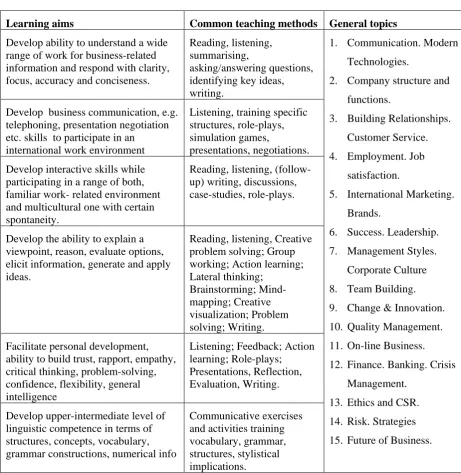
Learning aims Common teaching methods General topics Develop ability to understand a wide
range of work for business-related information and respond with clarity, focus, accuracy and conciseness.
Reading, listening, summarising,
asking/answering questions, identifying key ideas, writing.
1. Communication. Modern Technologies.
2. Company structure and functions.
3. Building Relationships. Customer Service. 4. Employment. Job
satisfaction.
5. International Marketing. Brands.
6. Success. Leadership. 7. Management Styles.
Corporate Culture 8. Team Building. 9. Change & Innovation. 10. Quality Management. 11. On-line Business. 12. Finance. Banking. Crisis
Management. 13. Ethics and CSR. 14. Risk. Strategies 15. Future of Business. Develop business communication, e.g.
telephoning, presentation negotiation etc. skills to participate in an international work environment
Listening, training specific structures, role-plays, simulation games,
presentations, negotiations. Develop interactive skills while
participating in a range of both, familiar work- related environment and multicultural one with certain spontaneity.
Reading, listening, (follow-up) writing, discussions, case-studies, role-plays.
Develop the ability to explain a viewpoint, reason, evaluate options, elicit information, generate and apply ideas.
Reading, listening, Creative problem solving; Group working; Action learning; Lateral thinking;
Brainstorming; Mind-mapping; Creative visualization; Problem solving; Writing. Facilitate personal development,
ability to build trust, rapport, empathy, critical thinking, problem-solving, confidence, flexibility, general intelligence
Listening; Feedback; Action learning; Role-plays; Presentations, Reflection, Evaluation, Writing.
Develop upper-intermediate level of linguistic competence in terms of structures, concepts, vocabulary, grammar constructions, numerical info
Communicative exercises and activities training vocabulary, grammar, structures, stylistical implications.
Table 1.3 Common teaching methods to reach learning aims (developed by authors)
1. Several papers may be included in one unit depending on its relevance for a particular company. 2. Paper tasks may be used for variety of methodological purposes, e.g. compliment basic information, specific skills training, follow up activity, testing purposes.
3. Papers may be integrated in the course/unit/lesson in variety of ways enhancing the course flexibility and customisation.
* Author developed papers, i.e. customized content of all tasks without changing their structure and purpose, sources used - LCCI papers, Market Leader, Business class, Financial times, Online literature sources (references available in bibliography section)
Customized for Company 1 (110 academic hours)
Customized for Company 2 (60 academic hours)
General skills trained:
Business awareness and vision; skimming; scanning; listening; writing; providing information with clarity, accuracy, relevance and structural coherence; eliciting information; inference; discussion; briefing; evaluating; assessing; feedback; reasoning; problem-solving; decision-making; summarizing; feedback; constructive criticism; flexibility; emotional intelligence/empathy; critical thinking;
linguistic competences; engaging. Focused skills trained:
Team-work; intercultural communication; tolerance; empathy; brainstorming; fast decision-making; multitasking; transferrable skills; giving instructions and explanations; developing conversations; praise and recognition; information reformulation; dealing with complaints;
Extensive business practice awareness; information (incl. numerical) analysis,
interpretation and delivering; conflict resolution; negotiation; interviewing; telephoning; reasoning; persuasion; presentation; promotional and
advertising skills; rational thinking; personalised approach; flexibility, targeting, focused
communication.
Communication. Modern Technologies – Paper “Why Good Communication is Good Business” 1. Reading Text. Key communication notions,
value, problems and statistical information; also includes real information about “Evolution Latvia”( Company1)
2. Listening. Dialogue about communication breakdown problems typical for Company 1. 3. Memo. Related to Communication problem. 4. Role-play. Discussion of Co.1 typical
communication problems, reasons for those and measures to improve corporate communication.
1. Reading Text. Viability of effective communication; includes research based information about recruitment business.
2. Listening. Negotiating collaboration agreement and problems involved.
3. Business text. Candidate evaluation report. 4. Role-play. Discussion of the candidate with the client. Disagreement about the candidates’ communication skills.
Marketing. Customer Care and Service - Paper ”Customer Focused Corporate Culture” 1. Reading Text. Basic marketing/international
marketing notions, their relevance for Company1 and its customer focused business.
2. Listening. Dialogue about customer complaints.
3a.Memo (1) Customer complaints handling system.3b. Letter of complaint/ apology. 4. Role-play. Discussion of action plan to improve customer satisfaction.
1. Reading Text. Real client company marketing information analyses relevant for Customer Relations staffing.
2. Listening. Discussion of shortlisted candidates’ proposals on Building Customer Loyalty.
3. Candidates’ briefs on the client’s problem. 4. Role-play. Assessment of candidates’ ideas with a client.
Employment. Job satisfaction - Paper1 “Latest Trends in Employment Practices” 1. Reading Text. Co.1 employment practices.
2. Listening. Talk about Co.1 employment problems.
3. Memo. Updates to International staff
1. Reading Text. Key forces effecting labour markets.
2. Listening. Flexi-work pattern discussion with client.
recruitment programme.
4. Role-play. High staff turnover. Paper 2.”Job Appraisal”.
3. Memo. Best candidate’s work-life balance preferences.
4. Role-play. Discussing candidate’s counter proposal.
Paper 2. Job Interviews. Success. Leadership - Paper “ Company Key Success Factors’’
1. Reading Text. Company 1 success factors. Managers and leaders.
2. Listening. Different views of success and ways to it.
3. Memo. Leadership training courses. 4. Role-play. All company managers must be trained to be leaders.
1. Reading Text. Successful companies attract high fliers and strong leaders.
2. Listening. Discussing key leadership skills for a position.
3. Memo. Assessing candidate’s leadership skills against client’s criteria.
4. Role-play. Professional vs. leadership skills Management Styles. Corporate Culture. – Paper “Correlation Between Management Styles and Corporate Culture”.
1. Reading Text. Management styles and corporate culture of Co.1.Values and principles. 2. Listening. Consistency of management style and corporate culture throughout Company 1. 3. Memo. Ways to promote Co.1 corporate culture.
4. Role-play. Peer management style evaluation.
1. Reading Text. Growing popularity of
participative management style and its effect on corporate culture.
2. Listening. Discussing job advertisement contents.
3. Memo. Client emphasises necessity to fit corporate culture and flexibility of management style.
4. Role-play. Job interview to identify candidate’s management style flexibility.
Team Building - Paper ’’Team Based Management Practices’’ Paper1.
1. Reading Text. Company 1-team/project based organisation and rationale for this.
2. Listening. Cross functional approach to team work practices.
3. Memo. Team work training needs. 4. Role-play. Do we need generalists or specialists?
Paper 2. Building a team for a project.
1. Reading Text. Effective teamwork success factors.
2. Listening. Team player interview. 3. Brief. Feedback to client.
4. Role-play. Co. Consultants’ meeting. Assessing two candidates team playing skills.
Finance. Banking. Crisis Management - Paper “Company Key Financial Operations and Risks” 1. Reading Text. Co.1 Key Financial Operations
and cost efficiency.
2. Listening. Credit crunch and its impact on Co.1
3. Memo. Cost cutting options.
1. Reading Text. High demand for Finance Professionals.
2. Listening. Core competencies of Finance Specialists.
3. Candidate’s update on co. financial situation.
4. Role-play. Due Diligence at Co.1 4. Role-play. Company financial crises.
Table 1.4 Customized papers (task sets) for key topics of the course (developed by authors)
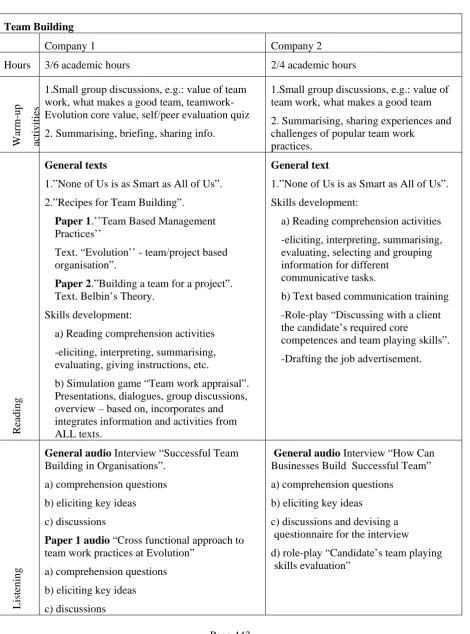
Team Building
Company 1 Company 2
Hours 3/6 academic hours 2/4 academic hours
W
ar
m
-up
ac
tiv
itie
s
1.Small group discussions, e.g.: value of team work, what makes a good team, teamwork-Evolution core value, self/peer evaluation quiz 2. Summarising, briefing, sharing info.
1.Small group discussions, e.g.: value of team work, what makes a good team 2. Summarising, sharing experiences and challenges of popular team work
practices.
R
ead
in
g
General texts
1.”None of Us is as Smart as All of Us”. 2.”Recipes for Team Building”.
Paper 1.’’Team Based Management Practices’’
Text. “Evolution’’ - team/project based organisation”.
Paper 2.”Building a team for a project”. Text. Belbin’s Theory.
Skills development:
a) Reading comprehension activities -eliciting, interpreting, summarising, evaluating, giving instructions, etc.
b) Simulation game “Team work appraisal”. Presentations, dialogues, group discussions, overview – based on, incorporates and integrates information and activities from ALL texts.
General text
1.”None of Us is as Smart as All of Us”. Skills development:
a) Reading comprehension activities -eliciting, interpreting, summarising, evaluating, selecting and grouping information for different
communicative tasks.
b) Text based communication training -Role-play “Discussing with a client the candidate’s required core
competences and team playing skills”. -Drafting the job advertisement.
Lis
te
n
in
g
General audio Interview “Successful Team Building in Organisations”.
a) comprehension questions b) eliciting key ideas c) discussions
Paper 1 audio “Cross functional approach to team work practices at Evolution”
a) comprehension questions b) eliciting key ideas c) discussions
General audio Interview “How Can Businesses Build Successful Team” a) comprehension questions
b) eliciting key ideas
c) discussions and devising a questionnaire for the interview
d) role-play “Candidate’s team playing skills evaluation”
Paper 1 role-play “Motivating team for a challenge” C ase st u d y
“Motivating a Team” a) problems discussion b) sales reps evaluation
c) role plays “Suggesting Changes’’ d) meeting
e) writing memo
“Motivating a Team”
a) group discussion-situation evaluation b) meeting-“Suggesting Changes’’ c) role play- Proposing training scheme d) writing memo
Vo cab u lar y , Gr am m ar st ru ct u res ex p ressi o n s
Topic related vocabulary, e.g. personality types, features, team roles, effective team features. Modal perfect, e.g. You should/could have... Expressing attitudes, resolving conflict, making suggestions, summarizing, persuasion
Topic related vocabulary, e.g. personality types, features, team roles, effective team features.
Modal perfect, e.g. You should/could have...
Subject with the infinitive constructions. Expressing attitudes, agreement,
disagreement, reasoning, resolving conflict, suggesting, summarizing, and persuasion. Fo llo w -up, A ddi ti o na l c om m ent s Testing
Paper2.”Building a team for a project”. Text. Belbin’s Theory
a) Questions
b) Briefing presentation
Listening. “International team work practices at Evolution”.
a) Questions b) Key points
c) Opinion, assessment, problem solving Memo. Information evaluation, interpretation and reformulation. Writing a summary note. Role-play. Authentic Evolution project based dialogue. (Cue cards provided). Identifying team players’ roles and allocating project tasks.
Follow-up and testing
Paper 1 and Paper 2 texts (cross reading)
Paper1 ’’Team Based Management Practices’’
Text. Effective teamwork success factors Paper2.”Building a team for a project”. Text. Belbin’s Theory
a) Questions
b) Briefing presentation Listening. 2 interviews with 2
candidates assessing their team playing skills.
Brief. Feedback to client. Written brief communicated on the phone.
Role-play. Company consultants’ meeting. Assessing 2 candidate team playing skills.
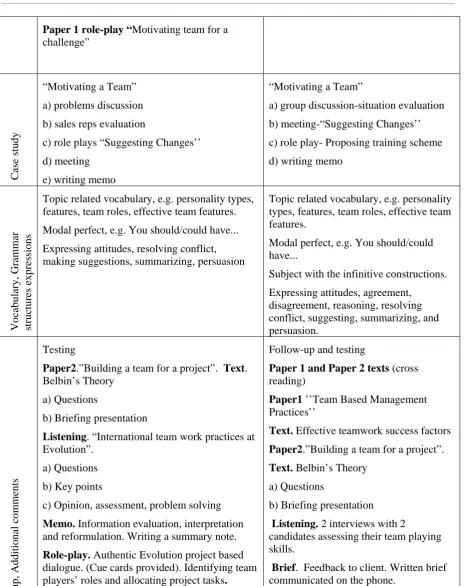
Table 1.5 One unit outline example (developed by authors)
Data analysis
Internal pre-training and post-training assessment tests were held in order to evaluate the students’ level entering the training course and to compare with the scores obtained after the course had ended, all in all 57 students were subject to both tests, all of which had intermediate to advanced level of knowledge upfront, no beginner level students had taken the training, the results can be seen in the figures below:
Figure 1.1 Number of students at each level, pre and post training (developed by authors)
As can be seen the general trend is a positive one – the number of students at more advanced levels post training has increased, whilst the number of intermediate students decreased indicating a move towards professional skill development.
Figure 1.2 Student scores, pre and post training (developed by authors)
Figure 1.2 demonstrates each student’s individual score pre and post training, the general trend is growth, though there are some cases where a slight decrease is seen (5% of all scores, the average score decrease is 3%, due to low attendance and poor performance during the course). The average increase in scores is 38% from the initial result, the biggest increase is 2.5 times and the smallest 1.04 times, disregarding the 5% of students that scored lower in post-training assessment).
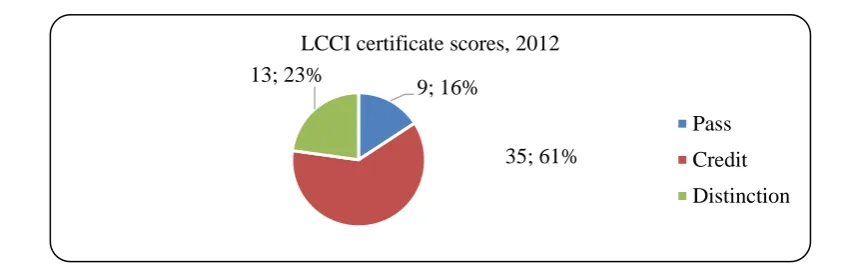
All of the students were taking the London Chamber of Commerce and Industry examination to received their certificates, no pre-scoring was done for this activity, however presented below are the achievements that demonstrate post-training effectiveness (according to official LCCI web-site passing the Level 3 certificate examination cannot be done without proper training based just on good level of English Language knowledge):
0
38
19
0 0
11
39
7
0 10 20 30 40 50
Beginner Intermediate Upper Intermediate
Advanced
Number of students at each level, pre and post training
Pre - training Post - training
40 90
0 10 20 30 40 50 60
Student scores pre and post training
Pre - training Post - training
Figure 1.3 LCCI certificate scores, 2012 (developed by authors)
The information portrayed in Figure 1.3 clearly demonstrates that none of the students failed, 16% passed, 23% received a distinction and the majority 61% were credited for their level of knowledge. Observation sessions were conducted at both organisations within a 3 month period after training had been completed, both contrived and non-contrived approaches were used. Observation data was alter on compared to internal company data gathered throughout supervisor review sessions, manager personal observations as well as peer reviews the companies internally collect on a semi-annual basis. The results have revealed employee morale and motivation increase due to their improved self-esteem, greater confidence, more professional knowledge and its application experience, moreover inner-team, inner-department colleague relationships have definitely benefitted as more open discussions are taking place, new channels of communication have been established and greater understanding exists among colleagues, supervisors have also noted that the teams have become more participative and are willing to share their concerns and successes.
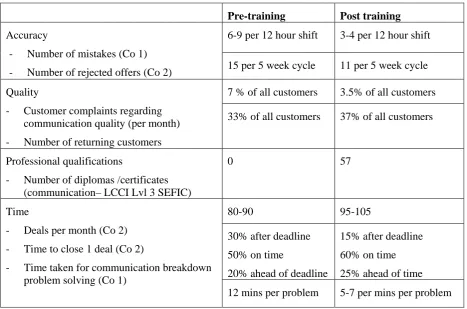
Coupled with researcher observations work shadowing sessions have been held by peers and managerial staff, the results are similar to observations performed by the researchers, however work shadowing has particularly highlighted increased work efficiency, better performance (company figures are presented further in data analysis) and higher levels of customer satisfaction.
The management of both companies was interviewed extensively pre, throughout and post training to gain an organisational perspective of the quality and evaluate whether the method has its effect. The management has noted that training needs were met to the fullest extent including enhancing team work environment, developing better co-operation within project work, raising multi-tasking effectiveness, building trust relationships within the workforce, improving morale, creating a more open work environment, pushing towards a green door managerial environment. The management has also noted more favourable results in job appraisal sessions, employee of the month awards were obtained more by people who undertook the training. Training participants are involved more often in variety of projects – training new comers, new product development, and secondments.
Students were also given a possibility to provide feedback on the course, their views ranged from mere appreciation for the provided language and communication training to greatest gratitude for giving them wider insights to their own work, as well as equipping them with tools and techniques aiding them in pursuing their professional careers, moreover students noted that their vision and understanding of the business world, its practices and functions, has improved, students realized and acknowledged the increased ability to better structure any messages.
Teacher self-review demonstrates the value of conducting the research on training professionals rather than university students, as this provided understanding of those professional needs and skills that are relevant and are to be trained with academic students. Also it has become clear that a major prerequisite for training success is meticulous scrutiny of company structure, their needs, values, management style and other elements. Preparatory work should encompass different aspects, starting with surveys and questionnaires to assess company needs and requirements, as well as interviews and information sharing with participants at various levels – coming from supervisors, HR, top
9; 16%
35; 61% 13; 23%
LCCI certificate scores, 2012
Pass Credit Distinction
management of the company. Peer success stories and experience shared also contribute to productive and motivated training. Greater levels of participation and involvement are seen when company management recognise and promote corporate communication training and its value. Creativity and contribution to reaching the overall aim of the course is seen as a major challenge for the instructor of the course, therefore motivation (both financial and non-financial) should be adequate to the work performed. However, once the skill of compiling and integrating papers improves methodology applicability and flexibility expands. Another difficulty is presenting the course viability to key decision makers in the company for them to realise the corporate training added value to business. No less essential is the necessity to sustain the motivational spirit throughout the course, focusing on continuous evaluation and regular feedback both to participants themselves and company administration. Certain failures can also be noted such as instructor’s overestimated expectations, often disregarded objective reasons for students’ poor performance, difficulty to switch from academic environment and its methods to corporate business environment and its specifics, international inability to be knowledgeable enough in all business areas which limits course customization possibilities.
Pre-training Post training Accuracy
- Number of mistakes (Co 1) - Number of rejected offers (Co 2)
6-9 per 12 hour shift 3-4 per 12 hour shift
15 per 5 week cycle 11 per 5 week cycle
Quality
- Customer complaints regarding communication quality (per month) - Number of returning customers
7 % of all customers 3.5% of all customers
33% of all customers 37% of all customers
Professional qualifications
- Number of diplomas /certificates (communication– LCCI Lvl 3 SEFIC)
0 57
Time
- Deals per month (Co 2) - Time to close 1 deal (Co 2)
- Time taken for communication breakdown problem solving (Co 1)
80-90 95-105
30% after deadline 50% on time
20% ahead of deadline
15% after deadline 60% on time 25% ahead of time 12 mins per problem 5-7 per mins per problem
Table 1.6 Company average measures (collected by authors, September 2012 – 2013)
Key findings
• Research subjects can be regarded as a representative sample of business community – companies taken into account operate across the globe, have multiple functions, perform both, in teams and individually, are on different levels of knowledge beginning the course, are of different ages and nationalities, as well as genders and education backgrounds.
• In order to achieve the effectiveness of the course preparatory work in analysing the company in questions should be performed, the methodology’s effectiveness is raised when the exercises and activities are custom tailored to fit the organisational aims of the client.
• Activities and exercises are formed based on a common approach, however customizing the content, and therefore, focused skills are trained in each of the units.
• Though customization is key to success, the course still has to be based on classical approach to teaching a language.
• The length of the course can differ; it is determined by the client following researcher recommendations.
• Personal and professional growth is observed as the result of communication training.
• Performance improvement is apparent analysing company figures and key performance indicators, it cannot be assumed though that it is only communication training facilitating measure improvement, though it has been proved that training can be considered a major contributor. • Training effectiveness is acknowledged both, internally – starting from participants and ranging up
to top level management, as well as externally – customer and key stakeholder views.
Conclusions
• The approach to assessing teaching method effectiveness has proven to work.
• The method of teaching business communication is effective and ensures participant personal and professional growth, as well as gives a positive effect on company performance.
• The model described is applicable throughout the business world irrespective of the company size, markets, operations and other key characteristics.
• Instructor involvement and participation in both, planning, delivering and assessment stages are necessary to ensure the success of the course.
Bibliography
Andersen, P., 2007, “Nonverbal Communication: Forms and Functions”, Waveland Press. Andrews, D.C., Andrews, W.D., 1988, “Business Communication”, New York: Macmillan.
Bisem, V., Priya, 2009, “Business Communication” New Age International (P), Ltd, Publishers, New Delhi
Bourner, T., 1997, “Teaching methods for learning outcomes”, Eduction + Training, Vol. 39, Num 9, pp. 344-348
Bovee, C.L., Thill, J.V., 1992, “Business Communication Today”, NY, NY:McGraw-Hill.
Braskamp, L.A., Brandenburg, D.C, Ory, J.C., 1984, “Evaluating teaching effectiveness: A practical guide”, Beverly Hills, CA: Sage
Burkill, T., 2010, “Developing Teaching and Learning”, Cambridge University Press Burnett, M.J., Dollar, A., 1989, “Business Communication: Strategies for Success”, Texas.
Burns, A., 2010, “Doing Action Research in English Language Teaching: A guide for practioners”, Taylor and Francis e-library, ISBN 0-203-86346-1
Cashin, W.E., 1989, “Defining and Evaluating College Teaching”, Kansas State University, Center for Faculty Evaluation and Development, Continuous Education Division, Paper no 21
Center for Research on Learning and Teaching, “Methods of evaluating teaching”, University of Michigan, Online Resource, accessed on 12 March 2014
Centra, J.A, 1993, “Reflective faculty evaluation: Enhancing teaching and determining faculty effectiveness”, San Francisco: Jossey-Bass.
Cross, K.P., Angelo, T.A., 1993, “Classroom assessment techniques: A handbook for college teachers”, 2nd ed., San Francisco: Jossey-Bass.
Darling-Hammond, L., 2012, “Creating a Comprehensive System for Evaluating and Supporting Effective Teaching”, Stanford Center for Opportunity Policy in Education (SCOPE)
Devimeenakshi, K., Sarika, T., 2013, “A Study on Teaching Business Communication/English in Indian Classroom”, English Language teaching Journal, Vol 6, No 6, ISSN 1916-4742
Gibson, J.W., Hodgetts, R.M., 1990, “Business Communication: Skills and Strategies”, NY, NY: Harper& Row.
Hargie, O., Dickson, D., 2004, “Skilled Interpersonal Communication: Research, Theory and Practice”, Hove: Routledge.
Kaul, A., 2003, “Effective Business Communication”, New Delhi: PHI
Leigh, R., 201, “Why Employer Want Good Business communication”, Demand Media, Houston Chronicle, Texas
Lesikar, R.V., Pettit, J. D., 1989 “Business Communication: Theory and application”, 6th edition, Richard D Irwin publication
Mitra, B.K, 2006, “Effective Technical Communication”, New Delhi: Oxford University Press.
Nielsen, L., 2012, “Why is effective business communication important to employers”, Demand Media, Houston Chronicle, Texas
Padmashree, R., Anjum, Z., 2011, “The importance of communication”, The IUP Journal of Soft Skills, December 2011 edition
Poe, W.R., Fruehlini, T.R., 2000, “Business Communication a Case Method approach”, AITBS. Ramesh, M.S., Pattanshetti, C.C., 2001, “Business Communication”, R.Chand & Co.
Reevers, L., 2014, “Fundamental elements of business communication”, Demand Media, Houston Chronicle, Texas
Williams, K., Krizan, A.C., Logan, J., Merrier, P., 2011, “Communicating in Business”, Cengage Learning
Sources used for customizing tasks
Cotton D., Falvey, D., Kent, S., 2001, “Market Leader: Upper Intermediate Business English”, Pearson Education ESL
Cotton D., Falvey, D., Kent, S., 2010, “Market Leader: Intermediate”, 3rd edition, Pearson Longman Cotton D., Falvey, D., Kent, S., 2012, “Market Leader: Pre-intermediate”, 3rd revised edition, Longman
Cotton, D., Robbins, S., 1997, “Business Class”, Longman
Dubicka, I., O’Keeffe, M., 2011, “Market Leader : Advanced Business English”, 3rd edition, Prentice hall College Division
London Chamber of Commerce and Industry (LCCI) official web site – Level 3 SEFIC Set A Past paper 2003 - http://www.ediplc.com/documents/SeficL3%20setA.pdf