USING E-LEARNING IN THE ENGLISH FOR ACADEMIC PURPOSES COURSE Jana Bérešová
Department of English Language and Literature, Faculty of Education, Trnava University in Trnava, Priemyselná 4, P.O. BOX 9, 918 43 Trnava, Slovakia
Abstract
The submitted paper focuses on the English for Academic Purposes course, developed within a university e-learning project as an online course. The course, based on the needs of the English Major students (writing up a thesis in English and defending it orally), was expected to support developing academic skills, language, critical thinking and autonomy. The paper discusses the data gathered from the students´ responses to the questionnaires before and after the piloting phase of the project. The conclusions related to the effectiveness of such a course on the development of communicative skills in English required for study purposes in formal education systems will be analyzed and discussed in the end.
Key words: English for academic purposes (EAP), learner autonomy, cultural awareness, authenticity, communicative competence
1 INTRODUCTION
The Department of English Language and Literature of the Faculty of Education hosted by Trnava University has been preparing students for their future profession as teachers of English qualified to teach at both primary and secondary schools for more than 20 years. The English Major is studied in combination with language (Slovak and German), sciences (mathematics, computer studies, biology, chemistry, physics), ethics and the arts. The study program is based on the European Credit Transfer and Accumulation System (ECTS), which is adapted in the country as it is closely related to the modernization of higher education in Europe. In particular, it is a central tool in the Bologna Process which aims to make national systems more compatible. The study program is divided into a bachelor-degree program and master-bachelor-degree program. Both programs are completed by writing a thesis and defending it orally, apart from the final examination based on linguistic disciplines and British and American literature. The last two years, the Ministry of Education introduced the program for checking the originality of the theses and the students are given a certificate which is a part of the submitted documentation. In past years, the Department recognized that it is necessary to dedicate some lectures to prepare students to be able to write their theses in English and then defend them orally. The first decision referred to the tutorials during which each supervisor was responsible for training his/her students to become aware of written and spoken academic English, academic skills and culture. The supervisors followed the same syllabus, which consolidated taking notes, writing references, paraphrasing, conducting research, stating hypotheses, etc.
As modern technologies are playing a more and more active role in higher education, Trnava University applied for EU funding and was awarded a grant to cover the costs related to preparing online courses. Three faculties actively entered the process of writing the courses which will be applicable through the Portal Wiki. An ongoing discussion about the effectiveness of tutorials related to thesis writing resulted in a project design with the aim to produce an online course, which will enable English Major students to be better prepared for writing their theses in English from the various perspectives, such as study skills, academic language and culture.
Before the course preparation started the Department conducted research based on needs analysis proposed by Jordan (2012), including Munby's sociolinguistic model for defining the content of purpose-specific language programs (Munby 1997) and completed by Hutchinson and Waters's
learning centered approach (Hutchinson and Waters, 1992). The analysis of the students´ learning needs required the application of Allwright's distinction (Robinson 1980), between the skills relevant for students (needs), the skills the students consider important and want to improve (wants) and the desired competence of the students (lacks). The data were collected through surveys, questionnaires, proficiency tests, and interviews provided to sophomore students as they are expected to write their bachelor thesis in the third year of their studies. The results of this research were presented at the 6th International Language Conference on The Importance of Learning Professional Foreign Languages for Communication between Cultures in Celje, Slovenia in 2013. Summarizing students´ needs, wants and deficiencies, we concluded that apart from communicative language skills the proficiency level of which was expected at CEFR level C1, the students need to enhance not only their communicative language competence but general academic study skills as well. 77 percent of respondents admitted their problems with using monolingual dictionaries, 79 percent claimed that they are not familiar with their learning styles, what is more, 85 percent were disappointed by not being able to think critically and justify viewpoints with providing evidence. In testing language in use, the students made most mistakes related to using the passive, complex sentences, ing-forms replacing a relative, the past participle and cohesive devices. This might be a consequence of the traditional approach to grammar teaching based on language forms rather than language use during students´ secondary-school studies. The students of the bachelor-degree program were not aware of nominalization, hedging and boosting, which is part of the syllabus referring to the Linguistic characteristics of English course in the first semester of the master-degree program. They were not confident enough in using tense, aspect, voice and modality to structure and signpost texts, and how sentences are typically linked. Their theoretical knowledge prevailed over practical use. Their mistakes, typical for vocabulary use, highlighted the differences between formal and informal English. A large number of students (68%) admitted that they did not distinguish words from the formality perspective, and they were only able to see the differences between specific words and general words. Their concept related to English for Academic/Specific Purposes was based on the traditional approach to technical English, which meant technical words.
Some issues related to needs analysis have been discussed in the article EAP Courses – Enhancing Critical Thinking and Autonomy: Practical Insights for Slovak University Students. (Bérešová 2013). On the other hand, this paper investigates the impact of an online course on students' reinforcement of study skills, academic language and academic culture.
2 AN ONLINE ENGLISH FOR ACADEMIC PURPOSES COURSE
As it was mentioned above, the English Major students are expected to write their theses and to defend their assumptions supported by evidence in English to complete the bachelor-degree program. In previous years, the students had been hesitant in choosing one of the presented topics suitable for an English thesis as they did not feel competent enough from various aspects. They had experienced academic studies, however, the first two years of the bachelor-degree program are based on linguistics and literature more theoretically embraced rather than practically approached.
When the official approval of the Virtual University project was obtained, the first approach to solving the students' concerns based on preparing the English for Specific Purposes (ESP) course, but from the early beginnings it was difficult to choose which discipline it would be focused on. Since the course was planned to meet general requirements set on students studying English in combination with other disciplines.
2.1 Academic study skills
Being able to write a thesis in English and defend it orally needs a high level of proficiency in English. An online course enables the students to assess the proficiency level they have achieved, providing evidence for their claims. The students are required to determine their way of learning: learning by memorization or discovering new things. The material provided in an online course encourages the students to become aware of their learning styles, determine their strengths and suggest some ways of improving their weaknesses. The students are given enough material to enable them to discuss their
preferences with regard to working on their own or in a group of classmates who are ready to share their opinions and experience. The list of study skills which are likely to be needed in the study situations is based on Jordan's integrated relationship of different skills (Jordan 2012). The online EAP course is aimed at students who have already begun their academic studies. They have experienced listening to an English lecture, but mostly they have taken notes from the teacher's slides without working them out. They miss experience of writing a paper using their notes in English.
The idea of reinforcing communicative language skills resulted in online EAP course sections related to receptive and productive skills, taking into account specifics of academic environment. Listening and reading needed to be complemented by issues like taking notes, using abbreviations, distributing facts from ideas, distributing relevant ideas from irrelevant ones, etc. Online AEP course listening activities focus not only on taking notes, recognizing lecture structure, deducing the meaning of words or phrases, recognizing the speaker's attitude, selecting information, selecting relevant points and changing listening skills (listening for gist, specific information) based on the situation. Reading activities reinforce sub-skills such as scanning (to locate a known item), search reading (to search for information), receptive reading (to discover accurately what the writer wishes to convey), and responsive reading (to reflect upon what the writer has written). The activities enable the students to retrieve information from the text, to write notes in English and the list of shortened words and abbreviations in English make their work in English academic context much easier.
Apart from being fluent and accurate, good speakers of the target language must be competent socially and culturally as they need to communicate with the proper politeness, directness, and formality. The intended meaning can be conveyed through particular strategies which are selected according to a variety of sociocultural factors. As our students are expected to function in the English-speaking environment, they should be familiar with the target culture (the culture of native English speakers). The speaking section focuses on oral production and oral interaction. Apart from activities that encourage the students to use verbal language appropriately, the focus on body language and gestures considered natural and appropriate for English native speakers was laid and students are to analyze many situations to be able to distinguish between formal and informal English while speaking. Personality types and their influence on speaking skills are discussed, and some advice how to become a good speaker is provided. Students are expected to analyze their strengths and weaknesses related to their speaking skills and discussed their compensation strategies to overcome their gaps in vocabulary or grammar.
In the writing section, writing is seen as a complex skill, which includes the process of writing (planning, drafting, reviewing, editing) and the product of writing (a text which forms a connected, contextualized, and appropriate piece of information. The product is influenced by having a reader in mind and a purpose of writing, which is reflected in content of a piece of writing and the usage of formal or informal English. The skills that learners need should be developing and organizing the content clearly and convincingly, getting the grammar right, having a range of vocabulary, using a range of sentence structures, linking ideas across sentences to develop a topic, using the conventions of layout correctly, punctuating meaningfully and spelling accurately.
2.2 Academic language
In the online course, academic English is seen as an international language, having a great deal in common in terms of grammar. Certain differences between spoken academic language and written academic language are presented and practiced in the activities. Spoken academic language (lectures, seminars) includes spoken words that are accompanied by presentations, handouts and whiteboard notes, which have an effect on the grammar used, for example deictic words referring to visuals (McCarter & Jakes 2009). In academic English, many words are the same as everyday vocabulary, but they are often used with a slightly different meaning, which may be specialized, e.g. discipline, underline, etc. (Carter & McCarthy 2006). In writing, vocabulary is based on neutral expressions and formal expressions, which are practiced in writing activities of the online course. Much of the grammar used in academic English is shared with that of general English, mostly in a spoken academic style, therefore speaking activities enable students to use them in a natural and acceptable way. As academic writing is based on frequent occurrences of complex structures, noun phrases with
much pre-modification and post-modification, nominalizations, the passive voice, hedging, boosting, and impersonal constructions, the online course provides a lot of authentic material, which encourages the students to recognize appropriate structures and support their effort in using them. Special attention is devoted to cohesion as sentences in academic English are carefully linked, and different coherent devices are used in the students´ mother tongue. The language in use section supports functional language for
• oral and/or written production (describing, defining, exemplifying, classifying, assuming, hypothesizing, comparing, summarizing, paraphrasing, etc.)
• oral interaction (formulating questions, agreeing, disagreeing, interrupting, apologizing, etc.) while initiating and responding, which means contributing to a discussion.
2.3 Academic culture
Slovak academic culture is still significantly influenced by rote learning based on memorization of facts such as dates, locations, rules, or formulas, and students are used to reciting the passages learnt by heart with no accurate comprehension of content. There are controversial approaches to rote memorization, as many educators and psychologists claim that the process does not encourage actual learning, while others consider rote memorization as an effective strategy to learn the basics of language, mathematics, and reading. Having experienced Anglo-American academic culture, the members of the Department of English Language and Literature of the Faculty of Education of Trnava University supports discovery learning as an approach that guides and motivates students to explore information and concepts, embrace new knowledge, and apply it in real-life situations. The second concept of the department refers to learner autonomy. The students are encouraged to think independently and present ideas in their own way. Each judgment about anything is required to be based on testing it against certain criteria or standards. The online EAP course leads the students to be curious and want to know something new each time working with the material. The students are encouraged to discover the core of the problem, and facing the problem, to come up with comprehensive solutions. The online course supports critical thinking, which expects students to be open to change and develop.
Using the online EAP, the students are exposed to many experiences from English academic culture. The online course provides easily accessible activities by means of which the students are trained how to communicate efficiently and appropriately in English academic context. As communication is full of similarities and differences across languages and cultures, the students are challenged to various situations, which require tolerance in terms of cultural awareness. Being able to be tolerant of other languages and cultures means to be aware of our own language and culture, so the students have an opportunity to compare behavior in Slovak academic environment with that of English one.
The online course has brought the problem of plagiarism into sharp focus. Copying material from other sources without properly referencing it is usually a consequence of poor language and study skills. Last year the board of examiners had to face the problem of plagiarism when one student presented a Dutch student's research as her own. The online course supports development of students' own competences. The material presented in the course explains when student's writing might include incorporation of material from another source if he/she needs to add support or exemplification. However, this can be done through citation, and its forms such as summary, paraphrase and quotation are explained and practiced.
3 RESEARCH DATA ANALYSIS
Our research was based on the assumption that students who would attend an online EAP course would benefit from it improving their study skills, academic language and culture. The data of the students´ achievements were collected from the following sources:
- the official results of those who wrote their theses and defended them in 2012-201
- the official results of those who wrote their theses and defended them in 2013-2014
- the official results achieved in the course
- the questionnaires provided to students completing their bachelor-degree program in 2012-2013
- the questionnaires provided to students completing their bachelor-degree program in 2013-2014
The assessment procedures related to the bachelor thesis are approved by the Academic Senate of the Faculty of Education and then incorporated into the faculty guidelines and regulations. The thesis is assessed by two reviewers, out of whom one is the student's supervisor. After one-two weeks the student's thesis is assessed by the reviewer who is expected to write a review and pose questions related to the thesis topic or research discussed in the thesis. The review is officially read during the final examination after student´s presentation and he/she is to answer the reviewer's comments or questions and then all the members of the examination board might ask the questions. The final grade includes two grades which measured quality of writing the thesis and one grade for the thesis presentation and discussion.
Trnava University uses the ECTS system of grades, and the Department of English language and Literature of the Faculty of Education have agreed upon the classification system in which measurement of knowledge, skills and competences are measured should be distributed into grades as follows: A (100-92), B (91-85), C (84-79), D (78-73) and E (72-65). The value of A is 1.00, B – 1.50, C – 2.00, D – 2.50 and E – 3.00.
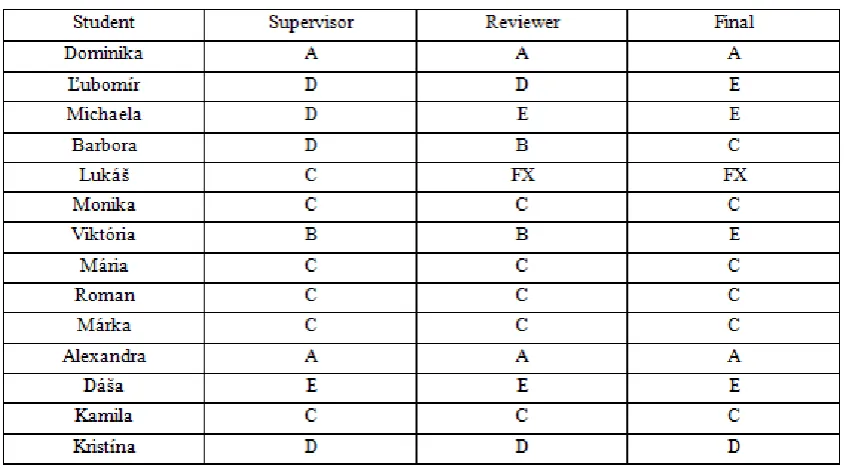
In 2013, fourteen students applied for writing their theses in English. Most of the assessments given by a supervisor and a reviewer were identical. In two cases, the reviewers assessed theses by worse grades, in one case one level lower, in one case three levels lower. One student´s thesis was measured more positively by a reviewer than by her supervisor. Only in three cases the final grades were worse than partial grades due to a poor presentation and inability to defend viewpoints providing evidence to the claims.
Table 1 Grades achieved by students in academic year 2012-2013 for their theses and oral defense performances
Two students were given A, six students achieved C, five students' theses were awarded by E and one student thesis was assessed FX by a reviewer. This student's performance while defending his thesis was very poor and the total grade was FX. The average is 2.26, which equals the total grade D.
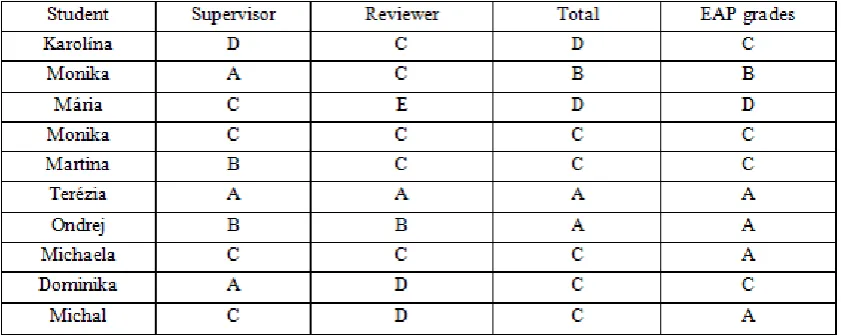
In the 2013-2014 academic year, the online course was attended by 12 students and only 10 of them completed their bachelor-degree studies submitting the theses and defending them.
Two students were given A, one student achieved B, five students' theses were assessed C and two students were given D. To conclude this analysis it is necessary to say that the 2012-2013 students were students achieving better results during their bachelor-degree studies. However, the 2013-2014 students were definitely better prepared for writing their theses as well as defending them presenting the aim of work, methods, procedures, samples, statistical data and conclusions. The grades they were given while completing their EAP course have sharper differences in terms of Michaela and Michal who were hard-working students but then, admitted their lack of time while writing their theses. This shortage of time influenced both their written and oral performances. The total grade achieved by the students after their defending speeches was C (1.85). The average grade achieved in the online EAP course was B (1.6). During a discussion the students admitted that while writing and presenting their theses they had forgotten to focus on those issues which they had used automatically during the course. Nevertheless, it is necessary to mention that the course was offered to the second year student of the bachelor-degree program and the average grade was D (2.42). These younger students had more problems and were not motivated as their communicative language skills and study skills had not been developed so much and the idea of writing their thesis in English was too far way.
Table 2 Grades achieved by students in academic year 2013-2014 for their theses and oral defense performances and EAP course grades
The following analysis is based on questionnaires related to students' preferences. The questions in the questionnaire focused on three areas: study skills, academic language and culture. Respondents (students of both control and experimental groups) were asked to tick the most suitable options and their answers were analyzed statistically.
Study skills analysis has revealed that the most problematic area is analyzing, synthesizing and collating information (90%).The second area was finding and analyzing evidence and using data appropriately (82%). And last, but not least, paraphrasing, using quotations, bibliography (78%). The control group students were not aware of learner autonomy, and preferred to be strictly guided rather than encouraged to develop responsibilities for their own learning. On the other hand, the experimental group students did not mind working on their own as the online course involves a lot of activities related to developing learner strategies and students had to examine their learning styles from various approaches (Fleming's VAK/VARK model, Knowles's cognitive style model, Gardner's multiple intelligences framework, or Kolb's model suitable for university students).
Academic language was measured in the students' theses and presentations. The language of the experimental group was better, predominantly in these grammatical structures such as the passive,
relative clauses, however, nominalization, hedging, boosting were rarely used by the experimental group students (34%) and control group students (23%). This rare use can be explained by the fact that these grammatical trends typical for academic language are lectured in the first year of the master-degree program. The online course only presents them and practices them without any special focus on them. The most problematic issue was formality as many sentences were too informal and not suitable for academic language (control group – 78%, experimental group – 52%).
From the academic culture perspective the questions referred to conventions with regard to the higher education behavior, conventions attached to academic writing and referencing. While being asked about ranking personal qualities typical for a university student, both groups gave a high ranking to such qualities as having a lot of knowledge, being methodological and precise. The qualities typical for university students in English academic environment are curiosity, the ability to be critical and honesty. Table 3 displays the students' answers.
Table 3 Students' answers to the questionnaire items
Rote learning still prevails in the country. Many university teachers focus on knowledge and preciseness a lot and students have to memorize definitions, teacher's presentations, one-way directed approaches to lectured topics and thematic units. The problem with critical thinking is a national cultural problem. Critical thinking helps improve attention, the ability to identify the key points in a text, ability to respond to the appropriate points in a text, knowledge how to get one's own point across more easily.
4 CONCLUSION
English for Academic Purposes (EAP) is concerned with those communication skills in English which are required for study purposes in formal education systems (Jordan, 2012). They refer to reading academic books, journals, articles, listening to lectures and discussions. Students should be trained to acquire micro-skills such as note-taking, shortening words and sentences, using English abbreviations, etc. From the productive skills perspective, academic writing helps develop reference skills, seminars and discussions support to learn how to justify viewpoints, providing evidence, how to respond on questions and comments of the audience, how to use academic English register, formal academic style, and so on.
The online EAP course, introduced in the 2013-2014 academic year, focused on critical thinking concerning the development of reasoning, decision-making, analysis, judgment, observation and persuasion. Cottrell (2011) claims that critical thinking brings precision to the way people think and work. Practice in critical thinking helps students to be more accurate and specific in noting what is relevant and what is irrelevant. It helps them not become distracted by less important material, ideas and be able to distinguish between facts and ideas. Due to weak reasoning skills the control group students were given poor grades for their work as their theses lack evidence of rigorous critical thinking. This finding resulted in the decision to include the questionnaire related to critical thinking written by Stella Cottrell (2011) in student´s self-assessment portfolio to help them rate their own awareness of their critical thinking skills.
In academic year 2012-2013, one of the students' theses while being checked by the official registration of originality was given a high score of similarities with another thesis. This resulted in a
careful check of the theses and more than 45% of similarities were discovered. The student failed. This case reflected in the online EAP course where a lot of material was based on plagiarism, proper referencing, citation and paraphrasing.
A lack of awareness of learning styles, admitted by the control group students, evoked a necessity of introducing four self-assessment grids in the online EAP course. The students are encouraged to bring the inner processes of their learning to the conscious level of their thinking, to change their attitudes to learning becoming more active and to change their role in the learning process. The online EAP course is based on transferring from learner-centeredness to learner autonomy, building confidence for independent learning. The idea was to bring students to the experience of exploring and expanding their abilities.
The data analyzed in this article are quite small and drawing conclusions should be done very carefully, but they indicate that after exposure to an online EAP course, the students from the experimental group were better prepared for writing their theses in English and were more confident in presenting their ideas, supporting and contrasting points. Critical thinking, learner autonomy and honesty need to be adopted in a systematic and gradual approach. The online EAP course enables students to work when they feel like working, to check what they have done, to practice what they need with the aim to diminish deficiencies. The online EAP course is based on ideas from today´s world, current trends in English language teaching (ELT) and modern technologies which are expanding teaching horizons with the goal to enable students to become responsible for their own learning.
References
Bérešová, J 2013, EAP Courses – Enhancing Critical Thinking and Autonomy: Practical Insights for Slovak University Students in P Vičič, VM Ipavec & A Plos (eds.), The Importance of Learning professional Foreign Languages for Communication between Cultures, University of Maribor, Celje, pp. 26-32.
Bérešová, J 2014, English for Academic Purposes, Trnavská univerzita,Trnava.
Carter, M & McCarthy, R 2006, Cambridge Grammar of English, Cambridge University Press, Cambridge.
Cottrell, S 2011, Critical Thinking Skills, 2nd edn, Palgrave Macmillan.
Hutchinson, T & Waters, A 1992, English for Specific Purposes. A learning-centred approach, 7th printing, Cambridge University Press, Cambridge.
Jordan, RR 2012, English for Academic Purposes, 13th printing, Cambridge: Cambridge University Press.
McCarter, S & Jakes, P 2009, Uncovering EAP, Macmillan, Oxford.
Munby, J 1997, Communicative Syllabus Design, 11th printing, Cambridge University Press, Cambridge.
Robinson, PC 1980, English for Specific Purposes, Prentice Hall.