Page 309
OPPORTUNITIES FOR IMPLEMENTATION OF INFORMATION AND COMMUNICATION TECHNOLOGIES IN THE HEALTHCARE EDUCATION
Kalina Stefanova, Pavlinka Dobrilova, Stefan Velikov
Subsidiary "Prof. Dr. Ivan Mitev" to Vratsa - Medical University of Sofia, 3000, Vratsa, Bulgaria
Abstract
The increasing needs of the population for a health care, increasing the prestige of the nursing profession, and the application of modern approaches to health care require the introduction of new information and communication technologies (ICT) in the education and the organization of the nurses.
To investigate and analyze the basic training of nurses with degree "Bachelor" and the opportunities it provides for the introduction of ICT.
In the period March - June of the academic year 2017/2018 an active study of 66 students - graduates trained in "Prof. Ivan Mitev" Branch - Vratsa was made. The study was conducted during the clinical practice of the students (VIII semester).
85% of graduate students are on the opinion that the introduction of ICT in the university education will help to acquire professional knowledge, skills and habits that meet the requirements of public health activities.
Keywords: information and communication technologies, healthcare education, Bulgaria
INTRODUCTION
In the condition of a rapidly developing scientific and technological revolution and the creation of the so- "Information society" puts qualitatively new demands on the nursing profession and new challenges arise from modern healthcare education. In this connection, the introduction and more efficient use of ICT in the learning process ensures the creation of highly competent healthcare professionals.
The expanded knowledge and competencies allow the future nurses to perform their professional duties and to carry out an information and electronic dialogue with other medical specialists by involving them in the healing process.
This training needs to be purposeful and systematized, to improve the healthcare in our country. The modernization of the modern nursing education is a step towards the harmonizing it with the European education.
According to the new mission and functions of the nurses developed by the World Health Organization (WHO), the curricula for a degree "Bachelor" complies with European standards and create an opportunity for better and quality professional training.
As a result of this new educational service, the access to the electronic modules will improve and facilitate and at the same time there is the possibility of individual work and self-preparation.
That is why in the present work, it’s done exploring and analyzing the opportunities for introducing ICT in the basic education of the nurses with Bachelor's degree. In this sense, the following tasks should be fulfilled:
1. To analyze the attitudes and the readiness of the students - graduates to apply ICT in their training; 2. To make a short analysis of the basic health education and the prerequisites for the objective
Page 310 RESULTS AND DISCUSSION
All this above gives us reason to believe that there is a need for a change in the nursing training, which is also determined by:
Our membership in the European Union; The health care reform;
The rapid progress in the field of medicine and healthcare internationally.
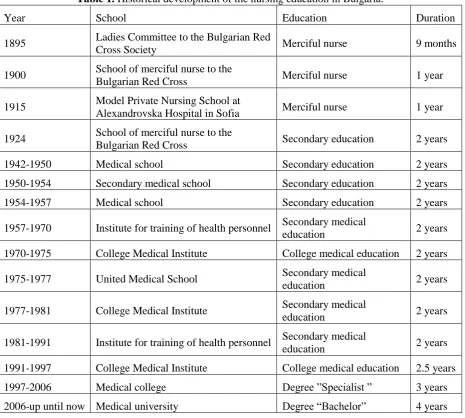
Historically, the nursing education in Bulgaria shows that the educational qualification degree has changed from secondary education to secondary vocational, college, specialist and bachelor, educational qualification degree in higher education.
Table 1. Historical development of the nursing education in Bulgaria.
Year School Education Duration
1895 Ladies Committee to the Bulgarian Red
Cross Society Merciful nurse 9 months
1900 School of merciful nurse to the
Bulgarian Red Cross Merciful nurse 1 year
1915 Model Private Nursing School at
Alexandrovska Hospital in Sofia Merciful nurse 1 year
1924 School of merciful nurse to the
Bulgarian Red Cross Secondary education 2 years
1942-1950 Medical school Secondary education 2 years
1950-1954 Secondary medical school Secondary education 2 years 1954-1957 Medical school Secondary education 2 years
1957-1970 Institute for training of health personnel Secondary medical
education 2 years
1970-1975 College Medical Institute College medical education 2 years
1975-1977 United Medical School Secondary medical
education 2 years
1977-1981 College Medical Institute Secondary medical
education 2 years
1981-1991 Institute for training of health personnel Secondary medical
education 2 years
1991-1997 College Medical Institute College medical education 2.5 years
1997-2006 Medical college Degree ”Specialist ” 3 years
2006-up until now Medical university Degree “Bachelor” 4 years
Page 311
in eight semesters. This training aims to provide a university-type professional training of nurses for effective health care in a changing social, economic and health environment.
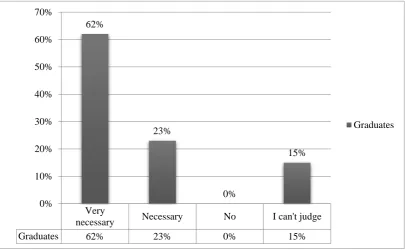
The medical profession is dynamic and fast growing, which requires a good professional to constantly improve and expand the acquired knowledge and skills. The healthcare training also provides opportunities for continuous professional improvement for the nurses by organizing specializations. In Bulgaria the conducting specializations for nurses starting in 2001. For the first time they are regulated by Ordinance № 31 of 28.07.2001 for postgraduate education in the field of the healthcare. The new philosophy of nursing is based on new knowledge, concepts and qualities that we find in the architecture of the Information and Communication System introduced in Healthcare Education. The majority (85%) of the respondent’s graduate students expressed a positive attitude about the introduction of ICT in the education of health care.
Figure 1. Attitude towards the implementation of ICT in healthcare education
The results obtained from the conducted study with the students are very important for the modern training of the nurses. The modernization of training increases the ability of healthcare professionals to take on higher professional responsibilities, building on the contemporary knowledge, skills and competencies which are acquired from the proposed wider information platform.
The high percentage of respondents' positive opinion shows that the respondents have the importance of university education and have an established vision of a new role for the nurse.
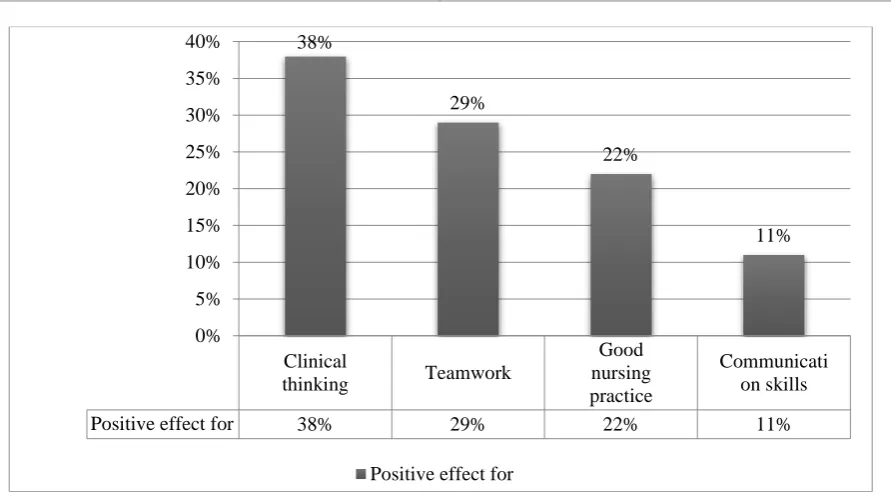
It’s given an opportunity for the students to express their views on the beneficial effects of ICT in their training. There are four areas identified as the main objectives of the technologies in education, from which the graduating students indicate the one which, in their opinion, is the most developed by the impact of ICT.
Very
necessary Necessary No I can't judge
Graduates 62% 23% 0% 15%
62%
23%
0%
15%
0% 10% 20% 30% 40% 50% 60% 70%
Page 312
Figure 2. Evaluation of the impact of ICT applications on the healthcare education
The encouraging this type of training enables it to become a significant incentive for its optimization as well as a key tool for ongoing processes. The whole concept of the upgrading university education and, in particular, a healthcare education would undoubtedly lead to increase the quality of the training process and the professional qualification.
In connection with the organization of nurses' training in eight semesters, it’s given the opportunity for students to identify the most appropriate starting point for the introduction of ICT in teaching specialist care.
The high percentage of the respondents, who said that it is appropriate for ICT to be introduced in the first academic year, shows that these students appreciate the usefulness of early technology deployment. The conclusion is that the graduates express a strong attitude about the improvement of the healthcare training and believe that the innovative approach in the education would provide better-prepared healthcare professionals.
Figure 3. Timeframe for introduction of ICT in the healthcare education. Clinical
thinking Teamwork
Good nursing practice
Communicati on skills
Positive effect for 38% 29% 22% 11%
38%
29%
22%
11%
0% 5% 10% 15% 20% 25% 30% 35% 40%
Positive effect for
I academic years II academic year III academic year IV academic
year
Students 78% 22%
0% 10% 20% 30% 40% 50% 60% 70% 80% 90%
Page 313 CONCLUSION
In summary, it can be argued that the acquired information and communication skills are extremely necessary for the modern nurse. The absence of these skills would prevent the nurse to apply correctly and consistently scientific methodology in her practice. The proper application would lead to the realization of a modern, adequate and effective nursing process led by qualified health care professionals. The presence of the mentioned components helps to increase the nurses' reputation and the prestige of the profession. The nurse in Bulgaria is an expert in the health care and deserves to be a part of the world nursing.
The data from the conducted own survey confirms the expectations for a positive attitude in the students for the introduction of ICT in the healthcare education.
ACKNOWLEDGMENTS
The present research is conducted in the execution on a scientifically research project which is financed by Consul of Medical Science in Medical University-Sofia, contract №: D-102/03.04.2018, from a competition GRANT-2018 with topic: “Exploring the possibilities for using a computing and communication technology in a healthcare training in the affiliate "Prof. Dr. Ivan Mitev "- Vratsa".
REFERENCES
1. Alexandrova M. (2007). Communication and communication skills in training nurses, CONTACT, press „TEMTO“S., 2007
2. Alexandrova M. (2007). Strategies and technologies in continuous training nurses, CONTACT, press „TEMTO“S., 2007
3. Alexandrova M. (2007). Current trends in the training of nurses, S., 2007.
4. Alexandrova M. (2010). Models for continuous training of nurses - Modern education - mission and vision. Univ. Press “Neophyte Rilski”,Blagoevgrad 2010
5. Vodenicharov Ts., S.Popova. (2003). Medical ethics, DAK, S., 2003 6. Mladenova S. (2009). Health education, Press Arthic, S., 2009.
7. New public health, edited by Borisov V., Glutnikova Zl., Vodenicharov Ts. Program Far, Project "Public Health Education", ed. "Aquagraphic ", Sofia 1998
8. Popova S. (2001). Development of the nursing - priority issues. - In: Communication skills and autonomous functions of nursing. Plovdiv, 2001, 7-12.
9. Popova S. (2001). Communication in the nursing – barriers to effective communication. - In: communication skills and autonomous functions of nursing. Plovdiv, 2001, 63-70.
10. Stambolova, Iv. (2006). Organizational aspects of nursing care in primary care; Sofia, 2006 11. Toncheva S., (2001). Educational, organizational and social aspects in the activities of the nurses;
Varna, 2001