Page 412
MATHEMATICS AND EDUCATION PROBLEMS OF TRANSPORT MODELING IN COMPLEX SOCIO-TECHNICAL AND BIOLOGICAL SYSTEMS
A. P. Buslaev, A. S. Dotkulova, M. V. Yashinа
Moscow Automobile and Road State Technical University, 64 Leningradskiy prospect, 125319 Moscow, Russia
Moscow Technical University of Communications and Informatics, 8а Aviamotornaya, 111024 Moscow, Russia
Abstract
Russian education has deep historical traditions and over the last decade entered the Bologna process. Since year 2006 MADI teaches bachelors and masters the course of “Mathematical and computer modelling of complex social-and-technical systems” in automobile field. The main themes of the diploma projects are traffic flows, traffic networks, transport logistics and infrastructure. It turned out that mathematical methods of studying traffic networks are closely connected with the researches of structure of matter and new materials of metabolic process in pharmacology and biology, genetic codes, infocommunication networks, parallel and distributed processing. There is a method of testing knowledge, which make students ranking using automatic questions generation and create a new platform using Russian traditions of Mathematics and modern researches.
Key words: mathematics, education, education process, Bologna process, information revolution, test system
1. MATHEMATICAL EDUCATION IN RUSSIA 1.1. A history of mathematical education
Right up to XVIII century in Russia only trading computation activity needed mathematical education, by the way in Europe shipping and navigation stimulated astronomical developments and geodesy, and geometry and trigonometry (Buslaev, Gorodnichev & Yashina 2015). When Peter the Great returned from Europe he made his huge reforms in Russia and took the course on further progress of natural science, shipbuilding, and navigation. One of the most important achievements was territorial aggrandizement in Baltic region in XVI century. The first school of mathematics and navigation was opened in 1701 in Suharevskaya tower (Yushkevich 1961). From the start students were studying writing, reading, and rudiments of arithmetic and then navigation, astronomy, mathematical geography, drawing and etc. It was first steps to popularize schools and libraries and to form the system of professional education. All the science researches in XVIII were based on the creation of new economic instruments due to French bourgeoisie revolutions, which redistributed financial management and means of production to bourgeoisie. New economic realities required a large amount of skilled workers and, moreover, free education. The reforms of education in Russia were directed towards introduction and modernization of the Western model to avoid revolution. The first task of education was the mining, development of steam engines and analysis of stock markets.
Page 413
power and the education always followed the economy. For example, during the industrialization the opening of Moscow and Gorky automobile factories was planned in 1930 and then Automobile University.
1.2. Traditions of mathematical education
A. N. Kolmogorov (1963) said: “I always lived by the rule that the truth is the blessing and our duty is to find and prove it …”. Andrey Nikolaevich Kolmogorov was an academician of AN USSR, one of the most honorable mathematicians of the XX century. He was the founder of the large scientific community. We can find many great scientists among his followers: V.I. Arnold, I.M. Gelfand, B.P. Demidovich, V.M. Alekseev, G.I. Barenblatt, A.A. Borovkov, A.G. Vitushkin, B.V. Gnedenko, R.L. Dobrushin, E.B. Dynkin, A.I. Maltsev, M.D. Millionshchikov, V.S. Mikhalevich, A.S. Monin, S.M. Nikolsky, A.M. Obukhov, Yu. V. Prokhorov, Ya. G. Sinai, V.M. Tikhomirov, Yu. N. Tyurin, A.N. Shiryaev, V.A. Uspensky, C. V. Fomin, A. M. Yaglom and others. Andrey Nikolaevich was also the reformer of middle school education. In 1963 A. N. Kolmogorov, I. K. Kikoin and I. G. Petrovsky formed school named after A. N. Kolmogorov, which helped to find talented pupils in the mathematical and natural science fields. He wanted for people who lived far from the scientific centers to be more closely connected with the science. A. N. Kolmogorov tried to develop science in spite of different situations preserving human dignity. S.M. Nikolsky one of Kolmogorov’s student followers remembered with trepidation the time when A. N. Kolmogorov was evacuated from Moscow because of World War II, but anyway saved and then read his manuscript and said that it was thesis for a Doctor's degree.
Their first meeting happens when A. N. Kolmogorov и P. S. Alexandrov came to the Dnepropetrovsk University to give some lectures. S.M. Nikolsky who was working in this university listened to these lectures with a great pleasure and soon became his assistant and was working on problems of functional analysis of approximation theory. Sergey Mikhailovich is a very famous Russian and Soviet mathematician and academician of (RAS). He is the author of large series of books about theory of differentiable and multivariable functions. He wrote more than 100 works including three monographs, 2 textbooks for students and 7 books for pupils of middle school. S.M. Nikolsky said that all of us have to self-develope and do not be afraid of falls. Sergey Mikhailovich (2005) said to his students: “Cross out all I told you on the past lecture”. L.D. Kudryavcev was a specialist in theory of functions and theory of differentiable functions. As member of AN USSR in mathematics the author wrote more than 100 different mathematical works (Bavrin, II, Emelyanov, SV, Emelyanova, IS, Kirillov, AI, Kolyagin, YuM , Polotovsky, GM, Rozanova, SA, Rozov, NKh, Rusakov, AA, Chubarikov, VN & Iagola 2012). Lev Dmitriyevich Kudryavcev works on problems of education and morality. He thinks that the lecturer must not only read the lecture, but help his students with different problems of modern society. In his books he considers trending global problems: quality of the learning curve of graduates and moral and ethical education. He identifies 10 rules for a good math teaching (Kudryavtsev1985):
1. Mathematical structures being learnt in math;
2. Mathematics is a single whole;
3. The full course of math cannot be determined from a purely pragmatic point of view, based only on the specifics of future profession of the student, without considering the internal logic of mathematics itself;
4. The main goal is to help students to gain different kinds of knowledge, to help them to use mathematical methods, to develop mathematical intuition and to understand the nature of mathematical culture;
5. Teaching math must be simple, clear, natural and based on the level of intelligent rigor;
6. You must teach what is needed and what is difficult to learn;
7. Theorems of existence are useful not only for pure but for applied mathematics too;
Page 414
9. Solving applied problems of mathematical methods is not a problem of mathematical courses but it is the main problem of mathematical specialists;
10. What students need to learn is the main issue and that is why specialists must make a plan how to teach them. But only professional mathematicians can teach students.
In the modern information society, some of these theses require quantitative measurements. “You need to learn what you need and what it is difficult to learn” - how to define what is difficult to learn? Automation and robotics – is the foundation of modern world. It is impossible not to keep up the trends without solving applied problems using mathematical methods. Environment dictates us what we need to learn. That is why we need to unite specialists from all fields. However, the issues of the integrity of mathematics and the goals of studying remain relevant to this day. There must be an overall compromise.
1.3. Russian education and Bologna process
1.3.1. Features of the Bologna process
It was 19 June 1999 when Declaration which was created for effective development of society was signed between 28 countries in Bologna. The Bologna Declaration was based on The Sorbonne Declaration and The Great University Charter. In the Sorbonne Declaration noted that the creation of a European higher education – is the main goal to help students to find their path and help them with employment. In the great University Charter, the basic principles were: the indivisibility of teaching and research in universities, freedom of research and teaching is a fundamental principle of University life. This meeting in Bologna has become a new era of higher education. Participation in the Bologna process is the desire to build similar systems of education in different countries for greater mobility and opportunities to meet the requirements of modern information society. The storage system helps in the implementation of the comparison of different educational programs. At this moment there are two educational programs QF-EHEA (Qualifications of the European Higher Education Area) and learning throughout life EQF-LLL (European Qualifications Framework for Lifelong Learning). Both of them use multilevel system of training and collaboration with each other.
1.3.2. Russian education in Bologna process
After the collapse of the Soviet Union, politic crisis in 1993 and financial crisis in 1998 in Russia education became absolutely useless for a lot of people. Their main task was to ensure their financial security, and education itself doesn’t bring money. Society saw that educated people and people without education were in a similar situation. Classical education has proven to be ineffective in the new economic realities, therefore, the government's decision to join the Bologna process, the first radical attempt to make education demanded in international labor market. If students would understand that education in Russia is taught at a high level, the need for education abroad will disappear, and vice versa, with the introduction of some standardization increases the mobility of students. If students would understand that education in Russia is taught at a high level, the need for education abroad will disappear, and vice versa, with the introduction of some standardization increases the mobility of students. There can’t be new “Kolmogorovs”, if students do not want to go to study, but for the occurrence of desire it is necessary for the Russian education ensured its future.
Russian education, with deep historical traditions, over the past decade, has entered in the Bologna process. This restructuring gave rise to a large number of problems on both the methodological and demanding of theoretical study.
Page 415
29 Dec 2012 the President of the Russian Federation signed Federal Law No. 273-FZ “On education in Russian Federation”. Federal law “On education in Russian Federation” changed on 1 September 2013 the two existing up to that time the Federal laws: law of the RF “On education” and the Federal law “On higher and postgraduate professional education”. This law regulates legal, organizational and economic aspects of education in the Russian Federation, the main directions of state policy of the Russian Federation in the educational sphere, the General rules of functioning of the system of education in Russia and the implementation of educational activities, defines the legal relationship of the parties in the field of education. According to the Federal Law No. 273-FZ of the Russian Federation there are following levels of professional education:
1. secondary vocational education;
2. higher education - undergraduate;
3. higher education - specialist, master;
4. higher education - training of higher qualification (postgraduate, doctoral).
Tasks, solution of which requires the implementation of the Bologna principles into the Russian system of education:
1. improvement of language training of staff and students for the implementation of mobility and implementation of research activities recognized abroad;
2. improvement of educational programs and their accompanying documentation in accordance with the demand on the international labor market for the implementation of quality training of specialists, including foreign ones;
3. increase funding of research activities to ensure the fame of the Russian research and development at the international level.
Despite some difficulties in the European education and heterogeneity of Russian higher education – the Bologna process contributes to the formation of unified European companies with highly qualified personnel and higher education. The accession of Russia to this process can achieve higher position of our universities and experts, as well as to solve the problem of recognition of Russian diplomas and to strengthen our position in the world market of educational services. Despite that Russia moved to a new system it is impossible to ignore the positive traditions of the Soviet school. In Soviet times, the priority of mathematics education had international recognition. The main problem is that how you can find a compromise between the trends towards standardization of the Bologna process and individualization required in mathematical training.
2. THE INFORMATION REVOLUTION: A LOT OF DATA AND A SHORTAGE OF MODELS The information revolution is the stage of development of society, associated with the new method of transmitting and information processing. Since the ancient times, the ways of communication had varied depending on the development of society. Mankind have tried to preserve knowledge and good transmission. At first using the images on stone, wood, clay, and later with the development of appeared language and writing.
The advent of writing – the first stage of the information revolution. It gave a quantitative leap in the development of society. Appeared the method and means of knowledge accumulation. Information is easier to store and transmit into structured data.
Page 416
The third stage – the creation of the radio (late XIX century). The telegraph, telephone and radio have appeared, allowing to quickly transmit and accumulate information in any volume and at any distance. There were means of information communications.
The fourth stage – the advent of microprocessors and personal computers (late XX century). Gradually personal computers decreased in size but increased their power and the possibility of combining in one network. On this stage of the revolution made the transition from industrial to information society. Information society — is the society in which most of the people engaged in the production, storage and processing of information.
The main features of the information society:
1. A large amount of information and its constant growth;
2. Special technical means for processing and storing information;
3. The development of technology, computer networks, information technologies, cloud services;
4. The emergence and development of market information services;
5. Automatization of various processes in society.
With each new stage came the ability to transfer information, knowledge, in a quicker way. The number of people who could use the obtained information obtained. The technological revolution that began in the postwar period brings new wireless technologies in electronics, computers, communication systems, Internet. This is reflected in the society. The global network have removed all restrictions on the receipt of new information, relevant issues and was given the opportunity to develop the society even faster. Thanks to such technology, all people are “neighbors”. Any person who is interested in a development project, may send a request to participate in it. There is a rapid development of information technology and engineering. It is impossible to imagine any area of activity without the introduction of computer or smartphone. Smartphones, which were full of many new features and functions, not so long ago appeared in the modern world, but have become an integral part of our lives. With the rapid development of technology and the ever-increasing volume of information, the question arises: what is happening to modern society?
Every day it is becoming more and more difficult to maintain isolation in the world. Everything and everybody is connected. For the active development of society it is impossible to act alone, we must combine our knowledge, skills and technology to achieve even greater success. Technologies development are changing the world around us. The big breakthrough of innovative technologies is observed in medicine, ecology, electronics, etc. Medical electronics, fitted to the body, appears helping to follow the processes of the body, developing methods for the nanostructuring of carbon fiber for the newest composite materials are being introduced on brain implants that facilitate the functioning of people with problems of musculoskeletal system, etc. increases the amount of data (Big Data) and required new methods for their treatment.
The role of distance education. The needs of modern society require increasing the share of information sciences in the process of learning in universities. The most popular specialties associated with the production, storage, processing of information and implementation of technological developments in all spheres of activities. Specialist, graduated from the university must possess the principles and methods of automated services, information services, analyze and design new processes using electronic computing and telecommunications equipment.
3. THE RELEVANCE OF MATHEMATICAL EDUCATION IN RUSSIA IN THE ERA OF BIG DATA
Page 417
with the introduction of electronic technology is undergoing dramatic changes. Changing the concept of school education: verbal calculations is replaced with calculators, instead of notebooks and pens there are more and more computers and tablets etc. The basic concept of higher mathematical education in Russia has changed a little: the lion's share of time is dedicated to technique of differentiation and integration and almost no time is paid to topical issues of modern society. Compromise is needed. The traditional sections of the higher mathematics course are important parts of the educational process, however, the solution to modern problems is not related only with these sections. The traditional sections of the course higher mathematics are important parts of the educational process, however, the solution of modern problems is not related only with these sections. Many of the traditional questions and issues of research design in mathematics based on the paradigm of “function is given by…” that a few centuries ago meant a table of values of a relatively small size. Today it is not so: a huge amount of multidimensional information, obtained with the use of modern automated technology, complex algorithms, calibration and verification of models. The problem of Russian education is that the vast majority of new technology is not created within the scientific and pedagogical sphere but comes from the outside in a finished form, from abroad. Modern economic installations are not entirely clear for creative generation. The desire to “catch up and overtake” in certain areas does not negate the need for an integrated development of the economy, since the state is the single whole. As for the profile of auto-road formation, since the concept of “good car” and the “right multilane auto-road pie”, which are not contain in the process of creating unpredictable human impact (if follow strictly according to the technology), however, come to the study of the functioning of complex socio – technical systems in logistics, decision-making under uncertainty. The behavior of complex systems scientists has not yet learned to explore, the complex of disciplines associated with this problem, such as pattern recognition, fuzzy sets, fuzzy logic, stability and chaos, etc. - until they don’t find place among the traditional questions: “calculate the derivative of a multistory function”, “take the integral” with final response, which does not fit the Board size in the wall of the audience. The development of the automotive industry in the world shows that the car becomes more intelligent, do less mistakes than human can do in flow control system. Each device that contributing to this includes the work of different physical science profile scientists, engineers, designers, etc. When we received this device in the form of the box, which is often situated on the right place we cannot imagine that these specialists were needed. Because the quality of education and the university level is determined by the qualifications and desire to give his soul to the profession, as well as honest students who are hunger for knowledge. Therefore, one of the main goals of teaching mathematics in universities for the formation full specialist is opening the possibility before the student of understanding modern scientific world, logical and abstract thinking, the formation of a creative approach, understanding of the nature and value of research directions. The purpose of higher education is to give fundamental knowledge and skills needed in life and profession of each person.
4. QUESTIONS OF MODERN EDUCATION IN RUSSIA
The question remains: what people should know and how to be a man of the modern world? We will try to answer this question by considering some aspects of the educational process.
4.1. The first question-what shall we teach?
Due to the exponential growth of information, the concept of “knowledge” transformed. Assuming that knowledge is a structured set of information that people will be able to play for a minimum amount of time, then education is the transfer of knowledge from one person to another. First, the educational process is built on the transfer of knowledge and skills between objects of the education system. Secondly, it is an indicator of the level of competence. This is the level of possession of the topic, the immersion of a person in this topic, how well a person understands and how quickly he can find the right decision, how he reacts to problems.
Page 418
this question. And if he have a lack of such knowledge? A man will think and will gradually put all the coins on the chessboard. Eventually he comes to the correct answer, showing his wit. It is needed to try to find new solutions using the available knowledge in order to achieve a result or to obtain the missing knowledge. To solve any problem you shall be creative, but creativity without the ability to think is impossible.
The second thing you need to teach is to raise the level of personal responsibility. Work on the course task, on a project at work or a scientific experiment requires responsibility from the contractor. What happens if the surgeon is careless about operation or builder will resort scheme in the design of the building? There will be consequences that cannot be prevented. A man needs to instill a sense of responsibility from his birth and, if necessary, to recall it.
4.2. Secondly-how shall we teach?
First of all, we shall give fundamental knowledge to students. Without the base it is impossible to build anything. Before you build a house, firstly you need to lay the foundation, and before pursuing the solutions of the motion of a body thrown horizontally, it is necessary to understand the concepts of vector, velocity, acceleration, etc. Modern education system produces professionals who receive disparate theoretical knowledge, the application of which they can't see in life. This is a problem, as there is no unified systematic approach. If the process of education was built so that the students obtain actual knowledge necessary for the decision of tasks of development of society, the learning process would seem more interesting. It is necessary to go to interdisciplinary approach in education.
The second – an integrated approach. Without a systematic approach it is impossible to give a complete and quality education. A person is educated, if he has knowledge, and knowledge is a structured set of facts and relationships. For example, the equation of vibration of a string doesn’t use the fact that the string, derived from the equilibrium position, performs an oscillatory motion, and used only elastic nature of the adhesion forces of the individual elements. The result is equation, which are oscillatory in nature. It can be used to conduct qualitative and quantitative analysis of the motion of the string as a whole, because it is quite well corresponding to the actually occurring phenomenon. Thus, in this case all information about the behavior of the whole object are contained in the information about its local behavior on the basis of this information, we construct a mathematical model that gives the opportunity to study the phenomenon in general, to predict its development, to make a quantitative assessment of changes occurring in over time. And how can we do here without a knowledge of mathematics and physics in general?
To find a way out of the current situation in the education and science system the suggested solutions shall provide the opportunity to study the theory simultaneously with obtaining practical skills. The effectiveness of the merger will be achieved only with the support of the state.
The mathematics during the development of continual methods in the last half century turns to the unification of the educational process and the production sector of the so-called computer science that the classification of mathematical topics relates to discrete mathematics (mathematical logic, graph theory, theory of algorithms, etc.).
4.3. Third-reverse question-how shall we estimate students’ knowledge?
This task is to promote the development of mathematical methods of test as a subpart of game theory and the theory of schedules. Testing is the ability to quickly troubleshoot issues and time to adjust the learning process. But testing cannot be the sole method of assessment. As a result, it is possible to identify gaps, but not to establish the cause. Everyone needs a holistic approach.
Page 419
It is possible to estimate the complexity of the task by knowing the number of steps or links that need to be overcome from the beginning to the end of the solution algorithm. The easiest task is the one-step task. More detailed step by step algorithm of evaluation of knowledge is discussed in the control system implemented at the department of “Higher mathematics”.
4.4. Problems of organization
The switch towards the new Russian education system, governed by the provisions of the Bologna process, does not always occur smoothly and quickly. There are a number of difficulties that hinder the process:
1. The introduction of new educational standards, which requires a large amount of time and rethinking of the structure of curricula and syllabi;
2. Minimum connection of educational process and production;
3. The lack of qualified specialists, receptive to innovations;
4. Small updatability of personnel, etc.
5. SPECIALTY “APPLIED MATHEMATICS”
Both modern scientist or engineer and engineering graduate must know classical and modern research methods that can be applied in its area sufficiently good. In order to be able to use mathematical methods in the study of an issue, you need to have the necessary knowledge in addition to be able to handle the math and to know the boundaries of acceptable use of the considered mathematical model.
Page 420
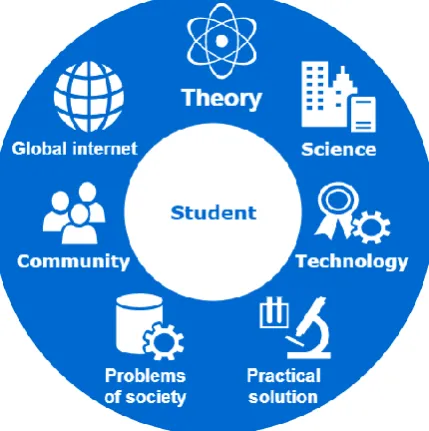
Fig. 1. Interaction of educational process objects
Within the specialty a student studies more than 50 mathematical and applied disciplines. In addition to fundamental training in the field of classical mathematics and physics, students gain knowledge and skills in many applied and relevant fields of the natural sciences: high-level programming, pattern recognition, mathematical modeling, client-server systems, mobile applications, etc. a large number of special courses on contemporary topics in mathematics and applied disciplines allow to get needed skills. The learning process goes from simple to complex. After receiving the necessary theoretical knowledge, the student applies them in practice by solving problems. In the study of this discipline, knowledge is not limited on this. In addition to this is going the lecture course to supplement the skills of using information and computer technology (Fig. 1).
Teaching in MADI, specialty “Applied mathematics” gives the possibility of forming a new research and educational approaches to the analysis of complex socio-technical processes in society, including revolutionary changes in information technology.
6. THE NEW STANDARDS OF EDUCATION: “A DROP OF EDUCATION IN THE SEA OF KNOWLEDGE”
Page 421
portion. The system of evaluation is reduced to a set of tools for analyzing the quality of the development of educational programs. The most effective pedagogical method for assessing knowledge is testing. Testing is a test, limited in time, standardized and serving for rapid diagnosis of quantitative and qualitative indicators.
Testing is used in all areas of human activity. In education, testing is a standard method of determining the level of preparation, because it provides a quick way to test the knowledge of a large number of students and a vast amount of information using information systems.
6.1. Testing system at the department of “Higher Mathematics”
For more than 20 years, the “Higher Mathematics” department has been using a testing system (Fig. 2). Initially, this system was developed for rapid testing of knowledge in large groups (more than 100 people).
The base of tests of the department “Higher Mathematics” (MathTestDB) consisted of more than 3000 questions on higher mathematics, classified by subject and disciplines. Examination tickets were generated using a special developed “Test Maker” program (Buslaev, Burikova, Guseva, Nakonechniy and Yashina 2013). The teacher chose a semester, topics and a number of questions. The system from each topic automatically select 1 task from the file and add it to the question form. The questionnaire consisted of 20 test tasks that were generated using the “Test Maker” program on the A4 sheet. The initial file with the questions have a name consisting of parameters. For example, consider file F_310102. The file name contain all the necessary parameters: a semester, a section, a topic and a question number for the given topic (Fig.3).
The drawback of this program was that the subjects had to choose the teachers manually. To solve this problem, a method for automatic generation of test tasks was created.
Page 422
Fig. 3. Parameters of the source file
6.1.1. Automatic generation of test tasks
In connection with accession to the Bologna Process and the opening of the specialty “Applied Mathematics, there was a need to restructure the testing method and the test database (MathTestDB). In addition to the subjects of tasks, the level of complexity of the task was added to the testing base, the ability to link questions to specific competence and the level of mastering this competence. The classification of the file name has also changed. The name contains all the necessary parameters: the level of preparation, the code of the discipline, the section, the subject, the level of complexity of the question, the question number for the given topic, the code of competence and the type of competence. Consider file B_d002s004ss001l1q0002ok04k (Fig. 4).
Fig. 4. Parameters of the updated questions file
Parameter B is the level of training (bachelor, master, specialist), 002 is the discipline code in the catalog, 004 is the section number within this discipline, 001 is the topic in the section, l1 is the task complexity level, 0002 is the question number, OK04 is the type (OK, PC, OPK) and the code of competence, which is checked by this question, K is the type of competence (knowledge, skills or possessions).
Page 423
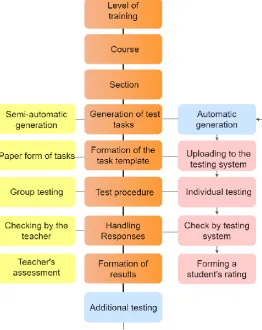
Fig. 5. Logic scheme for automatic generation of tasks
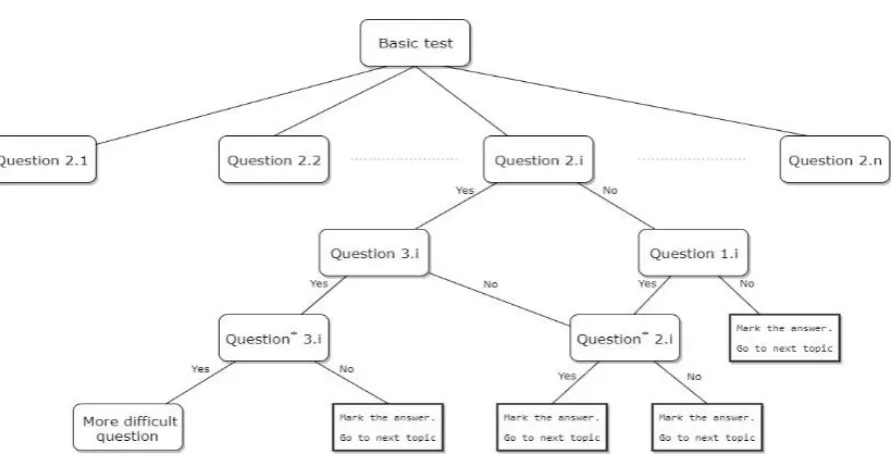
With the correct solution of the problem by the student, the system records data that the subject is learned by the student at a basic, advanced or advanced level. If at none of the levels the student was able to give the correct answer, the system records data that the topic is not mastered. Upon completion of the testing, the results are added to the database containing information about the student's trajectory (StudRaitDB). Database StudRaitDB stores data about the student, the results of previous tests, student attendance, performance in the classroom, the results of control and laboratory work, etc., thereby generating rating indicators of trainees.
With the subsequent generation of tests, the system can take into account the results of previous tests and output tasks corresponding to the student's level of preparation. This method is one of the types of testing. The main task of the method is to identify gaps in the knowledge obtained and to minimize the chance of passing the testing. All this will give an opportunity to correct the educational process of the chosen student in time.
6.1.2. Technology of results evaluation
Page 424
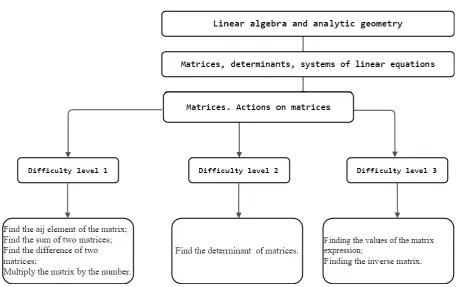
Fig. 6. Distribution of topics by levels of complexity
The levels of complexity of tasks are determined based on the number of steps necessary to accomplish in order to arrive at the final result. The criterion for assessing assignments is based on the levels of complexity of tasks, the average time spent on the solution, and also empirically.
The tasks of class 1 are the simplest and check the knowledge of the definition of the matrix. The complexity of this problem is 1. This task class is evaluated at 1 point.
The tasks of class 2-4 are simple and test knowledge of the definition of a matrix and the ability to perform simple operations on them. The complexity of this problem is 1. This task class is evaluated at 1 point.
The tasks of class 5 are basic. They check the knowledge of the definition of the matrix, the algorithm for finding the product of matrices, the ability to determine their dimensionality. The complexity of this problem is 2, because consists of two steps: determining the dimension of matrices and applying the rule for the product of matrices. The criterion for rating points for this type of tasks varies from 2 to 3. Two points are awarded for multiplying matrices of dimension 2 and 3, three points for a higher dimension.
The tasks of class 6 are average. They check the knowledge of the definition of a matrix, the ability to perform operations on matrices: addition, subtraction, multiplication by number, multiplication of matrices. The complexity of this problem is 3, because consists of several steps. This class of problems is evaluated in 3 points.
The tasks of class 7 are average. They check the knowledge of the definition of a matrix, the definition of an inverse matrix, the ability to perform elementary transformations on strings, the ability to multiply matrices. The complexity of this problem is 3, because consists of several steps. This class of problems is evaluated at 3 or 4 points, depending on the dimension of the original matrix.
Based on the results of testing and testing of knowledge and skills, it is possible to go on to assess the skills of the property, i.e. the ability to apply the knowledge gained in solving the simplest tasks. Let's consider an example.
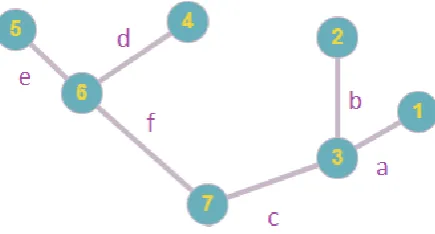
Page 425 A) without regard to the direction of flow;
B) taking into account the direction of flow (streams gradually merge into one (vertex 7));
Initial data: the network section is depicted as a graph.
Fig. 7. Graphical representation of the network section
This task is complex. It includes knowledge from the field of linear algebra and graph theory.
Solution algorithm:
1. Bring the graph to a convenient form;
2. Create matrices of contiguity of vertices and edges of the graph;
3. Analyze the matrices and draw a conclusion;
4. Determine the direction of the flow and redefine the matrix;
5. Analyze new matrices and draw a conclusion.
To solve this problem, the student must know: definition of the graph, definition of graph connectivity, defining the matrix, basic matrix operations; be able to: submit graphs, determine the presence of connections between vertices, construct an adjacency matrix, apply simple operations on matrices.
Evaluation criteria: for a more correct assessment of the knowledge, skills and possessions of the student, it is necessary to break the task into blocks. Blocks are similar to those in the solution algorithm. There can be more points in the algorithm. We are considering the minimum possible value. Each block is estimated at 1 point. The complexity of the problem is 5, i.e. the number of minimum blocks.
If this problem is successfully solved, the student gets skills in working with graphs and the ability to correct the data when the conditions of the task change. If at some point there are difficulties, thanks to the block algorithm design, the problem will be easy to identify. As shown by practical studies (Dotkulova, Nakonechniy and Yashina 2016), regular testing is an indicator of achievement and a quick way to identify gaps in the study material. However, testing should not be the only way to test knowledge. The test helps to identify the gaps in the mastery of the material, but will not reveal the causes of these problems. When forming any evaluation, an integrated approach is needed.
6.2. Electronic books at the Department of Higher Mathematics
Page 426
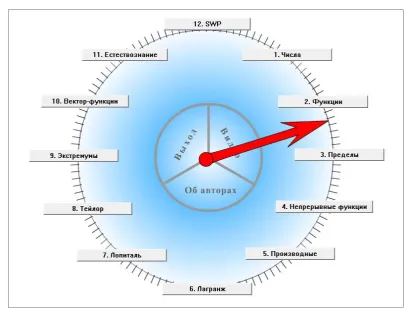
Fig. 8. Contents of the multimedia book
The developed multimedia textbook consists of a theoretical part, a geometric interpretation and a testing section (Fig. 9).
Fig. 9. Design of sections of the multimedia book
Page 427
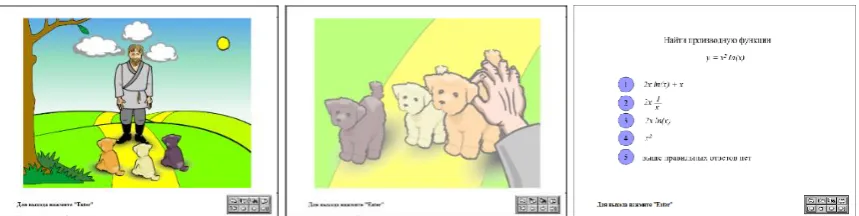
presented material, the student is invited to take a test performed in a game form. The student chooses the task that he wants to go through (Fig. 10).
Multimedia book - a universal tool. It can be used by the instructor in the classroom as an element of interactive learning, the student can - as reference material, and in anyone who wants in the distance learning.
Fig. 10. Interactive testing of the multimedia book
CONCLUSION
The role of information sciences in modern world in the learning process in universities is increasing progressively. The most popular professions are related to the fields of production, storage, conversion of information and integration of technological developments in all business areas. The specialist, graduated from a university, must master the principles and methods of automated services, information services, analysis and design of new technological processes using electronic computing and telecommunication facilities.
Competent training of specialists provides opportunities for the formation of new scientific and educational approaches to a systematic analysis of processes occurring in society, including revolutionary changes in informatization.
REFERENCES
Bavrin, II, Emelyanov, SV, Emelyanova, IS, Kirillov, AI, Kolyagin, YuM , Polotovsky, GM, Rozanova, SA, Rozov, NKh, Rusakov, AA, Chubarikov, VN & Iagola, AG,2012, ‘History of mathematics. People. Lev Dmitrievich Kudryavtsev’, Mathematics in Higher Education, vol. 10 <http://www.unn.ru/math/no/10/_nom10_008_kudryavtsev.pdf> (In Russ.)
Buslaev, AP, Burikova, TA, Guseva, AS, Nakonechny, II &Yashina, MV, 2013, Application of information and computer networks for monitoring complex social and technical processes using the example of a system for tracking the quality of knowledge in mathematics in a university. MTUSI-IMSUT, Moscow (In Russ.)
Buslaev, AP, Gorodnichev, MG & Yashina, MV, 2015, ‘Mathematics, transport and automobile and road education’. Avtomobil'. Doroga. Infrastruktura, (4(6)) (In Russ.)
Dotkulova, AS, Nakonechniy, II & Yashina, MV, 2016, The method of cloud services using for testing in mathematical education. Proceedings of the 16th International Conference on Computational and Mathematical Methods in Science and Engineering, CMMSE 2016, p.1309-1327
Dotkulova, AS & Moseva, MS, 2017, Method of intellectual verification of logical connections of modules of educational program in accordance with new educational standards, Transactions of GKF MTUCI –2017, pp. 287-293 (In Russ.)
Page 428
Kudryavtsev, LD, 1985, Modern mathematics and its teaching, Science, Moscow (In Russ.)
Samko, SG, 2005, ‘Nikolsky SM (on the centenary of his birth)’,Vladikavkaz Mathematical Journal, vol. 50, no. 2 <http://www.vmj.ru/articles/2005_2_1.pdf> (In Russ.)
Shiryaev, A.N., 2006, Kolmogorov in the memories of his disciples, MCNMO, Moscow (In Russ.)