
CHILDREN’S UNIVERSITY: OPTICS AND PHOTONICS FOR CHILDREN Dana Seyringer
Research Centre for Microtechnology, Vorarlberg University of Applied Sciences, Hochschulstr. 1, 6850 Dornbirn, Austria
Abstract
Today, optics and photonics is widely regarded as one of the most important key technologies for this century. Many experts even anticipate that the 21st century will be the century of the photon. Optics and photonics technologies have impact on nearly all areas of our life and cover a wide range of applications in science and industry.
However even so attractive, the photonics is not well known by majority of the people. In order to motivate especially the young generation for the optics and photonics we offered already three times the lecture about “optical data transmission” to the children of age 8-12 years in the frame of Children’s University. We prepared many practical activities and experiments to explain how the modern communication through the optical networks works. Combining the hands-on teaching with having a fun while learning about the basic optics concepts we aroused interest of not only the children but also the parents, with a very positive feedback.
Key words: Children University, optical data transmission, hands-on teaching, basic optics concepts
1. CHILDREN’S UNIVERSITY AT VORARLBERG UNIVERSITY OF APPLIED SCIENCES The active, interest-based learning through extracurricular activities such as children's universities provides a way to expand interest related knowledge.
The children’s university at Vorarlberg University of Applied Sciences (FHV) has a long tradition [1]. It is dedicated to the children of age between 8 and 12 years. The lecture topics come from the fields of business, engineering, design and social studies, like for example: “How can I organize my birthday?”, “Crazy Machines”, “When children need a help”, “My house from the future” but also “Laser: how it works?”, “Are computers really so clever?”, “Which language talk computers?”, etc. There are 12 courses per academic year, which are held at FHV (8 courses) and at the Vorarlberg State Conservatory (4 courses). The dates are always on Wednesday from 14 pm to 15 pm and repeated from 16 pm to 17 pm. The courses take place in a lecture room where about 150 children can participate (i.e. all together about 300 children). FHV offers also the technical possibilities for video transmissions in the next room, where the parents, waiting for the children, can also follow the lectures. The visit is free and each participating child together with the accompanying person (usually parents) will get a free ticket for the local transportation. After each course, the children get a small snack.
The children have to register for each upcoming lecture a week before the lecture starts at the university homepage. There is very often waiting list for the children those are too late for the registration. The university offers also the possibility to register the whole school classes as it was the case for optical data transmission lecture that will be described in this paper. Especially, the topics like “Laser”, “Optical data transmission” or “How computers work?”, the topics those are only potentially included in the curricula are overbooked because of the high school class participation.
Lecturers at the children’s university are usually from the Vorarlberg University of Applied Sciences, but they can also be from the other institutions. They prepare a lot of material for the children to work with during the lecture and to take home. The children, who participated at least in half of the courses a year of study, obtain as part of a graduation the certificate or a diploma from the university chancellor at the end of the academic year.
It is very important to mention that since more than three years the FHV has been offering also the “Youth University” for the adolescents of age 13 to 15 years. The lectures for these “students” are usually organized by the university in cooperation with the local companies.
In this paper, we will present the Children University related to the optics and photonics. The reason for this is the fact that on 20 December 2013, the UN General Assembly 68th Session proclaimed 2015 as the International Year of Light and Light-based Technologies (IYL 2015). In proclaiming an International Year focusing on the topic of light science and its applications, the UN has recognized the importance of raising global awareness about how light-based technologies promote sustainable development and provide solutions to global challenges in energy, education, agriculture and health. Light plays a vital role in our daily lives and is an imperative cross-cutting discipline of science in the 21st century. It has revolutionized medicine, opened up international communication via the Internet, and continues to be central to linking cultural, economic and political aspects of the global society [2].
Fig. 1. Children’s activities at the children’s university lecture: “Laser” and “Optical data transmission” [3].
2. INTRODUCTION INTO OPTICAL DATA TRANSMISSION
Today we can no longer imagine our lives without computers. We write messages to friends, surf the Internet, download music and videos or just play games online, all this belongs to our daily life. But do we also know what's behind that all?
2.1. The Internet connects people as the roads
The Internet is a huge network connecting the millions of people. One can imagine it as the road network. Houses where we live are the computers in the network and the roads connecting the houses just like the cables connecting all computers together. Cars that drive on the roads, is information that we send or download (Fig. 2).
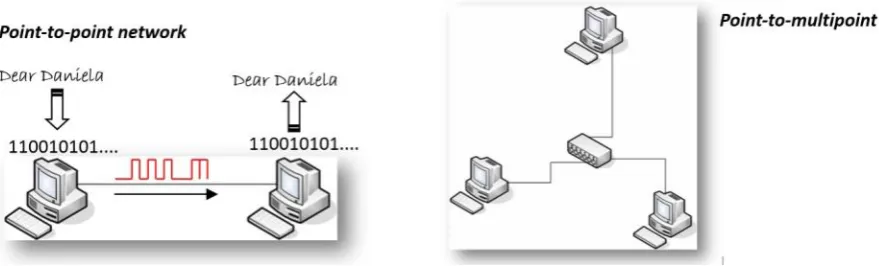
The simplest network consists of two computers that are connected via electric cable (Fig. 3, so called "point -to-point" network). All information (data) will then be transmitted in the form of electrical signals between computers. Whether an email, a song or a photo, all are first in the computer encoded in bits (translated into computer language), i.e. consist of many 0’s and 1’s (so called “binary code”). Each bit is then assigned to an electric signal (logical 1) or no signal (logical 0) and sent over the cable. The first computer is also called "transmitter" because it sends (transmits) the data. The second computer is called "receiver" since it receives the data. The received data is then decoded back into a text, a song or a photo.
ROAD NETWORK COMPUTER NETWORK
Fig. 2. Road network versus computer network.
As long as only two computers are connected via cable, the data transfer is very fast. But when multiple computers have to share a communication cable (Fig. 3, " point-to-multipoint" or even "multipoint-to-multipoint" network), the transmission is getting always slower. The biggest challenge lies in the communication cables that connect cities, countries and even continents. To solve this problem not only "one-way street" (one electrical cable), but a highway with many lanes must be built to serve so many cars (huge amount of data) to be able to simultaneously drive (to be simultaneously transferred).
Well, the question is how to do it?
Fig. 3. Point-to-point and point-to-multipoint network.
2.2. Light signals are the solution
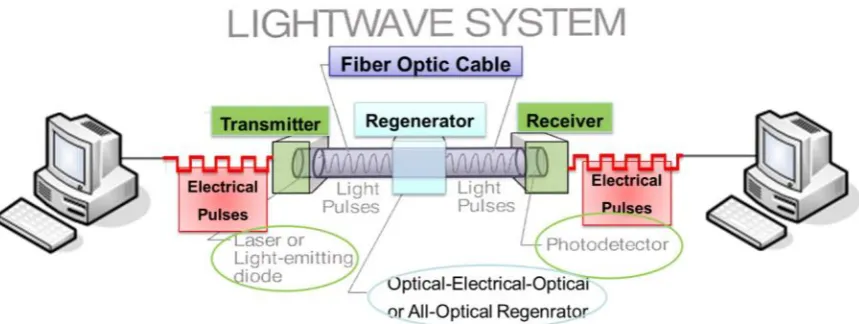
The solution to this problem lies in the application of a new technology that uses optical signals rather than electrical signals for the data transmission. To achieve this, our point-to-point communication system from Fig. 3 must be extended (see Fig. 4). In this new system, as a first step the electrical signals (coming from an electrical part of the network) need to be converted into optical signals. To this purpose, the transmitter is used, consisting of light sources such as a light emitting diode (LED) or a laser. This source is modulated, that is turned on or off to represent the binary digits (1's and 0's) from the electrical part of the network. The output are the optical signals. A glass fiber in a fiber optic cable then transmits these signals (light pulses) over long distances. Of course, since the computers can only work with electrical signals, the received optical pulses are converted back into electrical signals again. Photodetectors are usually required on the receiving side. The last part of our optical communication system is the regenerator. When the light signal has to be transmitted in an optical fiber over long distances, it is attenuated and begins to lose its shape. The result is that the signal cannot be recognized at the receiving end. Here so-called regenerators are used.
Fig. 3. Point-to-point optical system.
2.3. Fiber Optics: a new technology revolution on the Internet
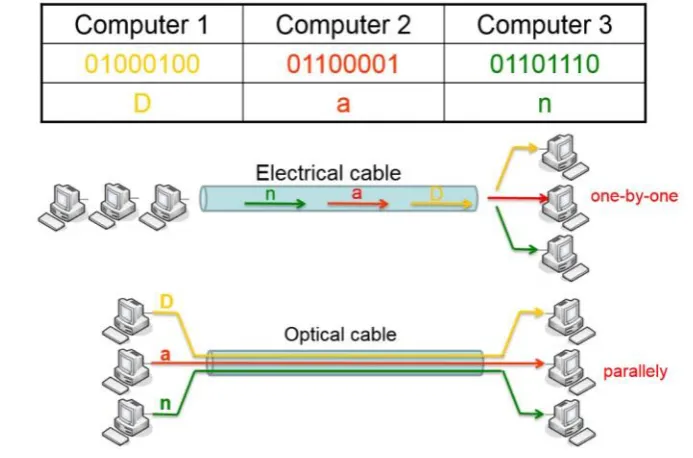
This new technology is called "Fiber Optics": "Optics" - because the light signals are used as an information medium and "Fiber", because glass fibers are used as the transmission medium. In the model image of our streets the light signals are passing cars and the glass fibers are like a "virtual highway", in which you can increase the number of tracks without having to rebuild it, thereby taking advantage of the fact that the light is coloured. Each colour is as a track on the highway (a separate transmission channel). The more colours we use, the more data we can send through a single fiber at the same time without interfering with each other. Already using two different light signals, we can double the transmission capacity. That is one of many benefits of this technology. This new technique is called Wavelength Division Multiplexing (WDM).
Fig. 4. Wavelength Division Multiplexing technique.
The next important advantage of this technology is that the optical signals can be sent over hundreds of kilometres. Nevertheless, how is it possible that the light remains trapped in the fiber and get not lost?
2.4. How the fiber works?
The fact that the light can be guided in a fiber almost without losses over hundreds of kilometres, is based on two physical phenomena: reflection and refraction of light at the boundary between two optically different media. Considering these two phenomena, under particular conditions, so called total internal reflection takes place. In other words, the light will not enter the other optical medium but stays kept inside the fiber.
TOTAL INTERNAL REFLECTION OPTICAL FIBER
Fig. 5. Total internal reflection (left) and optical fibre (right).
3. OPTICAL DATA TRANSMISSION FOR CHILDREN
The lecture in optical data transmission took three times place at Vorarlberg University of Applied Sciences. The reason for that was an enormous interest not only from children’s side but also from the teachers of secondary schools.
The lecture was split into a couple of topic oriented sections. For each section, we prepared the questions for children where for each question at least two or three children could give some answers and this way each time other children could participate on the discussion. After the section was finished, we summarized it with the slide where all new gained information was repeated again (Fig. 6).
Fig. 6. Preparation of the lecture [3].
The lecture was split into following topics: • What is a computer and what can I do with it? • What language the computers really talk?
• How will be the data transferred through the network?
3.1. What is a computer and what can I do with it?
We started with the information about what is the computer and where it can be used. To this topic we prepared a couple of questions like “What do you usually do with the computer at home?”, “What is an E-mail?” or “Which parts consists computer of?”. This was the simplest part of the lecture since the children are very familiar with using computers.
3.2. What language the computers really talk?
In this part of the course we were discussing how complicated is our language and that many people speak many languages. We use the different symbols and numbers and this overall is too complicated for computers. Therefore, a completely new language was developed for the computers to understand and communicate with each other (Fig. 7-left). The translation from our language to the computer language and back was also discussed. At the end of this section, we played the communication between two computers. The children sent the information using their fingers (they encoded the data from our language to the computer language, Fig. 7-middle) and all others could decode it (i.e. they translated it back into useful information, Fig. 7-right). This way all children were able to participate in the game and had a lot of fun while decoding the data.
Fig. 7. Encoding and decoding of the sent information.
3.3. How can be the data transferred through the network?
In the last section, the children could learn how the data will be transferred through the network. The original way was to send them in the form of electrical signals. However, such data transfer strongly limits the network capacity since the data can be sent through communication links only on one-by-one basis (see Fig. 4). To show what it means three children played again the computers (senders) and sent the data (1's and 0's) simultaneously as a show of hands (in Fig. 8-left). After sending each “bit” they changed the positions and other children had to decode the information (Fig. 8-right) that our three computers had sent (Fig. 8-middle). The result, it was not possible to recognize the signals from different computers because the electrical signals are all the same. From this follows, the electrical signals can be sent through the network only on one-by-one basis to be able to recognized them.
Fig. 8. Sending the electrical signals through the network.
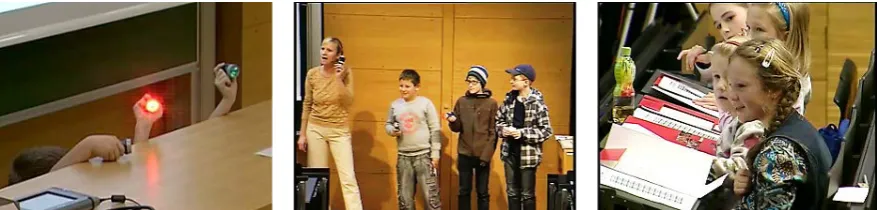
If the electrical signals are replaced by the optical signals, they can be easily recognized even the children (different computers) changed the position (Fig. 9-left). To present this, the game was played again. This time the children did not use the hands but flash-lamps with different colours (Fig. 9-middle). Of course, it was not difficult to decode the data (Fig. 9-right).
Fig. 9. Sending the optical signals through the network.
At the end of the course, we presented an experiment (Fig. 10-left, 10-middle) of Daniel Colladon, young professor of physics at the University of Geneva, so called “Daniel Colladon's Light fountain or Light Pipe”. He was the first person, who demonstrated the total internal reflection (Fig. 10-right) [4].
Fig. 10. Demonstration of the total internal reflexion [3].
Understanding this, the children played the last game where they used real fiber to send the information to the others (Fig. 11). Finally, we would conclude that not only children had a lot of fun while learning about optical data transmission, but also the parents, watching the lecture in the next room. They were also playing the encoding and decoding the information games.
Fig. 11. Sending the optical signals through the fiber.
ACKNOWLEDGEMENTS
Author would like to thank T. Auer, B. Egle, S. Dallapiccola, M. Mayer and S. Weirather from FHV for the development of the “Light Pipe” experimental set-up. This work was supported by the project “Photonics4All” that has received funding from the European Union’s Horizon 2020 research and innovation programme under grant agreement No 644606.
REFERENCES
[1] http://www.fhv.at/kinder-jugend [2] http://www.light2015.org [3] http://www.neue.at
[4] http://deepblue.lib.umich.edu/bitstream/handle/2027.42/63261/0892779041271445.pdf
![Fig. 1. Children’s activities at the children’s university lecture: “Laser” and “Optical data transmission” [3]](https://thumb-us.123doks.com/thumbv2/123dok_us/102524.1510591/2.595.75.522.266.602/children-activities-children-university-lecture-laser-optical-transmission.webp)
![Fig. 6. Preparation of the lecture [3].](https://thumb-us.123doks.com/thumbv2/123dok_us/102524.1510591/6.595.73.527.235.334/fig-preparation-of-the-lecture.webp)
![Fig. 10. Demonstration of the total internal reflexion [3].](https://thumb-us.123doks.com/thumbv2/123dok_us/102524.1510591/8.595.70.529.385.503/fig-demonstration-total-internal-reflexion.webp)
