Production And Energy Characterisation of
Briquettes: Produced With Agroforestable
Waste Cotton And Wood Saws For Burning In
Steam Generator For Process
Rafael Santos de Castro, Tiago Bittencourt Nazaré, Patricia Wernek Silva de Oliveira
FIC UNIS CATAGUASES-BRASIL
Abstract — Millions of tons of lignocellulosic waste generated in Brazil that could be applied to energy generation, has as its main destination this incorporation in the soil. Given the need to evaluate the energy potential of these wastes, the present work has as objective the production and the energetic characterization of briquettes produced from cotton wastes from the preparation of impurities removal material from a textile industry and sawdust residues. from the furniture industries both in the Mata Mineira region under different formulations for comparison purposes. The formulations analyzed were: T1 (60/40) and T2 (40/60), respectively, T3 (100% cotton residue), T4 (100% sawdust residue). Biomass characterization was performed by apparent density, immediate analysis, calorific value and mechanical resistance of briquettes. The results of the energy characterization indicated higher energy potential of T3 and T4 samples than in the other samples, especially their volatile content, fixed carbon and calorific value. The mechanical strength of the briquettes was higher in the tests performed with those composed by a mixture of 100% cotton waste and 100% wood sawdust. Finally, it was concluded that cotton waste can be used in the briquetting process having good mechanical and physical-chemical characteristics, and can be a great source of renewable raw material to subsidize the generation of energy distributed in the national energy matrix.
Keywords — Energy characterization; briquettes; density; calorific power;
I.INTRODUCTION
In this context, we highlight the residues of agricultural activity, which are biomasses that have an added energy value and are produced in huge quantities, but are often discarded in the environment without adequate utility.
According to Dias et al. (2012), briquette is considered an agroenergetic product, capable of replacing firewood, both for use in homes, as well as in industries and commercial establishments.
According to Mao et al (2018) and Chen (2018), the development and use of energy from biomass demonstrates a sustainable energy system capable of effectively promoting economic development and strengthening environmental protection, based on actions that minimize environmental degradation and its use of non-renewable natural resources.
According to the 2017 National Energy Balance (BEM, 2018) data, 42.9% of the country's energy proposal is of renewable origin, in which the total, lignocellulosic biomass accounts for only 8.0%. However, the potential of this energy source is quite high, but it has been little explored and often not optimally.
According to Briquettes (2012), briquettes usually have a higher calorific value than firewood and require less storage space, enabling the maintenance of regulatory and emergency stocks. As briquetting makes use of low medium-sized and ground residues, considerably all types of agricultural, forestry, industrial and urban organic waste can be used. The briquetting process serves to concentrate energy capacity. Quirino & Brito (1991); Capote (2012), when compared to the calorific powers, has that 1m of briquette is five times more energetic than 1 st of firewood.
According to Jornal Biomassa BR (2015) report, in Brazil about 1.2 million tons of briquettes are produced annually. Of these 930 thousand tons are wood and 272 thousand tons come from agricultural residues (such as sugarcane bagasse, straw and rice husks, cottonseed residues and acai). Also according to data from the same author, the growth rate of demand is 4.4% per year, which shows us its viability for the renewable energy market.
the process is little known hinders the deployment of this alternative energy source for large-scale use.
This work aims to produce briquettes of agroforestry residues cotton and sawdust and their energetic characterization in the physical, mechanical and thermal aspects. Taking into account the growing demand for briquettes as a source for distributed power generation and its low capacity for environmental pollution.
II. LITERATUREREVIEW
For the elaboration of this work several bibliographic sources were used through articles and books already published, in which data and information about the briquettes sector were collected. For Protássio et al (2011) in view of the growing worldwide concern to increase the use of energy from renewable sources, waste from various sources emerges as interesting energy alternatives. In Brazil there is a waste production from agroforestry biomass if not reused can cause environmental damage ranging from siltation of rivers and lakes, contamination of watercourses, occupation of large areas in industries and air pollution from open burning.
A. BIOMASS
Vilas Boas (2011) states biomass can be converted into energy through different processes such as combustion, pyrolysis, gasification and liquefaction. It is important to highlight that the use of residual biomass has been highlighting each year as a way to use waste for energy generation, bringing environmental, social and economic gains.
According to Dionizio (2017) the most relevant and valued points when it comes to the use of biomass as a source of energy generation are the low levels of ash and sulfur. The fact that they are renewable fuels that can be used in liquid, solid and gaseous forms, due to their contribution to the neutral balance between emissions and the fixation of polluting gases such as carbon dioxide. As highlighted by Quirino et al (2012) the advantage of plant biomass is that, in most cases, it is the residue generated from agroindustrial activities, thus reducing the great pressure on natural resources that are directly exploited as a source of energy.
B. BIOMASS QUALITY FOR ENERGY USE
According to Brazilian Industry Association Biomass and Renewable Energy (2018), various types of biomass can be converted into briquettes to enable the utilization according to their energy potentials, especially the agro-industrial waste, since their availability is very significant. Briquettes from agricultural waste can replace fossil
fuels such as oil or coal, and can be used to heat boilers in factories, among others.
To this end, Oliveira et al (2018), briquetting is a technique in which biomass, composed of small solid particles defined and with high density is compacted to form solid briquettes. According to the Brazilian Association of Biomass and Renewable Energy (2018), the most important advantage of biomass is the zero balance of carbon dioxide (CO2) emissions, which are released during combustion, such as lower sulfur dioxide emissions. (SO2), nitrogen oxides (NOx) and carbon monoxide (CO), being compared with fossil fuels. For Embrapa (2012), the characteristics of commercial briquettes produced in Brazil have a density of 650-1200 kg / m3, with a diameter of approximately 60 mm, having a length of 25 to 300 mm, Superior Calorific Power (PCS) in the range of 16, 92 to 17.64 MJ / kg and humidity between 7 and 12%, however, for export, solid biofuels are produced according to the technical standards of the customer or the importing country.
Thus, this technique can enable the energy use of most agro-industrial waste, allowing the use of energy distributed to small and large farmers, in addition to generating employment and income, given that the significant amount of waste that is generated Brazilian agro-industrial sectors, especially in agriculture, where they are generally not adequately utilized.
According to Quirino (1991) apud Souza (2014) in the briquetting process, with the use of binders the best use of a fuel is achieved making it of better density, more homogeneous, very uniform grain size, better mechanical resistance and low generation of thin, maintaining the energetic characteristics, contributing to the handling, the storage and enabling its transport at greater distances.
III.METHODOLOGY
For the present study, several bibliographic sources were used through articles and books already published. The characterization of briquettes was produced with cotton waste from the preparation of impurities removal raw material from a textile industry in the region of Mata Mineira region and wood sawdust from furniture industries in the same region under different formulations. The production of the briquettes was carried out in the textile industry itself and the physical and mechanical tests were performed in the Physics Laboratory of the Faculty Integrated de Cataguases FIC / Unis.
A. BRIQUETTING
24h to reduce their high initial moisture content, after being stored in sealed polyethylene bags for better homogenization of the humidity at room temperature (25 ° C ± 2 ° C) until use. After drying, it was possible to standardize the moisture content of raw materials with moisture content between 8 to 12%. The moisture content was adjusted using a TESTO 616 moisture meter, a spray bottle containing distilled water and a semi-analytical balance. According to Quirino (1991) apud Konishi et al (2011), they consider the moisture content of 12% as ideal for the manufacture of briquettes..
B. BIOMASS CHARACTERIZATION
The energetic characteristics of the biomass selected in this study were evaluated by the apparent density analysis, calculated according to ASTM E 873-82, immediate analysis, which consists in the determination of the moisture content (E 871-82), the volatiles ( E 872, ashes (E 1755-01) and fixed carbon = 100 - 8% - gray% - volatile% For higher calorific value it was determined using a Parr calorimetric pump containing 10 cm nickel-chrome fuse wire with a caloric value of 2.3 cal / cm, according to ASTM E711-87.For such, the results of these analyzes were submitted to descriptive statistics for better understanding of them with greater reliability.
C. BRIQUETTES PRODUCTION
In preliminary tests, with biomass humidity ranging between 0, 8, 10 and 12%, confirmed that 8% is the moisture content being the most suitable for the production of cracked briquettes.
Briquettes were produced using cornstarch as binders. The gelatinized cornstarch was based on the methodology proposed by Martins et al (2016) of a mass of 30g of starch with the addition of 125ml of distilled water, and after mixing they were heated until they reached a temperature of 58ºC. remained until the solution reached the gelatin point. The mixture between the residues and binders was done manually for 5 minutes and then placed in the mold. The total volume of the mold was filled with the homogenized material, and the mass of this residue volume corresponded to the respective briquette mass. They were produced with 30g mass respecting two proportions: T1 (100% cotton residue), T2 (100% sawdust residue), T3 (60/40) and T4 (40/60), respectively, as description in table 1.
Table 1- Description of Samples
Features
Composition (%)
Biomass Cotton waste Wood sawdust samples
T1 60 40
T2 40 60
T3 100 NC
T4 NC 100
* NC - Does not contain. Source: Author 2019
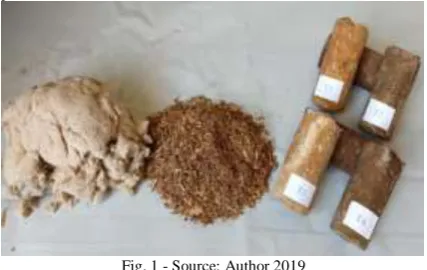
The briquettes were made using a LilMarcon MARCON MPH-15 hydraulic cold press, with the aid of 45mm diameter and 160mm long stainless steel cylindrical molds, which were subjected to a pressure of 1.2 TON at 58 ° C. for 5 min. For each sample 4 briquettes weighing 30 g each were produced. Figure 1 shows the biomass of cotton waste and wood sawdust, with particle size <5 mm and briquette produced.
Cotton waste, wood sawdust, blending biomass and briquette produced
Fig. 1 - Source: Author 2019
After molding, all specimens were analyzed, weighed and measured using a digital caliper their proper dimensions (height and diameter). A total of 12 samples were cast, where 8 samples were used for the mechanical strength test and 4 samples used for the calorific test. The apparent density of the briquettes was determined experimentally by measuring its mass and dividing it by its calculated volume based on length and diameter. The compressive strength of each briquette was determined according to NBR 7215-ABNT (2019) and NBR 5739-ABNT (2018) using a standard AG-I 100 KN test machine, SHIMADZU. The compression load was applied longitudinally over each briquette, prone to having the maximum force supported by it at the breaking point. Six briquettes from each sample were tested using a test speed of 0.3 mm / min.
IV.RESULTS
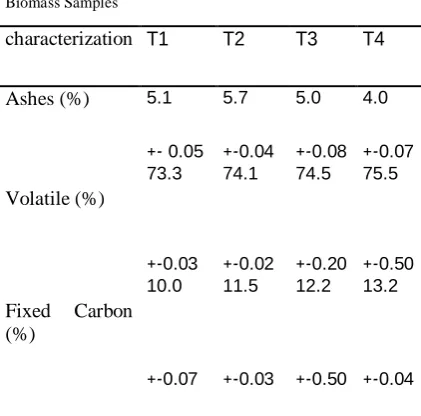
moisture is an extremely important factor for the production of briquettes, since it acts as a binding agent between particles, exerting the forces of Van der Waals between them. When moisture content is high, briquettes have less durability because they are more susceptible to abrasion. According to Hellwig (1985) apud Moreno et al (2016), high moisture residues can have low ignition and reduce the quality of combustion. The results of the compositional analysis of the studied biomasses are presented in Table 2.
Table 2- Chemical Composition of Biomass Samples
Biomass Samples
characterization T1 T2 T3 T4
Ashes (%) 5.1 5.7 5.0 4.0
+- 0.05 +-0.04 +-0.08 +-0.07
Volatile (%)
73.3 74.1 74.5 75.5
+-0.03 +-0.02 +-0.20 +-0.50
Fixed Carbon (%)
10.0 11.5 12.2 13.2
+-0.07 +-0.03 +-0.50 +-0.04
Source: Author 2019
According to Table 2, T1 and T2 samples showed similar results for volatiles, ashes and fixed carbon content. The same was observed among T3e T4 samples. However, it can be seen that T4 have lower ash content, higher volatile content and fixed carbon. According to Mckendry (2002) high levels of volatile carbon and fixed carbon promote Calorific Power, as they consist of chemical energy stored in biomass.
The results of density and calorific value of biomass dust and briquette density are presented in Table 3. It can be observed that samples T3 and T4 have higher calorific values when compared to T1 and T2. For Erol et al (2010) the calorific power of biomass corresponds to the indication of the chemical energy present in it, being converted into thermal energy.It is the very important property of a fuel as it determines its energy value.
Table 3- Chemical Composition of Biomass Samples
Bulk density (g / cm3)
Biom ass samples
Briquettes Densitie (g / cm3)
Calorific Power (MJ / Kg)
T1 0.32 +-
0.03
1.22 +-
0.4
16.2 +-
0.03
T2 0.38 +-
0.06
1.12 +-
0.7
16.7 +-
0.07
T3 0.31 +-
0.07
1.20 +-
0.3
17.2 +-
0.06
T4 0.35 +-
0.05
1.12 +-
0.2
19.0 +-
0.05 Source: Author 2019
According to Table 3, briquette density increased in all samples compared to bulk density compared to biomass powder. According to Moreno (2016), densification reduces transportation costs, its handling and storage. It is also noticed that the briquettes densities were influenced by the inorganic mineral content of biomasses, presenting the highest values for those with high ash content and, consequently, they presented the lowest values of calorific value. According to Avelar et al (2016) the ash content has no flammable properties and can act reducing the energy potential of biomass.
Briquette density results are in accordance with the technical specifications required by the European Standard for Briquette Solid Biofuels (CEN / TS 14961 2005). For that, Gomes (1997) briquettes density is a very important parameter to determine variables related to the transport of a certain amount of energy. Together the compressive strength should be considered for quality control of this product. The compressive strength results of Figure 2 show no significant difference between the samples. However, a considerable 20 to 23% increase in compressive strength of these T3 and T4 mixtures, respectively, was observed.
Fig. 2- Chemical Composition of Biomass Samples- Source: Author 2019
For Oliveira et al (2017), the most suitable briquette for commercial purposes should have an ideal combination between mechanical resistance and Calorific Power. And according to Pietsch (2012) the mechanical resistance is linked with the adhesion forces between the biomass particles. In this study it was observed that the briquettes produced with T4 mixture (cotton residue and sawdust) that presented the highest strength content and the highest compressive strength values. According to Oliveira
V.CONCLUSION
The energy characterization carried out with the cotton waste from a Mata Mineira textile industry and wood sawdust from the Mata Mineira zone furniture industries indicated that they have significant energy potential to be used as an alternative source of energy , since they presented considerable values of Calorific Power, volatile content and fixed carbon. The values related to the density and mechanical resistance of the briquettes was higher for the T3 and T4 mixture biomasses. These results confirm that the increase in compressive strength is attributed to the compositional characteristics of each part used in briquette production, having a positive correlation in cotton residues with mechanical strength. The use of mixed cotton waste crop residues for briquette production, in addition to improving product characteristics, can promote economic advantages by reducing waste disposal costs.
Regarding briquettes, all samples presented a considerable energy density and mechanical resistance, indicating that the briquetting of cotton waste and wood sawdust is a potential source of distributed energy generation and may reduce the possible environmental impacts caused by the practice. Reintroduction of these residues into the soil and in addition to generating employment and income.
VI.BIBLIOGRAPHICREFERENCES
[1] ABNT - Brazilian Technical Standards Association (2018) NBR 5739 Concrete - Compression test of cylindrical specimens. Rio de Janeiro, p 4.
[2] ABNT - Brazilian Association of Technical Standards (2019) NBR 7215 Portland Cement - Determination of compressive strength. Rio de Janeiro, p 8
[3] ASTM E 711-87 (1996) Standard Test Method for Gross Calorific Value of Refuse-Derived Fuel by the Bomb Calorimeter. American Society for Testing and Materials (ASTM), Philadelphia.
[4] ASTM Standard 1755-01. Standard test method for ash in biomass, American Society for Testing and Materials (ASTM), Philadelphia, USA, 2007.
[5] ASTM Standard E 871-82. Standard test method for moisture analysis of particulate wood fuels, American Society for Testing and Materials (ASTM), Philadelphia, USA, 2006.
[6] ASTM Standard E 872-82. Standard test method for volatile matter in the analysis of particul ate wood fuels, American Society for Testing and Materials (ASTM), Philadelphia, USA, 2006.
[7] ASTM Standard E 873-82. Standard Test Method for Bulk Density of Densified Particulate Biomass Fuels, American Society for Testing and Materials (ASTM), Philadelphia, USA, 2006.
[8] AVELAR, N. V. et al. Evaluation of briquettes made from textile industry solid waste. Renewable Energy, 91:417- 424, 2016
[9] BEN 2018 - National Energy Balance 2016: Base Year 2017: Prelimin ary Results / Ministry of Mines and Energy. Energy research company. Rio de Janeiro: EPE, 2018 [10] Brazilian Industry Association Biomass and Renewable
Energy. Brazil Status Report, 2012: bioenergy - biomass -
renewable energy. Available at:
<http://abibbrasil.wix.com/brazilianassociationbiomass>. Accessed April 7, 2019
[11] CEN/TS 14961 (2005) Solid biofuels. Fuel specifications and classes. British Standards Institution. Comite Europeen de Normalisation (CEN), London.
[12] CHEN, D. et al, 2018. Analysis of pyrolysis characteristics and kinetics of sweet sorghum bagasse and cotton stalk. J Therm Anal Calorim, 131:1899–1909, 2018.
[13] DIAS, J, M, C, S . [et al.]. Production of briquettes and pellets from agricultural, agroindustrial and forest waste - Brasília, DF: Embrapa Agroenergia, 2012. Available at: <http://ainfo.cnptia.embrapa.br/digital/bitstream/item/78690 /1/ DOC-13.pdf>. Accessed April 15, 2019.
[14] DIONIZIO, A. F. (2017). Energy use of agro-industrial waste in the Federal District. Master Thesis in Forest Sciences, Publication - Department of Forest Engineering, University of Brasilia, Brasília, DF, 97p.
[15] Erol MH, Haykiri-Acma, Küçükbayrak S (2010) Calorific value estimation of biomass from their proximate analyses data. Renewable Energy 35: 170–173. https://doi 10.1016/j.renene.2009.05.008.
[16] Gomes RS, Wilson PN , Coates WE, Fox RW, (1997) Cotton (Gossypium) plant residue for industrial fuel. Ind Crop Prod 7(1):1–8
[17] HELLWIG, G. Basic of the combustion of wood and straw. In: Palz W, Coombs J, Hall DO, editors. Energy from biomass, London: Elsevier Applied Science, 1985, 3ª ed. E.C. Conference, p. 793–798.
[18] MAO, G. et al. Research on biomass energy and environment from the past to the future: A bibliometric analysis. Science of The Total Environment, 635:1081-1090, 2018.
[19] MARTINS, M. P .; BENCIO, E. L .; JR, A. F. D .; ALMEIDA, R. B .; OAK, A.M .; YAMAJI, F. M. Production and evaluation of briquettes of charcoal fines compacted with cellulosic waste from the pulp and paper industry. Tree Magazine, v. 40, no. 1, p. 173-180, 2016. [20] MCKENDRY, P. Energy production from biomass (part 1):
overview of biomass, Bioresour. Technol, 83: 37 – 46, 2002. https://doi 10.1016 /S0960-8524(01)00118-3.
[21] Moreno AI, Front R, Conesa JA (2016) Physical and chemical evaluation of furniture waste briquetes. Waste
Management 49: 245–252. https://doi
10.1016/j.wasman.2016.01.048.
[22] OLIVEIRA et al. Briquettes production for use as power source for combustion using charcoal thin waste and sanitary sewage sludge. Environ Sci Pollut Res, 24:10778– 10785, 2017.
[23] Oliveira RS, Palácio SM, da Silva EA, Mariani FQ, Reinehr TO (2017) Briquettes production for use as power source for combustion using charcoal thin waste and sanitary sewage sludge. Environ Sci Pollut Res. 24:10778– 10785. https:/ doi 10.1007/s11356-017-8695-0.
[24] Pietsch W (2002) Agglomeration Processes – Phenomena, Technologies, Equipment. Weinheim: John Wiley & Sons, 624p. https:// doi 10.1002/9783527619801.
[25] PROTÁSIO, T. P .; ALVES, I. C. N .; TRAIL, P. F .; SILVA, V. O. BALIZA, A.E. R. (2011). Plant biomass compaction aiming at the production of solid biofuels. Brazilian Forest Research, 31 (68), 273.
[26] QUIRINO, W. F. Characteristics and indices of combustion of charcoal briquettes. Piracicaba, 1991. 64f. Dissertation (Master in Forest Sciences) - University of São Paulo, São Paulo.
[27] QUIRINO, W.F. et al. X-ray densitometry in the quality analysis of wood residue briquettes.
[28] ScientiaForestalis.2012;96:525;536Availableat:<http://www .ipef.br/publicacoes/scientia/nr 96/cap11.p df>. Accessed April 7, 2019.