http://www.sciencepublishinggroup.com/j/am doi: 10.11648/j.am.20180704.17
ISSN: 2327-2503 (Print); ISSN: 2327-252X (Online)
Optimization of Intercritical Annealing Process Parameters
for SCM435 Alloy Steel Wires by Using Taguchi Method
Chih-Cheng Yang
1, *, Nan-Hua Lu
21
Department of Mechanical Engineering and Automation Engineering, Kao Yuan University, Kaohsiung, Taiwan, R.O.C 2Graduate School of Fasteners Industry Technology, Kao Yuan University, Kaohsiung, Taiwan, R.O.C
Email address:
*
Corresponding author
To cite this article:
Chih-Cheng Yang, Nan-Hua Lu. Optimization of Intercritical Annealing Process Parameters for SCM435 Alloy Steel Wires by Using Taguchi Method. Advances in Materials. Vol. 7, No. 4, 2018, pp. 144-152. doi: 10.11648/j.am.20180704.17
Received: December 7, 2018; Accepted: December 27, 2018; Published: January 16, 2019
Abstract:
The quality of a spheroidized annealed wire affects the forming quality of fasteners. In the fastener industry, wire manufacturers use an intercritical process for spheroidized annealing medium carbon steel wires. The influence of intercritical annealing parameters namely section-area reductions, preheating rate, spheroidized annealing temperature, prolonged heating time, holding temperature and time, cooling rate and temperature is investigated for the responses of quality characteristics of wires, such as tensile strength and ductility, after spheroidized annealing operation. A series of experimental tests on SCM435 alloy medium carbon steel wires is carried out in a commercial hydrogen furnace. Taguchi method along with ANOVA is used to obtain optimal spheroidized annealing conditions to improve the mechanical properties of alloy steel wires for cold forming. It is experimentally revealed that the area reduction ratio, spheroidized annealing temperature, holding temperature and cooling temperature significantly affect the quality of annealed SCM435 alloy steel wires. The optimal combination of process parameters lead to obtaining the optimal mean tensile strength of 567.8 MPa and mean ductility of 0.361. A comparison between the results obtained using the optimal spheroidized annealing conditions and the measures determined using the original settings shows that the new spheroidizing parameter settings effectively improve the performance measures over their values at the original settings. The cold formability of SCM435 alloy steel wires is effectively improved.Keywords:
Intercritical Process, Spheroidized Annealing, Taguchi Method, Formability1. Introduction
A cold-forging quality SCM435 alloy medium carbon steel wire is widely used to manufacture high strength bolts and machine parts. Cold forging is widely used for forming alloy steel fasteners. A cold-forging quality steel rod is usually used to manufacture wire for cold forming. The wire is generally produced by drawing wire coil into wire, followed by spheroidizing treatment to achieve the necessary formability for cold forging. The majority of all spheroidizing activity is performed to improve the ductility of steel [1-3] for cold formability. A spheroidized microstructure is desirable for cold forming because it reduces the flow stress of the material. Steels may be spheroidized to produce a structure of globular carbides in a ferritic matrix [4]. The subcritical and intercritical processes are usually used for the spheroidized annealing of steel wires
[4] with a protective atmosphere of nitrogen or hydrogen [5]. A subcritical annealing treatment is simply heating them to a temperature below the Ac1 temperature and holding at this
temperature which the annealing time may be very long. An intercritical annealing treatment involves heating to, and holding at, a temperature between the Ac1 and Ac3
temperatures to obtain partial austenitisation, and followed by slow cooling or holding at a temperature below the critical temperature.
and AISI 4037, used in the bolt industry with two process cycles, namely, intercritical and subcritical cycles. Introducing defects into cementites by severe plastic deformation is one of the effective methods for increasing the spheroidization speed. Shin et al. [9] studied the enhanced spheroidization kinetics in terms of carbon dissolution from cementites and defects induced in cementites by a severe plastic deformation, and revealed that the increase in accumulated strain in the equal channel angular pressed steel decreased the spheroidization temperature and time. Ko et al. [10] proposed a method of continuous shear drawing (CSD) for industrial applications to steel wire manufacturing and compared the spheroidization behavior of medium-carbon steel processed by CSD to that processed by conventional drawing. Gul’ et al. [11] developed a new method for a more intense spheroidization of cementites to accelerate spheroidization. Spheroidization is induced by nonisothermal holding at high temperatures using an internal heat source. The results show that the spheroidized annealing temperature and prolonged heating time have the greatest effect on the mechanical properties of steel wires. Min and Ha [12] conducted the spheroidization heat treatment of SK85 high-carbon steel sheets with various initial microstructures obtained after cold rolling at various reduction ratios at two annealing temperatures. Joo et al. [13] indicated that the cementite in steel spheroidizes much more easily after a severe drawing, and SEM results also revealed that the prior cold working could increase the spheroidization ratio with cold workability improved by subcritical annealing. Ji et al. [14] investigated the effect of subcritical annealing temperature on microstructure and mechanical properties of SCM435 steel through changing the heating and soaking temperature.
Yang and Liu [15] conducted the experiment by using Taguchi method to obtain optimum spheroidised annealing conditions to improve the mechanical properties of AISI 1022 low carbon steel wire for cold forming. The results show that the spheroidized annealing temperature and prolonged heating time have the greatest effect on the mechanical properties of steel wires. Okonogi and Yamazaki
[16] investigated the effects of microstructure on mechanical properties of spheroidizing annealed medium carbon steel wire rods and control methods of microstructure of JIS SWRCH40K medium carbon steel wire rods. The fine dispersed cementites and coarse ferrite grain after spheroidizing annealing were observed in the medium carbon steel wire rods manufactured by isothermal transformation treatment. Wang et al. [17] investigated the effects of deformation amount, deformation temperature and subsequent holding time on the deformation spheroidising process of high-carbon-bearing steel containing aluminium and the effects of aluminium contents on the mechanism of spheroidisation. Equbal et al. [18] investigated experimentally the optimal set of process parameters such as forging temperature, percentage deformation and cooling rate during hot forging process by using grey Taguchi method to optimize the mechanical properties like tensile strength and impact strength of commercial 35C8 medium carbon forging steel. Yang and Wang [19] studied experimentally on AISI 10B21 steel wires by using Taguchi method to obtain optimal subcritical annealing conditions to improve the mechanical properties of steel wires for cold forming.
For wire manufacturers, an intercritical process is used for spheroidized annealing cold-forging quality SCM435 alloy medium carbon steel wire. The wire must be spheroidizing annealed after drawing the wire coil (⌀9.0 mm) to a specific size with section-area reduction of about 13.1%. Various parameters affect the quality characteristics of intercritical annealing, such as section-area reductions, preheating rate, spheroidized annealing temperature, prolonged heating time, holding temperature and time, cooling rate and temperature. The effects of spheroidized annealing parameters affect the quality characteristics of wires, such as tensile strength and ductility. In this study, a series of experimental tests on SCM435 alloy medium carbon steel wires is carried out in a commercial bell furnace with a protective atmosphere of hydrogen and the Taguchi method [20, 21] is used to obtain optimal intercritical annealing conditions to improve the mechanical properties of alloy steel wires for cold forming.
2. Experimental Design
Table 1. Chemical composition of SCM435 alloy steel wires (wt%).
C P Mn Si Al Cu Ni Cr Mo
0.37 0.014 0.74 0.21 0.048 0.007 0.01 0.99 0.17
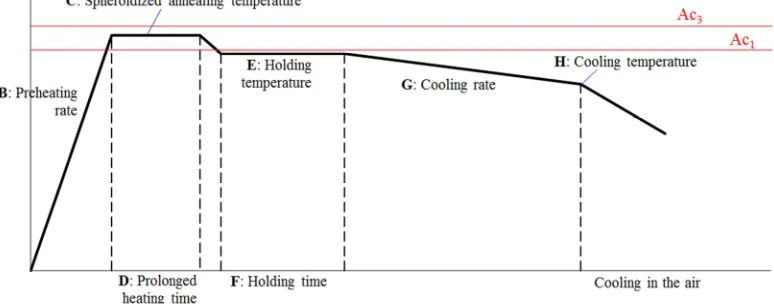
In this study, an intercritical process, as illustrated in Figure 1, is used for the spheroidized annealing of SCM435 alloy medium carbon steel wires, heating them into the intercritical temperature (750-780°C) for 1.5-4.5 h and then cooling to a lower temperature (710-745°C) and holding at this temperature for 0.0-6.0 h before slowly cooling to the temperature (610-680°C). A series of experimental tests on SCM435 alloy medium carbon steel wires is carried out in an A210 bell-type furnace with a protective atmosphere of hydrogen (Rad-Con Inc., Cleveland, OH, USA). The alloy steel wire coil is manufactured by China Steel Corporation, Kaohsiung, Taiwan. Its chemical composition is shown in Table 1.
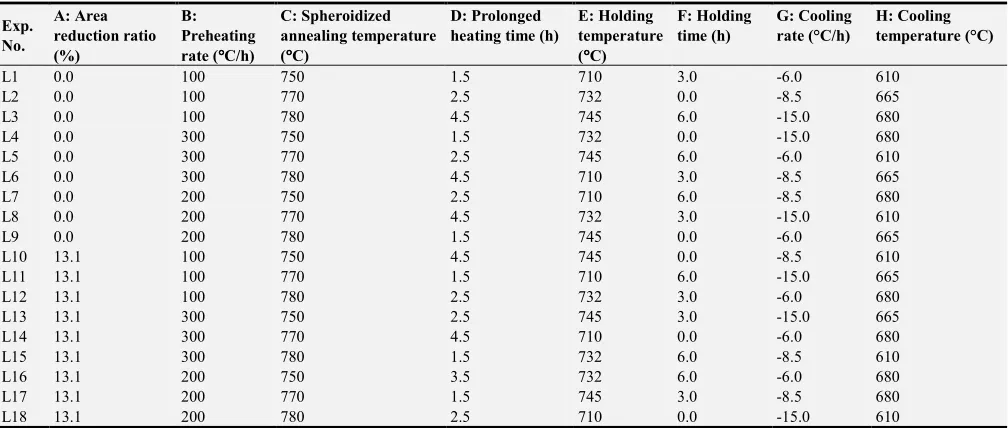
To evaluate the mechanical properties of SCM435 alloy medium carbon steel wires, eight controllable process factors are identified: 1 at two levels and 7 at three levels. All factors and their levels are shown in Table 2. The parameters of Level 2 are the original spheroidized annealing process conditions, which are used in Fang Sheng Screw Co., Ltd., Taiwan.
The Taguchi method allows simultaneous changes of many factors in a systematic manner, ensuring the reliable and independent study of the factors’ effects. The orthogonal array table, L18 (21×37) [20, 21], is used as an experimental
design for these eight factors, as shown in Table 3.
Table 2. Experimental factors and their levels for L18 orthogonal array.
Factor Level 1 Level 2 Level 3
A: Area reduction ratio (%) 0.0 13.1
B: Preheating rate (°C/h) 100 300 200
C: Spheroidized annealing temperature (°C) 750 770 780
D: Prolonged heating time (h) 1.5 2.5 4.5
E: Holding temperature (°C) 710 732 745
F: Holding time (h) 3.0 0.0 6.0
G: Cooling rate (°C/h) -6.0 -8.5 -15.0
H: Cooling temperature (°C) 610 665 680
Table 3. L18 (21×37) orthogonal array experimental parameter assignment.
Exp. No.
A: Area reduction ratio (%)
B: Preheating rate (°°°°C/h)
C: Spheroidized annealing temperature (°°°°C)
D: Prolonged heating time (h)
E: Holding temperature (°°°°C)
F: Holding time (h)
G: Cooling rate (°C/h)
H: Cooling temperature (°C)
L1 0.0 100 750 1.5 710 3.0 -6.0 610
L2 0.0 100 770 2.5 732 0.0 -8.5 665
L3 0.0 100 780 4.5 745 6.0 -15.0 680
L4 0.0 300 750 1.5 732 0.0 -15.0 680
L5 0.0 300 770 2.5 745 6.0 -6.0 610
L6 0.0 300 780 4.5 710 3.0 -8.5 665
L7 0.0 200 750 2.5 710 6.0 -8.5 680
L8 0.0 200 770 4.5 732 3.0 -15.0 610
L9 0.0 200 780 1.5 745 0.0 -6.0 665
L10 13.1 100 750 4.5 745 0.0 -8.5 610
L11 13.1 100 770 1.5 710 6.0 -15.0 665
L12 13.1 100 780 2.5 732 3.0 -6.0 680
L13 13.1 300 750 2.5 745 3.0 -15.0 665
L14 13.1 300 770 4.5 710 0.0 -6.0 680
L15 13.1 300 780 1.5 732 6.0 -8.5 610
L16 13.1 200 750 3.5 732 6.0 -6.0 680
L17 13.1 200 770 1.5 745 3.0 -8.5 680
L18 13.1 200 780 2.5 710 0.0 -15.0 610
In this study, two quality characteristics of the spheroidized annealed wire, tensile strength and ductility, are investigated. Each test trial, including ten specimens, is followed by a manufacture process and the results are transformed to signal-to-noise (S/N) ratios. Spheroidizing provides the needed ductility for cold forgeability. The tensile test is used as a measure of ductility by calculating the elongation of the specimen upon fracture [22]. The tensile tests are conducted on a 20 ton universal testing machine
under a constant ram speed of 7 mm/min at room temperature. Therefore, in terms of the desired characteristics for ductility, the higher the better, and the S/N ratio is [21]
n y n
i i
∑
= −
= 1
2 / 1 log 10
S/N , (1)
n is the test number.
The ductility of the steel wire may be improved through spheroidized annealing and their strength may be reduced as well. However, the given strength of the annealed steel wire must be provided for cold forming. Therefore, the tensile strength of the alloy steel wire is the main quality characteristic, with a target value of 574 MPa, which is assigned by Fang Sheng Screw Co., Ltd, Taiwan. The S/N ratio for the nominal-the-best response is [21]
] ) µ [( log 10
S/N=− −m 2+S2 , (2)
where µ is the mean of each trial, m is the target value, and S
is the standard deviation.
The analysis of variance (ANOVA) is an effective method of determining the significant factors and optimal fabrication conditions required to obtain the optimal quality. For the Taguchi method, the experimental error is evaluated using ANOVA to test the significance of various factors. The nature of the interaction between factors is considered as the experimental error [20, 21]. If the effect of a factor in comparison with the experimental error is sufficiently large, it is identified as a significant factor. The confidence level of a factor is evaluated using the experimental error to identify the significant factor that affects the material properties of the alloy steel wire.
3. Results and Discussion
When SCM435 alloy steel wire is produced by drawing with section-area reduction of 13.1%, the tensile strength and ductility are respectively 1005 MPa and 0.109 due to heavy plastic work. The tensile strength and ductility of non-drawing wire are respectively 912.5 MPa and 0.177. Spheroidization is the process of producing a microstructure in which the cementite exhibits a spheroidal distribution. The obtained globular structure improves the formability of the steel wire. When the wire is fabricated following the original spheroidized annealing conditions (Level 2 in Table 2), the mean tensile strength and ductility are respectively 554.6 MPa and 0.388. The strength is about half and the ductility is more than twice of the non-spheroidized wire.
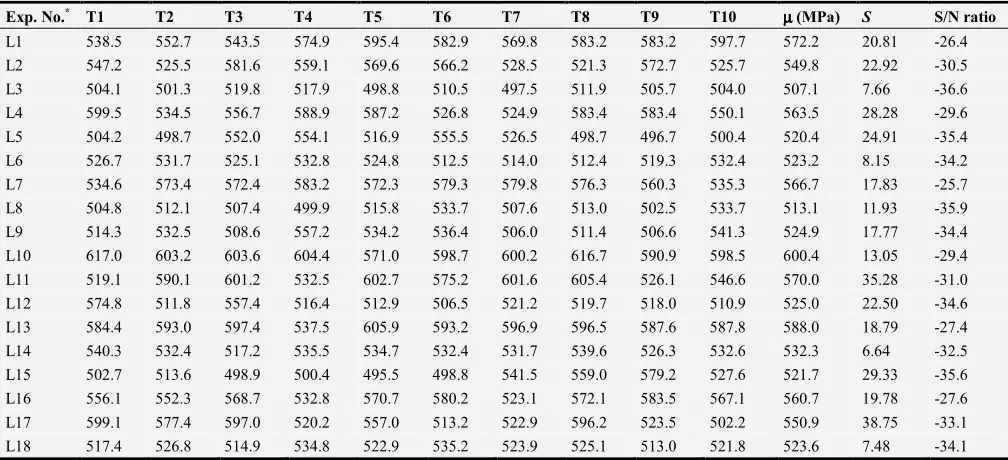
The experimental results of the tensile strength and ductility (mean, µ; standard deviation, S; and S/N ratio) of the spheroidized annealed steel wires are shown in Tables 4 and 5, respectively. The mean tensile strength varies from 507.1 (test L3) to 600.4 MPa (test L10), as shown in Table 4. The mean tensile strength of test L1 is very close to the target value. The standard deviation varies from 6.64 to 38.75 MPa and test L14 is the smallest among the eighteen tests.
The mean ductility varies from 0.288 (test L10) to 0.444 (test L5), as shown in Table 5, and the mean values of tests L3, L5, L6, L8, L9, L14, L15, and L18 are larger than the value at the original settings. The standard deviation varies from 0.007 (test L13) to 0.054 (test L15). The properties of the spheroidized annealed steel wires are obviously varied under various spheroidized annealing process conditions.
Table 4. Experimental results for tensile strength.
Exp. No.* T1 T2 T3 T4 T5 T6 T7 T8 T9 T10 µµµµ (MPa) S S/N ratio
L1 538.5 552.7 543.5 574.9 595.4 582.9 569.8 583.2 583.2 597.7 572.2 20.81 -26.4 L2 547.2 525.5 581.6 559.1 569.6 566.2 528.5 521.3 572.7 525.7 549.8 22.92 -30.5 L3 504.1 501.3 519.8 517.9 498.8 510.5 497.5 511.9 505.7 504.0 507.1 7.66 -36.6 L4 599.5 534.5 556.7 588.9 587.2 526.8 524.9 583.4 583.4 550.1 563.5 28.28 -29.6 L5 504.2 498.7 552.0 554.1 516.9 555.5 526.5 498.7 496.7 500.4 520.4 24.91 -35.4 L6 526.7 531.7 525.1 532.8 524.8 512.5 514.0 512.4 519.3 532.4 523.2 8.15 -34.2 L7 534.6 573.4 572.4 583.2 572.3 579.3 579.8 576.3 560.3 535.3 566.7 17.83 -25.7 L8 504.8 512.1 507.4 499.9 515.8 533.7 507.6 513.0 502.5 533.7 513.1 11.93 -35.9 L9 514.3 532.5 508.6 557.2 534.2 536.4 506.0 511.4 506.6 541.3 524.9 17.77 -34.4 L10 617.0 603.2 603.6 604.4 571.0 598.7 600.2 616.7 590.9 598.5 600.4 13.05 -29.4 L11 519.1 590.1 601.2 532.5 602.7 575.2 601.6 605.4 526.1 546.6 570.0 35.28 -31.0 L12 574.8 511.8 557.4 516.4 512.9 506.5 521.2 519.7 518.0 510.9 525.0 22.50 -34.6 L13 584.4 593.0 597.4 537.5 605.9 593.2 596.9 596.5 587.6 587.8 588.0 18.79 -27.4 L14 540.3 532.4 517.2 535.5 534.7 532.4 531.7 539.6 526.3 532.6 532.3 6.64 -32.5 L15 502.7 513.6 498.9 500.4 495.5 498.8 541.5 559.0 579.2 527.6 521.7 29.33 -35.6 L16 556.1 552.3 568.7 532.8 570.7 580.2 523.1 572.1 583.5 567.1 560.7 19.78 -27.6 L17 599.1 577.4 597.0 520.2 557.0 513.2 522.9 596.2 523.5 502.2 550.9 38.75 -33.1 L18 517.4 526.8 514.9 534.8 522.9 535.2 523.9 525.1 513.0 521.8 523.6 7.48 -34.1
*: Experimental conditions as defined in Table 3.
Table 5. Experimental results for ductility.
Exp. No.* T1 T2 T3 T4 T5 T6 T7 T8 T9 T10 µ S S/N ratio
Exp. No.* T1 T2 T3 T4 T5 T6 T7 T8 T9 T10 µ S S/N ratio
L4 0.321 0.391 0.342 0.347 0.324 0.407 0.391 0.331 0.331 0.304 0.349 0.035 -9.3 L5 0.449 0.481 0.399 0.382 0.493 0.411 0.431 0.467 0.477 0.446 0.444 0.037 -7.1 L6 0.423 0.438 0.458 0.419 0.444 0.455 0.437 0.438 0.445 0.468 0.442 0.015 -7.1 L7 0.430 0.363 0.350 0.353 0.358 0.354 0.346 0.364 0.329 0.389 0.364 0.028 -8.8 L8 0.474 0.458 0.475 0.459 0.411 0.399 0.444 0.408 0.434 0.417 0.438 0.028 -7.2 L9 0.442 0.395 0.430 0.392 0.392 0.410 0.433 0.434 0.429 0.364 0.412 0.026 -7.7 L10 0.289 0.276 0.294 0.291 0.264 0.280 0.295 0.304 0.303 0.287 0.288 0.012 -10.8 L11 0.396 0.313 0.312 0.369 0.312 0.299 0.304 0.317 0.420 0.387 0.343 0.045 -9.5 L12 0.337 0.416 0.330 0.405 0.386 0.398 0.372 0.369 0.403 0.410 0.383 0.030 -8.4 L13 0.293 0.284 0.290 0.287 0.299 0.291 0.300 0.288 0.304 0.286 0.292 0.007 -10.7 L14 0.406 0.408 0.425 0.428 0.412 0.403 0.418 0.391 0.421 0.438 0.415 0.014 -7.7 L15 0.444 0.419 0.456 0.405 0.444 0.455 0.362 0.323 0.333 0.340 0.398 0.054 -8.2 L16 0.322 0.255 0.319 0.268 0.270 0.315 0.356 0.285 0.323 0.338 0.305 0.034 -10.5 L17 0.298 0.296 0.351 0.355 0.324 0.369 0.387 0.293 0.352 0.391 0.342 0.037 -9.5 L18 0.420 0.390 0.420 0.398 0.401 0.386 0.420 0.395 0.398 0.426 0.405 0.015 -7.9
*: Experimental conditions as defined in Table 3.
3.1. Tensile Strength
In order to obtain the optimal quality, ANOVA is carried out to determine significant factors and optimal fabrication conditions. The contribution and confidence level of each factor constructed in Table 6 could identify the significant factor affecting the tensile strength of the wire. The contribution of a factor is the percentage of the sum of squares (SS), that is, the percentage of the factor variance to the total quality loss [21].
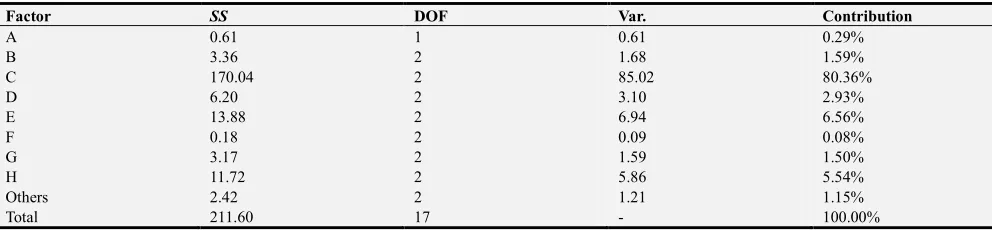
The effect of a factor may be pooled to error if its confidence level or contribution is relatively small. It is obvious from the ANOVA table that the contribution of spheroidized annealing temperature (C) is 80.36% of the total variation, which is obviously the highest contributor to the variability of the experimental results. The contributions of holding temperature (E, 6.56%) and cooling temperature (H, 5.54%) are respectively the second and third highest.
However, the other five factors are not significant for the S/N ratio since their contributions are relatively small. With the pooling of errors from the non-significant factors (A, B, D, F and G), the error for the S/N ratio is estimated [21] and then the confidence levels are 100.0, 96.8 and 95.2%, respectively, for spheroidized annealing temperature (C), holding temperature (E) and cooling temperature (H). That is, the three factors, particularly the spheroidized annealing temperature, significantly affect the tensile strength of the
alloy steel wire with a confidence level of more than 95.0%. Figure 2 illustrates the factor response diagram and the level averages of eight factors with respect to the S/N ratio. For each factor, the effect is indicated by the range of level averages and the maximum level average is considered the optimal level [20, 21]. It is obviously revealed that, for the eight factors, the original levels (Level 2) are not the optimal fabrication parameters for obtaining the target tensile strength.
For the significant factors of spheroidized annealing temperature (C), holding temperature (E) and cooling temperature (H), Level 1 for the spheroidized annealing temperature (750°C, C1), Level 1 for holding temperature (710°C, E1) and Level 2 for cooling temperature (665°C, H2) are evidently the optimal levels, as shown in Figure 2. It is observed that the response is almost linear with the annealing temperature and holding temperature, but is not linear with the cooling temperature. For the spheroidized annealing temperature, the response of the optimal level is much more effective than the other two levels. For the other five non-significant factors, the optimal levels are respectively Level 2 for the area reduction ratio (13.1%, A2), Level 1 for the preheating rate (100°C/h, B1), Level 2 for the prolonged heating time (2.5 h, D2), Level 2 for the holding time (0.0 h, F2) and Level 2 for the cooling rate (-8.5°C/h, G2).
Table 6. ANOVA results of S/N ratio for tensile strength.
Factor SS DOF Var. Contribution
A 0.61 1 0.61 0.29%
B 3.36 2 1.68 1.59%
C 170.04 2 85.02 80.36%
D 6.20 2 3.10 2.93%
E 13.88 2 6.94 6.56%
F 0.18 2 0.09 0.08%
G 3.17 2 1.59 1.50%
H 11.72 2 5.86 5.54%
Others 2.42 2 1.21 1.15%
Pooling of errors
Factor SS DOF Var. F Confidence Significance
A Pooled
B Pooled
C 170.04 2 85.02 58.64 100.0% Yes
D Pooled
E 13.88 2 6.94 4.79 96.8% Yes
F Pooled
G Pooled
H 11.72 2 5.86 4.04 95.2% Yes
Others Pooled
Error 15.95 11 1.45 Sexp = 1.20
Total 211.60 17 *Note: At least 95.0% confidence
SS, sum of squares; DOF, degree of freedom; Var., variance; F, F-ratio; Sexp, experimental error
Figure 2. Factor response diagram for tensile strength.
3.2. Ductility
The ANOVA results of the S/N ratio for the ductility of the annealed steel wire are shown in Table 7. It is evident from Table 7 that the highest contributor to the variability of the experimental results is also the spheroidized annealing temperature (C, 57.36%). The contribution of area reduction ratio (A) is 24.66%, which is the second highest contribution. However, the preheating rate (B), prolonged heating time (D), holding temperature (E), holding time (F), cooling rate
(G), and cooling temperature (H) are not significant factors because their contributions are relatively small. With the pooling of errors from the non-significant factors (B, D, E, F, G, and H), the confidence levels are 99.9 and 100.0%, respectively, for the area reduction ratio (A) and spheroidized annealing temperature (C). That is, the ductility of the steel wire is significantly affected by the area reduction ratio and spheroidized annealing temperature, with a confidence level of more than 99.0%.
Table 7. ANOVA results of S/N ratio for ductility.
Factor SS DOF Var. Contribution
A 6.43 1 6.43 24.66%
B 1.14 2 0.57 4.37%
C 14.95 2 7.47 57.36%
D 0.79 2 0.39 3.01%
E 0.71 2 0.36 2.73%
F 0.07 2 0.04 0.28%
G 0.52 2 0.26 1.99%
H 1.38 2 0.69 5.31%
Others 0.07 2 0.04 0.28%
Total 26.06 17 100.00%
Pooling of errors
Factor SS DOF Var. F Confidence Significance
A 6.43 1 6.43 19.21 99.9% Yes
B Pooled
C 14.95 2 7.47 22.34 100.0% Yes
D Pooled
Factor SS DOF Var. F Confidence Significance
F Pooled
G Pooled
H Pooled
Others Pooled
Error 4.68 14 0.33 Sexp = 0.58
Total 26.06 17 *Note: At least 99.0% confidence
SS, sum of squares; DOF, degree of freedom; Var., variance; F, F-ratio; Sexp, experimental error
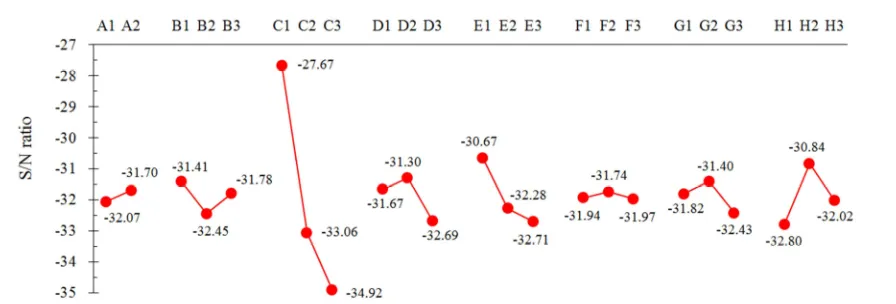
The factor response diagram and the level averages of the eight factors with respect to the S/N ratio are illustrated in Figure 3. It is observed that most of the effects are smaller than the effects of tensile strength, as shown in Figure 2. For the two significant factors of area reduction ratio (A) and spheroidized annealing temperature (C), the optimal levels are Level 1 for the area reduction ratio (0.0%, A1) and Level 3 for the spheroidized annealing temperature (780°C, C3), as
shown in Figure 3. The effects of the other six factors are relatively small. The optimal levels are respectively Level 2 for the preheating rate (300°C/h, B2), Level 3 for prolonged heating time (4.5 h, D3), Level 1 for holding temperature (710°C, E1), Level 3 for holding time (6.0 h, F3), Level 1 for cooling rate (-6.0°C/h, G1), and Level 1 for cooling temperature (610°C, H1).
Figure 3. Factor response diagram for ductility.
With the results of the optimal quality characteristics of tensile strength and ductility, the optimal conditions are shown in Table 8. The spheroidized annealing temperature (C) is obviously significant for both tensile strength and
ductility but at different levels. Since the tensile strength of the steel wire is the main quality characteristic and has a higher effect, the optimal level is thus determined as Level 1 for the spheroidized annealing temperature (750°C, C1).
Table 8. Optimal conditions for spheroidized annealing.
Factor Tensile strength Ductility Optimal
A: Area reduction ratio (%) A2 A1* A1
B: Preheating rate (°C/h) B1 B2 B1
C: Spheroidized annealing temperature (°C) C1* C3* C1
D: Prolonged heating time (h) D2 D3 D2
E: Holding temperature (°C) E1* E1 E1
F: Holding time (h) F2 F3 F2
G: Cooling rate (°C/h) G2 G1 G2
H: Cooling temperature (°C) H2* H1 H2
* Significant factor.
The holding temperature (E) and cooling temperature (H) are significant for the tensile strength but not for ductility. Thus, Level 1 for the holding temperature (710°C, E1) and Level 2 for cooling temperature (665°C, H2) are then chosen as the optimal levels. However, the area reduction ratio (A) is not significant for the tensile strength, but is significant for the ductility. Level 1 for the area reduction ratio (0.0%, A1) is chosen as the optimal level. The other four factors are not significant either for the tensile strength or ductility, as shown in Table 8; thus, Level 1 for the preheating rate (100°C/h, B1), Level 2 for prolonged heating time (2.5 h,
D2), Level 2 for holding time (0.0 h, F2), and Level 2 for cooling rate (-8.5°C/h, G2) are respectively determined.
3.3. Confirmation Experiments
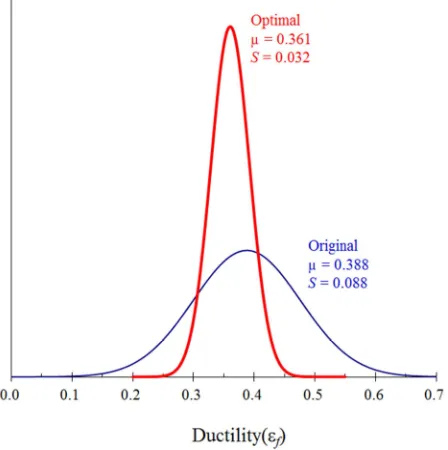
It is observed that, compared with the original results, the optimal mean tensile strength of 567.8 MPa is not only closer to the target value, as shown in Figure 4, but also the deviation is decreased by about 63%. The optimal mean ductility of 0.361, as shown in Figure 5, is slightly smaller than the original mean ductility of 0.388. However, the deviation obviously decreases by about 64% as compared with the original result. The new parameter settings evidently improve the performance measures, such as strength and ductility, over their values at the original settings, as well as the quality of the spheroidized annealed alloy steel wire. Therefore, the formability of the SCM435 alloy steel wire is effectively improved.
Figure 4. Probability distribution diagram for tensile strength.
Figure 5. Probability distribution diagram for tensile ductility.
4. Conclusions
The cold formability of SCM435 alloy medium carbon steel wires is studied. The influence of intercritical annealing parameters namely section-area reductions, preheating rate, spheroidized annealing temperature, prolonged heating time, holding temperature and time, cooling rate and temperature is investigated for the responses of tensile strength and ductility after spheroidized annealing operation. Taguchi’s experiment design along with ANOVA is used to determine significant factors and optimal fabrication conditions. The tensile strength is the main quality characteristic of spheroidized annealed steel wires since the given strength of the annealing steel wire must be provided for cold forming.
It is experimentally revealed that the area reduction ratio (A), spheroidized annealing temperature (C), holding temperature (E) and cooling temperature (H) are significant factors; the determined levels are Level 1 for area reduction ratio (0.0%, A1), Level 1 for spheroidized annealing temperature (750°C, C1), Level 1 for holding temperature (710°C, E1), Level 2 for cooling temperature (665°C, H2), Level 1 for the preheating rate (100°C/h, B1), Level 2 for prolonged heating time (2.5 h, D2), Level 2 for holding time (0.0 h, F2), and Level 2 for cooling rate (-8.5°C/h, G2). They lead to obtaining the optimal mean tensile strength of 567.8 MPa and the optimal mean ductility of 0.361. The new spheroidizing parameter settings evidently improve the performance measures over their values at the original settings as well as the quality of the spheroidized annealed alloy steel wire. The cold formability of SCM435 alloy steel wires is effectively improved.
The optimization of intercritical annealing process parameters for SCM435 alloy steel wires contributes to the improvement in formability of cold heading high strength bolts and machine parts.
Acknowledgements
The authors would like to acknowledge the support of Fang Sheng Screw Co., Ltd., Kaohsiung, Taiwan, for providing the materials and apparatus to carry out the spheroidized annealing experimental work.
References
[1] R. Hill. Annealing: The First Step in Cold Forming. Wire Journal International. 17, (1984) pp.95-97.
[2] P. L. Ebner. Heat Treating Cold-Heading Wire in High-Convective Bell Annealers. Wire World International. 29, (1987) pp. 88-90.
[3] J. Dhers, B. Thivard and A. Genta. Improvement of steel wire for cold heading. Wire Journal International. 25, (1992) pp. 73-76.
[5] P. Johnson. Furnace Atmospheres. In Heat Treating, ASM International: Materials Park, OH, USA, (1991).
[6] Y. L. Tian and R. W. Kraft. Mechanisms of Pearlite Spheroidization. Metallurgical Transactions A. 18, (1987) pp. 1403-1414.
[7] K. Hono, M. Ohnuma, M. Murayama, S. Nishida, A. Yoshie and T. Takahashi. Cementite Decomposition in Heavily Drawn Pearlite Steel Wire. Scripta Materialia. 44, (2001) pp. 977-983.
[8] J. M. O’Brien and W. F. Hosford. Spheroidization Cycles for Medium Carbon Steels. Metallurgical and Materials Transactions A. 33, (2002) pp. 1255-1261.
[9] D. H. Shin, S. Y. Han, K.-T. Park, Y.-S. Kim and Y.-N. Paik. Spheroidization of Low Carbon Steel Processed by Equal Channel Angular Pressing. Materials Transactions. 44, (2003) pp. 1630-1635.
[10] Y. G. Ko, S. Namgung, D. H. Shin, I. H. Son, K. H. Rhee and D.-L. Lee. Spheroidization of Medium Carbon Steel Fabricated by Continuous Shear Drawing. Journal of Materials Science. 45, (2010) pp. 4866-4870.
[11] Y. P. Gul’, M. A. Sobolenko and A. V. Ivchenko. Improvement in the Spheroidizing Annealing of Low-Carbon Steel for Cold Upsetting. Steel in Translation. 42, (2012) pp. 531-535.
[12] S. H. Min and T. K. Ha. Tensile Behavior of Spheroidizing Heat Treated High Carbon Steel. International Journal of Chemical, Molecular, Nuclear, Materials and Metallurgical Engineering. 8, (2014) pp.105-107.
[13] H. S. Joo, S. K. Hwang, H. M. Baek, Y.-T. Im, I.-H. Son and C. M. Bae. The Effect of a Non-circular Drawing Sequence on Spheroidization of Medium Carbon Steel Wires. Journal of Materials Processing Technology. 216, (2015) pp.348-356.
[14] C. Ji, L. Wang and M.-Y. Zhu. Effect of Subcritical Annealing Temperature on Microstructure and Mechanical Properties of SCM435 Steel. Journal of Iron and Steel Research, International. 22, (2015) pp. 1031-1036.
[15] C.-C. Yang and C.-L. Liu. Improvement of the Mechanical Properties of 1022 Carbon Steel Coil by Using the Taguchi Method to Optimize Spheroidized Annealing Conditions.
Materials. 9, 693, (2016).
[16] M. Okonogi and K. Yamazaki. Development of Medium Carbon Steel Wire Rods for Cold Heading by Isothermal Transformation Treatment. Nippon Steel & Sumitomo Metal Technical Report. 116, (2017) pp.65-70.
[17] M. Wang, J. Shan, C. Zheng, M. Zhang, Z. Yang and F. Zhang. Effects of Deformation and Addition of Aluminium on Spheroidisation of High-carbon-bearing Steel. Materials Science and Technology. (2017) pp. 1-11.
[18] M. I. Equbal, A. Equbal, M. A. Equbal and R. Pranav. Optimisation of Forging Parameters of 35C8 Steel Using Grey Relational Analysis. Int. J. Microstructure and Materials Properties. 13, Nos. 3/4, (2018) pp.198-212. [19] C.-C. Yang and S.-T. Wang. Improvement of the Mechanical
Properties of Spheroidized 10B21 Steel Coil Using Taguchi Method of Robust Design. Sensors and Materials. 30, (2018) pp. 503-514.
[20] N. Logothetis. Managing for Total Quality: From Deming to Taguchi and SPC, Prentice Hall International, London, UK, (1992).
[21] H.-H. Lee. Taguchi Methods: Principles and Practices of Quality Design, Gau Lih Book, New Taipei City, Taiwan, (2008).