Open Access
Research article
Prevalence, intensity and extent of Oral Impacts on Daily
Performances associated with self-perceived malocclusion in
11-12-year-old children
Eduardo Bernabé*
1,2, Carlos Flores-Mir
1,3and Aubrey Sheiham
2Address: 1Unidad de Investigación en Salud Pública Dental, Departamento de Odontología Social, Universidad Peruana Cayetano Heredia, Lima,
Perú, 2Department of Epidemiology and Public Health, University College London, London, UK and 3Department of Dentistry and Cranio-facial
& Oral-Health Evidence-based Practice Group, Dentistry/Pharmacy Centre, University of Alberta, Edmonton, Canada
Email: Eduardo Bernabé* - [email protected]; Carlos Flores-Mir - [email protected]; Aubrey Sheiham - [email protected] * Corresponding author
Abstract
Background: To determine the prevalence, intensity and extent of the Oral Impacts on Daily Performances associated with self-perceived malocclusion among Peruvian schoolchildren.
Methods: Eight hundred and five children aged 11 to 12 years attending 4 of 7 randomly selected schools linked to a Health Centre in Lima, Peru, participated in the study. The Spanish (Peru) Child-OIDP was used to assess the prevalence, intensity and extent of oral impacts on 8 daily performances (eating, speaking, teeth cleaning, sleeping, smiling, studying, emotion and social contact). Self-perceived malocclusion included complaints about position of teeth, spacing of teeth and deformity of mouth or face. The prevalence of oral impacts was compared by covariables using the Chi-square test, whereas the intensity and extent of oral impacts were compared by covariables through the Mann-Whitney test.
Results: Only 15.5% of children reported impacts associated with self-perceived malocclusion during the last 3 months. Of them, 18.4% reported impacts of severe or very severe intensity and 76.0% reported impacts on only one daily performance. Psychosocial activities such as smiling, emotion and social contact were the most frequently and severely impacted everyday activities.
Conclusion: Impacts of self-perceived malocclusion primarily affected psychological and social everyday activities. These findings provide further evidence to support the importance of psychological and social components of oral health on children's lives.
Background
A better knowledge about the physical, social and psycho-logical effects of malocclusion is important since it pro-vides insights into the perceived impacts of malocclusion on children's lives [1,2]. To date, there is conflicting evi-dence on the impact of malocclusion on quality of life. A recent review concluded that a greater understanding is
required of the physical, psychological and social conse-quences of malocclusion [3]. Therefore, there is a need for a more comprehensive and rigorous assessments of the impacts of malocclusion on quality of life. These assess-ments should be done on representative population-based epidemiological samples, rather than using patient-based studies, and through the use of specific, rather than
Published: 16 May 2007
BMC Oral Health 2007, 7:6 doi:10.1186/1472-6831-7-6
Received: 7 February 2007 Accepted: 16 May 2007
This article is available from: http://www.biomedcentral.com/1472-6831/7/6
© 2007 Bernabé et al; licensee BioMed Central Ltd.
generic, oral health related quality of life (OHRQoL) measures.
Specific OHRQoL measures are designed for use in clini-cal situations. Their narrow focus means that they are potentially more responsive to small, but clinically impor-tant, changes in health [2,4,5]. Specific instruments may be divided into four types: (1) condition-specific; focusing on individuals with a particular disease or clinical condi-tion, (2) domain-specific; focusing in detail on one dimension only, such as psychological domain, (3) pop-ulation-specific; focusing on subgroups of people such as elderly or children, and (4) symptom-specific; focusing on one type of symptom, such as pain [4,6].
Condition-specific instruments are the most commonly used specific measures to assess quality of life [2]. The advantage of these instruments is that the emphasis is on a specific area of quality of life, rather than assessing qual-ity of life globally [5,6]. Although some OHRQoL meas-ures have been specifically developed to assess the impact of oral characteristics on children's day-to-day living [7-9], the child version of the Oral Impacts on Daily Perform-ances (Child-OIDP) is the only one specifically designed to identify the oral problems leading to the impacts on quality of life, thereby linking the impacts to the oral con-dition needing attention [9]. To make the link, partici-pants are asked about oral problems they consider cause the impacts on their daily living. The condition-specific Child-OIDP (CS-Child-OIDP), based on the calculations related to specific oral conditions, can assist in deciding which groups of children should be treated first [10,11]. This characteristic has enabled its use in the assessment of treatment needs [12,13].
Previous studies assessing the impact of malocclusion on children or adolescents have only reported on the preva-lence of impacts on quality of life [14-16]. No study has explored the intensity or the extent (number of affected daily activities) of the impacts associated with perceived malocclusions. Therefore, the objective of this study was to determine the prevalence, intensity and extent of the oral impacts associated with self-perceived malocclusion among Peruvian schoolchildren.
Methods
The study was carried out within the area related to the Mother-Child Health Centre of Zapallal in Puente Piedra (Lima, Peru). There are 7 public schools in this jurisdic-tion. In 2006, 1519 children aged 11 to 12 years (born in 1995 and 1994 respectively) attended these schools. 4 of these 7 schools were randomly selected as clusters, and all their 903 11-12-year-old children were invited to partici-pate in the study. Ethical approval was obtained from the International Review Board at the Universidad Peruana
Cayetano Heredia. Parents signed a consent letter accept-ing participation of their children. Children also gave written consent for interviews.
Before data collection, the original English version of the Child-OIDP was cross-culturally translated and adapted into Spanish. Then, the validity and reliability of the Spanish (Peru)Child-OIDP were evaluated. For criterion validity, the Spanish (Peru)Child-OIDP scores were signifi-cantly associated with self-perceived oral health status, self-perceived dental treatment need and satisfaction with oral health status (p < 0.001 in all cases). For internal reli-ability, all inter-item correlations were positive and statis-tically different from zero (p ≤ 0.007), whereas the Cronbach's alpha coefficient was 0.62 and did not increase when any performance was deleted. Finally, test-retest reliability was evaluated through intraclass correla-tion coefficient, whose value was 0.85.
The Child-OIDP was administered through individual interviews, except for the first question that was self-administered in a classroom setting. The children were first asked to provide socio-demographic information related to their sex, age and education level (e.g. primary or secondary school), and then, to identify problems with their mouth or teeth perceived during the last 3 months. Thereafter, 2 trained interviewers carried out individual face-to-face structured interviews. Oral impacts on daily life were assessed in relation to 8 daily performances namely, eating, speaking, mouth cleaning, sleeping, smil-ing, studysmil-ing, emotion and social contact. If children reported an impact on any performance, the frequency of the impact (scale from 1 to 3) and the severity of its effect on daily life (scale from 1 to 3) were scored [9]. If no impact was reported, then a zero score was assigned. Finally, children with impacts were asked to identify the oral conditions they perceived as causes of their impacts, using the list of answers to the self-administered question. Although children reported a number of oral problems as causes of their impacts, for this study only those associ-ated with 'bad position of teeth', 'spacing of teeth' and/or 'deformity of mouth or face' were analysed to calculate the condition-specific impacts for malocclusion, hereafter referred to as the CS-Child-OIDP. Because no normative data were collected in this study, the information repre-sents impacts related to self-perceived malocclusion.
oral impacts, the intensity of the impact on each perform-ance score (ranging from 1 to 9) was classified into 5 lev-els: very little (1), little (2), moderate (3–4), severe (6) and very severe (9) [17,18]. The overall intensity of impacts was then estimated as the most severe impact on any of the 8 performances [17]. Finally, the extent of impacts, ranging from 1 to 8 performances, was calculated as the number of performances with impacts [17,18].
For the statistical data analysis, the prevalence of condi-tion-specific impacts was compared according to sex, age and education level using the Chi-square test. The inten-sity and extent of condition-specific impacts were com-pared according to covariables using the Mann-Whitney test. Non-parametric tests were used to compare intensity and extent because the former was measured using an ordinal scale and the latter was not normally distributed in the sample (Kolmogorov-Smirnov test, p < 0.05 for all groups).
Results
Eight hundred and five of the 903 11–12 year-old chil-dren attending the 4 selected schools participated in the study; a response rate of 89.1%. Fifty one percent (51.2%) were female and 48.8% male; 53.5% were at primary edu-cation and 46.5% at secondary eduedu-cation level. The mean age of the children was 11.93 ± 0.63 years.
The prevalence of self-perceived malocclusion was 36.3% [CI95%(32.9; 39.6)]. The most frequently reported oral condition related to malocclusion was position of teeth (28.4%), followed by spacing of teeth (16.3%) and deformity of mouth or face (1.6%). The prevalence of self-perceived malocclusion did not differ by sex or age (p = 0.275 and 0.057 respectively). However, there was a sig-nificant difference of perceived malocclusion by educa-tion level (p = 0.021) (Table 1).
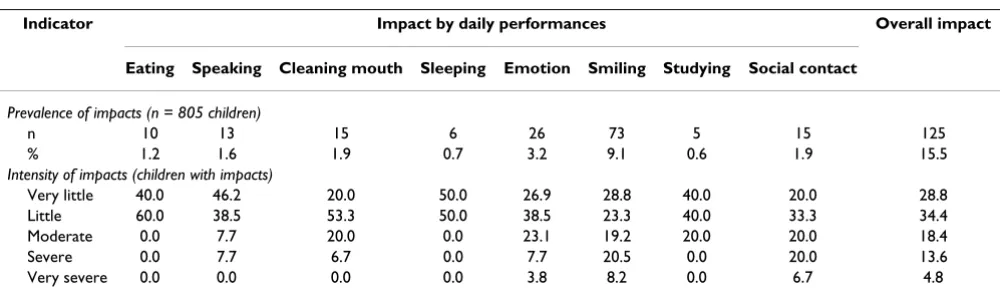
The prevalence of condition-specific impacts was 15.5% [CI95%(13.0; 18.1)]. The most common daily perform-ances affected by malocclusion were smiling and emotion (9.1% and 3.2% respectively). The prevalence of condi-tion-specific impacts on the other evaluated 6 daily per-formances was less than 2.0% (Table 2). There was no statistically significant difference when the prevalence of condition-specific impacts was compared by covariables (p > 0.118 in all cases) (Table 3).
Among children with condition-specific impacts, 18.4% [CI95%(11.5; 25.3)] reported impacts of severe or very severe intensity (Table 2). In the analysis by perform-ances, smiling and social contact were the most severely impacted daily performances; 28.7% and 26.7% of the children with condition-specific impacts reported impacts of severe or very severe intensity respectively, whereas
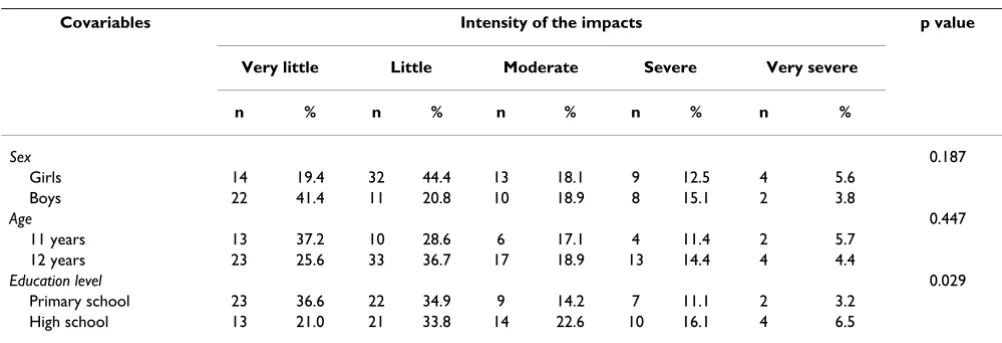
eat-ing, sleeping and studying were the least severely impacted performances and no child reported condition-specific impacts of severe or very severe intensity for them. The intensity of condition-specific impacts differed only between education levels (p = 0.029) (Table 4).
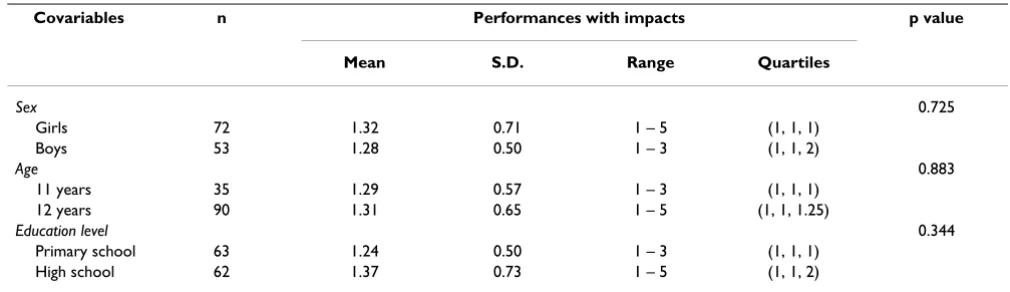
The mean number of performances impacted was 1.30 [IC95%(1.19; 1.41)], with 76.0% of children with condi-tion specific impacts reporting 1; 19.2% reporting 2, 3.2% reporting 3, 0.8% reporting 4 and 0.8% reporting 5 per-formances affected. None reported condition-specific impacts on 6 or more of the 8 daily performances. No sta-tistically significant difference was found when the extent of the condition-specific impacts was compared by covari-ables (p > 0.344 in all cases) (Table 5).
Discussion
The present study is the first to assess the intensity and extent of the impacts associated with perceived malocclu-sion on the quality of life of children. We used self-per-ceived malocclusion rather than a normative definition of malocclusion since normative orthodontic need indexes are not strongly associated with people's perceptions of their oral health status [19,20] and quality of life [3,14,15]. Subjective impacts directly identified as being related to malocclusion have been previously used to cap-ture subjective feelings [21,22]. Although a similar group of oral conditions has been used in the development of a socio-dental model to assess children's orthodontic needs [12], it should be noted that impacts associated to spacing of teeth among 11–12 year-old children may include spaces due to unerupted permanent teeth or physiological diastemas rather than spaces indicating a need for ortho-dontic treatment. A proper discrimination would only be possible through a comprehensive clinical examination, which was not done in this study.
norms for acceptable dental arrangement operate in areas with low and high treatment frequency [25].
Slightly less than one-fifth of the Peruvian children with condition-specific impacts reported severe or very severe intensity. Children reported a greater prevalence and intensity of impacts related to smiling, laughing and showing the teeth without embarrassment, contact with people (e.g. going out with friends, going to a friend's house) and maintaining the usual emotional state with-out being irritable. Other psychosocial activities such as carrying out schoolwork (e.g. going to school, participat-ing in class, doparticipat-ing homework) and relaxparticipat-ing/sleepparticipat-ing (e.g. watching television, reading a comic book) were the least frequent and least severely impacted. These findings high-light the importance of the psychological and social aspects of the teeth and mouth on children's lives. Teeth mainly affect social interaction with peers, where satisfac-tion with dental appearance plays a very important role [16,20,26].
Interference with predominantly physical activities such as eating and enjoying food, speaking clearly and cleaning mouth (e.g. rinsing your mouth, brushing your teeth)
were only reported by between 1.3% and 1.9% of the chil-dren. It has been reported that dissatisfaction with ability to chew was less often a reason for seeking orthodontic treatment because problems with chewing may be less common than problems related with dental appearance [15,27]. These findings question long-standing beliefs that the main effects of malocclusion are on mastication and speech. However, it is difficult to draw firm conclu-sions about these issues from this study.
More than three-quarters of the children with impacts had only one daily performance affected. The performances affected were mainly related to smiling, laughing and showing teeth without embarrassment. Eating, sleeping and studying were not frequently affected. No child reported impacts on more than 5 daily performances. The findings support the view that children with a perceived malocclusion are more concerned with dental aesthetics than with function. Therefore, psychological factors, such as dental aesthetics, self-perception of dental appearance, rather than the severity of the clinical occlusal condition, most probably determine children's demand for ortho-dontic treatment [27,28].
Table 2: Prevalence and intensity of the impacts associated with self-perceived malocclusion among 11-12-year-old Peruvian schoolchildren
Indicator Impact by daily performances Overall impact
Eating Speaking Cleaning mouth Sleeping Emotion Smiling Studying Social contact
Prevalence of impacts (n = 805 children)
n 10 13 15 6 26 73 5 15 125
% 1.2 1.6 1.9 0.7 3.2 9.1 0.6 1.9 15.5
Intensity of impacts (children with impacts)
Very little 40.0 46.2 20.0 50.0 26.9 28.8 40.0 20.0 28.8
Little 60.0 38.5 53.3 50.0 38.5 23.3 40.0 33.3 34.4
Moderate 0.0 7.7 20.0 0.0 23.1 19.2 20.0 20.0 18.4
Severe 0.0 7.7 6.7 0.0 7.7 20.5 0.0 20.0 13.6
Very severe 0.0 0.0 0.0 0.0 3.8 8.2 0.0 6.7 4.8
Table 1: Prevalence of self-perceived malocclusion among 11-12-year-old Peruvian schoolchildren
Covariables Perceived malocclusion No perceived malocclusion p value
n % n %
Sex 0.275
Girls 142 34.5 270 65.5
Boys 150 38.2 243 61.8
Age 0.057
11 years 91 41.6 128 58.4
12 years 201 34.3 385 65.7
Education level 0.021
Primary school 172 39.9 259 60.1
The Child-OIDP measures impacts on the ultimate level of the oral impacts [9,29], equivalent to the disability and handicap dimensions in the WHO model [30]. Measuring impacts only at the ultimate level covers all major impacts, and omits very minor intermediate level condi-tions thereby avoiding over-scoring when intermediate impacts are also measured [31].
If the figures reported here were used for orthodontic serv-ices planning, the estimates of orthodontic treatment need would likely be lower than those obtained using normative indexes alone [12,14,15]. Using the prevalence and intensity of oral impacts associated with perceived malocclusion, only 125 (15.5%) and 23 (2.9%) respec-tively of the 805 children would require orthodontic treat-ment based on their subjective perceptions. Although normative needs and OHRQoL are associated, there is a considerable difference between them. Therefore, OHR-QoL measures cannot replace normative needs or
vice-versa [32]. Instead, both should be used in combination to cover different dimensions of oral health. Since the normative approach to estimate orthodontic needs gives unrealistically high estimates of need, a more realistic method of assessing needs requires the integration of a normative measure with an indicator of the child's feel-ings and/or oral impacts [12,13]. Using such a socio-den-tal model to assess orthodontic need is more appropriate for dental service planning. It provides more appropriate manpower estimates based on the potential for oral health gain [10,11].
Although it has been argued that the physical, social and psychological effects are important reasons why ortho-dontic care is sought [3], our findings support the idea that the impact of the malocclusion, at least the self-per-ceived, primarily affected the psychological and social components of oral health and those factors may induce demand. However, a recent 20-year longitudinal study
Table 4: Intensity of the impacts associated with self-perceived malocclusion, by covariables, among 11-12-year-old Peruvian schoolchildren
Covariables Intensity of the impacts p value
Very little Little Moderate Severe Very severe
n % n % n % n % n %
Sex 0.187
Girls 14 19.4 32 44.4 13 18.1 9 12.5 4 5.6
Boys 22 41.4 11 20.8 10 18.9 8 15.1 2 3.8
Age 0.447
11 years 13 37.2 10 28.6 6 17.1 4 11.4 2 5.7
12 years 23 25.6 33 36.7 17 18.9 13 14.4 4 4.4
Education level 0.029
Primary school 23 36.6 22 34.9 9 14.2 7 11.1 2 3.2
High school 13 21.0 21 33.8 14 22.6 10 16.1 4 6.5
Mann- Whitney test was used
Table 3: Prevalence of the impacts associated with self-perceived malocclusion, by covariables, among 11-12-year-old Peruvian schoolchildren
Covariables Impacts No impacts p value
n % n %
Sex 0.118
Girls 72 17.5 340 82.5
Boys 53 13.5 340 86.5
Age 0.828
11 years 35 16.0 184 84.0
12 years 90 15.4 496 84.6
Education level 0.443
Primary school 63 14.6 368 85.4
High school 62 16.6 312 83.4
concluded that there was little objective evidence to sup-port the assumption that orthodontics improves long-term psychological health. Thus, orthodontics cannot be justified on psychological grounds alone [33]. Therefore, further studies are needed to provide a greater under-standing of the consequences of malocclusion, the effects of malocclusion if left untreated, and also the possible benefits of orthodontic care on day-to-day activities. These studies should be based not only on normative need but also on OHRQoL information acquired from the children. That would improve orthodontic treatment need assessments [12].
Conclusion
- Only 15.5% of the interviewed children reported impacts associated with self-perceived malocclusion dur-ing the last three months. Among children with impacts, 18.4% reported impacts of severe or very severe intensity and 76.0% had impacts on only one daily performance.
- Among children with impacts, psychosocial activities such as smiling, emotion and social contact were the most frequently and severely impacted. These findings provide further evidence in support of the importance of psycho-logical and social components of oral health children's lives.
- Education level was the only demographic variable that significantly affected the prevalence of self-perceived malocclusion and intensity of the impacts associated with self-perceived malocclusion.
Competing interests
The author(s) declare that they have no competing inter-ests.
Authors' contributions
Eduardo Bernabé conceived of the study, was responsible for the data collection in Peru, conducted the statistical analysis and was responsible for the completion of the whole manuscript. Carlos Flores-Mir was consulted for methodology and revised the manuscript. Aubrey Shei-ham contributed to the conception and design of the study and critically revised the manuscript. All authors read and approved the final version of the manuscript.
Acknowledgements
This study was supported by the Programme Alβan, the European Union Programme of High Level Scholarships for Latin America, Scholarship N° (E06D1000352PE).
References
1. O'Brien K, Kay L, Fox D, Mandall N: Assessing oral health out-comes for orthodontics--measuring health status and quality of life. Community Dent Health 1998, 15(1):22-26.
2. Cunningham SJ, Hunt NP: Quality of life and its importance in orthodontics. J Orthod 2001, 28(2):152-158.
3. Zhang M, McGrath C, Hagg U: The impact of malocclusion and its treatment on quality of life: a literature review. Int J Paedi-atr Dent 2006, 16(6):381-387.
4. Guyatt GH, Feeny DH, Patrick DL: Measuring health-related quality of life. Ann Intern Med 1993, 118(8):622-629.
5. Allen PF: Assessment of oral health related quality of life. Health Qual Life Outcomes 2003, 1(1):40.
6. Camilleri-Brennan J, Steele RJ: Measurement of quality of life in surgery. J R Coll Surg Edinb 1999, 44(4):252-259.
7. Jokovic A, Locker D, Stephens M, Kenny D, Tompson B, Guyatt G:
Validity and reliability of a questionnaire for measuring child oral-health-related quality of life. J Dent Res 2002,
81(7):459-463.
8. Filstrup SL, Briskie D, da Fonseca M, Lawrence L, Wandera A, Ingle-hart MR: Early childhood caries and quality of life: child and parent perspectives. Pediatr Dent 2003, 25(5):431-440. 9. Gherunpong S, Tsakos G, Sheiham A: Developing and evaluating
an oral health-related quality of life index for children; the CHILD-OIDP. Community Dent Health 2004, 21(2):161-169. 10. Gherunpong S, Sheiham A, Tsakos G: A sociodental approach to
assessing children's oral health needs: integrating an oral health-related quality of life (OHRQoL) measure into oral health service planning. Bull World Health Organ 2006,
84(1):36-42.
Table 5: Extent of the impacts associated with self-perceived malocclusion, by covariables, among 11-12-year-old Peruvian schoolchildren
Covariables n Performances with impacts p value
Mean S.D. Range Quartiles
Sex 0.725
Girls 72 1.32 0.71 1 – 5 (1, 1, 1)
Boys 53 1.28 0.50 1 – 3 (1, 1, 2)
Age 0.883
11 years 35 1.29 0.57 1 – 3 (1, 1, 1)
12 years 90 1.31 0.65 1 – 5 (1, 1, 1.25)
Education level 0.344
Primary school 63 1.24 0.50 1 – 3 (1, 1, 1)
High school 62 1.37 0.73 1 – 5 (1, 1, 2)
Publish with BioMed Central and every scientist can read your work free of charge
"BioMed Central will be the most significant development for disseminating the results of biomedical researc h in our lifetime."
Sir Paul Nurse, Cancer Research UK
Your research papers will be:
available free of charge to the entire biomedical community
peer reviewed and published immediately upon acceptance
cited in PubMed and archived on PubMed Central
yours — you keep the copyright
Submit your manuscript here:
http://www.biomedcentral.com/info/publishing_adv.asp
BioMedcentral
11. Gherunpong S, Tsakos G, Sheiham A: A sociodental approach to assessing dental needs of children: concept and models. Int J Paediatr Dent 2006, 16(2):81-88.
12. Gherunpong S, Tsakos G, Sheiham A: A socio-dental approach to assessing children's orthodontic needs. Eur J Orthod 2006,
28(4):393-399.
13. Sheiham A, Tsakos G: Oral health needs assessments. In Com-munity Oral Health Edited by: Pine C, Harris R. New Malden , Quintes-sence Publishing Co. Limited; 2007.
14. de Oliveira CM, Sheiham A: The relationship between norma-tive orthodontic treatment need and oral health-related quality of life. Community Dent Oral Epidemiol 2003, 31(6):426-436. 15. de Oliveira CM, Sheiham A: Orthodontic treatment and its impact on oral health-related quality of life in Brazilian ado-lescents. J Orthod 2004, 31(1):20-7; discussion 15.
16. Marques LS, Ramos-Jorge ML, Paiva SM, Pordeus IA: Malocclusion: aesthetic impact and quality of life among Brazilian school-children. Am J Orthod Dentofacial Orthop 2006, 129(3):424-427. 17. Gherunpong S, Tsakos G, Sheiham A: The prevalence and
sever-ity of oral impacts on daily performances in Thai primary school children. Health Qual Life Outcomes 2004, 2(1):57. 18. Kida IA, Astrom AN, Strand GV, Masalu JR, Tsakos G:
Psychomet-ric properties and the prevalence, intensity and causes of oral impacts on daily performance (OIDP) in a population of older Tanzanians. Health Qual Life Outcomes 2006, 4:56. 19. Bernabé E, Flores-Mir C: Normative and self-perceived
ortho-dontic treatment need of a Peruvian university population. Head Face Med 2006, 2:22.
20. Shaw WC: Factors influencing the desire for orthodontic treatment. Eur J Orthod 1981, 3(3):151-162.
21. Ekanayake L, Weerasekare C, Ekanayake N: Needs and demands for dental care in patients attending the University Dental Hospital in Sri Lanka. Int Dent J 2001, 51(2):67-72.
22. Hensel E, Born G, Korber V, Altvater T, Gesch D: Prevalence of defined symptoms of malocclusion among probands enrolled in the Study of Health in Pomerania (SHIP) in the age group from 20 to 49 years. J Orofac Orthop 2003,
64(3):157-166.
23. Tubert-Jeannin S, Pegon-Machat E, Gremeau-Richard C, Lecuyer MM, Tsakos G: Validation of a French version of the Child-OIDP index. Eur J Oral Sci 2005, 113(5):355-362.
24. Bernabé E, Flores-Mir C: Orthodontic treatment need in Peru-vian young adults evaluated through dental aesthetic index. Angle Orthod 2006, 76(3):417-421.
25. Espeland LV, Gronlund G, Stenvik A: Concern for dental appear-ance among Norwegian young adults in region with low uptake of orthodontic treatment. Community Dent Oral Epidemiol
1993, 21(3):151-157.
26. Espeland LV, Stenvik A: Perception of personal dental appear-ance in young adults: relationship between occlusion, aware-ness, and satisfaction. Am J Orthod Dentofacial Orthop 1991,
100(3):234-241.
27. Tuominen ML, Tuominen RJ: Factors associated with subjective need for orthodontic treatment among Finnish university applicants. Acta Odontol Scand 1994, 52(2):106-110.
28. Albino JE, Cunat JJ, Fox RN, Lewis EA, Slakter MJ, Tedesco LA: Var-iables discriminating individuals who seek orthodontic treat-ment. J Dent Res 1981, 60(9):1661-1667.
29. Locker D: Measuring oral health: a conceptual framework. Community Dent Health 1988, 5(1):3-18.
30. WHO: International classification of impairments, disabilities and handicaps. Geneva , World Health Organization; 1980. 31. Adulyanon S, Sheiham A: Oral Impact on daily performances. In
Measuring oral health and quality of life Edited by: Slade GD. Chapel Hill , University of North Carolina; 1997:151-160.
32. Tsakos G, Gherunpong S, Sheiham A: Can oral health-related quality of life measures substitute for normative needs assessments in 11 to 12-year-old children? J Public Health Dent
2006, 66(4):263-268.
33. Kenealy PM, Kingdon A, Richmond S, Shaw WC: The Cardiff dental study: a 20-year critical evaluation of the psychological health gain from orthodontic treatment. Br J Health Psychol
2007, 12(Pt 1):17-49.
Pre-publication history
The pre-publication history for this paper can be accessed here: