Open Access
Research article
Cost-efficiency assessment of Advanced Life Support (ALS) courses
based on the comparison of advanced simulators with conventional
manikins
José Antonio Iglesias-Vázquez*
†1, Antonio Rodríguez-Núñez
†2,
Mónica Penas-Penas
†1, Luís Sánchez-Santos
3, Maria Cegarra-García
1and
Maria Victoria Barreiro-Díaz
1Address: 1Public Emergency Medical System of Galicia-061 (PEMSG), Servicio Galego de Saúde (SERGAS), Santiago de Compostela, Spain, 2Pediatric Emergency and Critical Care Division, Department of Pediatrics, Hospital Clínico Universitario de Santiago de Compostela, Servicio
Galego de Saúde (SERGAS) and University of Santiago de Compostela, Spain and 3Arzúa's Primary Care Center, Servicio Galego de Saúde
(SERGAS), Arzúa, A Coruña, Spain
Email: José Antonio Iglesias-Vázquez* - [email protected]; Antonio Rodríguez-Núñez - [email protected]; Mónica Penas-Penas - [email protected]; Luís Sánchez-Santos - [email protected]; Maria
Cegarra-García - [email protected]; Maria Victoria Barreiro-Díaz - [email protected] * Corresponding author †Equal contributors
Abstract
Background: Simulation is an essential tool in modern medical education. The object of this study was to assess, in cost-effective measures, the introduction of new generation simulators in an adult life support (ALS) education program.
Methods: Two hundred fifty primary care physicians and nurses were admitted to ten ALS courses (25 students per course). Students were distributed at random in two groups (125 each). Group A candidates were trained and tested with standard ALS manikins and Group B ones with new generation emergency and life support integrated simulator systems.
Results: In group A, 98 (78%) candidates passed the course, compared with 110 (88%) in group B (p < 0.01). The total cost of conventional courses was €7689 per course and the cost of the advanced simulator courses was €29034 per course (p < 0.001). Cost per passed student was €392 in group A and €1320 in group B (p < 0.001).
Conclusion: Although ALS advanced simulator systems may slightly increase the rate of students who pass the course, the cost-effectiveness of ALS courses with standard manikins is clearly superior.
Background
Cardiopulmonary resuscitation (CPR) training needs spe-cific courses built on experienced instructors, adequate lectures, skill-stations and the simulation of realistic sce-narios. The availability of specifically designed manikins
and the implementation of learning systems and course regulations, following Resuscitation Council's recom-mendations, have allowed for the effective training of a huge number of health care professionals [1-8].
Published: 22 October 2007
BMC Emergency Medicine 2007, 7:18 doi:10.1186/1471-227X-7-18
Received: 16 May 2007 Accepted: 22 October 2007
This article is available from: http://www.biomedcentral.com/1471-227X/7/18
© 2007 Iglesias-Vázquez et al; licensee BioMed Central Ltd.
Simulation is a general term for an interactive educational strategy that has been shown to be highly useful in the qualification of professionals working in emergency con-ditions (like flight pilots and physicians) [9-12]. Simi-larly, new simulation systems, including sophisticated manikins and computers, represent an important step ahead in technology as well as in medical training possi-bilities.
The theoretical advantages of "simulation system mani-kins" include: real-time records of the scenario (including responses or treatments applied by the student to the patient) allowing for a more accurate debriefing, more sophisticated manikin features (central and peripheral pulses, real cardiac and respiratory sounds, improved air-way simulation etc.) and connection to a personal com-puter that permits the design and execution of an array of closed and open scenarios according to the trainings needs of courses, instructors and candidates [13-16].
The introduction and development of simulation models in health care professional's training programs should attempt to improve the quality of training and, subse-quently, clinical practice. However there is currently little evidence of this. Today simulation systems are very expen-sive [17] and doubts exist about whether they are worth-while in cost-effective terms and in terms of the quality of the training process compared to usual ALS teaching materials and courses.
The aim of the present study is to assess the impact of the introduction in ALS courses of last-generation simulation system in terms of cost-effectiveness.
Methods
The Public Emergency Medical System of Galicia-061 (PEMSG) has a teaching center in charge of practical train-ing of all PEMSG health care staff (emergency medical technicians, nurses and physicians). It also offers courses for other health care professionals (primary care doctors and nurses, pediatricians and other medical specialists) as well as courses for (e.g.) the police or fire-brigade ALS courses are mandatory for PEMSG nurses and physicians and they follow the course regulations (in terms of pro-grams, teaching material and instructors) recommended by the European Resuscitation Council (ERC) and the Spanish Resuscitation Council (SRC).
Two hundred fifty students admitted to ALS courses were divided in two groups: 125 candidates were assigned to 5 courses that followed the "standard rules" and used
con-ventional ALS manikins (ALS Skilltrainer® with Heartsim
200® arrhythmia simulator, designed by the Laerdal
Com-pany, Stavanger, Norway) (group A) and the remaining 125 were assigned to 5 courses based on scenarios
sup-ported by the brand new SimMan® simulator (software
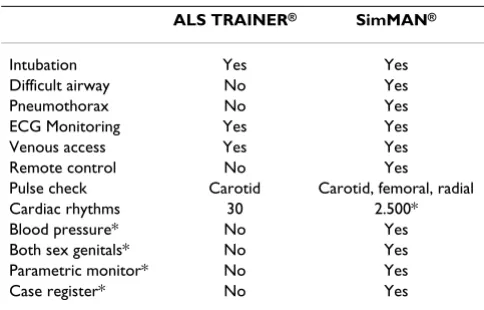
version 2.1), also designed and manufactured by Laerdal Company, Stavanger, Norway (group B). The manikins main characteristics appear in table 1.
Candidates were assigned to groups at random, and the course programs (with the exception of manikins used) were similar in both groups. The duration of the course was 20 hours over four days (5 hours/day) with a ratio of lectures to practical sessions of 1:1 (practical tests not included). The number of trainees per course was 24–26, with 4 instructors (student/instructor ratio of 6:1), one course director and one person in charge of the equip-ment. The schedule was designed according to teaching programs currently recommended by major CPR associa-tions [18,19]. Nurses and physicians were present and mixed in all courses and requirements to pass the course were the same for all candidates.
All skill stations and test scenarios were designed before-hand using CPR instructor manuals [18,20,21]. They included predefined flow charts, with acceptable and unacceptable responses, specific points to be addressed and the minimum number of responses accepted to pass the practical test. Borderline pass candidates at scenario test were re-tested by another instructor. Cut-off point to pass written test was 85%.
A total of 10 expert instructors participated in the courses. All of them had passed at least one ALS instructor course, had participated in at least in 3 prior ALS courses and had also received specific training on the use of the SimMan®
simulator, including its periodic updates during the study period (years 2003 and 2004). The course director has extensive experience at national and international level in ALS, pediatric advanced life support and advanced trauma life support courses.
Table 1: Manikins' characteristics
ALS TRAINER® SimMAN®
Intubation Yes Yes
Difficult airway No Yes
Pneumothorax No Yes
ECG Monitoring Yes Yes
Venous access Yes Yes
Remote control No Yes
Pulse check Carotid Carotid, femoral, radial Cardiac rhythms 30 2.500* Blood pressure* No Yes Both sex genitals* No Yes Parametric monitor* No Yes
Case register* No Yes
The cost calculations for the courses were made by the PEMSG accounting staff. They were unaware of the object of this study and have considered all the used material (property of the center, renting, disposable equipment and pharmacy material), educational material, secretarial duties, instructors pay and other additional costs (like transport, classrooms, etc.).
Instructors received 48 euros for each lecture and 30 euros for each skill station. In the structural costs we included the property costs of the educational services of our edu-cational center (personnel, place conditioned for the formative activity, etc.). We also included the common costs derived from the day to day running of the founda-tion generated by the course (cleaning, communicafounda-tions, supplies, management, etc.). We imputed a proportional form to the weight of the personnel of the educational center inside the Foundation, which represent 2.5%.
For the material property of the center we considered depreciation and maintenance costs. We included in every course the proportional part of costs depending on the number of effective utilization hours of the equipment. For renting we considered the rent cost of three rooms for 10 practical hours and one theoretical class-room with capacity for 30 pupils equipped with projection screen, table, and auxiliary material. We also included three classrooms necessary for practical stations. Renting cost of manikins was calculated considering cost of product, maintenance and number of uses during the redemption period. Results are expressed in euros.
Statistical analysis
Results are presented as number and percentage or mean ± standard deviation. Statistical testing were done with Chi-squares test for categorical and Student's t-test for continuous data, as appropriate. A p < 0.05 was consid-ered significant.
Results
Candidates of both groups were similar in terms of age, sex, previous training and employment status (Table 2).
In group A (conventional training) 98 students (78%) passed and 27 (22%) failed the course. In contrast, in group B (new simulator training) 110 students (88%) passed and 15 (12%) failed the course (p = 0.06).
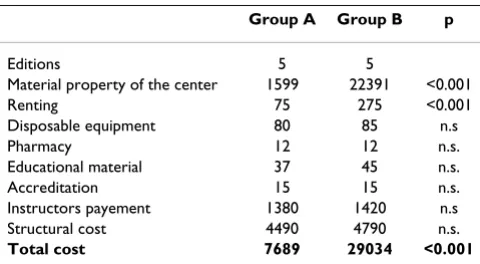
The total cost of course B (€ 29034 per edition) was sig-nificantly higher than cost of course A (€ 7689 per edi-tion) (p < 0.001). The items that account for the cost difference between courses were "material property of the center" (22391 vs. 1599 euros, p < 0.001) and "renting" (275 vs 75 euros, p < 0.01) (Table 3).
When considering cost per passed student, the results
were € 1320 in course B and € 392 in course A (p <
0.001).
Also, teaching costs per candidate were higher in course B (€ 1161) than course A (€ 308) (p < 0.001).
Discussion
The Best Evidence Medical Education (BEME) Collabora-tion systematic review of high-fidelity simulaCollabora-tion studied the characteristics and uses of medical simulations that lead to most effective learning, identifying ten key features of medical use of simulation: providing feedback, repeti-tive practice, curriculum integration, range of difficulty level, multiple learning strategies, capture clinical varia-tion, controlled environment, individualized learning, defined outcomes and simulator validity [22].
Simulation systems that include advanced manikins and computer represent a qualitative step ahead in teaching technology as well as in training possibilities for emer-gency healthcare staff.
Although same closed or open scenarios can be used, and the critical points for scenario resolutions use similar
standards for the ALS trainer® and SimMan®, when
com-pared with standard manikin-based courses, integrated
Table 3: Costs of the courses (in euros).
Group A Group B p
Editions 5 5
Material property of the center 1599 22391 <0.001
Renting 75 275 <0.001
Disposable equipment 80 85 n.s
Pharmacy 12 12 n.s.
Educational material 37 45 n.s.
Accreditation 15 15 n.s.
Instructors payement 1380 1420 n.s Structural cost 4490 4790 n.s.
Total cost 7689 29034 <0.001
Table 2: Candidates characteristics
Group A Group B P
Students 125 125
Men/women* 58/67 49/76 n.s.
Physicians* 61 68 n.s.
Nurses* 64 57 n.s.
Age (years)# 41 ± 6,3 44 ± 8,1 n.s. Prior ALS courses* 42 37 n.s. Courses in last two years* 31 29 n.s.
simulators also offer very realistic scenarios and provide the possibility to do in depth debriefing as well as improved feed-back [23-25]. This is important because feed-back is a crucial component of the learning process associated to simulation that can be improved in quality with in depth debriefing of the scenario performed by means of candidates and instructor interaction.
Previous concerns have been expressed about efficiency of simulation systems [26,27]. In this way the use of
advanced systems like SimMan® for the purposes of ALS
courses may have relevant drawbacks. Simulators are very expensive even for wealthy training centres; then a signif-icant amount a budget must be devoted to the purchase and maintenance of sufficient quantities of manikins. This fact has limited in many cases the teaching possibili-ties of centers, especially in low income areas or in non-public funded institutions [28-30]. New simulation sys-tems will challenge the budgets of teaching centers and might hinder the global objective of training and retrain-ing all healthcare staff in advanced life support [31-34].
In addition, simulation needs expert instructors with the ability to simultaneously interact with the students and the simulator. To achieve this expertise many work hours are needed and a learning curve must be considered. This fact could limit the access of interested candidates to courses. In addition, some SimMan® features that
contrib-ute to its high cost are not essential to fulfill the specific ALS course objectives.
Taking into account the theoretical virtues and drawbacks,
is it worthwhile to implement SimMan® or other advanced
simulators in ALS courses?.
In this sense, and as far as we know, our study is the first to assess from a practical point of view the comparative cost-effectiveness of an advanced simulator in ALS courses. Our results are quite clear and indicate that, although simulator systems can slightly increase the rate of passed candidates (from 78% to 88%) it is achieved at a high cost (3.77 times when total expenses are consid-ered and 3.35 times if related to the cost per passed stu-dent).
Our study has limitations that must be considered. We have not included the costs derived from instructor's spe-cific training to manage simulation systems [31]. This expense is very difficult to estimate accurately and will increase the cost difference in favor of standard manikins. Our results could be influenced by some differences in manikin performance and their capability to practice and measure the depth of chest compressions. In this sense our instructors and candidates did not make objections
and we consider that such differences had a minimal influence on results.
Despite the possible disadvantage of simulation in cost-effectiveness for ALS courses, we consider that simulation may have an outstanding role in medical training includ-ing emergency, critical care, trauma, surgery and general and nurse procedures. In our opinion, significant effort should be made by manufacturers in order to produce high quality products at a reasonable price that permit wide implementation of medical simulation [35-41].
Finally, our results should not be generalized because they were obtained in a specific environment and in a public medical emergency system and it is possible that a similar study, carried out in institutions with different character-istics, would give different results. We encourage such studies.
Conclusion
New medical simulation systems are effective training tools for ALS courses but they are not worthwhile, in terms of cost, when compared to ALS courses based on conventional manikins.
Competing interests
The author(s) declare that they have no competing inter-ests.
Authors' contributions
JAIV conceived the study, participated in the design of the study and drafted the manuscript. ARN and LSS partici-pated in the design of the study, statistical analysis and reviewed the manuscript. MPP worked with all the cost study and the design of the economical part of the study. MCG and MVBD participated in the design and reviewed the manuscript. All authors read and approved the final manuscript.
Acknowledgements
To the Public Emergency Health Foundation of Galicia and especially to all the members that participate in the advanced life support courses as teach-ers.
References
1. Álvarez JA, Lecuona MJ, Sabugo P, Catalán B: Supervivencia de las paradas cardíacas extrahospitalarias tratadas por unidades móviles medicalizadas. Emergencias 1993, 5:177.
2. Marrugat J, Elosua R, Gil M, Muerte súbita (I): Epidemiología de la muerte súbita cardiaca en España. Rev esp Cardiol 1999,
52:717-725.
3. Handley AJ, Monsieurs KG, Bossaert LL: European Resuscitation Council Guidelines 2000 for Adult Basic and Advanced Life Support. Resuscitation 2001, 48:199-205.
Publish with BioMed Central and every scientist can read your work free of charge "BioMed Central will be the most significant development for disseminating the results of biomedical researc h in our lifetime."
Sir Paul Nurse, Cancer Research UK
Your research papers will be:
available free of charge to the entire biomedical community
peer reviewed and published immediately upon acceptance
cited in PubMed and archived on PubMed Central
yours — you keep the copyright
Submit your manuscript here:
http://www.biomedcentral.com/info/publishing_adv.asp
BioMedcentral 5. Cobb l, Weaver D, Fahrenbruch C, Hallstrom A, Copass M:
Com-munity- Based interventions for sudden cardiac death. Circu-lation 1992, 85(Supl):98-102.
6. Atkins JM: Emergency medical service systems in acute car-diac care state of the art. Circulation 1986, 74(suppl 6, pt 2): IV-4-IV-8.
7. Safar P: History of cardiopulmonary-cerebral resuscitation.
Edited by: Kaye W, Bicher N. New York: Churchill Livingstone; 1989:1-53.
8. Cummins RO, Ornato JP, Thies WH, Pepe PE: Improving survival from sudden cardiac arrest: the "chain of survival" concept. A statement for health professionals from the Advanced Cardiac Life Support Subcomittee and the Emergency Car-diac Care Committee, American Heart Association. Circula-tion 1991, 83:1832-1847.
9. Sexton JB, Thomas EJ, Helmrich RL: Error, stress and temawork in medicina and aviation: cross sectional surveys. Br Med J 2000, 320:745-9.
10. Schiew H: A flight Simulator for general anestesia training.
Comput Biomed Res 1987, 27:161-168.
11. Issenberg SB, McGaghie C, Hart IR, Mayer JW, Felner JM, Petrusa ER, et al.: Simulation technology for health care professional skills training. Anesthesiology 1988, 69:387.
12. Small SD, Wuerz RC, Simon R, Shapiro N, Conn A, Setnik G: Dem-ostration of high-fidelity simulation team training for emer-gency medicine. Acad Emerg Med 1999, 6:312-323.
13. Ruano M, Tormo C: Manual de Soporte Vital Avanzado. Consejo Español de RCP. Masson 3a edition. 2003.
14. Rabanal JM, Del Moral I, Quesada A, Díaz de Terán JC, Borregán JL, Teja JL, et al.: Los simuladores médicos en la formación contin-uada: nuestra experiencia con 535 médicos de urgencia hos-pitalarios. Emergencias 2003, 15:333-338.
15. Bond WF, Spilane L: The use of simulation for emergency med-icine resident acess. Acad Emerg Med 2002, 9:1295.
16. Gaba DM, Howard SK, Flanagan b: Assessment of clinical per-formance during simulated crisis using both technical and behavioural ratings. Anesthesiology 1998, 89:8.
17. Schwid HA, Rooke GA, Carline J, Steadman RH, Murray WB, Olympo M, et al.: Evaluation of anesthesia residents using mannequin-based simulation. A multiinstitutional study. Anesthesiology 2002, 97:1434-44.
18. Chamberlain DA, Hazinski MF: Education in resuscitation. Resus-citation 2003, 59:11-43.
19. Baskett P: Progress of the advanced life support courses in Europe and beyond. Resuscitation 2004, 62:311-313.
20. Morgan PJ, Cleave-Hogg D: Simulation technology in training students, residents and faculty. Curr Opin Anaesthesiol 2005,
18:199-203.
21. Kneebone R: Evaluating clinical simulations for learning pro-cedural skills: a theory-based approach. Acad Med 2005,
80:549-553.
22. Issenberg SB, McGaghie WC, Petrusa ER, Lee GD, RJ Scalese RJ: Fea-tures and uses of high-fidelity medical simulations that lead to effective learning: a BEME systematic review. Med Teach 2005, 27:10-28.
23. Maran NJ, Glavin RJ: Low-to high-fidelity simulation – a contin-uum of medical education? Med Educ 2003, 37:22-28.
24. Bradley P, Postlethwaite K: Simulation in clinical learning. Med Educ 2003, 37:1-5.
25. Kneebone R: Simulation in surgical training: educational issues and practical implications. Med Educ 2003, 37:267-277. 26. Schwid HA, Rooke GA, Ross BK, Sivarajan M: Use of a
computer-ized advanced cardiac life support simulator improves reten-tion of advanced cardiac life support guidelines better than a textbook review. Crit Care Med 1999, 27:821-824.
27. Granneman S, Conn VS: An evaluation of the effectiveness of competency-based code blue education. J Nurs Staff Dev 1996,
12:283-288.
28. Boonmak P, Boonmak S, Srichaipanha S, Poomsawat S: Knowledge and skill after brief ACLS training. J Med Assoc Thai 2004,
87:1311-1314.
29. Marchette L, Jones S, Bagg A, Cohen A, Palau D, Thaw P: The effect of an advanced cardiac life support course on advanced car-diac life support ability. Heart Lung 1985, 14:594-598.
30. Makker R, Gray-Siracusa K, Evers M: Evaluation of advanced car-diac life support in a community teaching hospital by use of actual cardiac arrests. Heart Lung 1995, 24:116-120.
31. Alinier G, Hunt B, Gordon R, Harwood C: Effectiveness of inter-mediate-fidelity simulation training technology in under-graduate nursing education. J Adv Nurs 2006, 54:359-369. 32. Nolan JP: Advanced life support training. Resuscitation 2001,
50:9-11.
33. Curry L, Gass D: Effects of training in cardiopulmonary resus-citation on competence and patient outcome. CMAJ 1987,
137:491-496.
34. Hammond J: Simulation in critical care and trauma education and training. Curr Opin Crit Care 2004, 10:325-329.
35. McFetrich J: A structured literature review on the use of high fidelity patient simulators for teaching in emergency medi-cine. Emerg Med J 2006, 23:509-511.
36. Kaye W, Lindares KC, Breault RV, Norris PA, Stamoulis CC, Khan AH: The Mega-Code for training the advanced cardiac life support team. Heart Lung 1981, 10:860-865.
37. Steadman RH, Coates WC, Huang YM: Simulation-based training is superior to problem-based learning for the acquisition of critical assessment and management skills. Crit Care Med 2006,
34:151-157.
38. Kaye W, Manzini ME, Rallis SF: Advanced cardiac life support refresher course using standardized objective-based Mega Code testing. Crit Care Med 1987, 15:55-60.
39. Pottle A, Brant S: Does resuscitation training affect outcome from cardiac arrest? Accid Emerg Nurs 2000, 8:46-51.
40. Lowenstein SR, Sabyan EM, Lassen CF, Kern DC: Benefits of train-ing physicians in advanced cardiac life support. Chest 1986,
89:512-516.
41. Gaba DM, DeAnda A: A comprehensive anesthesia simulation environment: re-creating the operating room for research and training. Anesthesiology 1988, 69:387-394.
Pre-publication history
The pre-publication history for this paper can be accessed here: