SRef-ID: 1684-9981/nhess/2006-6-89 European Geosciences Union
© 2006 Author(s). This work is licensed under a Creative Commons License.
and Earth
System Sciences
Stability of saprolitic slopes: nature and role of field scale
heterogeneities
A. Aydin
The University of Hong Kong, Department of Earth Sciences, Pokfulam Road, Hong Kong SAR, PR China
Received: 1 September 2005 – Revised: 5 December 2005 – Accepted: 5 December 2005 – Published: 17 January 2006
Abstract. Heterogeneities in various forms and scales often control the mechanisms and locations of failure and defor-mation, and the factor of safety of saprolitic slopes. This paper presents a critical review of field scale heterogeneities and their roles in controlling the stability of saprolitic slopes. In particular corestones and relict joints are analysed, with emphasis on characterization and possible instability modes. Abnormal flow patterns, fast build-up and/or chaotic distri-bution of pore water pressure are the most common causative factors of landslides. As heterogeneities are often responsi-ble for the occurrence of such localized abnormalities, real-istic models incorporating effects of these features can help predict how and where abnormal flow/pressure patterns may develop. Potential pitfalls during ground investigation in landslide prone slopes are elucidated and effective investi-gation strategies to avoid these pitfalls are recommended.
The uncertainties, for example, in distribution and vol-umetric percentage of corestones and in delineating zonal boundaries, require continuous upgrading of the engineering geological model during the construction stage of site investi-gations. Such uncertainties can be reduced in a cost-effective manner by recording drill penetration rates during installa-tion of soil nails and horizontal drains. A better understand-ing of the interactions among the heterogeneities, the ma-trix and the engineering geological environment as a whole should enable the significance of discrete features in stability to be more consistently assessed, thereby providing a more rational basis for investigation and design practice in sapro-litic profiles.
1 Introduction
The term saprolite refers to that part of the weathering profile where the soil largely preserves the microfabric and volume of its parent rock (Aydin et al., 2000). In humid climates,
Correspondence to: A. Aydin
saprolites often reach depths of tens of meters and generally have unusually heterogeneous internal structures and spa-tially variable boundaries. The uppermost section (generally less than 2 m) of the soil over saprolites is considered as true or mature residual soils (or as lateritic soils). The mature and the saprolitic soils together are often referred to as (tropical) residual soils. As mappable and generally irregular upper part of weathered rock profiles, saprolite consists of materi-als dominantly decomposed to Grades IV and V (according to the six-fold weathering classification system). This defini-tion of saprolite corresponds to the “saprolith” of Taylor and Eggleton (2001).
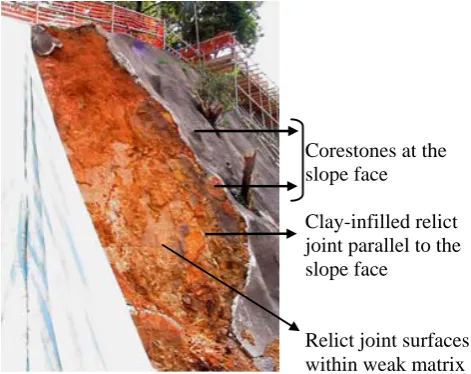
Heterogeneities in various forms and scales often con-trol the mechanisms and locations of failure and deforma-tion and the factor of safety of saprolitic slopes. Sources of heterogeneity in saprolitic profiles include: a) microfab-ric and mineralogical variations at the material scale (Aydin and Duzgoren-Aydin, 2002); and b) macrostructural features such as relict joints, relict veins, secondary clay seams, rel-atively less weathered intact rock slabs, irregular zones of contrasting weathering, differentially weathered dykes, core-stones, and soil pipes at the field scale (Figs. 1 and 2). This large variability in type, abundance and scales of hetero-geneities in saprolitic profiles means that critical features that control stability of slopes may go undetected during routine ground investigations.
90 A. Aydin: Stability of saprolitic slopes
Fig. 1. Development of a saprolitic profile over volcanic (welded
ash tuff) bedrock.
Corestones at the slope face
Clay-infilled relict joint parallel to the slope face
Relict joint surfaces within weak matrix
Fig. 2. A saprolitic profile cut normal to the slope face.
the behaviour of soil elements, and that the profile charac-teristics must be considered as a whole. Brand added that the rigorous application of engineering methods of analysis to provide design solutions was questionable, implying that design based on actual performance (precedent), back anal-ysis and risk/hazard zoning (an engineering geological ap-proach) is most fruitful. Similarly, Costa et al. (1989) indi-cated that macrostructural features in saprolitic soils were in many cases of greater importance for the behaviour of the soil mass.
This paper presents a critical review of the field scale heterogeneities, how their presence modifies mechani-cal/hydraulic behaviour and hence controls the stability of saprolitic slopes. Ground investigation methods and strate-gies to increase the likelihood of detecting and locating these heterogeneities in saprolites are examined. A preliminary study is presented to show how uncertainties can be reduced in a cost-effective manner by recording drill penetration rates during installation of soil nails and horizontal drains.
ABP (%): 29 50 72 0 (matrix) 31 53 74
c (psi) : 345 233 199 330 250 206 163
φ (o) : 26.2 33.5 39.6 24.7 32.9 32.3 38.2
ABP (%): 33 54 73 100 (block) 29 57 71
c (psi) : 377 229 180 445 276 231 302
φ (o) : 23.4 33.3 41.2 38.3 32.8 37.6 34.0
Fig. 3. Physical models designed to study influences of average
block proportion (ABP) and block orientation (with respect to uni-axial loading direction) on cohesion (c) and internal friction angle (φ)(Lindquist and Goodman, 1994).
2 Corestones
A common form of heterogeneity defined by the chaotic oc-currence of large particles (boulders and cobbles) in a matrix of considerably smaller particles (sand and silt) is typical of saprolites developed over widely to moderately jointed ig-neous and metamorphic rocks (Aydin et al., 2000). Due to the difficulties of sampling representative volumes of hetero-geneous ground and the poor control of boundary conditions in the field experiments, physical model studies are most ap-propriate to study the effects of various factors both in isola-tion and in combined form. Lindquist and Goodman’s model study (1994) found that (Fig. 3): a) increasing block pro-portion leads to a decrease in cohesion and an increase in internal friction angle and modulus of deformation; b) block orientation leads to anisotropy in strength (particularly cohe-sion component) and modulus; and c) there exists a threshold block proportion of 30% below which the presence of blocks has little effect on strength, confirming an earlier proposal by Hencher and Martin (1982). However, in saprolites, the potential presence of other features such as relict joints and heterogeneity of the intervening matrix material complicates such predictions.
A. Aydin: Stability of saprolitic slopes 91
Fig. 4. Influence of large particles on the failure surface: (a)
involv-ing intrablock fracture; (b) through block-matrix contacts; and (c) forming a wide shear zone (West et al., 1991).
the physical model studies (Lindquist and Goodman, 1994) showed that failures tended to form along the block matrix contacts even if the blocks were only about twice as strong as the matrix in unconfined compression. The possibilities explored by West et al. (1991) do not account for the posi-tion and distribuposi-tion of other features such as small relict dis-continuities around which slip zones may initiate and prop-agate. Furthermore, the relative position and orientation of corestones with respect to the slope toe may significantly in-fluence the critical local stress concentration and possibly the thickness and geometry of the potential slip zone.
Flintoff and Cowland (1982) suggested that many cut slopes in decomposed granites in Hong Kong stood at steep angles because of a favourable orientation of corestones close to the face. Conversely, on a steep face, a shallow soil cover developed over corestones can fail along the interface where
Fig. 5. A view from the shotcreted scar of a recent large-volume
landslide within a saprolitic profile developed over pyroclastics (Shum Wan Road, Hong Kong). Note the projections of corestones on the nearly vertical surfaces forming the side and rear faces of the scar.
infiltrated water concentrates close to the face. Corestones often seen as projections on the high angle scars of landslides in saprolitic slopes prove the influence of their presence on defining the boundaries of failure (Fig. 5).
Penetrative weathering along fractures in the transition zone decreases shear strength and stiffness and increases the degree of freedom of blocks to rotate during deformation. Sandroni (1985) suggested that if remnant blocks are not in touch with one another and there exists a small thickness of residual soil between them, the mass will behave more like a soil in terms of shear strength and like a weak rock in terms of deformation. This assertion ignores the vital influence of relict joints on the behaviour of saprolitic slopes.
3 Relict joints
As microfabric features, macro-structural features such as joints inherited from the parent rock are preserved, particu-larly in igneous saprolites. Although these relict joints un-dergo a weakening process during weathering, their loca-tion, orientaloca-tion, continuity and role as preferential weak-ness planes essentially remain unchanged. Main weathering-induced changes in joint properties are mineralogical (wall alteration and filling/coating material) and geometrical (de-crease in roughness and aperture through grain alteration and healing upon softening of asperities, increasing curvature of planes through creep and mass deformation). The detection, sampling and testing of relict joints therefore becomes in-creasingly difficult as material decomposition increases.
92 A. Aydin: Stability of saprolitic slopes
Fig. 6. Slickensided black seam on the surface of a relict joint plane.
suggested that relict joints represent a significant and un-certain hazard in the formation of temporary and perma-nent slopes. This is because relict joints are difficult to de-tect with the aid of routine site investigation procedures, and their potential occurrences are ignored until their control on mass shear strength becomes apparent by movements or fail-ures along them (Deere and Patton, 1971; De Mello, 1972; Howat, 1985; Sandroni, 1985; Blight, 1989).
Relict joints often participate in slope failures as a com-bination of a near vertical release surface and an extensive basal slip plane. Complex failure surfaces may form when several discontinuities join or lie within a close distance. In the latter case, the intervening intact weathered rock blocks are sheared along certain segments of such surfaces. Of-ten, toppling failures in saprolites is in the form of rotation of blocks within a creeping saprolitic mass. An increase in matrix-to-block proportions accelerates the rate of renewal of slope failure events.
Relict joints with black seams are common in saprolites (Figs. 6 and 7). Chemical analyses of black seams show that they generally contain fine-grained weathering products coated with Fe-Mn oxides and a humic substance leached from the upper horizons (St. John et al., 1969; Massad and Teixeira, 1985). Slickensides frequently observed on relict joints of this type are likely caused by repeated volumetric changes during saturation-drying cycles, particularly in slop-ing terrains where creep, gradual stress relief due to erosion and sudden removal of confining material during landslides can be expected. Relict joints with slickensided black seams have been found to have a much lower friction angle than other relict joints.
The likelihood that relict joints may form part of a poten-tial failure surface depends on their geometrical distribution parameters, including their orientation, spacing and persis-tence. These also determine the likelihood of their intersect-ing with other joints and formintersect-ing a network within saprolites. However, generally limited site data and possible changes in structural domains of nearby exposures and cuts require a sound structural framework of the area to be established to
Fig. 7. Black seams sandwiched within a white clay vein formed
along a deformed relict joint plane showing irregular waviness.
guide extrapolation and grouping of data into sets. The re-sulting distribution parameters can be used either in a prob-abilistic (Koo, 1982) or deterministic manner to assess the stability of slopes in saprolites developed over jointed rock masses.
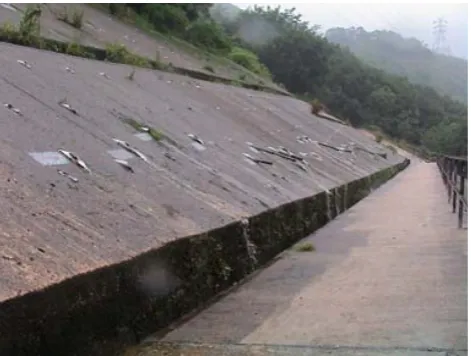
4 Heterogeneity regulating groundwater regime Relict joints, corestones, dykes and soil pipes regulate groundwater regimes and often dominate the field behaviour of saprolitic slopes. Sudden increases and gradual (delayed) decreases (asymmetric responses of saturation-dissipation curves) can be attributed to these features, which are inter-connected or open to surface infiltration paths but terminate at low permeability boundaries. The prolonged state of sat-uration leads to loss of cohesion (relict bonding) and col-lapse of the material, as in shallow landslides and joint con-trolled failures. Remarkably different piezometric levels in closely spaced boreholes and irregular distributions and vari-able seepage rates observed in horizontal drains in cut slopes (Fig. 8) and (repaired) landslide scars testify to the complex-ity of groundwater storage and percolation patterns in sapro-litic profiles.
with different permeabilities, which are aligned parallel to natural surfaces. For example, lower permeability layers over higher permeability zones parallel to a slope can result in the development of artesian or excess pore-water pressures in weathered slopes that may precede a slope failure (Deere and Patton, 1971).
Soil pipes are often centred in the head scarps of small shallow landslides. From Hele-Shaw simulation of flow potentials around a soil pipe parallel to an inclined slope, Pierson (1983) suggested that the highest-pressure build-up may develop some distance downhill. This indicates that such pipes may not always expose on the failure surface unless subsequent failures cut deeper into the slope. Relict joints and corestone-matrix boundaries may act as preferen-tial seepage paths, sometimes resulting in high inflow rates leading to internal erosion and soil pipes (Brand et al., 1986) or in local pressure build-up at narrow conduits leading to removal of loose material and widening of the local aperture. Raj (1998) reported a landslide along a relict fault plane where failure was attributed to the triggering role of ground vibrations caused by three large capacity trucks passing at the time of failure. However, an unusually long, dry period of 27 days prior to 29 days of continuous wet period was also noted as a preparatory factor. A relict fault is assumed to have acted as an impermeable barrier over which a perched water table would develop. However, it is clear that other cut slopes in the area received similar amounts of rainfall, and this casts doubt on Raj’s claim that the failure of this slope was due to loss of matric suction. Other site-specific failure mechanisms might have operated. For example, as the relict fault did not daylight on the cut-slope face, the strength of the weathered rock-bridge between the slope face and the fault plane was critical to the stability of the slope. A progressive weakening of this bridge could have taken place, as this was the first fail-ure since the excavation and occurred 5.7 years afterwards. Another possible mechanism is local shear failure within this highly pre-stressed bridge, as the slope had previously expe-rienced a dry period followed by full saturation (Aydin and Egeli, 2001).
As primary joint sets in igneous saprolites are often sub-vertical, the damming effect of infilled subvertical relict joints may be extremely important in slope hydrogeology modelling and in the design of horizontal drains for pore water pressure relief. Transient water pressure-build up be-hind such joints and the confinement of infiltration and seep-age pattern within isolated compartments leads to vertical groundwater movement and anomalous piezometric readings immediately after rainfalls. The length and frequency of hor-izontal drains (Fig. 8) should be selected to intercept such isolated compartments within a critical zone behind the slope face.
5 Ground investigation in saprolites
Variability in thickness and distribution of the boundaries of “uniform mixtures” of materials (i.e. zonal boundaries) are
Fig. 8. A multiberm high slope with regular rows of raking and
hor-izontal drains. Note the irregular flows pattern (Tsing Tsui Estate, HK).
one of the most common forms of heterogeneity in weath-ered profiles. De Mello (1972) suggested that after estab-lishing the variability at scales of tens of meters it was nec-essary to reduce this scale to 1 to 2 m, and finally to tens of centimetres within representative samples. This strategy addresses the problem of multilevel complex heterogeneity problem in ground investigation. On the other hand, Hencher and McNicholl (1995) pointed out that it was often difficult to predict geotechnical conditions accurately, despite careful investigation, and that variability cannot usually be predicted from interpolation or extrapolation. As a result, ground in-vestigations in saprolites should be planned with the aim of minimizing the chance of the presence of field scale hetero-geneities if their influence on mass strength, deformability and permeability is to be taken into account in design. Deere and Patton (1971) also strongly recommended “slope design by modified precedent”, a process which requires a detailed surface and limited subsurface exploration. Additional sub-surface data to determine the unfavorable/favorable condi-tions not considered in the design could be gathered by care-ful observations during the construction stage by experienced personnel with full knowledge of the design assumptions.
94 A. Aydin: Stability of saprolitic slopes
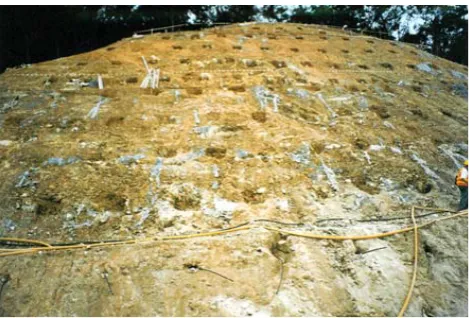
Fig. 9. Soil nails installed over a regular grid pattern of boreholes
drilled throughout a volcanic saprolite profile.
are considered as widened joints (Shaw, 1997). However, this definition is not appropriate for the characterization of rock/soil masses, in which very thin weakness zones may dominate deformation and failure.
Geophysical methods such as seismic refraction are po-tentially useful for detecting overall (large-scale) variations in bedrock level. However, seismic refraction is not sensi-tive to site-scale lateral and vertical variations such as deep weathering pockets, alternating bands of weathered and un-weathered materials, and zones of partially un-weathered mate-rial above bedrock (Forth and Platt-Higgins, 1981). Deere and Patton (1971) suggested that surface geophysical meth-ods such as seismic and electrical resistivity surveys can vide considerable assistance in delineating weathering files if interpreted with knowledge of typical weathering pro-files and if borings are provided for calibrating the propro-files. Down-hole geophysical methods such as gamma-gamma and neutron logging may be more helpful in locating zones of different densities and water content respectively in the tran-sitional zone (Deere and Patton, 1971).
As drill coring is often an unsatisfactory method for de-tecting and fully characterizing joint parameters, many inves-tigators prefer large-diameter boreholes, deep trenches and hand-dug trial pits to establish the pattern of relict disconti-nuities (Deere and Patton, 1971; Sandroni, 1985). Recogni-tion of the structural subdomain scales, heterogeneity levels and the variability within and between these domains should facilitate identification and characterization of relict joints within saprolites. This requires a comprehensive study that relates regional geological processes such as tectonics, em-placement, cooling and unloading to the formation and in-herited evolution of ubiquitous joint patterns at site scales.
Patton (1984) emphasized the importance of accurate piezometric measurements in slope stability analysis and pointed out that piezometric readings are affected mainly by the length of completion zones and by the quality of the pack-ers or seals. He suggested the use of modular piezometpack-ers by which a complete record of piezometric pressure
distri-bution within short multiple intervals along a borehole can be obtained. Piezometric profiling is especially important in saprolitic slopes where heterogeneities regulate groundwater regimes. To determine the influence of heterogeneities on contaminant transport in saprolites, Corley et al. (1999) em-ployed a multi-level sampler to obtain a continuous record of the relative distribution of hydraulic conductivity. They found that particularly vertical structures such as relict joints, veins and dykes missed during drilling had a significant influ-ence on the plume geometry and could be detected by contin-uous profiling. This approach could also be used in locating and assessing the efficiency of horizontal drains in slopes cut into saprolitic profiles.
It is obvious that in-situ tests and field instrumentation are not easy to locate, carry out and interpret in heterogeneous ground. Nevertheless, significant advances in field charac-terization and testing were reported in a recent study (Anon., 1999). The high level of uncertainty that remains even af-ter a careful and thorough ground investigation means that the engineering geological model of the ground may not ac-curately represent the critical features. Furthermore, impor-tant features in slope stability of saprolitic profiles such as zonal boundaries of weathering and a volumetric percentage of corestones in each zone are extremely difficult to predict from routine ground investigations. This uncertainty neces-sitates a continuous upgrading of the model during the con-struction stage of site investigation. This means an additional cost that is often difficult to justify in routine ground investi-gations. However, in most steep cut-slopes in saprolitic pro-files, particularly in urban settings, extensive drilling is car-ried out for purposes of installing soil nails (Fig. 9) and hor-izontal drains (Fig. 8). Accurate penetration rate records of non-coring pneumatic percussive drilling (Fig. 10) calibrated against various drilling parameters will provide valuable ad-ditional data in a very cost-effective way, enabling engineer-ing geological models to be updated durengineer-ing the construction stage. This approach complements the mixed design practice recommended by Deere and Patton (1971).
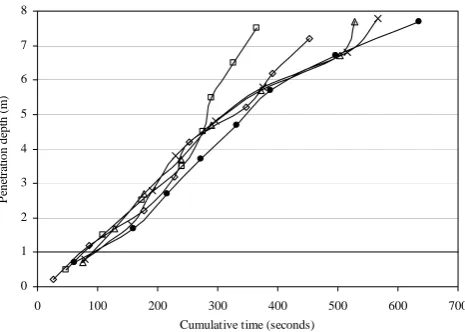
A preliminary study was carried out under the supervi-sion of the author to demonstrate the use of penetration rate records to help improve predictions of subsurface conditions within saprolitic slopes in Hong Kong (Lam, 2000). A to-tal of 24 drill penetration rate records were obtained at four cut slopes for which reasonably good control of ground con-ditions were available from the site investigation drillholes. The depth vs. cumulative drill time curves such as shown in Fig. 11 suggested that even minor variations in the ground conditions can be interpreted especially when a complete set of drilling parameters are recorded simultaneously.
6 Conclusions
A. Aydin: Stability of saprolitic slopes 95
Fig. 10. A pneumatic rotary-percussive drill machine on a
tempo-rary platform set-up for the installation of soil nails and horizontal drains along a predefined series of rows.
corestones on the mass shear strength, modulus and threshold block proportions.
– Although relict joints undergo a weakening process dur-ing weatherdur-ing, their location, orientation, continuity and their role as a preferential weakness planes essen-tially remain unchanged. This means that ground in-vestigation resources should be devoted to the detection and characterization of joints rather than to expensive “undisturbed” sampling and testing for matrix proper-ties.
– The damming effect of infilled subvertical relict joints in igneous saprolites may be extremely important in slope hydrogeology modelling and in design of horizon-tal drains for pore water pressure relief. Transient pore water pressure build-up behind such joints and confine-ment of infiltration and seepage pattern within isolated compartments leads to vertical groundwater movement and anomalous piezometric readings immediately af-ter rainfalls. The limited open length and diameaf-ter of
0 1 2 3 4 5 6 7 8
0 100 200 300 400 500 600 700
Cumulative time (seconds)
P
ene
tra
ti
on de
pt
h
(m
)
Fig. 11. Penetration depth vs. cumulative time curves from
pneu-matic drilling records in a saprolitic slope (7SE-D/C246) developed over pyroclastic rocks in Hong Kong (data from Lam, 2000). Note significant variations in penetration rate patterns along and among very closely spaced drillholes implying various forms of hetero-geneities resisting (e.g. corestones, slabs, vegetation roots) or facil-itating penetration (e.g. preferentially weakened – fractured and/or leached – zones, soil pipes).
drains may be inappropriate to deal with such vertical and isolated compartment flow patterns.
– In view of the multilevel complex heterogeneity in saprolites, ground investigations should be planned with the sole aim of minimizing the chance of the presence of field scale heterogeneities. The inevitable uncertain-ties require a continuous upgrading of the engineering geological model during the construction stage of the site investigation, and the remaining uncertainties can be reduced in a cost-effective manner by the use of accu-rate penetration accu-rate records. This data, where available, presents a valuable opportunity for the modification of slope design.
– Continuous profiling of pore pressure, flow rate and tracer distributions along boreholes is potentially useful for characterizing the heterogeneities in saprolites, par-ticularly in detecting subvertical features. These mea-surements could also be used in locating and assessing the efficiency of horizontal drains in cut-slopes. – Slip zones rarely develop entirely within the confines of
96 A. Aydin: Stability of saprolitic slopes
Acknowledgements. This study was supported by a grant from the
Research Grants Council of the Hong Kong Special Administrative Region, China (Project No. HKU 7002/03P).
Edited by: M. Parise Reviewed by: two referees
References
Anon.: Behavioral characteristics of residual soils. Geotechnical Special Publication No. 92, American Society of Civil Eng., 1999.
Au, S. W. C.: Decomposed dolerite dykes as a cause of slope failure, Hong Kong Engineer, 2, 14, 33–36, 1986.
Aydin, A., Duzgoren-Aydin, N. S., and Malpas, J.: A review of ig-neous and metamorphic saprolites, Journal of Nepal Geological Society, 22, 11–16, 2000.
Aydin, A. and Egeli, I.: Stability of slopes cut in metasedimentary saprolites in Hong Kong, Bull. Eng. Geol. Env., 60, 315–319, 2001.
Aydin, A. and Duzgoren-Aydin, N. S.: Indices in scaling and pre-dicting weathering-induced changes in rock properties, Environ-mental and Engineering Geoscience, VIII, 2, 121–135, 2002. Blight, G. E.: Design assessment of saprolites and laterites, Proc.
12th Int Conf SMFE, 4, 2477–2484, 1989.
Brand, E. W.: Analysis and design in residual soils, Proc. ASCE Conf on Engineering and Construction in Tropical and Residual Soils, 89–143, 1982.
Brand, E. W., Dale, M. J., and Nash, J. M.: Soil pipes and slope stability in Hong Kong, Quarterly J. Engineering Geology, 19, 301–303, 1986.
Corley, H. P., Martin, R. L., and Macklin, R. L.: Characterization of saprolite heterogeneities using innovative techniques. Geotechni-cal Special Publication No. 92, American Society of Civil Eng., 64–76, 1999.
Chigira, M.: Mirco-sheeting of granite and its relationship with landsliding specifically after the heavy rainstorm in June 1999, Hiroshima Prefecture, Japan, Engineering Geology, 59, 219– 231, 2001.
Costa, A. J. and Fernandes, C. E. M.: Slides in saprolites from gneissic rocks with relict slip surfaces, the B.N.E.D.E.S. case history, Proc. 1st Int. Conf. on Tropical Lateritic and Saprolitic Soils, 2, 49–55, 1985.
Costa, L. M., Dobereiner, L., de Campos, T. M. P., and Vargas, E.: Fabric and engineering properties of saprolites and laterites, Proc. 12th Int. Conf. SMFE, 4, 2763–2476, 1989.
Cowland, J. W. and Carbray, A. M.: Three cut slope failures on relict discontinuities in saprolitic soils, Proc. 2nd Int. Conf. on Geomechanics in Tropical Soils, 1, 253–258, 1988.
De Mello, V. F. B.: Thoughts on soil engineering applicable to resid-ual soils, Proc. 3rd Southeast Asian Conf. on Soil Engineering, 5–34, 1972.
Deere, D. U. and Patton, F. D.: Slope stability in residual soils, Fourth Panam. Conf. SMFE, San Juan, Puerto Rico, 1, 87–170, 1971.
Flintoff, W. T. and Cowland, J. W.: Excavation design in residual soil slopes, Proc. ASCE Conf on Engineering and Construction in Tropical and Residual Soils, 539–556, 1982.
Fookes, P. G. (Ed.): Tropical residual soils: Geological Society En-gineering Group Working Party Revised Report, The Geological Society, London, 1997.
Forth, R. A. and Platt-Higgins, P. M.: Methods of investigation of weathered rocks in Hong Kong, Proc. Int. Symp. on Weak Rock, 519–526, 1981.
GCO: Guide to site investigation (Geoguide 2), Geotechnical Con-trol Office, Hong Kong SAR, 1987.
Hencher, S. R. and Martin, R. P.: The description and classifica-tion of weathered rocks in Hong Kong for engineering purposes, Proc. 7th Southeast Asian Geotechnical Conf., 125–142, 1982. Hencher, S. R. and McNicholl, D. P.: Engineering in weathered
rock, Quarterly J. Engineering Geology, 28, 253–266, 1995. Hencher, S. R., Massey, J. B., and Brand, E. W.: Application
of back-analysis to some Hong Kong landslides, Proc. 4th Int. Symp. on Landslides, 631–638, 1984.
Howatt, M. D.: Completely weathered granite-soil or rock?, Quart. J. Engineering Geology, 18, 199–206, 1985.
Irfan, T. Y. and Woods, N. W.: The influence of relict discontinu-ities on slope stability in saprolitic soils, Proc. 2nd Int. Conf. on Geomechanics in Tropical Soils, 1, 267–276, 1988.
Koo, Y. C.: Relict joints in completely decomposed volcanics in Hong Kong, Canadian Geotechnical Journal, 19, 117–123, 1982. Lam, K. M.: Implication and use of accurate drill progress rate mea-surements, Graduation Project, Department of Earth Sciences, The University of Hong Kong, 2000.
Lindquist, E. S. and Goodman, R. E.: Strength and deformation properties of a physical model melange, Proc. 1st NARM Symp, 843–850, 1994.
Massad, F. and Teixeira, H. R.: Deep cut on saprolitic soils condi-tioned by relict structures, Proc. 1st Int. Conf. on Tropical Lat-eritic and Saprolitic Soils, 2, 381–391, 1985.
Patton, F. D.: Climate, groundwater pressures and stability analyses of landslides, Proc. 4th Int. Symp. on Landslides, 43–59, 1984. Pierson, T. C.: Soil pipes and slope stability, Quarterly J.
Engineer-ing Geology, 16, 1–11, 1983.
Raj, J. K.: The failure of a slope cut into the weathering profile de-veloped over a porphyritic biotite granite, Journal of Asian Earth Sciences, 16, 4, 419–427, 1998.
Sandroni, S. S.: Sampling and testing of residual soils in Brazil, in: Sampling and Testing of Residual Soils, edited by: Brand, E. W. and Phillipson, H. B., Scorpion Press, Hong Kong, 31–50, 1985. Shaw, R.: Variations in sub-tropical deep weathering profiles over the Kowloon Granite, Hong Kong, J. Geol. Soc., 154, 1077– 1085, 1997.
St. John, B. J., Sowers, G. F., and Weavers, C. H. E.: Slickensides in residual soils and their engineering significance, Proc. 7th Int. Conf. on SMFE, II, 591–597, 1969.
Vargas, M. and Pichler, E.: Residual soil and rock slides in Santos (Brazil), Proc. 4th Pan-American Conf on SMFE, 6/27, 394–398, 1957.
Wen, B. P. and Aydin, A.: Microstructural study of a natural slip zone, quantification and deformation history, Engineering Geol-ogy, 68, 289–317, 2003.