A screening for benzo[a]pyrène in cocoa
beans subjected to different drying methods
during on farm processing
Eboua N. Wandan1, Eric F. Elleingand2*, Aubin M. Ndouba3
1
Department of Water, Forestry and Environment, INP-HB, BP 1313 Yamoussoukro, Côte d’Ivoire. 2
Department of Chemical Engineering and Food Science, INP-HB, BP 1313 Yamoussoukro, Côte d’Ivoire. 3
Laboratoire de Thermodynamique et Physicochimique du Milieu, Université d’Abobo-Adjamé, Côte d’Ivoire *
Corresponding author. E-mail:[email protected]
ABSTRACT
Benzo[a]pyrene as well as moisture and physical characteristics of cocoa bean subjected to different mode of drying were evaluated during the second period of cocoa harvesting in Côte d’Ivoire. The moisture content of smoked beans (8.22±0.06) was significantly lower compared to those sun-dried (8.97±0.18). Among the physical characteristics, purple beans were over 4%, and slaty beans 1.57±0.20%. The percentage of moldy beans was significantly higher for sun-dried beans (8.72±0.17%) than for smoked beans (2.13±0.14%). Supplementing sun-drying with smoking during the rainy season helped reduce the level of moldy beans which are favored by their high moisture content. The level of free fatty acid found in beans was in average 1.74% with those subjected to sun drying having significantly (P=0.04) higher levels. These levels were higher than the expected levels (< 1.0%) to meet the acceptable level of 1.75% in cocoa butter extracted from the dry cocoa beans. This high level of free fatty acid found might be favored by the high level of moulds found in beans mostly in sun-dried beans. Benzo[a]pyrene was found at the levels ranging from 7.698 to 3701/25 µg/kg in beans sun-dried/smoked or smoked only. When beans were dried by smoking only, the level of Benzo[a]pyrene found was significantly (p<0.05) elevated (3709.25±526.03). Based on an estimated daily chocolate consumption of 5,53 g/day, the daily intake of carcinogenic BaP was found to 1.05 µg/day. This level was two times the recommended background concentration of 0.5 µg/kg recommended by the WHO in food samples.
Keywords: Polycyclic aromatic hydrocarbons; Benzo[a]pyrene; cocoa bean; smock; toxicity.
INTRODUCTION
Polycyclic aromatic hydrocarbons (PAHs) are a group of well-known chemical compounds with a wide distribution in the environment and formed by the incomplete combustion of organic compounds and geochemical processes (Barranco et al., 2003). They have been the subject of much concern in recent years because of their toxic potential and comprise some well-known Carcinogens formed by four to seven fused benzene rings (called heavy PAH), Among which, the most important one is benzo[a]pyrene (BaP) (Moret et al., 2005; Yusty and Davina, 200).
Benzo[a]pyrene (Fig. 1) is a five-ring polynuclear aromatic hydrocarbon (PAH), belonging to the alternant class of PAHs (Harvey, 1997). It is known to be a ubiquitous environmental carcinogen. BaP have been proven to be genetoxic, it has produced stomach tumor, mammary gland tumor, lung and respiratory tumors, hepatic tumors in laboratory animals (SCF, 2002; ATSDR, 1995). Human exposure to BaP occurs through several routes namely the skin, the gastrointestinal tract and the pulmonary tract (Yang et al., 1998; WHO, 1998). It is generated by incomplete combustion of organic materials arising in part from natural combustion such as forest fires and volcanic eruption (Grova, 2002; Anyakora, 2004; EFSA, 2008; SCF, 2002).
compounds have shown carcinogenicity in experimental animals and genotoxicity and mutagenicity in vitro and in vivo (WHO, 1998; SCF, 2002).
Cocoa (Theobroma cacao) is grown principally in West Africa, Central and South America and Asia. 90% of world production comes from eight countries, among which Côte d’Ivoire is the world’s leading producer (38%), Although it is largely produced in developing countries, it is mostly processed and consumed in industrialized countries (International Statistics of Cabisco/ICCO, 2004).
Storage and processing conditions of cocoa in the countries are not very safe and formation of PCBs may be possible at many critical points (Ramsey, 1973) of the cocoa production chain. Generally, poor harvest management can lead to rapid deterioration in stored foodstuffs and feeds quality. This improper post-harvest processing and handling is pervasive and has led to significant origin discounts of cocoa from Côte d’Ivoire on the world market. Smoking is sometimes used to supplement sun-drying due to lack of sunshine during rainy season. Incorrect artificial drying with poorly controlled of fire will cause smoke contamination. This contamination can lead to the formation of PAH in dried beans (Serra Bonvehi J. and Ventura Coll F. 1995). This study aims to investigate the occurrence of benzo[a]pyrene occurring in cocoa beans subjected to smoking as drying practice during post-harvest processing on farm level. Results obtained will give insight knowledge on cocoa board Committee in order to establish a risk assessment for these substances in cocoa beans.
EXPERINMENTAL SETUP
Samples collection
Cocoa bean seeds (Theobroma cacao L.) were collected from fully ripe pods harvested from cocoa trees in a plantation located in Soumié in the Southeast of Côte d’Ivoire. The beans were fermented for six days by a heaping method, using plantain leaves to cover the beans for 6 days before drying. The fermented beans were divided into four parts. Each part was spread on bamboo mats and subjected to four drying methods:
(1) Open air sun-dried (10 days)
(2) Open air Sun-dried (2 days) followed by smoking (8 days) (3) Open air Sun-dried (4 days) followed by smoking (6 days) (4) Open air sun-dried (4 days) followed by smoking (6 days) (5) Smoking for 8 days
(6) Smoking for 6 days (7) Smoking 4 days
While on the drying bed, the beans were turned several times each day with a rake made of wood plank. After the drying period, beans were put in jute bags which were tighten with rope and stored in a room in the farmer’s house until selling.
Sampling
Ten samples of approximately 1 kg of beans from each treatment were taken at a single sampling time one month after the drying during the selling and kept inside polythene bags. They were transported from the farm to the laboratory where they were stored in the laboratory in the manner cocoa is stored in commercial warehouse. In the laboratory, beans are be sorted in order to remove the flat beans, shriveled beans, black beans, small and/or double beans, beans with insect damage. The remaining was stored for further analysis..
Cocoa bean quality analysis
Moisture content
Moisture in the beans was determined using the ISO method (Hamid and Lopez, 2000). Approximately 10 g of ground bean sample was placed into a pre-weighed dish (W) with a lid and re-weighed to the nearest mg (W). The dish and contents were put in an oven at 103±2°C for 16 h. The lidded dish was then removed from the oven and put in desiccators to cool. After cooling they were weighed (W) and the percentage moisture content calculated using the following formula:
(%) =(( − ))
Cut test score (%)
lengthwise using a cutter to expose a maximum cotyledon surface. Both halves of the cotyledon were examined visually in day-lighting for mould infestation, as w ell as for the color of the beans (molds, slate, purple). Slaty beans characteristics; include rubbery cotyledon, blackish color, and resistance to cutting. Purple beans are produced when the fermentation is not complete. Moldy beans come from poor drying, stocking or wounded beans. T he results were expressed as a percentage.
Fatty acid content
About 100g of cocoa beans were finely ground in a coffee grinder. The obtained powder was extracted by Soxhlet method from about 10 g of cocoa powder homogenized in 350 ml ether during one night. The solvent was then removed by evaporation and the fat was dried by oven-drying at 110°C during 4 hours. FFA content expressed as percentage oleic acid was measured according to the official method 42-1993 (IOCCC, 1996). Five g of cocoa butter was weighed (W) and dissolved in 100 ml ether/ethanol (1:1) mixing prior neutralized and containing thymol blue indicator.
Fatty acids titration was carried out with 0.1N KOH to alkali color stable for 30 s end point. The volume of KOH solution used (V) was noted. FFA (% oleic acid) was calculated as follows:
% =28.2 × × × 100
Benzo(a)pyrene determination
Reagents
All chemicals and reagents were of analytical grade and of highest purity possible. LC grade dichloromethane used for extractions was obtained from Fischer Scientific; Silica gel used to clean up the extracts was supplied by BDH Laboratories. A PAH standard mixture (NIST, Baltimore, MD) containing different chemicals among which, benz[a]anthracene, benzo[b]flouranthene, benzo[k]flouranthene, benzo[a]pyrene, benzi[ghi]perylene
dibenzo[a,h]anthracene and indeno[1,2,3-cd]pyrene was used in this study.
Soxhlet Extraction
About 15 g of cocoa beans were carefully shelled manually. Cocoa nibs were grinded in a kitchen-scale coffee grinding (Moulinex, France) to the smallest particle (size < 500 µm). Twenty grams of cocoa powder were carefully transferred into the extraction thimble and placed in the extraction chamber of a Soxhlet extraction unit. Soxhlet extractions were carried out using a modified method 3540 of the EPA (Wang et al., 1999) using 150 mL dichloromethane for 16 hours. The extract was concentrated in a Fischer brand rotavaporator to the desired concentration.
Post-Extraction Cleanup
The extract was concentrated to 1 mL and loaded onto a silica gel column. The silica gel column was prepared by loading an activated silica gel onto a chromatographic column (1 cm internal diameter) to about 5 cm. An additional 1cm of anhydrous Na2SO4 was added to the column. This was conditioned with methylene chloride. One mL of concentrated extract was loaded and eluted with 10 mL of methylene chloride (Anyakora, 2005a). The eluate was evaporated with a rotavoparator and the volume reduced to 1 mL with liquid nitrogen.
Analysis
The GC/MS system used for the analyses consisted of a Finnigan Magnum instrument equipped with a CTC A200S autosampler, a 30 m, 0.25 ID DB-5ms fused silica capillary column (J & W Scientific, Folson CA), and the Finnigan Magnum data system. Helium was used as the carrier gas and the column head pressure was maintained at 10 psi to give an approximate flow rate of 1 mL/min. The injector and transfer line were maintained at 290 °C and 250 °C respectively. All injection volumes were 1 mL in the splitless mode. The column temperature was initially held at 70 °C for 4 minutes, ramped to 300 °C at a rate of 10 °C/min, then held at 300 °C for 10 minutes (Anyakora, 2005b). The mass spectrometer was used in electron ionization mode and all spectra were acquired using a mass range of m/z 50 – 400 and automatic gain control (AGC).
Statistical Analysis
RESULTS AND DISCUSSION
Moisture content and physical characteristics of beans
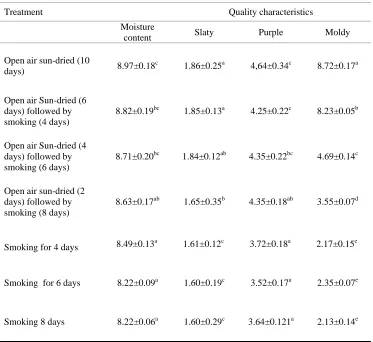
Table 1 presents the results of measurement of moisture content and physical characteristics of beans from each treatment. Moisture content of beans ranged from 8.22 to 8.97. Mean moisture content of a l l cocoa samples ( 8 . 5 8 ± 0 . 3 0 ) was above critical value (8 %) and air-dried beans s a m p l e s contained s i g n i f i c a n t l y ( p < 0 . 0 5 ) highest moisture content compared to smoked one. The values agreed with those obtained in similar study (Legrand, 1999). T he high moisture content was due to insufficient drying using only sun drying method. The second harvest period coincides with the relatively high rainfall (average 60-65mm per mo nth) in this growing area. This is why farmers used to alternate the natural air sun-drying with smoking. The beans exchange moisture in accordance with the site (Hamid and Lopez, 2000). Even though, cocoa beans were properly dried, cocoa beans could absorb moisture during the storage because of poorly stored condition as it was the case with this stud.
Significant differences (p<0/05) in percentage of moldy beans were detected between sun-dried beans and smock dried beans with beans subjected to sun drying having high content of mold. It was also observed that supplementing sun drying with more smoking period reduced the level of moldy beans. High percentage of moldy beans in sun dried beans could have been favored by their high moisture content as stated by Magan and Lacey (1988). According to Hamid and Lopez (2000) at moisture content above 8 percent the cocoa beans are liable to mould development. These results are in agreement with the moisture content of bean samples as inadequate drying due to lack of sun lead to high moisture content which favored moulds g r o w t h . Foodstuffs with high moisture content were easily attacked by moulds.(Poisson and Cahagnier, 1979; Raghavendra and Prakash, 2002) These moulds could produce lipase (Wood and Lass, 1985) which in contact with cocoa butter of broken cocoa nibs released FFA from triglycerides.
The results indicated that only sun-dried beans presented percentage of purple over 4%. In general, the results indicated a mean level of purple beans of 4.07±0.45% in all the beans but beans subjected to smoking only presented significantly (F=25.47, P=0.01) less purple than the others. The mean value of slaty beans was 1.57±0.20 and there was no significantly difference (P=0.66, F=0,699) between different treatments.
Fatty acid content
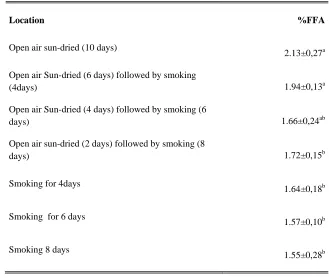
The mean free fatty acid (FFA) content of all the beans from all the treatment was found to be 1.74% with the beans subjected to sun drying having significantly (F=3.748, P=0.04) higher levels of FFA compared to those which were only smoked. These levels found were in agreement with the levels of 2.57% and 1.43% reported for beans from Côte d’Ivoire (Jonfia-Essien and Navarro, 2010). The levels found were higher than the expected levels (< 1.0%) to meet the acceptable level of 1.75% in cocoa butter extracted from the dry cocoa beans. The high level of free fatty acid found in cocoa beans can be explained by the high level of moulds found in beans mostly in sun-dried beans.
benzo[a]pyrene content of beans
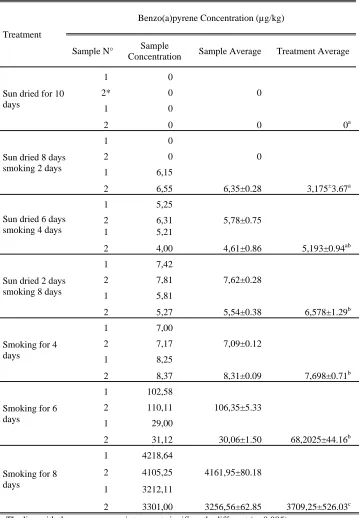
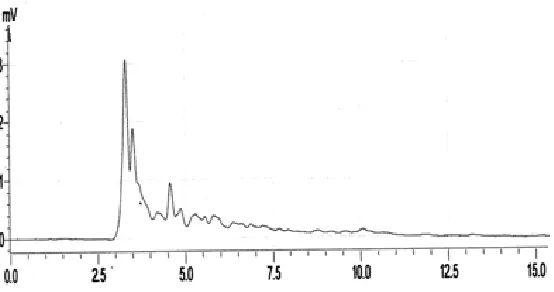
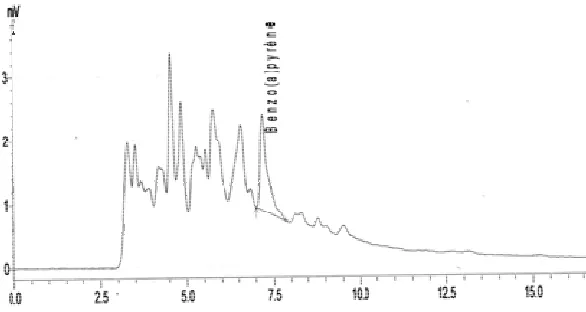
In this study, BaP contents for the different cocoa bean samples from the different treatments were determined. Under the chromatographic conditions of GLC, the characteristic chromatographic peak of BaP appeared after 27.18 min. The linearity range was 0.123-0.238 µg/kg. The limits of detection and quantitation (LODs and LOQs) were 0.17 µg/kg and 0.55µg/kg respectively. The detection limits found for BaP by other workers were 0.276 µg/kg (Yusty and Davina, 2005), 0.0042 µg/kg (Chen 2004). Quantitation was performed by the method of calibration curve using benzo[a]pyrene standard solutions. The recovery of BaP from samples was determined by standard BaP Addition method and the results were corrected according to 100% recovery. The recovery yields were good, ranging from 95.5 to 98.7%. Figure 2 showed the chromatography of the typical chromatogram of a standard pure BaP sample is. Figures 3 and 4 illustrated the chromatography of extract of non smoked beans and smoked beans respectively.
abnormally levels of benzo[a]pyrene subjected to only smoking. It was reported an increasing level of PAH during torrefaction and drying of coffee beans and tea leaves (SCF, 2002).
For now, there is no LMR of benzo[a]pyrene in cocoa beans. Since WHO recommended a background concentration of benzo[a]pyrene of 0.5 µg/kg in food samples (WHO, 1998) and The European commission by law n° 1881/2006 dec 19, 2006 has set the LMR for BaP for oils and fat intended for human consumption at 2.0 µg/kg bw.
Based on the estimated annual chocolate amount consumed by European population of 1,99 kg/year or 166 g/year, the daily intake of carcinogenic BaP can be calculated as:
= ( ) ⁄ ( ) × ( ⁄ ( )(/1000 )/
where C, is the mean concentration of BaP in the sample of cocoa beans subjected to only a few days of smoking (2 days) (6.35 µg/kg). This calculation gave the level of 1.05 µg of benzo[a]pyrene /person/day. This level was two times the recommended background concentration of 0.5 µg/kg recommended by the WHO in food samples.
Moisture and humidity are potential problems. Ideally, cocoa beans should have a moisture content of not more than 6 per cent, in equilibrium with relative humidity of 65 per cent at 30 C, but for practical reasons the trade standard is 7-8 per cent because the hygroscopic characteristics of cocoa beans mean that they easily absorb moisture because of the humid conditions prevailing in the tropics. The correlation between mould growth and moisture content is obvious, and it is clear that cocoa beans stored for several months under tropical conditions will develop mould. Mould in cocoa beans causes a rise in free fatty acids, and reduces the quality of the product and its acceptability to processors. This is for this reason that farmers use to combine sun drying with smoking when the sky is cloudy. But the current commercial standard stipulates that cocoa beans shall be free from smoky, hammy and other abnormal odors and dry. Because of the outer shell of cocoa bean, the nibs are not directly in contact with the nibs reducing the smoky odor and the occurrence of benzo[a]pyrene.
REFERENCES
[1] Anyakora C, Ogbeche A, Coker H., Ukpo G. Ogah C (2004). A screen for Benzo(a)pyrene, a carcinogen, in the water samples from
the Niger Delta Using GC-MS. Nigerian Quarterly Journal of Hospital Medicine, 14: 288 - 295.
[2] Anyakora C, Ogbeche A, Palmer P, Coker H (2005a). Determination of Polynuclear aromatic hydrocarbons in marine samples from
Siokolo Fishing settlement. Journal of Chromatography A, 1073: 323 – 330.
[3] Anyakora C, Ogbeche A, Palmer P, Coker H, Ukpo G, Ogah C. (2005b). GC/MS analysis of polynuclear aromatic hydrocarbons
in sediment samples from the Niger Delta region. Chemosphere, 60: 990 – 997.
[4] ATSDR (1995). Toxicological profile for polycyclic aromatic hydrocarbons (PAH). Atlanta, GA, US Department of Health and
Human Services, Public health service, agency for toxic substances and disease registry.
[5] Chen H-W (2004). Determination of polycyclic aromatic hydrocarbons in Water by solid-phase micro extraction and liquid
chromatography. Anal.Sci. 20, 1383–1388.
[6] EFSA (2008). Polycyclic aromatic hydrocarbons in food. Scientific opinion of the Panel on Contaminants in the Food Chain.
(Question No EFSA-Q-2007-136) http://www.efsa.europa.eu/EFSA/efsa_locale-1178620753812_1211902034842/htm
[7] Grova N, Feidt C, Crepineau C, Laurent C, Lafargue PE, Hachimi A, Rychen G (2002). Detection of Polycyclic Aromatic
Hydrocarbon level in Milk Collected Near Potential Contamination Sources. J. Agric. Food Chem. 50: 4640 - 4642.
[8] H amid A Lopez A.S ( 200 0). Q uality and weight changes in cocoa beans stored under two warehouses’ conditions
in East Malaysia. The planter, Kuala Lumpur, 76: 619-637.
[9] Harvey RG (1997). Polycyclic Aromatic Hydrocarbons, New York, Wiley-VCH.
[10] International Statistics of Cabisco/ICCO, 2004
[11] IOCCC (1996). Determination of free fatty acids (FFA) content of cocoa fat as a measure of cocoa nib acidity. International Office of Cocoa, Chocolate and Sugar Confection.
[12] Analytical Method n° 42-1993.
[13] Jonfia-Essien, W. A., Navarro, S. (2010) Effect of storage management on free fatty acid content in dry cocoa beans, 965-970, Flinn
P., Alder C. [Eds.] Integrated Pest Management, Proceedings of the 10th International Working Conference on Stored Product Protection, 27 June to 2 July 2010, Estoril, Portugal Julius-Kühn-Archiv, 425, Bundesforschungsinstitut für Kulturpflanzen, Berlin, 1077 p.
[14] Legrand A., 1999, la filière cacao en côte d’ivoire dans le contexte de la libération: Evolution de la concurrence, des prix et de la qualité. M. S. thesis CNEARC.
[15] Magan N. Lacey J ( 1988). The p hylloplane microbial population of wheat and effect of late fungicide applications. Annals of
Applied Biology, 109: 117 -12 8.
[16] Moret S, Purcaro G, Conte LS (2005). Polycyclic aromatic hydrocarbons in vegetable oils from canned foods. Eur. J. Lipid Sci
Technol. 107, 488–496.
[17] Poisson J, Cahagnier B (1979). Développement des moisissures sur les graines en fonction d e diverses caractéristiques du substrat et de la population fongique. Tech. Indust. Céréalières, 169: 3-8.
[18]Raghavendra MP, Prakash V (2002). Phenylcolboronic acid - a potent inhibitor of lipase from Oryzae sativa. J. Agric. Food Chem. 50: 6037-6041.
[19]Ramsey, L. L.(1973) Quarterly Bulletin of the Association of Food and Drug Officials of the United States 37 (1) 43-57
[20] SCF (2002). Opinion of the Scientific Committee on Food on the risks to human health of Polycyclic Aromatic Hydrocarbons in food.
[21] Serra Bonvehí J. and Ventura Coll F. (1998). Evaluation of Smoky Taste in Cocoa Powder. J. Agric. Food Chem., 46 (2), pp 620– 624
[22] Wang G, Lee AS, Lewis M, Kamath B, Archer RK (1999). Accelerated solvent extraction and gas chromatography/mass spectrometry
for determination of polycyclic aromatic hydrocarbons in smoked food samples. J Agric Food Chem.47:3 1062-1066.
[23] WHO (1998). Polynuclear Aromatic Hydrocarbons. In: Guidelines for Drinking-water Quality, 2nd ed. Vol. 2. Health Criteria and
other Supporting Information. Geneva, World Health Organization, pp. 123 - 152.
[24] Wood GA, Lass RA (1985). Cocoa. Logman scientific and technical, Essex.
[25] Yang HH, Lee WJ, Chen S.J, Lai SO, (1998). PAH emission from various industrial stacks. J. Hazard. Mater., 60: 159 – 174.
[26] Yusty LMA, Davina CJL (2005). Supercritical fluid extraction and high performance liquid chromatography fluorescence detection
method polycyclic aromatic hydrocarbons investigation in vegetable oil. Food Control 16, 59–64.
Tables
Table 1; Cut-test scores (%) of total cocoa beans samples in accordance with beans physical appearance (mean ±s.d, n=4)
Treatment Quality characteristics
Moisture
content Slaty Purple Moldy
Open air sun-dried (10
days) 8.97±0.18
c
1.86±0.25a 4,64±0.34c 8.72±0.17a
Open air Sun-dried (6 days) followed by smoking (4 days)
8.82±0.19bc 1.85±0.13a 4.25±0.22c 8.23±0.05b
Open air Sun-dried (4 days) followed by smoking (6 days)
8.71±0.20bc 1.84±0.12ab 4.35±0.22bc 4.69±0.14c
Open air sun-dried (2 days) followed by smoking (8 days)
8.63±0.17ab 1.65±0.35b 4.35±0.18ab 3.55±0.07d
Smoking for 4 days 8.49±0.13a 1.61±0.12c 3.72±0.18a 2.17±0.15e
Smoking for 6 days 8.22±0.09a 1.60±0.19c 3.52±0.17a 2.35±0.07e
Table 2: Fatty acid content (%) of cocoa beans samples (mean ± sd, n=6)
Location %FFA
Open air sun-dried (10 days)
2.13±0,27a Open air Sun-dried (6 days) followed by smoking
(4days) 1.94±0,13a
Open air Sun-dried (4 days) followed by smoking (6
days) 1.66±0,24ab
Open air sun-dried (2 days) followed by smoking (8
days) 1.72±0,15b
Smoking for 4days
1.64±0,18b
Smoking for 6 days
1.57±0,10b
Smoking 8 days
Table 3; Benzo(a)pyrene concentration (µg/kg) in cocoa beans sampled from different treatment (mean ±sd, n =2)
Treatment
Benzo(a)pyrene Concentration (µg/kg)
Sample N° Sample
Concentration Sample Average Treatment Average
Sun dried for 10 days
1 0
2* 0 0
1 0
2 0 0 0a
Sun dried 8 days smoking 2 days
1 0
2 0 0
1 6,15
2 6,55 6,35±0.28 3,175±3.67a
Sun dried 6 days smoking 4 days
1 5,25
2 6,31 5,78±0.75 1 5,21
2 4,00 4,61±0.86 5,193±0.94ab
Sun dried 2 days smoking 8 days
1 7,42
2 7,81 7,62±0.28 1 5,81
2 5,27 5,54±0.38 6,578±1.29b
Smoking for 4 days
1 7,00
2 7,17 7,09±0.12 1 8,25
2 8,37 8,31±0.09 7,698±0.71b
Smoking for 6 days
1 102,58
2 110,11 106,35±5.33 1 29,00
2 31,12 30,06±1.50 68,2025±44.16b
Smoking for 8 days
1 4218,64
2 4105,25 4161,95±80.18 1 3212,11
2 3301,00 3256,56±62.85 3709,25±526.03c The line with the same superscript are not significantly different (p<0.005)
FIGURES
Fig 1: Chemical Structure of Benzo(a)pyrene.
Figure 2: Chromatogram of the standard solution of benzo(a)pyrene
Figure 4: Chromatogram of the extract of cocoa bean subjected to Sun dried for 2 days and smoking for 8 days