
indian
i.
Plant
Physioi, Vol.XXxI.
No.3, pp. ~33-237,1988
INCREASED NITRATE CONTENT, NITRATE REDUCTASE ACTIVITY AND GROWTH OF WHEAT SEEDLINGS BY PRE-SOWING SEED
TREATMENT WITH ASCORBIC ACID
I. HAQUE AND A. AHMAD
. Department of Botany, Aligarh Muslim University, AHgarh-202002, India.
SUMMARY
Wheat (Triticum aestiom L. cv. HD2285) grains were soaked in water, 0.001, 0.01 or 0.1 % aqueous ascorbic acid 50lution for 8 h. The seedlings were raised in sand culture under glass house conditions and sampled at 15.20.25 and 30 days after sowing. Ascorbic acid treatment significantly enhanced root and shoot growth. leaf nitrate and protein contents and nitrate reductase activity. Most of the parameters studied gave optimum response to the two higher concentrations (0.01 and 0.1%) of the vitamin.
INTRODUcrION
Ascorbic and is known to activate the biosynthesis of RNA in the seedlings ·of
Sinapis alba (Schopfer, 1967) and Cicer arietinum (Chinoyand Saxena, 1971). It
increases total nucleic acid content (Chinoy, 1962, Chinoy and Mansuri, 1966) and stimuiatesindirectly seed germination (Chinoy, 1967) and seedling growth (Chinoy
et 01., 1951).
It may be emphasized that utilization of nitrate by the plants is limited by the level of substrate-induced nitrate reductase (Hewitt and Mridi, 1959; Beevers and Hageman, (1910).
A sand culture experiment was taken to study the effect of pre-sowing seed treatment with ascorbic acid on inducibility of NRA in the presence of the substrate and its inturn effect on plant growth.
MATERIALS AND METHODS
Triticumaestivum L. CV. HD 2285 grains obtained fIom IARI, New Delhi,
were surface sterilised with 0.01
%
HgCh for 5 minutes followed by washing with dis tilled water. These grains were soaked in water (coqtroO and 0.001, 0.01 or 0.1%
ascorbic acid solution for 8 h. They were air dried and sown (6 seeds pot~l) in acid washed sand in 15 em earthen pots. The inner surface of the pot ,was lined with polythene sleeve whose other end passed through fil(t:ooUom bole and made loose
-- ... ' . ' " ,
"~-- --,
~
t
i. HAQUE AND A. AHMAD
~t:
to ensure proper drainage a conditions on marble slabs.
nd ~aeration. These pots were Long Ashton complete nutrient
kept under gJass~house
solution (Hewitt, 19(;6) was supplied, 100 ml pot-I, on alternate days. Thinning was done after the emergence of the seedlings leaving three healthy plants per pot.
The sampling was done at IS, 20, 25 and 30 days after sowing during which five pots were randomly selected from each treatment. Polythene sleeves containing sand were taken out carefully and transferred to a waterfilled bucket in order to obtain entire and intact mass of the plant. Adhering sand particles were removed with washing in water currents.
Plants were analysed for root and shoot growth characteristics, leaf-protein, nitrate content and nitrate reductase activity (NRA). Leaf nitrate reductase activity was measured following the method of 1aworski (1971), leaf protein and nitrate accor ding to the methods of Lowry et al. (1951) and 10hnson and Albert (1950). respecti vely.
RESULTS AND DISCUSSION
All the growth characteristics of root and shoot were significantly affected by the pre-sowing seed treatment with ascorbic acid (Figs. 1 and 2). A progressive in crease in length, fresh and dry weight of both root and shoot was noted with time. The effect of the treatment on most of the character was more prominent with the two higher concentrations of the vitamin (0.01
%
and 0.1%)
at the later stages ofgrowth (from 20 days onwards) .
.
~
Fig. 1. Effect of ascorbic acid on fresh weight. dry weight and length of roots of wheat. ( . •
~
control, 6.-6. 0.001.. • 0.01 andc
o --
0 0.1 per cent ascorbic acid).~
IS 10
...
H aD25
-.
t-
,0!!!
..
M
...
0,104
L
"
().Sj~ ~,
"3
(ll
C)'
(105 ~ _ GO,
g!, 0.03
..
00'SEED TREATMENT WITH ASCORBIC 'ACIJ) ON NItA IN WHl!AT
235
Soaking the grains in aqueous solution of ascorbic acid must have augmented the vitamin content to a level sufficient to stimulate the processes leading to seed germination as observed earlier (Haque et al., 1987 and Chinoy, 1967). An increase in the rate of ceU division (Chinoy, 1969) in association with additional amount of RNA synthesis (Schopfer, 1967 and Chinoyand Saxena, 1971) induced by ascorbic acid may be the main reason assigned to the above observation.
45
40 35
I:!
...
GI 30 C..
- -... E 25
OU
~ .... 20
1ft
15 10
5
a b
"
16
14
,... r
12
to
8
(> III 3~~
-
..
..
...
"
6
4
2
t d
2·5
2·0 ()'()8
::t
1.1.
Ut
a-
001 ;:r.I: - 1·5 0
It) 2
0
~ 1·0
0.5
15 20 25 30
.
15 20 25 30days days
rig. 2. Effect of ascorbic acid or shoot fre§h weight, dry weiiht, ln~h :md ]eet\r ~reil of whe~t
'236
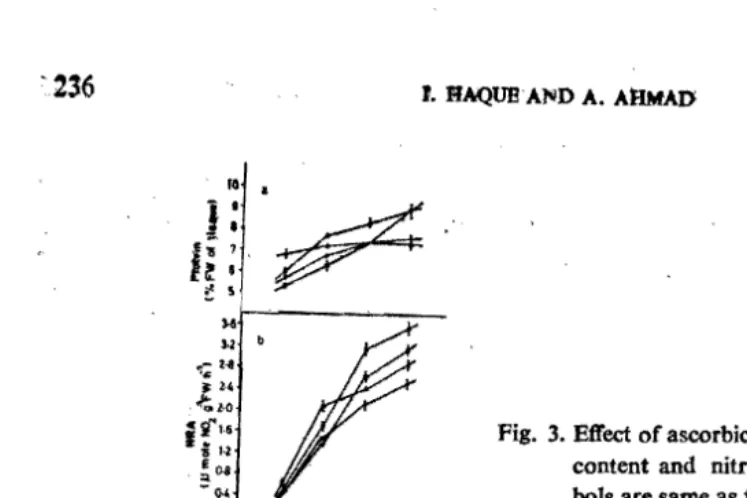
I. HAQUBAJ'ilD A. AhMADFig. 3. Effect of ascorbic acid or leaf IProtein, nitrate content and nitrate reductase activity. (sym
bols are same as fig. 1).
" 2 0 J I ) o
The plants grown from ascorbic acid treated seeds bad increased root growth which would naturally be expected to explore more surface area in the culture medium. The roots will, therefore, remove additional quantities of water and mineral elements which is evident from the observed higher nitrate level in the plants grown from ascorbic acid treated grains (Fig. 3 c). The high nitrate content led to an ob served increase in NR activity (Fig. 3 b) as it is a substrate (nitrate) indueed enzyme. A similar increase in NRA in young maize seedlings with pre-sowing seed treatment with ascorbic acid was noted by Asthana and Srivastava (1978). Higher NRA in plants grown from ascorbic acid treated seeds resulted ultimately in more organic ni trogen production which was in tum responsible for the enhancement of the protein coB:tent (Fig. 3 a) required to sustain the differentiation at a stimulated rate. The general pattern of Jeaf-nitrate and protein contents and NR activity, therefore, follo wed some what a similar pattern, where midium concentration (0.01
%)
of ascorbic acid produced maximum response (Fig. 3). Thus the acquired higher rate of meriste matic activIty at the root level accompanied with th~ availability of additional amounts of organic N will naturally result in healthy shoot growth of the plants grown from aecorbic acid treated seeds.REFERENCES
Asthana. J.S. and Srivastava, H.S. (1978). Effect of presowing treatment of maize seeds with ascorbic acid on seed germination, seedling growth and nitrate assimilation in the seed ling. Indian I. Plant Physiol., :n : 150·155.
I
~
r-"L.
SEED TREATMENT WITH ASCORBIC ACID ON NRA IN WHEAT 237
Candela, M.I., Fischer E.G. and Hewith, E.J. (1957). Molybdenum as plant nutrient X. Some factors affecting the activity of nitrate reductase in cauliflower plants grown with different nitrogen sources and molybdenum levels in sand culture. Plant Physiol., 32 : 280. Chinoy, J.J. (1962). Formation and utilization of ascorbic acid in the shoot apex of wheat as
factors of growth and development. Indian J. Plant Physiol., 5: 172-201.
Chinoy, J.J. (1967). Role of as~orbic acid in crop 'production. Poona Agric. Coli. Mag., S7: 1-6.
Chinoy, J.J. (1969). A new concept of flowering on the basis of molecular and submolecular events occurring in the shoot apex and leaf of wheat. Indian J. Plant Physiol., 12 : 67-80.
Chinoy, J.J. and Mansuri, A.D. (1966). Further evidence in support of ascorbic acid, nucleic acid, protein metabolism concept of flowering in plants. Proceedings of seminar held at the Department of Botany, Punjab University, Chandigarh. Eds. R.D. Asana and K.K.
Nanda, pp. 68-83.
Chinoy, J.J., Nanda, K.K. and Garg, O.P. (1957). Effect of ascorbic acid on growth and flowering of Tril"onellafoenumgraecum and Brassica chinensis. Physiol. Plant .. 10 : 869-876. Chinoy, J.J. and Saxena, O.P. (1971). Inductive effect of ascorbic acid on RNA. amylase,
protease and RNase. 16th International Seed Testing Congress, Washington, June, 1971. Haque, I., Ahmad, Ahmad, A. and Muzaffar. S.S. (1987). Effect of soaking in thiamine, pyri
doxine and ascorbic acid on seed germination and at-amylase activity in triticale, J. Indian bot. Soc., (in press).
Hewitt. E.J. and Afridi, M.M.R.K. (1959). Adaptive synthesis of nitrate reductase in higher plants. Nature 183 : 57-58.
Jaworski E.G. (971). Nitrate reductase assay in intact plant tissues. Biochem. Biophy. Res. Commun. 43: 1274-1279.
Johnson, C.M. and Albert, U. (1950). Determination of nitrate in plant material. Anal. Chem. 22: 1526.
Lowry, O.H.• Rosebrough, N.J.. Farr. A.L. and Randall, R.J. (1951). Protein measurements with folin phenol reagent. J. BioI. Chem., 193 : 265-257.
![Poly[dichloridobis[μ 1 (4 pyridylmethyl) 1H 1,2,4 triazole]copper(II)]](data:image/gif;base64,R0lGODlhAQABAIAAAP///wAAACH5BAEAAAAALAAAAAABAAEAAAICRAEAOw==)