Enterprise Pharo
a Web Perspective
Damien Cassou Stéphane Ducasse Luc Fabresse Johan Fabry Sven Van Caekenberghe
Copyright 2015 by Damien Cassou, Stéphane Ducasse, Luc Fabresse, Johan Fabry, and Sven Van Caekenberghe.
The contents of this book are protected under the Creative Commons Attribution-ShareAlike 3.0 Unported license.
You arefree:
• toShare: to copy, distribute and transmit the work, • toRemix: to adapt the work,
Under the following conditions:
Attribution. You must attribute the work in the manner specified by the author or licensor (but not in any way that suggests that they endorse you or your use of the work).
Share Alike. If you alter, transform, or build upon this work, you may distribute the resulting work only under the same, similar or a compatible license.
For any reuse or distribution, you must make clear to others the license terms of this work. The best way to do this is with a link to this web page:
http://creativecommons.org/licenses/by-sa/3.0/
Any of the above conditions can be waived if you get permission from the copyright holder. Nothing in this license impairs or restricts the author’s moral rights.
Your fair dealing and other rights are in no way affected by the above. This is a human-readable summary of the Legal Code (the full license):
http://creativecommons.org/licenses/by-sa/3.0/legalcode
[&]
Published by Square Bracket Associates, Switzerland. http://squarebracketassociates.orgISBN 978-1-326-65097-1 First Edition, April 2016.
This book has been sponsored by ESUG.
About this book
Enterprise Pharois the third volume of the series, followingPharo by Example
andDeep into Pharo. It covers enterprise libraries and frameworks, and in particular those useful for doing web development.
The book is structured in five parts.
The first parttalks about simple web applications, starting with a mini-mal web application in chapter 1 on Teapot and then a tutorial on building a more complete web application in chapter 2.
Part twodeals with HTTP support in Pharo, talking about character encod-ing in chapter 3, about usencod-ing Pharo as an HTTP Client (chapter 4) and server (chapter 5), and about using WebSockets (chapter 6).
In the third partwe discuss the handling of data for the application. Firstly we treat data that is in the form of comma-separated values (CSV) in chap-ter 7. Secondly and thirdly, we treat JSON (chapchap-ter 8) and its Smalltalk coun-terpart STON (chapter 9). Fourthly, serialization and deserialization of object graphs with Fuel is treated in chapter 10. Lastly, we discuss the Voyage per-sistence framework and persisting to MongoDB databases in chapter 11. Part fourdeals with the presentation layer. Chapter 12 shows how to use Mustache templates in Pharo, and chapter 13 talks about programmatic gen-eration of CSS files. The documentation of applications could be written in Pillar, which is presented in chapter 14. How to generate PDF files from the application with Artefact is shown in chapter 15.
The fifth partdeals with deploying the web application. This is explained in chapter 16 that talks not only about how to build and run the application, but also other important topics like monitoring.
This book is a collective work The editors have curated and reformatted the chapters from blog posts and tutorials written by many people. Here is the complete list of contributors to the book, in alphabetical order:
Olivier Auverlot Sven Van Caekenberghe Damien Cassou
Gabriel Omar Cotelli Christophe Demarey Martín Dias
Liudmyla Dolia Stéphane Ducasse Luc Fabresse Johan Fabry
Cyril Ferlicot Delbecque Norbert Hartl
Guillaume Larchevêque Max Leske
Esteban Lorenzano Attila Magyar
Contents
Illustrations viii
I Simple Web applications
1 Teapot 3
1.1 Getting Started . . . 3
1.2 A REST Example, Showing some CRUD Operations . . . 4
1.3 Route . . . 5
1.4 Transforming Output from Actions . . . 7
1.5 Before and After Filters . . . 9
1.6 Error Handlers. . . 10
1.7 Serving Static Files . . . 10
1.8 Conclusion. . . 10
2 Building and Deploying a Small Web application 11 2.1 Saying Hello World. . . 12
2.2 Serving an HTML Page With an Image. . . 14
2.3 Allowing Users to Upload an Image . . . 17
2.4 Live Debugging . . . 19
2.5 Image Magic . . . 21
2.6 Adding Tests . . . 23
2.7 Saving Code to a Repository. . . 26
2.8 Running a Real Cloud Server . . . 32
2.9 Have Fun Extending this Web App. . . 35
2.10 Conclusion. . . 38
II HTTP 3 Character Encoding and Resource Meta Description 41 3.1 Character Encoding . . . 41
3.2 Mime-Types . . . 50
Contents
4 Zinc HTTP: The Client Side 57
4.1 HTTP and Zinc . . . 57
4.2 Doing a Simple Request . . . 58
4.3 HTTP Success ? . . . 62
4.4 Dealing with Networking Reality. . . 63
4.5 Building URL’s . . . 64
4.6 Submitting HTML Forms. . . 65
4.7 Basic Authentication, Cookies and Sessions. . . 67
4.8 PUT, POST, DELETE and other HTTP Methods . . . 68
4.9 Reusing Network Connections, Redirect Following and Checking for Newer Data . . . 70
4.10 Content-Types, Mime-Types and the Accept Header . . . 71
4.11 Headers . . . 72
4.12 Entities, Content Readers and Writers. . . 73
4.13 Downloading, Uploading and Signalling Progress . . . 75
4.14 Client Options, Policies and Proxies . . . 76
4.15 Conclusion. . . 77
5 Zinc HTTP: The Server Side 79 5.1 Running a Simple HTTP Server . . . 79
5.2 Server Delegate, Testing and Debugging . . . 81
5.3 Server Authenticator . . . 82
5.4 Logging . . . 83
5.5 Server Variants and Life Cycle . . . 84
5.6 Static File Server . . . 85
5.7 Dispatching . . . 87
5.8 Character Encoding . . . 88
5.9 Resource Protection Limits, Content and Transfer Encoding . . . 89
5.10 Seaside Adaptor . . . 90
5.11 Scripting a REST Web Service with Zinc . . . 90
5.12 Conclusion. . . 95
6 WebSockets 97 6.1 An Introduction to WebSockets . . . 97
6.2 The WebSocket Protocol. . . 98
6.3 Source Code . . . 98
6.4 Using Client Side WebSockets . . . 99
6.5 Using Server-Side WebSockets . . . 100
6.6 Building a Pharo Statistics Web Page . . . 102
6.7 Building a Web Chat . . . 103
6.8 A Quick Tour of Zinc WebSocket Implementation . . . 104
6.9 Live Demo . . . 104
6.10 Conclusion. . . 104
III Data
Contents
7 NeoCSV 107
7.1 NeoCSV . . . 107
7.2 Generic Mode . . . 108
7.3 Customizing NeoCSVWriter . . . 109
7.4 Customizing NeoCSVReader. . . 110
8 NeoJSON 113 8.1 An Introduction to JSON . . . 113
8.2 NeoJSON. . . 114
8.3 Primitives . . . 114
8.4 Generic Mode . . . 115
8.5 Schemas and Mappings . . . 116
8.6 Emitting null Values . . . 118
8.7 Conclusion. . . 118
9 STON: a Smalltalk Object Notation 119 9.1 Introduction . . . 119
9.2 How Values are Encoded . . . 123
9.3 Custom Representations of Objects . . . 126
9.4 Usage . . . 129
9.5 Handling CR, LF inside Strings . . . 131
9.6 Conclusion. . . 132
9.7 Appendix: BNF. . . 132
10 Serializing Complex Objects with Fuel 135 10.1 General Information. . . 136
10.2 Getting Started . . . 138
10.3 Managing Globals . . . 140
10.4 Customizing the Graph . . . 142
10.5 Errors . . . 146
10.6 Object Migration. . . 147
10.7 Fuel Format Migration. . . 148
10.8 Built-in Header Support . . . 149
10.9 Conclusion. . . 150
11 Persisting Objects with Voyage 151 11.1 Setup . . . 152
11.2 Storing Objects . . . 154
11.3 Enhancing Storage. . . 158
11.4 Querying in Voyage . . . 162
11.5 Creating and Removing Indexes . . . 168
11.6 Conclusion. . . 170
Contents
12 Mustache Templates for Pharo 173
12.1 Getting Started . . . 173
12.2 Tags as Variables. . . 174
12.3 Sections . . . 175
12.4 Partial templates . . . 179
12.5 Miscellaneous . . . 181
12.6 Templates made Easy . . . 181
13 Cascading Style Sheets with RenoirSt 183 13.1 Getting Started . . . 183
13.2 Defining the Rules . . . 184
13.3 Defining the selectors . . . 194
13.4 Important Rules . . . 202
13.5 Media Queries . . . 203
13.6 Vendor-Specific Extensions . . . 205
13.7 Font Face Rules . . . 205
13.8 Interaction with other Frameworks and Libraries . . . 207
14 Documenting and Presenting with Pillar 209 14.1 Introduction . . . 209
14.2 5 Minutes Tutorial . . . 211
14.3 Writing Pillar Documents . . . 215
14.4 Configuring your Output . . . 225
14.5 Templating. . . 230
14.6 Command-Line Interface . . . 230
14.7 Pillar from Pharo. . . 231
14.8 Conclusion. . . 232
15 Generate PDF Documents with Artefact 233 15.1 Overview of Artefact . . . 233
15.2 Getting Started in 10 Minutes . . . 235
15.3 Document Definition . . . 237
15.4 Pages, Formats and Models . . . 240
15.5 Elements. . . 241
15.6 Stylesheets for Newbies . . . 248
15.7 Create your own PDF Composite Elements . . . 252
15.8 Conclusion. . . 255
V Deployment 16 Deploying a Pharo Web Application in Production 259 16.1 Where to Host your Application? . . . 259
16.2 Which Operating System? . . . 260
16.3 Build your Image . . . 260
16.4 Run your Application . . . 261
16.5 Dealing with Crashes . . . 262
Contents
Illustrations
1-1 The Teapot welcome at http://localhost:1701/welcome . . . 4
1-2 Teapot producing plain text http://localhost:1701/sometext . . . 9
2-1 A simple Web application . . . 12
2-2 Defining a first version of the application . . . 13
2-3 Your first hello world Web app in action. . . 14
2-4 Using the debugger to navigate execution . . . 15
2-5 Returning an HTML response . . . 16
2-6 Serving the Pharo logo . . . 18
2-7 Changing the displayed image. . . 20
2-8 Debugging . . . 21
2-9 Live change . . . 22
2-10 Automatically create a test class. . . 24
2-11 Running a test case . . . 25
2-12 Opening Monticello on your package . . . 27
2-13 The Monticello browser . . . 28
2-14 Smalltalkhub project page. . . 29
2-15 Adding a Smalltalkhub repository in Monticello for your project. . . 30
2-16 Multiple repositories for a project in Monticello. . . 31
2-17 Our Web app, running in the cloud . . . 35
4-1 Client/Server interacting via request/response . . . 57
10-1 Example of changes to a class . . . 147
14-1 An example Pillar output . . . 210
14-2 This is the caption of the picture . . . 220
14-3 My script that works . . . 221
15-1 Page and Document Elements . . . 242
15-2 Composite Elements. . . 242
Part I
C H A P T E R
1
Teapot
We begin the book in this first chapter by showing how basic web applica-tions can be written using just a few lines of code. In the second chapter we will treat the construction of web applications more in depth, also touching on the fundamentals of web application building. But we start by keeping it simple, which is possible thanks to Teapot.
Teapot is amicroweb framework on top of the Zinc HTTP web server de-scribed in Chapter Zinc Server. It focuses on simplicity and ease of use and is itself small: around 600 lines of code, not counting unit tests. Teapot is de-veloped by Attila Magyar and this chapter is heavily inspired from the origi-nal documentation.
1.1
Getting Started
To get started, execute the following code snippet, it will load the latest sta-ble version of Teapot.
Gofer it
smalltalkhubUser: 'zeroflag' project: 'Teapot'; configuration; loadStable.
It is straightforward to launch Teapot and add a page:
Teapot on
GET: '/welcome' -> 'Hello World!'; start.
Teapot
Figure 1-1 The Teapot welcome at http://localhost:1701/welcome
Differences between Teapot and other Web Frameworks
Teapot is not a singleton and doesn’t hold any global state. You can run mul-tiple Teapot servers inside the same image with their state being isolated from each other.
• There are no thread locals or dynamically scoped variables in Teapot. Everything is explicit.
• It doesn’t rely on annotations or pragmas, the routes are defined pro-grammatically.
• It doesn’t instantiate objects (e.g. ”web controllers”) for you. You can hook http events to existing objects, and manage their dependencies as required.
1.2
A REST Example, Showing some CRUD Operations
Before getting into the details of Teapot. Here is a simple example for man-aging books. With the following code, we can list books, add a book and delete a book.
| books teapot |
books := Dictionary new. teapot := Teapot configure: {
#defaultOutput -> #json. #port -> 8080. #debugMode -> true }.
1.3 Route
teapot
GET: '/books' -> books;
PUT: '/books/<id>' -> [ :req | | book | book := {'author' -> (req at: #author). 'title' -> (req at: #title)} asDictionary. books at: (req at: #id) put: book ];
DELETE: '/books/<id>' -> [ :req | books removeKey: (req at: #id) ];
exception:
KeyNotFound -> (TeaResponse notFound body: 'No such book'); start.
Now you can create a book with ZNClient or your web client as follows:
ZnClient new
url: 'http://localhost:8080/books/1';
formAt: 'author' put: 'SquareBracketAssociates'; formAt: 'title' put: 'Pharo For The Enterprise'; put
You can also list the contents usinghttp://localhost:8080/booksFor a more complete example, study theTeapot-Library-Examplepackage. Now that you get the general feel of Teapot, let us see the key concepts.
1.3
Route
The most important concept of Teapot is the Route. The template for route definitions is as follows:
Method : '/url/*/pattern/<param>' -> Action
A route has three parts:
• an HTTP method (GET,POST,PUT,DELETE,HEAD,TRACE,CONNECT, OP-TIONS,PATCH),
• an URL pattern (i.e./hi,/users/<name>,/foo/*/bar/*, or a regular expression),
• an action (a block, message send or any object).
Here is another example:
Teapot on
GET: '/hi' -> 'Bonjour!';
GET: '/hi/<user>' -> [:req | 'Hello ', (req at: #user)]; GET: '/say/hi/*' -> (Send message: #greet: to: greeter); start.
Teapot
The second route shows that the action block optionally takes the HTTP re-quest. The third route is an example of a message send, by using theSend
class. The selector of the message can take maximum 2 arguments, which will be instances of aTeaRequestandTeaResponse.
It is also possible to use the Zinc client (see Chapter Zinc Client Side) to query the server. The example below illustrates the use of parameters, which we discuss next.
(ZnEasy get: 'http://localhost:1701/hi/user1') entity string. --> "Hello user1"
Parameters in URLs
The URL pattern may contain named parameters (e.g.,<user>above), whose values are accessible via the request object. The request is an extension of
ZnRequestwith some extra methods.
Query parameters and Form parameters can be accessed the same way as path parameters(req at: #paramName). Teapot can perform conversions of parameters to a number, for example as follows:
Teapot on
GET: '/user/<id:IsInteger>' -> [ :req | users findById: (req at: #id) ]; output: #ston; start.
• IsIntegermatches digits (negative or positive) only and converts the value to an Integer.
• IsNumbermatches any integer or floating point number and converts the value to a Number.
See also the,IsIntegerandIsNumberclasses for information about intro-ducing user defined conversions.
Using Regular Expressions
Instead of<and>surrounded named parameters, the regexp pattern may contain subexpressions between parentheses whose values are accessible via the request object.
The following example matches any/hi/userfollowed by two digits. Teapot on
GET: '/hi/([a-z]+\d\d)' asRegex -> [ :req | 'Hello ', (req at: 1)];
start.
(ZnEasy get: 'http://localhost:1701/hi/user01') entity string. --> "Hello user01"
1.4 Transforming Output from Actions
ZnEasy get: 'http://localhost:1701/hi/user' --> not found
How are Routes Matched?
The routes are matched in the order in which they are defined.
The first route that matches the request method and the URL is invoked.
• If a route matches but it returns a 404 error, the search will continue.
• If no route matches, the error 404 is returned.
• If a route was invoked, its return value will be transformed to a HTTP response, e.g. if a string is returned it will be transformed to a re-sponse with thetext/htmlcontent-type.
• If a route returns aZnResponse, no transformation will be performed.
• If a route has a response transformer defined (see below), the specified transformation will be performed.
Aborting
Anabort:message sent to the request object immediately stops a request (by signaling an exception) within a route. For example:
Teapot on
GET: '/secure/*' -> [ :req | req abort: TeaResponse unauthorized]; GET: '/unauthorized' -> [ :req | req abort: 'go away' ]; start.
1.4
Transforming Output from Actions
The default output for Teapot is HTML: the output of an action is interpreted as a string and the content-type of the HTML response is set totext/html. The output of an action may actually undergo any kind of transformations by a response transformer. Response Transformers heve the ultimate responsi-bility for constructing the outgoing HTTP response (an instance of the class
ZnResponse). To clarify, HTTP requests take the following path through Teapot:
ZnRequest -> [Router] -> TeaRequest -> [Route] -> response -> [Resp.Transformer] -> ZnResponse
The response returned by the action can be:
Teapot
• ATeaResponsethat allows additional parameters to be added (re-sponse code, headers).
• AZnResponsethat will be handled directly by theZnServerwithout further transformation.
For example, the following three routes produce the same output.
GET: '/greet' -> [:req | 'Hello World!' ]
GET: '/greet' -> [:req | TeaResponse ok body: 'Hello World!' ] GET: '/greet' -> [:req |
ZnResponse new
statusLine: ZnStatusLine ok;
entity: (ZnEntity html: 'Hello World!'); yourself ]
Response Transformers
The responsibility of a response transformer is to convert the output of the action block to HTML and to set the content-type of the response. Some re-sponse transformers require external packages (e.g., NeoJSON, STON, Mus-tache). See theTeaOutputclass for more information, for example the HTML transformer isTeaOutput html.
For example, with the following configuration:
Teapot on
GET: '/jsonlist' -> #(1 2 3 4); output: #json;
GET: '/sometext' -> 'this is text plain'; output: #text; GET: '/download' -> ['/tmp/afile' asFileReference readStream]; output: #stream; start.
Figure 1-2 shows the result for the/sometextroute.
If the NeoJSON package is loaded (See chapter NeoJSON.) thejsonlist trans-former will return a JSON array:
(ZnEasy get: 'http://localhost:1701/jsonlist') entity string. --> '[1,2,3,4]'"
If you have a file located/tmp/afileyou can access it ZnEasy get: 'http://localhost:1701/download'
--> a ZnResponse(200 OK application/octet-stream 35B)
If Mustache is installed (See chapter Mustache.) you can output templated information.
Teapot on
GET: '/greet' -> {'phrase' -> 'Hello'. 'name' -> 'World'}; output: (TeaOutput mustacheHtml: '<b>{{phrase}}</b>
<i>{{name}}</i>!'); start.
1.5 Before and After Filters
Figure 1-2 Teapot producing plain text http://localhost:1701/sometext
1.5
Before and After Filters
Teapot also offers before and after filters. Before filters are evaluated be-fore each request that matches the given URL pattern. Requests can also be aborted (by sending theabort:message) in before and after filters. In the following example a before filter is used to enable authentication: if the session has no#userattribute, the browser is redirected to a login page. Teapot on
before: '/secure/*' -> [ :req | req session
attributeAt: #user
ifAbsent: [ req abort: (TeaResponse redirect location: '/loginpage')]];
before: '*' -> (Send message: #logRequest: to: auditor); GET: '/secure' -> 'I am a protected string';
start.
After filters are evaluated after each request and can read the request and modify the response.
Teapot on
after: '/*' -> [ :req :resp |
Teapot
1.6
Error Handlers
Teapot also handles exceptions of a configured type(s) for all routes and be-fore filters. The following example illustrates how the errors raised in ac-tions can be captured by exception handlers.
Teapot on
GET: '/divide/<a>/<b>' -> [ :req | (req at: #a) / (req at: #b)]; GET: '/at/<key>' -> [ :req | dict at: (req at: #key)];
exception: ZeroDivide -> [ :ex :req | TeaResponse badRequest ]; exception: KeyNotFound -> {#result -> 'error'. #code -> 42}; output: #json; start.
The request/div/6/3succeeds and returns 2. The request/div/6/0raises an error and it is caught and returns a bad request.
(ZnEasy get: 'http://localhost:1701/div/6/3') entity string. --> 2
(ZnEasy get: 'http://localhost:1701/div/6/0'). --> "bad request"
You can use a comma-separated exception set to handle multiple exceptions.
exception: ZeroDivide, DomainError -> handler
The same rules apply for the return values of the exception handler as were used for the Routes.
1.7
Serving Static Files
Teapot can straightforwardly serve static files. The following example serves the files located on the file system at/var/www/htdocsat the/staticURL. Teapot on
serveStatic: '/static' from: '/var/www/htdocs'; start.
1.8
Conclusion
Teapot is a powerful and simple web framework. It is based on the notion of routes and request transformations. It supports the definition of REST application.
Now an important point: Where does the name come from?418 I’m a teapot (RFC 2324)is an HTTP status code. It was defined in 1998 as one of the tra-ditional IETF April Fools’ jokes, in RFC 2324, Hyper Text Coffee Pot Control Protocol, and is not expected to be implemented by actual HTTP servers.
C H A P T E R
2
Building and Deploying a Small
Web application
This chapter details the whole development process of a Web application in Pharo through a detailed example. Of course, there are an infinite number of ways to make a Web application. Even in Pharo, there are multiple frame-works approaching this problem, most notably Seaside, AIDAweb and Iliad. However, the presented example is directly built on top of the foundational framework called Zinc HTTP Components. By doing so, we’ll be touching the fundamentals of HTTP and Web applications and you will understand the ac-tual basic mechanics of building and deploying a Web application.
You will also discover that using nice objects abstracting each concept in HTTP and related open standards makes the actual code easier than you might expect. The dynamic, interactive nature of Pharo combined with its rich IDE and library will allow us to do things that are nearly impossible us-ing other technology stacks. By chronologically followus-ing the development process, you will see the app growing from something trivial to the final re-sult. Finally, we will save our source code in a repository and deploy for real in the cloud.
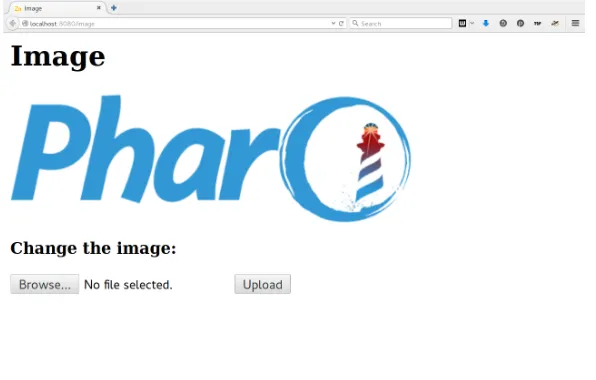
The Web application that we are going to build, shown in Figure 2-1, will dis-play a picture and allow users to change the picture by uploading a new one. Because we want to focus on the basic mechanics, the fundamentals as well as the build and deploy process, there are some simplifications. There will be one picture for all users, no login and we will store the picture in memory.
Building and Deploying a Small Web application
Figure 2-1 A simple Web application
submit its data to/imageas a POST request.
2.1
Saying Hello World
Let’s lay the groundwork for our new Web application by making a version that only says ’Hello World!’. We’ll be extending the Web app gradually until we reach our functional goal.
Open the Nautilus System Browser and create a new package (right click in the first column) called something like ’MyFirstWebApp’. Now create a new class (right click in the second column) with the same name, MyFirst-WebApp. You will be given a template: edit ’NameOfSubclass’ and accept by clicking ’OK’. Your definition should now appear in the bottom pane.
Object subclass: #MyFirstWebApp instanceVariableNames: '' classVariableNames: '' poolDictionaries: '' category: 'MyFirstWebApp'
Any object can be a Web app, it only has to respond to thehandleRequest:
message to answer a response based on a request. Now add the following method:
MyFirstWebApp>>handleRequest: request request uri path = #image
ifFalse: [ ^ ZnResponse notFound: request uri ]. ^ ZnResponse ok: (ZnEntity text: 'Hello World!')
2.1 Saying Hello World
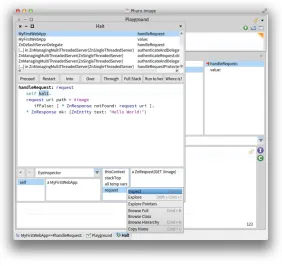
Figure 2-2 Defining a first version of the application
Create a new protocol calledpublic(by right-clicking in the third column). When the new protocol is selected, a new method template will appear in the bottom pane. Overwrite the whole template with the code above and accept it as shown Figure 2-2.
What we do here is to look at the incoming request to make sure the URI path is/imagewhich will be the final name of our Web app. If not, we return aNot Found(code 404) response. If so, we create and return anOKresponse (code 200) with a simple text entity as body or payload.
Now we define the methodvalue:to make it an alias ofhandleRequest:as follows:
MyFirstWebApp>>value: request ^ self handleRequest: request
This is needed so our Web app object can be used more flexibly. To test our Web app, we’ll add it as one of the pages of the default server, like this:
ZnServer startDefaultOn: 8080.
Building and Deploying a Small Web application
Figure 2-3 Your first hello world Web app in action
The second expression adds a route from/imageto anMyFirstWebApp in-stance. If all is well,http://localhost:8080/imageshould show a friendly message as shown in Figure 2-3. Note how we are not even serving HTML, just plain text.
Debugging our Web App
Try putting a breakpoint inMyFirstWebApp>>handleRequest:(by insert-ingself haltin the method source code). Then, if you refresh the page from the web browser, a debugger will open in Pharo allowing you to inspect things. You can just continue the execution by clicking on the proceed but-ton. Or you can look into the actual request and response objects as shown in Figure 2-4.
Note how Pharo is a live environment: you can change the behavior of the application in the debugger window (such as changing the response’s text) and the change is immediately used.
You can leave the server running. If you want you can enable logging, or switch to debug mode and inspect the server instance as explained in Chap-ter Zinc Server. Don’t forget to remove any breakpoints you set before con-tinuing.
2.2
Serving an HTML Page With an Image
HTML generation can be done with some of existing high-level Pharo frame-works such as Mustache (see Chapter Mustache). In the following, we
2.2 Serving an HTML Page With an Image
Figure 2-4 Using the debugger to navigate execution
ally compose the HTML to focus on app building and deployment. Go ahead and add a new method namedhtml.
MyFirstWebApp>>html
^ '<html><head><title>Image</title> <body>
<h1>Image</h1> </body></html>'
Additionally, change thehandleRequest:method to use the new method.
MyFirstWebApp>>handleRequest: request request uri path = #image
ifFalse: [ ^ ZnResponse notFound: request uri ]. ^ ZnResponse ok: (ZnEntity html: self html)
Refresh the page in your web browser. You should now see an HTML page as in Figure 2-5.
but-Building and Deploying a Small Web application
Figure 2-5 Returning an HTML response
ton and write some documentation. You can also use the class comment as a notepad for yourself, saving useful expressions that you can later execute in place such as the two expressions above to start the server.
Serving an Image
For the purpose of our Web app, images can be any of three types: GIF, JPEG and PNG. The application will store them in memory as an object wrapping the actual bytes together with a MIME type.
To simplify our app, we will arrange things so that we always start with a de-fault image, then we always have something to show. Let’s add a little helper: thedownloadPharoLogomethod:
MyFirstWebApp>>downloadPharoLogo ^ ZnClient new
beOneShot;
get: 'http://pharo.org/files/pharo.png'; entity
Quickly test the code by selecting the method body (not including the name) and inspecting the result. You should get the bytes of an image back. Now add the accessorimagedefined as follow:
MyFirstWebApp>>image
^ image ifNil: [ image := self downloadPharoLogo ]
When you try to accept this method, you will get an error. The method is trying to use an unknown variable namedimage. Select the option to
2.3 Allowing Users to Upload an Image
matically declare a new instance variable.
Remember that we decided we were going to serve the raw image itself using a query variable, like/image?raw=true. Make the following modification to existing methods and add a new one as shown below.
MyFirstWebApp>>html
^ '<html><head><title>Image</title> <body>
<h1>Image</h1>
<img src="image?raw=true"/> </body></html>'
MyFirstWebApp>>handleRequest: request request uri path = #image
ifFalse: [ ^ ZnResponse notFound: request uri ]. ^ self handleGetRequest: request
MyFirstWebApp>>handleGetRequest: request
^ (request uri queryAt: #raw ifAbsent: [ nil ])
ifNil: [ ZnResponse ok: (ZnEntity html: self html) ] ifNotNil: [ ZnResponse ok: self image ]
The HTML code now contains animgelement. ThehandleRequest:method now delegates the response generation to a dedicatedhandleGetRequest:
method. This method inspects the incoming URI. If the URI has a non-empty query variableraw, we serve the raw image directly. Otherwise, we serve the HTML page like before.
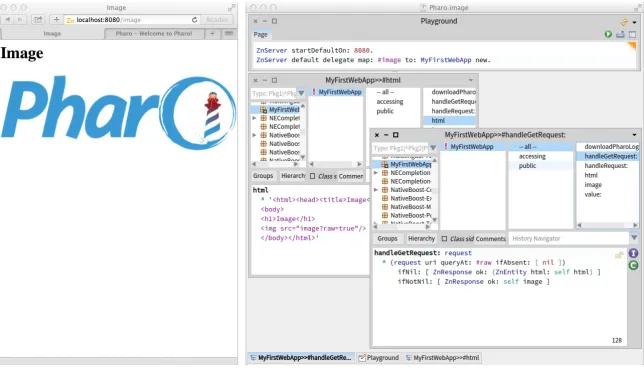
When you refresh the page in the web browser, you should now see an image as in Figure 2-6.
2.3
Allowing Users to Upload an Image
Interaction is what differentiates a Web site from a Web application. We will now add the ability for users to upload a new image to change the one on the server. To add this ability we need to use an HTML form. Let’s change our HTML one last time.
MyFirstWebApp>>html
^ '<html><head><title>Image</title> <body>
<h1>Image</h1>
<img src="image?raw=true"/> <br/>
<form enctype="multipart/form-data" action="image" method="POST"> <h3>Change the image:</h3>
Building and Deploying a Small Web application
Figure 2-6 Serving the Pharo logo
The user will be able to select a file on the local disk for upload. When he clicks on theUploadsubmit button, the web browser will send an HTTP POST request to the action URL,/image, encoding the form contents using a tech-nique called multi-part form-data. With the above change, you will see the form but nothing will happen if you click the submit button: this is because the server does not know how to process the incoming form data.
In our request handling, we have to distinguish between GET and POST re-quests. ChangehandleRequest:one last time:
MyFirstWebApp>>handleRequest: request request uri path = #image ifTrue: [
request method = #GET ifTrue: [ ^ self handleGetRequest: request ]. request method = #POST ifTrue: [
^ self handlePostRequest: request ] ]. ^ ZnResponse notFound: request uri
Now we have to add an implementation ofhandlePostRequest:to accept the uploaded image and change the current one.
MyFirstWebApp>>handlePostRequest: request | part |
part := request entity partNamed: #file. image := part entity.
^ ZnResponse redirect: #image
We start with a simple version without error handling. The entity of the incoming request is a multi-part form-data object containing named parts. Each part, such as the file part, contains another sub-entity: in our case, the
2.4 Live Debugging
uploaded image. Note how the response to the POST is a redirect to the main page. You should now have a fully functional web application.
Nevertheless, we have taken a bit of a shortcut in the code above. It is pretty dangerous to just accept what is coming in from the internet without doing any checking. Here is an improved version.
MyFirstWebApp>>handlePostRequest: request | part newImage badRequest |
badRequest := [ ^ ZnResponse badRequest: request ]. request hasEntity ifFalse: badRequest.
(request contentType matches: ZnMimeType multiPartFormData) ifFalse: badRequest.
part := request entity partNamed: #file ifNone: badRequest. newImage := part entity. (newImage notNil
and: [ newImage contentType matches: 'image/*' asZnMimeType ]) ifFalse: badRequest.
image := newImage.
^ ZnResponse redirect: #image
Our standard response when something is wrong will be to return aBad Re-quest(code 400). We define this behavior in a temporary variable so that we can reuse it multiple times over. The first test makes sure the current POST request actually contains an entity and that it is of the correct type. Next, the code checks that there is no file part. Finally, the code makes sure the file part is actually an image by matching with the wildcardimage/*MIME type. The user can now upload a new image through the application as can be seen in Figure 2-7. This image is saved in memory and displayed for all visitors until the application is restarted.
If you are curious, set a breakpoint in thehandlePostRequest:method and inspect therequestobject of an actual request. You will learn a lot from inspecting and manipulating live objects.
2.4
Live Debugging
Let’s make a deliberate error in our code. ChangehandlePostRequest:so that the last line reads like:
^ ZnResponse redirectTo: #image
The compiler will already complain, ignore the warning and accept the code anyway. If you try to upload a new image, your browser window will display a following text which corresponds to a Pharo error:
Building and Deploying a Small Web application
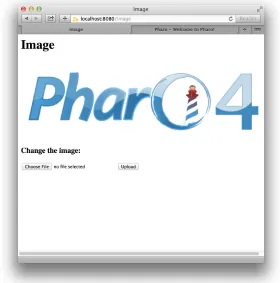
Figure 2-7 Changing the displayed image
But, we can do better and activate the debug mode of the server. Let’s stop and restart our Web app using:
ZnServer stopDefault.
(ZnServer startDefaultOn: 8080) debugMode: true.
ZnServer default delegate map: #image to: MyFirstWebApp new.
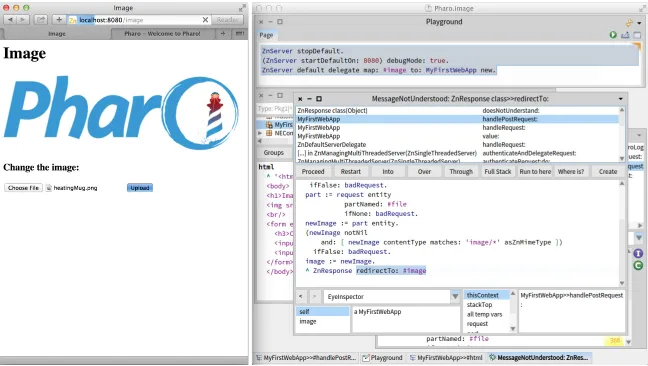
If you now try to upload an image through the Web browser, the debugger will pop up in Pharo telling you thatZnResponsedoes not understand redi-rectTo:and show you the offending code. You could fix the code and try uploading again to see if it works as shown in Figure 2-8.
But we can do even better! Just fix the code directly within the debugger window and accept it. Now you can restart and proceed the execution. The same request is still active and the server will now do the correct thing. Have a look at your Web browser: you will see that your initial action, the upload, that first initially hung, has now succeeded.
2.5 Image Magic
Figure 2-8 Debugging
Up to now, the suggestion was that you can use the debugger and inspector tools to look at requests and responses. But you can actually change them while they are happening! Prepare for our experiment by making sure that you change the image to be different from the default one. Now set a break-point inhandleGetRequest:and reload the main page. There will be two requests coming in: the first request for/imageand the second request for
/image?raw=true. Proceed the first one.
Now, with the execution being stopped for the second request, click on the image instance variable in the bottom left pane (see Figure 2-9). The pane next to it will show some image entity. Select the whole contents and replace it withself downloadPharoLogoand accept the change. Now proceed the execution. Your previously uploaded image is gone, replaced again by the default Pharo logo. We just changed an object in the middle of the execution. Imagine doing all your development like that, having a real conversation with your application, while you are developing it. Be warned though: once you get used to this, it will be hard to go back.
2.5
Image Magic
Building and Deploying a Small Web application
Figure 2-9 Live change
with JPEG, GIF or PNG.
Would it not be cool to be able to actually parse the image that we were ma-nipulating as an opaque collection of bytes up till now? To make sure it is real. To look at it while debugging. Turns out this is quite easy. Are you ready for some image magick, pun intended?
The Pharo object that represents images is called a form. There are objects calledGIFReadWriter,PNGReadWriterandJPEGReadWriterthat can parse bytes into forms. Add two helper methods,formForImageEntity:andform. MyFirstWebApp>>formForImageEntity: imageEntity
| imageType parserClassName parserClass parser | imageType := imageEntity contentType sub.
parserClassName := imageType asUppercase, #ReadWriter.
parserClass := Smalltalk globals at: parserClassName asSymbol. parser := parserClass on: imageEntity readStream.
^ parser nextImage
MyFirstWebApp>>form
^ self formForImageEntity: self image
2.6 Adding Tests
What we do is use the sub type of the mime type, like ”png” in image/png, to find the parser class. Then we instantiate a new parser on a read stream on the actual bytes and invoke the parser with sendingnextImage, which will return a form. Theformmethod makes it easy to invoke all this logic on our current image.
Now we can have a look at, for example, the default image like this:
MyFirstWebApp new form asMorph openInWindow.
Obviously you can do this while debugging too. We can also use the image parsing logic to improve our error checking even further. Here is the final version ofhandlePostRequest:
MyFirstWebApp>>handlePostRequest: request | part newImage badRequest |
badRequest := [ ^ ZnResponse badRequest: request ]. (request hasEntity
and: [ request contentType matches: ZnMimeType multiPartFormData ])
ifFalse: badRequest. part := request entity
partNamed: #file ifNone: badRequest. newImage := part entity. (newImage notNil
and: [ newImage contentType matches: 'image/*' asZnMimeType ]) ifFalse: badRequest.
[ self formForImageEntity: newImage ] on: Error
do: badRequest. image := newImage.
^ ZnResponse redirect: #image
Before making the actual assignment of the new image to our instance vari-able we added an extra expression. We try parsing the image. We are not interested in the result, but we do want to reply with a bad request when the parsing has failed.
Once we have a form object, the possibilities are almost endless. You can query a form for its size, depth and other elements. You can manipulate the form in various ways: scaling, resizing, rotating, flipping, cropping, com-positing. And you can do all this in an interactive and dynamic environment.
2.6
Adding Tests
Building and Deploying a Small Web application
Figure 2-10 Automatically create a test class
Writing tests is creating objects, letting them interact and asserting some conditions. Start by creating a new subclassMyFirstWebAppTestof Test-Case. The Pharo browser helps you here using the ”Jump to test class” item in the contextual menu onMyFirstWebApp(see Figure 2-10).
Add now the following helper method onMyFirstWebAppTest: MyFirstWebAppTest>>withServerDo: block
| server |
server := ZnServer on: 1700 + 10 atRandom. [
server start.
self assert: server isRunning & server isListening. server delegate: MyFirstWebApp new.
block cull: server ] ensure: [ server stop ]
Since we will need a configured server instance with our Web app as delegate for each of our tests, we move that logic into#withServerDo:and make sure the server is OK and properly stopped afterwards. Now we are ready for our first test.
2.6 Adding Tests
Figure 2-11 Running a test case
MyFirstWebAppTest>>testMainPage self withServerDo: [ :server |
| client |
client := ZnClient new.
client url: server localUrl; addPath: #image. client get.
self assert: client isSuccess.
self assert: (client entity contentType matches: ZnMimeType textHtml).
self assert: (client contents includesSubstring: 'Image'). client close ]
IntestMainPagewe do a request for the main page,/image, and assert that the request is successful and contains HTML. Make sure the test is green by running it from the system browser by clicking on the round icon in front of the method name in the fourth pane (see Figure 2-11).
Let’s try to write a test for the actual raw image being served.
Building and Deploying a Small Web application
| client |
client := ZnClient new.
client url: server localUrl; addPath: #image; queryAt: #raw put: #true.
client get.
self assert: client isSuccess.
self assert: (client entity contentType matches: 'image/*' asZnMimeType).
self assert: client entity equals: server delegate image. client close ]
Note how we can actually test for equality between the served image and the one inside our app object (the delegate). Run the test.
Our final test will actually do an image upload and check if the served image did actually change to what we uploaded. Here we define the methodimage
that returns a new image.
MyFirstWebAppTest>>image ^ ZnClient new
beOneShot;
get: 'http://zn.stfx.eu/zn/Hot-Air-Balloon.gif'; entity
MyFirstWebAppTest>>testUpload self withServerDo: [ :server |
| image client | image := self image. client := ZnClient new.
client url: server localUrl; addPath: #image.
client addPart: (ZnMimePart fieldName: #file entity: image). client post.
self assert: client isSuccess.
client resetEntity; queryAt: #raw put: #true. client get.
self assert: client isSuccess.
self assert: client entity equals: image. client close ]
The HTTP client object is pretty powerful. It can do a correct multi-part form-data POST, just like a browser. Furthermore, once configured, it can be reused, like for the second GET request.
2.7
Saving Code to a Repository
If all is well, you now have a package calledMyFirstWebAppcontaining two classes,MyFirstWebAppandMyFirstWebAppTest. The first one should have 9 methods, the second 5. If you are unsure about your code, you can double
2.7 Saving Code to a Repository
Figure 2-12 Opening Monticello on your package
check with the full listing at the end of this document. Our Web app should now work as expected, and we have some tests to prove it.
But our code currently only lives in our development image. Let’s change that and move our code to a source code repository.
The Monticello Browser
For this we first have to use the Monticello Browser tool. In the first pane of the Nautilus Browser, click on the icon in front of your package named
MyFirstWebAppas shown in Figure 2-12.
Once opened, Monticello shows on it left pane the list of loaded packages. The currently selected one should be yours as depicted in Figure 2-13.
The left pane of Monticello shows the list of repositories in which the cur-rently selected package can be saved. Indeed, Pharo uses distributed source code management. Your code can live on your local file system, or it can live on a server. As shown in Figure 2-13, by default, yourMyFirstWebApp
Building and Deploying a Small Web application
Figure 2-13 The Monticello browser
http://www.smalltalkhub.com. Go over there and create yourself a new ac-count. Once you have an account, create a'MyFirstWebApp'project. You can leave the public option checked, it means that you and others can down-load the code without having to enter any credentials. Your project’s page should look like the one on Figure 2-14.
On this page, select and copy the Monticello registration template (make sure to copy the whole contents, including the username and password parts). Now, go back to Pharo and in Monticello, click on the+Repositorybutton (be sure that your package is selected in the left pane).
Select Smalltalkhub.com as repository type and overwrite the presented template with the one you just copied. It should look similar to Figure 2-15. Before accepting, fill in your user(name) and password (between the single quotes), the ones you gave during registration on SmalltalkHub.
Now, Monticello Browser shows you to select repositories to save your pack-age as shown in Figure 2-16.
You may have noticed that there is an asterisk (*) in front of your package name, indicating the package is dirty: i.e., it has uncommitted changes. By
2.7 Saving Code to a Repository
Figure 2-14 Smalltalkhub project page
clicking on the ’Changes’ button, Monticello will list everything that has changed or will tell you nothing has changed (this happens sometimes when Monticello gets out of sync). If Monticello finds actual changes, you will get a browser showing all the changes you made. Since this is the first version, all your changes are additions.
Committing to SmalltalkHub
Go back to the Monticello Browser and click the ’Save’ button (with your package and repository selected). Leave the version name, something like MyFirstWebApp-SvenVanCaekenberghe.1 alone, write a nice commit mes-sage in the second pane and press Accept to save your code to SmalltalkHub. When all goes well, you will see an upload progress bar and finally a version window that confirms the commit. You can close it later on.
Building and Deploying a Small Web application
Figure 2-15 Adding a Smalltalkhub repository in Monticello for your project.
You can now browse back to Smalltalkhub.com to confirm that your code arrived there.
After a successful commit, it is a good idea to save your image. In any case, your package should now no longer be dirty, and there should be no more differences between the local version and the one on SmalltalkHub.
Defining a Project Configuration
Real software consists of several packages and will depend on extra external libraries and frameworks. In practice, software configuration management, including the management of dependencies and versions, is thus a neces-sity. To solve this problem, Pharo is using Metacello (the book Deep into Pharohttp://deepintopharo.comcontains a full chapter on it). And although we don’t really need it for our small example, we are going to use it anyway. Of course, we will not go into details as this is a complex subject.
To create a Metacello configuration, you define an object, what else did you expect? But we must respect some name conventions so Monticello can help us to generate part of this Metacello configuration. Open Monticello
2.7 Saving Code to a Repository
Figure 2-16 Multiple repositories for a project in Monticello
and click on the +Config button to add the ConfigurationOfMyFirstWe-bAppconfiguration. With a right click on it, you can ”Browse configuration” which open a Nautilus browser on this newly created class. We are now going to define three methods: one defining a baseline for our configuration, one defining concrete package versions for that baseline, and one declaring that version as the stable released version. Here is the code:
ConfigurationOfMyFirstWebApp>>baseline1: spec <version: '1-baseline'>
spec for: #common do:[ spec
blessing: #baseline; repository:
'http://smalltalkhub.com/mc/SvenVanCaekenberghe/MyFirstWebApp/main'; package: 'MyFirstWebApp' ]
ConfigurationOfMyFirstWebApp>>version1: spec <version: '1' imports: #('1-baseline')> spec for: #common do: [
Building and Deploying a Small Web application
blessing: #release; package: 'MyFirstWebApp'
with: 'MyFirstWebApp-SvenVanCaekenberghe.1' ]
ConfigurationOfMyFirstWebApp>>stable: spec <symbolicVersion: #'stable'>
spec for: #common version: '1'
Once you committed the project (that consists in both the Metacello config-uration and the Monticello package'MyFirstWebApp'), you can test your configuration by trying to load it.
ConfigurationOfMyFirstWebApp load.
Of course, not much will happen since you already have the specified version loaded. For some feedback, make sure the Transcript is open and inspect the above expression.
Now add your SmalltalkHub repository to the ConfigurationOfMyFirst-WebAppMonticello package. Double-check the changes in the Monticello Browser, remember we copied a whole class. Now commit by saving to your SmalltalkHub repository. Use the Web interface to verify that all went well.
2.8
Running a Real Cloud Server
So we created our first Web app and tested it locally. We stored our source code in the SmalltalkHub repository and created a Metacello configuration for it. Now we need a real cloud server to run our Web app.
It used to be hard and expensive to get access to a real server permanently connected to the internet. Not anymore: prices have comes down and op-erating cloud servers has become a much easier to use service. If you just want to test the deployment of this Pharo Web app, you can use cloud9 (http: //c9.io). It freely provides some testing environments after creating an ac-count. Note that cloud9 is for testing purpose only and that a real hosting solution such as Digital Ocean (http://www.digitalocean.com) is better.
For this guide, we will be using Digital Ocean. The entry level server there, which is more than powerful enough for our experiment, costs just $5 a month. If you stop and remove the server after a couple of days, you will only pay cents. Go ahead and make yourself an account and register a credit card.
Create a Droplet
A server instance is called a Droplet. Click the ‘Create Droplet’ button and fill in the form. Pick a hostname, select the smallest size, pick a region close to you. As operating system image, we’ll be using a 32-bit Ubuntu Linux, ver-sion 13.04 x32. You can optionally use an SSH key pair to log in - it is a good
2.8 Running a Real Cloud Server
idea, see How to Use SSH Keys with DigitalOcean Droplets - just skip this op-tion for now if you are uncomfortable with it, it is not necessary for this tuto-rial. Finally click the ‘Create Droplet’ button.
In less than a minute, your new server instance will be ready. Your root pass-word will be emailed to you. If you look at your droplets, you should see your new server in the list. Click on it to see its details.
The important step now is to get SSH access to your new server, preferably through a terminal. With the IP address from the control panel and the root password emailed to you, try to log in.
$ ssh [email protected]
Your server is freshly installed and includes only the most essential core packages. Now we have to install Pharo on it. One easy way to do this is us-ing the functionality offered byhttp://get.pharo.org. The following command will install a fresh Pharo 2.0 image together with all other files needed.
# curl get.pharo.org/40+vm | bash
Make sure the VM+image combination works by asking for the image ver-sion.
# ./pharo Pharo.image printVersion [version] 4.0 #40614
Let’s quickly test the stock HTTP server that comes with Pharo, like we did in the third section of this guide.
# ./pharo Pharo.image eval --no-quit 'ZnServer startDefaultOn: 8080'
This command will block. Now access your new HTTP server. You should see the Zinc HTTP Components welcome page. If this works, you can press ctrl-C in the terminal to end our test.
Deploy for Production
We now have a running server. It can run Pharo too, but it is currently using a generic image. How do we get our code deployed? To do this we use the Metacello configuration. But first, we are going to make a copy of the stock
Pharo.imagethat we downloaded. We want to keep the original clean while we make changes to the copy.
# ./pharo Pharo.image save myfirstwebapp
Building and Deploying a Small Web application
# ./pharo myfirstwebapp.image config \
http://smalltalkhub.com/mc/SvenVanCaekenberghe/MyFirstWebApp/main \
ConfigurationOfMyFirstWebApp
'Available versions for ConfigurationOfMyFirstWebApp' 1
1-baseline bleedingEdge last
stable
You should have only one version, all the above are equivalent references to the same version. Now we will load and install the stable version.
# ./pharo myfirstwebapp.image config \
http://smalltalkhub.com/mc/SvenVanCaekenberghe/MyFirstWebApp/main \
ConfigurationOfMyFirstWebApp --install=stable 'Installing ConfigurationOfMyFirstWebApp stable'
Loading 1 of ConfigurationOfMyFirstWebApp... ...
After loading all necessary code, the config option will also save our image so that it now permanently includes our code. Although we could try to write a (long) one line expression to start our Web app in a server and pass it to the eval option, it is better to write a small script. Create a file called ‘run.st’ with the following contents:
ZnServer defaultOn: 8080.
ZnServer default logToTranscript. ZnServer default delegate
map: 'image' to: MyFirstWebApp new;
map: 'redirect-to-image' to: [ :request | ZnResponse redirect: 'image' ];
map: '/' to: 'redirect-to-image'. ZnServer default start.
We added a little twist here: we changed the default root (/) handler to redi-rect to our new/imageWeb app. Test the startup script like this:
# ./pharo myfirstwebapp.image run.st
2015-06-15 15:59:56 001 778091 Server Socket Bound 0.0.0.0:8080 2015-06-15 15:59:56 002 013495 Started ZnManagingMultiThreadedServer
HTTP port 8080 ...
You can surf to the correct IP address and port to test you application. Note that/welcome,/helpand/imageare still available too. Type ctrl-c to kill the server again. You can then put the server in background, running for real.
2.9 Have Fun Extending this Web App
Figure 2-17 Our Web app, running in the cloud
# nohup ./pharo myfirstwebapp.image run.st &
Figure 2-17 shows how the deployment looks like on cloud9.
2.9
Have Fun Extending this Web App
Did you like the example so far? Would you like to take one more step? Here is a little extension left as an exercise. Add an extra section at the bottom of the main page that shows a miniature version of the previous image. Ini-tially, you can show an empty image. Here are a couple of hints. Read only as far as you need, try to figure it out by yourself.
Hint 1
You can scale a form object into another one using just one message taking a single argument. You can use the same classes that we used for parsing as a tool to generate PNG, JPEG or GIF images given a form.
Building and Deploying a Small Web application
Hint 2
Change thehtmlmethod referring to a new variant,/image?previous=true, for the second image. AdjusthandleGetRequest:to look for that attribute. Add a helper methodpngImageEntityForForm:and apreviousImage ac-cessor. It is easy to create an empty, blank form as default. Call a updatePre-viousImageat the right spot inhandlePostRequest:and implement the necessary functionality there.
Hint 3
If you found it difficult to find the right methods, have a look at the following ones:
• Form>>scaledIntoFormOfSize:
• Form class>>extent:depth:
• PNGReadWriter>>nextPutImage:
• ByteArray class>>streamContents:
• ZnByteArrayEntity class>>with:type:
Solution, Part 1, New Methods
Here are 3 new methods that are part of the solution.
pngImageEntityForForm: form ^ ZnByteArrayEntity
with: (ByteArray streamContents: [ :out |
(PNGReadWriter on: out) nextPutImage: form ]) type: ZnMimeType imagePng
previousImage
^ previousImage ifNil: [ | emptyForm |
emptyForm:= Form extent: 128 @ 128 depth: 8.
previousImage := self pngImageEntityForForm: emptyForm ]
updatePreviousImage | form scaled | form := self form.
scaled := form scaledIntoFormOfSize: 128.
previousImage := self pngImageEntityForForm: scaled
Solution, Part 2, Changed Methods
Here are the changes to 3 existing methods for the complete solution.
2.9 Have Fun Extending this Web App
html
^ '<html><head><title>Image</title> <body>
<h1>Image</h1>
<img src="image?raw=true"/> <br/>
<form enctype="multipart/form-data" action="image" method="POST">
<h3>Change the image:</h3> <input type="file" name="file"/> <input type="submit" value= "Upload"/> </form>
<h3>Previous Image</h3>
<img src="image?previous=true"/> </body></html>'
handleGetRequest: request
(request uri queryAt: #raw ifAbsent: [ nil ]) ifNotNil: [ ^ ZnResponse ok: self image ]. (request uri queryAt: #previous ifAbsent: [ nil ])
ifNotNil: [ ^ ZnResponse ok: self previousImage ]. ^ ZnResponse ok: (ZnEntity html: self html)
handlePostRequest: request | part newImage badRequest |
badRequest := [ ^ ZnResponse badRequest: request ]. (request hasEntity
and: [ request contentType matches: ZnMimeType multiPartFormData ])
ifFalse: badRequest. part := request entity
partNamed: #file ifNone: badRequest. newImage := part entity. (newImage notNil
and: [ newImage contentType matches: 'image/*' asZnMimeType ]) ifFalse: badRequest.
[ self formForImageEntity: newImage ] on: Error
do: badRequest. self updatePreviousImage. image := newImage.
^ ZnResponse redirect: #image
Solution, Part 3, Updated Configuration
Building and Deploying a Small Web application
version2: spec
<version: '2' imports: #('1-baseline')> spec for: #common do: [
spec
blessing: #release;
package: 'MyFirstWebApp' with: 'MyFirstWebApp-SvenVanCaekenberghe.2' ]
stable: spec
<symbolicVersion: #'stable'> spec for: #common version: '2'
Of course, you will have to substitute your name for the concrete version.
2.10
Conclusion
Congratulations: you have now built and deployed your first Web app with Pharo. Hopefully you are interested in learning more. From the Pharo web-site you should be able to find all the information you need. Don’t forget about the Pharo by Example book and the mailing lists. This guide was an introduction to writing Web applications using Pharo, touching on the fun-damentals of HTTP. Like we mentioned in the introduction, there are a cou-ple of high level frameworks that offer more extensive support for writing Web applications. The three most important ones are Seaside, AIDAweb and Iliad.
The code of the Web app, including tests and the Metacello configuration, is on SmalltalkHub1. A similar example is also included in the Zinc HTTP
Com-ponents project itself, under the nameZnImageExampleDelegate[Tests].
1http://smalltalkhub.com/#!/~SvenVanCaekenberghe/MyFirstWebApp
Part II
C H A P T E R
3
Character Encoding and
Resource Meta Description
The rise of the Internet and of Open Standards resulted in the adoption of a number of fundamental mechanisms to enable communication and collabo-ration between different systems.
One such mechanism is the ability to encode strings or characters to bytes or to decode strings or characters from bytes. Different encoding standards have been developed over the years and Pharo supports many current and legacy encodings.
Another important aspect of collaboration is the ability to describe resources such as files. Both Mime-Type and URLs or URIs are basic building blocks for creating meta descriptions of resources and Pharo also has objects that implement these fundamental aspects.
In this chapter we discuss Character encoding, MIME types and URL/URIs. They are essential for the correct implementation of HTTP, but they are in-dependent from it, as they are used for many other purposes.
3.1
Character Encoding
Character Encoding and Resource Meta Description
Characters and Strings use Unicode Internally
Proper character encoding and decoding is crucial in today’s international world. Internally, Pharo stores characters and strings using Unicode. Uni-code1is a very large internationally standardized collection of code points
(integer numbers) representing all of the world languages’ characters.
We can obtain the code point (Unicode value) of a character by sending it the
codePointmessage, for example: $H codePoint
--> 72
Here are some example strings in multiple languages with their Unicode code points:
'Hello' collect: #codePoint as: Array. --> #(72 101 108 108 111)
'Les élèves français' collect: #codePoint as: Array. --> #(76 101 115 32 233 108 232 118 101 115
32 102 114 97 110 231 97 105 115)
'Ελλάδα' collect: #codePoint as: Array. --> #(917 955 955 940 948 945)
For a simple language like English, all characters have code points below 128 (which fits in 7 bits, for historical reasons). These characters are part of ASCII2. The very first part of the so called Basic Multilingual Plane of Unicode
(the first 128 code points of it) are identical to ASCII.
$a codePoint --> 97
Next come a number of European languages, like French, which have code points below 256 (fitting in 8 bits or one byte). These characters are part of Latin-1 (ISO-8859-1)3, whose first 256 code points are identical in Unicode.
$é codePoint --> 233
And finally, there are hundreds of other languages, like Chinese, Japanese, Cyrillic, Arabic or Greek. You can see from the example above: Greece writ-ten in Greek, that those code points are higher than 256 (and thus no longer fit in one byte).
λ
$ codePoint --> 955
1http://en.wikipedia.org/wiki/Unicode 2http://en.wikipedia.org/wiki/ASCII 3http://en.wikipedia.org/wiki/ISO/IEC_8859-1
3.1 Character Encoding
Unicode code points are often written using a specific hexadecimal notation. For example, the previous character, the Greek lowercase lambda, is written asU+03BB. The Pharo inspector also shows this value next to the codepoint.
The good thing is, we can work with text in any language in Pharo. However, to display everything correctly a font must be used that is capable of showing all the characters (or glyphs) needed, for example Arial Unicode MS.
Encoding and Decoding
For communication with the world outside Pharo, the operating system, files, the internet, et cetera, we have to represent our strings as a collec-tion of bytes. Yet code points are different to bytes, as will be shown below. Therefore we need a way to transform our internal strings into external col-lection of bytes and vice versa.
Character encoding is the standard way of converting a native Pharo string, i.e. a collection of Unicode code points, to a series of bytes. Character de-coding is the reverse process: interpreting a series of bytes as a collection of Unicode code points, to create a Pharo string.
To implement character encoding or decoding, a concrete subclass of the classZnCharacterEncoderis used, e.g.ZnUTF8Encoder. Character encoders do the following:
• encode a character (messagenextPut:toStream:) or string (message
next:putAll:startingAt:toStream:) onto a binary stream
• convert a string (encodeString:) to a byte array
• decode a binary stream to a character (nextFromStream:) or string (readInto:startingAt:count:fromStream:)
• convert a byte array to string (decodeBytes:)
• compute the number of bytes that are needed to encode a character (encodedByteCountFor:) or string (encodedByteCountForString:) • move a binary stream backwards one character (backOnStream:)
Character encoders do proper error handling, throwing an error of the class
ZnCharacterEncodingErrorwhen something goes wrong. The strict/le-nient setting controls some behavior in this respect, and this will be dis-cussed later in this chapter.
The recommended encoding is the primary internet encoding: UTF-84. It
is a variable length encoding that is optimized somewhat for ASCII and to a lesser degree for Latin1 and some other common European encodings.
Character Encoding and Resource Meta Description
Converting Strings and ByteArrays
The first use of encoders is to convert Strings to ByteArrays and vice-versa. We however deal only indirectly with character encoders. TheByteArray
andStringclasses have some convenience methods to do encoding and de-coding:
'Hello' utf8Encoded.
--> #[72 101 108 108 111]
'Hello' encodeWith: #latin1. --> #[72 101 108 108 111]
Our ASCII string,'Hello'encodes identically using either UTF-8 or Latin-1. 'Les élèves français' utf8Encoded.
--> #[76 101 115 32 195 169 108 195 168 118 101 115 32 102 114 97 110 195 167 97 105 115]
'Les élèves français' encodeWith: #latin1. --> #[76 101 115 32 233 108 232 118 101 115
32 102 114 97 110 231 97 105 115]
Our French string,'Les élèves français', encodes differently though. The reason is that UTF-8 uses two bytes for the accented letters like é, è and ç. Note how for Latin-1, andonlyfor Latin-1 and ASCII, the Unicode code points are equal to the encoded byte values.
'éèç' utf8Encoded.
--> #[195 169 195 168 195 167]
'éèç' encodeWith: #latin1. --> #[233 232 231]
'éèç' collect: #codePoint as: ByteArray --> #[233 232 231]
'Ελλάδα' utf8Encoded.
--> #[206 149 206 187 206 187 206 172 206 180 206 177]
'Ελλάδα' encodeWith: #latin1.
--> ZnCharacterEncodingError: 'Character Unicode code point outside encoder range'
Our greek string,'Ελλάδα', gives an error when we try to encode it using Latin-1. The reason is that the Greek letters are outside of the alphabet of Latin-1. Still, UTF-8 manages to encode them using just two bytes.
The reverse process, decoding, is equally simple:
#[72 101 108 108 111] utf8Decoded. --> 'Hello'
3.1 Character Encoding
#[72 101 108 108 111] decodeWith: #latin1. --> 'Hello'
#[76 101 115 32 195 169 108 195 168 118 101 115 32 102 114 97 110 195 167 97 105 115] utf8Decoded.
--> 'Les élèves français'
#[76 101 115 32 195 169 108 195 168 118 101 115
32 102 114 97 110 195 167 97 105 115] decodeWith: #latin1. --> 'Les élèves français'
#[76 101 115 32 233 108 232 118 101 115
32 102 114 97 110 231 97 105 115] utf8Decoded.
--> ZnInvalidUTF8: 'Illegal continuation byte for utf-8 encoding'
#[76 101 115 32 233 108 232 118 101 115
32 102 114 97 110 231 97 105 115] decodeWith: #latin1. --> 'Les élèves français'
#[206 149 206 187 206 187 206 172 206 180 206 177] utf8Decoded. --> 'Ελλάδα'
#[206 149 206 187 206 187 206 172 206 180 206 177] decodeWith: #latin1.
--> ZnCharacterEncodingError: 'Character Unicode code point outside encoder range'
Our English'Hello', being pure ASCII, can be decoded using either UTF-8 or Latin-1. Our French'Les élèves français'is another story: using the wrong encoding gives either gibberish orZnInvalidUTF8error. The same is true for our Greek'Ελλάδα'.
You might wonder why in the first case thelatin1encoder produced gib-berish, while in the second case it gave an error. This is because in the sec-ond case, there was a byte with value 149, which is outside its alphabet. So called byte encoders, like Latin-1, take a subset of Unicode characters and compress them in 256 possible byte values. This can be seen by inspecting the character or byte domains of aZnByteEncoder, as follows:
(ZnByteEncoder newForEncoding: 'iso-8859-1') byteDomain. (ZnByteEncoder newForEncoding: 'ISO_8859_7') characterDomain.
Note that identifiers for encodings are interpreted flexibly (case and punctu-ation do not matter).