R E S E A R C H A R T I C L E
Open Access
Development and acceptability testing of
ready-to-use supplementary food made from
locally available food ingredients in Bangladesh
Tahmeed Ahmed
1,2*, Nuzhat Choudhury
1, M Iqbal Hossain
1,2, Nattapol Tangsuphoom
3, M Munirul Islam
1,
Saskia de Pee
4, Georg Steiger
5, Rachel Fuli
6, M Shafiqul A Sarker
1, Monira Parveen
6, Keith P West Jr.
7and Parul Christian
7Abstract
Background:Inadequate energy and micronutrient intake during childhood is a major public health problem in developing countries. Ready-to-use supplementary food (RUSF) made of locally available food ingredients can improve micronutrient status and growth of children. The objective of this study was to develop RUSF using locally available food ingredients and test their acceptability.
Methods:A checklist was prepared of food ingredients available and commonly consumed in Bangladesh that have the potential of being used for preparing RUSF. Linear programming was used to determine possible combinations of ingredients and micronutrient premix. To test the acceptability of the RUSF compared toPushtipacket (a cereal based food-supplement) in terms of amount taken by children, a clinical trial was conducted among 90 children aged 6–18 months in a slum of Dhaka city. The mothers were also asked to rate the color, flavor, mouth-feel, and overall liking of the RUSF by using a 7-point Hedonic Scale (1 = dislike extremely, 7 = like extremely).
Results:Two RUSFs were developed, one based on rice-lentil and the other on chickpea. The total energy obtained from 50 g of rice-lentil, chickpea-based RUSF andPushti packetwere 264, 267 and 188 kcal respectively. Children were offered 50 g of RUSF and they consumed (mean ± SD) 23.8 ± 14 g rice-lentil RUSF, 28.4 ± 15 g chickpea based RUSF. Pushti packetwas also offered 50 g but mothers were allowed to add water, and children consumed 17.1 ± 14 g. Mean feeding time for two RUSFs andPushti packetwas 20.9 minutes. Although the two RUSFs did not differ in the amount consumed, there was a significant difference in consumption between chickpea-based RUSF andPushtipacket (p= 0.012). Using the Hedonic Scale the two RUSFs were more liked by mothers compared toPushti packet.
Conclusions:Recipes of RUSF were developed using locally available food ingredients. The study results suggest that rice-lentil and chickpea-based RUSF are well accepted by children.
Trial registration:ClinicalTrials.gov NCT01553877. Registered 24 January 2012.
Keywords:Ready-to-use supplementary food (RUSF), Local food ingredients, Development, Acceptability
* Correspondence:[email protected]
1Centre for Nutrition and Food Security, icddr,b, 68 Shaheed Tajuddin
Ahmed Sarani, Mohakhali, Dhaka 1212, Bangladesh
2James P. Grant School of Public Health, BRAC University, Dhaka, Bangladesh
Full list of author information is available at the end of the article
Background
Bangladesh has one of the highest childhood malnutri-tion rates in the world. The prevalence of underweight (<−2 z score weight-for-age) among children less than five years old is 36 percent and stunting (<−2 z score height-for-age), which denotes chronic malnutrition, is 41 percent [1]. Bangladesh has an estimated 600,000 children with severe acute malnutrition (SAM) and 1.8 million with moderate acute malnutrition (MAM). As a result, currently there are 2.4 million children under five years of age in the country suffering from acute malnu-trition (<−2 z score weight-for-height) [1]. Malnutrition is nearly always accompanied by deficiencies of essential micronutrients, raising the importance of evaluating the impact of micronutrient content of food products in re-ducing micronutrient deficiencies during 6–12 months of life [2]. Although breast feeding rates have increased considerably in Bangladesh (90 percent of under-two children breast fed and 64 percent exclusively breast fed during the first 6 months of life), only 24 percent of young children are fed as per appropriate infant and young child feeding (IYCF) practices [1]. Research done in rural Bangladesh showed that complementary foods are grossly deficient in essential micronutrients [3]. In a recent study we assessed the adequacy of intake of 11 micronutrients among 24–48 months children in rural Bangladesh [4]. The overall mean prevalence of adequacy of micronutrient intakes for children was only 43 percent. The prevalence of adequacy was less than 50 percent for iron, calcium, riboflavin, folate, and vitamin B12. In the same population we observed that children consumed sub-optimal amounts of fat and in most children, only one to four percent of the total energy came from essential fatty acids [5]. These observations reflect food insecurity which affects about 20–30 percent of the population of the country, as well as low dietary diversity and low feed-ing frequency of young children among a larger part of the population. Although effective counseling to improve the quality of complementary feeding works in food se-cure communities, supplementation with nutritious food may be imperative for children, especially those who can-not afford an adequately diverse diet [6,7].
To reduce growth faltering among young children in re-source constrained countries several food supplements have been developed and tested with contrasting results [8-10]. However, considering the country context, a new supplementary food made of locally available food ingredi-ents needs to be developed in Bangladesh. This new sup-plementary food was designed similar to thePushtipacket (a mixture of roasted rice and lentil flour, with molasses and oil), the food supplement used in the erstwhile National Nutrition Program of Bangladesh. This food supplement is referred in this paper as‘Ready-to-use sup-plementary food’ (RUSF) made of locally available food
ingredients and designed to have the required amount of micronutrients and vitamins essential for growth and de-velopment of children 6–24 months of age. RUSF does not require cooking and can be consumed without adding water either on its own or by mixing with other food such as rice porridge. It has minimal water content and thus, the risk of contamination or bacterial growth is greatly re-duced. These characteristics make provision of RUSF a safe nutrition for young children in Bangladesh. This paper aims to describe the formulation of newly developed RUSF recipes and to assess whether these RUSF are ac-ceptable compared with the existingPushtipacket among children aged 6–18 months in a clinical trial design.
Methods
Development of RUSF Selection of ingredients
As part of the development of RUSF, a checklist was pre-pared for all food ingredients available and commonly consumed in Bangladesh that have the potential of being used for developing a RUSF. A final selection was made based on the nutritive value, local availability, and cost of the local ingredients. All ingredients were purchased from the local market. Vitamin and mineral premix was obtained from DSM Switzerland.
Recipe formulation and production
small amount (1 percent) of soy lecithin was added to the recipe in order to improve the consistency and pre-vent oil separation.
Determination of RUSF quality and stability
Microbiological tests (total viable count, yeasts, moulds, coliforms, Escherichia coli, Bacillus cereus, Staphylococci,
Listeria monocytogenes, Cronobacter sakazaki) were done at icddr,b Food Safety Laboratory. Chemical properties (pH, water activity, moisture, peroxide value, total aflatoxin), nu-tritional composition (protein, fat, energy, carbohydrates) and micronutrient composition (vitamins, and minerals) were determined at the Institute of Nutrition, Mahidol University, Thailand based on standard procedures.
In order to preliminarily assess the storage stability of RUSF, sensory quality of RUSF was assessed after two weeks of storage under ambient conditions (30.0°C, 58 percent relative humidity). Difference-from-control test was conducted by thirteen panelists from among staff of icddr,b and are caregivers familiar with feeding their children complementary food but not directly involved with the present study. Panelists received three samples (15–20 g in white plastic cups) for each formula, one stored at room temperature (test sample) and two con-trols (A and B) stored in a freezer. All samples were blinded to the panelist and were coded with three-digit random numbers except control sample A. They were randomly served to each panelist. Panelists were asked to rate for the degree of difference in odor and flavor of sam-ples from the control sample A. The rating was performed on 5-point scale with 0: no difference and 4: extremely dif-ferent. No difference in odor and flavor was observed be-tween sample that was kept at room temperature and the one kept in a freezer, suggesting that the RUSF could be kept at room temperature for up to two weeks without any change in its sensory quality. There was also no change in microbiological quality of RUSF stored at room temperature over two weeks. The product development stage took nine months between January-September 2011. However, the RUSF used for the acceptability trial were freshly prepared every alternative day.
Acceptability trial Outcome variables
The primary outcome variable for the acceptability trial was to see the acceptability of RUSF or Pushti packet by measuring the amount of food consumed by children. The secondary outcome variable was to measure children’s mothers’opinion on the food’s color, flavor, mouth feel, and overall acceptability by using a seven point Hedonic Scale.
Study settings
The acceptability trial was carried out in an under-privileged community living in a slum in Mirpur, Dhaka,
Bangladesh. The slum in Mirpur was selected as the site of the study because it is inhabited by poor families, and represents a typical slum settlement in Bangladesh. Mir-pur is one of the 27Thanasof Dhaka City with a popu-lation of about one million in an area of 59 square kilometres. The acceptability study was conducted dur-ing January-February 2012. This was an open labeled study. Blinding was not done because the various types of foods were very distinct.
Sample size
The sample size was based to test the hypothesis that the mean consumption of RUSF during the acceptability test would be at least 40 percent of the amount offered. We assumed that the standard deviation of consumption would be 15 percent of the amount offered. The sample size of 30 for each diet would therefore allow us to reject the null hypothesis with 80 percent power if the true means were at least 60 percent. The sample size was also adjusted for multiple comparisons using Bonferonni correction.
Enrollment
All children in the community aged 6–18 months were screened for nutritional status and presence of any ill-ness. Upon fulfilling the enrolment criteria (age 6–18 months, started semi-solid food) and receiving the con-sent for participation in the study from the parents or legal guardians, the children together with their respect-ive mother/caregrespect-iver were randomly allocated into three different study groups and children were enrolled. Chil-dren did not meet the enrolment criteria if their weight-for-age or weight-for-height z-score was <−3, if they had any acute illness or features suggestive of any chronic disease such as tuberculosis, any congenital anomalies such as trisomy 21, cleft lip or palate.
Randomization
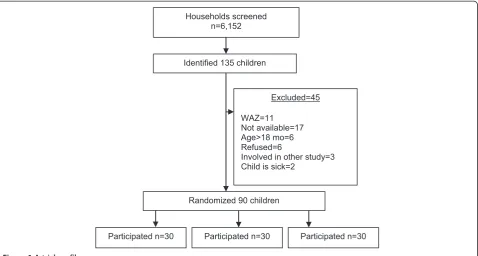
A total of 135 children from 6,152 households were identi-fied (Figure 1) for randomization. Of these children, 90 children were assigned to three different study groups (rice-lentil RUSF, chickpea based RUSF or Pushti packet groups) using simple random sampling according to computer-generated random numbers. Computer gener-ated numbers were given by another researcher within the same organization but not involved with the existing study.
Intervention
Pushti packet was prepared using roasted rice powder (26.3 g), roasted lentil powder (13.2 g), molasses (6.6 g), and soybean oil (3.9 g) per serving. It does not contain any added micronutrients. Therefore, in addition to exist-ing exist-ingredients of Pushti packet, we gave one sachet of
Pushtikona(Renata Limited, Dhaka),which is a micronu-trient powder containing 15 micronumicronu-trients (vitamin A 0.40 mg, vitamin C 30 mg, vitamin D 0.005 mg, vitamin E 5 mg, Thiamine 0.5 mg, riboflavin 0.5 mg, niacin 6 mg, pyridoxine 0.5 mg, Cyanocobalamin 0.0009 mg, folic acid 0.15 mg, iron 10 mg, zinc 4.1 mg, copper 0.56 mg, selen-ium 0.017 mg, iodine 0.09 mg). While givingPushtipacket we allowed mothers to add water to the food mix as per requirement, and asked them to add thePushtikona.
Observation of feeds and interviews with caregivers The feeding on first day was held at the nutrition centre in Baoniabad slum of Mirpur, Dhaka. The first day feeding session enabled study staff to get familiarized with the mothers and children and also for the latter to be habitu-ated to the food. After the first day feeding session all participants were supplied with the respective food sup-plement for two days to use under real life conditions with a daily dose of 50 g. Before end of first two days supple-mentation, our field worker visited the households and continued her visit in the households every alternate day to give the supplements and recorded morbidity, if there was any. At the end of one week period, field workers re-quested the participants to come again to the nutrition
centre and the feeding was observed for the second time. Data on this second day at the end of the one week period was included in the analysis.
The RUSF was prepared each morning by our health workers in icddr,b Food Processing Laboratory under supervision of the investigators, and then carried to the nutrition centre in Mirpur. On the first day of the study, information was sought on the families’wealth, standard of housing, family structure and parental characteristics. A trained research assistant recorded the children’s nude weight or with light clothing using a digital scale with 10 g precision (Seca, model-345), length (using a cali-brated length board), and mid upper-arm circumference to the nearest mm (using a non-stretch insertion tape). We ensured that infants were offered the assigned diet at least 2 hours after they were last fed.
During the feeding time, the mothers were asked to spoon feed their children the assigned diet until the child refused to eat. After a two-minute pause, the same food was offered a second time until s/he refused again. After a second two-minute pause, the food was offered a third time until refused again. After this third refusal, the feed-ing episode was considered terminated. The duration of the feeding (excluding the intervening‘pause periods’) was recorded by stopwatch, and the total duration of the feed-ing was noted. The feedfeed-ing episode took place under the direct supervision of a trained research assistant to make sure that feeding was not forceful. Children were consid-ered as refusing intake if they moved their head away from Households screened
n=6,152
Identified 135 children
Excluded=45
WAZ=11 Not available=17 Age>18 mo=6 Refused=6
Involved in other study=3 Child is sick=2
Randomized 90 children
Participated n=30 Participated n=30 Participated n=30
the food, cried, clamped the mouth shut or clenched the teeth, or became agitated, spit out the food or refused to swallow. The amount of food ingested was calculated by subtracting the left-over from the offered amount. Pre-weighed napkins were provided; any food that was regur-gitated, vomited or spilled was swabbed, the napkin weighed and subtracted from the weight of the amount of-fered. Using a 7-point Hedonic Scale in which each point (1 = dislike extremely, 2 = dislike moderately, 3 = dislike, 4 = neither dislike nor like, 5 = like slightly, 6 = like moder-ately, 7 = like extremely) was depicted by a facial drawing, we asked mothers to rate the food’s color, flavor, mouth feel, and overall acceptability.
Analysis
We performed data analysis using SPSS version 16. Back-ground characteristics of the participants were evaluated
by using descriptive statistics. For the acceptability test, we calculated the percent of RUSF that children con-sumed as well as mean ± SD of the amount of the RUSF. We used one-way ANOVA and post-hoc Bonferonni test to detect differences in continuous variables, and chi-squared tests for proportions. Data from the Hedonic Scale questions were presented as mean ± SD.
Ethical approval
Ethical approval was obtained from icddr,b Institutional Review Board. Informed and signed consent were ob-tained individually from the caregivers of the partici-pants in the study, and all data were coded to remove identifying information and secure confidentiality. The trial was registered at Clinical trials.gov and the registra-tion number of this trial is NCT01553877.
Results
Development of RUSF
Rice, lentil and chickpea were chosen as ingredients for making RUSF. These ingredients are widely grown and consumed in Bangladesh and other South Asian coun-tries. Two varieties of RUSF were developed - one was rice and lentil based and the other was chickpea based. Dried skimmed milk powder, sugar, soybean oil and vita-min vita-mineral premix were the common ingredients for both RUSF. The total energy content of 50 g of rice-lentil and of chickpea-based RUSF was 264 kcal and 267 kcal respectively. Protein-energy ratio (PER) for rice-lentil and chickpea recipes were 7.7 and 8.9 percent respectively, whereas fat-energy ratio (FER) for the two recipes were 50.4 percent and 53.6 percent respectively. These RUSF had greater energy density than Pushti packet (energy 188 kcal per 50 g, PER 10.4 percent, and FER 20.1 percent). Preparation of RUSF undergoes dif-ferent steps i.e. roasting, particle size reduction, homo-geneous blending and packaging (Figure 2).
Acceptability trial
A total of 135 children were identified in the community of whom 90 children were found eligible; they were en-rolled and completed the trial. They included 52 girls (57.8 percent) and 38 boys (42.2 percent), and their mean age was 13.9 ± 2.9 months. Mean years of household head’s education was 6.0 ± 3.8 years (Table 2). Individual or household characteristics did not differ significantly by study groups (Table 2).
Children consumed on an average 23.1 ± 15.4 g of of-fered food which took them 20.9 ± 9.6 mins (Table 3). Amounts of food consumed by rice-lentil and chickpea-based food groups, and the times taken to consume them did not differ significantly. Children consumed an average of 47.1-56.7 percent of the RUSF and 34.4 per-cent of Pushti packet offered. There was a significant
Table 1 Composition of RUSF andPushtiPacket per 50 g (per serving)
Rice-Lentil based RUSF
Chickpea based RUSF
Pushti
packet
Energy (Kcal) 264 267 188
Moisture (g) 1.0 1.2 ND
Protein (g) 5.1 6 4.9
Total fat (g) 14.8 15.9 4.2
Carbohydrate (g) 27.6 24.9 32.6
Dietary fibre (g) 1.1 0.6 ND
Ash (g) 1.95 2.5 ND
Vitamin A (μg) 427.5 294 0.39
Βcarotene (μg) 8.5 26.5 ND
Vitamin C (mg) 16 20.5 0.65
Vitamin E (mg) 10.41 14.0 ND
Vitamin B1(mg) 0.475 0.78 0.07
Vitamin B2(mg) 0.515 0.63 0.04
Calcium (mg) 286.0 413.3 0
Phosphorus (mg) 240 318 ND
Sodium (mg) 20.5 37 ND
Potassium (mg) 317 424.5 ND
Magnesium (mg) 51.425 71.5 ND
Iron (mg) 5.905 7.0 1.92
Copper (mg) 0.34 0.4 ND
Zinc (mg) 4.15 4.9 0.80
Chloride (mg) 38.5 68.5 ND
Aflatoxin Not detected Not detected ND
Water activity (24.6˚C) 0.32 0.32 ND
pH 6.3 4.1 ND
Peroxide value 0.2 0 ND
difference (p= 0.012) in amount of chickpea-based RUSF
and Pushti packet consumed (the former was better)
(Table 3). On the 7-point Hedonic Scale, mean response for each sensory quality (color, flavor, mouth feel, and overall liking by mother’s opinion) of all foods was more than 6. Rice-lentil, and chickpea-based RUSF were sig-nificantly better compared to Pushti packet in terms of ‘overall liking’(Table 3).
Interviews with the caregivers/mothers with the struc-tured questionnaire revealed that 18/30 children (60%) liked rice-lentil and 20/30 children (66%) preferred the chickpea-based RUSF. In Pushti packet group, only 12/ 30 (40%) caregivers reported that their children liked the supplement. The common reason stated by the mother for her child’s liking was that the child ate most of the portion served. Almost one third of the caregivers felt that the consistency of the RUSF was appropriate for children. Fifteen caregivers felt that the consistency of
rice-lentil (5/30) and chickpea-based (10/30) supple-ments was thick. Some caregivers reported that rice-lentil (10/30) and chickpea based (9/30) supplements were too sweet in taste, whereasPushtipacket study par-ticipants (11/30) reported the taste was neither sweet nor salty. Few mothers (5/60) in rice-lentil and chickpea based RUSF study groups mentioned that the food had a strong taste which is more like a medicine.
Discussion
Our results suggest that rice-lentil and chickpea-based RUSF were more acceptable than Pushti packet, which was the least acceptable of the three foods studied. The assessment of the acceptability of the three food supple-ments was a bit challenging because we had to depend partially on the opinion of mothers whose tastes and food preferences, as adults, are different from those of the children. Although our primary objective was to
Other ingredients receiving Rice and Lentil/Chickpea
Cleaning Foreign materials
Water (5% by wt)
Foreign particles Sorting Grinding
Weighing
Roasting (Temp 120°-130°C, moisture < 4%)
Cooling (by cool air)
Sieving
Mixing
Filling (size <150µm)
Packing/Coding
Dispatch
Soybean oil
Whole milk
Soy lecithin
Sugar
Sieving
Grinding Sorting
Premix Foreign particles
measure the mean proportion of offered food consumed by the children but we also measured the mean Hedonic Scale score. Our rationale was that with no forced feed-ing, the amount of the offered food consumed by chil-dren would depend largely on the extent to which they
liked the food, given that none of the children were fed for at least 2 hours prior to the feeding session. Children consumed an average of 47.1-56.7 percent of the RUSF offered and 34.4 percent of Pushtipacket offered. Mean Hedonic Scale score for Pushti packet was also signifi-cantly lower compared to the two RUSF. We can, there-fore, say with reasonable certainty that children accepted rice-lentil and chickpea based RUSF more compared to
Pushti packet. The Hedonic Scale responses from the mothers suggested a high level of acceptability, but as observed in a similar study in Mexico and Ghana [8,13], such Hedonic Scale responses may not be conclusive because respondents could be reluctant to give any nega-tive comment [14]. Our mean Hedonic Scale across all three foods was high suggesting this may have also oc-curred in our study. On the other hand, total consump-tion of the offered food is an opconsump-tion to assess the acceptability of food supplements [8,10]. Thus, combin-ing the results from Hedonic Scale testcombin-ing and total consumption is probably the best way to judge the ac-ceptability of the RUSF.
The concerns raised by few caregivers about the taste of RUSF being similar to a medicine warrants discussion. Our general observation was that caregivers considered the supplement as food, and therefore, they seem to ex-pect it to taste much the same way as a typical food might taste. The relatively high mineral concentration makes any attempt to get the supplement to taste like a typical food a challenge, from a food technology per-spective [3]. There may be a way to deal with the medi-cinal taste issue: it should be explained to caregivers that the RUSF, although it looks like food, has a high nutrient concentration and therefore may not taste like a normal
Table 2 Characteristics of children who completed the study
Characteristics Rice-Lentil based RUSF
(n = 30)
Chickpea based RUSF
(n = 30)
Pushti
packet (n = 30)
(1) (2) (3)
Child characteristics
Age (mo), mean ± SD 14.1 ± 2.9 13.9 ± 2.6 13.8 ± 3.2
Sex% Girl (n) 60 (18) 53.3 (16) 60 (18)
Weight, Kg (mean ± SD) 8.2 ± 0.6 8.3 ± 0.7 8.1 ± 0.7
Height, cm (mean ± SD) 72.7 ± 3.5 73.2 ± 3.2 71.5 ± 4.4
MUAC, mm (mean ± SD) 139.1 ± 7.2 137.7 ± 7.4 136.6 ± 6.8
Weight-for-height z score <−2,% (n)
16.7 (5) 3.3 (1) 6.7 (2)
Height-for-age z score <−2,% (n)
36.7 (11) 36.7 (11) 50.0 (15)
Weight-for-age z score <−2,% (n)
33.3 (10) 26.7 (8) 36.7 (11)
Household characteristics
Family size (mean ± SD) 4.43 ± 1.3 4.9 ± 1.9 4.6 ± 2.0
Household head completed primary education,% (n)
73.3 (22) 60.0 (18) 63.3 (19)
Using shared latrine,% (n) 80.0 (24) 86.3 (26) 80.0 (24)
Tap water source of drinking water,%
96.7 (29) 96.7 (29) 93.3 (28)
Table 3 Results of test feeding of RUSF
Rice-Lentil based RUSF (n = 30)
Chickpea based RUSF (n = 30)
Pushti packet (n = 30)
Pvalue1 Pvalue2
(1) (2) (3) 1vs.2 2vs.3 1vs.3
Mean Hedonic Scale (mean ± SD)
Color of the supplement 6.9 ± 0.2 6.9 ± 0.3 6.8 ± 0.4 ns - -
-Aroma/flavor of the supplement 6.8 ± 0.4 6.8 ± 0.3 6.5 ± 0.6 0.042 ns 0.049 ns
Texture/mouth feel 6.7 ± 0.4 6.8 ± 0.3 6.2 ± 0.7 0.000 ns 0.000 0.002
Overall Liking 6.9 ± 0.2 6.9 ± 0.3 6.4 ± 0.6 0.000 ns 0.000 0.000
Amount offered, g (mean ± SD) 50.4 ± 0.5 50.2 ± 0.5 49.9 ± 1.2 (118.0 ± 12*) ns - -
-Amount consumed, g (mean ± SD) 23.8 ± 14 28.4 ± 15 17.1 ± 14 (40.8 ± 35*) 0.015 ns 0.012 ns
Percent of food consumed from offered food (%)
47.2 ± 28 56.7 ± 31 34.4 ± 28 0.017 ns 0.014 ns
Energy received from consumed food (mean ± SD), Kcal
125 ± 76 152 ± 83 64 ± 53 0.000 ns 0.000 0.005
Feeding time, minutes (mean ± SD) 23.0 ± 10 20.7 ± 10 20.4 ± 7 ns - -
-Velocity, g/min 1.3 ± 1.0 1.9 ± 2.2 0.8 ± 0.8 0.020 ns 0.016 ns
food to few caregivers. Indeed it would be a point for counseling when the product will be launched at larger scale in a nutrition program.
Pushti packet was found less acceptable among chil-dren and caregivers. This supplement had one major characteristic that contributed to its lesser acceptance by the children or caregivers, which is: adding water to
Pushti packet increases the volume of food and in turn it reduces the sweetness. Moreover, the fat content is less than RUSF. This study has provided useful insights for the efficacy trial of RUSF which is now being con-ducted in Gaibandah, in the northern part of Bangladesh, in collaboration with John Hopkins University and the World Food Programme. In this efficacy trial, approxi-mately 5000 children, 6–18 months old, have been ran-domly assigned to the two locally produced RUSF, Supercereal Plus (also known as wheat soya blend plus plus or WSB++) and a commercially available, imported food supplement called Pumpy’Doz™. The trial will not only evaluate the effects of RUSF on the nutritional status of children, but will also provide extensive information on the long term acceptability of these products and add to what we have learned from this acceptability study.
Conclusion
We developed two RUSF based on locally available food ingredients. We conclude that the newly developed rice-lentil and chickpea-based RUSF are acceptable to children and their caregivers. This study presenting acceptability data on locally produced RUSF for children, which is a novel way to ensure nutritional adequacy of children’s diet particularly those living in food insecure conditions, and is nutritionally more complete thanPushtipacket.
Competing interests
Authors do not have any conflict of interest in writing this paper. Authors’contribution
Conceptualized the work, participated in data collection and management, and drafting of manuscript: TA, NC, MIH, NT and MMI. Provided technical assistance and contributed to the manuscript: GS. Helped in interpretation of findings, and contributed to the critical revision of the manuscript for making the final draft for submission: SdP, GS, RF, SAS, MP, KPW, and PC. All authors approved the draft.
Acknowledgments
This research activity was funded by World Food Programme (WFP) through Project Laser Beam and a sub-agreement from John Hopkins University (JHU). icddr,b acknowledges with gratitude the commitment of WFP and JHU to its research efforts. icddr,b gratefully acknowledges the following donors which provide unrestricted support: Australian Agency for Inter-national Development (AusAID), Government of the People’s Republic of Bangladesh, Canadian International Development Agency (CIDA), Swedish International Development Cooperation Agency (Sida), and the Department for International Development, UK (DFID).
Author details
1
Centre for Nutrition and Food Security, icddr,b, 68 Shaheed Tajuddin Ahmed Sarani, Mohakhali, Dhaka 1212, Bangladesh.2James P. Grant School
of Public Health, BRAC University, Dhaka, Bangladesh.3Food Science Unit, Institute of Nutrition, Mahidol University, Nakhon Pathom 73170, Thailand.
4World Food Programme, Via Cesare Giulio Viola 68/70, Rome 00148, Italy. 5
DSM Nutritional Products Ltd, 4303 Kaiseraugst, Switzerland.6World Food Programme, E/8A Rokeya Sharani, Agargaon, Sher-e-Bangla
NagarDhaka-1207, Bangladesh.7Center for Human Nutrition, Department of International Health, Johns Hopkins Bloomberg School of Public Health, Baltimore, MD 21205, USA.
Received: 26 January 2014 Accepted: 19 June 2014 Published: 27 June 2014
References
1. NIPORT, Mitra and Associates, Macro International:Bangladesh Demographic and Health Survey 2011.Dhaka, Bangladesh and Calverton, Maryland, USA: NIPORT, Mitra and Associates, Macro International; 2011:18.
2. Ahmed T, Bhutta ZA, Goel KM:Nutrition: Protein-energy malnutrition and micronutrient deficiencies in childhood. InHutchison’s Pediatrics.Edited by Goel KM, Gupta DK. New Delhi: Jaypee Brothers; 2012.
3. Kimmons JE, Dewey KG, Haque E, Chakraborty J, Osendarp SJM, Brown KH: Low nutrient intakes among infants in rural Bangladesh are attributable to low intake and micronutrient density of complementary foods.
J Nutr2005,135:444–51.
4. Arsenault JE, Yakes EA, Hossain MB, Islam MM, Ahmed T, Hotz C, Lewis B, Rahman AS, Jamil KM, Brown KH:The current high prevalence of dietary zinc inadequacy among children and women in rural Bangladesh could Be substantially ameliorated by zinc biofortification of rice.J Nutr2010, 140:1683–90.
5. Yakes EA, Arsenault JE, Islam MM, Hossain MB, Ahmed T, German JB, Gillies LA, Rahman AS, Drake C, Jamil KM, Lewis BL, Brown KH:Intakes and breast-milk concentrations of essential fatty acids are low among Bangladeshi women with 24-48-month-old children.Br J Nutr2011,105:1660–1670.
6. Bhutta ZA, Ahmed T, Black RE, Cousens S, Dewey K, Giugliani E, Haider BA, Kirkwood B, Morris SS, Sachdev HP, Shekar M, Maternal and Child Undernutrition Study Group:What works? Interventions for maternal and child undernutrition and survival.Lancet2008,371:417–40.
7. Bhutta ZA, Das JK, Rizvi A, Gaffey MF, Walker N, Horton S, Webb P, Lartey A, Black RE, The Lancet Nutrition Intervention Review Group, and the Maternal and Child Nutrition Study Group:Evidence-based interventions for improvement of maternal and child nutrition: what can be done and at what cost?Lancet2013,282:452–477.
8. Adu-Afarwuah S, Lartey A, Zeilani M, Dewey KG:Acceptability of lipid-based nutrient supplements (LNS) among Ghanaian infants and pregnant or lactating women.Matern Child Nutr2011,7:344–56. 9. Bisimwa G, Owino VO, Bahwere P, Dramaix M, Donnen P, Dibari F, Collins S:
Randomized controlled trial of the effectiveness of a soybean-maize-sorghum–based ready-to-use complementary food paste on infant growth in South Kivu, Democratic Republic of Congo.Am J Clin Nutr 2012,95:1157–64.
10. Phuka J, Ashorn U, Ashorn P, Zeilani M, Cheung YB, Dewey KG, Manary M, Maleta K:Acceptability of three novel lipid-based nutrient supplements among Malawian infants and their caregivers.Matern Child Nutr2011, 7:368–77.
11. Smith VE:Linear programming models for the determination of palatable human diets.J Farm Econ1959,31:272–83.
12. Briend A, Ferguson AE, Darmon N:Local food price analysis by linear programming: a new approach to assess the economic value of fortified food supplements.Food Nutr Bull2001,22:184–189.
13. Young SL, Blanco I, Hernandez-Cordero S, Pelto GH, Neufeld LM:Organoleptic properties, ease of use, and perceived health effects are determinants of acceptability of micronutrient supplements among poor Mexican women.
J Nutr2010,140:605–11.
14. Albaum G:The Likert scale revisited: an alternate version.J Mark Res Soc 1997,39:331–48.
doi:10.1186/1471-2431-14-164
Cite this article as:Ahmedet al.:Development and acceptability testing of ready-to-use supplementary food made from locally available food