ISSN: 2231-5381
http://www.ijettjournal.org
Page 3706
Design and Development of a Hand-glove
Controlled Wheel Chair Based on MEMS
First Author#1, Second Author*2, Third Author#3
1Dr.Shaik Meeravali, 2M . Aparna
1.
Department of Electronics and communication Engineering,
RRS College of Engineering and Technology, Muthangi,
Faculty of Electronics and Communication Engineering,
Jawaharlal Technological University, Hyderabad, India.
2. Master Of Scholar, RRS College of Engineering and Technology, Muthangi,
Abstract
— This paper presents the Design And
Development of a Hand-glove controlled wheel chair based on MEMS. This paper purpose of life in the lives of disabled people based on MEMS, The aim at incorporating the modern ways of wheel chair dynamics and control and at the same time making it cost effective, so that it is affordable to the common masses. The goal of this research is to develop a wheelchair system which controls its movement by the merely bending of a person’s fingers. In this research a prototype of an affordable and technologically advanced wheelchair is to be designed and developed. The proposed prototype will be communicating wirelessly between the controller and the plant and it will also replace the traditional joystick by the implementation of user hand glove control based on MEMS. The MEMS sensors inside the glove can sense the movement of fingers. The controller sends the signals to the receiver section which is placed under the wheelchair through a wireless technology. In The receiver section get the signals from the transmitter according to the signals the motor is running which changes the wheel movement. The technologies presented in this paper suggest a wide domain of possibilities to a wide variety of users. In addition, it also aims at making a hi-tech wheelchairs are made and so that control the security problem with Alarm and cost effective by people Disabilities.Keywords: Underneath the Wheel Chair; On the Hand-glove .
I.INTRODUCTION
ISSN: 2231-5381
http://www.ijettjournal.org
Page 3707
II. LITERATURE REVIEW
This technology progress provides there were the manual
wheelchairs’, then came the electric powered wheelchairs and
now there are Smart Wheelchairs. In this particular we are
designing electric powered wheelchair which is controlled by
hand movement. As per our need to control wheelchair, we
use only two fingers of hand gloves. On these two fingers we
place two photodiodes at upper side and two tactile micro
switches below the finger as sensors. The signal coming from
these gets encoded and sends to the transmitter to transmit.
On the other hand, at receiver side we get this signal with the
help of receiver and send it to the decoder to decode it.
Microcontroller is already been programmed for different
code combinations, so that the decoded signal gets converted
into appropriate movement of wheelchair with the help of
relays and DC motor. A ‘Motorized Chair’ consists of a chair
with the two motors and a joystick controller. A
microcontroller outputs the speed and direction to the motors.
Most wheelchairs are controlled from their back wheels. The
front wheels respond direction of rotation of motors and rotate
in accordance to the back wheels. The design a hand-glove
wheel chair which is controlled according to the movement of
fingers of hand .These always requires an extra effort. So,
instead we can opt for use of daily gestures like hand, head
movements and also voice to drive these devices. Initially
wheelchairs were used just as a fast and easy means to move
disabled from one place to another, but this role changed as
society progressed. Numerous inventions and improvements
fashioned push rim for self-propulsion and slings for seat and
backrests Then came the joystick controlled wheel chair . The
joystick was pushed or pulled against on/off switches which
would cause the chair to jerk when it started, stopped or
changed directions. So the next big step in electric wheelchair
development was the introduction of electronic circuitry and
proportional control drive of a man motorized wheel chair
merely by the movement of a person’s fingers.
III. METHODOLODY AND WORKING
The methodology consists of a thorough
study and analysis of electric powered and joy-stick controlled
wheelchairs, The Microcontroller will continuously monitors
MEMS sensor values and if it found any security problem
then the Microcontroller will switch on the Alarm until the
Reset button was pressed. In this particular we are designing
electric powered wheelchair which is controlled by hand
movement. As per our need to control wheelchair, we use only
two fingers of hand gloves. On these two fingers we place two
photodiodes at upper side and two tactile micro switches
below the finger as sensors. The signal coming from these
gets encoded and sends to the transmitter to transmit. On the
other hand, at receiver side we get this signal with the help of
receiver and send it to the decoder to decode it.
Microcontroller is already been programmed for different
code combinations, so that the decoded signal gets converted
into appropriate movement of wheelchair with the help of
relays and DC motor.
ISSN: 2231-5381
http://www.ijettjournal.org
Page 3708
A. Underneath The wheel chair
A ‘Motorized Chair’ consists of a chair with the
two motors and a joystick controller. A microcontroller
outputs the speed and direction to the motors. Most
wheelchairs are controlled from their back wheels. The front
wheels respond direction of rotation of motors and rotate in
accordance to the back wheels. ZigBee is a cost-effective,
standard-based home-area wireless network, designed
specifically to replace the proliferation of individual remote
controls, and supports low data rates, low power consumption,
security, and reliability. To address those specifications, the
ZigBee Alliance, an industry working group [4], develops
standardized application software, working closely with the
IEEE to ensure an integrated, complete, and interoperable
network for the market. In this project we are using the two
microcontrollers. ZIGBEE, fire sensor and home appliances
are interfaced one microcontroller, ZIGBEE transceiver,
switch, and Buzzer is connected to the microcontroller. The
function of the motor driver circuit is to control the direction
of rotation of the motors. Through the H-bridge the motors
receive the instructions and act consequently, having complete
control over the speed and direction of rotation of the motors.
Hence, the wheelchair begins to move according to the
movement or bending of the user’s fingers. Once the voltage
is received by the microcontroller, it needs to be transmitted
over to the other side of the system, which is the wheelchair,
underneath which lies the main controller board. This is done
by the transmitting circuit present on the hand-glove, hence
realizing wireless communication between the chair and the
glove. The wireless transfer protocol used is Zigbee, since it is
easier to use and the wheelchair doesn’t require a long-range
communication. A motor-control ATMEGA328p circuit
controls the speed and the direction of rotation of motors.
report on the development of a device called ‘The Magic
Glove’. The ‘Magic Glove’ is an instrumented glove with
wide range of applications in the field of robotics. The glove
measures the force exerted by the wearer of a material
handling robot.
Figure 1. Block Diagram Of Wheel Chair Side
B. On the Hand-glove
ISSN: 2231-5381
http://www.ijettjournal.org
Page 3709
provided for the abnormal bending because of the tendency of the fingers to follow the one which is bent, although vaguely. If all four fingers are bent at a time, the microcontroller is programmed such that it will all the operations and the chair will come to standstill.
Figure 2. Block Diagram On the Hand-Glove
IV. RESULT AND ANALYSIS
The main purpose of the robot is to detect any Landmine in its path and provide the information to the controller and handle the device to defuse. The ‘Magic Glove’ is an instrumented glove with wide range of applications in the field of robotics. The glove measures the force exerted by the wearer of a material handling robot. Once the force is sensed and measured, it is broadcasted to the controller. The wireless transfer protocol used is Zigbee, since it is easier to use and the wheelchair doesn’t require a long-range communication.
The equations will be represented based on MEMS in the form of:
if(tilt==0x15) ---(1)
{
lcd_str(" forward ");
serial1("@front*");
}
if(tilt==0x19) ---(2)
{
lcd_str(" backward ");
serial1("@back*");
}
if(tilt==0x05) ---(3)
{
lcd_str(" left ");
serial1("@right*");
}
if(tilt==0x09) ---(4)
{
lcd_str(" right ");
serial1("@left*");
}
ISSN: 2231-5381
http://www.ijettjournal.org
Page 3710
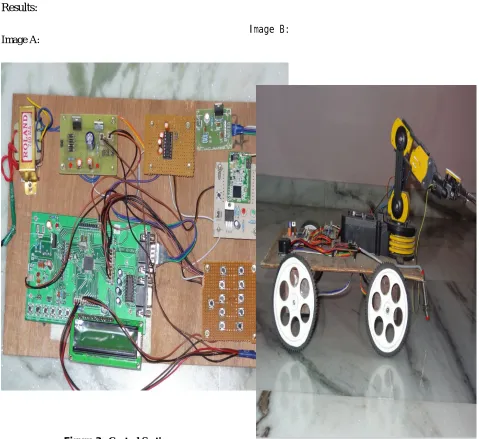
Results:
Image A:
Figure 3. Control Section
Image B:
ISSN: 2231-5381
http://www.ijettjournal.org
Page 3711
V. CONLUSION
In this paper, The main aim of our project is to detect wheel chair control and the cost effective and security problems by alarms is discussed. To develop this Project we are using MEMS sensor, and the system is fully controlled microcontroller. In this paper hand glove controlled Smart Wheelchair is A model of the system has been developed which is believed to provide better control to people with severe disabilities in comparison to the traditional joystick-controlled because of the lesser amount of force required to manipulate the hand glove in contrast to the joystick and it includes the integration of an obstacle avoidance and collision detection system. The Microcontroller will continuously monitors MEMS sensor values and if it found any security problem then the Microcontroller will switch on the Alarm until the Reset button was pressed. Further research includes the integration of an obstacle
avoidance and collision detection system, there is also a huge scope to improve breaking mechanisms of the system on which research is underway.
R
EFERENCES[1]A.BIRK AND S.CARPIN,“RESCUE ROBOTICS – A CRUCIAL
MILESTONE ON TH ROAD TO AUTONOMOUS SYSTEMS,”
ADVANCED ROBOTICS JOURNAL, VOL.20,J.PETERS,ED.NEW
YORK:MCGRAW-HILL,1964, PP.15–64.
[2]A.DAVIDS,“URBAN SEARCH AND RESCUE ROBOTS: FROM
TRAGEDY TO TECHNOLOGY,”INTELLIGENT SYSTEMS, IEEE, VOL.
17, NO.2,2002, PP.81-83.
[3]J.Y.WONG,THEORY OF GROUND VEHICLE, 3RD EDITION.
JOHN WILEY AND SONS,INC., 2001, CH.4.5.
[4]LARRY SHAPIRO,SPECIAL POLICE VEHICLES , ISBN
0-7603-07602,MBI PUBLICATIONS, PG 44-45.
[5]DAVID AXE,WAR BOTS: US MILITARY BOTS TRANSFORMING
WAR IN IRAQ, AFGANISTHAN AND FUTURE, ISBN
978-1-934840-37-5,NIMBLE BOOKS INC.
[6] GOURLEY,SCOTT R"JOINT EODRAPID RESPONSE VEHICLE
(JERRV)".ARMY.FINDARTICLES.COM.03APR,2011.
[7]Li Xuewen, Meng Cai, Liang Jianhong, Wang Tianmiao,
“Research on Simulation and Training System for EOD
Robots”, Industrial Informatics, 2006 IEEE International
Conference Singapore, ISBN: 0-7803-9700-2, Aug. 2006,
pp 810 – 814.
[8] Shahin Farhani, “Zigbee wireless and sensor networks”,
ISBN 978-0-7506-8393-7, 2008, Newens publications.
[9]Fred Eady, “Hands on Zigbee: implementing 802.15.4 with
microcontrollers”, ISBN 978-0-12-370887-8, 2007, pp
63-67.[10] Andrew N. Sloss, Dominic Symes, Chris Wright,
“ARM system developer's guide: designing and optimizing
system software”, ISBN 1-55460-874-5, 2004, Morgan
Kaufmana publications.
[11] J.R.Gibson, “ARM assembly language- an introduction”,
ISSN: 2231-5381
http://www.ijettjournal.org
Page 3712
AUTHORS DETAILS:
FIRST AUTHOUR:
Dr. SHAIK MEERAVALI,
Professor and Head, Department of electronics and communication Engg, RRS college of engineering and Technology, Muthangi, Andhra Pradesh, India.