Emperor International Journal of Finance and Management Research [EIJFMR] Page 21
A STUDY ON THE SERVICE QUALITY
OF SBI WITH SPECIAL REFERENCE TO
ERNAKULUM BRANCH
JAYASHANKAR.J Assistant Professor
Department of Commerce and Management School of Arts and Sciences, Kochi
Amrita University
Abstract
Service Quality is the degree of excellence in the service performance. Quality in customer service is the only way a business can differentiate itself from its competitors. It is regarded as a strategic organizational weapon. This study aims to find out the most important attributes of service quality in commercial banks which can be used to evaluate the characteristics of banking service quality as perceived by customers and it attempts to measure and compare service quality among private, public and foreign banks in Chennai city on the basis of customer’s expectations and perceptions of quality of services. Service quality measure is based on modified version of SERVQUAL as proposed by Parasuraman et al. (1988), which involve five dimensions of Service quality, namely Reliability, Responsiveness, Empathy, Assurance, and Tangibles With respect to customer services there are notable perceived differences. Hence this study on customer service quality of commercial banks looks for bringing out the differences between perceptions of customers of these banks.
Keywords: Service quality, Reliability,
Assurance, Tangibility, Empathy, Responsiveness
I. INTRODUCTION
Banks plays an important role in the economic development of a country. It deals with money and credit. It is a financial institution that accepts deposits and channels those deposits into lending activities either directly or through capital market.
A bank connects customers which have capital deficits to those customers with capital surpluses. The banking industry in India is facing certain challenges of quality of services, customer satisfaction, customer retention, customer royalty. Quality of services plays a major role in achieving customer satisfaction and creating brand royalty in banking sector. Therefore it plays an important role in the economy of any country as they hold the savings of public.
II. LITERATURE REVIEW
Prabha, Divya et al. (2006) in their study analyzed the service quality perceptions of the Corporate customers in Coimbatore regarding the services provided by their banks. For the study they considered both product and service based sectors and SERVQUAL scale based questionnaire for the survey. By this study it has been reported that even though customers are more satisfied with the competence and customer orienting dimensions of service quality, still banks need to focus upon the aspects of communication,modernization and quickness of service.
Emperor International Journal of Finance and Management Research [EIJFMR] Page 22 revealed that service quality of foreign banks is
comparatively much betterthan that of Indian Banks and there are service quality variations acrossdemographic variables like age, income, occupation, geographic location ofbanks etc.
Bhat, Mushtaq A. (2005) studied service quality perceptions of Indian banks in comparison with that of foreign banks. SERVQUAL instrumentdeveloped by Parasuraman et al. in the year 1988 and its five dimensions suchas reliability, responsiveness, empathy, assurance and tangibility were usedfor collecting primary data. A major finding of the study was that Indianbanks fall much below the perceptions of their customers on all dimensions ofservice quality. Foreign banks are surpassing the perceptions of theircustomers on tangibility and reliability dimensions of service quality
Krishna Chithanya, V. (2005) studied the meaning, nature and scopeof financial activities in India and its features and to frame a marketingstrategy to attain service quality and to propose effective channel ofdistribution. By this study, service quality is the difference between theperceptions of actual service quality and expectation of customers and thecustomer courtesy, credibility and security. It proposed a two way channel fordistributing financial services such as, remote - T.V, Phone, PC etc., and face to-face - traveling, visiting offices etc.
Bauer,Hans H. et al. (2005) empirically examined characteristics of awebsite that transform into an extensive e-banking portals and to analysedifferent facts of the quality of services delivered throughe-banking portals in order to process a service quality measurement model.The measurement model constructed in this study was based on differentdimensions such as security and trust, basic service quality, cross-buyingservice quality, added value, transaction support and
responsiveness. Here,the identified dimensions were classified on the basis of its nature as coreservices, additional services and problem solving services
Bodla, B.S. (2004) he tried to examine andmeasure the quality of services provided by commercial banks in India. Forthe study, sample consisted of the customers of four private sector banks andfour pubic sector banks in Chandigarh, Delhi and Haryana. The studyrevealed the important gap existed between the expectations and perceptionsin relation to quality of services offered by these selected banks. It also foundthat service quality of private sector banks is better than that of public sectorbanks on all dimensions except 'assurance'.
Sharma, Alka et al. (2004) compared four leading banks by usingAmerican perspective concept of service quality – SERVQUAL SERVPERF,on the assumption that customers do not perceive quality as a one dimensionalconcept. This model explains the service quality on the basis ofgap between the expected level of service and perception of the customersregarding the level of service received. The study pointed out that ICICI bankand SBI provide better quality services compared to the services of otherbanks and public sector banks have failed to satisfy their customers.
Emperor International Journal of Finance and Management Research [EIJFMR] Page 23 Sachdev, Sheetal B. et al. (2004) attempted to
examine the role ofnature of service in knowing the order of importance of service qualitydimensions. SERVQUAL tool is used to measure the difference betweenperception of delivered service and expected quality of service. The methodsused to find the relative importance of service quality attributes and toestablish consistency in their order of importance are zone of tolerance,regression and direct evaluation. The study found that tangibility is evaluatedas least important and empathy as the second least in banking servicesmarketing. Zone of tolerance and direct evaluation methods were used toreach this finding.
Paswan, Audhesh K. et al. (2004) conducted a study with anobjective to identify the search quality dimensions related to financial servicesand to examine the relationship between demographic variables and thedimensions. A sample size, selected by using quota sampling technique, of731 was taken for the purpose. It identified four dimensions viz., empathy,tangibility, routine transaction cost and loan transaction cost as domain ofconsumer's evaluation of search quality in the financial services industry. Outof these dimensions, it has been found that, loan transaction cost wasknown as most important factor and only gender and home ownership wereemerged as the strongest determinants among the demographic factors.
Gani, A. et al. (2003) attempted to study the service quality and itsdimensions in commercial banks by using SERVQUAL scale. Thedimensions of service quality considered in this study were tangibility,reliability, responsiveness, empathy and assurance. The result of the studyrevealed that service quality of foreign banks is comparatively much betterthan Indian banks. They also identified two reasons for the lower performanceof Indian banks. One reason was that foreign banks operate
in selectedmarkets and offer selected services and the second reason was thetechnological advancement of foreign banks, which gives them differential orcomparative border in financial service markets.
Suresh Chandar, G.S. et al. (2003) hascritically examined the service quality issues from the perspective ofcustomers with respect to the developing economy-India. The public sector,
private sector and foreign sector in India have been compared with respect to each of the five factors of service quality - reliability, responsiveness,empathy, assurance and tangibility. It revealed that these three sectors arevary significantly in terms of the delivery of the five service quality factors. Italso stated that foreign banks seem to be performing well followed byprivate sector banks and public sector banks.
Suresh Chandar, G.S, et al. (2002) in their study, critically examinedthe service quality issues in the Indian banking sector from the management'spoint of view or their perspective. For the purpose, they considered threesectors of banks and investigated the differences between these sectors withrespect to the total quality service dimensions. A 12 - dimensions instrument
was used for data collection and discriminant analysis technique was used toanalyse data. It has been revealed that the public sector banks in India lack aneffective quality management program. It also revealed several areas wherespecial attention of management was needed to improve the effectiveness ofquality management implementation and quality of service delivered.
Emperor International Journal of Finance and Management Research [EIJFMR] Page 24 and criticized the 22item .SERVQUAL instrument
on the ground that it has no human element.The studies identified five critical factors of service quality and framed a well-rounded instrument to measure and understand customer perceptions ofservice quality.
Kandampully, Jay (1998 ) tried to examine how a firm's serviceemployees develop the emotional connection with customers which leads toexceptional service and the ability to exceed customer expectations. Itrevealed that a customer's loyalty and trust is gained by the servicepersonnel's commitment to seem less, consistent and superior service, whichauthenticate itself to the customer as service quality. On this ground he arguedthat service quality precedes customer loyalty. He viewed service loyalty asa pre requisite in today's competitive environment if an organization desiresto maintain market relationship.
Malhotra, Naresh K. et al. (1994 ) conducted a study for anevaluation of the determinants of service quality between developed anddeveloping countries. Ten dimensions of service quality, suggested byParasuraman et al. was used and assigned some environmental factors such aseconomic and socio-cultural factors to each of ten dimensions. A majorfinding of the study was that the customers in developed countries havehigher expectations and lower tolerance for ineffective services. On the otherhand, customers in developing countries tend to have higher tolerance levelsand lower quality expectations.
Vannirajan (2006) conducted a study to examine the impact ofservice quality dimensions on customer satisfaction. It revealed that theimportant services offered by banks are traditional services, non-traditionalservices, tangibles, reliability, responsiveness, assurance and empathy. It alsofound that reliability and non-traditional services affect more on the
customersatisfaction level. The study ended that the private sector banks andassociates of State Bank of India are better in providing services to thecustomers than the nationalist banks and co-operative banks.
Raheem, Abdul A. (2005) conducted a study to identify the potentialfactors determining satisfaction of the quality parameters in public sectorbanks. It pointed out four major parameters of service quality such asempathy, responsiveness, system and tangibility. The customer perfection onthese service quality dimensions was obtained by averaging the mean value ofthe entire dimensions. The study highlighted the areas in which public sectorbanks need to improve to survive the competition posed by the new entrantsin the banking sector.
Man Siu, Noel Yee et al. (2005), the study was anattempt to examine customer's service quality perceptions in internet bankingas well as the impact of these on customer satisfaction and futureconsumption behavior. The study was based on four dimensions of servicequality viz., credibility, efficiency, problem handling and security. The resultsof the study showed that all dimensions except security are important indetermining overall service quality perceptions, credibility, problem handlingand security are important on customer satisfaction and security andefficiency are significantly associated with future consumption behaviour. Itconcluded and ended , technically functioning websites and quick confirmations arethe essential elements in satisfying customer needs.
Emperor International Journal of Finance and Management Research [EIJFMR] Page 25 Statement of the Problem
The Indian banks are considered to be the lifeline of the economy. In the current scenario, demonetization is major issue that affected the banking industry and its sudden announcement has made the situation become chaotic. It has affected the functioning and profitability of the financial institutions. It has caused a huge inconvenience to a wide range of customers in respect of the banking transactions which includes products and services rendered to them. In this context, it is relevant to analyse the service quality rendered to the customers.
Objectives
1. To find out the various services provided by SBI
2. Examine the essential dimensions of service quality that is RATER:
• reliability • assurance • tangibility • empathy and
• responsiveness of SBI and its effect on customer satisfaction.
3. To find out the level of perception of customers from the service quality offered by the banks.
4. To know which service quality dimension of the bank is performing well.
5. To identify which dimension of service quality needs improvement so that the quality of service of SBI is enhanced.
6. To make suggestions on the basis of study. Scope of the Study
The study is done upon the customers of SBI in Ernakulam district. The study is conducted by taking a sample size of 100 samples including both male and female. This study finds out the services provided by the bank and the quality of services rendered to their customers and the level of perception of customers. It also analyses the dimensions of service quality.
Methodology
The study intend to use both primary data such as questionnaire and secondary data like books, website. Primary data was collected from customers by using questionnaire and got 100 samples. Sample design: For collecting data 100 samples were selected using simple random sampling method. Data collection strategy: The data was collected in and around Ernakulum district ( Ernakulam, aluva, Angamaly).
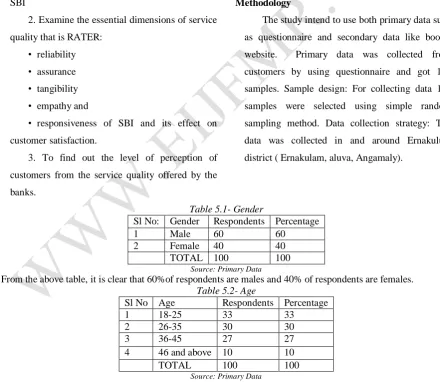
Table 5.1- Gender
Sl No: Gender Respondents Percentage
1 Male 60 60
2 Female 40 40
TOTAL 100 100
Source: Primary Data
From the above table, it is clear that 60%of respondents are males and 40% of respondents are females.
Table 5.2- Age
Sl No Age Respondents Percentage
1 18-25 33 33
2 26-35 30 30
3 36-45 27 27
4 46 and above 10 10
TOTAL 100 100
Source: Primary Data
Emperor International Journal of Finance and Management Research [EIJFMR] Page 26
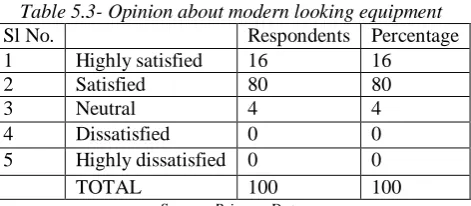
Table 5.3- Opinion about modern looking equipment
Sl No. Respondents Percentage
1 Highly satisfied 16 16
2 Satisfied 80 80
3 Neutral 4 4
4 Dissatisfied 0 0
5 Highly dissatisfied 0 0
TOTAL 100 100
Source: Primary Data
From the above table, it is clear that 80% of the respondents are satisfied and 4% of the respondents have no opinion.
Table 5.4- Opinion about the physical features
Sl No. Respondents Percentage
1 Highly satisfied 20 20
2 Satisfied 72 72
3 Neutral 0 0
4 Dissatisfied 8 8
5 Highly dissatisfied 0 0
TOTAL 100 100
Source: Primary Data
From the above table, it is clear that 72% of the respondents are satisfied with the opinion and 8% of the respondents are dissatisfied.
Table 5.5- Opinion about the reception desk
Sl No. Respondents Percentage
1 Highly satisfied 12 12
2 Satisfied 60 60
3 Neutral 20 20
4 Dissatisfied 4 4
5 Highly dissatisfied 4 4
TOTAL 100 100
Source: Primary Data
From the above table, it is clear that 60% of the respondents are satisfied with the opinion, 4% are dissatisfied and 4% are highly dissatisfied.
Table 5.6- Opinion about the services such as pamphlets or statements.
Sl No. Respondents Percentage
1 Highly satisfied 20 20
2 Satisfied 56 56
3 Neutral 20 20
4 Dissatisfied 4 4
5 Highly dissatisfied 0 0
TOTAL 100 100
Source: Primary Data
From the above table, it is clear that 56% of the respondents are satisfied with the opinion and 4% of the respondents are dissatisfied.
Table 5.7- Opinion about the punctuality
Sl No. Respondents Percentage
1 Highly satisfied 16 16
2 Satisfied 12 12
3 Neutral 52 52
4 Dissatisfied 16 16
5 Highly dissatisfied 4 4
TOTAL 100 100
Source: Primary Data
Emperor International Journal of Finance and Management Research [EIJFMR] Page 27
Table 5.8- Opinion about the bank’s interest in solving complaints
Sl No. Respondents Percentage
1 Highly satisfied 20 20
2 Satisfied 16 16
3 Neutral 48 48
4 Dissatisfied 8 8
5 Highly dissatisfied 8 8
TOTAL 100 100
Source: Primary Data
From the above table, it is clear that 48% of the respondents have no opinion and 8% of the respondents are highly dissatisfied with the opinion.
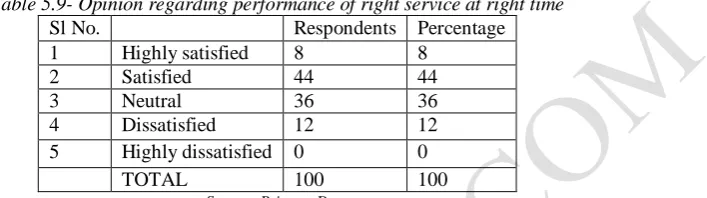
Table 5.9- Opinion regarding performance of right service at right time
Sl No. Respondents Percentage
1 Highly satisfied 8 8
2 Satisfied 44 44
3 Neutral 36 36
4 Dissatisfied 12 12
5 Highly dissatisfied 0 0
TOTAL 100 100
Source: Primary Data
From the above table, it is clear that 44% of the respondents are satisfied with the opinion and 8% of the respondents are highly satisfied.
Table 5.10- Opinion on error free records
Sl No. Respondents Percentage
1 Highly satisfied 16 16
2 Satisfied 28 28
3 Neutral 44 44
4 Dissatisfied 8 8
5 Highly dissatisfied 4 4
TOTAL 100 100
Source: Primary Data
From the above table, it is clear that 44% of the respondents have no opinion and 4% of the respondents are highly dissatisfied with the opinion.
Table 5.11- Opinion regarding information provided
Sl No. Respondents Percentage
1 Highly satisfied 20 20
2 Satisfied 28 28
3 Neutral 36 36
4 Dissatisfied 16 16
5 Highly dissatisfied 0 0
TOTAL 100 100
Source: Primary Data
From the above table, it is clear that 36% of the respondents have no opinion and 16% of the respondents are dissatisfied with the opinion.
Table 5.12- Opinion regarding accessibility of service
Sl No. Respondents Percentage
1 Highly satisfied 12 12
2 Satisfied 12 12
3 Neutral 64 64
4 Dissatisfied 12 12
5 Highly dissatisfied 0 0
TOTAL 100 100
Source: Primary Data
Emperor International Journal of Finance and Management Research [EIJFMR] Page 28
Table 5.13- Opinion regarding willingness of employees for help.
Sl No. Respondents Percentage
1 Highly satisfied 4 4
2 Satisfied 36 36
3 Neutral 44 44
4 Dissatisfied 16 16
5 Highly dissatisfied 0 0
TOTAL 100 100
Source: Primary Data
From the above table, it is clear that 44% of the respondents have no opinion and 4% of the respondents are highly satisfied with the statement.
Table 5.14- Opinion regarding delay in service providing
Sl No. Respondents Percentage
1 Highly satisfied 16 16
2 Satisfied 12 12
3 Neutral 56 56
4 Dissatisfied 12 12
5 Highly dissatisfied 4 4
TOTAL 100 100
Source: Primary Data
From the above table, it is clear that 56% of the respondents have no opinion and 4% of the respondents are highly dissatisfied with the opinion.
Table 5.15- Opinion regarding trustworthiness
Sl No. Respondents Percentage
1 Highly satisfied 24 24
2 Satisfied 36 36
3 Neutral 36 36
4 Dissatisfied 4 4
5 Highly dissatisfied 0 0
TOTAL 100 100
Source: Primary Data
From the above table, it is clear that 36% of the respondents are satisfied, 36% of the respondents have no opinion and 4% of the respondents are dissatisfied with the opinion.
Table 5.16- Opinion regarding behavior of employees
Sl No. Respondents Percentage
1 Highly satisfied 4 4
2 Satisfied 28 28
3 Neutral 56 56
4 Dissatisfied 12 12
5 Highly dissatisfied 0 0
TOTAL 100 100
Source: Primary Data
From the above table, it is clear that 56% of the respondents have no opinion and 4% of the respondents are highly satisfied with the opinion.
Findings
1. Majority of the respondents are of the age group of 18-25years.
2. Majority of the respondents are male i.e.60%.
3. Almost 80% are satisfied with the bank’s modern looking equipments.
4. About 72% are satisfied with the bank’s physical features.
5. Majority of the respondents are satisfied with the bank’s reception desk
6. About 56% are satisfied with service such as pamphlets or statements.
7. About 52% have no opinion regarding punctuality.
Emperor International Journal of Finance and Management Research [EIJFMR] Page 29 9. About 44% are satisfied regarding that the
bank performs services at the right time.
10. About 44% have no opinion regarding the error free records.
11. About 36% have no opinion regarding the information provided.
12. Majority of the respondents have no opinion regarding the accessibility of services.
13. About 44% of the respondents have no opinion regarding the willingness of employees to help the customers.
14. About 56% have no opinion regarding delay in service providing.
15. About 36% are satisfied regarding the trustworthiness of employees.
16. About 56% have no opinion regarding the behavior of employees.
17. About 52% are satisfied regarding the safety.
18. About 36% are satisfied with the knowledge of employees.
19. About 68% have no opinion regarding the attention given to the customer by the bank.
20. About 56% have no opinion regarding the operating hours.
21. About 60% are dissatisfied with the bank’s best interest at heart.
22. About 56% are dissatisfied regarding the employees understanding of specific needs of customers.
III. CONLCUSION
Indian commercial banking industry has undergone quick changes and fundamental developments in the post liberalisation period. Banks are competing with one another to offer value added services to expand their customer base thereby enhancing efficiency. In the present study, operational efficiency of Indian commercial banks on the basis of profitability and productivity and also the perceptions of the bank customers regarding the
Emperor International Journal of Finance and Management Research [EIJFMR] Page 30 banks ranked first and showed significant difference
with all other bank groups. But New Private Sector Banks showed much steeper declining trend in the bank productivity. Thus it can be concluded from the analysis that when compared group wise it cannot be said that a particular commercial bank group is more operationally efficient than others. In evaluating the perceptions of customers regarding services provided by their banker using SERVPERF, it is concluded that Old Private Sector Banks ranked first in the service quality when compared to other bank groups thus providing quality services to their customers, but they have significant difference only with Nationalised Banks. Old Private Sector Banks ranked first in responsiveness, assurance and empathy but has the least score in tangibility and reliability. To provide quality services, banks must emphasise on tangibles (the physical appearance, communication materials etc.), reliability (performing promised services), responsiveness (willing to help), assurance (inspire trust and confidence) and empathy (personalised and customised services). As far as service quality of the Indian commercial banking industry is concerned, the satisfaction level of customers is only moderate. Customers are more satisfied with tangibility and reliability and mostly dissatisfied with responsiveness, assurance and empathy. Thus it can be concluded that no Indian commercial bank group is providing a better service quality to their customers. In this present study, it is concluded that a moderate quality service providing Indian commercial banking industry is not operationally efficient. Indian commercial banking industry need to improve the operational efficiency and the quality of services provided.
Suggestions
In an increasingly globalised and competitive world, it is imperative that financial institutions not only follow global practices, but also that they are globally competitive, efficient and sound. In order to
Emperor International Journal of Finance and Management Research [EIJFMR] Page 31 provided by their bankers. Therefore banks should
concentrate more on retaining the existing customers by providing better services thereby they can increase their operational efficiency.
IV. REFERENCE
1) R All.S.M.Marine Fisheries Economics and Development in India, MD Publication private ltd, New Delhi, 2004.
2) Anderson, Lee.G.Fish Economic of Fisheries Management, John Hopkins and university press, Baltimore, 1997.
3) Annamalai and Kandoran, “Economics of Motorized Traditional Craft”, Fishery Technology, 27 (1), 2011.
4) Balasubramanian, T.S., New grounds for Deep Sea Prawn explored off-Tuticoin, Marine Fisheries Information Service, C.M.F.R.I., Tuticorin, M.F.I.S. No. 105 July, August, and September 2008