Original Research Article
Evaluation of clinical and laboratory characteristics of patients with
bladder cancer in Ardabil province, 2016
Ali Hoseinkhani, Firouz Amani*, Yasaman Torabi
INTRODUCTION
Bladder cancer is ninth in terms of global outbreak. More than 12 million new cases occur worldwide every year, with about 145,000 deaths reported due to its.1
Bladder cancer was more prevalent in developed countries but currently the incidence of death due to bladder cancer has decreasing trend in these countries but increasing trend in developing countries.2-4
Study registered data of cancer in Iran in years 2003-2009 showed that 27898 cases of bladder cancer was registered in the country of Iran that of them 2745 cases were in 2003 which was increased to 4601 cases in 2009. In country provinces the most incidences was seen in Men in Tehran and the least in South Khorasan and for female the most was seen in South Khorasan and the least in Kohkoloyeh Boyer-Ahmad. In Ardabil, the standardized incidence rate was 9.92 per 100000 in men and 3.22 per 100000 in women.5
ABSTRACT
Background: Bladder cancer is the most common cancer of the urethra and genital tract and is ranked ninth in terms of its incidence. The aim of this study was to investigate the clinical and laboratory characteristics of patients with bladder cancer in Ardabil province.
Methods: This is a cross-sectional study that has been done on 81 patients with bladder cancer. Necessary information such as age, sex, blood type, RH, family history of bladder cancer, smoking, drug use, tumor stage and grade and type of tumor were collected from the patient's hospital record or by telephone interview.
Results: Sixty seven patients (82.7%) were male. The mean age of patients was 66.9±15.02 years. The blood group A, was the most common type of blood. (39.5%) of all patients, 54.3% had cigarette smoking and 47(58%) live in city. The most common type of tumor grade was high-grade papillary urethral carcinoma (48.1%).The most common stages of the tumor was Ta (40.7%) and the most common clinical manifestation was hematuria (90.1%). 27 patients (33.3%) had a delay of more than 3 months between observation of hematuria and cystoscopy.
Conclusions: The findings showed that the most common grade and stage of the tumor in patients were high-grade papillary urethral carcinoma and Ta; the most prevalent clinical presentation was hematuria; the prevalence of the disease was higher among males, at ages older than 70 years old, in people with a blood type A, and among people living in urban areas; a study with bigger sample size should be done in future in the country Iran.
Keywords: Bladder cancer, Laboratory characteristics, Clinical properties, Ardabil
Department of Surgery, Faculty of Medicine, Ardabil University of Medical Science, Ardabil, Iran
Received: 23 December 2017
Revised: 16 January 2018
Accepted: 17 January 2018
*Correspondence:
Dr. Firouz Amani,
E-mail: [email protected]
Copyright: © the author(s), publisher and licensee Medip Academy. This is an open-access article distributed under the terms of the Creative Commons Attribution Non-Commercial License, which permits unrestricted non-commercial use, distribution, and reproduction in any medium, provided the original work is properly cited.
The golden standard in diagnosis and staging of bladder cancer, was systescopia in which all bladder cancer cases have been observed and studied and all of observed tumors evaluated in terms of size, location and form of growth (papillary or smooth or solid). Treatment of bladder tumors given the severity of the disease and the involved layers, is different from scarring to cancerous cystsectomy. Current studies about incidence, clinical and laboratory characteristics of patients with bladder cancer in various areas showed that this disease has relation with culture, behavior and life style of people.6,7
Bladder cancer is a cancer with high mortality rate, and any action that can somehow help in early diagnosis of it, can reduce the cost of treatment and increase the possibility of responding to treatment and the rate of recovery in patients. Studies showed that Hematuria is the most common clinical manifestation of bladder cancer which has seen in 75% of patients and also, bladder stimulus symptoms such as urticaria or urinalysis may be a primary manifestation of disease.8,9
The prevalence of disease in male was 4 to 5.2 times more than female and the mean onset age of patients was 65 to 70 years.10,11
The prevalence of this disease is related to smoking and exposure to potential carcinogens.12-16
Pathologic studies in patients with bladder cancer have shown that, generally, orthelial or transdermal cardiomyocytes are the most common histological findings of this cancer.17
The aim of this study was to investigate the clinical and laboratory characteristics of patients with bladder cancer in Ardabil province in 2016-2017.
METHODS
In this cross-sectional study 81 patients with bladder cancer in Ardabil city during April 2016 to September 2017. Patients who had symptoms such as Hematuria, diarrhea, frequent urination and in the ultrasonography of the bladder they have mass and candidate for cystoscopy and resection of the tumor, were entered the study and Patients with incomplete hospital records excluded from the study.
After sending samples to the laboratory, the report of pathology studied in terms of tumor grade and stage. Necessary information such as age, sex, blood type, RH, family history of bladder cancer, smoking and opium use, stage and degree of tumor, distance from first hematuria until referred to systescopia and type of tumor collected from patients files and or collected by call and interview with patient and their families. Collected data analyzed by statistical methods in SPSS 19.
RESULTS
Of all patients, 67 (82.7%) were male and rest of them were female. The mean age of patients was 66.9±15.02 and most of them were in age group 70-90 years (49.4%). Of all patients, 32 (39.5%) have blood type A and 71 (87.7%) have positive RH (Table 1).
Table 1: The demographic data of patients.
% n
Variables
87.7 71
RH+
17.3 14
Female
Sex
82.7 67
Male
66.6 54
Smoking and hookah
14.8 12
Opium
58 47
Urban
Residence
place Rural 34 42
39.5 32
A
Blood type B 15 18.6
4.9 4
AB
37 30
O
2.4 2
<30
Age groups 30-70 39 48.2
49.4 40
70-90
2.5 2
Family history +
The highest grade of bladder tumor was in patients with high-grade papillary urethral carcinoma with 39 (48.1%) (Figure 1).
Figure 1: The grade of bladder cancer in patients.
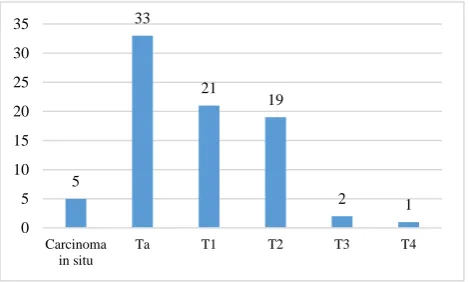
The stage of tumor in most of patients was in stage Ta with 33 (40.7%) (Figure 2).
The type of tumor in most of patients was papillary with 67.9% (Figure 3).
The first symptoms in most of patients was Hematuria with 90.1% (Figure 4).
13% 6%
33% 48%
urothelial papilloma
Papillary urothelial neoplasm of low malignant potential
Low grade papillary urothelial carcinoma
The mean of distance time between observation hematuria and referred to systescopia in patients was 2.85±2.83 month that most of patients have delay in this process (33.3%).
Figure 2: The stage of bladder tumor in patients.
Figure 3: The type of tumor in patients.
Figure 4: The symptoms in patients.
DISCUSSION
In this study, the frequency of bladder cancer in male with 82.7% was more than female with 17.3% and sex ratio male to female was 4.8 to 1. In other studies in Iran and other places, the rate of cancer in male was more and the sex ratio was different from 3-8.6 to 1.5,18-28
In this study, the mean age of patients was 66.9±15.02 and similar to other studies there wasn’t significant difference between two sexes.7,26-29,30-34
More than 90% of patients in this study have age up 50 years that in a study in Iran during 2003-2009, the most of incidence was seen in age group up 80 which in line with our study result.5
Also, in a study in Sri Lanka 89.9% of patients have age up 50 years and in Fedva et al study, in Egypt most of patients were in age group 60-69 years.2
The pattern of cancer incidence is related to regional conditions and physical-chemical environmental factors, nutritional habits, and genetic factors that can justify differences in various studies. The most grade of tumor in patients was high grade papillary urothelial carcinoma which was seen in 39 (48.1%) of patients. Our study results was similar to Sjöström and et al in Sweden, Ramazani et al study, Payandeh and et al study in Kermanshah and Dobbs and et al study in America.18,23,24,29 But in some studies the most of grade was low-degree tumors which can pointed to the Sasikumar et al in Sri Lanka, Biswas et al study in India and Salehi study in Shiraz.19,30 The most frequent stage of bladder tumors in our study was Ta, which was seen in 40.7% of all patients. In Sjöström et al study in Sweden, Dobbs and et al study in America and Gupta and et al study in India the most frequent stage was Ta and then T1, T2 which was in line with our study results.18,29 The most symptoms in patients was hematuria with 90.1% and in other studies similar to our study results the most prevalent symptoms was hematuria.7,21,23,26,28
According to the current and other study results it can be said that the most important clinical manifestation of bladder cancer is hematuria and it need for more attention from physicians to urinary symptoms, especially hematuria, as a possible sign of cancer. The mean of distance time between observation hematuria and referred to systescopia in patients was 2.85±2.83 month that most of patients have delay in this process (33.3%). The mean of delay in a study in Esfahan was 2.76 month which was similar to our study results. In generally studies showed that the distance more than 3 month from onset to treatment significantly decreases the rate of treatment response and this suggests the need for early diagnosis of bladder cancer.32
In our study 54.3% of patients have history of smoking which was similar to other studies.2,20,23-26
In generally, the most important risk factor for bladder cancer was smoking which increase the risk of cancer about 4 times and it was estimated that smoking is causes of 50% of all bladder cancer cases in male and 30% in female.5,32,33
5
33
21 19
2 1
0 5 10 15 20 25 30 35
Carcinoma in situ
Ta T1 T2 T3 T4
sessile 27%
papillary 68%
sessile+pa pillary
5%
sessile papillary sessile+papillary
0 10 20 30 40 50 60 70 80
Hematuria Burning of the urine
Urinary frequency
In our study, most of patients with 39.5% have blood type A which was upper than country rate with 31.63%.5 In Shafeei et al study in Babol, two blood groups A and O have the most frequency.7 In Biswas et al study in India, most of patients was in Blood group B with 41%. In this study most of patients live in urban areas with 58%. Contrary to the current study, in Ramazani et al study, in Kermanshah 75% live in Rural but in Ahmadi et al study in Mazandaran most of patients about 60.7% live in Urban.23,26 In a study in Egypt this rate was similar between Urban and Rural.2
Physical-chemical environmental contact with harmful substances is one of the known risk factors for bladder cancer and it was reported that bladder cancer is prevalent in industrial areas.35
It is thought that, the increasing of the disease in urban areas relates to rural areas which are partly due to the industrialization of cities towards the countryside; the results of the present study also confirm these findings. Of course, there are a number of environmental and geographical risk factors that are common in rural areas such as agricultural waste and heavy metals entering underground waters and suffer these areas with problems in futre.36
CONCLUSION
The findings of this study showed that the most common grade and stage of tumor in patients with bladder cancer were high-grade papillary urethral carcinoma and Ta, the most common pre-clinical presentation was hematuria. The prevalence of this disease was higher among men over the age of 70 years, in people with type A, and among people living in urban areas. Also, cigarette smoking was common among these patients, and one-third of patients between hematuria and cystoscopy were delayed for more than 3 months. A study with a higher sample size is necessary in the future to achieve more accurate results.
Funding: No funding sources Conflict of interest: None declared
Ethical approval: The study was approved by the Institutional Ethics Committee
REFERENCES
1. Ploeg M, Aben KK, Kiemeney LA. The present and future burden of urinary bladder cancer in the world. World J Urol. 2009;27(3):289-93.
2. Fedewa SA, Soliman AS,Ismail K, Hablas A, Seifeldin IA, Ramadan M, et al. Incidence analyses of bladder cancer in the Nile delta region of Egypt. Cancer Epidemiol. 2009;33(3–4):176-81.
3. Burger M, Catto JW, Dalbagni G, Grossman HB, Herr H, Karakiewicz P, et al. Epidemiology and risk factors of urothelial bladder cancer. Euro Urol. 2013;63(2):234-41.
4. Chavan S, Bray F, Lortet-Tieulent J, Goodman M, Jemal A. International Variations in Bladder Cancer Incidence and Mortality. Eur Urol. 20147;66(1):59-73.
5. Koohi F, Salehiniya H. The trend of incidence of bladder cancer in Iran, 2003-2009. UMJ. 2015;26(1):1-9.
6. Lerner SP, Schoenberg M, Sternberg C, editors. Textbook of bladder cancer. CRC Press; 2006. 7. Shafi H, Ramaji A, Pasha A, Pasha Y, Kasayan A,
Aghajanimir M, et al. A Survey on 175 Cases of Bladder Cancer in the Patients Who Referred to the Hospitals Affiliated to Babol University of Medical Sciences, Iran (2001-2011). JBUMS. 2013;15(2):116-22.
8. Jemal A, Siegel R, Xu J, Ward E. Cancer statistics, 2010. CA Cancer J Clin. 2010;60(5):277-300. 9. Whelan P. Survival from bladder cancer in England
and Wales up to 2001. Br J Cancer. 2008;99 Suppl 1: S90-2.
10. Scosyrev E, Noyes K, Feng C, Messing E. Sex and racial differences in bladder cancer presentation and mortality in the US. Cancer. 2009;115(1):68-74. 11. Brookfield KF, Cheung MC, Gomez C, Yang R,
Nieder AM, Lee DJ, et al. Survival disparities among African American women with invasive bladder cancer in Florida. Cancer. 2009;115(18):4196-209.
12. Brennan P, Bogillot O, Cordier S, Greiser E, Schill W, Vineis P, et al. Cigarette smoking and bladder cancer in men: A pooled analysis of 11 case-control studies. Int J Cancer. 2000;86(2):289-94.
13. Brennan P, Bogillot O, Greiser E, Chang-Claude J, Wahrendorf J, Cordier S, et al. The contribution of cigarette smoking to bladder cancer in women (pooled European data). Cancer Causes Control. 2001;12(5):411-7.
14. Gaertner RR, Trpeski L, Johnson KC, Canadian Cancer Registries Epidemiology Research Group. A casecontrol study of occupational risk factors for bladder cancer in Canada. Cancer Causes Control 2004; 15(10): 1007-19.
15. Kogevinas M, Mannetje A, Cordier S, Ranft U, González CA, Vineis P, et al. Occupation and bladder cancer among men in Western Europe. Cancer Causes Control. 2003;14(10):907-14. 16. Smailyte G, Kurtinaitis J, Andersen A. Mortality
and cancer incidence among Lithuanian cement producing workers. Occup Environ Med. 2004;61(6):529-34.
17. Cheng L, Lopez-Beltran A, Bostwick DG. Bladder pathology. John Wiley & Sons; 2012.
18. Sjöström G, Thorstenson A, Jahnson S. Urothelial Carcinoma of the Bladder in Swedish Geriatric Patients:A Population-based Study. MOJ Gerontol Ger. 2017:1(3):1-3.
changing demographics of bladder cancer in Sri Lanka. Advances Urol. 2016:1(1):1-6.
20. Dobbs RW, Hugar LA, Revenig LM, Al-Qassab U, Petros JA, Ritenour CW, Issa MM, Canter DJ. Incidence and clinical characteristics of lower urinary tract symptoms as a presenting symptom for patients with newly diagnosed bladder cancer. International Braz J Urol. 2014;40(2):198-203. 21. Biswas RR, Mangal S, Guha D, Basu K, Karmakar
D. An epidemiological study of cases of urothelial carcinoma of urinary bladder in a tertiary care centre. J Krishna Institute of Med Sci. 2013;2(1):82-8.
22. Ray D, Mondal R, Acharya S, De S, Mondal S. A retrospective study of bladder cancer and the impact of age, sex and smoking habits related clinicopathological correlations in tribal population of Bankura, WB, India. IOSR J Dent Med Sci. 2013;10 (4):29-32.
23. Gupta P, Jain M, Kapoor R, Muruganandham K, Srivastava A, Mandhani A. Impact of age and gender on the clinicopathological characteristics of bladder cancer. Indian J Urol: IJU: journal of the Urological Society of India. 2009;25(2):207. 24. Ramezani M, Naderi N, Almasi A, Sadeghi M.
Epidemiological and Clinicopathological Features of Bladder Cancer:A Report from Kermanshah Province, Iran. Iranian J Blood Cancer. 2016;8(2):43-6.
25. Aliramaji A, Kaseean A, Pasha YR, Shafi H, Kamali S, Safari M, Moudi E. Age distribution types of bladder cancers and their relationship with opium consumption and smoking. Caspian J Internal Med. 2015;6(2):82.
26. Payandeh M, Sadeghi M, Sadeghi E. Characteristics of Patients With Transitional Cell Carcinoma of the Urinary Bladder in Kermanshah Province, Iran. Iranian J Cancer Prevent. 2015;8(6):1-4.
27. Ahmadi M, Ranjbaran H, Amiri MM, Nozari J, Mirzajani MR, Azadbakht M, Hosseinimehr SJ. Epidemiologic and socioeconomic status of bladder cancer in Mazandaran Province, northern Iran. Asian Pacific J Cancer Prevent. 2012;13(10):5053-6.
28. Farahmand M, Almasi-Hashiani A. Epidemiology of Bladder Cancers in Fars Province, Southern Iran
(2003-2008). J Kerman Univ Med Sci. 2013;20(4):387-94.
29. Salehi A, Khezri AA, Malekmakan L, Aminsharifi A. Epidemiologic status of bladder cancer in Shiraz, southern Iran. Asian Pac J Cancer Prev. 2011;12(5):1323-7.
30. Taghavi A, Khorami M. The Causes of Delay to Diagnosis the Cancer of Bladder in Patients with Symptoms. J Isfahan Med School. 2011;29 (152):1155-60.
31. Fahmy N, Kassouf W, Jeyaganth S, Amin M, Mahmud S, Steinberg J, et al. An analysis of preoperative delays prior to radical cystectomy for bladder cancer in Quebec. Can Urol Assoc J. 2008;2(2):102-8.
32. Kiriluk KJ, Prasad SM, Patel AR, Steinberg GD, Smith ND. Bladder cancer risk from occupational and environmental exposures. Urol Oncol. 2012;30(2):199–211.
33. Mohr SB, Garland CF, Gorham ED, Grant WB, Garland FC. Ultraviolet B Irradiance and Incidence Rates of Bladder Cancer in 174 Countries. Am J Preventive Med. 2010;38(3):296- 302.
34. Mohammadali F, Pourfathollah A. Association of ABO and Rh Blood Groups to Blood - Borne Infections a mong Blood Donors in Tehran - Iran. Iran J Public Health. 2014;43(7):981-9.
35. Sharp L, Donnelly D, Hegarty A, Carsin AE, Deady S, McCluskey N, Gavin A, Comber H. Risk of several cancers is higher in urban areas after adjusting for socioeconomic status. Results from a two-country population-based study of 18 common cancers. Journal of Urban Health. 2014;91(3):510-25.
36. Ramesht M, Pourfarzi F, Entezari M, Karamati H. An Epidemiologic Study of Spatial and Temporal Patterns of Gastric Cancer in Ardabil)Years 2006- 2012. J Health. 2015;6(3):345-54.
Cite this article as: Hoseinkhani A, Amani F, Torabi Y.Evaluation of clinical and laboratory