Cost Accounting: Economic-Financial Viability of
Implementation of a New Product Line
Miguel Lorenzetti Marta Elisete Ventura Da Motta
Alice Munz Fernandes Maria Emilia Camargo
Ademar Galelli
Beatriz Lúcia Salvador Bizotto
Abstract
Cost accounting helps in the process of managerial decision-making, as well as provides strategies and techniques that minimize the company's expenses and maximize its economic-financial return. The objective of this research was to determine if the production costs of ice creams and popsicles in a micro-enterprise are influenced by the implementation of a new product line. To do so, a quantitative, exploratory and descriptive research was carried out as a case study, whose data were initially collected through a market survey, for which a cross-sectional survey was used and, later, a document analysis. The object of investigation was a small ice cream company located in the city of Vacaria/RS/Brazil. The results showed that the implementation of the new product would maximize its profit by 63.67%. It was also identified that the implementation of this product would not interfere in the cost of the other products of the company, so that incorporating it to the product mix would reflect in economic-financial returns for the organization and would consist of a technique of differentiation by offering something innovative to the market. Keywords: Cost Accounting. Entrepreneurship. Economic and Financial Viability.
1.INTRODUCTION
In today's scenario, where competition is fierce and consumers become increasingly demanding, climatic factors become influential in maximizing the consumption of frozen foodstuffs. Thus, in recent years there has been a significant increase for the ice cream industry, according to the Brazilian Association of Ice Cream Industries (ABIS, 2014).
According to the Gaucho Association of Edible Ice Foods (AGAGEL, 2011), ice cream is becoming a popular dessert among Brazilians and easily acquired by different social classes, so that companies are creating a mix of varied products for different types of tastes and purchasing power. In 2014, 1.305 billion liters of ice cream were consumed, an increase of 4.9% over the previous year. In the last ten years (2005-2014), the index reached 80.2% growth (ABIS, 2014). At the state level, Rio Grande do Sul has 403 industries manufacturing ice cream and other edible ice creams (AGAGEL, 2011).
The objective of this research was to determine if the production costs of ice creams and popsicles in a micro-enterprise are influenced by the implementation of a new product line. For that, a quantitative, exploratory and descriptive research was carried out by means.
Thus, this study is composed of four other sessions. The following presents a literature review, contemplating types and conceptualization of cost accounting, as well as entrepreneurship and indicators of economic-financial viability. Subsequently, the research method is presented, describing the data collection and analysis procedures. Then, empirical results are discussed and compared with other investigations. Finally, there are considerations that address the limitations of research and suggestions for future studies.
2.LITERATURE REVIEW 2.1 Cost Accounting
According to Kaplan and Cooper (1998), accounting assumes the role of information provider for business effectiveness, so that methods and techniques help to maximize profit. Concomitantly, Ribeiro (2003, p. 19) states that accounting refers to "science that enables, through its techniques, the permanent control of corporate patrimony".
Also, it intends to plan, allocate, organize, register, analyze, interpret and report the costs of products manufactured and marketed by organizations (MARTINS 2001; CREPALDI, 2002). These costs refer to the monetary values of the inputs and consumptions necessary for the production and commercialization of certain products (BERTÓ and BEULKE, 2005).
According to Martins (2001) and Megliorini (2007), costs can be classified according to their purpose (direct and indirect) and their behavior (variable and fixed) in order to provide information that meets the needs of users of cost accounting. According to Ribeiro (2003) the direct costs refer to the expenses with materials, labor and general manufacturing expenses. On the other hand, Hansen and Mowen (2001) affirm that direct costs are those that can be identified to each product and that can be appropriated directly for the specific units.
Leone (2000) emphasizes that indirect costs are those that are not easily identified with the item (product or service). Thus, the author points out that these are expenses related to secondary materials, such as indirect labor, general manufacturing expenses or any cost that cannot be applied directly to the product or service.
Regarding the classification by behavior, the fixed costs are the expenses that remain constant within a certain limit of installed capacity, independently of the volume of production (COSTA, 2006), so that its division by unit occurs by means of apportionment ( HANSEN and MOWEN, 2003).
On the other hand, variable costs are those that vary proportionally according to the level of production or activity, so that their values depend directly on the volume produced (HANSEN and MOWEN, 2003). In this sense, Perez Júnior, Oliveira and Costa (2006) elucidate that these are the costs that remain directly linked to the volume of production or service.
2.1.1 Costing Methods
The costing system is composed of principles that discuss the portion of expenses that should be attributed to the products, that is, a method that establishes how to allocate these expenses to the units produced (BORNIA, 2002). According to Megliorini (2007), costing methods differ in the allocation of direct and indirect costs, whose traditional methods are called absorption costing and variable costing.
In absorption costing, all fixed and variable costs are tied to the products. Thus, product costs incorporate all inefficient expenditures, serving as a measure of the firm's current adherence to market costs (BORNIA, 2002). According to Stark (2007, p. 158), the absorption cost method "appropriates all costs, fixed or variable to the production of a certain period ... non-production costs will be excluded."
Regarding variable or direct costing, Martins (2001) points out that this connects variable costs to the products, with fixed costs considered as expenses of the period. For Bornia (2002), variable costing is important for short-term decisions, making them more attractive than fixed costs. In this sense, Hansen and Mowen (2003) corroborate that variable costing is characterized by assigning only variable manufacturing costs to the products, so that the final stock of finished products is taken fully into the result of the exercise (MEGLIORINI, 2007).
2.2 Entrepreneurship
The companies seek, from an accuracy perspective, development and growth (DORNELAS, 2005). For Dolabela (2006), to undertake is to have a sharp vision of the dreams and use tools that allow to organize ideas and information regarding the need, creating, therefore, ways to supply them in the chosen segment. In this sense, this research consisted in analyzing the implementation of a new product line within the company of an ice cream, object of this study, so it is imperative to associate entrepreneurship with innovation.
According to Schumpeter (1982), innovation refers to the creation of processes capable of promoting the rupture of the economic system through the emergence of innovations. Bessant and Tidd (2009) collaborate affirming that the innovation associates to the growth, considering that businesses are created from new ideas.
Innovation is still seen as a process of change, where new or significantly improved products and processes replace existing ones. Thus, innovation can be defined as the implementation or significant improvement of a product (good or service), process, marketing method or organizational method "in business practices, in the organization of the workplace or in external relations" (MANUAL OF OSLO, 2005, p. 55).
Thus, there are four dimensions of innovation: product; process; marketing; and organizational. Finally, product innovation, the focus of this study, is the introduction of a new or significantly improved product or service, in relation to technical specifications, materials, ease of use, and other functional characteristics (OSLO, 2005).
2.3 Indicators of Economic and Financial Viability
that financial elaboration makes it possible to make precise decisions based on numbers and cross-information according to projections and worksheets, which makes the management process viable.
However, for the elaboration of economic and financial feasibility indicators, it is imperative to elaborate the cash flow that, according to Braga (1995), consists of the set of inflows and outflows of cash in a given period of time, since the monetary movements of a company are not uniform all the time. For Zdanowicz (2000), the cash flow allows the manager to identify the areas that are using more capital than they should, which makes it possible to adopt measures that minimize costs and maximize profit.
In order to do so, it is necessary to make sales forecasts, that is, numerical projections that express the expectations of the organization portrayed at a given moment by the opinions and analyzes of its professionals and the market bias (MOREIRA, 2010). Among the decisions to be taken by the company, one of the primordial is the formation of the Sales Price (SP), being indispensable to know the cost of a product to fix its price for commercialization (SILVA, 2001; MARTINS, 2001).
Thus, to calculate the SP, the commonly used method is the Mark-up, whose base is the value of the costs, that is, it is an index applied on the cost of a good or service for the formation of the price (SANTOS , 2005). Mendes (2009) affirms that the value of Total Fixed Cost (TFC) and the price elasticity of demand for this product influence the definition of Mark-up, so that the larger the TFC, the larger the Mark-up
Santos (2005) lists other factors that interfere in the formation of price and market demand, such as quantity to be produced, organization management costs and costs incurred in the marketing of products. Thus, the SP aims to maximize profits and maintain the quality of products, so its calculation must cover all resources (SANTOS, 2005).
There is also the Contribution Margin (CM), which is considered to be the difference between the unit SP of a product and its variable costs and expenses (PADOVEZE, 2006). In this sense, Wernke (2008) elucidates that knowledge on CM is valid for decisions to be made in the short term, aiming at cost minimization analyzes.
In turn, the Break-even Point (BEP) consists of a parameter that indicates the minimum amount that the company must reach so that it can operate, balancing profits and losses (MEGLIORINI, 2007). Thus, Dutra (2010) assures that there is no ideal BEP, since for each company there is a revenue, demand and productivity necessary for optimizing profits and minimizing losses.
Thus, the Accounting Break-Even Point (ABEP) is the one that covers all fixed costs and expenses of a given period (MEGLIORINI, 2007), whose calculation is given in units (parts, meters, kilos, etc.) and value (WERNKE, 2008). The Financial Break-Even Point (FBEP) consists of one that affirms a result that supports fixed costs and expenses, disregarding depreciation (MEGLIORINI, 2007). Lastly, there is the Economic Break-Even Point (EBEP), which refers to that "in which total revenues are equal to the total costs plus a minimum return on invested capital" (SANTOS, 2011, p. 47), being necessary for the company to establish how much profit it wants to obtain.
Regarding the financial indicators, the Minimum Attractiveness Rate (MAR) refers to the "best rate, with degree of risk, available for the capital investment" (SOUZA; CLEMENTE, 2004, p. 74). For Santos (2005), this rate is established according to the cost of capital of the companies, so that in Brazil it is fixed between 12% and 15% per year.
As regards the Internal Rate of Return (IRR) of an investment, Santos (2005) defines it as the percentage of return obtained on the balance of the invested capital, so that, mathematically, it is the interest rate that equals the present value of cash inflows and outflows. According to Hoji (2010), a project will only be considered economically attractive if the IRR is higher than the MAR, otherwise investing in this business would represent financial loss.
According to Gitman (2001), the Net Present Value (NPV) consists of a capital budgeting technique, obtained by subtracting the initial investment. According to Hoji (2010), the NPV method allows the identification of a value at the initial moment, based on a cash flow composed of revenues and expenditures, discounted with the MAR. On the other hand, payback is an indicator that calculates how much time it takes for the company to obtain a return on the investment applied, that is, it demonstrates the time for the investor to recover the value applied in his enterprise. Thus, payback is calculated from the input and output stream (GITMAN, 2001).
On the other hand, the Income Statement (IS) consists of a global indicator of business efficiency, which aims to provide the company's results during the period, presenting profit and / or loss (MARION, 2013). Thus, the income, costs and expenses incurred by the company are accrued on an accrual basis (NETO, 2012).
3. METHODOLOGICAL PROCEDURES
that makes it possible to empirically investigate a certain contemporary phenomenon within a real-life context, when the boundaries between them are not clearly defined (YIN, 2015).
3.1 Research steps
Thus, the research is composed of two stages, according to the procedures of data collection, which are: exploratory through a cross-sectional survey and descriptive through document analysis.
3.1.1 Survey
To verify the economic-financial viability, a market survey was initially conducted. According to Gil (2002, p. 50), this data collection procedure consists of "requesting information to a significant group of people about the problem studied and then, through quantitative analysis, obtain the corresponding conclusions from the data collected".
The research population was defined as the students of the third year of high school in the three largest schools located in the city center of Vacaria/RS/Brazil, academics of the Bachelor of Science in Accounting course at the University of Caxias do Sul/Campus Universitário de Vacaria and traders of all segments, also located in the central region of the city, totaling 625 people. The adoption of this population is justified by the location of the company under study and by the profile of the customers of its other products (ice creams and popsicles), so that it is inferred that these would probably also acquire the Mexican style popsicles, a product whose economic and financial viability was analyzed empirically.
In this way, the sample was non-probabilistic, for convenience, defined by easy access (GIL, 2002), composed of 240 people corresponding to about 38% of the population. The data were collected in March 2015, through a structured questionnaire composed of 12 (twelve) "closed" questions, in order to identify the profile of the respondents and their consumption habits. The data storage and processing were performed by Sphinx Plus Software.
3.1.2 Document Analysis
After the survey was applied, a document analysis of the company object of the study was carried out, whose objective was to list its costs, expenses and SP (sales prices), and to analyze them jointly with those resulting from the new product proposed.
Thus, the data were collected from economic and accounting documents, records in archives, sales histories, among others. Finally, the sales projections of the new product, its representativeness in the company's cash flow and, finally, calculations of economic and financial feasibility indicators.
3.2 Description of the company under study
For Jung (2004, p. 158), "through a case study it is possible to explain or describe a production system or technical system in the private or collective scope". Thus, the company object of this study is an ice cream shop located in the city of Vacaria/RS/Brazil, whose activities began more than 10 years ago. Currently, the microenterprise serves at two central sales points, expanding its product line over the years, also making popsicles and ice cream. Table 1 shows the type of popsicles and ice creams as well as the average quantity marketed per month and the selling price.
Table 1 – MoTablenthy sales of popsicles and ice cream
Product Type Sales/Month SP (R$)
Popsicles
Water based 900 1.50
Milk based 1,200 2.00
Special 600 3.00
Ice cream
180 ml 1,600 2.50
1 Liter 600 8.50
2 Liters 300 16.50
Font: research data.
The company operates a mix of 12 (twelve) flavors, namely: chocolate, strawberry, grape, kiwi, milk cream, condensed milk, avocado, plum, coconut, toasted coconut, eggs cream and pineapple. The choice of these flavors is due to the acceptance and preference of the customers.
4 RESULTS ANALISYS AND DISCUSSION
Table 2 – Contribution margin of products
POPSICLES PRICE (R$) CM (R$) CM % C/DF unit (R$) PROD/YEAR Total C/DF (R$) Water based 1.50 0.48 0.32 0.52 10,800 5,606.75 Milk based 2.00 0.74 0.37 0.52 14,400 7,475.66 Specials 3.00 0.84 0.28 0.52 7,200 3,737.83 ICE CREAM
180 ml 2.50 1.28 0.51 0.58 19,200 11,126.11 1 Liter 8.50 2.73 0.32 0.58 7,200 4,172.29 2 Liters 16.50 6.13 0.37 0.58 3,600 2,086.15 MEXICAN
Fruit 5.00 1.77 0.35 0.01 14,976 187.17 Mousse 5.00 1.90 0.38 0.01 14,976 187.17
Font: research data.
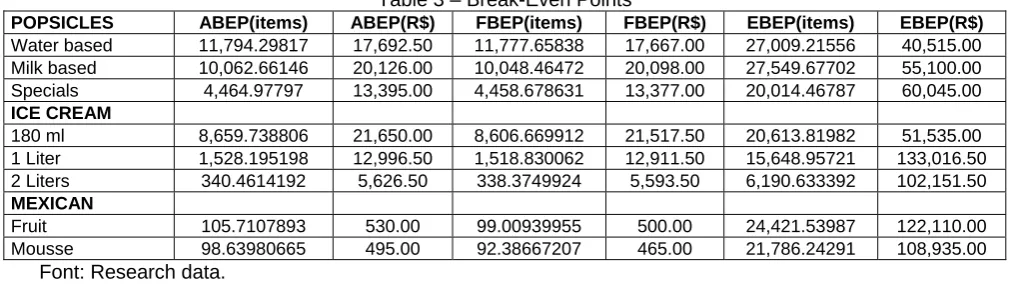
By adding up all the variable costs, the Contribution Margin (MC) is obtained in values and percentage, which eliminates the fixed costs of each product. Subsequently, the calculation of the Accounting Brake-Even Point (ABEP) was carried out, thus exposing the quantity and values necessary to zero the fixed costs of each product. Next, the Financial Brake-Even Point (FBEP) was obtained by disregarding the value of the depreciation (the apportionment of this occurred between each product). And finally, for the definition of the Economic Break-Even Point (EBEP), we considered the increase in the desired profit, represented by the mark-up by the profit margin, multiplied by the total annual production of each product. Table 3 shows the value of the Brake-Even Points (BEP) mentioned.
Table 3 – Break-Even Points
POPSICLES ABEP(items) ABEP(R$) FBEP(items) FBEP(R$) EBEP(items) EBEP(R$) Water based 11,794.29817 17,692.50 11,777.65838 17,667.00 27,009.21556 40,515.00 Milk based 10,062.66146 20,126.00 10,048.46472 20,098.00 27,549.67702 55,100.00 Specials 4,464.97797 13,395.00 4,458.678631 13,377.00 20,014.46787 60,045.00 ICE CREAM
180 ml 8,659.738806 21,650.00 8,606.669912 21,517.50 20,613.81982 51,535.00 1 Liter 1,528.195198 12,996.50 1,518.830062 12,911.50 15,648.95721 133,016.50 2 Liters 340.4614192 5,626.50 338.3749924 5,593.50 6,190.633392 102,151.50 MEXICAN
Fruit 105.7107893 530.00 99.00939955 500.00 24,421.53987 122,110.00 Mousse 98.63980665 495.00 92.38667207 465.00 21,786.24291 108,935.00
Font: Research data.
In order to calculate the economic and financial viability indicators, considering the Selic rate currently practiced, the country's inflation bias, as well as the expansion projections of the enterprise, it was adopted for a Minimum Attractiveness Rate (TMA) of 15% per year. Thus, it was obtained as the Internal Rate of Return (IRR), 1,372.32% per year for each type of Mexican style popsicles (fruit and mousse). Finally, it was verified that under the conditions and prices presented, the payback would occur in 14.42 days. Thus, it can be verified that the proposed enterprise is economically and financially feasible and the costs arising from its implementation do not influence the cost of the other products commercialized by the company.
5 FINAL CONSIDERATIONS
The market becomes increasingly competitive, so it is imperative that companies innovate. In this context, having in-depth knowledge of their products, costs and expenses, enables managers to establish strategies capable of maximizing the position of companies in this scenario. With this in mind, the empirical research carried out was aimed at identifying if the production costs of ice creams and popsicles in a microenterprise are influenced by the implementation of a new product line.
Through market research, it was first verified the market acceptance of the new product proposed by the company, as well as the possibility of acquisition considering the stipulated selling price (SP). Subsequently, through analysis of economic, financial and accounting documents, it was found that the company under study would increase its profit by 63.67% if the new product was manufactured.
We acknowledge the limitations of this research in relation to the impossibility of generalization of the results obtained, as well as the specific conditions established for the feasibility analysis and allocation of costs and expenses. For future research, it is suggested to carry out surveys considering multiple cases, in order to compare the costs of companies of different sizes and / or economic segments, as well as in different regions and / or cities.
REFERENCES
ABIS. Associação Brasileira das Indústrias e do Setor de Sorvetes. Dados estatísticos de consumo de sorvete. 2014. Disponível em: <http://www.abis.com.br/estatistica_producaoeconsumodesorvetesnobrasil.html>. Acessed on: March 10, 2015.
AGAGEL. Associação Gaúcha de Alimentos Gelados Comestíveis. Consumo crescente de sorvete. 2011. Disponível em: <http://www.agagel.com.br/site/brasileiros-consumiram-1167-milhao-de-litros-de-sorvete-em-2011/>. Acessed on: April 5, 2015.
BERTÓ, D. J.; BEULKE, R. Gestão de custos. São Paulo: Saraiva, 2005.
BESSANT, J.; TIDD, J. Inovação e empreendedorismo. Rio de Janeiro: Bookman, 2009.
BORNIA, A. C. Análise gerencial de custos: aplicações em empresas modernas. Porto Alegre: Bookman, 2002. BRAGA, R. S. Fundamentos e técnicas de administração financeira. São Paulo: Atlas, 1995.
BRYMAN, A. Quantity and quality in social research. London: Routledge, 1988. CREPALDI, A. S. Contabilidade gerencial: teoria e prática. São Paulo: Atlas, 2002.
DOLABELA, F. Boa ideia. E agora? Plano de negócio, o caminho seguro para criar e gerenciar sua empresa. São Paulo: Cultura, 2006.
DORNELAS, J. C. A. Empreendedorismo: Transformando Idéias em Negócios. 2 ed. Rio de Janeiro: Elsevier, 2005. DUTRA, R. G. Custos: uma abordagem prática. 7 ed. São Paulo: Atlas, 2010.
GIL, A. C. Como elaborar projetos de pesquisa. 4 ed. São Paulo: Atlas, 2002.
GITMAN, L. J. Princípios de administração financeira: essencial. 2 ed. Porto Alegre: Bookman, 2001.
HANSEN, D. R.; MOWEN, M. M. Gestão de custos: Contabilidade e Controle. 3 ed. São Paulo: Pioneira, 2003.
HOJI, M. Administração financeira e orçamentária: matemática financeira aplicada, estratégias financeiras, orçamento empresarial. 9 ed. São Paulo: Atlas, 2010.
JUNG, C. F. Metodologia para pesquisa & desenvolvimento. 1 ed. Rio de Janeiro: Axcel Books do Brasil Editora, 2004. KAPLAN, R. S.; COOPER, R. Custo e desempenho: administre seus custos para ser mais competitivo. São Paulo: Futura,
1998.
LEONE, G. S. G. Curso de contabilidade de custos. 2 ed. São Paulo: Atlas, 2000.
\MANUAL DE OSLO. Diretrizes para coleta e interpretação de dados sobre inovação. 3 ed. OECD/FINEP, 2005. MARION, J. Contabilidade básica. 10 ed. São Paulo: Atlas, 2013.
MARTINS, E. Contabilidade de custos. 8ed. São Paulo: Atlas, 2001.
MEGLIORINI, E. Custos: análise e gestão. 2. ed. São Paulo: Pearson Pretince Hall, 2007. MENDES, J. T. G. Economia: fundamentos e aplicações. 2 ed. São Paulo: Pearson, 2009.
MOREIRA, D.A. Pesquisa operacional: curso introdutório. 2. ed. São Paulo: Cengage Learning, 2010. NETO, A. A. Estrutura e análise de balanços: um enfoque econômico-financeiro. São Paulo: Atlas, 2012. OLIVEIRA, G. P. de. Contabilidade tributária. 4 ed. São Paulo: Saraiva, 2013.
PADOVEZE, C. L. Curso básico gerencial de custos. 2 ed. São Paulo: Cengage Learning, 2006.
PEREZ JÚNIOR, J. H.; OLIVEIRA, L. M. de; COSTA, R. G. Gestão estratégica de custos. 5 ed. São Paulo: Atlas, 2006. RIBEIRO, O. M. Contabilidade básica fácil. 24. ed. São Paulo: Saraiva, 2003.
SANTOS, J. Contabilidade e análise de custos: modelo contábil, métodos de depreciação, ABC-Custeio Baseado em Atividade, análise atualizada de encargos sociais sobre salários, custos de tributos sobre compras e vendas. 6. ed. São Paulo: Atlas, 2011.
SANTOS, J. Fundamentos de custos para formação de preço de venda e lucro. 5ed. São Paulo: Atlas, 2005. SHUMPETER, J. Teoria do desenvolvimento econômico. São Paulo: Nova Cultural, 1982.
SILVA, J. P. da. Análise financeira das empresas. 5 ed. São Paulo: Atlas, 2001.
SOUZA, A.; CLEMENTE, A. Decisões financeiras e análise de investimento. São Paulo: Atlas, 2004. STARK, J. A. Contabilidade de custos. São Paulo: Pearson Education do Brasil, 2007.
WERNKE, R. Gestão de custos: uma abordagem prática. 2 ed. São Paulo: Atlas, 2008. YIN, R. Estudo de caso: planejamento e métodos. 5. ed. Porto Alegre: Bookman, 2015.