Original Research Article
Analysis of factors that motivate and prevent the blood donation
decision among the medical college students
Chandrashekhar R.
1, Shashidhar S. Basagoudar
2*, Shivappa Hatnoor
2, Rahul C. Kirte
2INTRODUCTION
Human blood is an essential element of human life and there are no substitutes to blood as yet. Availability of safe blood and blood products is a critical component in improving health. Millions of lives are saved each year through blood transfusion particularly in developing countries.1
"Safe blood starts with me, blood saves lives" was the WHO theme for 2000 AD. Blood can save millions of lives and young people are the hope and future of a safe
blood supply in the world. India needs about 6–7.5 million units of blood annually and every year there is a gradual increase in the demand. National blood donation policy of India highlights on the need of supplying safe and quality blood to the needy through collecting blood from regular voluntary blood donors.2
Donating blood is an act that can save the lives of thousands of people world-wide because blood is an essential element of human life and there are no substitutes for it. In spite of extensive efforts and a number of blood donation programmes being organised
ABSTRACT
Background: Human blood is an essential element of human life. Medical colleges students can be very good source for voluntary blood donation. This study was done with the objectives - to find out the factors motivating blood donation and the factors responsible for not donating the blood among the medical students.
Methods: A cross sectional study was conducted among the students of a government autonomous medical college, situated at northern part of Karnataka, India. Data was collected by a pre tested, semi structured, self administered, questionnaire. All the students studying MBBS in RIMS, Raichur who have joined the course between 2013 -2016 were included in the study.
Results: In our study a total of 319 students have participated. Among the total students studied 85 (26.64%) have donated the blood at least once and 234 (73.36%) students have not donated even once. The major motivating factor for voluntary blood donation as responded by students was altruism/ doing good to others (51.8%). Major reason for non-donation of blood was he/she was never been asked for blood donation (56.4%). In the present study, the voluntary blood donation was significantly high among males (40.3%) compared to females (8.7%). Proportion of people who have donated blood increased with each year of study, highest among MBBS phase III Part 2 (53.6%).
Conclusions: Having knowledge and attitude alone will not improve the voluntary blood donation unless, blood donation opportunity is available. So creating opportunities for donation of blood through voluntary blood donation drives is very much needed.
Keywords: Blood donation decision, Voluntary, Motivating factors, Medical students
Department of Community Medicine, 1Raichur Institute of Medical Sciences, Raichur, 2RIMS, Raichur, Karnataka, India
Received: 21 September 2018
Accepted: 30 October 2018
*Correspondence:
Dr. Shashidhar S. Basagoudar, E-mail: [email protected]
Copyright: © the author(s), publisher and licensee Medip Academy. This is an open-access article distributed under the terms of the Creative Commons Attribution Non-Commercial License, which permits unrestricted non-commercial use, distribution, and reproduction in any medium, provided the original work is properly cited.
world-wide, the availability of blood still remains short to meet the increased demand.3
Blood transfusion services in India have gained special significance in recent years and forms a vital part of national health care system as it saves millions of lives each year, permits complex medical and surgical interventions, improves life expectancy and quality of life in variety of acute and chronic conditions. Because of increasing incidence of HIV/AIDS, blood safety programme was initiated in the year 1989-90 and subsequently became an integral part of national AIDS control organisation (NACO).4
College students particularly from Medical colleges can be very good source of quickly accessible, quality blood if they are motivated and are willing to be voluntary blood donors. By knowing the factors preventing blood donation through this study, measures can be taken up to increase the percentage of voluntary non- Remunerated blood donation. Hence this study was done with the objectives to find out the factors motivating blood donation among medical students and to find out the factors responsible for not donating the blood among the medical students.
METHODS
A cross sectional study was conducted among the students of Raichur Institute of Medical Sciences (RIMS), Raichur, Government autonomous medical college situated at northern part of Karnataka, India. The study was begun after obtaining ethical clearance from the institutional ethics committee, RIMS, Raichur. Study was conducted during June –August 2017.
Data was collected by a pre tested, semi structured, self administered, questionnaire. Questionnaire consisted of data regarding the general information of students and socio-demographic profile of students, blood donation history and the factors motivating and preventing them from blood donation.
All the students studying MBBS in RIMS, Raichur who have joined the course between 2013 -2016 were included in the study. All the participants were briefed about the objectives of the study, informed verbal consent was taken. Only those participants who were willing to participate and who gave a verbal consent were included. They were assured of the confidentiality of the personal data. Out of total 400 students, 319 students participated in the study.
The data was analysed using Epi Info statistical package. Data presented as proportions and represented in tabular form. Chi square test was used to find out association between independent variables like gender, year of study, blood donation status.
RESULTS
In our study a total of 319 students have participated. 181 (56.7%) participants were males and 138 (43.3%) were females. Among the total students studied 85 (26.64%) have donated the blood at least once and 234 (73.36%) students have not donated even once. Out of the 85 voluntary blood donors 73 were males and 12 were females i.e. out of 26.64% blood donors males accounted for 22.88% and females 3.76%. Prevalence of blood donation among males was 40.33% whereas among females it was only 8.7%.
Among the voluntary blood donors majority 50 (58.8%) have donated only once, 17 (20%) have donated twice and 18 (21.2%) have donated thrice. 46 (54.4%) students have donated blood less than a year ago 39 (45.6%) have donated more than one year back. 80 (94.1%) students said they had good general feeling following blood donation, in that 44 (51.8%) felt satisfied, 32 (37.6%) generally felt better and 4 (4.7%) felt relaxed. 5 (5.9%) said they felt fatigued after blood donation (Table 1).
Table 1: Distribution of voluntary donors based on frequency, last voluntary donation and general feeling
following donation.
Characteristics Category Number (%)
(n=85)
Frequency of blood donation
Once 50 (58.8)
Twice 17 (20)
Thrice 18 (21.2)
last voluntary donation
<1 year ago 46 (54.1) >1 year ago 39 (45.9)
General feeling following blood donation
Satisfied 44 (51.8)
Generally better 32 (37.6)
Relaxed 4 (4.7)
Fatigue 5 (5.9)
Table 2: Factors motivating voluntary blood donation among participants.
Factors Number (%)
1. Altruism/doing good to others 44 (51.8)
2. Sense of social responsibility 35 (41.2)
3. For helping friends/relatives 33 (38.8)
4. Gaining experience 13 (15.3)
5. For knowing blood groups 3 (3.5)
6. Social pressure 2 (2.4)
7. For blood donor credit 2 (2.4)
8. For getting screened for
diseases 2 (2.4) 9. Spiritual bliss 2 (2.4)
Table 3: Reasons for non-donation of blood.
Factors Number (%)
1. Never been asked for blood donation 132 (56.4)
2. Underweight 34 (14.5)
3. Objection from elders 33 (14.1)
4. Fear of needles 25 (10.7)
5. Lack of time 17 (7.3)
6. Fear of illness 13 (5.6)
7. Leads to weight problems 12 (5.1)
8. Transmission of HIV 9 (3.8)
9. Anaemia 8 (3.4)
10. Apprehension following donation 8 (3.4)
11. Misuse of blood in hospitals 5 (2.1)
12. Fear of discovering disease 3 (1.3)
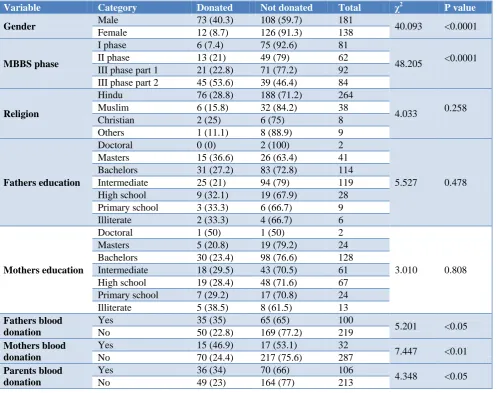
Table 4: Association between various factors and voluntary blood donation.
Variable Category Donated Not donated Total χ2 P value
Gender Male 73 (40.3) 108 (59.7) 181 40.093 <0.0001
Female 12 (8.7) 126 (91.3) 138
MBBS phase
I phase 6 (7.4) 75 (92.6) 81
48.205 <0.0001
II phase 13 (21) 49 (79) 62
III phase part 1 21 (22.8) 71 (77.2) 92
III phase part 2 45 (53.6) 39 (46.4) 84
Religion
Hindu 76 (28.8) 188 (71.2) 264
4.033 0.258
Muslim 6 (15.8) 32 (84.2) 38
Christian 2 (25) 6 (75) 8
Others 1 (11.1) 8 (88.9) 9
Fathers education
Doctoral 0 (0) 2 (100) 2
5.527 0.478
Masters 15 (36.6) 26 (63.4) 41
Bachelors 31 (27.2) 83 (72.8) 114
Intermediate 25 (21) 94 (79) 119
High school 9 (32.1) 19 (67.9) 28
Primary school 3 (33.3) 6 (66.7) 9
Illiterate 2 (33.3) 4 (66.7) 6
Mothers education
Doctoral 1 (50) 1 (50) 2
3.010 0.808
Masters 5 (20.8) 19 (79.2) 24
Bachelors 30 (23.4) 98 (76.6) 128
Intermediate 18 (29.5) 43 (70.5) 61
High school 19 (28.4) 48 (71.6) 67
Primary school 7 (29.2) 17 (70.8) 24
Illiterate 5 (38.5) 8 (61.5) 13
Fathers blood donation
Yes 35 (35) 65 (65) 100
5.201 <0.05
No 50 (22.8) 169 (77.2) 219
Mothers blood donation
Yes 15 (46.9) 17 (53.1) 32
7.447 <0.01
No 70 (24.4) 217 (75.6) 287
Parents blood donation
Yes 36 (34) 70 (66) 106
4.348 <0.05
No 49 (23) 164 (77) 213
In the present study, the voluntary blood donation was significantly high among males (40.3%) compared to females (8.7%). Proportion of people who have donated blood increased with each year of study, highest among MBBS phase III Part 2 (53.6%) and difference was
blood compared those with father’s who have not donated. There was significantly higher proportion of blood donor’s among those with mother’s who donated blood compared those with mother’s who have not donated. Proportion of blood donation was higher among those with either of the parents are blood donors compared none of the parents are blood donors and this difference was statistically significant (Table 4).
DISCUSSION
The prevalence of blood donors in the study was 26.64% and for male donors it was 40.33% and female donors 8.7% respectively. The prevalence was higher than what was observed in other similar study conducted at jammu but lower than what was observed in Sabu et al study among health science students (64.1%).1,2
As the study subjects were medical students the awareness and knowledge about importance of voluntary blood donation may have a role in explaining this observation. The female donors were very less compared to male donors similar to study done by Agrawal in uttarakhand where the prevalence among female was 16% compared to males 84%.3 Significant association between males to females donors in our study is similar to study done by Agravath et al a study about knowledge attitude and pracice among medical students in Rajkot.5 This difference is very important to target education based interventions for voluntary donation of blood.
The majority of blood donors in our study were one time donors, suggesting the need for better awareness, not been asked for blood donation again can be the factor responsible for absence of repeated blood donations following one time donation.2 It suggests that the students are ready to donate but there is lack of opportunity for the voluntary regular donation.
The social factors like altruism (doing good for others), sense of social responsibility, helping relatives/friends were the major reasons motivating the medical students for voluntary blood donations. Self efficacy (gaining experience was another factor among students who did donations. The findings were similar to previous studies conducted by Kumari et al.1
The major factors responsible for non donation among the medical students in our study were "never been asked for donation, objection from elders, perceived underweight, fear of needles. Similar to study done by Bharatwaj et al at Pondicherry among medical under graduates suggesting the lack of opportunity, lack of family support and fear were the major factors.4
In our study, the voluntary blood donation among medical students was found to be associated with Gender, year of MBBS, fathers/mothers past experience of voluntary blood donation. Similar study done by Tadesse et al in regular health science students of Samara
University, Ethiopia showed association of level of knowledge of voluntary blood donation with year of study and religion.6
All countries in the world are trying to phase out replacement system and move towards 100% voluntary non-remunerated regular blood donation.7
Students remain the most important target group and can easily be targeted in schools, colleges and universities. As young people can be prospective regular blood donors. Education towards voluntary blood donation, need for safe blood and healthy lifestyles for young people are needed.
ACKNOWLEDGEMENTS
Authors would like to thank all students and staff of Raichur Institute of Medical Sciences, Raichur, who have cooperated and supported in conducting this study. The authors are also grateful to authors, editors, and publishers of all those articles, journals and books from where the literature for this article has been reviewed and discussed.
Funding: No funding sources Conflict of interest: None declared
Ethical approval: The study was approved by the
Institutional Ethics Committee, Raichur Institute of
Medical Sciences, Raichur
REFERENCES
1. Kumari S, Raina TR. Knowledge, attitude and
practices (KAP) regarding voluntary
non-remunerated blood donation (VNRBD) among the students of colleges of Jammu, India. Int J Community Med Public Health. 2015;2:45-50.
2. Sabu KM, Remya A, Binu VS, Vivek R.
Knowledge, Attitude and Practice on Blood Donation among Health Science Students in a University campus, South India. Online J Health Allied Scs. 2011;10(2):6-8.
3. Agrawal A, Tiwari AK, Ahuja A, Kalra R. Knowledge, attitude and practice of people towards voluntary blood donation in Uttarakhand. Asian J Transfus Sci. 2013;7:59-62.
4. Bharatwaj RS, Vijaya K, Rajaram P. A Descriptive study of knowledge, attitude and practice with regard to voluntary blood donation among medical undergraduate students in Pondicherry, India. J Clin Diagn Res. 2012;6:602-4.
5. Agravat AH, Gharia A, Gauravi DA, Kakadia M. Knowledge, attitude, and practice of voluntary blood donation among medical students of PDU Medical College Rajkot. Int J Curr Res. 2014;6:6839-41.
Regular Health Science Students of Samara University, Ethiopia. Health Sci J. 2018;12(1):542. 7. WHO. World health organisation. Towards 100%
Voluntary Blood Donation A Global Framework for
Action. Available at http://www.who.int/
bloodsafety/publications/9789241599696_eng.pdf?u a=1. Accessed on 20 August 2018.