Original Research Article
Knowledge, attitude and practices regarding dengue
in a rural setting of Jammu
Deepika Dewan, Bhavna Sahni*, Dinesh Kumar, Kiran Bala
INTRODUCTION
Dengue viruses are arboviruses infecting humans. It is transmitted by the bite of an aedes mosquito infected with one of the four dengue virus serotypes. The spectrum of illness ranges from asymptomatic infection to classic dengue fever or dengue haemorrhagic fever with shock or without shock. The incidence of dengue has grown dramatically around the world in recent decades. The actual numbers of dengue cases are underreported and many cases are misclassified. One recent estimate indicates 390 million dengue infections per year (95%
credible interval 284–528 million), of which 96 million (67–136 million) manifest clinically (with any severity of disease).1 Dengue is endemic in India and has become a major public health problem. It is a leading cause of hospitalization and death among children and adults. There has been an increasing spread from urban and periurban areas to rural areas. During epidemics, infection rate among those who have not been previously exposed to the virus are often 40 to 50% but can also reach 80 to 90%.2 In Jammu, there has been recent increase in the number of cases from 79 cases in 2016 to 488 cases in 2017. During monsoon season there is water
ABSTRACT
Background: Rapid urbanization, environmental changes and migration of communities is becoming a major reason
for increase in number of cases and deaths due to dengue over recent years. Key lies in prevention, since only symptomatic treatment is available. Knowledge, attitude and practice studies provide important information about prevalent scenario regarding awareness of particular health problem in a community.
Methods: The present study was descriptive and cross sectional in nature, conducted in July 2017. The study participants belonged to village Tanda of Block RS Pura which is a field practice area of Department of Community Medicine, Government Medical College Jammu. The data was collected by a face to-face interviews of respondents after obtaining informed consent. Enumerators were provided a schedule containing formalized set of questions on knowledge, attitude and practice of dengue control. Information was collected by interviewing the available adult in every second household.
Results: Knowledge about dengue was intermediate. Only 35% of the respondents knew atleast two most common
symptoms of dengue. They had insufficient knowledge regarding time of dengue mosquito bite and common breeding sites. However attitude of people regarding dengue was good. Almost all the respondents think that dengue is dangerous and one should consult a registered Medical Practioner in case dengue occurs. Commonly used preventive methods included coils and sprays. Drains and surroundings were cleaned to prevent mosquito breeding.
Conclusions: There is an urgent need to increase awareness of people especially belonging to rural communities regarding prevention and common signs and symptoms of dengue.
Keywords: Dengue, Knowledge, Awareness, Practices, Rural community, Jammu
Department ofCommunity Medicine, Government Medical College, Jammu, Jammu and Kashmir, India
Received: 01 March 2018
Accepted: 16 March 2018
*Correspondence: Dr. Bhavna Sahni,
E-mail: [email protected]
Copyright: © the author(s), publisher and licensee Medip Academy. This is an open-access article distributed under
the terms of the Creative Commons Attribution Non-Commercial License, which permits unrestricted non-commercial use, distribution, and reproduction in any medium, provided the original work is properly cited.
logging at many places and the main reason cited was stagnant water. Measures are required to be taken at personal, household, community and departmental level to fight the disease. Dengue prevention and control depends on effective vector control measures. A dengue vaccine has been licensed by several National Regulatory Authorities for use in people 9-45 years of age living in endemic settings.3 Preventive measures require support, cooperation and participation by the community. Therefore, it is vital to know the level of knowledge, attitude and the practices (KAP) of the community concerning the disease. This study could provide useful baseline information, which could be extrapolated and utilized to improvise on the existing strategic and awareness plan being adhered to under the NVBDCP.
METHODS
The present study was descriptive and cross sectional in nature, conducted in July 2017. The study participants belonged to village Tanda of Block RS Pura which is a field practice area of Department of Community Medicine, Government Medical College Jammu. Total population of Tanda is 1350 with 296 households. The data was collected by face to-face interviews of respondents who agreed to participate in the study. Enumerators were provided a schedule containing
formalized set of questions on knowledge, attitude and practice of dengue only. The schedule was divided into three sections; the first section concerned with knowledge comprised 6 questions, the second part related to practice and the third part concerned with attitude each consisted of 4 questions. The questions were asked to the respondents and responses were noted by enumerators. Every enumerator filled 4 interview schedules. The data was collected from 148 respondents / households by interviewing the available adult in every second household.
Data was entered and analysed using Windows 7 Microsoft Excel. Each question was analysed individually. Knowledge, attitude and practice were assessed using a scoring system.
RESULTS
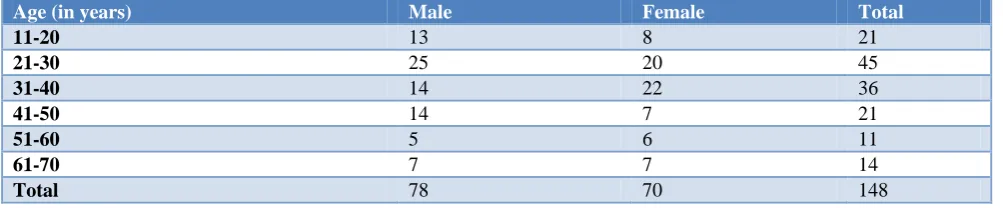
A total of 148 individuals were interviewed. Nearly 81 (55%) respondents belonged to age group of 21-40 years.
Mean age of respondents was 35.98 years. There were 78 males and 70 females with male to female ratio of 1:1.1. Maximum females who participated in the interview were housewives (94.3%). Regarding occupation, majority were either students or Government employees. Education status was good as overall 83.7% respondents were literates (Table 1).
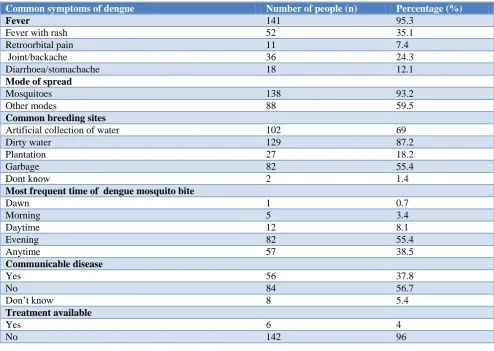
Knowledge about dengue was intermediate. 95.3% persons knew that fever is the common symptom. 52 (35%) persons enumerated that fever with rash as the most common symptom and only 5 persons knew atleast three symptoms of dengue i.e. fever with rash with retro orbital pain. Almost all people (93.2%) knew that mosquito bite is the mode of spread 102 persons (69%) had knowledge that dengue mosquitoes breed in artificial collection of water like pots, tyres and buckets. 12 persons (8.1%) had correct knowledge about time of mosquito bite. Regarding treatment for dengue, 142 persons (96%) knew that there is no treatment available for dengue (Table 3).
Attitude towards dengue
Most of participants 144 (97.3%) think that dengue is dangerous for their families. About 124 (83.7%) persons agree that dengue is preventable. Maximum people think that both people of community and government are responsible for controlling mosquito breeding. 93% people think that person should consult registered medical practitioner in case of suspicion of dengue (Table 4).
Practice
The practices employed in community to prevent dengue are good. Good number of people used mosquito coils (77.7%) and spray (47%). Nearly 52% people had meshed doors and windows. Majority had practice of cleaning drains and surroundings and draining artificial water regularly. In case dengue is suspected, almost all house-holds had practice of consulting doctor and visit hospital. When asked about the initiatives taken in last three years to spread awareness about dengue almost all respondents (95%) told that there were no initiatives taken by anybody to spread awareness about dengue (Table 5).
Table 1: Age distribution of respondents.
Age (in years) Male Female Total
11-20 13 8 21
21-30 25 20 45
31-40 14 22 36
41-50 14 7 21
51-60 5 6 11
61-70 7 7 14
Table 2: Distribution of respondents according to occupation and education.
Occupation Number (N=148) Percentage (%)
Government employees 17 11.5
Professional workers 2 1.35
Skilled workers 9 6.08
Business men 18 12.1
Housewife 66 44.6
Students 32 21.6
Unemployed 4 2.7
Education
Illiterate 24 16.2
Primary 14 9.4
Secondary 52 35.1
Higher secondary 39 26.4
Graduate 19 12.8
Table 3: Knowledge of respondents regarding dengue.
Common symptoms of dengue Number of people (n) Percentage (%)
Fever 141 95.3
Fever with rash 52 35.1
Retroorbital pain 11 7.4
Joint/backache 36 24.3
Diarrhoea/stomachache 18 12.1
Mode of spread
Mosquitoes 138 93.2
Other modes 88 59.5
Common breeding sites
Artificial collection of water 102 69
Dirty water 129 87.2
Plantation 27 18.2
Garbage 82 55.4
Dont know 2 1.4
Most frequent time of dengue mosquito bite
Dawn 1 0.7
Morning 5 3.4
Daytime 12 8.1
Evening 82 55.4
Anytime 57 38.5
Communicable disease
Yes 56 37.8
No 84 56.7
Don’t know 8 5.4
Treatment available
Yes 6 4
No 142 96
Table 4: Practice of respondents regarding dengue.
Number of people (n) Percentage (%)
Protective measures to prevent dengue
Mosquito sprays 71 48
Mosquito coil 115 77.7
Mosquito net 60 40.5
Meshed doors & Windows 77 52.2
Wearing full sleeve shirts 47 31.8
Number of people (n) Percentage (%) Methods to prevent breeding sites of dengue
Clean drains and surroundings 121 81.8
Spraying/fogging with insecticides 45 30.4
Draining artificially water regularly 72 48.6
Covering stored water 54 36.5
Do not know 2 1.4
Immediate steps one would take once dengue is suspected
Consult doctor/hospitalization 146 98.6
Intake of plenty of fluids 8 5.4
Rest 16 10.8
Self medication 2 1.35
Alternative medicine 2 1.35
Initiatives taken in last 3 years to spread awareness about dengue
Yes 6 4
No 141 95.8
Do not know 1 0.7
Table 5: Attitude of respondents regarding dengue.
Number of people (n) Percentage (%)
Do you think dengue is dangerous for your family
Yes 144 97.3
No 2 1.4
Do not know 2 1.4
Whom should a person consult in case of suspicion of dengue
Registered medical practitioner 137 92.6
Local chemist 19 12.8
Self-medication 2 1.4
Do you think dengue is preventable?
yes 124 83.78
No 18 12.1
Do not know 6 4
Who is responsible for controlling dengue mosquito breeding?
People of community 28 18.9
Government 11 7.4
Both 106 71.6
DISCUSSION
Maximum persons (93.2%) knew that mosquito bite is the mode of spread but 88 persons (60%) also associated dengue with flies and water. Similar pattern of findings were observed in a hospital based study conducted in New Delhi, Thialand and study conducted in slum and rural area of Delhi.4-6 Our study reported higher percentage of persons having knowledge about signs and symptoms of dengue. At least 95% of persons could enumerate fever as the most common symptom of dengue and 35% persons had knowledge about two common symptoms i.e. fever and rash. These figures were higher as compared to other studies.4,6 However the findings corroborated with other researchers as well.7,8 Less number of participants could enumerate more than two symptoms. So there was little less knowledge among respondents about different symptoms of dengue. Regarding common breeding sites of mosquitoes, 69%
respondents had knowledge about breeding of dengue mosquitoes in artificial collection of water. This finding corroborated with various studies.5-7 Large number of respondents did not know the biting time of dengue mosquito. This finding was similar to another study done in slums of Chandigarh city.8
Low level of knowledge observed was may be due to low literacy levels among participants. This reflects that we need to do more IEC activities regarding epidemiology and prevention of dengue.
of the belief that controlling dengue is the responsibility of both government and people. Study done in Kuala Kangsar however highlighted the general opinion that it is the responsibility of people.7 These findings accentuate the fact that the general sentiment points towards shared responsibility of both the government and the general population in control and prevention of Dengue. A study done by Pérez-Guerra et al regarding attitudes towards dengue prevention revealed that participants insisted that "neighbours" needed to control larval habitats, and the Government had the responsibility to fumigate.10
Regarding personal protection against mosquito bites, 115 (77.7%) respondents had practice of using mosquito coils and 71 (48%) were using mosquito sprays. In a study done in Kuala Kangsar district, almost all participants had the habit of using mosquito net and half used insecticidal sprays to reduce mosquito breeding. 7 A et al and Hairi et al had reported these methods to be most effective means of prevention.11,12 In our study, 37% covered stored water to prevent mosquito breeding. This percentage is higher than another study where 25% respondents covered stored water.7
Overall the study revealed that there is urgent need to increase awareness about dengue in our communities by means of IEC activities through posters, pamphlets, lectures, role plays etc. focussing on its agent, spread, prevention and practices.
Limitation of the study
We would like to mention that this is a cross-sectional study done on small sample size which may not be truly representative of the entire community. Also we cannot analyse the relationship between various risk factors and dengue through this cross sectional study design.
We cannot totally rely on responses of respondents as they may give answers which may please the interviewer and are socially more acceptable. Moreover they are also prone to recall bias.
The study has provided useful baseline information about knowledge, attitude and practices of dengue.
Funding: No funding sources Conflict of interest: None declared
Ethical approval: The study was approved by the Institutional Ethics Committee
REFERENCES
1. Bhatt S, Gething PW, Brady OJ, Messina JP, Farlow AW, Moyes CL, et al. The global distribution and burden of dengue. Nature. 2013;496:504-7.
2. Park K. Park’s Textbook of Preventive and Social Medicine. 24th ed. Jabalpur: Banarsidas Bhanot; 2017.
3. WHO. Dengue and severe dengue, 2017. Available at: www.who.int/mediacentre/factsheets/fs117/en/. Accessed on 01 Mar 2018.
4. Matta S, Bhalla S, Singh D, Rasania SK, Singh S. Knowledge, Attitude & Practice (KAP) on Dengue fever: A Hospital Based Study. Indian J Com Med. 2006;31(3):185-6.
5. Swaddiwudhipong W, Lerdlukanavonge P, Khumklam P, Koonchote S, Nguntra P, Chaovakiratipong C. A survey of knowledge, attitude and practice of the prevention of dengue hemorrhagic fever in an urban community of Thailand. Southeast Asian J Trop Med Public Health. 1992;23(2):207-11.
6. Gupta P, Kumar P, Aggarwal OP. Knowledge, attitude and practices related to dengue in rural and slum areas of Delhi after the dengue epidemic of 1996. J Commun Dis. 1998;30(2):107-12.
7. Hari F, Ong CHS, Suhaimi A, Tsung TW, Ahmad ABA, Sundaraj C, et al. A Knowledge, Attitude and Practices (KAP) study on Dengue among selected rural communities in Kuala Kangsar District. Asia Pacific J Public Health. 2003;15(1):37-43
8. Malhotra G, Yadav A, Dudeja P. Knowledge, awareness and practices regarding dengue among rural and slum communities in North Indian city, India. Int J Med Sci Public Health. 2014; 3:295-9. 9. Mohapatra S, Aslami AN. Knowledge, attitude and
practice regarding dengue fever among general patients of a rural tertiary-care hospital in Sasaram, Bihar. Int J Community Med Public Health. 2016;3(2):586-91.
10. Pérez-Guerra CL, Seda H, García-Rivera EJ, Clark GG. Knowledge and attitudes in Puerto Rico concerning dengue prevention. Revista Panamericana de Salud Pública. 2005;17(4):243-53 11. Itrat A, Khan A, Javaid S, Kamal M, Khan H, Javed
S, et al. Knowledge, awareness and practices regarding dengue fever among the adult population of dengue hit cosmopolitan. PLoS One. 2008;9(3):e2620.
12. Hairi F, Ong CH, Suhaimi A, Tsung TW, bin Anis Ahmad MA, Sundaraj C, et al. A Knowledge, attitude and practices (KAP) study on dengue among selected rural communities in the Kuala Kangsar district. Asia Pac J Public Health. 2003;15(1):37-43.
Cite this article as: Dewan D, Sahni B, Kumar D,