http://www.ijcmph.com pISSN 2394-6032 | eISSN 2394-6040
Original Research Article
Mode of delivery and its associated obstetric and fetal outcome:
a retrospective study
Darshan K. Mahyavanshi
1, Mitali G. Patel
1*, Sunil Nayak
1, Damini Patel
2,
Asmi Parmar
2, Dhara Patel
2INTRODUCTION
The number of maternal death has decreased by 43% from an estimated 532,000 in 1990 to 303,000 in 2015. The progress is notable, but the annual rate of decline is less than half of what is needed to achieve the millennium development goal (MDG) target of reducing the maternal mortality ratio by 75% between 1990 and 2015, which would require an annual decline of 5.5%. The 44% decline since 1990 translates into an average annual
decline of just 2.3%. Between 1990 and 2000, the global maternal mortality ratio decreased by 1.2% per year, while from 2000 to 2015 progress accelerated to a 3.0% decline per year. The risk of a woman in a developing country dying from a maternal-related cause during her lifetime is about 33 times higher compared to a woman living in a developed country. Maternal mortality is a health indicator that shows very wide gaps between rich and poor, urban and rural areas, both between countries and within them.1
ABSTRACT
Background: The number of maternal death has decreased by 43% from an estimated 532 000 in 1990 to 303 000 in 2015. The progress is notable, but the annual rate of decline is less than half of what is needed to achieve the Millennium Development Goal (MDG) target of reducing the maternal mortality ratio by 75% between 1990 and 2015, which would require an annual decline of 5.5%. Our aims of study to evaluate the mode of delivery and its obstetric and fetal outcomes and to find out the association between Mode of delivery with socio demographic and medical complication.
Methods: Study design was a retrospective analytical record based study. In study setting,conducted in tertiary care hospital at GMERS Medical College and Civil hospital, Valsad, Gujarat. Detailed information is obtained from last 6 months review of data from obstetric and gynecology department. A data analysis of the outcome was carried out by using appropriate statistical test and MS excel.
Results: out of total 692 mothers for maternal age majority of them from the age group of 21-25 ages followed by 26- 30 yrs of age which were 46.96% and 24.27% respectively. Out of the 644 babies majority of babies were born at term (43.43%) followed by very low birth weight (41.55%).
Conclusions: No statistically proven association found between modes of delivery with mothers socio demographic characteristics and between mothers literacy status with weight of child and week of gestations.
Keywords: Modes of delivery, Fetal outcomes, Maternal education, Socio demographic characteristics
1
Department ofCommunity Medicine, GMERS Medical College, Valsad, Gujarat, India
2GMERS Medical College, Valsad, Gujarat, India
Received: 28 January 2018
Revised: 28 March 2018
Accepted: 29 March 2018
*Correspondence:
Dr. Mitali G. Patel,
E-mail: [email protected]
Copyright: © the author(s), publisher and licensee Medip Academy. This is an open-access article distributed under the terms of the Creative Commons Attribution Non-Commercial License, which permits unrestricted non-commercial use, distribution, and reproduction in any medium, provided the original work is properly cited.
A frequent dilemma for obstetricians is to determine the best mode of delivery in order to optimize pregnancy outcome for both mother and the neonate. If all independently significant parameters can be used to construct a predictive model, it would be possible to identify appropriate mode of delivery. Controversy exist as to whether the increase of intervention such as operative vaginal delivery and ceaserian section improves obstetric outcome.2
Maternal socioeconomic status and modifiable, non-biological factors that affect mental and physical well-being have been associated with maternal nutrition and pregnancy outcome. The risk of preterm birth has been reported in mother’s of low socioeconomic status. The intrauterine growth has influence with the varying education level. The lowest level of education had significantly elevated risk of small for gestational age new borns compared to high level of education.3 There are numerous reports in the literature assessing the effect of advanced maternal age on pregnancy outcomes but results have varied.4
C section is a surgical intervention which is carried out to ensure safety of mother and child when vaginal delivery is not possible or when the doctors consider the danger to the mother and the baby would be greater with vaginal delivery. Every day in 2015, about 830 women died due to complications of pregnancy and child birth. Almost all of these deaths occurred in low-resource settings, and most could have been prevented. The primary causes of death are haemorrhage, hypertension, infections, and indirect causes, mostly due to interaction between pre-existing medical conditions and pregnancy. Of the 830 daily maternal deaths, 550 occurred in sub-Saharan Africa and 180 in Southern Asia, compared to 5 in developed countries.1 Proportion of CS to total births is considered as one the important indicators of emergency obstetric care (WHO 2009). A figure below 5 percent implies that a substancial proportion of women do not have assess to surgical obstetric care., on the other hand rate higher than 15 percent indicates overutilization of the procedure for other than life saving reasons(WHO 1985, WHO 1993).5
Aims and objectives
1. To evaluate the mode of delivery and its obstetric and fetal outcomes.
2. To find out the association between Mode of delivery with various socio demographic characteristic. 3. To reveal the association between the mode of
delivery with medical complication.
METHODS
Study design
It is a retrospective analytical record based study.
Study setting
Conducted in a tertiary care hospital at GMERS Medical College and Civil hospital, Valsad, Gujarat.
Study duration
5 months (July 2018 to December 2018).
Data collection
Detailed information is obtained from last 6 months review of data from obstetric and gynecology department. The obstetric and fetal outcome of the patients during pregnancy were noted and tabulated. This includes demographic details and information of maternal health, pregnancy, labour, delivery and perinatal outcome.
Data analysis
An analysis of the outcome was carried out by using appropriate statistical test and MS excel.
RESULTS
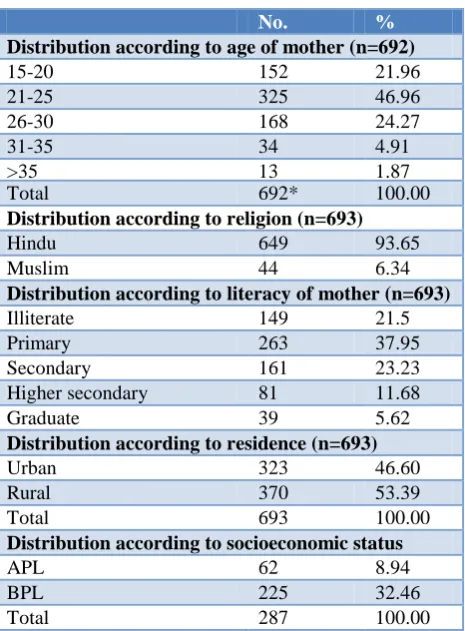
In present study retrospectively obstetric data of last 6 months obtained in which around 693 mothers data has been found. In Table 1, it shows that distributions of mothers according to their socio-demographic characteristics in which it was observed that out of total 692 mother for maternal age majority of them from the age group of 21-25 age followed by 26-30 yrs of age which were 46.96% and 24.27% respectively. While mother above the age of >35 years were only 1.87%. Out of 693 mothers majority of were from the Hindu religion which are 93.65%, followed by Muslim which were 6.34%. It might be because of Hindu religion predominant and overall population of Hindu in this district are more. Majority was mother’s educational status was up to primary (37.95%) followed by secondary (23.23%) and the only few mothers were graduate (5.62%). Majority of 53.39% mothers were belong to rural population while only 46.60% from urban locality. Out of total 693 mothers data found only 287 mothers data for socioeconomic status were found available in which 32.46% were belongs to below poverty line and only few mothers i.e. 8.94% were above poverty line.
Table 1: Distribution of mothers according to their sociodemographic characteristics.
No. %
Distribution according to age of mother (n=692)
15-20 152 21.96
21-25 325 46.96
26-30 168 24.27
31-35 34 4.91
>35 13 1.87
Total 692* 100.00
Distribution according to religion (n=693)
Hindu 649 93.65
Muslim 44 6.34
Distribution according to literacy of mother (n=693)
Illiterate 149 21.5
Primary 263 37.95
Secondary 161 23.23
Higher secondary 81 11.68
Graduate 39 5.62
Distribution according to residence (n=693)
Urban 323 46.60
Rural 370 53.39
Total 693 100.00
Distribution according to socioeconomic status
APL 62 8.94
BPL 225 32.46
Total 287 100.00
Table 2: Distribution of mothers according to their obstetric history.
No. %
Parity of mother
Primi 305 44.01
Multi 388 55.98
Type of delivery
NVD 377 54.4
LSCS 301 43.43
Others* 15 2.16
Medical history of mother
HIV positive 7 1.01
Hbs Ag positive 12 1.73
VDRL positive 1 0.14
Rh negative 13 1.87
No history 660 95.23
Total 693 100.00
In Table 3 which shows the distribution of mothers according to their fetal outcome, in which it was observed that the data available for the gestational term at which they delivered was found written only for 644 mothers out of total 693 mothers delivered in that period. Out of the 644 babies majority of babies were born at term (43.43%) followed by very low birth weight (41.55%) and only least number of babies were born post term. While data shows regarding gender in which it was
observed that there was no indiscrimination found for gender, male and female babies were found nearby equal i.e. 52.02% and 48.79%. We found in our study that only 53.34% babies were came with normal birth weight followed by low birth weight which were 38.97% and the extremely low birth weight were around 3%.
Table 3: Distribution of mothers according to their fetal outcome.
No. %
Weeks of gestation*(n=644)
Preterm (<37 wks) 342 53.10 Term (37-<42 wks) 301 46.73
Postterm (≥42 wks) 1 00.14
Total 644 100.00
Babies gender (n=703)
Male 360 51.02
Female 343 48.79
Total 703 100.00
Birth weight of babies (n=703)
Normal (2500-4000 gm) 375 53.34 LBW (1500-<2500 gm) 274 38.97 VLBW (1000-<1500 gm) 32 4.55
ELBW (<1000 gm) 22 3.12
Total 703 100.00
Table 4 shows that association of mothers various socio demographic characteristics, parity with type of delivery in which it shows that out of total data found of 693 mothers 21% were illiterate and amongst these majority around 58% of them mode of delivery was by normal vaginal delivery. While those are graduate and more in which out of 39 majority around 54% were mode of delivery is LSCS which shows education play a role in modes of delivery. While statistically it's not significant. In our study it was found that around 94% were Hindu amongst them while we see the association between religion and mode of delivery it was not observed any difference and statistically also insignificant. Parity of mother and mode delivery association shows there was no any specific or significant association between primigravida and multi gravida with modes of delivery which is 53% and 55% for normal delivery respectively.
Table 4: Association of mothers various socio demographic characteristics, parity with type of delivery.
Type of delivery Normal Lscs Others Total X2, P value
No. %↓ %→ No. %↓ %→ No. %↓ %→ No. Total
Literacy status of mother
X2=8.51; P=0.38 The result is not significant p<0.05. Illiterate 86 22.81 57.71 61 20.26 40.93 2 13.33 1.34 149 21.50
Primary 154 40.84 58.55 102 33.88 38.78 7 46.66 2.66 263 37.95 Secondary 77 20.42 47.82 80 26.57 30.41 4 26.66 2.48 161 23.23 H. Secondary 43 11.40 53.08 37 12.29 45.67 1 6.66 1.23 81 11.68 Graduate & more 17 4.50 43.58 21 6.97 53.84 1 6.66 2.56 39 5.62
Religion X2=1,44; P=0.48
The result is not significant p<0.05. Hindu 355 94.16 54.69 281 93.35 43.29 13 86.66 2.00 649 93.65
Muslim 22 5.83 50 20 6.64 45.45 2 13.33 4.54 44 6.34
Parity of mother
X2=2.10; P=0.34 The result is not significant p<0.05.
Primi 160 42.4 52.45 136 45.1 44.59 9 60 2.95 305 44.01
Multi 217 57.5 55.92 165 54.81 42.52 6 40 1.54 388 55.98
Total 377 100.0 54.4 301 100.0 43.4 15 100.0 2.2 693 100.0
Table 5: Association of mother’s literacy status with weight of child and week of gestations.
Literacy of mother
Illiterate Primary Secondary ≥higher secondary
graduate Total X
2 , P value
No. %↓ %→ No. %↓ %→ No. %↓ %→ No. %↓ %→ No. %↓
Weight of child
ELBW 4 02.6 18.2 8 02.9 36.4 4 02.4 18.2 6 7.05 27.3 22 3.1
X2=5.81 P=0.75
VLBW 7 04.6 21.9 11 4.1 34.3 6 03.7 27.3 8 7.05 3.1 32 4.6
LBW 61 40.4 22.3 111 41.4 40.5 56 34.6 20.4 46 35.36 16.8 274 39.0 Normal 79 52.3 21.1 138 51.5 36.8 96 59.3 25.6 62 50.00 16.5 375 53.3 Total 151 100.0 21.5 268 100.0 38.1 162 100.0 23.0 122 100.0 17.4 703 100.0 Weeks of gestation
Preterm 65 49.25 19.0 129 55.8 37.7 85 56.66 24.85 63 56.57 12.57 342 53.2
X2=1.88 P=0.59 Term 67 50.75 22.2 119 51.5 39.4 65 43.33 21.52 51 43.43 10.92 302 46.8
Total 132 100.0 20.5 248 100.0 38.5 150 100.0 23.2 114 100.0 17.7 644 100.0
DISCUSSION
In present study it was observed that around 47% were born with low birth weight while study done by Singh et al observed only 16% of low birth weight babies which shows high prevalence of LBW in our study.6 Similar study done by Saoji et al found that around 70% mothers were from rural area while in our study it was around 53% were from rural locality.7 The association between maternal education and risk of C-section has been described by numerous authors, although some authors could not find such correlation. The association between maternal education and C-section markedly decreases in few studies while in our study while those are graduate and more in which out of 39 majorities around 54% were mode of delivery is LSCS which shows education play a role in modes of delivery. While statistically it's not significant. Study done by Saoji et al did not show significant association between maternal education and c-section.7 In terms of parity we found that, multipara women have undergone majority of normal delivery (55.92%) while majority of C-sections were done amongst the primigravida mothers (44.59%). This data may confirm the results of a previous study, which indicated that there is an association between advanced
maternal age and interventions during labour, including caesarean delivery.
In many European countries like England, France, Netherland etc. midwives are responsible for attending normal deliveries and population-midwife ratio is very low. In India doctors are accounted for any delivery. To avoid harassment and litigation they may choose caesarean delivery. Besides, in India the population pressure is so high and the proper vaginal delivery related infrastructure (e.g., bed, electronic foetal monitoring system, skilled neonatal intensive care, blood transfusion facility etc.) is so lacking in many private as well as public health institutions that doctors sometimes favour CS over vaginal delivery. The difficulty in arranging for an emergency CS within short period is another factor that may be important in Indian context (Pahari and Ghosh).5
compared to present study c section were done amongst 43.4% while 54% and 2% were normal and others like assisted vacuum, forceps etc. respectively.2
CONCLUSION
There is no statistically significant association shows between modes of delivery with mothers various socio demographic characteristics, parity. Similarly not found any proven association between mother’s literacy status with weight of child and week of gestations. Further randomised and multi-centred research study is required to compare the pregnancy outcomes on different policies of operative intervention.
Funding: No funding sources Conflict of interest: None declared
Ethical approval: The study was approved by the Institutional Ethics Committee
REFERENCES
1. Global health observatory data maternal and reproductive health, available at http://www.who. int/gho/maternal_health/mortality/maternal_ mortality_text/en/. Accessed on 26 September 2017. 2. Shamsa A, Bai J, Raviraj P, Gyaneshwar R. Mode of delivery and its associated maternal and neonatal
outcomes. Open J Obstetrics Gynecol. 2013;3:307-12.
3. Ugwuja EI, Akubugwo EI, Ibiam UA, Obidoa O. Maternal Sociodemographic Parameters: Impact on Trace Element Status and Pregnancy Outcomes in Nigerian Women. J Health Popul Nutr. 2011;29(2):156–62.
4. Ushadevi G, Arul Anne Rose S Effect of maternal age on fetal outcome. Int J Med Res Rev. 2015;3(4):390-3.
5. Shabnam S. Caesarean section in India: causes and concerns Research scholar, Jawaharlal Nehru University, New Delhi – 110067.
6. Singh G, Chouhan R, Sidhu K. Maternal factors for Low Birth weight babies. MJAFI. 2009;65(1):10-2. 7. Saoji A, Nayse J, Deoke A, Mitra A. Maternal Risk
Factors of Caesarean Delivery in a Tertiary Care Hospital in Central India: A Case Control Study. People’s J Scientific Res. 2016;9(2):18-23.
Cite this article as: Mahyavanshi DK, Patel MG, Nayak S, Patel D, Parmar A, Patel D. Mode of delivery and its associated obstetric and fetal