http://www.ijcmph.com pISSN 2394-6032 | eISSN 2394-6040
Original Research Article
Study to assess internet usage patterns and prevalence of internet
addiction among medical and engineering students of Bengaluru city
Sunil Kumar D. R., Ipsita Debata*
INTRODUCTION
The term “addiction” has generally been associated with substance use. However, with internet access becoming widespread, problematic internet use is increasingly being reported. It has been suggested that excessive internet use could represent addictive behavior with mental health implications.1-3
In tandem with the splurge in access to the Internet globally, with the rise of new-generation gadgets, the risk of “internet addiction” is emerging as a significant behavioral addiction pandemic to be tackled worldwide.
The developing countries are not spared either due to extreme infiltration of technology even into the remotest corners.4
College students are especially vulnerable to this, because of, availability of time, unlimited access to the internet, the psychological and developmental characteristics of young adulthood, limited parental supervision and as a project to communication with peers and mentor. And also, internet offering a route of escape from exam stress, all of which make internet overuse a significant cause of concern for parents and faculty.5,6
ABSTRACT
Background: Internet has become today, one of the most powerful tools for everybody, playing major roles in the life of adolescents. In tandem with the splurge in access to the Internet globally, with the rise of new-generation gadgets, the risk of “internet addiction” is emerging as a significant behavioral addiction pandemic to be tackled worldwide.
Methods: A cross sectional study was carried out among 200 medical and engineering students, with 100 selected from each course. Data on internet usage patterns was collected by administering a semi-structured pre-tested questionnaire. Prevalence of internet addiction was estimated by using Young’s internet addiction scale.
Results: The mean age of the participants was 18.85±0.197 years, among which 52% were females and 48% were males. While assessing internet usage patterns, it was found that the frequency of years of internet usage for 1-5 years was 80% (160) and that of internet use per day for 0-2 hours was 50.5% (101). Both these factors were significantly associated with internet addiction. Most common location of internet access was hostel, i.e. 51.5% (103). 93.5% (187) of students used Mobile phones and social media was found to be the main purpose for internet use which was 60% (120). Totally 67% (134) of medical and engineering students had internet addiction.
Conclusions: The present study highlights the vulnerability of professional college students for internet addiction. Large scale epidemiological studies should be undertaken to assess the real problem and thereby take appropriate steps to tackle the growing problem.
Keywords: Internet addiction, Professional college students, Internet usage pattern
Department of Community Medicine, Akash Institute of Medical Sciences and Research Center, Devanahalli, Bengaluru, Karnataka, India
Received: 30 January 2018
Accepted: 05 March 2018
*Correspondence:
Dr. Ipsita Debata,
E-mail: [email protected]
Copyright: © the author(s), publisher and licensee Medip Academy. This is an open-access article distributed under the terms of the Creative Commons Attribution Non-Commercial License, which permits unrestricted non-commercial use, distribution, and reproduction in any medium, provided the original work is properly cited.
Studies have shown that internet addiction is a worldwide phenomenon and its prevalence varied greatly from 03% to 38% depending on the population studied, methodology of the study, and diagnostic instrument used.7
Internet addiction commonly refers to an individual’s inability to control his or her use of the Internet (including any online-related, compulsive behavior), which eventually causes one’s marked distress and functional impairment in daily life. Internet addiction has also been found to be significantly associated with some psychiatric disorders such as alcohol abuse, attention deficit and hyperactivity, depression, and anxiety.8 Since the mid-90s the term “internet addiction” has been proposed and different opinions have been put forward as to whether problematic Internet use should be considered as a psychiatric disorder or a mental illness similar to other well established addictive disorders.9 Young was the first to find that excessive use of the Internet for nonacademic and nonprofessional reasons was associated with unfavorable effects to academic and professional performance. Greenfield found that approximately 6% of those who use the internet appear to do so impulsively, frequently to point of grave harmful consequences.10 The studies in India have showed there is internet addiction among college students but the studies on internet addiction among medical and engineering students are scanty. This study is intended to conduct further research on these aspects.
METHODS
Study design and study setting
A cross sectional study was carried out among first year medical (MBBS) and engineering students studying in professional medical and engineering college respectively in Bengaluru. Ethical clearance was obtained from Institution Ethical Committee. A total number of 200 students, who were using internet since 1 year were included in the study by simple random sampling method, with 100 selected randomly from each of medical and engineering college. Students who gave informed consent were included in the study. Participants were assured that the information given by them would be anonymous and confidential to avoid reporting bias.
Study population
A pilot study was conducted on 20 students and necessary modifications were made before the start of the study based on pilot study.
All questionnaires were distributed to the participants in classroom settings at a predetermined time and were collected onsite after 30 min. The questionnaires were anonymous and self-administered.
Teachers left the classrooms during the 30-min period to avoid any bias, influence or hesitancy.
First, the students were stratified according to their year of academic course, i.e., 1st, 2nd, and 3rdyear, and then, the required numbers of participants were selected by simple random sampling method from each group so that each academic year will have equal representation in a study sample.
Sample size
Taking internet addiction as 50% among students of professional courses.
Using the formula,
N= Z2×P (1-P) d2
Z=1.96; P=50%; 1-P=50%; d=relative error of 15% of p=7.5
On substituting in the above formula,
N= (1.96)2×50×50/(7.5)2=177
The calculated sample size comes out to be 177.
10% of the sample will be added for non-response rate. 177+17=194. Rounding it to 200 students.
100 medical students and 100 engineering students were selected for the study.
Study tools
A semi-structured, pretested questionnaire was developed and administered to the medical and engineering students.
The questionnaire consisted of:
Socio-demographic details,
Questions on pattern of internet usage and
Young’s internet addiction scalewas used to assess the degree of internet addiction.11
The rationale for choosing Young’s diagnostic questionnaire for the study was that it is the first global psychometric measure and hence has been extensively and frequently used across many studies globally, is self-completed, has been validated on adult and adolescent populations, and has good internal consistency reliability as well as concurrent validity.
Young’s scale of internet addiction
Young’s Internet Addiction Test (IAT) is a widely used 20- item instrument that has demonstrated good reliability, to screen for internet addiction.
Young Scale consists of 20 questionnaires and it is assessed based on the following grading.
0=Never; 1=Rarely; 2=Occasionally; 3=Frequently; 4=Often; 5=Always.
1) 20-49 points: Average online user, may surf the web a too bit long at times, but have control over the usage.
2) 50-79 points: Experiencing occasional or frequent problems because of internet impact on life.
3) 80-100 points: The internet usage is causing significant problems in life, should evaluate the impact on the internet on your life and address the problems directly caused by your internet usage.
The required modifications were made to the questionnaire before the start of the study.
Study duration: May- September 2017.
Statistical analysis
Data was entered in MS Excel, analysed using SPSS version 24.
Descriptive statistics (percentage, mean, standard deviation, range) were used to summarize baseline characteristics of the study subjects. Socio-demographic variables were denoted by frequency tables. The prevalence of Internet addiction was described in terms of percentage. An association between two categorical variables was analysed by using Chi-square test and Fisher`s exact test and p<0.05 was considered to be statistically significant.
RESULTS
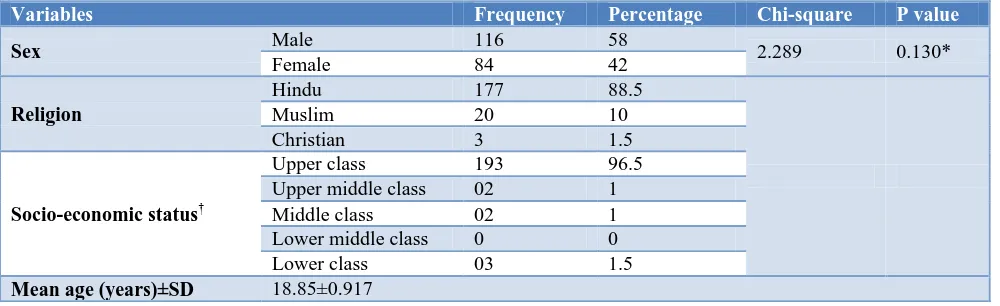
A total of 200 questionnaires were collected for the study. The mean age of participants among the study population of 200 students was found to be 18.85±0.917 (Mean±standard deviation) years. Out of 200 students, 58 (58%) were males and 42 (42%) were females. Significant association was not found between male gender and presence of internet addiction (p=0.130) using Chi Square test. Majority of the students belonged to Hindu religion (88.5%) and majority belonged to upper class of socio-economic status (96.5%) as per revised BG Prasad socio-economic classification (Table 1).
While assessing internet usage patterns, it was found that the years of internet usage for 1-5 years was 80% (160), followed by 16% (32) of 6-10 years of internet usage as the study populations are in their early 20s. Years of internet use was found to be significantly associated with internet addiction using Fisher’s exact test (p=0.004).
The internet use per day was more for 0-2 hour’s i.e., 50.5% (101), followed by for 3-4 hours which was 31.5% (63). Very less proportion of students were using internet for more than 8 hours per day, i.e. 2% (04). This association with internet addiction was found to be statistically significant (p=0.035).
The most common location of internet access was hostel, i.e. 51.5% (103), followed by residence, i.e. 38% (76). Amongst common mode of internet access it was found that mobile internet was most commonly used, i.e. 61.5% (123), followed by Wi-Fi, i.e. 29.5% (59). Negligible proportions used data card and other modalities to access internet. Majority of students used mobile phones, i.e. 93.5% (187) to access internet. Other devices usage like laptops, desktops, etc. was almost negligible. Social media was found to be the main purpose for internet use, i.e. 60% (120). Remaining 40% of students used internet for other purposes like gaming, shopping, academic, etc.
Table 1: Table depicting baseline socio-demographic data of study population and association between gender and internet addiction.
Variables Frequency Percentage Chi-square P value
Sex Male 116 58 2.289 0.130*
Female 84 42
Religion
Hindu 177 88.5
Muslim 20 10
Christian 3 1.5
Socio-economic status†
Upper class 193 96.5
Upper middle class 02 1
Middle class 02 1
Lower middle class 0 0
Lower class 03 1.5
*Chi-square test to test association between gender and internet addiction; †According to revised BG Prasad socio-economic classification.
Table 2: Descriptive statistics of internet usage.
Questions on internet usage Frequency
(n=200) Percentage (%)
Fisher’s
value P value
Years of internet use (years)
1-5 160 80
23.317 0.004#
6-10 32 16
11-15 08 04
Internet use per day (hours)
0-2 101 50.5
26.837 0.035
#
3-4 63 31.5
5-6 21 10.5
7-8 11 5.5
>8 04 2
Expenditure on internet per month (Rs.)
<300 128 64
21.780 0.007#
300-600 57 28.5
>600 15 7.5
Most common location of internet access
Residence 76 38
25.942 0.273#
Cyber cafe 03 1.5
Library 04 02
Classroom 06 03
Computer lab 00 00
Hostel 103 51.5
Other public places 08 04
Most common mode of internet access
Wi Fi 59 29.5
26.225 0.426#
Broadband 05 2.5
Data card 13 6.5
Mobile internet 123 61.5
Most used gadget for accessing internet
Desktop 04 02
73.215 0.414#
Laptop 07 3.5
Tablet 02 01
Mobile phone 187 93.5
Purpose of internet usage
Social media 120 60
27.781 0.991#
Others (shopping, gaming, academic, etc.)
80 40
Do you use the internet as a way of escaping from problems or relieving stress?
Yes 119 59.5
8.852 0.215#
No 81 40.5
Do you think that usage of internet has impaired your physical activities?
Yes 86 43
10.504 0.122#
No 114 57
Do you deactivate your social
website account during exams? Yes
65 32.5
14.329 0.293#
No 135 67.5
#Fisher’s exact test to test association between internet usage patterns and internet addiction is significant.
Table 3: Overall analysis of level of internet addiction as per Young’s internet addiction scale.
Young’s scale Frequency Percentage (%)
Average online user 115 57.5
Experiencing occasional or frequent problems because of internet impact on
life 18 09
Internet usage is causing significant problems in life 1 1.5
*66 students (33%) were normal users with no kind of addiction, whose values were found missing during analysis as total scoring was less than 20.
Strikingly many students, i.e. 59.5% (119) used internet to solve their problems and relieve stress. However, this was not found to be statistically significant with Internet addiction. Majority of the students, i.e. 67.5% (135) did not deactivate their online account during exams (Table 2).
66 students (33%) were normal users with no kind of addiction and remaining 67% of students were found to have Internet Addiction as per Young’s scale. Amongst these 67% students, 57.5% (115) were found to be average online user who surfed the web for lengthy hours. The proportion of students who experienced occasional or frequent problems because of internet impact on life was found to be around 9% (18). Only 1.5% (1) of study population was facing significant problems in life because of internet usage (Table 3).
DISCUSSION
Among the study population of 200 students, the mean age of the participants was 18.85±0.197 years. Male constituted 52% of study population while female constituted 48% of the study population.
While assessing internet usage patterns, it was found that the years of internet usage for 1-5 years was 80% (160), followed by 16% (32) of 6-10 years of internet usage as the study population is in their early 20s. Years of internet use was found to be significantly associated with internet addiction using Fisher’s exact test (p=0.004). A study by Krishnamurthy et al among college students in Bengaluru found that the patterns of Internet use are extremely varied, with the majority of students having been using computers for more than 5 years, using Internet for less than 5 h a day, which is similar to our study.5
The internet use per day was more for 0-2 hours i.e. 50.5% (101), followed by for 3-4 hours which was 31.5% (63). Very less proportion of students was using internet for more than 8 hours per day, i.e. 2% (04). This association with internet addiction was found to be statistically significant (p=0.035). A study by Sharma et al among professional college students in Jabalpur, Madhya Pradesh found that more than sixty percent of sample (65.7%) spending <2 hours per day on internet which is similar to our study.12 Grover et al, in their study also found that more than half (56.73%) of the sample was using internet at least for 2h/day which is in line with our study.13
The most common location of internet access was hostel, i.e. 51.5% (103), followed by residence, i.e., 38% (76). Amongst common mode of internet access it was found
that mobile internet was most commonly used, i.e. 61.5% (123), followed by Wi-Fi, i.e. 29.5% (59). Negligible proportions used data card and other modalities to access internet.
Majority of students used Mobile phones, i.e. 93.5% (187) to access internet. Other devices usage like laptops, desktops, etc. was almost negligible. The findings of the study show that majority of students these days have access to smartphones which has become the most preferred gadget for accessing internet. A study by Krishnamurthy et al among college students in Bengaluru also found that mobile phone is the most preferred gadget for Internet use.5
Social media was found to be the main purpose for internet use, i.e. 60% (120). Remaining 40% of students used internet for other purposes like gaming, shopping, academic, etc.
Strikingly many students, i.e. 59.5% (119) used internet to solve their problems and relieve stress. However, this was not found to be statistically significant with Internet addiction Majority of the students, i.e., 67.5% (135) did not deactivate their online account during exams. This is a worrying situation as this may affect their academic performance and activity.
Our study showed that 67% (134) of students had internet addiction. The prevalence of Internet addiction was 67%. 66 students (33%) were normal users with no kind of addiction. Amongst this 67% students, 57.5% (115) were found to be average online user who surfed the web for lengthy hours. The proportion of students who experienced occasional or frequent problems because of internet impact on life were found to be around 9% (18). Only 1.5% (1) of study population were facing significant problems in life because of internet usage.
Study by Kishore et al among college going students in Nanded city assessed internet addiction by using Young’s scale and found that mild internet addiction was seen among 90 (31.36%) of study subjects and moderate internet addiction was in 99 (34.49%). None of study subject was having severe addiction.14
Study by Chathoth Mavila et al among medical (MBBS) students in Mangalore revealed prevalence of internet addiction in 18.8% of students.15
A study on internet addiction disorder among medical students in China reported a prevalence of 16.2%.16 Naffise Mashaei et al observed the prevalence of internet addiction in students of Rafsanjan University of Medical Sciences, Iran, as 51.3% mild, 5.4% moderate and 0.9% severe, while 42.4% students were not addicted to the internet.17
Study by Choudhari et al among medical students in Maharashtra found internet addiction prevalence to be 58.87% which is very similar to our study. About 51.42% of the students were mildly addicted while 7.45% of the students were moderately addicted to the internet.18 The studies that have estimated the prevalence of Internet addiction have come up with varying results (0.9-38%) depending on the criteria used and the sample studied.19,20 In the present study, our findings show that internet addiction is present among majority of medical and engineering students and the level of internet addiction is high. Internet usage patterns among the medical and engineering students highlights that majority of the study population have been using internet for less than 2 hours per day and majority of them have been accessing internet for less than 5 years. The most common location of internet access is hostel and mobile phone is the most preferred gadget. The expenditure on internet use per month is less that Rs. 300. Social media is the main purpose for accessing internet. However, daily internet usage has not impaired the physical activity among these professional college students. Strikingly, our study showed that many students use internet to solve their problems and relieve stress which seems ironical. Further research is needed on this aspect. Majority do not deactivate their online account during exams, which possesses a worrisome picture on their academic performance.
The present study highlights the vulnerability of professional college students for internet addiction which seems to be rising at an alarming rate. Large scale epidemiological studies should be undertaken to assess the real problem and thereby take appropriate steps to tackle the growing problem.
ACKNOWLEDGEMENTS
The authors extend their sincere thanks to the Director Dr. Satish Babu H.V. and Principal Dr. Vasudeva D.S., Akash Institute of Medical Sciences and Research Center, Devanahalli, Bengaluru for their encouragement and support to conduct the research study. We sincerely thank Management, staff and all the participants of medical and engineering colleges for their support in carrying out the study. We also thank Dr. Madhavi Gajula, Assistant
Professor, Department of Community Medicine, MVJ Medical College, Bengaluru for her contribution during the drafting of the proposal for this study.
Funding: No funding sources Conflict of interest: None declared
Ethical approval: The study was approved by the Institutional Ethics Committee
REFERENCES
1. Matar Boumosleh J, Jaalouk D. Depression, anxiety, and smartphone addiction in university students- A
cross sectional study. PLoS One.
2017;12(8):e0182239.
2. Block JJ. Issues for DSM-V: internet addiction. Am J Psychiatry 2008;165:306-7.
3. Collier R. Internet addiction: New-age diagnosis or
symptom of age-old problem? CMAJ
2009;181:575-600.
4. Christakis DA. Internet addiction: A 21st century epidemic? BMC Med. 2010;8:61.
5. Krishamurthy S, Chetlapalli SK. Internet addiction: Prevalence and risk factors: A cross-sectional study among college students in Bengaluru, the Silicon
Valley of India. Indian J Public Health.
2015;59:115-21.
6. Yan W, Li Y, Sui N. The Relationship between Recent Stressful Life Events, Personality Traits,
Perceived Family Functioning and Internet
Addiction among College students. J Stress Health. 2014;30:3-11.
7. Chakraborty K, Basu D, Vijaya Kumar KG. Internet
addiction: Consensus, controversies, and the way ahead. East Asian Arch Psychiatry. 2010;20:123– 32.
8. Ho RC, Zhang MW, Tsang TY, Toh AH, Pan F, Lu
Y, et al. The association between internet addiction and psychiatric co-morbidity: A meta-analysis. BMC Psychiatry. 2014;14:183.
9. Lam LT. Temporal Stability of Repeated
Assessments of Problematic Internet Use Among Adolescents. Tech. 2009;3(1):1–9.
10. Young SK, de Abreu CN. Internet Addiction: A Handbook and Guide to Evaluation and Treatment. 2011: 1-289.
11. Young K, Christiano NA. Assesment of Internet Addiction Centre for Internet Addiction Recovery.
Available at: http://www.icsao.org/fileadmin/
Divers_papiers/KYounginternetaddiction5.pdf. Accessed on 27 January 2017.
12. Sharma A, Sahu R, Kasar PK, Sharma R. Internet addiction among professional courses students: A study from Central India. Int J Med Sci Public Health. 2014;3:1069-73.
13. Grover S, Chakraborty K, Basu D. A survey of Internet use pattern among professionals. Ind Psychiatry J. 2010;19:94–100.
Addiction and Its Association with Mental Health Among College Going Students in Nanded City. Sch J App Med Sci. 2017;5(2):385-90.
15. Chathoth VM, Kodavanji B, Nayanatara AK, Pai SR. Internet behaviour pattern in undergraduate medical students in Mangalore. Int J Innovative Res Sci Eng Tech. 2013;2:2133.
16. Liu X, Bao Z, Wang Z. Internet Use and Internet Addiction Disorder Among Medical Students: A Case from China. Asian Social Sci. 2010;6:1.
17. Mashaei N, Mohammad A, Ahmad PB, Omid R,
Ayatollahi A, reza B, et al. The Prevalence of Internet Addiction Among The Students Of Rafsanjan University Of Medical Sciences. ASEAN J Psychiatr. 2013;14:109-16.
18. Chaudhari B, Menon P, Saldanha D, Tewari A,
Bhattacharya L. Internet addiction and its
determinants among medical students. Ind
Psychiatry J. 2015;24(2):158–62.
19. Yoo HJ, Cho SC, Ha J, Yune SK, Kim SJ, Hwang J,
et al. Attention deficit hyperactivity symptoms and Internet addiction. Psychiatry Clin Neurosci. 2004;58:487-94.
20. Jang KS, Hwang SY, Choi JY. Internet addiction
and psychiatric symptoms among Korean
adolescents. J Sch Health. 2008;78:16571.