Improved Good put using Harvest-Then-Transmit
Protocol for Video Transfer
Ms. Kishori Shendokar
Department of Computer Engineering, MIT Academy of Engineering, Alandi, Pune Email: [email protected]
Mrs. Rajeshwari M Goudar
Department of Computer Engineering, MIT Academy of Engineering, Alandi, Pune Email :[email protected]
---ABSTRACT---In multiple wireless networks, large end-to-end delay and packet losses can decrease meaningfully the traffic flowgoodput due to path irregularity and multiplicity. To report these problems, current methods are proposed by using management of queue and decision making process. Hence, this paper proposesa Harvest-Then-Transmit (HTT) Protocol which selects an energy efficient path based on multiple parameters i.e. energy, delay, transmission time and perform transmission of video to handle number of video packets. A multipath environment is establishing where a server performs transferring of video along the energy efficient path of wireless network. Simulation shows the proposed protocol improves the overall goodput up to 10%, increases packet delivery rate up to 12%, and reduces end-to-end delay up to 3%, compared to existing system.
Keywords –End-to-end Delay, Goodput, HTT, Real-time Traffic, Wireless Networks.
--- --- Date of Submission: July 31, 2017 Date of Acceptance: August 10, 2017
---1.
I
NTRODUCTIONT
he improvement in wireless infrastructures and hand-held gadgets allow mobile users to get multimedia contents with wide spread access routes. The network heterogeneity, high availability and connectivity to various access medium, which increased chances to find multiple paths between the end devices[4]. Still, the enriched throughput may lead to longer end- to-end delays, which turn in rapid video feature degradation. Goodput varies from throughput as it signifies the sum of data received by the target successfully within the limited deadline. Multi-path transport protocol enhances multiMulti-path transmission to TCP. In the recent decade, there is widespread use of Wire- less communication networks. Different handlers are accessing the wireless communication networks like businessmen for their e-commerce events, scientists for their research events, students for their studies, doctors for medical emergencies, kids for gaming and common men for communication (like Face Time), entertainment (audio, video, online TV) etc.[5].Wireless communication networks of next generation are facilitated with heterogeneity where multiple wireless technologies exist together. At the overlapping coverage areas of these multiple technologies, a receiver can access multiple interfaces simultaneously. This paper proposes a Harvest-Then-Transmit (HTT) protocol in which we have considered multiple parameters like energy, delay, and congestion to select the energy efficient and congestion free paths among selected paths. In the proposed work, a multipath environment is establishing where a server performs forwarding of video packets through base stations to the client along efficient path.
Reordering of the received video packets is performed at the client before giving to the application. In HTT, due to energy efficient path selection, congestion free path finding and equally distribution of load based on capacity makes the proposed solution perform better than the existing approach. Our simulation results show that HTT improve the overall goodput and packet delivery rate with decrease in end-to-end delay.
The rest of the paper is formed as specified. Highlight on previous research work is described in the related work section. Introduction of the architecture and system flow is done in the proposed work. Experiments conducted and data collected to evaluate the proposed work is described in Experiments and results section. Finally, conclusion of the paper is done.
2.
R
ELATED WORKroutes, second path chooser to select a suitable route for individually packet, and at last capacity connector to vigorously approximation the end-to-end intervals on individually route.
A MultiPath LOss Tolerant (MPLOT) transport protocol has proposed [3]. By using end-to-end multiple paths, it increased bandwidth pertaining to very high and burst loss rates. This protocol provided the bandwidth aggregation on several path with improved goodput, through different path even though existence of various delay within the paths. This protocol built on the standard of splitting uniformity and congestion control. It used erasure codes within the paths to provide consistency joined with loss rate calculation at the total-level through the paths. However, an intelligent packet mapping drawing like the robust rank establish method was being used through MPLOT required to make prominent use of the aggregate goodput among the diverse plus dynamic module paths. By transferring the latest response on the best path also mapping packages, effects were being realized and found upon a rank operate that values smaller round trip time, minor loss, and greater capability path on various paths. It has authorities to achieve an essential adjustment point within goodput as well as delay and boundary the amount of re- sending required in order to block-data retrieval. In totaling to transporting considerably, greater goodput compared to extra multipath carrying protocols and also succeeds a lesser delay. Thus, making it further proper for a big assortment of requests that seek consistent distribution under defeat circumstances. Protocol being used for varied choices of requests efficiently to deliver well efficiency with upper goodput and poorer delay than left over protocols under extensive sequence of link circumstances.
3. PROPOSED WORK
In this section, proposed work is described by mentioning the Harvest-Then-Transmit Protocol (HTT) with the help of system architecture, algorithm and the system flow indicating various activities carried out. As per the analysis of existing model, most of the protocols are considering the parameters (energy, delay) to find out the efficient path. This sometimes may result and chooses longer path, path with congestion, path with less energy etc. Different load distribution techniques have been proposed in which energy parameter is not considered. So, we have proposed harvest-then-transmit protocol which selects the efficient path by considering multiple parameters and efficiently distribute the video packet between generated efficient paths based on above observations. Proposed protocol first harvesting energy of node and also transmit the video file along the energy efficient path. The basic purpose of proposed system is to improve goodput and packet delivery rate and reduce the delay of transmitted video over wireless network.
3.1Working of HTT
HTT protocol uses multi-path transmission capability of wireless network to carried out video transmission. A
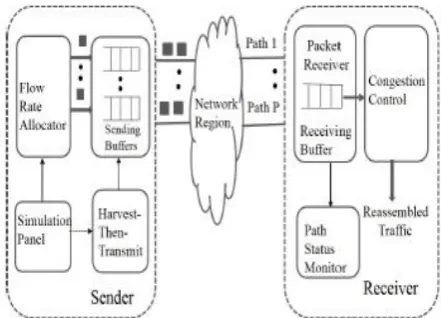
multiple paths connecting through the base station. First source harvesting video file along energy efficient path i.e. divide video packets in between energy efficient path. At destination, rearrange all the video packets. During video transmission, destination node selects the efficient path along with higher energy, computes its capacity and transmit the video packet according to its packet carrying capacity. A multiple overlap network integrating multiple communication paths between two terminals. The end-to-end connection can be constructed by binding a pair of IP addresses from the source and destination node, respectively. The flow rate allocator is responsible for partitioning the input traffic into several sub-flows and dispatching each of them to the available paths. The allocated sub-flows will be temporarily stored in the sending buffers for different communication path. The system overview of the proposed protocol as shown in below Figure 1.
Figure 1: Architecture for Video Transmission 3.2 HTT Energy Efficient Path
Algorithm 1: Algorithm at Server Input:video file
Output: Video Packets, METADATA Begin:
Let P be set of paths Check for available paths p for each path p in P do
Check available energy Calculate round-triptime end
ASSIGN energy to nodes in P end for
if video file ≤ available energy efficiency then call efficient-path-transfer()
Perform video harvesting ASSIGN sequences to packets Create METADATA
Send METADATA to client Send video packets to client Update free resources of path p end
Algorithm at Client
At the receiver side, there are chances of receiving the packets as out of order. An algorithm to reorder the packets is implementing at receiver. This performs reordering of packets before delivering to the application.
Algorithm 2: Algorithm at Client Begin:
REQUEST video file
CHECK energy efficient paths Transmission of video packets Send request to server
Receive METADATA of packets PERFORM transmitting of video packets PERFORM reordering of packets Give OUTPUT to applications. end
3.3Video Transmission
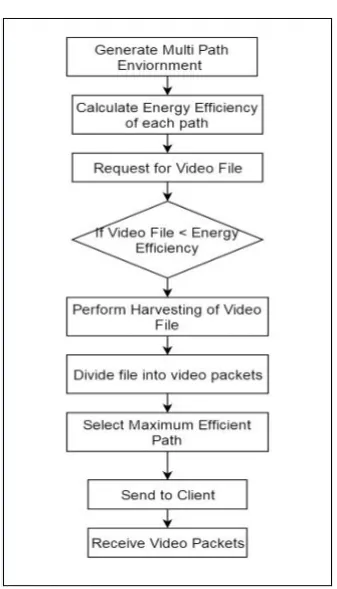
The system flow is as illustrated in Figure 2. A video file transmission is requested by the client. The server picks the video file from the database. In order to improve transmission goodput, a harvest-then-transmit algorithm is applied and then file is transferred. This video file is divided into video packets of fixed size say 1000 bytes and maximum utilization algorithm is used to forward the packets along efficient paths [6]. The packets are assigned a sequencing number as packet id. At the receiver side, a buffer is maintained to receive the arrival packets through efficient path. There are chances of encountering packets arriving as out of order. Based on packet id of each packet, reordering of the packets is done so as to restore original video before delivering to the application.
Figure 2: System Flow
4.
P
ERFORMANCE METRICSThe evaluation results are measured with the performance metrics as mentioned below:
4.1 Goodput
As the video packets are transferred along energy efficient path and there is chance of arriving as out of order, it leads to distortion of video file. Hence, measure the goodput as number of useful information bits successfully received within limited time considering 20 % network overhead. Incorporation of harvest-then-transmit algorithm enhances to get better goodput in the proposed system. Comparison of video files transmitted in base system and proposed system with harvest-then-transmit protocol as shown in Figure 3.
4.2 End to End Delay
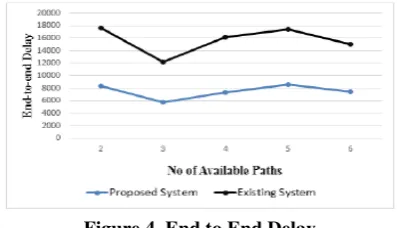
The time taken to transmit a complete video file is the transmission time. Here, as the video file is divided into packets and sent along efficient path, transmission time is reduced. As incorporating harvesting data and then transmit file, it further reduces the transmission time. Comparison of transmission time in existing system and proposed system using harvest-then-transmit protocol is done in Figure 4. There is 5-10% reduction in transmission time.
Figure 4. End to End Delay 4.3Packet Delivery Rate
The percentage of video packets received by the client with respect to the number of video packets sent by the server is calculated as packet delivery rate. Comparison of packet delivery rate with existing system and proposed system using harvest-then-transmit protocol is done in Figure 5. There is 20- 30 % increase in video packet delivery rate in the proposed system.
Figure 5. Packet Delivery Rate
5.
E
XPERIMENTAL RESULTSExperiments on a transmission of various video files of different sizes are carried out and measure the different parameters considered in the previous section. The video files differing in size as around 100KB, 200KB, 300KB, 400KB, 500KB, and 700KB are considered and transmitted. Transmission goodput is designed as fraction of whole number of bytes expected to total number of bytes directed with the 20 % minimum network overhead for video transmission. The graph that gives comparison of existing system and proposed system incorporating first harvesting video then transmit video is as shown in Figure 6. Here, increased in transmission goodput can be seen in proposed system with respect to different video size which
Figure 6. Comparison of Transmission Goodput
6.
C
ONCLUSIONThe growth of real-time traffic over the internet has become a major dynamic strength for multihomed communication sover corresponding network paths. Network traffic which causes congestion and results in fast depletion of energy is not taking into consideration while selecting the path. In network infrastructures, it is challenge to effectively deliver applications with stringent delay, goodput, and reliability requirements. So, we have proposed harvest-then-transmit (HTT) protocol. Proposed protocol first harvesting energy efficient path at trans- port layer of network. Hence, harvesting the video file and then transmit through energy efficient path is attained. Simulation results shows that HTT protocols performs better compared to existing system and improves the overall goodput up to 8%, increases packet delivery rate up to 12%, and reduces end to end delay up to 3%. In future, also reduces the response time of the system exponentially and traffic on network.
ACKNOWLEDGEMENTS
I take immense pleasure in expressing my humble note of gratitude to my guide Mrs. Rajeshwari M Goudar, Associate Professor, Department of Computer Engineering, MIT Academy of Engineering, Alandi, Pune for their cooperation and support. Authors are also thankful to all those who have directly or indirectly provided their overwhelming support during the paper.
REFERENCES
[1] Bui V., Zhu W., A Markovian approach to Multipath Data Transfer in Overlay Networks, IEEE Transactions on Parallel and Distributed Systems, 21(10), 2010, 1398-1411.
[2] PrabhavatS., NishiyamaH., AnsariN. and KatoN., Effective Delay-Controlled Load Distribution over Multipath Networks, IEEE Transactions on Parallel
and Distributed Systems, 22(10), 1730-1741, 2011.
[3] Sharma V., Kar K., Ramakrishnan K. K., A Transport Protocol to Exploit Multipath Diversity in Wireless Networks, IEEE/ACM Transactions on Networking, 20(4), 1024-1039, 2012.
Transactions on Mobile Computing, 12(11), 2193-2205, 2013.
[5] Seetha RamanS., Srikanth S., Integrated approach towards Bandwidth Aggregation (BAG) in multihomed devices, 3rd International Conference
on Signal Processing, Communication and
Networking (ICSCN) March 2015.
[6] Prabhavat S.,Nishiyama H., AnsariN., and KatoN., On Load Distribution over Multipath Networks, IEEE Communications Surveys and Tutorials, 14(3), 662-680, 2012.
[7] WuJ., YuenC., ChengB., ShangY., ChenJ., Goodput-Aware Load Distribution for Real-time Traffic over Multipath Networks, IEEE Transactions on Parallel Distributed Systems, 26, (8), 2286-2299, 2015. [8] Suhaimi A. Latif, Mosharrof H. Masud, Farhat
Anwar and Md. Khorshed Alam, An Investigation of Scheduling and Packet Reordering Algorithms for Bandwidth Aggregation in Heterogeneous Wireless Networks, Middle-East Journal of Scientific Research 2013.
[9] Ferlin S., Dreibholz T. and Alay O., Multipath transport over heterogeneous wireless networks: Does it really pay off? 2014 IEEE Global Communications Conference, Austin, 2014, 4807-4813.
[10] Chebrolu K. and RaoR. R., Bandwidth aggregation for real- time applications in heterogeneous wireless networks,IEEE Transactions on Mobile Computing, 5(4), 388-403, 2006.
[11] WuJ., YuenC., ChengB., YangY., WangM. and ChenJ., Bandwidth-Efficient Multipath Transport Protocol for Quality-Guaranteed Real-Time Video Over Heterogeneous Wireless Networks, IEEE Transactions on Communications, 64(6), 2477-2493, 2016.
[12] Kim J-O., Ueda T., Obana S., MAC level measurement based traffic distribution over IEEE 802.11 multi-radionetworks, IEEE Transactions on Consumer Electronics, 54(3), 118-591, 2008.
Authors Biography
Ms. Kishori Shendokar is pursuing M.E. in Computer Engineering at MIT Academy of Engineering, Alandi, Pune. She has completed B.E. CSE from Sant Gagde Baba University Amaravati. Her research interests include computer networking and mobile computing.
Mrs. Rajeshwari M. Goudar is an