Identifying an Appropriate Model for Information
Systems Integration in the Oil and Gas Industry
Fatemeh SoleimaniRoozbahani
Department of Information Technology Management, Islamic Azad University, Science & Research Branch of Tehran, Iran
Email: [email protected] Reza ShojaeiBarjouei
B. Sc in Petroleum Engineering, Iran Email: [email protected]
Sanaz Nikghadam Hojjati
Robotics and Industrial Complex Systems(RISC) Research Group,UNINOVA,Portugal Email :[email protected]
---ABSTRACT---Nowadays organizations are using information systems for optimizing processes in order to increase coordination and interoperability across the organizations. Since Oil and Gas Industry is one of the large industries in whole of the world, there is a need to compatibility of its Information Systems (IS) which consists three categories of systems: Field IS, Plant IS and Enterprise IS to create interoperability and approach the optimizing processes as its result. In this paper we introduce the different models of information systems integration, identify the types of information systems that are using in the upstream and downstream sectors of petroleum industry, and finally based on expert’s opinions will identify a suitable model for information systems integration in this industry.
Keywords -Information Systems Integration, Process Optimizing, Coordination,SCADA, SOA, MES, Oil & Gas Industry.
--- Date of Submission: May 03, 2018 Date of Acceptance: May 19, 2018
---I.
INTRODUCTION
N
owadays, the present competitive environment, companies are wondering how to reduce their information Technology (IT) costs while increasing their efficiency and agility to react when changes in the business processes are required [1], and it seems necessary for each organization to move towards process-focused that it is supported and presided by IT [2]. In the new era, time, speed, location, and distance find new meanings and with electronic communication, the world transforms into a small and close virtual community [3]. In other side companies that are active in the oil and gas industry carry out various activities via a variety of purchased applications or ordered ones, but unfortunately most of these companies have no strategy for integrating the software. Consequently, this leads to inconsistent information space, is an obstacle to the formation of a unified information space of the enterprise and slow exchange of information between different parts of the organization. Today oil and gas companies are utilizing enterprise automation solutions provided by a variety of software. These solution packs have two different categories: 1st category contains the software which integrate the different levels of the company and often used universal integration platform, such as Microsoft BizTalk [4]; 2nd category contains the software which used for integrating a particular domain.There are different classifications of integration [5]. In this paper we consider the type of integration that integrates
information systems (IS) applications of oil and gas companies.
II.
I
NTEGRATION SOLUTIONS FOR OIL AND GAS INDUSTRYIn this part of paper, we introduce the software and models which utilize for integrating the IS of oil and gas companies.
III.
C
OMPUTER-
INTEGRATED MANUFACTURING(CIM)
Computer-integrated manufacturing (CIM) is the manufacturing approach of using computers to control the entire production process [6]. This integration allows individual processes to exchange information with each other and initiate actions. Through the integration of computers, manufacturing can be faster and less error-prone, although the main advantage is the ability to create automated manufacturing processes. Typically CIM relies on closed-loop control processes, based on real-time input from sensors. It is also known as flexible design and manufacturing [7].
IV.
M
ANUFACTURINGE
XECUTIONS
YSTEMS(MES)
To Manufacturing Execution Systems is an on-line extension of the planning system with an emphasis on execution or carrying out the plan.
Execution means:
Making products.
Turning machines on and off. Making and measuring parts.
Moving inventory to and from Workstations. Changing order priorities.
Setting and reading measuring controls. Assigning and reassigning personnel. Changing order priorities.
Assigning and reassigning inventory. Scheduling and rescheduling equipment.
The MES is a manufacturing tool designed and built for manufacturing. Most manufacturing companies use a planning process (MRPII/ERP or equivalent) to determine what products are to be manufactured. Once that plan has been developed, there must be a translation of the plan that deals with real resources that are currently available. What is necessary is a method to take input from the planning system and translate that plan into a language that fits the plant floor and the resources required to execute the plan—a major role for the MES [10].
For communication on a discrete time axis higher level system with real-time event-driven systems, the lower level of the guild system used intermediate level (Manufacturing Execution Systems - MES) [9].
V.
S
UPERVISORYC
ONTROL ANDD
ATAA
CQUISITION(SCADA)
SCADA systems are highly distributed systems used to control geographically dispersed assets, often scattered over thousands of square kilometers, where centralized data acquisition and control are critical to system operation. They are used in distribution systems such as water distribution and wastewater collection systems, oil and gas pipelines, electrical power grids, and railway transportation systems.
SCADA systems consist of both hardware and software. Typical hardware includes an MTU placed at a control center, communications equipment (e.g., radio, telephone line, cable, or satellite), and one or more geographically distributed field sites consisting of either an RTU or a PLC, which controls actuators and/or monitors sensors [11].
The lower level models are elements of data collection (sensors), device control (eg. controllers, machine tools with numerical control) and automated dispatch control system SCADA (Supervisory Control and Data Acquisition), interacting with hardware [9].
VI.
E
NTERPRISER
ESOURCEP
LANNING(ERP)
ERP is defined as an integrated computer-based system that manage internal and external organization resources, materials, and human resources. At the same time, ERP is an application and software architecture that facilitates information flows between various business functions inside and outside an organization and, as such, is an enterprise-wide information system. Using a centralized database and operating on a common computing platform, ERP consolidates all business operations into a uniform system environment [12].When processes are standardized, data is consistent, as opposed to having many different systems across the company. In an industry with so many units dispersed geographically, an enormous number of wells, complex supply chain demands and increased competition, standardization plays an important role, and ERP provides it [13].
Interact with SCADA MES-system of collecting data, including industrial processes and allows you to quickly manage the production company. Solutions MES, in turn, provide aggregate information available to the enterprise-class systems Enterprise Resource Planning (ERP) - ERP and Business Intelligence (BI) - analytical systems [9].
VII.
O
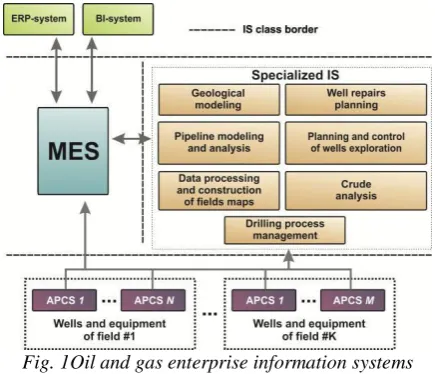
IL AND GAS ENTERPRISE DATA INTEGRATIONAccording to CIM model, the interaction of enterprise information system has two directions of its implementation –"horizontal" and "vertical". The “vertical” integrationprovides data exchange: (1) between the level of technological processes (APCS) and the level of factory floor productionmanagement (MES); (2) between MES-level and enterprise control level (ERP, BI). The "horizontal" integration provides data gathering within one level, for example, integration of MES and specialized information systems for oil and gas industry (for processing geological prospecting data, for the oil reservoirs modeling, etc.) [14].Fig. 1 shows Oil and gas enterprise information systems interaction.
Let's consider the process of manufacturing data exchange in detail(fig.1). Manufacturing data is gathered on oil and gas fields by means of APCS while processes of hydrocarbon crude materials producing, preparing and transporting. The considerable part of the data from the technological control level is delivered to the MES-level. The MES, first of all, automates the business processes of the industrial departments within different levels of production management; it allows planning and
controlling technological activities for equipment maintenance and repair, coordinating functions of all the industrial departments within the enterprise. Some kinds of information (well condition data, volumes of extraction and preparation of hydrocarbon crude materials, the results ofchemical analyses of production transferred in the main oil and gas pipelines) come in to the MES as input data. Vice versa, some part of the data from the MES (the aggregated technological data, the data about well condition, etc.) is necessary for the information systems solving specialized data processing an analysis tasks [14]. These tasks for the most of MES are beyond their functionality (for example, pipelines modeling, geological field models development, etc.). The part of data from MES which is usually aggregated and consolidated (production volume of hydrocarbon crude material, its leakage, its usage for technological purposes, etc.) should arrive into the ERP and BI systems i.e. on the higher level of enterprise management [15].
According to the model CIM, the interaction of IP Enterprise runs on two fronts - "Horizontal" and "vertical". Vertical integration provides the automation of data exchange, first, between the level of supervisory process control (SCADA) and the level of production management (shop) Enterprise (MES), and secondly, between the level of
MES and the level of enterprise management (ERP, BI). Horizontal integration provides data collection within a single level of government, such as the integration of MES with the applied research level process control (data processing of exploration, oil reservoir simulation, etc.) [9].
Process data are collected by means of oil and gas fields of automated process control (DCS) in the extraction, preparation and transportation of hydrocarbons. Automation of the top-level management in the control system provides SCADA-systems. Much of the data from the process control level comes to the level of performance management in the MES-system. MES-system in the first place, automatesproduction services at different levels of production management, ability to plan and monitor the implementation of technological measures for maintenance and repair of equipment, coordinate all production services company. As input to these systems apart from a number of process parameters is receiving data on the state of the down hole Fund, on volumes of mining and preparation of hydrocarbons, the results of chemical analyzes of transmitted into the main gas and oil products. Part of the data MES-systems (aggregated process data, data on wells and so on) requires information systems, deciding specialized engineering problems. These
tasks for most MES-systems are beyond the scope of its functionality (eg, simulation of pipelines, construction of geological models of deposits, etc.). Part of the data from the MES-system, usually aggregated and consolidated (hydrocarbon production, the amount of its losses, use of the products for their own needs, etc.), should fall into the automation of enterprise resource planning and predictive analysis, i.e. higher level of company management (ERP-systems and BI-system) [9].
Thus, in accordance with the model of CIM, you can highlight the main integration challenges that must be addressed to create a single information space of a typical oil and gas company. These are the problems: vertical integration (MES SCDA, MES ERP) and horizontal integration (MES specialized ICs).
For the above-mentioned problems in the oil industry there are highly unified integration standards, except for the standard OPC (OLE for Process Control) [16].
VIII.
APPROACH
TO
IS
INTEGRATION
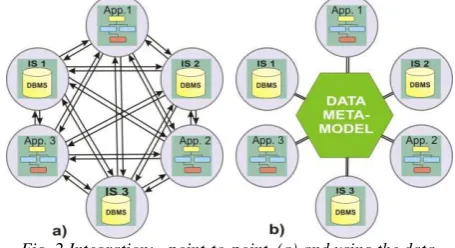
Each information system realizes an original interpretation of application domain. Thus, the problem of data correlation is rather complex. The availability of an enterprise data meta model, intermediate for all the involved information systems, simplifies this problem significantly [17]
The presence of such meta-datasignificantly reduces the number of adapters that integrate the application and the enterprise, and you can have the connection with each other through the "expensive" pair of adapters to connect them through a common data model [9] (Fig. 2).
Fig. 2 Integration: «point-to-point»(a) and using the data metamodel(b)
Meta model of the enterprise may be established on the basis of conceptual models of IP used in the enterprise, in fact, is to create a new original meta data. Either can be used pre-existing meta model, developed for the oil and gas industry. The second variant of the least time consuming. There are a number of ready standards to integrate IP in the oil and gas domain, including how we select the most mature PRODML [17], the standard has been taken by us as a basis for the formation of a common data model of oil and gas companies.
IX.
PRODML
have their own data structures and incompatible designs. This leads to high cost of integration, a proliferation of point to point links, high cost of maintenance and poor flexibility to cope with change.
PRODML is the name of an industry initiative to provide standard interfaces between software tools used to monitor, manage and optimize hydrocarbon production. It is also the name of the family of web services and data exchange standards that the initiative has created.
The purpose of PRODML is to increase innovation in the composition of optimization solutions for production systems while reducing cost and risk. This translates into enabling the development of plug compatible software by energy sector vendors as well as energy companies. The PRODML standards form a framework within which energy companies can configure processes related to operations, optimization, reporting, and/or information management [18].
This standard - an extension to standard WITSML, widely used for the transmission of information in the process of drilling wells.
The data model offered by standard PRODML covers the whole process from the moment of producing oil and gas till the moment of its realization. Using this data model makes it possible to significantly simplify integration task solving, but the standard model cannot cover all the features of an enterprise, each of which is unique and has its own peculiarities. Therefore, one needs tools allowing expanding PRODML for a concrete enterprise. At present, the adoption of standard PRODML is not supported by tools [13]. Therefore, the problem of the tools and implementation technology developing is crucial.
The data model presented in this work defines the ontology that allows describing the company business objects on its Information Technology (IT) platform. This will allow making the interpretation of all the elements in the company IT platform in a coherent way, establishing a common ontology to be used for integrating different available systems and applications [14].
X.
S
ERVICEO
RIENTEDA
RCHITECTURE(SOA)
An important aspect is how to implement the transport layer data traffic integrable systems. Generally accepted approach to integration is the SOA (Service Oriented Architecture, SOA) [5]. SOA is an approach to software systems architecture, offering assemble functional modules of a distributed system as a service (web-services), which can be caused by any program querying service. SOA and web-services use the programming language and platform independent interfaces between applications. Open standards, which describe Web-services, SOA can be used to interact with all IP and applications used in the enterprise. Web-services based on a common and open protocols: HTTP, XML, UDDI, WSDL and SOAP. Web-services and SOA are becoming a popular and useful means of strengthening integration solutions to improve business processes in the oil and gas industry [19]. In this regard, we propose to use thetechnology to communicate SOA integrable IP and application of oil and gas companies.
XI.
T
HE PROPOSED INTEGRATIONM
ODELThe essence of the technology in the world to combine integration approach based on meta-domain with the architecture of SOA, it must use the industry standard PRODML as a basis to create a meta-model integration platform, the oil and gas company.
Meta data allows us to describe all the entities of the domain and the relationships between them. It reflects a potential structure of the company, the level of data collection technology to the level of financial reporting and planning: borehole fund of wells, drilling, repair, applications, etc.
Based on meta-built private model, which reflects the structure of a particular object of the enterprise - a single register of integration objects, those objects that are necessary to use in the integration process IP. This model is complemented by new objects for their participation in the integration process. The presence of a particular model solves the matching objects between different IP enterprise [9].
XII.
C
ONCLUSIONIn this paper the problem of integration of IP in technological / production data and the technology that allows you to minimize the cost of oil and gas on a solution to this problem. Positive aspect of this technology is thatit does not require the reorganization of IT-company structure and can be implemented gradually, as soon as the integration of specific tasksIP. It allows to accelerate and simplify the integration of IP and provides the successful evolution of IP in developing the information space of the oil and gas company.
REFERENCES
[1] A. Poorebrahimi and F. SoleimaniRoozbahani, "Effects of Security and Privacy Concerns on using of Cloud Services in Energy Industry, an Oil and Gas Company: A Case Study," Int. J. Advanced Networking and Applications , pp. 2779-2783, 2015.
[2] A. Poorebarahimi, F. Razavi and F. SoleimaniRoozbahani, "Presenting VALIT Frameworks and Comparing between Them and Other Enterprise Architecture Framework," Int. J. Advanced Networking and Applications , vol. 7, no. 4, pp. 2805-2809, 2016.
[4] "Microsoft BizTalk Server," Aug 2012. [Online]. Available:
http://www.microsoft.com/biztalk/en/us/default.aspx . [Accessed Aug 2012].
[5] M. Juric, SOA approach to integration, Birmingham: Birmingham: Packt Publishing Ltd., 2007.
[6] S. Kalpakjian and S. Schmid, Manufacturing engineering and technology (5th ed.), Prentice Hall, 2006.
[7] "Computer-integrated manufacturing," 07 Aug 2012.
[Online]. Available:
http://en.wikipedia.org/wiki/Computer-integrated_manufacturing. [Accessed 07 Aug 2012].
[8] "ISO. Industrial automation systems and integration – Open systems application integration framework – Part 1: Generic reference description," Aug 2012.
[Online]. Available:
http://workspaces.nema.org/public/iso_tc184_sc5/Sh ared%20Documents/SC%205%20Working%20Docu
ments/N%20777%20-%20FINAL%20VOTING%20REPORT%20ON%20 DIS%2015745-4/ISO-15745-4-_E_-V5.03.pdf. [Accessed Aug 2012].
[9] V. Veyber, A. Kudinov and N. Markov, "Model Driven Approach for Oil & Gas Information Systems and Applications Integration," IEEE, pp. 156-162, 2010.
[10] M. McClellan, "INTRODUCTION TO MANUFACTURING EXECUTION SYSTEMS," in MES CONFERENCE & EXPOSITION, Baltimore, Maryland, 2001.
[11] K. Stouffer, J. Falco and K. Kent, Guide to Supervisory Control and Data Acquisition (SCADA) and Industrial Control Systems Security, Gaithersburg: National Institute of Standards and Technology, September 2006.
[12] H. Bidgoly, The Internet Encyclopedia., John Wiley & Sons, 2003.
[13] J. Romero, N. Menon, R. D. Banker and M. Anderson, ERP: Drilling for Profit in the Oil and Gas Industry, Philadelphia : Temple University, 2008.
[14] V. Veyber, K. Anton and N. Markov, "Model-driven Platform for Oil and Gas Enterprise Data," International Journal of Computer Applications, pp. 14-20, 2012.
[15] N. Markov and A. Saraykin, "Forming of the oil and gas company common information space," Oil And Gas Journal Russia vol. 3, pp. 34-41, 2008.
[16] "About OPC- What is OPC," 07 Aug 2012. [Online]. Available:
http://www.opcfoundation.org/Default.aspx/01_abou t/01_whatis.asp. [Accessed o7 Aug 2012].
[17] "PRODML Standards," 08 Aug 2012. [Online]. Available:
http://www.energistics.org/production/prodml-standards. [Accessed 08 Aug 2012].
[18] "Business Overview of PRODML," 08 Aug 2012.
[Online]. Available:
http://w3.energistics.org/schema/PRODML_Busines s_Overview.pdf. [Accessed 08 Aug 2012].
[19] C. Zhang, A. Orangi, A. Bakshi and W. Da Sie, "A service-oriented data composition architecture for integrated asset management," in SPE Intelligent Energy Conference and Exhibition (IECE), April 2006.