www.ijaems.com Page | 714
Finite Element Analysis & Design Optimization of
Material Handling Equipment
Dharamendra Kumar
1, Rahul
21Department of ME, CBS Group of Institution, Jhajjar, Haryana, India 2
Assistant Professor, Department of ME, CBS Group of Institution, Jhajjar, Haryana, India
Abstract— Material handling equipment is mechanical
equipment used for the movement, storage, control products throughout the process of manufacturing, and disposal. The different types of material handling equipment can be classified into four major categories, transport equipment, positioning equipment, unit load formation equipment, and storage equipment. Excavator is used to excavate the material of the ground on which the machine rests and load it into trucks or tractor. In the severe working conditions, excavator parts are subjected to very high loads. The excavator mechanism must work reliably under random working conditions. Thus it is very much essential for the designers to evaluate not only a equipment of maximum reliability but also of minimum weight and cost, considering design safe under all loading conditions. It can be accomplished that, mechanical strength analysis is an important to step in the design of excavator parts. Finite Element Analysis (FEA) is the most appropriate technique in strength calculations of the structures working under known load and boundary conditions. In general, computer aided drawing model of the parts to be analyzed must to be set prior to the FEA. It is also promising to reduce the weight of the mechanism by performing optimization in FEA. This paper provides the platform for proceeding for the Modeling, FEA and optimization of backhoe excavator attachment, which was already carried out by other researchers for their related applications and it can be very helpful for development of any material handling equipment and new excavator attachment.
Keywords— Material Handling equipment, Finite Element Analysis, Design Optimization.
I. INTRODUCTION
In the era of globalization and tough competition the use of machines and material handling equipment is increasing for the earth moving and industrial works, significant attention has been focused on designing of the material handling equipment. Today hydraulic excavators are widely used for material handling in construction, mining, excavation, and
forestry applications. Excavators also called diggers. There are many variations in excavators. They may be either crawler or rubber-tire-carrier-mounted, and there are many similar operating attachments. With the options in types, attachments, and sizes of machines, there are differences in suitable applications and therefore variations in economical advantages. Excavator digs, elevates, swings and dumps material by the action of its mechanism, which consists of boom, hydraulic cylinders arm & bucket. Bucket is used for trenching, in the placement of pipe and other under-ground utilities, digging basements or material handling, maintaining slopes and mass excavation. Due to severe working conditions, excavator parts are subjected to corrosive effect and high loads.
The excavator mechanism should function reliably under unpredictable working environment.
II. PROBLEM FORMULATION
www.ijaems.com Page | 715
III. UTILITY OF FEA AND OPTIMIZATION
FOR EXCAVATOR ATTACHMENT
The strength analysis is very important step in the design of excavator. Finite Element Analysis (FEA) is the most powerful technique in mechanical strength calculations of the structures working under known load and boundary conditions. One can determine the critical loading conditions of the excavator by performing static force analysis of the mechanism involved for different piston displacements. The boundary conditions for strength analysis will be determined according to the results of static force analysis. In general, computer aided drawing (CAD) model of the parts to be analyzed must be prepared prior to the FEA. Preparation of the CAD model can be done either using a commercial FEA program or using a separate commercial program, which is specialized for CAD. Structural optimization for strength is very popular subject in modern engineering design. It has been widely used to obtain an optimum strength/material mass ratio for structures under particular load conditions. The FEA and optimization is multipurpose tool for designing the backhoe attachment in hydraulic excavator. The next section includes the research work carried out by other researchers in the same field. It can be very helpful to the new researchers for reducing the failure problems of backhoe parts and getting optimized design without negotiation with its strength and performance during digging operation.
Fig.1:Structural model of micro- excavator digging arm
IV. FEA OF BACKHOE ATTACHMENT
Finite element analysis is very important part of the overall design process, serving to verify or validate a design prior
www.ijaems.com Page | 716
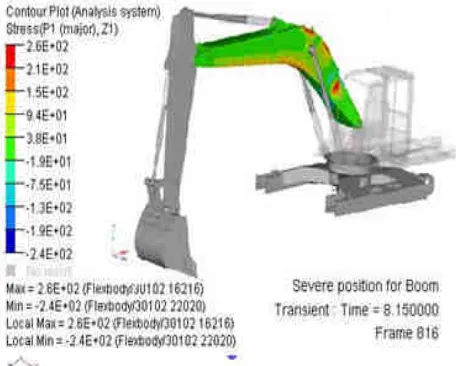
of rigid body system under the application of cylinder forces and/or motions. The link to be designed is considered as a flexible body. Two cycles of digging and dumping operations are simulated to determine the reaction forces generated at each joint and stresses generated on the flexible body. The figure 2 shows stresses in boom of 20T excavator at worst position. The generated load case can be used for detailed FE analysis. The stress results of particular gauge locations are also compared with experimental data. They have concluded that the desktop prototype testing helps the designer to find out the worst operating condition, severe conditions and locate the trajectory of operation [7]. Jun-Yong Park, Heui-Won Kim and Wan-Suk Yoo, in 2004, have presented a three dimensional modeling and simulation of a hydraulic excavator using flexible multibody dynamics code ADAMS. A hydraulic excavator consists of 16 bodies, three revolute joints, six spherical joints, four translational joints, eight universal joints and a fixed joint.
Fig.2:Stresses in boom at worst position
The boom was modeled as a flexible body using the NASTRAN program and the joint reaction forces of a rigid model and a flexible model are compared. A finite element model of the boom, shown in Figure 3, consists of 4,880 nodes and 4,101 elements (Hex element 1128, Wedge element 364, Quad element 2601, Tri element 8). External nodes are selected at the points at which kinematic joints are located. The flexible effect of the boom on the joint reaction forces was investigated including deformation modes of the boom in the simulation. The accelerations of an arm from the ADAMS simulation and the experiment are also compared. The result of the flexible multibody
dynamics analysis showed that the operating frequencies were about 4 ~ 5Hz. For the good result of the flexible multibody dynamics analysis using the ADAMS, it is necessary to set up the step size up small. The calculated results were also compared to the physical experiment. The calculated results were in a good agreement to the experimental results and were acceptable for the design purpose [8]. Yefei Li, Xianghong Xu and Qinying Qiu, in 2006, have presented an application of Grid-enabled computing technologies in the field of engineering design using Finite Element Method (FEM). A Grid-enabled analysis environment with self-developed codes provides easy access to computational and database capabilities to enhance the engineering system based on FEM results. The aim is to obtain better lighter and cheaper designs by using Finite Element Method based computational analysis models with easy-to-use grid environment. Data structure provides a high level abstraction to heterogeneous data involved in a FEM-based analysis process. Various search algorithms exposed in this environment enable complex search strategies to be constructed within the environment [9]. Tadeusz Smolnicki, Damian Derlukiewicz, and Mariusz Stańco, in 2008, have represented an application of the
www.ijaems.com Page | 717
Fig.3: The Finite Element model of the boom
Luigi Solazzi, in 2010, has carried out study on the boom and the arm of an excavator in order to replace the material, which they are usually made of, with another material. In particular, the study wants to substitute the steel alloy for an aluminum alloy. This change lightens the components of the arm, allows to increase the load capacity of the bucket and so it is possible to increase the excavator productivity per hour. Figure 5 shows the stress state. It has been assumed that the material used to make the arm is the steel alloy S355 JO EN 10025.
Fig.4: Digital model — finite element grid (1/2 of the model)
Fig.5: Stress state (Von Mises) in the first element
The evaluation of the new geometry of the arm with the different material has been studied in order to obtain at least the same safety factor and deformability of the original geometry (steel alloy) and for the new geometry (aluminum alloy). On the basis of the relationships state above between the geometry of the steel alloy panel and the geometry of the aluminum alloy panel, for each component of the arm has been developed a new section. With this cross-sections it has been numerically modeled the whole element of the arm.
The consequent step is to perform the FEM analyses in order to verify both the safety factor and the flexibility of the component as regards to the original value. This last operation has been repeated iteratively until the goal has been achieved.
Based on this study they achieve that the total weight of the arm is reduced of about 50% and the capacity of the bucket increased of about 30%. Also increase the capacity of the bucket from 1 m3 to 1.35 m3 and so to increase the productivity per hour of the excavator.
V. OPTIMIZATION OF BACKHOE
ATTACHMENT
www.ijaems.com Page | 718
Fig.6: Grid-enable analysis environment
In general there are 3 types of structural optimization techniques: sizing, geometrical and topology optimization. Out of these three techniques, topology optimization may give better results by changing the initial topology. Starting from an initial design, more than 100 alternative designs were created and compared with each other in terms of boom mass and maximum von Mises stresses. 21 shape parameters have been changed to obtain new boom geometries and the best design has been found at 90th design alternative. Maximum von Mises stress value at the 90th boom is 146 MPa while it is 186 MPa in the initial boom shape. Maximum von Mises stress has been reduced by 21.5 %. Mass of the 90th model is 1454 Kg and mass of the initial boom is 1403 kg. Thus, mass of the boom increases only by 3.6 % . Yefei Li, Xianghong Xu and Qinying Qiu, in 2006, have described a Grid-enabled analysis with self-developed codes provides easy access to Computational and database capabilities to enhance the engineering system based on FEM results which is shown in figure 6. The aim is to obtain better lighter and cheaper designs by using Finite Element Method based computational analysis models with easy-to-use grid environment. Data structure provides a high level abstraction to heterogeneous data involved in a FEM-based analysis process. Various search algorithms exposed in this environment enable complex search strategies to be constructed within the environment. They have explained a strategy of combining a design of expert system platform and at genetic algorithm (GA) with gradient descent search is used on design and checking of the hydraulic excavator. Optimization is carried out using genetic algorithm followed by a local search on the best point found using the Lagrange interval search method from self-developed codes. The results then used to build CAD model for validating the stress and displace distribution of
the whole parts of working equipment using the ANSYS model. It shows that the maximum stress of the working equipment is still under safe state, and results of optimization is as shown in figure 9, thus the structure design object has to been made compromise. As we know, a typical Finite Element Analysis (FEA) problem is composed by three essential steps: Modeling, mesh generation and solution, and post-process. A parametric geometry model suitable for FEM analysis is first generated using CAD software Pro/Engineer. The subsequent mesh is generated with minimum reference to the geometry information, as only the top-level entities in the CAD model are referenced in the meshing. There are two typically mesh tools used, either direct access provided to CAD parts and assemblies in their native mode, or third-party standard exchange data formats used. They have utilized interface between them which produce ANF file format as exchange geometry. Generation is processed in ANSYS batch mode. Volume mesh is then generated by applying parameters on adaptive meshing. The structure FEA solver ANSYS is then used to solve the problem, the model used in this work is an assembly static analysis. A three dimensional working equipment optimization problem is presented here. The problem is both complex and has a high computational cost. The goal is to reduce the weight and manufacture cost of hydraulic excavator, FEM is adopted here to analysis the whole structure’s stress and displacement distribution [9].
www.ijaems.com Page | 719
Fig.8: Element Size
Fig.9: Size Optimization of Arm representing stress over the upper plates.
Fig.10: Isometric view of the boom models distribution over
the upper plates (a) Initial model. (b) Optimized model
Bipin N. Patel, in 2007, has carried out study for optimization of backhoe attachment components like boom and arm for the purpose of reduction in weight. He has done the modeling using CATIA software, meshing in Hypermesh software, analysis in Abaqus software, and post processing in I-deas software. Optimization of boom is doing in Optistruct software. Optimum boom and arm geometry is shown in figure 9 and figure 10 respectively. After performing the optimization task, the weight of the boom is reduced up to 95 Kg. Same way optimization is done for arm and result shows the 40 Kg reduction in weight of the arm, without increasing the stress level compare to previous geometry of the arm and boom [13]. Cevdet Can Uzer, in 2008, have utilized the OPTIBOOM software developed by Mehmet Yener in 2005, which generates a CAD model using a finite set of parameters and then performs a finite element analysis by using a modified commercial program. The model parameter generation, model creation, analysis data collection and data evaluation phases are done by the Python and Delphi based computer codes. A global heuristic search strategy such as genetic algorithm is chosen to search different boom models and select an optimum. Evolutionary structural optimization method is used for removing inefficient material from the structure by using the predefined criteria. Optimum solutions of boom of HMK360 LC excavator is carried out. Initial design of the boom was 5% heavier than the final design and maximum stress was 10% higher than the Von Mises design stress criterion as shown in figure 10. Maximum stress was limited by predetermined global maximum stress value and weight is decreased 4.6% of the initial design. Actually obtained result is not the best one but it is one of the good results which is satisfying design criteria and aimed mass.
Feng Suli, Tian zhigang, Zhai Xuhua, Zhang Guangyu and Li Yan, in 2008, optimization mathematical model is established, where the mass is defined as objective function and the performance is taken as constraints condition as follows.
X = [x1, x2, x3,x4]
where, x1, x2 are width and thickness of the flat steel (m),
www.ijaems.com Page | 720
Fig.11:Optimized design flow chart based on neural network and genetic algorithms of top guard for excavator
Here, the mass of the top guard as objective function, namely:
min f(x) = ρ[pl1 x1 x2 + 4ql2 (x3 x4 – x24)]
where, ρ is density of the material, p and q are the quantity of flat steel and hollow square steel, respectively, and l1 and
l2 are length of flat steel and hollow square steel,
respectively.
There are three constraints considered here as follows: (1) Deformation constraint
g1(X) = ∆min - ∆≤ 0
where, ∆ is the largest deformation of top guard and ∆min is
the allow deformation of top guard.
(2) Strength and strain constraints
g2(X) = σ – [σ] ≤ 0
g3(X) = ε – [ε] ≤ 0
where, σ and ε are the max. stress and strain of top guard,
respectively, [σ] and [ε] are the allow stress and strain of the
top guard’s material.
(3) Boundary constraints
G3+i (X) = xi – xiu≤ 0
G7+I (X) = xii – xi≤ 0 I = 1,2,3,4
where, xil and xiu are the lower limit and upper limit of
design variables.
In order to transform the optimization problems into unconstrained problem an new target function is constituted as follows;
f (X) = f(X) + R d
where, R is punishment coefficient, a very large positive number, di denotes state of the ith in mass constraint where:
( ) = 0, ( ) ≤ 01, ( ) > 0
The relationship between the new objective function and the design variables is very complicated; thus computational simulation is employed using neural genetic algorithm. The steps of optimized design in the form of flow chart based on neural network and genetic algorithm of top guard for excavator is shown in figure 11.
Because of the material linearity, geometry non-linearity and contact non-non-linearity between the design variables and performance, explicit expression is hard to establish. And all the design programs require a large amount of calculation for finite element analysis owing to non-linear, large deformation. In order to solve this problem, the optimization method based on neural network and genetic algorithm is put forward, which calculates the response of protection structure through selecting sample points, trains neural network to simulate the relations between design variables and performance, and utilizes the genetic algorithm to solve the global optimal point. A genetic algorithm method was used to optimize the design of the top guard of excavator by developing computational program and optimization program as shown in figure 11. The optimization results are: x1 = 0.02, x2 = 0.003, x3 = 0.04
and x 4 = 0.0012. The mass of this structure is m = 18. 175
Kg, the mass of the original structure is m = 34.883 Kg. It means there is 47.8% mass reduced from the original mass of the structure.
VI. CONCLUSION
www.ijaems.com Page | 721
and then performs a finite element analysis. A Grid-enabled analysis with self-developed codes provides easy access to computational and database capabilities to improve the engineering system based on stress, strain, deformation (FEM) results. Topology optimization gives the better results by changing the initial topology. Spaceclaim and Ansys is a powerful tool for optimization. Better lighter and cheaper designs can be obtained by using FEM and optimization techniques and corrections are possible before prototyping. OPTIBOOM software developed by Mehmet Yener in 2005 and optimization of boom carried out by him. OPTIBOOM software used by Cevdet Can Uzer, in 2008 with commercial program.
REFERENCES
[1] Mehta Gaurav K, “Design and Development of an Excavator Attachment” M. tech Dissertation Thesis, Nirma University, Institute of Technology, Ahmedabad, May 2008, pp. 1.
[2] Bhargav J Gadhvi, B. P. Patel and P. M. Patel, “Development of a Controller for Mini Hydraulic Excavator as a Review”, Proceeding of National Conference on Recent Advances in Manufacturing, SVNIT, Surat, 19th - 21st July, 2010, pp. 198-203. [3] Mehmet Yener, “Design of a Computer Interface for
Automatic Finite Element Analysis of an Excavator Boom”, M.S. Thesis, The Graduate School of natural and Applied Sciences of Middle East Technical University, May 2005, pp. 1-4, 68-69.
[4] Nareshkumar N. Oza, “Finite Element Analysis and Optimization of an Earthmoving Equipment Attachment – Backhoe”, M. tech Dissertation Thesis, Nirma University, Institute of Technology, Ahmedabad, May 2006, pp. 31-68.
[5] MA Bromfield and WT Evans, “Computer modelling of microexcavator”, Computer Aided Design, Butterworth & Co (Publishers) Ltd., Vol. 20, No. 9, November 1988, pp. 549-554.
[6] Ram Vadhe and Vrajesh Dave, “ Multi-Body Simulation of Earthmoving Equipment using Motionview/Motionsolve”, Driving Innovations with Enterprise Simulation, L & T e-engineering Solutions, 1993, pp. 1-5.
[7] Jun-Yong Park, Heui-Won Kim and Wan-Suk Yoo, “Matching of Flexible Multibody Dynamic Simulation and Experiment of a Hydraulic Excavator”, Proceedings of ACMD, 2004, pp. 459-463.
[8] Yefei Li, Xianghong Xu and Qinying Qiu, “FEM-Based Structure Optimization with Grid-Enabled
Analysis Environment”, Proceedings of the 6th World Congress on Intelligent Control and Automation, IEEE, Dalian, China June 21 - 23, 2006, pp. 6915-6919. [9] Tadeusz Smolnicki, Damian Derlukiewicz, and
Mariusz Stańco, “Evaluation of load distribution in the
superstructure rotation joint of single-bucket caterpillar excavators”, Automation in Construction, Elsevier, 2008, pp. 218-223.
[10]Luigi Solazzi, “Design of aluminium boom and arm for an excavator”, Journal of Terramechanics, Elsevier, Vol. 47, 2010, pp. 201–207.
[11]J. Mottl, “Excavator optimization using the voting method”, Computer Methods in Applied Mechanics and Engineering, No. 98, North-Holland, 1992, pp. 227-250.
[12]Bipin N. Patel, “Finite Element Analysis and Optimization of Arm and Boom of Excavator”, M. Tech. Thesis, Institute of Technology, Nirma University of Science and Technology, Ahmedabad, May 2007, pp. 40-72.
[13]Cevdet Can Uzer, “Shape Optimization of an Excavator Boom by Using Genetic Algorithm”, Master of Science Dissertation Thesis, The Graduate School of Natural and Applied Sciences of Middle East Technical University, June 2008, pp. iv, 25, 90, 104.