Original Research Article
The dilemma of delayed presentation in breast cancer: a perspective
from the Radiology department of a developing country of Asia
Palwasha Gul
1, Pari Gul
1*, Shama Jogezai
2, Khanda Gul
2, Tanzila Parveen
1INTRODUCTION
The incidence of cancer is increasing though out the world, with new cancer cases and cancer-related mortality mostly occurring in low- and middle-income countries (LMIC).1 It is estimated that by 2035, two-thirds of new cancer diagnoses will occur in developing countries.2 Breast cancer (BC) remains the leading cancer diagnosis and cause of cancer-related deaths among women globally.1 There was increase in new breast cancer cases by more than 50% worldwide from 1980 to
2010, with more cases reported in low-and middle-income countries, where more than half of BC cases now occur. It is further noted that young women are disproportionately affected in LMICs, such that 23% of new breast cancer cases occur among women age 15 to 49 years in LMICs versus 10% in high-income countries, the reasons for which are multiple including lack of breast cancer awareness, early detection, poverty, cultural and religious beliefs, misconceptions about the disease and fear of mastectomy in these countries.3 There is further lack of availability of screening mammography
ABSTRACT
Background: In Asia, Pakistan has the highest incidence of breast cancer with 1 in 8 women will develop breast cancer at some stage of their life. Delays in presentation and diagnosis are major determinants of breast cancer survival, but these have not been comprehensively investigated in Pakistan.
Methods: A cross-sectional study was done from June 2017 till October 2018 at Radiology department of Bolan medical complex hospital in Quetta, Pakistan. Patients with breast cancer above the age of 18 and below 70 years were interviewed who were diagnosed with breast cancer. The time interval between self-detection and deciding to seek care was defined as delayed if the woman presented to a health care professional three months or more after detecting an abnormality
Results: A total of 86 breast cancer patients fulfilling the criteria were included in the study. Of these, 34% presented to physician within 3 months of appearance of symptoms, 68% patients presented with a delayed of more than 3 months. Presentation delay was due to financial issues which were seen in 30 patients. 18 patients (20.9%) showed delayed to due difficulty in reaching hospitals, 16 patients (18%) stated delay due to prior use of alternative therapies. Embarrassment and spiritual belief constituted 4.6% cases. 51% and 36% presented with stage III and IV disease out of which majority belonged to poor socio-economic status.
Conclusions: The findings suggest that majority of the patients with breast cancer presented late and this has significant effect on their disease prognosis. Most cases of breast cancer presented in advanced stage probably due to poor economic status, difficulty in reaching hospital, illiteracy and negligence by patient or family.
Keywords: Breast cancer, Asia, Delayed presentation, Illiteracy
1
Department of Diagnostic Radiology, 2Department of Obs and Gynae, Bolan Medical Complex Hospital, Quetta, Pakistan
Received: 10 May 2019
Revised: 03 July 2019
Accepted: 05 July 2019
*Correspondence:
Dr. Palwasha Gul,
E-mail: [email protected]
Copyright: © the author(s), publisher and licensee Medip Academy. This is an open-access article distributed under the terms of the Creative Commons Attribution Non-Commercial License, which permits unrestricted non-commercial use, distribution, and reproduction in any medium, provided the original work is properly cited.
and proper health care systems in LMICs. Clinical breast examination is recommended by International guidelines as a preferred approach.3 In country like Pakistan awareness about self-examination could be an effective approach to early diagnosis of breast cancer. More than half of women with newly diagnosed breast cancers have stage III or IV disease in LMICs due to lack of awareness and proper resources.3-5
In this study we discuss multiple factors resulting in delayed diagnosis of breast cancer patients. Socioeconomic, educational status, inability to reach hospitals, ignorance about the disease, non-specific treatments, spiritual beliefs has played significant role in delay of breast cancer patients. Delayed presentation due to the economic status and lack of basic necessities causing patients to have problems in reaching hospitals have played a major role.
METHODS
A cross-sectional study was done from June 2017 till October 2018 in Radiology department of a tertiary care Bolan Medical Complex Hospital in Quetta, Pakistan. Female patients with breast cancer above the age of 18 and below 70 years were interviewed who were diagnosed with breast cancer clinically and after radiological investigations. Further histopathology confirmation was also done. Ethical approval was obtained.
For this study, the time interval between self-detection and deciding to seek care was defined as delayed if the woman presented to a health care professional three months or more after detecting a breast abnormality.
Newly diagnosed breast cancer patients were asked particular questions specified in the questionnaire. The short face to face interview included questions in regional language about age, income level, educational and marital status, family history of breast cancer, etc. The patients were also asked to specify the first presenting symptom and period from first onset of symptoms to first medical consultation. Based on the family monthly income patients were divided into low class<10000 PKR/month, middle class 10,000 to 50,000 PKR/ month and high class as >50,000 PKR/month. The education levels were defined as low (primary or below), Middle (matric/intermediate) and high (graduate and above).
Overall, 86 patients were interviewed during the study period and 5 patients were excluded from the study based on exclusion criteria, i.e., age above 70 years and presence of non-cancerous lumps and inadequate information according to the questionnaire.
RESULTS
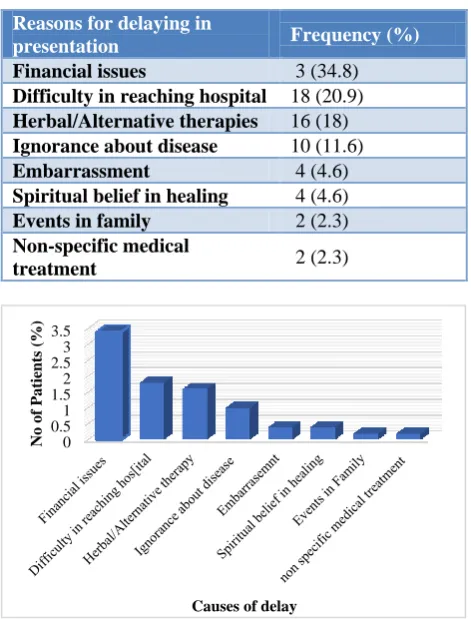
A total of 86 breast cancer patients fulfilling the criteria were included in the study. Of these, (Table 1) 34%
presented to physician within 3 months of appearance of symptoms. 68% patients presented with a delayed of more than 3 months. Presentation delay was due to due to financial issues and low socioeconomic class which was seen in 30 patients (34.8%). 18 patients (20.9%) showed delayed to due reasons of difficulty in reaching hospitals stating clinic/hospital was too far away and 16 patients (18%) stated delay due to prior use of herbal or alternative therapies. Ignorance of disease was seen in 10 patients (11.6%) which made up the 4th highest cause of delayed presentation. Embarrassment (4 patients) and spiritual belief (4 patients) constituted 4.6% cases of delayed with patient being shy to visit a doctor or pressure of the family, in laws to explain her symptoms and felt hesitant about undergoing surgical procedures. Deficiency of health care providers and easy availability of spiritual healers, patients believed that they have been spiritually healed. Even the educated class has misconception that healers can channel healing energy to a patient. Two patients, 2.3% informed us about events in the family, too busy in family affairs and non-specific medical treatment resulted in delay.
Table 1:Reasons for delay in diagnosis.
Reasons for delaying in
presentation Frequency (%)
Financial issues 3 (34.8)
Difficulty in reaching hospital 18 (20.9)
Herbal/Alternative therapies 16 (18)
Ignorance about disease 10 (11.6)
Embarrassment 4 (4.6)
Spiritual belief in healing 4 (4.6)
Events in family 2 (2.3)
Non-specific medical
treatment 2 (2.3)
Figure 1:Reasons for delay in diagnosis.
Table 2 explains the presenting symptoms and duration of delay. 53 patients (61%) had a painless lump out of which 13 patients (24%) presented within 3 months to seek medical consultation and 40 patients (75.4%) presented with a delay stating that as it was painless so didn’t attracted much of her attention. 15.1% presented
0 0.5 1 1.5 2 2.5 3 3.5
No
of
Patients
(%
)
with lump in the armpit, 10.4% with redness and swelling over the breast and 5.8% with nipple discharge.
Table 2:Frequency of patients presenting with symptoms and duration of presentation delay.
Symptom Patients
Delay <3 months
Delay >3 months
N (%) N (%) N (%)
Painless lump 53 (61) 13 (24) 40 (75.4)
Lump in armpit 13 (15.1) 5 (38.4) 8 (61.5)
Change in
breast shape 1 (1.1) 0 1 (100) Nipple
discharge 5 (5.8) 1 (20) 4 (80) Painful lump in
breast 3 (3.4) 3 (100) 0 Bone pain 0 0 0
Redness/swellin
g over breast 9 (10.4) 6 (66.6) 3 (33.3) Ulcer over
breast 2 (2.3) 1 (50) 1 (50) Total 86 29 57
51% and 36% presented with stage III and IV disease out of which majority belonged to poor socioeconomic status. None of the low income class patient presented in stage I and II disease. Of these major number of patients were married had 3/4 years of education and common to all were the low social status. It was found that larger number of patients from higher income groups were diagnosed in earlier stage of disease i.e., stage I (3.4%) and II (9.35%) disease with none in stage III/IV.
Table 3:Stage of tumor according to the economic status among patients with breast cancer.
Stage
Poor SEC (%)
Middle SEC (%)
High SEC (%)
Total (%)
I Nil 2 (2.3) 1 (1.1) 3 (3.4)
II Nil 6 (6.9) 2 (2.3) 8 (9.3)
III 33 (38.3) 11 (12.7) Nil 44 (51.1)
IV 23 (26.7) 8 (9.3) Nil 31 (36.0)
Total 56 (65.1) 27 (31.3) 3 (3.4) 86 (100)
Socio-economic class (SEC)
DISCUSSION
Breast cancer is a major health care problem which is thought of as a disease of the industrialized world, however newer studies show that around 45% of breast cancer cases and 55% of breast cancer deaths occur in low and middle income countries. BC incidence has historically, been less common in Asia compared to the West. Many barriers are identified which may correlate
with the lower incidence and higher mortality in LMICs compared to high-income countries.6 In Pakistan, BC is more common in young females, contrary to the West, where it occurs after the age of 60 years, on an average.7 The age-related incidence rate of breast cancer in Pakistani women is almost 50.1/100,000 per year.8 One out of every nine Pakistani women will develop breast cancer during her lifetime. Pakistan has the highest incidence and mortality rates of breast cancer, with incidence and mortality rates >5.2 times and >2.8 times higher, respectively, than the rates within the rest of Asia. Incidence rate of BC was >2.5 times higher in Pakistan as compared to India and Iran.9,10
Because of social taboos, women with breast cancer feel embarrassment and shyness when discussing breast-health concerns. Cultural barriers cause married woman to have less access to caregivers. Most of them rely on alternative medicines for treatment. Thereby, not seeking prompt attention for breast problems.13,17,18
Table 2 shows the initial breast cancer symptoms experienced by patients who were later diagnosed with breast cancer. The most common clinical symptom was the presence of a painless breast lump which was seen in 53 out of total 83 patients. Of these 40 women presented late to seek medical advice, according to them the mass was painless which she didn’t take seriously. According to Amri AMA the main presenting symptom of patients with breast cancer was breast mass and 90% or more of Pregnancy associated breast cancer (PABC) and non-PABC had a breast lump either by itself or in association with other symptoms. According to the Merck Manual of diagnosis and therapy, >80% of breast cancer are discovered when a woman feels a lump herself.19 In Nigeria and Kenya, 12.0% and 23.5% of breast cancer patients respectively delayed because the lump they noticed was painless.16,20 Second common presentation was mass in the armpit which affected 13 patients out of which 8 had delayed presentation. Five women had complained of nipple discharge. Three presented with painful lump and 2 presented with ulcer on the breast.
Highest percentage of patients (87%) presented to us in stage III and IV disease. Out of these 64.7% belonged to poor socio-economic status. None of the patient with low income class presented in Stage I and II which is further consistent with our findings of financial issues as the major cause of delay in breast cancer patients. In a recent study done in Pakistan, the clinical presentation of patients was highest in advanced stages III and IV amounting to 65.7% in poor societies and 43.6% in middle- and high-income societies. Both of these values are significantly higher than the 18.9% and 11.3% incidence of stage III and IV among African-Americans and American whites, respectively. In another study in Nigeria, 72% of patients presented with stage III or IV disease. In Arab countries, 60 to 80% of cases showed advanced or metastatic stage. In Egypt, stages III and IV constitute 68% of all breast cancer cases. As for Saudi Arabia, stages III and IV constitute about 46% of cases. Efforts aimed at early detection can decrease stage at diagnosis and potentially improve the probability of survival and cure.6,21 Those who perceived the symptoms as very serious were less likely to delay.
CONCLUSION
Diagnosing cancer at an earlier stage is of grave importance if treatment is to be successful. Majority of the patients in Pakistan presents late because of financial issues, difficulty to reach health care providers, ignorance about the disease symptoms, misconceptions and inappropriate knowledge about the disease and its
management. Failure to understand breast cancer symptoms is again a common cause of delay. To reduce patient delay health education programs regarding breast cancer awareness should be implemented and target women who are at higher risk of delay. Government and health care providers should focus on causes mentioned in the study to remove the barriers resulting in patient delay. With time breast cancer awareness programs would result in reduced overall burden of the disease in Pakistan.
Limitations
The present study had a small sample size and was conducted over a time span of only 17 months compared to the large number of breast cancer patients in Baluchistan population. The study was also limited as patients presenting to Bolan Medical complex hospital were included. Therefore, there may have been a bias in the data related to the regional and background characteristics of the patients. We need to enroll all the tertiary care hospitals, radiation/ oncology centers, histopathology data, NGOs to get a larger data that will be true representative of the population of Baluchistan/ Pakistan.
Funding: No funding sources Conflict of interest: None declared
Ethical approval: The study was approved by the Institutional Ethics Committee
REFERENCES
1. Martei YM, Pace LE, Brock JE, Shulman LN. Breast cancer in low and middle-income countries. Why We Need Pathology Capability to Solve This Challenge. Clin Lab Med. 2018;38(1):161-73. 2. Tefferi A, Kantarjian H, Rajkumar SV, Baker LH,
Abkowitz JL, Adamson JW et al. In support of a patient-driven initiative and petition to lower the high price of cancer drugs. Mayo Clin Proc. 2015;90(8):996-1000.
3. Gutnik LA, Matanje-Mwagomba B, Msosa V, Mzumara S, Khondowe B, Moses A et al. Breast cancer screening in low-and middle-income countries: a perspective from Malawi. J Glob Oncol. 2015;2(1):4-8.
4. Coughlin SS, Ekwueme DU. Breast cancer as a global health concern. Cancer Epidemiol. 2009;33(5):315-8.
5. Howlader N, Noone AM, Krapcho M, Miller D, Bishop K, Kosary CL et al. SEER Cancer Statistics Review, 1975-2014. National Cancer Institute: Bethesda, MD.
6. Tfayli A, Temraz S, Mrad RA, Shamseddine A. Breast cancer in low- and middle-income countries: An Emerging and Challenging Epidemic. J Oncol. 2010;2010:490631.
Lahore. Ann King Edward Med Univ. 2006;12(2):227-8.
8. Butt Z, Haider SF, Arif S. Breast cancer risk factors: a comparison between pre-menopausal and post-menopausal women. J Pak Med Assoc. 2012;62(2):120-4.
9. Asif HM, Sultana S, Akhtar N, Rehman JU, Rehman RU. Prevalence, risk factors and disease knowledge of breast cancer in Pakistan. Asian Pac J Cancer Prev. 2014;15(11):4411-6.
10. Majeed AI, Jadoon M, Riazuddin S, Akram J. Awareness and screening of breast cancer among rural areas of Islamabad capital territory, Pakistan. Ann Pak Inst Med Sci. 2017;13(1):103-7.
11. Ruddy KJ, Gelber S, Tamimi RM, Schapira L, Come SE, Meyer ME, et al. Breast cancer presentation and diagnostic delays in young women. Cancer. 2014;120(1):20-5.
12. Khan N, Ahmad R, Nadeem M, Hussain I. Influence of education and socio-economic factors on stage of cancer diagnosis: a study in Pakistani population. Ann Pak Inst Med Sci. 2016;12(4):225-9.
13. Gulzar F, Akhtar MS, Sadiq R, Bashir S, Jamil S, Baig SM. Identifying the reasons for delayed presentation of Pakistani breast cancer patients at a tertiary care hospital. Cancer Manag Res. 2019;11:1087-96.
14. Khan MA, Hanif S, Iqbal S, Shahzad MF, Shafique S, Khan MT. Presentation delay in breast cancer patients and its association with sociodemographic factors in North Pakistan. Chin J Cancer Res. 2015;27(3):288-93.
15. Pace LE, Mpunga T, Hategekimana V, Dusengimana JM, Habineza H, Bigirimana JB, et al. Delays in breast cancer presentation and diagnosis at two rural cancer referral centers in Rwanda. Oncologist. 2015;20(7):780-8.
16. Otieno ES, Micheni JN, Kimende SK, Mutai KK. Delayed presentation of breast cancer patients. East Afr Med J. 2010;87(4):147-50.
17. Rehman H, Moazzam A, Ansari N. Role of microfinance institutions in women empowerment: a case study of Akhuwat, Pakistan. South Asian Stud. 2015;30(1):107-25.
18. Khan MA, Ahmed M, Ahmed N. Treatment navigation pathway and barriers to treatment for cancer patients in Khyber Pakhtunkhwa, Pakistan. J Med Sci. 2017;25(2):209-12.
19. Al-Amri AM. Clinical presentation and causes of the delayed diagnosis of breast cancer in patients with pregnancy associated breast cancer. J Family Community Med. 2015;22(2):96-100.
20. Ezeome ER. Delays in presentation and treatment of breast cancer in Enugu, Nigeria. Niger J Clin Pract. 2010;13(3):311-6.
21. Aziz Z, Iqbal J, Akram M. Effect of social class disparities on disease stage, quality of treatment and survival outcomes in breast cancer patients from developing countries. Breast J. 2008;14(4):372–5.