Original Research Article
Knowledge regarding renal stone among the nurses working
in a selected specialized hospital in Bangladesh
Khondoker Mahmuda Akter Halim
1, Shirin Sultana
2, Ratna Khatun
3,
Sharmin Islam
3, Faisal Muhammad
4*
INTRODUCTION
Renal stone disease is a crystal concretion formed usually within the kidneys. It is an increasing urological disorder of human health, affecting about 12% of the world population and it has also been associated with an increased risk of end-stage renal failure.1 Renal stones form when compounds in the urine aggregate into a solid
mass.2 Renal stones form in the kidneys as a result of precipitation of urinary constituents and may develop in one or both of the kidneys. The lifetime risk of urinary stone disease is 12% in males and 6% in females and the prevalence of the condition is increasing, resulting in approximately 12,000 hospital admissions every year.3 Renal stone disease is a considerable burden on public health worldwide.4,5 Kidney stones can cause extreme pain and urinary blockage in severe cases.6,7
ABSTRACT
Background: Renal stone disease is a considerable burden on public health worldwide. This study aimed to assess the nurse’s knowledge regarding renal stone among the nurses working at a selected specialized hospital.
Methods: A total of 120 samples were collected through purposive sampling technique. A descriptive cross-sectional study was conducted under quantitative approach. Data were collected using a structured questionnaire through face to face interview. A written informed consent was obtained from the hospital authority and nurses. Data were analysed using SPSS version 20.
Results: In this study ninety percent of the respondents were female and about 43.3% of the respondents were in the age group 31-35 years. About 35.8% of the respondents had postgraduate qualification and the majority (63.3%) of the respondents had 4 years and above years of service experience. More than nine-tenths (95.8%) of the respondents mentioned that renal stone is one kind of urological disease and 75.8% of the respondents mentioned that calcium oxalate is responsible elements for formation of renal stone. About 63.3% of them mentioned pain or burning during urination as the symptoms of renal stone. 66.7% of the respondents mentioned that a patient with renal stone should be counseled on stone-specific dietary interventions.
Conclusions: The findings reveal that most of the study participants had good level of knowledge regarding the renal stone. It was recommended thata special training on renal stone for nurses might be geared up to increase their level of knowledge.
Keywords: Knowledge, Nurses, Renal stone, Respondents, Disease
1
Department of Nutrition, 3Department of Adult Medical and Surgical Nursing, Grameen Caledonian College of Nursing, Mirpur-2, Dhaka, Bangladesh
2
Department of Midwifery, Ibn Sina Nursing Institute (ISNI), Kallyanpur, Dhaka, Bangladesh
4
Department of Public Health, Faculty of Allied Health Sciences, Daffodil International University, Dhaka, Bangladesh
Received: 08 April 2019
Accepted: 17 May 2019
*Correspondence:
Mr. Faisal Muhammad, E-mail: [email protected]
Copyright: © the author(s), publisher and licensee Medip Academy. This is an open-access article distributed under the terms of the Creative Commons Attribution Non-Commercial License, which permits unrestricted non-commercial use, distribution, and reproduction in any medium, provided the original work is properly cited.
Very small stones can pass through the entire urinary tract without causing symptoms, but larger stones can become lodged in the kidneys, ureters, bladder, or urethra.8,9 Renal stones are frequently passed without complications, using only conservative treatment such as pain relief and hydration.10,11
Renal stones increase the risk of chronic kidney disease and end-stage renal disease, independently of risk factors shared by stone formers and those with chronic kidney disease such as high blood pressure and diabetes.12 It is estimated that the risk of chronic kidney disease is twice as high in stone formers compared with non-stone formers.13
Renal stone is one of the most vulnerable diseases in the renal system. One person of every 20 people suffers from this disease in Bangladesh. Renal stone is the high risk for male after 40 years, and female are after 50 years. However, in any time of the age of people can suffer renal stone and whose are suffered renal stone in more times, they may suffer renal stone again and again.14 In Bangladesh, 20 million peoples are suffering from renal diseases. In this type of disease 5 people are died in early age. At present renal stone accounts for about 1 in every 10 patients in worldwide and 63% people die by non-communicable disease.14
Lack of knowledge about renal stone, the nurse would not be able to provide the appropriate care to the patients; as a result, there was increased risk of chronic kidney disease. In this situation, the patients suffered and they couldn’t take their treatment properly. The management of renal stones largely depends on medical and surgical procedures (according to patients need) and nurses duties are pre and postoperative management of renal stone. If the nurses have proper knowledge about the management of renal stone patients, they would be able to perform their responsibilities efficiently. Therefore, it was important to know the level of nurse’s knowledge regarding renal stone. The senior staff nurses working at National Institute of Kidney Diseases and Urology might had not sufficient knowledge about renal stone.
METHODS
A descriptive type of quantitative study was conducted to assess the level of nurse’s knowledge regarding renal stone.This study was carried out in “National Institute of Kidney Diseases and Urology, Dhaka Bangladesh for a period of 6 months (June to November, 2018).The study population was all the nurses working at National Institute of Kidney Diseases and Urology.
A purposive sampling technique was used to recruit the study participants. A total of 120 nurses were selected by considering exclusion and inclusion criteria. All registered nurses who had 2-4 years working experience were included and nurses who were sick or unavailable were excluded.
Data were collected using self-administered structured questionnaire and the structured questionnaires were prepared in English in the light of specific objectives. The pilot study was done on four nurses from “Kidney Foundation Hospital and Research Institute” to ensure validity and reliability of the instrument. Necessary correction and modification was made after reviewing by the experts and the research instrument was finalized on the basis of the pre-test. The data were coded numerically and entered into statistical software (SPSS version 20) for analysis.
Ethical consideration
A formal permission was taken from the authority of Grameen Caledonian College of Nursing and Director of hospital authority. The study purposes were explained to the nurses and then a written consent was taken from the nurses. Confidentiality was assured there would be no risk associated with the study. The identities of the respondents were coded in order to keep confidentiality and anonymity.
RESULTS
Socio-demographic characteristics of the respondents
Table 1 showed that ninety percent of the respondents were female and the rest of them were male. About 43.3% of the respondents were in the age group 31-35 years and 86.7% of the respondents were married. Regarding the religion about 76.7% of the study participants were Muslims, followed by Hindu (20%) and the remaining were Christina 93.3%). About 35.8% of the respondents had postgraduate level of education, followed by who had diploma in nursing (30%), B.Sc. in nursing (17.5%) and 16.7% had post basic qualification. The majority (63.3%) of the respondents had 4 years and above years of service experience and the rest had less than 4 years’ service experience (36.7%).
Knowledge about causes of renal stone
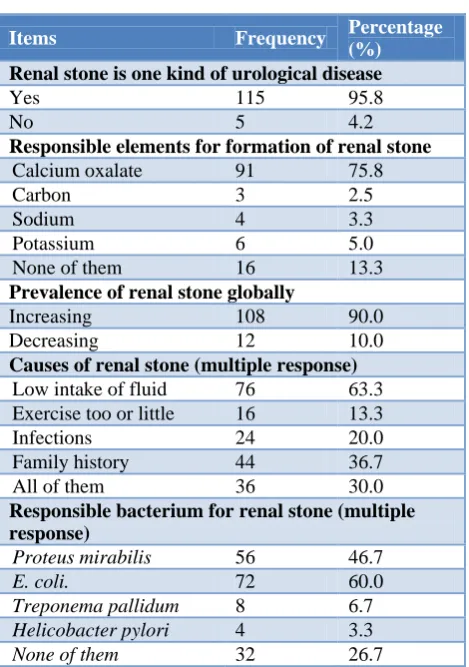
Table 2 showed that more than nine-tenths (95.8%) of the respondents mentioned that renal stone is one kind of urological disease and 75.8% of the respondents mentioned that calcium oxalate is responsible elements for formation of renal stone, followed by 5% who mentioned potassium, sodium (3.3%) and 2.5% mentioned carbon as the responsible element for formation of renal stone. Ninety percent of the respondents mentioned that the prevalence of renal stone is increasing globally. About 63.3% of the respondents mentioned that low intake of fluid is the causes of renal stone and 36.7% mentioned that family history is the cause of renal stone and 20% of them mentioned that infections are the causes of renal stone. About 60% of the respondents mentioned that E. coli is the responsible bacterium for renal stone, followed by Proteus mirabilis
Table 1: Socio-demographic characteristics of the respondents (n=120).
Characteristics Frequency Percentage (%)
Gender
Male 12 10.0
Female 108 90.0
Age (years)
≤30 36 30.0
31-35 52 43.3
36 & above 32 26.7
Marital status
Married 104 86.7
Single 16 13.3
Religion
Muslim 92 76.7
Hindu 24 20.0
Christian 4 3.3
Professional qualification
Diploma in nursing 36 30.0
B.Sc. in nursing 21 17.5
Post basic 20 16.7
Postgraduate 43 35.8
Working experience
≤3 years 44 36.7
≥4 years 76 63.3
Table 2: Knowledge about causes of renal stone (n=120).
Items Frequency Percentage
(%)
Renal stone is one kind of urological disease
Yes 115 95.8
No 5 4.2
Responsible elements for formation of renal stone
Calcium oxalate 91 75.8
Carbon 3 2.5
Sodium 4 3.3
Potassium 6 5.0
None of them 16 13.3
Prevalence of renal stone globally
Increasing 108 90.0
Decreasing 12 10.0
Causes of renal stone (multiple response)
Low intake of fluid 76 63.3
Exercise too or little 16 13.3
Infections 24 20.0
Family history 44 36.7
All of them 36 30.0
Responsible bacterium for renal stone (multiple response)
Proteus mirabilis 56 46.7
E. coli. 72 60.0
Treponema pallidum 8 6.7
Helicobacter pylori 4 3.3
None of them 32 26.7
Knowledge about symptoms of renal stone
Table 3 showed that about 76.7% of the respondents, mentioned that Pain in the back, belly, or side is the symptoms of renal stone and 63.3% of them mentioned Pain or burning during urination as the symptoms of renal stone. More than three-fifths (67.5%) of the respondents mentioned “urgent need to go” as the symptoms of renal stone and 43.3% also mentioned blood in the urine as the symptom of renal stone. More than half (55.8%) of the respondent mentioned cloudy or smelly urine as the symptoms of renal stone and 35% of them mentioned “Going a small amount at a time” as the symptom of renal stone. Half of the respondents stated that nausea and vomiting are the symptoms of renal stone and 17.5% of the respondents mentioned fever and chills as the symptoms of renal stone.
Table 3: Knowledge about Symptoms of Renal Stone (n=120)
Items Yes
N (%) No N (%)
Pain in the back, belly, or side 92 (76.7) 28 (23.3)
Pain or burning during
urination 76 (63.3) 44 (36.7) Urgent need to go 81 (67.5) 39 (32.5)
Blood in the urine 52 (43.3) 68 (56.7)
Cloudy or smelly urine 67 (55.8) 53 (44.2)
Going a small amount at a
time 42 (35.0) 78 (65.0) Nausea and vomiting 60 (50.0) 60 (50.0)
Fever and chills 21 (17.5) 99 (82.5)
Knowledge about prevention and management of renal stone
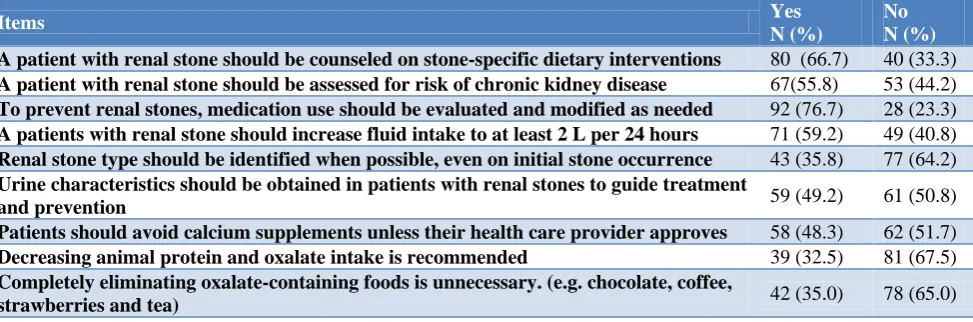
Table 4: Knowledge about prevention and management of renal stone (n=120).
Items Yes
N (%)
No N (%)
A patient with renal stone should be counseled on stone-specific dietary interventions 80 (66.7) 40 (33.3)
A patient with renal stone should be assessed for risk of chronic kidney disease 67(55.8) 53 (44.2)
To prevent renal stones, medication use should be evaluated and modified as needed 92 (76.7) 28 (23.3)
A patients with renal stone should increase fluid intake to at least 2 L per 24 hours 71 (59.2) 49 (40.8)
Renal stone type should be identified when possible, even on initial stone occurrence 43 (35.8) 77 (64.2)
Urine characteristics should be obtained in patients with renal stones to guide treatment
and prevention 59 (49.2) 61 (50.8)
Patients should avoid calcium supplements unless their health care provider approves 58 (48.3) 62 (51.7)
Decreasing animal protein and oxalate intake is recommended 39 (32.5) 81 (67.5)
Completely eliminating oxalate-containing foods is unnecessary. (e.g. chocolate, coffee,
strawberries and tea) 42 (35.0) 78 (65.0)
Overall knowledge level about renal stone
Figure 1 showed that most of the respondents (31.0%) had good level of knowledge regarding the renal stone and 29.0% of them had very good level of knowledge. About 16.7% of the respondents had average level of knowledge regarding the renal stone and 13.3% of the study participants had poor level of knowledge regarding the renal stone. However only 10% had excellent level of knowledge about the renal stone.
DISCUSSION
In this study more than nine-tenths (95.8%) of the respondents mentioned that renal stone is one kind of urological disease and ninety percent of the respondents mentioned that the prevalence of renal stone is increasing globally. A study reported that a renal stone is an important health problem in the world and is the most common disease in urinary tract system.15
A study reported that the symptoms of kidney stone are related to their location whether it is in the kidney, ureter, or urinary bladder.16 About 76.7% of the respondents, mentioned that Pain in the back, belly, or side is the symptoms of renal stone and 63.3% of them mentioned Pain or burning during urination as the symptoms of renal stone. More than half (55.8%) of the respondent mentioned cloudy or smelly urine as the symptoms of renal stone and half of the respondents stated that nausea and vomiting are the symptoms of renal stone. A Study reported that some conditions may result in nausea and vomiting with associated suffering from the stone event.17
More than six-tenths of the respondents mentioned that a patient with renal stone should be counseled on stone-specific dietary interventions. A study reported that a different environments and diets contribute variably to the incidence and composition of urinary stones.18,19
Most of the respondents (31.0%) had good level of knowledge regarding the renal stone and 29.0% of them
had very good level of knowledge. This is inconsistent with the finding of another study from India which reported that 10.42% of the respondents had good level of knowledge regarding the renal stone.20 In this study also 16.7% of the respondents had average level of knowledge regarding the renal stone and 13.3% of the study participants had poor level of knowledge regarding the renal stone. However only 10% had excellent level of knowledge about the renal stone. Another similar study reported that about 89.58% of the study participants had average level of knowledge regarding the renal stone.20
CONCLUSION
Based on the findings of the current study, it can be concluded that most of the study participants (31.0%) had good level of knowledge regarding the renal stone and 13.3% of the study participants had poor level of knowledge regarding the renal stone. However only 10% had excellent level of knowledge about the renal stone. It was recommended that a special training on renal stone for nurses might be geared up to increase their level of knowledge. A further study should be necessary because there was limited information regarding the nurse’s knowledge about the renal stone.
Funding: No funding sources Conflict of interest: None declared
Ethical approval: The study was approved by the Institutional Ethics Committee
REFERENCES
1. Alelign T, Petros B. Kidney Stone Disease: An Update on Current Concepts. Advances in Urology. 2018;(2018):3068365.
2. Aggarwal KP, Narula S, Kakkar M, Tandon C. Nephrolithiasis: molecular mechanism of renal stone formation and the critical role played by modulators. Biomed Res Int. 2013;2013:292953.
3. Cunningham P, Noble H, Al-Modhefer A.K, Walsh
4. Koeppen BM. The kidney and acid-base regulation. Adv Physiol Educ. 2009;33(4):275-81.
5. Lewis JL. MSD Manual Professional Version.
Acid-Base Regulation: 2013. Available from:
https://www.msdmanuals.com/professional/endocrin e-and-metabolic-disorders/acid-base-regulation-and-disorders/acid-base-regulation. Accessed on 3 May 2019.
6. University of Maryland Medical Center (UMMC). Health Information: Medical Reference Guide:
Kidney Stones: 2015 Available at
http://umm.edu/health/medical/reports/articles/kidne y-stones. Accessed on 3 May 2019.
7. Singh KJ, Kaur J. Comparison of three different endoscopic techniques in management of bladder calculi. Indian journal of urology: IJU: journal of the Urological Society of India; 2011;27(1):10-3. 8. National Library of Medicine (NLM). Kidney
Stones (Renal Calculi): 2015. Available from: http://www.ncbi.nlm.nih.gov/pubmedhealth/PMHT0 022762/. Accessed on 3 May 2019.
9. Johns Hopkins Health Library. Kidney Stones.
2015: Available from:
http://www.hopkins-medicine.org/healthlibrary/conditions/kidney_and_u rinary_system_disorders/kidney_stones_85,P01494/ Accessed on 3 May 2019.
10. Aliotta P.J, Alvero R. Ferri's Clinical Advisor. Urolithiasis (Nephrolithiasis): 2015 Available from: www.clinicalkey.com. Accessed on 3 May 2019. 11. Antonelli J, Maalouf N. ePocrates. Nephrolithiasis:
2015. Available from: https://online.epocrates.com/. Accessed on 3 May 2019.
12. Frassetto L, Kohlstadt I. Treatment and prevention of kidney stones: an update. Am Family Physician. 2011;84(11):1234-42.
13. Keddis MT, Rule AD. Nephrolithiasis and loss of kidney function. Current Opinion Nephrol Hypertension. 2013;22(4):390-6.
14. Samad MA. More than twenty million people are suffering from kidney diseases in Bangladesh. Kaler Kantho: 2017: Available at: http://www.kaler-kantho.com/online/national/2017/02/26/468266. Accessed on 3 May 2019.
15. Khan AS, Rai ME, Gandapur, Pervaiz A, Shah AH, Hussain AA, et al. Epidemiological risk factors and composition of urinary stones in Riyadh Saudi
Arabia. J Ayub Med Coll Abbottabad.
2004:16(3):56-8.
16. Kumar SB, Kumar KG, Srinivasa V, Bilal S. A review on urolithiasis. Int J Universal Pharmacy Life Sci. 2012;2(2):269–80.
17. Teichman JM. Joel MH. Acute renal colic from ureteral calculus. N Eng J Med. 2004;350(7):684– 93.
18. Alkhunaizi AM. Urinary stones in Eastern Saudi Arabia: Urol Ann. 2016;8(1): 6–9.
19. Chan SW, Ng CF, Man CW, Chung R, Li SK. A report on a randomly sampled questionnaire survey about renal stone disease in Hong Kong. Hong Kong Med J, 2008;14(6):427–31.
20. Shanthi S, Shambhavi, Souza V. Assess the knowledge of Renal Calculi among Patients Admitted in Urology Ward at Selected Hospital in Madurai with a View to Prepare a Pamphlet. Int J Nur Edu Res. 2014;2(4):294-6.