Original Research Article
The effect of individual-level factors in survival prognosis
for colorectal cancer in Malaysia
Anis K. Ghazali
1*, Thomas J. Keegan
2, Mohd R. Abu Hassan
3, Benjamin M. Taylor
2INTRODUCTION
Cancer is a major health burden across the world, with over 14.1 million new cancer cases worldwide in 2012. Of these, around 1.35 million cases (9.6%) are new cases of colorectal cancer. The number of colorectal cancer cases is expected to increase by 80% by the year 2035, climbing to approximately 2.4 million new colorectal cancer cases and contributing to 1.3 million deaths
worldwide.1 Colorectal cancer also is the third most
common cancer in men and the second most common
cancer in women.2
Cancer has been reported as the third leading cause of death in Malaysia by the Ministry of Health in Malaysia, after heart disease and pulmonary circulatory disease, and septicaemia. Colorectal cancer is the second most common type of cancer for both sexes, exceeded only by
ABSTRACT
Background: In Malaysia, colorectal cancer is the second most common type of cancer for both sexes, represents 10.2% of total cancer cases in Malaysia. This study aims to identify the effect of individual-level factors on survival prognosis for patients with colorectal cancer in Malaysia.
Methods: The study involved 4412 of colorectal cancer patients in Malaysia with histologically verified primary colorectal cancer, diagnosed between 2008 and 2013 (ICD-10, C18-C20), recorded in the database of National Cancer Patient Registry- Colorectal Cancer (NCPR-CC) Malaysia. We investigated the effect of individual characteristics such as age, gender, education as well as clinical characteristics such as cancer staging, cancer site and treatment modalities on survival prognosis after a diagnosis of colorectal cancer using a Cox regression survival model.
Results: Patients diagnosed at stage IV had an almost 6-fold greater risk of dying from colorectal cancer than those with stage I. Age, third-degree education, poor tumour differentiation, the presence of distant metastases and receiving „other‟ treatments were the other factors that increased the risk of death for colorectal cancer patients in Malaysian population.
Conclusions: Our analysis revealed that the severity of the disease lead to poor prognosis in colorectal cancer in the population after adjusting for other individual characteristics. Health education programs targeting high risk group and emphasizing the importance of early detection of cancer as well as knowledge on the importance of cancer treatment should be implemented. Formulation of a better screening program needs to be extended so that it is a genuinely national program.
Keywords: Survival, Colorectal cancer, Prognosis
1
Biostatistics and Research Methodology Unit, School of Medical Sciences, Universiti Sains Malaysia, Malaysia
2
Lancaster Medical School, Lancaster University, United Kingdom
3
National Cancer Patient Registry-Colorectal Cancer (CRC), Malaysia
Received: 13 March 2019
Revised: 08 May 2019
Accepted: 13 May 2019
*Correspondence:
Dr. Anis K. Ghazali, E-mail: [email protected]
Copyright: © the author(s), publisher and licensee Medip Academy. This is an open-access article distributed under the terms of the Creative Commons Attribution Non-Commercial License, which permits unrestricted non-commercial use, distribution, and reproduction in any medium, provided the original work is properly cited.
lung cancer in men and breast cancer in women,
represents 10.2% of total cancer cases in Malaysia.3
Cancer survival in Malaysia has been studied at a regional level. A retrospective record review study analysed survival rates of patients diagnosed with colorectal cancer between 1996 and 2005 in Hospital
Universiti Sains Malaysia (HUSM), Kelantan.4 The study
reported that the overall 5-year survival rate was 34.3% and three significant independent prognostic factors identified were Dukes staging at diagnosis, the presence of liver metastases and treatment modalities. Our study aim to identify the effect of individual-level factors on survival prognosis for patients with colorectal cancer diagnosed between six years period, covers whole states in Malaysia.
METHODS
The original data that we received from the database of the NCPR-CC consisted of 4501 patients with
histologically verified primary colorectal cancer
diagnosed between 2008 and 2013 (ICD-10, C18-C20). After excluding patients without Malaysian citizenship, patients with negative age and negative survival time, there were 4412 subjects‟ data available for analysis.
Variables chosen to be used to describe patients‟ social demographic were age, race, gender, education level and smoking status. For clinical characteristics, the presence of diabetes mellitus, tumour site, stage at diagnosis, the presence of metastases, and tumour differentiation were chosen to be included in the study. The treatment modalities were categorized into four types of treatment received by the patients. They are patients who underwent surgery alone, patients who underwent surgery followed by chemotherapy and/or radiotherapy, patients who underwent chemotherapy and/or radiotherapy and patients who got other alternative treatments or palliative care. Patients without information of treatment received were recorded as an unknown group.
Patient status in this data is given as either dead, alive, or lost to follow up. The date and cause of death were documented in our data where applicable. For each patients, survival time was computed from the date of diagnosis to date of death and follow up was done to the end of 2013 or the censoring date in this study was 31st December 2013. The specific cause of death provided in the data was not verified and could not therefore be deemed reliable, so we decided to perform the analysis on all-cause mortality.
A Cox regression model was used to explore the relationship between patients‟ survival and the chosen
explanatory variables.5 Analysis was performed using the
survival package in R.6
The validity of the proportional hazards (PH) assumption was assessed using Scaled Schoenfeld. Since all of our
variables are categorical (except for age), and computing correlation of such variables is not ideal, we looked at the correlation between the estimated parameters of the model instead. We additionally used the Variation inflation factor to check for multicollinearity. The possible interaction between variables in the model were checked by fitting cross product terms. The interactions were checked between the variables smoking, education, treatment, staging, site, tumor differentiation and metastasis.
Cox snell residuals were used for assessing overall model fit and determining whether the Cox regression model is a suitable choice for this data. A straight line with a unit slope and zero intercept indicates that the fitted survival model is satisfactory. Finally, findings are presented with hazard ratio (HR) and 95% confidence interval.
RESULTS
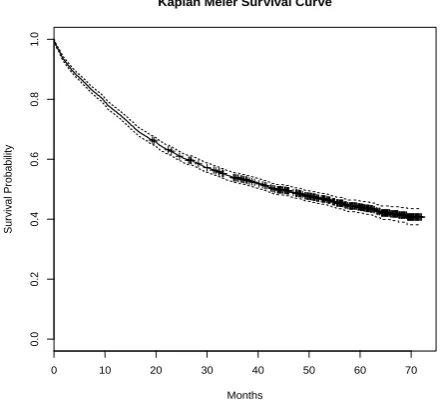
The Kaplan Meier estimates for all data are shown in Figure 1. The overall survival rate at the end of the first year was almost 80%, and the overall survival rate for the entire 5-year period in this study was 44%, 95% CI (42%,46%).
Figure 1: Kaplan Meier survival curve.
Kaplan Meier survival curve shows that the overall survival rate for the entire 5-year period in this study was 44%, 95% CI (42%, 46%).
We then fitted a Cox regression model to the data. Table 1 presents the effects of covariates on colorectal cancer survival, given in terms of hazard ratios and 95% confidence interval. Age, third-degree education, cancer staging, poor tumour differentiation, the presence of distant metastases and receiving „other‟ treatments were factors that increased the risk of death for colorectal cancer patients in the model.
0 10 20 30 40 50 60 70
0
.0
0
.2
0
.4
0
.6
0
.8
1
.0
Kaplan Meier Survival Curve
Months
S
u
rv
iv
a
l
P
ro
b
a
b
ili
Table 1: Cox regression model for individual effect on 4412 colorectal cancer patients in Malaysia.
Variable Mean±SD or N (%) Adjusted HR (95% CI)
Age (year) 61.2±12.7 1.01(1.01,1.02)
Sex
Female 1894 (42.9) 1.00
Male 2470 (56.0) 1.01 (0.91, 1.11)
Missing 48 ( 1.1) 0.67 (0.38, 1.18)
Race
Non Malay 2489 (56.4) 1.00
Malay 1901 (43.1) 1.32 (1.21, 1.45)
Missing 22 ( 0.5) 1.38 (0.64, 2.97)
Smoking
Non-smoking 1543 (35.0) 1.00
Former smoker 528 (12.0) 1.25 (1.07, 1.47)
Active smoker 423 ( 9.6) 1.17 (0.99, 1.39)
Missing 1918 (43.4) 1.04 (0.93, 1.18)
Education
No Education 399 ( 9.0) 1.00
Primary 553 (12.6) 0.92 (0.76, 1.12)
Secondary 651 (14.8) 0.96 (0.79, 1.16)
Tertiary 195 ( 4.4) 0.60 (0.45, 0.81)
Missing 2614 (59.2) 1.01 (0.87, 1.19)
Diabetes
No 3021 (68.4) 1.00
Yes 982 (22.3) 1.07 (0.96, 1.20)
Missing 409 ( 9.3) 0.85 (0.72, 1.00)
Cancer site
Colon 2394 (54.3) 1.00
Rectosigmoid junction 631 (14.3) 1.16 (1.02, 1.32)
Rectum 1379 (31.2) 1.08 (0.97, 1.19)
Missing 8 ( 0.2) 0.24 (0.03, 1.72)
Staging
Stage I 215 ( 4.9) 1.00
Stage II 600 (13.6) 1.53 (1.05, 2.24)
Stage III 802 (18.2) 2.86 (2.00, 4.08)
Stage IV 647 (14.7) 5.59 (3.90, 8.00)
Not staged 620 (14.0) 2.66 (1.85, 3.84)
Missing 1528 (34.6) 3.54 (2.50, 5.02)
Treatment modalities
Surgery Alone 1658 (37.6) 1.00
Surgery+Chemo/&Radio 1454 (32.9) 0.90 (0.80, 1.01)
Radio+&Chemo 437 ( 9.9) 1.14 (0.96, 1.35)
Other treatment 140 ( 3.2) 1.85 (1.47, 2.32)
Unknown treatment 723 (16.4) 1.17 (1.00, 1.36)
Our model shows that the most important prognostic factor affecting survival in colorectal cancer patients is the stage at diagnosis. Patients diagnosed when their cancer was already at Stage IV had an almost 6-fold greater risk of dying from colorectal cancer than those who were diagnosed at Stage I.
Patients who were active smokers had a greater risk of dying compared to non- smokers in but the effect was not significant. Malay race and tumour at the recto-sigmoid
junction increased significantly the risk of dying. Diabetic patients had a greater risk of dying compared to non-diabetic patients data, but this effect was not statistically significant.
DISCUSSION
come from the Malaysian National Cancer Patient Registry for Colorectal Cancer (NCPR-CC), which sources the data from 34 reference centres for colorectal cancer across Malaysia. Our analysis is based on data from 6 years of diagnoses and contains records on 4412 people, who are all Malaysian citizens.
An alternative approach that we could be applied to our
data is the net survival method.7 In estimating net
survival, there are approaches that can be applied: the cause specific approach and the all-cause mortality approach. The first requires knowing the cause of death for each individual and the second one requires all-cause mortality in the study group and an estimate of the “expected” mortality of a disease-free group having the same demographic characteristics as the study group. In a situation where the cause of death is not known, net survival estimators assume that the available expected cancer mortality rate correctly reflects mortality rates from other causes. This can be obtained from general population life tables. The mortality due to cancer can then be deduced from the all-cause and other-cause mortalities. This is also known as the excess hazard, if it refers to hazard.
Epidemiological studies usually use the second of the above approaches because cause of death is often unavailable or unreliable. Cancer epidemiologists use “Relative-survival methods” for net survival estimation
when there is no information on the cause of death.8 The
net survival method is applicable to measure cancer survival after excluding the influence of other causes of death and is very useful in large scale studies such as EUROCARE-4 (European cancer registry based study on survival and care of cancer patients) and iCONCORD (Global surveillance of cancer survival study) where
population survival differs substantially between
countries.7,9,10
We may consider using this method in future research with access to more data in order to get better picture of survival comparisons between countries, for instance extending our study to South East Asian countries. However, in this paper we chose to use the more widely applied Cox model; one advantage of doing this is that there already exists software for handling our planned work in spatial survival data analysis (the paper is in progress), though the extension to spatial net survival models would be novel and useful to the research community.
Older age, having Malay ethnicity, higher cancer staging, the presence of distant metastases, having a poorly differentiated tumour, having „other‟ treatment modalities and having ever smoked were all associated with statistically significant increases in risk of death in patients with colorectal cancer, while higher education level statistically decreased the risk of dying from colorectal cancer.
We found that cancer staging was the main factor affecting the risk of death in patients diagnosed with colorectal cancer. This data shows that there was an almost six-fold increase in the risk of death in patients with stage IV cancer compared to those with stage I cancer. This is consistent with previous findings and is obviously supported by biological theory because the stage of cancer describes the extent and severity of the
disease at the commencement of treatment.11-13
Many studies have reported that age was an independent
prognostic factor for colorectal cancer.13-16 Previous study
noted that the youngest age group in their study (≤35 years old) had significantly poorer overall survival rate compared to older patients due to the greater proportion of these younger patients presenting at a late stage of
cancer.16 However, having accounted for other variables,
age was not an independent prognostic factor in their study. Previous research analyzed age as a categorical variable, while our study analyzed age as a continuous variable. The data supported a linear trend in log risk with age. Our findings show that there is a very slight increase in the risk of death for each extra year of age at diagnosis.
Malaysia is a multi-ethnic country; the three main ethnic groups in Malaysia are Malay, Chinese and Indian. The predominant ethnic group in Malaysia is Malay, constituting 63.1% of the total population in Peninsular Malaysia. One study in Malaysia previously reported that the Chinese ethnicity has the highest age adjusted mortality rate (11.85 deaths per 100,000 population), compared to 9.56 and 7.08 deaths per 100,000 population
in Malay and Indian races respectively.17 However, they
did not assess the risk of death from colorectal cancer for each of these ethnic groups separately. In our study, we have re-categorized race into Malay and non-Malay to compare their risk of death from colorectal cancer. There are fewer Malay patients than non-Malay in this dataset (43% vs 56.4%), and we find that Malays had shorter survival than non-Malays; they had a 30% greater risk of dying from colorectal cancer than the non-Malays in our study.
Different populations may have different types and levels of education and little is hitherto known about how patient education level may affect survival of colorectal cancer. A previous study grouped their patients into three levels of education: low, middle and high education, and found that both middle and high education had significantly lower risk of death compared to the low
education group.18 They assume that the low education
group had received less treatment and different types of surgery than others in the two higher educational categories.
higher socioeconomic status commonly demonstrate better survival than those who do not. One study has suggested that higher survival rate can be achieved if the colorectal cancer patients adopted w ere to adopt a healthy lifestyle, and had better accessibility to medical
care and higher level education.19
In the meantime, public health information could be disseminated widely to help the population better what signs to look for and when to visit the doctor should early signs of cancer manifest themselves. Information on of available screening of screening programs should be made widely available to the population to encourage attendance.
Smoking has been reported to lead to poorer survival in colorectal cancer patients. Many studies also support the finding that smoking adversely affected all-cause
mortality in colorectal cancer patients.20-22 A possible
mechanism by which smoking impacts colon cancer survival is related in some way, to surgery. A recent study found that colon cancer patients who were current smokers who received surgery alone had a significantly higher risk of death (Adjusted HR =1.14, 95% CI: 1.07;1.12) from colon cancer compared to those in the
never smoker group.23
It is reasonable to expect an effect of cancer incidence from smoking, but there is also evidence that smoking
affects survival from colorectal cancer.24 The association
between current smoker and survival of colorectal cancer in our study was slightly insignificant but we did see a significant association between smoking and reduced survival in the former smoker group. Former smokers had a statistically significant 25% increase in the risk of dying from colorectal cancer compared to non-smokers. The risk for former smokers is higher even than for active smokers, who have a 17% increased risk of death compared to non-smokers. This could be because the classification of former smoker in this study is quite short (quit >30 days). We did not take into account the length of time for which ex-smokers had not smoked, or the number of cigarettes smoked per day. The effect of smoking may still be present if the former smokers had smoked for long periods of time, for example, more than 10 years. A previous study on cigarette smoking and cancer mortality reported that there is a significant relationship between duration of smoking with mortality
from colorectal cancer.25 Moreover, the risk of deaths
among former smokers decreases with the number of years since they have stopped smoking.
Furthermore, in our study, smoking status was derived by from medical records, and was not routinely recorded therein. Consequently assessment and assigning of exposure to smoking may be subject to misclassification, as we noted earlier that smoking also was found as the variable with the highest missing value in our data. Therefore, any association of between current smoker and survival from colorectal cancer in our study may not be
picked up by our study. We suggest registries make sure that this variable is routinely documented in cancer registration form as it is an important variable to look for.
Cancer in the rectosigmoid junction and rectum are often grouped together as rectal cancer or as left-sided colorectal cancer, and the outcome from these alternative classifications may be different to that which we observe here. Previous studies have reported that cancer at the right-side (colon) has poorer outcomes than the cancer at the left-side (combining recto-sigmoid and rectal
cancers).26 Our study classified the cancer sites separately
as colon, rectosigmoid junction or rectum and we found that the cancer site was not a significant predictor of outcome.
With regards to treatment modalities, our findings showed that the combination of surgery and therapies (chemotherapy and/or radiotherapy) decreased the risk of death compared to those who had surgery alone. This finding was similar to a previous work on Malaysian
colorectal cancer patients diagnosed in 2008-2009.17
They suggested that their results were an indicator of the importance of adjuvant therapies (chemotherapy or radiotherapy or both) after surgery to prolong the patients‟ survival from colorectal cancer. On the other hand, patients with non-surgical treatments, such as
chemotherapy, radiotherapy or other alternative
treatments, are reported to have a higher risk of death.4,27
This study demonstrated a slightly increased risk of death in men, similar to the previous findings but the result here
was not statistically significant.28 A study stated a
possibility that men may have a biologically more aggressive disease or a poorer response to adjuvant
therapies, which contributes to their poorer survival.29 A
better prognosis among women with colorectal cancer may be explained by the use of postmenopausal hormonal
replacement therapy (HRT).30 Another previous study
suggested that HRT extended survival in colon cancer.31
Having diabetes mellitus, the known presence of distant metastases, and having a poorly differentiated tumour were all found to be strong prognostic factors in other
studies.32,33 In our study, the presence of distant
metastases and having a poorly differentiated tumour do have a significant effect on the survival outcome for colorectal cancer patients, but having diabetes mellitus does not. This contradictory result may be explained by the low number of patients with this characteristic in our study compared to previous studies.
risk of death increased with increasing number of missing covariates in our cases. As this might introduce bias into our analysis, we decided not to ignore the cases with missing data; the missing values were likely to be connected with clinically relevant factors such as cancer staging. We assessed the likely effect on our results in two ways. First, we ran the analysis including „missing‟ as a level of each predictor variable. Secondly, we analysed the subset of the study population for those who have complete data (n=742). We compared the point estimate of the hazard ratio for both models. It was reassuring to see that the results were very similar for both complete and all-case datasets so we decided to choose all-data analysis as our main model.
Despite this challenge, this remains the largest study of colorectal cancer survival ever carried out in the country. With increasing rates of chronic disease in developing economies such as Malaysia, the results from this study are important and will help in understanding the individual effects on colorectal cancer prognosis in Malaysia.
We found that more than half of the patients presented late in the disease at Stage III, Stage IV and missing stages. Our analysis revealed that the severity of the disease lead to poor prognosis in colorectal cancer in the
population after adjusting for other individual
characteristics such as age, gender and ethnicity. The five year survival for patients with stage III cancer around 20%. In United States (US), the equivalent figures are between 90 and 53% for Stage III and around 12% for
Stage IV.34 Cancer survival is affected by a number of
factors. Stage at diagnosis is one, and the success of the treatment regime another. Age, race, smoking, and
unemployment are others.35 To improve survival in
Malaysia one strategy would be to increase the percentage of cases who present for diagnosis at Stage I or II. The five year survival rate in US for colon cancer
patients with Stage I and II cancers are from 95 to 62%.34
The success of such a strategy would depend on a number of factors. Public health campaigns can be helpful in persuading people with possible early signs of cancer, such as blood in stool, to go to the doctor. For example the National Bowel Cancer campaign in the UK has been successful in raising awareness, though they recognise that a subsequent change in survival will take time to
achieve.36
In Malaysia, in contrast to UK, there are barriers to health care based on income and social and economic circumstance. These too must be lessened or removed so that money and physical availability of suitable healthcare does not prevent people getting diagnosed and cared for when they have cancer.
Additionally, we think that health education programs targeting high risk group and emphasizing the importance of early detection of cancer as well as knowledge on the
importance of cancer treatment should be implemented. From the Kaplan Meier survival curve, we noted that in the non-education group had the poorest survival. Their survival was similar to those in missing education group, and it is possible that a bias has been introduced here since those with education missing might be more likely to be of lower educational status. Even though we found no interaction between cancer staging and education in this study, it is likely that education plays an important role in survival from colorectal cancer.
Formulation of a better screening program needs to be extended so that it is a genuinely national program. Currently, Malaysia has no national screening for colorectal cancer. More promotional activities with regards to cancer are recommended to increase population survival rate in the future.
CONCLUSION
The findings from this study may enlighten both health practitioners and patients on the subject of colorectal cancer in Malaysia and help policymakers, authorities and health professionals to develop better healthcare and adequately plan for disease management in Malaysia. Emphasis on increasing public knowledge of the risks, symptoms and prevalence of colorectal cancer, together with prominent campaigns to promote screening, should be a focus for the future.
ACKNOWLEDGEMENTS
The authors would like to thank the National Cancer
Patient Registry-Colorectal Cancer (NCPR-CRC)
Malaysia team for the given data for this research.
Funding: No funding sources Conflict of interest: None declared
Ethical approval: The study was approved by the Ministry of Health Medical Research Ethical Committee (MREC), Malaysia, the Economic Planning Unit (EPU), Malaysia, and from the Faculty of Health and Medicine Research Ethics Committee (FHMREC), Lancaster University
REFERENCES
1. Douaiher J, Ravipati A, Grams B, Chowdhury S,
Alatise O, Are C, et al. Colorectal cancer- global burden, trends, and geographical variations. J Surg Oncol. 2017;115:619-30.
2. Ferlay J, Soerjomataram I I, Dikshit R, Eser S,
Mathers C, Rebelo, M, et al. Cancer incidence and mortality worldwide: sources, methods and major patterns in GLOBOCAN 2012. Int J Cancer. 2014;136(5):359-86.
3. Omar ZA, Ibrahim Tamin NS. National Cancer
4. Ghazali AK, Musa KI, Naing NN, Mahmood Z. Prognostic factors in patients with colorectal cancer at Hospital Universiti Sains Malaysia. Asian J Surg. 2010;33:127-33.
5. Cox DR. Regression models and life tables. J R Stat
Soc Ser B. 1972;34(2):187-220.
6. Therneau TM. A Package for Survival Analysis in
S. 2015. Available at: https://cran.r-project.org/ package=survival. Accessed on 3 January 2019.
7. Perme MP, Stare J, Estève J. On estimation in
relative survival. Biometrics. 2012;68:113-20.
8. Roche L, Danieli C, Belot A, Grosclaude P, Bouvier
A.M, Velten M, et al. Cancer net survival on registry data: use of the new unbiased Pohar-Perme estimator and magnitude of the bias with the classical methods. Int J cancer. 2013;132:2359-69.
9. Coleman MP, Quaresma M, Berrino F, Lutz J-M,
De Angelis R, Capocaccia R, et al. Cancer survival in five continents: a worldwide population-based study (CONCORD). Lancet Oncol. 2008;9:730-56.
10. Sant M, Allemani C, Santaquilani M, Knijn A,
Marchesi F, Capocaccia R, et al. EUROCARE-4. Survival of cancer patients diagnosed in 1995--1999. Results and commentary. Eur J Cancer. 2009;45:931-91.
11. Kotake K, Asano M, Ozawa H, Kobayashi H,
Sugihara K. Gender differences in colorectal cancer survival in Japan. Int J Clin Oncol. 2016;21:194-203.
12. Maringe C, Walters S, Rachet B, Butler J, Fields T,
Finan P, et al. Stage at diagnosis and colorectal cancer survival in six high-income countries: a population-based study of patients diagnosed during 2000--2007. Acta Oncol (Madr). 2013;52:919-32.
13. McKay A, Donaleshen J, Helewa RM, Park J,
Wirtzfeld D, Hochman D, et al. Does young age influence the prognosis of colorectal cancer: a population-based analysis. World J Surg Oncol. 2014;12:370.
14. Stornes T, Wibe A, Romundstad PR, Endreseth BH.
Outcomes of rectal cancer treatment - influence of age? Int J Colorectal Dis. 2014;29:825-34.
15. Widdison AL, Barnett SW, Betambeau N. The
impact of age on outcome after surgery for colorectal adenocarcinoma. Ann R Coll Surg Engl. 2011;93:445-50.
16. Fu J, Yang J, Tan Y, Jiang M, Wen F, Huang Y, et
al. Young patients (35 years old) with colorectal cancer have worse outcomes due to more advanced disease: a 30-year retrospective review. Medicine (Baltimore). 2014;93:1-7.
17. Hassan MRA, Ismail I, Suan MAM, Ahmad F,
Khazim WKW, Othman Z, et al. Incidence and mortality rates of colorectal cancer in Malaysia. Epidemiol Health. 2016;38:1-5.
18. Cavalli-Björkman N, Lambe M, Eaker S, Sandin F,
Glimelius B. Differences according to educational level in the management and survival of colorectal cancer in Sweden. Eur J Cancer. 2011;47:1398-1406.
19. Rasouli MA, Moradi G, Roshani D, Nikkhoo B,
Ghaderi E, Ghaytasi B. Prognostic factors and survival of colorectal cancer in Kurdistan province, Iran: A population-based study (2009--2014). Medicine (Baltimore). 2017;96:1-7.
20. Walter V, Jansen L, Hoffmeister M, Brenner H.
Smoking and survival of colorectal cancer patients: systematic review and meta-analysis. Ann Oncol. 2014;25:1517-25.
21. Phipps AI, Shi Q, Newcomb PA, Nelson GD,
Dargent DJ, Alberts SR, et al. Associations between cigarette smoking status and colon cancer prognosis among participants in North Central Cancer Treatment Group Phase III Trial N0147. J Clin Oncol. 2013;31:2016-23.
22. Boyle T, Fritschi L, Platell C, Heyworth J. Lifestyle
factors associated with survival after colorectal cancer diagnosis. Br J Cancer. 2013;109:814.
23. Sharp L, McDevitt J, Brown C, Comber H.
Smoking at diagnosis significantly decreases 5-year cancer-specific survival in a population-based cohort of 18 166 colon cancer patients. Aliment Pharmacol Ther. 2017;45:788-800.
24. Phipps AI, Baron J, Newcomb PA. Prediagnostic
smoking history, alcohol consumption, and
colorectal cancer survival: the Seattle Colon Cancer Family Registry. Cancer. 2011;117:4948-57.
25. Chao A, Thun MJ, Jacobs EJ, Henley SJ, Rodriguez
C, Calle EE. Cigarette smoking and colorectal cancer mortality in the cancer prevention study II. J Natl Cancer Inst. 2000;92:1888-96.
26. Price TJ, Beeke C, Ullah S, Padbury R, Maddern G,
Roder D, et al. Does the primary site of colorectal cancer impact outcomes for patients with metastatic disease? Cancer. 2015;121:830-5.
27. Yeole BB, Sunny L, Swaminathan R,
Sankaranarayanan R, Parkin DM. Population-based
survival from colorectal cancer in
Mumbai,(Bombay) India. Eur J Cancer.
2001;37:1402-8.
28. Lydrup M-L, Höglund P. Gender aspects of survival
after surgical treatment for rectal cancer. Color Dis. 2015;17:390-6.
29. Cheung WY, Shi Q, O‟connell M, Cassidy J, Blanke
CD, Kerr DJ, et al. The predictive and prognostic value of sex in early-stage colon cancer: a pooled analysis of 33,345 patients from the ACCENT database. Clin Colorectal Cancer. 2013;12:179-87.
30. Majek O, Gondos A, Jansen L, Emrich K, Holleczek
B, Katalinic A, et al. Sex differences in colorectal cancer survival: population-based analysis of 164,996 colorectal cancer patients in Germany. PLoS One. 2013;8:e68077.
31. Mandelson MT, Miglioretti D, Newcomb PA,
Harrison R, Potter JD. Hormone replacement therapy in relation to survival in women diagnosed with colon cancer. Cancer Causes Control. 2003;14:979-84.
32. Aguero F, Murta-Nascimento C, Gallén M,
cancer survival: results from a hospital-based cancer registry. Rev Esp Enferm Dig. 2012;104:572-7.
33. Mills KT, Bellows CF, Hoffman AE, Kelly TN,
Gagliardi G. Diabetes and colorectal cancer prognosis: a meta-analysis. Dis Colon Rectum. 2013;56:1304.
34. American Cancer Society. Survival Rates for
Colorectal Cancer, by Stage. 2018.Avaialable at https://www.cancer.org/cancer/colon-rectal-cancer/ detection-diagnosis-staging/survival-rates.html# references. Accessed on 10 March 2017.
35. Shi R, Kodali MD, Wang SC, Lavu K.C, Liu L,
Shows JR, et al. Mortality risk factors and survival
of colon cancer patient. J Clin Oncol.
2013;31:e14653-e14653.
36. Cancer Research UK. Campaign evaluation. 2014.
Available at https://www.cancerresearchuk.org/
health-professional/early-diagnosis-activities/be-clear-on-cancer/bowel-cancer-campaign/evaluation# BCOC bowel evaluation1. Accessed on 11 May 2017.
Cite this article as: Ghazali AK, Keegan TJ, Hassan
MRA, Taylor BM.The effect of individual-level