Original Research Article
School related factors affecting non communicable diseases risk factors
among 13-15 years old adolescents from two schools in Delhi
Ashwini Kedar*, Sanjay Gupta
INTRODUCTION
Non communicable diseases (NCD) is the major cause of global deaths accounting for 71% of annual deaths in 2015.1 Children and adolescents are more vulnerable to developing NCD risk factors and NCDs, due to changing lifestyles. Children are the cornerstone of a life course approach to the prevention of NCDs. Childhood offers a golden-window of opportunity for cost effective prevention of NCDs.
As per the WHOs Global Health Initiative, Health promoting schools (HPS) is a holistic approach to improve health of the school going children and eventually that of the community.2 Schools can play a major role in creating awareness, imparting knowledge and slowly and steadily changing practices and behavior in the children, parents and finally that of the community A child spends a significant amount of time at school and as the schools shape the behavior of the children, it is
ABSTRACT
Background: Children and adolescents are more vulnerable to developing NCD (non communicable diseases) risk
factors due to changing lifestyles. Hence it is essential to recognize NCD risk factors among adolescents. School plays an important role in imparting knowledge and shaping the behaviours and practices among children. This study focusses on the school related factors that may be influencing the NCD risk factors among adolescents.
Methods: The study was conducted among 438 students, 13 to 15 years old of two central government schools in Delhi. A self-administered modified STEPS questionnaire, an observation checklist for assessing facilities at schools and an interview schedule for school staff were used to collect data.
Results: The statistically significant determinants of inadequate fruits and vegetable intake and excess fast food intake were consumption of fast food from vendors selling food outside the school (OR=4.36), inadequate physical activity at school (OR=2.56) and feeling stressed at school (OR=2.93). Physical activity at school was an important determinant for overall physical activity of students (OR=2.38). Current tobacco use and current alcohol use was determined by feeling stressed at school (OR=3.12). Health education classes at school had a protective effect on the NCD risk factors.
Conclusions: Many school related factors such as absence of playground at school, stressed life at school and vendors
selling fast food outside school were seen to influence lifestyle risk factors amongst adolescents. Hence an active involvement of school by increasing health education classes and providing adequate facilities for physical activities may help in reducing the NCD risk factors among students.
Keywords: Non-communicable diseases, School health, Health education, NCD risk factors, Adolescents
1
Department of Clinical Oncology, National Institute of Cancer Prevention and Research, Noida, India
2
Department of Epidemiology, National Institute of Health and Family Welfare, Munirka, Delhi, India
Received: 29 April 2019
Revised: 09 June 2019
Accepted: 11 June 2019
*Correspondence:
Dr. Ashwini Kedar,
E-mail: [email protected]
Copyright: © the author(s), publisher and licensee Medip Academy. This is an open-access article distributed under
the terms of the Creative Commons Attribution Non-Commercial License, which permits unrestricted non-commercial use, distribution, and reproduction in any medium, provided the original work is properly cited.
essential to assess the school related factors affecting the non-communicable diseases risk factors.
The main objective of this study was to find the school related factors associated with NCD risk factors.
METHODS
The study was conducted in the two central government schools in New Delhi district. New Delhi district was chosen for this study as permission for the study was granted for this district. The study was conducted between July 2015 to September 2015. There were three central government schools in this district. One school was selected randomly for pretesting and study was done at the other two schools.
A questionnaire was prepared based on the WHO STEPS questionnaire.3 Additional questions pertaining to school and factors that may be influencing NCD risk factors were also added in the questionnaire. The questionnaire was pretested in 21 children, 7 each from ages 13, 14 and 15 years.
The study population comprised of 13 to 15 years old students studying in two central government schools of Delhi. Informed consent was taken from parents as well as the students for their voluntary and willing participation in the study.
A sample size of 384 was derived using 95% confidence interval, 5% error and a prevalence of 50%. Prevalence of 50% was considered due to variability in prevalence of NCD risk factors in different studies from India. Considering a 10% non-response rate the total sample size was calculated to be 424.
From each school, 2 sections each were randomly selected from class 8th, 9th and 10th. Students in the age group 13 to 15 years were invited to participate in the study. The selection of students was done through convenience sampling till the sample size was reached. A total of 465 students from both the schools were invited to participate in the study. Since 9 parents did not give consent for their ward’s participation, data was collected from 456 students. 18 students attempted less than 50% questions in the questionnaire and thus were excluded during data analysis. Hence analysis was done of the data gathered from 438 students. Height, weight and blood pressure were measured using standardized tools and techniques. The CDC BMI metric calculator was used for BMI measurements.4
An observation checklist was prepared to assess the school`s facilities such as playground, canteen and neighborhood in terms of NCD risk factors. An interview schedule was prepared for the school teachers. The interview schedule had questions regarding their training with respect to health education classes and physical activity and dietary risk factors. A total of 12 teachers (6
from each school) were taken up for in depth interviews. The teachers were selected purposively and were teaching various subjects for the classes selected for the study.
The following operational definitions were used for the study:
Inadequate vegetable intake-vegetable intake on less than 5 days in a week.
Inadequate fruits intake-fruit intake on less than 5 days in a week.
Excess fast food intake-fast food intake on 3 or more days in a week.
inadequate physical activity-physical activity on less than 5 days/week.
inadequate physical activity at school-physical activity on less than 3 days/week at school.
Current tobacco use-use of smoking/smokeless tobacco at least once in the past one month.
Current alcohol use-consumption of alcohol at least once in the past one month.
Overweight-a study participant who’s BMI is between 85th -95th percentiles.
Obese-a study participant who’s BMI is greater than or equals to 95th percentile.
Prehypertension-a study participant whose systolic and/or diastolic B.P. is between 90th to less than 95th percentile.
Hypertension-a study participant whose systolic and/or diastolic B.P. is greater than or equals to 95th percentile.
Data was entered in excel spreadsheet with double checking for errors. SPSS version 20 was used to analyze the data. Association of NCD risk factors with school related factors was analyzed using Chi Square test (Fischer`s Exact test where applicable) and the strength of association was derived using multivariate logistic regression.
RESULTS
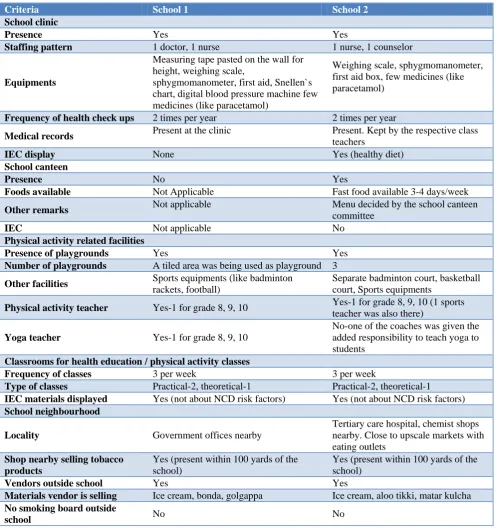
As summarized in Table 1, both the schools under study were located near government offices and hospital. Cigarettes and other tobacco products act (COTPA) regulations were not being followed at both the schools. Tobacco products were easily available near the school. Vendors selling fast food were present outside both the schools. A doctor and a nurse were present in the school clinic at School 1. A nurse and a counselor were present at School 2. Health checkups were being done twice in a year. None of them was doing BMI screening of the students. The counselor at school 2 was doing classroom based group counseling of students but was not taking stress management classes.
students. Among 12 teachers, 5 could enlist 4 NCD risk factors out of 9 known. Majority teachers did not get any formal or in service training in student's health related issues. Only yoga and physical education teachers had a formal training in their subjects and were receiving regular training or workshops on student’s health related
issues. Central government schools had an in-service training policy where various trainings were conducted mainly on education and training related issues. One of the topics covered in the schedule was adolescent education program which was a skill based program.
Table 1: A descriptive comparison of the two schools in the study.
Criteria School 1 School 2
School clinic
Presence Yes Yes
Staffing pattern 1 doctor, 1 nurse 1 nurse, 1 counselor
Equipments
Measuring tape pasted on the wall for height, weighing scale,
sphygmomanometer, first aid, Snellen`s chart, digital blood pressure machine few medicines (like paracetamol)
Weighing scale, sphygmomanometer, first aid box, few medicines (like paracetamol)
Frequency of health check ups 2 times per year 2 times per year
Medical records Present at the clinic Present. Kept by the respective class
teachers
IEC display None Yes (healthy diet)
School canteen
Presence No Yes
Foods available Not Applicable Fast food available 3-4 days/week
Other remarks Not applicable Menu decided by the school canteen
committee
IEC Not applicable No
Physical activity related facilities
Presence of playgrounds Yes Yes
Number of playgrounds A tiled area was being used as playground 3
Other facilities Sports equipments (like badminton
rackets, football)
Separate badminton court, basketball court, Sports equipments
Physical activity teacher Yes-1 for grade 8, 9, 10 Yes-1 for grade 8, 9, 10 (1 sports
teacher was also there)
Yoga teacher Yes-1 for grade 8, 9, 10
No-one of the coaches was given the added responsibility to teach yoga to students
Classrooms for health education / physical activity classes
Frequency of classes 3 per week 3 per week
Type of classes Practical-2, theoretical-1 Practical-2, theoretical-1
IEC materials displayed Yes (not about NCD risk factors) Yes (not about NCD risk factors)
School neighbourhood
Locality Government offices nearby
Tertiary care hospital, chemist shops nearby. Close to upscale markets with eating outlets
Shop nearby selling tobacco products
Yes (present within 100 yards of the school)
Yes (present within 100 yards of the school)
Vendors outside school Yes Yes
Materials vendor is selling Ice cream, bonda, golgappa Ice cream, aloo tikki, matar kulcha
No smoking board outside
school No No
Sociodemographic profile of the students
Equal number of students (146 each) were selected from the ages 13, 14 and 15 years old. The number of males in
Table 2: Sociodemographic profile of students.
Criteria Number of students in school-1 (n=219) (%)
Number of students in school-2 (n=219) (%)
Total (n=438) (%) Age (years)
13 73 (33.33) 73 (33.33) 146
14 73 (33.33) 73 (33.33) 146
15 73 (33.33) 73 (33.33) 146
Sex
Male 122 (55.70) 121 (55.25) 243(55.47)
Female 97 (44.25 ) 98 (44.75) 195(44.52)
SES** (Kuppuswamy’s classification)***
Class 1 (upper) 6 (2.73) 10 (4.56) 16(3.65)
Class 2 (upper middle) 192 (87.67) 188 (85.84) 380(86.75)
Class 3 (lower middle) 19(8.67) 20 (9.13) 39(8.9)
Class 4 (upper lower) 2 (0.91) 1(0.46) 3(0.68)
Class 5 (lower) 0 0 0
*Data are numbers with percentage in brackets; **SES-socioeconomic status; *** Kuppuswamy’s socioeconomic scale: updating income ranges for the year 2012.
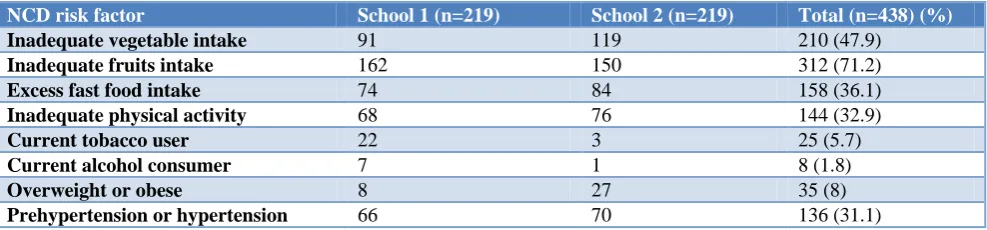
Table 3: Non communicable disease risk factors among study participants.
NCD risk factor School 1 (n=219) School 2 (n=219) Total (n=438) (%)
Inadequate vegetable intake 91 119 210 (47.9)
Inadequate fruits intake 162 150 312 (71.2)
Excess fast food intake 74 84 158 (36.1)
Inadequate physical activity 68 76 144 (32.9)
Current tobacco user 22 3 25 (5.7)
Current alcohol consumer 7 1 8 (1.8)
Overweight or obese 8 27 35 (8)
Prehypertension or hypertension 66 70 136 (31.1)
NCD risk factors
Dietary and physical activity related risk factors were seen to be high among the study population. The behavioral risk factors were not found to be very high among the study population as summarized in Table 3. The prevalence of overweight / obese was found to be 8% and prehypertension and hypertension was found in one third of study participants.
School related factors associated with dietary risk factors of NCDs
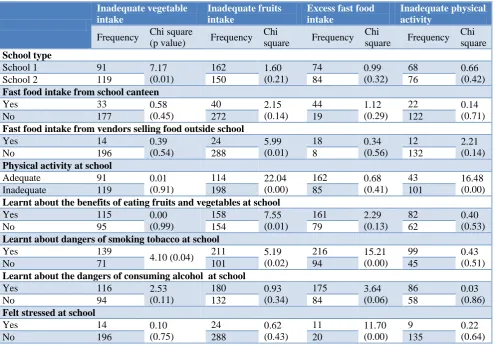
More number of students from school 1 had inadequate vegetable intake than those at school 2 and this difference was statistically significant. The number of students who had learnt about the benefits of eating fruits and vegetables was also higher at school 1 in comparison to school 2: however, this difference was not statistically significant (Table 4).
Inadequate fruits intake was found to be associated with inadequate physical activity at school. Students who were inadequately active at school had odds of 2.56 to consume inadequate fruits (Table 5).
One or more variables related to health education classes were strongly associated with inadequate fruits intake, inadequate vegetable intake and excess fast food intake. The health education classes related variables were strong predictors with a protective effect for dietary NCD risk factors.
Fast food intake of students from vendors selling fast food outside school was associated with inadequate fruits intake however it was not a strong predictor. As observed, both the schools had fast food vendors within 100 yards of their school (Table 1).
Excess fast food intake was strongly associated with feeling stressed at school and the odds of the same were 2.94.
School related factors associated with physical activity related risk factors
school 2. School 1 did not have a proper playground instead a tiled area was being utilized for sports, yoga and other physical education activities (Tables 4, 5).
School related factors associated with tobacco use and alcohol consumption
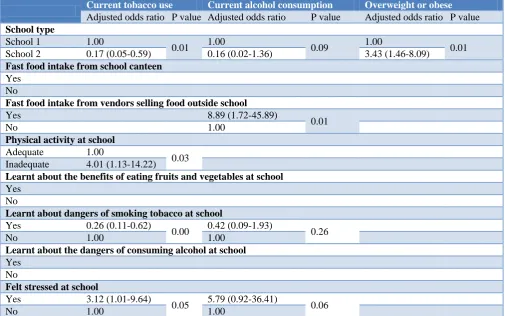
More number of current tobacco users belonged to school 1. The odds of current tobacco users studying in school 1
was 5.9 as compared to those studying at school 2. Other behavioral risk factors were also more among current tobacco users with the odds of inadequate physical activity at school being 4.01 for current tobacco users and the odds of students feeling stressed at school being 3.12 for current tobacco users. Health education classes at school regarding dangers of smoking tobacco had protective effect for the current tobacco users (Tables 6, 7).
Table 4: Factors associated with dietary and physical activity related NCD risk factors.
Inadequate vegetable intake
Inadequate fruits intake
Excess fast food intake
Inadequate physical activity
Frequency Chi square
(p value) Frequency
Chi
square Frequency
Chi
square Frequency
Chi square
School type
School 1 91 7.17
(0.01)
162 1.60
(0.21)
74 0.99
(0.32)
68 0.66
(0.42)
School 2 119 150 84 76
Fast food intake from school canteen
Yes 33 0.58
(0.45)
40 2.15
(0.14)
44 1.12
(0.29)
22 0.14
(0.71)
No 177 272 19 122
Fast food intake from vendors selling food outside school
Yes 14 0.39
(0.54)
24 5.99
(0.01)
18 0.34
(0.56)
12 2.21
(0.14)
No 196 288 8 132
Physical activity at school
Adequate 91 0.01
(0.91)
114 22.04
(0.00)
162 0.68
(0.41)
43 16.48
(0.00)
Inadequate 119 198 85 101
Learnt about the benefits of eating fruits and vegetables at school
Yes 115 0.00
(0.99)
158 7.55
(0.01)
161 2.29
(0.13)
82 0.40
(0.53)
No 95 154 79 62
Learnt about dangers of smoking tobacco at school
Yes 139
4.10 (0.04) 211 5.19
(0.02)
216 15.21
(0.00)
99 0.43
(0.51)
No 71 101 94 45
Learnt about the dangers of consuming alcohol at school
Yes 116 2.53
(0.11)
180 0.93
(0.34)
175 3.64
(0.06)
86 0.03
(0.86)
No 94 132 84 58
Felt stressed at school
Yes 14 0.10
(0.75)
24 0.62
(0.43)
11 11.70
(0.00)
9 0.22
(0.64)
No 196 288 20 135
Table 5: School related determinants of the dietary and physical activity risk factors for NCD.
Inadequate vegetable intake
Inadequate fruits intake
Excess fast food intake
Inadequate physical activity
Adjusted
Odds ratio P value
Adjusted
Odds ratio P value
Adjusted
Odds ratio P value
Adjusted
Odds ratio P value
School type
School 1 1.00
0.01
School 2 1.73
(1.18-2.53)
Fast food intake from school canteen
Yes No
Fast food intake from vendors selling food outside school
Yes 4.36
(0.99-9.12) 0.05
No 1.00
Inadequate vegetable intake
Inadequate fruits intake
Excess fast food intake
Inadequate physical activity
Adjusted
Odds ratio P value
Adjusted
Odds ratio P value
Adjusted
Odds ratio P value
Adjusted
Odds ratio P value
Physical activity at school
Adequate 1.00
0.00
1.00
0.00
Inadequate 2.56
(1.66-3.96)
2.38 (1.56-3.64)
Learnt about the benefits of eating fruits and vegetables at school
Yes 0.62
(0.39-0.97) 0.04
No 1.00
Learnt about dangers of smoking tobacco at school
Yes 0.62
(0.41-0.95) 0.03
0.61
(0.37-1.02) 0.06
0.49
(0.39-0.76) 0.00
No 1.00 1.00 1.00
Learnt about the dangers of consuming alcohol at school
Yes 0.90
(0.59-1.39) 0.64 No
Felt stressed at school
Yes 2.93
(1.34-6.41) 0.01
No 1.00
Table 6: Factors associated with tobacco use, current alcohol consumption, obesity and prehypertension and hypertension.
Current tobacco user Current alcohol
consumer Overweight or obese
Prehypertension or hypertension
Frequency Chi square Frequency Chi
square Frequency
Chi
square Frequency Chi square
School type
School 1 22 15.31
(0.00)
7 4.58
(0.032)
8 11.21
(0.001) 66
School 2 3 1 27 70
Fast food intake from school canteen
Yes 3 0.12
(0.73)
1 0.023
(0.878)
9 3.966
(0.046)
23 1.024
(0.312)
No 22 7 26 113
Fast food intake from vendors selling food outside school
Yes 3 1.75
(0.18)
3 14.54
(0.00)
1 0.646
(0.422)
5 1.804
(0.179)
No 22 5 34 131
Physical activity at school
Adequate 5 10.77
(0.00)
1 3.20
(0.15)
17 0.95
(0.33)
Inadequate 20 7 18
Learnt about the benefits of eating fruits and vegetables at school
Yes 15 0.29
(0.59)
7 3.52
(0.061)
21 0.416
(0.519)
76 0.094
(0.759)
No 10 1 14 60
Learnt about dangers of smoking tobacco at school
Yes 9 15.50
(0.00)
3 4.363
(0.037)
25 0.008
(0.930)
100 0.732
(0.395)
No 16 5 10 36
Learnt about the dangers of consuming alcohol at school
Yes 12 1.36
(0.24)
5 0.038
(0.845)
23 0.682
(0.409)
89 3.249
(0.071)
No 13 3 12 47
Felt stressed at school
Yes 6 11.55
(0.00)
2 3.980
(0.046)
1 1.030
(0.310)
Table 7: School related determinants of current tobacco use, current alcohol consumption and overweight or obesity.
Current tobacco use Current alcohol consumption Overweight or obese
Adjusted odds ratio P value Adjusted odds ratio P value Adjusted odds ratio P value
School type
School 1 1.00
0.01 1.00 0.09 1.00 0.01
School 2 0.17 (0.05-0.59) 0.16 (0.02-1.36) 3.43 (1.46-8.09)
Fast food intake from school canteen
Yes No
Fast food intake from vendors selling food outside school
Yes 8.89 (1.72-45.89)
0.01
No 1.00
Physical activity at school
Adequate 1.00
0.03
Inadequate 4.01 (1.13-14.22)
Learnt about the benefits of eating fruits and vegetables at school
Yes No
Learnt about dangers of smoking tobacco at school
Yes 0.26 (0.11-0.62)
0.00 0.42 (0.09-1.93) 0.26
No 1.00 1.00
Learnt about the dangers of consuming alcohol at school
Yes No
Felt stressed at school
Yes 3.12 (1.01-9.64)
0.05 5.79 (0.92-36.41) 0.06
No 1.00 1.00
An association was seen between current alcohol consumption and type of school, knowledge gained at health education class related to smoking tobacco and feeling stressed at school; however, none of these were strong determinants for current alcohol consumption.
School related factors associated with overweight or obesity and hypertension or prehypertension
More number of overweight or obese students belonged to school 2 as compared to school 1. More number of overweight and obese had fast food from school canteen however the association was not strong to be a determinant. (Tables 6, 7) None of the school related
factors were associated with hypertension or
prehypertension.
DISCUSSION
This study brings out multiple school related factors which were found to determine the NCD risk factors among the study participants.
School related determinants for Dietary NCD risk factors
Dietary NCD risk factors i.e., inadequate vegetable and fruit consumption and excess fast food intake were seen
to be more prevalent in our study population as compared to a few other studies from India.6-9 Dietary risk factors was higher amongst students of school 2. School 2 had a school canteen where fast foods and fried foods were being provided on most days in a week. Though we were unable to show an association of NCD risk factors with the availability of fast food at the school canteen; however, other studies conducted in developed countries show that the availability of junk and fast foods at school increase the BMI and obesity among students.10
The school canteen at school 2 in our study was outsourced but the menu of the canteen was decided by the school canteen committee, yet a fast food was being served daily at the canteen. The school canteen guidelines were unavailable at this school. Similar findings were seen in a study conducted by Mehan et al in a private school situated in an urban city of India showed that the school canteen at this school was run by a contractor and there was no nutrition policy at this school.11
School related factors associated with physical activity related risk factors
Physical activity was inadequate in one third of study participants which was similar to other studies from India.8,13-14 A higher proportion of students at school 1 had inadequate overall physical activity in comparison to students at school 2. This difference was found to be statistically significant. The physical activity at school was the main school related determinant for the overall physical activity of students. This may be attributed to the lack of a proper playground and sports facilities at school 2. School 1 lacked a proper playground and a tiled area in front of the school building was being used for physical activities. The 8th All India Education Survey, 2009 and other data from India suggest that basic amenities, such as playgrounds are often lacking in Indian schools.15
School 1 did not have any sports coach. The physical education teacher at this school was also given the added responsibility of working as a sports coach. As per the National Policy on Education, it is mandatory to integrate the sports education in the curriculum and the school shall provide for such facilities. However, the implementation of this policy is low.16,17
A longitudinal study done in urban south Indian school children which showed a significant decline in moderate-to-vigorous physical activity over a single year follow up, largely due to a decrease in physical activity at school.18
School related factors associated with tobacco use and alcohol consumption
The prevalence of current tobacco use was lower than the GYTS study but similar to studies from Noida and Delhi.8,19,20 Stress at school was one of the independent school related factors seen to influence NCD risk factors particularly current tobacco use and current alcohol consumption. Studies have shown that stress among adolescents is associated with increased risk of initiation of tobacco use and for continuing tobacco use.21 Study among Hispanic adolescents has showed higher stress scores and alcohol consumption in past 30 days.22 It is notable that School 1 did not have a counsellor and Joseph et al study also reported the presence of counselors at very few schools in their study.23 The presence of a school counselor in urban schools is vital nowadays considering the problems like stress, unhealthy habits (tobacco smoking and tobacco chewing) and psychosocial issues which may happen due to being in the extremes of BMI measurement scale.
Current tobacco use was also determined by inadequate physical activity at school in our study. A study from Chandigarh also shows that physical inactivity was a strong determinant of tobacco use among young adults.24
COTPA 2003 is a regulation in India to control tobacco product use.25 As per COTPA 2003, all schools should
have a signage declaring that facility as a no smoking zone. All educational institutions should have a board on their boundary wall or at the entrance of their premises. The board should state prominently that “Sale of Cigarette or any Other Tobacco Products in an area within the radius of 100 yards of the Educational Institution is strictly prohibited; the offence is punishable with a fine up to Rs.200”. This was missing in both the schools and tobacco vendors were selling tobacco products near the school. Implementation of COTPA has been poor as seen from other studies in India.26,27
School related factors associated with overweight or obesity and hypertension or prehypertension
Overweight and obesity was present in 8% of study participants. A study done in Fiji showed a statistically significant association between non-compliance with school canteen guidelines and prevalence of overweight and obesity among students.28 The study also showed that the schools compliant with the school canteen guidelines had a higher proportion of children with healthy weight than the non-compliant schools. However, our study did not show similar findings.
In our study health check-ups were being conducted at six months’ interval at both the schools. BMI screening was not being done at both the schools. Studies from developed countries have shown that BMI screening done at school followed by notification to parents may help in correcting parents’ misperceptions about their child’s weight status, encouraging parents to seek medical help and make family-based behavioural changes and reducing risk for eating disorders and weight-related bullying and teasing.29
Health education
The present study showed that the school health education related variables had a strong protective effect on most of the NCD risk factors. A systematic review shows that school health education was effective in bringing a change in the behavioural NCD risk factors but were less effective for alcohol use, anthropometric
measurements, overweight and obesity.30 Health
education is an important activity under the School Health program.31 Health education classes were being held regularly at both the schools in our study, however the health related training of teachers was low. Capacity building of teachers is essential part of School Health Program however only 3 teachers in this study had received training under the Adolescent Education Program. Jamra et al study from Bhopal had also reported 16% of the government school teachers who received any health related training.32
learning and engaging in physical activity. Most participants pointed out that schools having physical activity in their curricula, having playground and other sports facilities and schools hosting sports competitions were thought to promote adolescent’s physical activity.33
CONCLUSION
Schools provide an influential environment which shapes the adolescents behaviour. The study shows that school may play a very important role in reducing the NCD risk factors amongst adolescents by imparting health education and ensuring that they provide facilities which enable adolescents to adopt a healthy lifestyle. Hence we may suggest collaboration of health and education departments for primary and primordial prevention of NCDs.
Funding: No funding sources Conflict of interest: None declared
Ethical approval: The study was approved by the Institutional Ethics Committee
REFERENCES
1. World Health Organization. Fact sheet:
Noncommunicable diseases. Available at:
https://www.who.int/news-room/fact-sheets/detail/noncommunicable-diseases. Accessed on 2 March 2019.
2. Health promoting schools. Geneva: World Health Organization. 1998. Available at: https://www.who. int/school_youth_health/media/en/92.pdf. Accessed on 2 March 2019.
3. WHO STEPS instrument. Geneva. World Health
Organization. Available at: https://www.who. int/ncds/surveillance/steps/STEPS_Instrument_ v2.1.pdf. Accessed on 2 March 2019.
4. Children`s BMI group calculator – Metric version . Centres for Disease Control and Prevention. Available at: https://www.cdc.gov/healthyweight /assessing/bmi/childrens_bmi/tool_for_schools.html . Accessed on 2 March 2019.
5. Kumar N, Gupta N, Kishore J. Kuppuswamy’s
Socioeconomic Scale: Updating Income Ranges for
the Year 2012. Indian J Public Health.
2012;56(1):103-4.
6. Jain A, Dhanawat J, Kotian MS, Angeline R. Assessment of risk factors of non- communicable diseases among high school students in Mangalore, India. Int J Health Allied Sci. 2012;1:249-54. 7. Bachani D, Sogarwal R, Shukla SK, Shelat T, Gupta
S. Dietary practices and physical activity performed by adolescent in selected districts of India. Ind J Comm Health. 2013;25(2):171-7.
8. Singh AK, Maheshwari A, Sharma N, Anand K. Lifestyle associated risk factors in adolescents. Indian J Pediatr. 2006;73(10):901-6.
9. Joseph N, Nelliyanil N, Rai S, BaBu YP, Kotian SM, Ghosh T, Singh M. Fast food consumption
pattern and its association with overweight among high school boys in mangalore city of southern india. J Clin Diagn Res. 2015;9(5):13-7.
10. Datar A, Nicosia N. Junk food in schools and childhood. Obesity J Policy Anal Manage. 2012;31(2):312–37.
11. Mehan M, Munshi A, Surabhi S, Bhatt T, Kantharia N. Study of school environment and prevalence of obesity and its predictors among adolescent (10-13 years) belonging to a private school in an urban Indian city. Natl J Community Med. 2012;3(3):400-7.
12. Saluja K., Rawal T., Bassi S., Bhaumik S, Singh A, Park MH, Kinra S, Arora M. School environment assessment tools to address behavioural risk factors of non-communicable diseases: A scoping review. Preventive Medicine Reports.2018;10:1-8
13. Galhotra A, Abrol A, Agarwal N, Goel N, Gupta S. Life Style Related Risk Factors for Cardiovascular Diseases in Indian Adolescents. Internet J Health. 2008;9(2):1-5.
14. Bukelo MF, Kiran B, Goud BR, Bukelo MJ, Kiran
PR, Kulkarni V, Kumar N, Kanchan T,
Unnikrishnan B. Risk factors for non-communicable diseases among rural adolescents: a school-based cross-sectional study. Asian J Pharm Clin Res. 2015;8(2):284-7.
15. National All India school education survey . National Council of Education Research and
Training. 2006. Available at:
http://www.ncert.nic.in/programmes/education_surv ey/pdfs/schools_physical_ancillary_facilities.pdf. Accessed on 1 March 2019.
16. National Policy on Education,2016 . Department of
Education, Ministry of Human Resource
Development, Government of India.2016. Available at: http://www.nuepa.org/new/download/NEP2016/ ReportNEP.pdf. Accessed on 26 February 2019. 17. Executive summary of 21 National Focus Groups
Position Papers, Position paper 3.5. National Council on Educational Research and Training. 2006. Available at: http://www.ncert.nic.in/ new_ncert/ncert/rightside/links/pdf/focus_group/exe cutive_summary.pdf.
18. Swaminathan S, Selvam S, Thomas T, Kurpad AV,
Vaz M. Longitudinal trends in physical activity patterns in selected urban south Indian school children. Indian J Med Res. 2011;134:174-80 19. Tobacco use among students and teachers. Findings
from the Global Youth Tobacco Survey (GYTS) and Global School Personnel Survey (GSPS).
Ministry of Health and Family Welfare,
Government of India. 2009. Available from: http://www.searo.who.int/india/tobacco/GYTS_Indi a_report_2003-09.pdf?ua=1. Accessed on 2 March 2019.
questionnaire based survey. Indian J Med Res. 2011;133:300-7.
21. Holliday E, Gould TJ. Nicotine, adolescence, and stress: a review of how stress can modulate the negative consequences of adolescent nicotine abuse. Neurosci Biobehav Rev. 2016;65:173-84.
22. Goldbach JT, Cardoso JB, Cervantes RC, Duan L. The relation between stress and alcohol use among hispanic adolescents. Psychol Addict Behav. 2015;29(4):960-8.
23. Joseph N, Bhaskaran U, Saya GK, Kotian SM, Menezes RG. Environmental sanitation and health facilities in schools of an urban city of south India. Ann Trop Med Public Health 2012;5(5):431-5. 24. Monga D, Goel S, Padhy SK. Level of physical
activity and its relationship with tobacco use among youth: a cross sectional survey in North India. Indian J Comm Health. 2018;30(4):348-53.
25. Guidelines for law enforcers for effective implementation of tobacco control laws. 2013. Ministry of health and family welfare, Government of India. Available from: https://cdn.s3waas.gov.in /s38c7bbbba95c1025975e548cee86dfadc/uploads/2 018/08/2018082818.pdf. Accessed on 2 March 2019.
26. Kummar JK, Jain K, Verma N, Sinha A, Bhawnani
D, Prasad M. Assessment of compliance of prohibition of smoking (under section4 of cigarettes and other tobacco products act) in Raipur city (C.G.), India: a cross sectional study. Int J Community Med Public Health. 2018;5:1327-34. 27. Yadav R, Swastcharan L, Garg R. Compliance of
specific provisions of tobacco control law around educational institutions in Delhi, India. Int J Preven Med. 2017;62(8):1-4.
28. Varman S, Bullen C, Tayler-Smith K, Van Den Bergh R, Khogali M. Primary school compliance
with school canteen guidelines in Fiji and its association with student obesity. Public Health Action. 2013;3(1):81–4.
29. Ruggieri DG, Bass SB. A comprehensive review of school-based body mass index screening programs and their implications for school health: do the controversies accurately reflect the research? J Sch Health. 2015;85:61-72.
30. Singh A, Bassi S, Nazar GP, Saluja K, Park MH, Kinra S, et al. Impact of school policies on noncommunicable disease risk factors: a systematic review. BMC Public Health. 2017;17:292:1-19. 31. School Health Program. 2005.National Rural Health
Mission. Ministry of Health and Family Welfare,
Government of India. Available from:
http://www.nhm.gov.in/nrhmcomponnets/reproducti ve-child-health/adolescent-health/shp.html.
Accessed on 2 March 2019.
32. Jamra V, Bankwar V, Saxena DM. A comparative study of basic health services provided in government and private schools of Bhopal city. Nat J Community Med. 2014;5(1):131-4.
33. Ssewanyana D, Abubakar A, Baar A, Mwangala PN, Newton CR. Perspectives on underlying factors for unhealthy diet and sedentary lifestyle of adolescents at a Kenyan coastal setting. Front Public Health. 2018;6:11:1-12.
Cite this article as: Kedar A, Gupta S.School related