Original Research Article
The socio-demographic determinants of gestational diabetes
mellitus among postnatal women from Palakkad district,
Kerala: comparative study
Seema V. Ennazhiyil
1, Sruthi M. Valsan
2*, Akshara V. Rajeev
1,
Chithra Srinivasan
3, Ramakrishnan P. Kunnath
1INTRODUCTION
Diabetes mellitus is a chronic clinical syndrome that occurs either when the pancreas does not produce enough insulin or when the body cannot effectively use the insulin it produces which leads to a higher blood glucose level. Globally, an estimated 422 million adults were
living with diabetes in 2014, compared to 108 million in 1980. The global prevalence of diabetes has nearly doubled since 1980, rising from 4.7% to 8.5% in the adult population.1 It is a major burden on health care facilities in all countries causing 5 million death and health care expenditure about 673 billion US dollars i.e 12% of total health care expenditure. 2 The epidemic of diabetes is
ABSTRACT
Background: The prevalence of diabetes is increasing all over the world and it is associated with different genetic factors as well as environmental factors. The increasing prevalence of type 2 diabetes among young people has led to an increase in number of pregnancies with this complication. As the incidence of diabetes is more in Kerala, the present study was undertaken to compare the socio-demographic determinants among pregnant mothers with normal gestation and mothers with GDM.
Methods: A hospital based cross-sectional study was carried out and sample size was calculated using the formulae of (Zα + Zβ) 2 × 2 × P × Q/d2. The calculated sample size was 108 and consecutive sampling technique was used for data collection. A semi-structured questionnaire containing socio-demographic and obstetrics details were used as a study tool and an interview schedule was used for data collection.
Results: Out of total 111 postnatal mothers, majority 80 (72.1%) belongs to the age group of 21-30 years, and more than half 64(57.66%) of mothers belongs to Hindu religion. When the socio-demographic and obstetrics details of mothers were compared among GDM and normal mothers it was found that there was statistically significant difference between religion, family history of diabetes and occurrence of GDM (p=0.001). Among obstetric details history of abortion, BMI of mothers and birth weight show statistically significant difference among two groups (p<0.001).
Conclusions: The study reveals that the socio demographic factors and obstetric factors influence the occurrence of GDM.
Keywords: Gestational diabetes mellitus, Obstetric, Palakkad, Socio-demographic 1Department of Anatomy, P K Das Institute of Medical Sciences, Palakkad, Kerala, India 2
Department of Community Medicine, Amala Institute of Medical Sciences, Thrissur, Kerala, India
3Department of Pathology, Saveeta Institute of Medical and Technical Sciences, Kuthambakkam, Tamil Nadu, India
Received: 25 February 2019
Revised: 05 April 2019
Accepted: 26 April 2019
*Correspondence:
Dr. Sruthi M. Valsan,
E-mail: [email protected]
Copyright: © the author(s), publisher and licensee Medip Academy. This is an open-access article distributed under the terms of the Creative Commons Attribution Non-Commercial License, which permits unrestricted non-commercial use, distribution, and reproduction in any medium, provided the original work is properly cited.
growing at an unprecedented rate, the global pandemic of type 2 diabetes mellitus is higher in certain ethnic groups like India. WHO has predicted that by 2025 India will be having the greatest number of diabetic patients thus destines to become the “Diabetic Capital of the World.” It is estimated that 41 million Indians have the disease and every fifth diabetic in the world is an Indian.3 As per Indian Council of Medical Research (ICMR) report 2011, India have 62.4 million diabetic and 77.2 million pre diabetic people which is expected to increase in the coming years. Diabetes is a major public health problem in India with prevalence rates reported to be between 4.6% and 14% in urban areas, and 1.7% and 13.2% in rural areas. India has an estimated 62 million people with type 2 diabetes mellitus (DM); this number is expected to go up to 79.4 million by 2025.4 According to prospective urban rural epidemiological study the prevalence of type 2 diabetes mellitus in India among males and females were 15% and 11% respectively.5 The prevalence of diabetes in Kerala is as high as 20% which is double the national average of 8% and hence Kerala is known as the diabetic capital of India. In Kerala 27.9% of males and 19% of in females were suffering from this non communicable epidemic.6 Kerala has a paradoxical increase of diabetes in rural dwellers and showed a prevalence of 11-19% in men and 15-22% in women in contrary to the national data showing the prevalence of diabetes is double in urban areas.7,8 Another study from Kerala showed an incidence of type 2 diabetes among adults as high as 11%.9 A recent study conducted in urban population of Palakkad district in Kerala had come up with prevalence as 65.68%.10
Prevalence of diabetes varies considerably around the world, being associated with different genetic factors as well as environmental factors such as greater longevity, obesity, unsatisfactory diet, sedentary life style, increasing urbanization, economic development and familial history.2 The incidence of diabetes continues to rise and increasingly affect individuals of all ages including young adult, children and women of child bearing age during pregnancy. The increasing prevalence of type 2 diabetes in general and in younger people in particular has led to an increase in number of pregnancies with this complication.11 Gestational diabetes mellitus (GDM) is defined as carbohydrate intolerance of variable severity with onset or first recognition during pregnancy. It is the most common medical complication of pregnancy with high maternal and fetal mortality and morbidity. The studies have shown that rise in prevalence of diabetes among general population always associated with parallel rise in GDM among pregnant mothers.12 Diabetes complicates 1-20% of all pregnancies worldwide.13 Indian women having higher prevalence of diabetes and their relative risk of developing GDM is 11.3 times compared with white women.14 About 2% to 5% of the total pregnancies may be affected by diabetes mellitus in India. Among pregnancies complicated by diabetes mellitus, about 65% cases involve gestational diabetes mellitus, whereas 35% cases are associated with
pre-existing diabetes mellitus.15 Studies carried out in different parts of India had shown the prevalence of ranges from 6.6% to 7.1%.16,17 The racial differences in population also influence the disease prevalence and perinatal outcome in GDM.18 Indian woman had higher prevalence of gestational diabetes at 22 to 25% as opposed to the worldwide prevalence figure of 15%.19In addition to these, GDM cases are expected to rise to 101.2 million by 2030. The prevalence of GDM in India varies from 3.8 to 21% in different parts of the country depending on the geographical locations and diagnostic methods used. GDM has been found to be more prevalent in urban areas rather than rural areas.20 The prevalence of GDM was observed to be 15.9% in northern Kerala and 11.2 in southern Kerala.21,22
GDM is the most common medical complication of pregnancy with high maternal and fetal mortality and morbidity.11 An early detection of patient’s specific risks through screening and monitoring would allow early commencement of appropriate preventive and interventional therapies, and improvement of maternal and foetal outcomes. As the incidence of diabetes is more in Kerala, the present study was undertaken to compare the socio-demographic determinants among pregnant mothers with normal gestation and mothers with GDM.
METHODS
and analyzed using SPSS 23 version. The categorical variables were expressed in proportion and continuous variables were expressed as mean and standard deviation. The appropriate statistical tests like chi-square and students t test were used for analysis. The level of significance was estimated with 95% confidence interval with p<0.05.
RESULTS
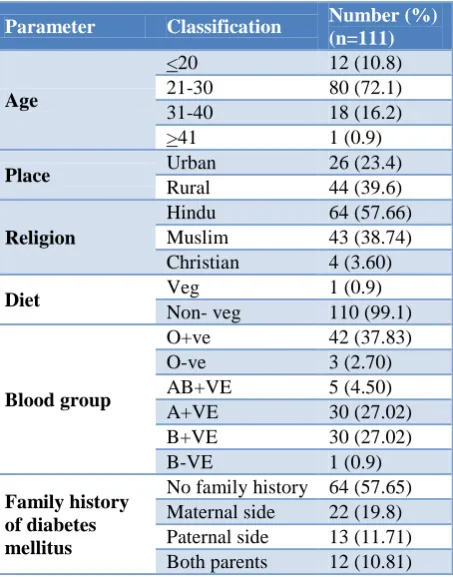
Out of total 111 postnatal mothers, majority 80 (72.1%) belongs to the age group of 21-30 years, 18 (10.8%) of mothers belongs to age 31-40 years, 12(10.8%) and 1 (0.9%) of mothers belongs to age <20 and >41 years respectively. The mean age was 26.13±4.706. It ranges from 19 to 44. More than half 64(57.66%) of mothers belongs to Hindu religion and 44 (39.6%) were residing in rural area. Almost all mothers were taking mixed diet and only 1 mother is vegetarian. About 42 (37.83%) belongs to O+ blood group and 47 (42.34%) of mothers had family history of type 2 diabetes mellitus (Table 1).
Table 1: Socio demographic details of study population.
Parameter Classification Number (%) (n=111)
Age
<20 12 (10.8)
21-30 80 (72.1)
31-40 18 (16.2)
>41 1 (0.9)
Place Urban 26 (23.4)
Rural 44 (39.6)
Religion
Hindu 64 (57.66)
Muslim 43 (38.74) Christian 4 (3.60)
Diet Veg 1 (0.9)
Non- veg 110 (99.1)
Blood group
O+ve 42 (37.83)
O-ve 3 (2.70)
AB+VE 5 (4.50)
A+VE 30 (27.02)
B+VE 30 (27.02)
B-VE 1 (0.9)
Family history of diabetes mellitus
No family history 64 (57.65) Maternal side 22 (19.8) Paternal side 13 (11.71) Both parents 12 (10.81)
Among 111 postnatal mother 38 (34.2%) of mothers were primigravida and rest 73 (65.8%) were multigravida. Out of total 73 multigravida mothers, 27 (36.98%) of mothers had previous history of abortion. The BMI was assessed taking weight and height of mothers at third trimester from previous records and found that mean BMI was 22.02±3.82 ranging from 14.94–35.4. The gestational weight gain was also assessed and found that mean was 8.82±4.29 ranging from 4- 24 kgs. The birth weights of
babies were also taken and the mean birth weight was 2.96±0.3 ranging from 2 – 4.1 kg (Table 2).
Table 2: Obstetrics details of study population.
Parameter Classification Number (%)
Gravida
1 38 (34.2)
2 27 (24.3)
3 20 (18)
4 14 (12.6)
5 7 (6.3)
6 5 (4.5)
Mean±SD Range Height 154.14±5.54 139-172
BMI 22.02±3.82 14.94–35.4
Gestational
weight gain 8.82±4.29 4-24 Birth weight of
babies 2.96±0.3 2–4.1
Out of 111 post natal mother, 52 mothers had no complications during their antenatal period and 59 mothers had gestational diabetes mellitus. The socio demographic details were compared among gestational diabetic mellitus group and normal antenatal mothers. Out of total 18 mothers in the age group 31-40years more than half 12 (66.7%)of them had gestational diabetes mellitus and out of 80 mothers in the age group 21 -30 years only 42(52.5%) of them had GDM. As the age increases the incidence of GDM also increases. But this difference is not statistically significance. There was a difference in mean age of mothers among GDM group and normal mother groups. The mean age of mothers among GDM mothers was 26.56±4.473 which was higher than normal mothers groups the mean was 25.63±4.955. But this difference was not statistically significant (t value -1.027, p=0.307). Present study found risk of developing GDM was found more in 26-30 year age group (OR=12.85; 2.31-74.087) and 31-35 year age group (OR=35.00; 4.195-291.98) as compared to ≤20 years age group. There was a statistically significant difference between religion and GDM. Among 64 Hindu mothers 40 (62.5%) of mothers had GDM and 24 (37.5%) of them had normal antenatal mothers. Out of 4 Christian mothers all 4 (100%) had GDM (p=0.001). There was no statistical significance exist between two groups when residence and blood group were compared. But the family history of diabetes mellitus shows a statistically significant difference between two groups. Out of 12 mothers with family history of diabetes mellitus among both parents majority 10 (83.3%) of mothers had GDM and among 64 mothers without family history of diabetes mellitus more than half 41(64.1%) were normal antenatal period (p=0.001) (Table 3).
group it was found among those mothers who had previous history of abortion had higher incidence of GDM in present pregnancy. Out of total 27 mothers who had abortion, 18 (66.67%) of mothers had GDM and out of total 46 mothers who had no history of abortion only 17 (37%) of mothers had GDM and this difference was statistically significant (p=0.04). Another finding obtained from this study was that the mean height of women in GDM group was 153.75±5.71 lesser than normal group (154.57±5.36) but this difference was not statistically significant. The GDM group has higher BMI (23.36±3.92) compared with normal group (20.51±3.11). This difference was statistically significant (p value -
0.0001). There was also statistically significant difference between birth weight of babies among GDM and normal group (p=0.0009). When the gender of babies were taken it was found mothers delivered male babies had higher incidence of GDM. But this difference was not statistically significant (Table 4). Out of total 59 GDM mothers 36 mothers were on insulin therapy and rest 23 were on diet control. The birth weight of GDM mothers babies were compared between insulin therapy and diet control. The mean birth weight of babies on insulin therapy was 3.10±0.39 and on diet control was 2.98±0.29 (p=0.18).
Table 3: Comparison of socio demographic details of study population among GDM and normal pregnancy.
Parameter Classification
Group
Total Statistical significance
GDM Normal
N (%) N (%)
Age
<20 5 (41.7) 7 (58.3) 12
Fischer’s exact value -3.518 P=0.318
21-30 42 (52.5) 38 (47.5) 80
31-40 12 (66.7) 6 (33.33) 18
>41 0 1 (100) 1
Religion
Hindu 40 (62.5) 24 (37.5) 64
Fischer’s exact value 13.13 P=0.001
Muslim 15 (34.9) 28 (65.1) 43
Christian 4 (100) 0 4
Residence Urban 15 (57.7) 11 (42.3) 26 Chi square value – 0.281,
P=0.59
Rural 44 (51.8) 41 (48.2) 85
Blood group
O+ve 20 (47.6) 22 (52.4) 42
Fisher’s exact value- 6.838
P=0.233
O-ve 1 (33.3) 29 (66.7) 3
AB+VE 1 (20) 4 (80) 5
A+VE 20 (66.7) 10 (33.3) 30
B+VE 16 (53.3) 14 (46.7) 30
B-VE 1 0 1
Family h/o of diabetes mellitus
No history 23 (35.9) 41 (64.1) 64
Fischer’s exact value -13.91 P=0.001
Maternal side 17 (77.3) 5 (22.7) 22 Paternal side 9 (69.2) 4 (30.8) 13 Both parents 10 (83.3) 2 (16.7) 12
Table 4: Comparison of obstetrics determinants among GDM mothers and normal antenatal mothers.
Parameter Classification Group Total Statistical significance
GDM Normal
Gravida
1 24 (63.2) 14 (36.8) 38
Fischer’s Exact Value- 6.77
P=0.238
2 14 (51.9) 13 (48.1) 27
3 7 (35) 13 (65) 20
4 9 (64.3) 5 (35.7) 14
5 2 (28.6) 5 (71.4) 7
6 3 (60) 2 (40) 5
History of Abortion (Total -73) Excluding Primi gravida
Yes 18 (66.67) 9 (33.33) 27
Chi-quare value- 6.36 P=0.04
No 17 (37) 29 (63) 46
Gender of baby
Male 37 (57.8) 27 (42.2) 64 Chi square value –
1.31; p=0.251
Table 5: Comparison of height, BMI, gestational weight gain and birth weight among GDM and normal pregnancy group.
DISCUSSION
The present study compared the socio demographic and obstetrics determinants among normal antenatal mothers and GDM mothers. The previous studies had reported that the increasing age of mother is a high risk for GDM.23-32 The present study also showed that as the age increases the incidence of GDM also increases and mean age of mothers among GDM group is higher than normal group. The previous study done by Kavitha 23 had shown that there was a higher incidence of GDM among Muslim religion, whereas another study done by Arora et al showed higher incidence of GDM among Hindu religion.28 The present study also found that GDM was significantly more in Hindus than Muslims. The residence of mothers also influences the occurrence of GDM. The previous studies done by Kavitha & Arora. had associated GDM with urban residence.23 In our study there is no significant association of GDM with the residence area. Both in urban and rural residence, more than half of mothers had GDM. As the hospital is situated in the rural place the result cannot be generalized but it confirms GDM is common in rural residents too. Out of 85 mothers residing in rural area 44 (51.8%) of mothers had GDM. This may be due to higher prevalence of Diabetes mellitus in rural area in Kerala.
The obstetric determinants like low maternal height28and increasing BMI were found to be strongly associated with GDM.23,28,30 In the present study also got a statistically significant association between BMI and GDM (p=0.0001). Mean maternal height was found less in GDM group but was not statistically significant. The GDM cases are even found to be related with increasing parity and spontaneous abortion.30-32 In the present study there was no significant association between parity and GDM, but the previous history of abortion was significantly associated with GDM. The birth weight of babies was compared among both groups and in accordance to a previous study found a statistically significant association (p=0.009) with GDM.25 The mean birth weight was higher among GDM group. The mean gestational weight gain in GDM was higher but was not statistically significant. The family history of Diabetes and previous history of GDM were also another factors which influence the development of GDM.23,30,32 In
accordance to the previous studies the present study also got a statistically significant (p=0.0001) link between GDM and family history. The present study even investigated the role of maternal blood group and fetal sex in the emergence of GDM and found no association. The role of maternal blood group in GDM was studied previously and the result was in accordance to ours.23
The consumption of non vegetarian diet is found to be a risk factor for GDM, but in our study all the participants except one were non vegetarians.26 It signifies that BMI of the mother should be considered relevant than the diet.
This study would be helpful to increase the public awareness regarding the role of socio-demographic and obstetric factors in the development of GDM. The study reveals that the socio demographic factors like age, religion, family history of Diabetes mellitus and obstetric determinants like previous history of abortion, maternal height, maternal BMI and birth weight of babies influence the occurrence of GDM.
Recommendations
Antenatal screening for GDM should be made mandatory for all the pregnant mothers. This study would even alert the physician about the alarming increase in the prevalence of GDM in the rural areas of Kerala and would initiate necessary health awareness programs among adult females which would help them in early detection of GDM and prevention of maternal and fetal complications.
Limitation and future scope
The hospital was located in a rural place where the study was conducted. So most of the inflow patients belong to rural population. Study can be done in large population at multicentre hospitals.
ACKNOWLEDGEMENTS
Authors are grateful to all the respondents who participated in the study. The authors would also like to thank the Obstetrics department of P K Das Institute of Medical Sciences, for their cooperation in data collection.
Parameter
Group
Statistical significance
GDM
Mean±Std deviation
Normal
Mean±Std deviation
Height 153.75±5.71 154.57±5.36 t value=0.78; p=0.43
BMI 23.36±3.92 20.51±3.11 t value=4.27; p=0.0001
Gestational weight gain 9.19±4.52 8.40±4.00 t value=1.08; p=0.338
Funding: No funding sources Conflict of interest: None declared
Ethical approval: The study was approved by the Institutional Ethics Committee
REFERENCES
1. WHO Global report on diabetes mellitus; 2016. Available at: https://apps.who.int/iris/bitstream/ 10665/204871/1/9789241565257_eng.pdf.
Accessed on 3 June 2018.
2. Stuart HR, Ian DP, Mark WS, Richard PH. Illustrated by Robert B. Davidson’s principles and practice of medicine Diabetesmellitus. Elsevier. Edinbergh, London, Newyork, Oxford, Philadeiphia. St Louis Sydney. 2018;23:719-62. 3. Kumar A, Goel MK, Jain RB, Khanna P, Chaudhary
V. India towards diabetes control: Key issues. Australas Med J. 2013;6(10):524-31.
4. Anjana RM, Pradeepa R, Deepa M, Datta M, Sudha V, Unnikrishnan R. Prevalence of diabetes and pre diabetes impaired fasting glucose and/or impaired glucose tolerance in urban and rural India:phase I results of the Indian Council of Medical Research India Diabetes (ICMR-INDIAB) study. Diabetologia. 2011;54:3022-7.
5. Dagenais GR. Variations in Diabetes Prevalence in Low-, Middle-, and High-Income Countries:Results From the Prospective Urban and Rural Epidemiological Study. Diabetes Care. 2016;39(5):780-7.
6. Mohan V, Sandeep S, Deepa R, Shah B, Varghese C. Epidemiology of type 2 diabetes: Indian scenario. Indian J Med Res. 2007;125(3):217-30.
7. Thankappan KR, Shah B, Mathur P. Risk factor profile for chronic non-communicable diseases:results of a community-based study in Kerala, India. Indian J Med Res. 2010;131:53-63. 8. Shah B, Mathur P. Surveillance of cardiovascular
disease risk factors in India:the need & scope. Indian J Med Res. 2010;132(5):634-42.
9. Menon VU Prevalence of known and undetected diabetes and associated risk factors in central Kerala – ADEPS. Diabetes Res Clin Pract Dec. 2006;74(3):289-94.
10. Ameesh M, Murugan S. Prevalence and its risk factors of diabetic patients in urban area of Palakkad:an observational study. Int J Community Med Public Health. 2017;4:3721-6.
11. Cunningham FG, Leveno KJ, Bloom SL, Spong CY, Dashe JS, Hoffman BL, et al. Williams obstetrics. 24th edition. New York: McGraw-Hill Education. 2014.
12. Ambrish Mithal, Beena Bansal, and Sanjay Kalra. Gestational diabetes in India: Science and society. Indian J Endocrinol Metab. 2015;19(6):701–4. 13. Landon MB, Gabbe SG. Diabetes mellitus and
pregnancy. Obstet Gynecol Clin North Am. 1992;19:633-54.
14. Dorhost A, Paterson CM, Nicholls JS, Wadsworth J, Chiu DC, Elkeles RS, et al. High prevalence of GDM in women from ethnic minority groups. Diabetic Med. 1992;9:820-5.
15. Saxena R. Bedside obstetrics and gynaecology. New Delhi: Jaypee Brothers Medical Publishers (P) Ltd; 2010. Chapter 13, Gestational Diabetes. 2010: 234-255.
16. Kalra P, Kachhwaha CP, Singh HV. Prevalence of gestational diabetes mellitus and its outcome in western Rajasthan. Indian J Endocr Metab. 2013;17(4):677-80.
17. Rajput R, Yadav Y, Nanda S, RajputM. Prevalence of gestational diabetes mellitus and associated risk factors at a tertiary care hospital in Haryana. Indian J Med Res. 2013;137:728-33.
18. Sharon LD, Byod EM, Nam H. Gestational diabetes mellitus: influence of race on disease prevalence and perinatal outcome in a U.S population. Diabetes. 1991;40(2):25-9.
19. Chhibber R. High prevalence of gestational diabetes among Indian women, Communications, Public Health Foundation of India, Delhi, 2015.
20. Seshiah V, Balaji V, Balaji MS, Paneerselvam A, Kapur A. Pregnancy and diabetes scenario around the world: India int J Gynaecol Obstet. 2009;104(suppl 1):S35-8.
21. Manju AM, Abin C. Evaluation of Prevalence and Risk Factors of Gestational Diabetes in a Tertiary Care Hospital in Kerala. Diabetes and Metabolic Syndrome Clin Res Rev. 2015;9(4):68-71.
22. Paulose KP. Prevalence of Gestational Diabetes in South Kerala. Kerala Med J. 2008;1(2).
23. Kavita M, Krishan KM, Kusum LM, Kusum LG, Mahesh CV, Amita K. Bio-Socio-demographic Risk factors of Gestational Diabetes: A Case Control Study. Int Multispecialty J Health. 2017;3(5):139-44.
24. Kalra P, Kachhwaha CP, Singh HV. Prevalence of gestational diabetes mellitus and its outcome in western Rajasthan. Indian J Endocrinol Metabol. 2013;17(4):677-80.
25. Sreekanthan K, Belicita A, Rajendran K, Vijayakumar A. Prevalence of Gestational Diabetes Mellitus in aMedical College in South India:A Pilot Study. Indian J Clin Pract. 2014;25(4):342-7. 26. Aggarwal P. Association of polymorphisms in
angiotensin-converting enzyme gene with gestational diabetes mellitus in Indian Women. Int J App Basic Med Res. 2016;6:31-7.
27. Rajesh R, Yogesh Y, Smiti N, Meena R. Prevalence of gestational diabetes mellitus & associated risk factors at a tertiary care hospital in Haryana .Indian J Med Res. 2013;37:728-33.
29. Wahi P, Dogra V, Jandial K, Bhagat R, Gupta R, Gupta S, et al. Prevalence of Gestational Diabetes Mellitus (GDM) and its Outcomes in Jammu Region. JAPI. 2011;59:227-30.
30. Khan R, Ali K, Khan Z. Socio-demographic Risk Factors of Gestational Diabetes Mellitus. Pak J Med Sci. 2013;29(3):843–6.
31. Vibeke A, Hidde P, Cheung NW, Rachel RH, Adrian EB. Sociodemographic Correlates of the Increasing Trend in Prevalence of Gestational Diabetes Mellitus in a Large Population of Women Diabetes Care. 2008;31(12):2288-93.
32. Shamsuddin K, Mahdy ZA, Siti I, Rafiaah MA, Jamil MD. Rahimah Risk factor screening for abnormal glucose tolerance in pregnancy. Int J Obstetr Gynaecol. 2001;75(1):27-32.