* To whom all correspondence should be addressed. Tel.: +98 6113738319; Fax: +98 6113738330 E-mail: [email protected]
A Comparison between the Effect of Green Tea and Kombucha
Prepared from Green Tea on the Weight of Diabetic Rats
Seyed Ahmad Hosseini1*, Mehran Gorjian2,Latifeh Rasouli3 and Saeed Shirali4
1Nutrition and Metabolic Diseases Research Center ,Ahvaz Jundishapur, University of Medical Sciences, Ahvaz, Iran.
2Ms of Biology(Biochemistry), Mashhad University, Iran.
3PhD student of Nutrition, Iran University of Medical Sciences, Tehran, Iran. 4Hyperlipidemia Research Center, Department of Laboratory Sciences,
Faculty of Paramedicine, Ahvaz Jundishapur University of Medical Sciences, Ahvaz, Iran. DOI: http://dx.doi.org/10.13005/bbra/1616
(Received: 05 February 2015; accepted: 10 March 2015)
Diabetes is the most common metabolic disease worldwide. One of the clinical features of diabetes type 1 is the weight loss. The weight loss is a very serious issue in the management and treatment of diabetes, especially diabetes type 1, which should be paid special attention. The present study was aimed to evaluate the effect of Kombucha prepared from green tea on weight of diabetic rats. This animal experimental study was conducted on 30 Wistar rats that have been diabetic by injecting 120 mg/kgof alloxan. The animals were randomly divided into three groups: 1) control group; 2) group receiving green tea; 3) diabetic group receiving Kombucha prepared from green tea. group 2, group 3, and control group were gavaged respectively with green tea brewed, Kombucha prepared from green tea and 5 ml/kg water daily for four weeks. Then, the amounts of the rats’ weight were measured. weight in the control than diabetic groups receiving the green tea and Kombucha prepared from green tea significantly decreased. Also, at the end of the study the weight in the group receiving the green tea of Kombucha prepared from green tea compared to the group receiving the green tea was significantly more. The consumption of the green tea and the Kombucha prepared from green tea could prevent the weight loss process in diabetic rats.Consumption of green tea and the Kombucha prepared from green tea could prevent the weight loss process in diabetic rats.
Key words: Kombucha, Diabetes, Weight, Green Tea.
Diabetes is a chronic and progressive disease that results in disability and premature mortality1 and appears in the form of
hyperglycemia, the altered metabolism of lipids, carbohydrates, proteins and also an increase in the risk of cardiovascular diseases2. In diabetes,
due to the lack of insulin the body cannot use glucose as a source of energy so enter the glucogeneosis phase that this makes the decrease and loss of muscle tissue and adipocytes. The weight loss is a very serious issue in the management and treatment of diabetes, especially diabetes type 1, which should be paid special
attention3. Effectiveness of medicinal plants in the
treatment or prevention of some diseases, including diabetes, is still contentious and is due to the lack of a clear mechanism of compounds present in these plants4, 5. Previous studies on the
effectiveness or ineffectiveness of medicinal plants in the animal or clinical trials suggests the effectiveness of some of the studied plants6-7).
Among the herbs used today to treat many diseases, green tea can be mentioned as one of their most important and the most widely used. Tea is obtained from the plant Camellia sinensis and used in the green and black form in different parts of the world8, 9. Among the teas, green tea
Green tea as a medicinal plant is one of the richest sources of flavonoids used in most of Asia, Europe and North America10. This material is
rich in catechin, epicatechin, epigallocatechin, and epigallocatechin gallate (EGCG). These flavonoids and other ingredients of green tea, including caffeine, theanine, vitamins, and saponins have been recognized as an anti-inflammatory, antioxidant, anti-cancer, anti-mutagenic agent and play a role in improving the insulin- resistance and the reduced obesity11-13. Some studies have shown
that green tea can prevent the weight loss induced by diabetes type 112, 14, 15.
Kombucha drink is a fermented product that is obtained from Kombucha mushrooms, tea and sugar and fungi can cause changes in the structure of the beverage ingredients. The researchers believe that drinking is considered a nutrient supplement and taking it strengthens the immune system of the body and prevents the diseases.
A Kombucha fungus is in the form of a symbiotic mass of yeast, and bacteria and belongs to the fungi family; also, it is in the form of a flat, smooth and slimy plate. Along with each fermentation process, a new layer is created on the screen that is detachable from the previous layer. This fungus initially is placed on the tea surface in the form of a thin leaf and then becomes thick.
The bacteria of Acetobacter xylinoides, Bacterium glutanicum, Acetobacteraceti spp.xylinum, Acetobacter xylinum,Acetobacter pasteurianus, and yeasts of Zygosaccharomyces bailii, Berttanomycesbruxellensis, Saccharomyce sludwigii, Saccharomyces cerevisiae, Schizosacc haromycespombe, Pishia, Candia krusei, Candida kefyer, and Issatchenkiaori entalisoccidentalis have been separated from the biomass. Several studies have indicated the existence of other yeasts in addition to the aforementioned microorganisms. So far, many compounds have been isolated from the Kombucha drink including acetic acid, carbonic acid, folic acid, gluconic acid, glucuronic acid, lactic acid, oxalic acid, citric acid, malic acid, vitamin C, B family vitamins, including B6, B2, B3, B1 and B1216.
Several studies have claimed that the useful effects of Kombucha may be related to its antioxidant activity or related to the compounds formed during fermentation. However, the exact
mechanisms of action of Kombucha are not yet cleared17.
Catechin found in tea has antioxidant, anticancer, anti-diabetic, anti-atherosclerosis properties which are better exerted under an environment containing acetic acid and glucuronic acid16. Therefore, the existence of acetic acid and
gluconic acid in the Kombucha can cause the increase of anti-diabetic effects of catechin available in tea.
With regard to the issues raised, and since the effect of Kombucha made from black tea in reducing the weight has been reported in a few studies, and according to the investigation conducted, effect of Kombucha made from green tea on weight of the human or animal has not been done yet, we decided to study the influence of Kombucha made from green tea; so, if positive results are obtained in the future, Kombucha made from green tea should be used in preventing the weight loss process in the diabetic patients.
MATERIALS AND METHODS
The study was conducted on 30 male Wistar rats weighing 200-220 g. The rats were obtained from the Breeding and Rearing Center of Animals Laboratory affiliated with the Institute of Medicinal Plants (ACECR). Under controlled conditions of temperature and light animals were kept and in order to adapt to the conditions tested, they underwent a free diet for a week.
Diabetes model in rats was established with a single intraperitoneally injection of 120mg/ kg alloxan per body weight18, 19.
A criterion for diabetes is the elevated blood glucose level above 130 mg /dl.
Then, rats were randomly distributed to three groups of 10 rats.
1) Control group (diabetic); 2) group receiving the green tea; 3) diabetic group receiving Kombucha prepared from the green tea.
Green Tea Preparation
The green tea at the rate 12 g/L is added in a flask containing boiling water and then after 5 minutes, placed in the room temperature let to cool and then the mixture is filtered20.
Intervention Procedure
Kombucha made from green tea industrially (prepared from the Delestan health tea), brewed green tea at a rate of 5ml/kg daily with the gavage method for four weeks; in addition, the control group were gavaged by water23. At the end of the
study, weights of the rats in different groups were measured.
Statistical Analysis
For data analysis, the SPSS (version 19) was used. Data were expressed as mean ± standard deviation (mean ± SD).One-way analysis (ANOVA) test and Tukey’s Post Hoc HSD test were used to determine significance of differences between means. In addition, a P-value of < 0.05 was considered as the significance interval for all statistical analyses.
RESULTS
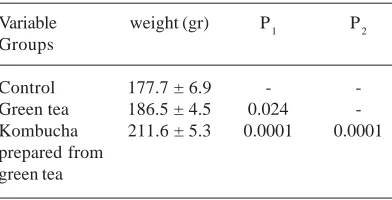
After inducing diabetes in the control group, the weight loss process increased. The mean weights of the rats in the studied groups are shown in the table as below. As the data in this table and figure 1 show, the weight loss process in the diabetic groups receiving the green tea and Kombucha made from green tea was significantly less than the control group (respectively p = 0.024 and (p = 0.0001). Moreover, the administration of Kombucha prepared from green tea compared with the green tea prevented significantly the weight reduction (p = 0.0001).
DISCUSSION
One of the distinguishing features of type 1 diabetes is the reduction of the weight. This weight loss can occur for various reasons. One of these reasons is the increased inflammation caused by the disease. In diabetes the inflammatory factors increase and make thebreakdown of the muscle tissue 21, 22. Another reason for the weight loss is
lack of insulin, because insulin is an anabolic hormone and it causes the protein and fat enter into the tissues. And a lack of this hormone in type 1 diabetes is in a direct relationship with cachexia seen in this disease23.
Effect of Kombucha made from black tea on weight of the diabetic rats has been reported in limited studies20 but effect of Kombucha made
from green tea on weight of the diabetic rats or diabetic humans has not been studied yet.
In the present study, the effect of green tea and Kombucha made from green tea on the level of weight was assessed. The results showed that the process of weight loss in diabetic groups receiving the green tea and Kombucha made from green tea compared with the diabetic control group is significantly less. Also weight in the group receiving Kombucha prepared from green tea was significantly more than the group receiving the green tea. Consumption of the green tea and Kombucha prepared from green tea could prevent the weight loss process in the diabetic rats.
Table 1. A comparison between average and standard deviation of the rate of weight among the studied rats
Variable weight (gr) P1 P2
Groups
Control 177.7 ± 6.9 -
-Green tea 186.5 ± 4.5 0.024
-Kombucha 211.6 ± 5.3 0.0001 0.0001
prepared from green tea
The value of p 0.05 was considered as significant. P1: the mean weight in the control group compared with the diabetic groups receiving the green tea and Kombucha prepared from green tea
P2: the mean weight in the group receiving the green tea compared with the group receiving Kombucha prepared from green tea
Fig. 1. A comparison between the effects of Kombucha prepared from green tea and green tea’s effects on the studied rats’ weight
In line with findings in the present study, results of a study conducted by Haidari et al. showed that consumption of 200 mg of green tea extract per kg of body weight caused an improvement in weight loss in diabetic rats15.
Also in another study the effect of three doses of green tea extract respectively 50, 100, and 200 mg for six weeks in diabetic rats was investigated. Weighing in three groups receiving different doses of the extract did not show any significant decrease compared to non-diabetic control group. After the induction of diabetes, significant weight loss was seen in all diabetic groups that this weight loss continued progressively in the diabetic control group; however, in the three experimental groups that received different concentrations of the green tea, this weight loss was stopped and a relative increase occurred in weight. So no significant difference was observed between the weight of experimental rats before induction of diabetes and at the end of the experiment12.
About Kombucha tea, in a study conducted by Srihari et al. in 2013, after 45 days it was observed that the consumption of Kombucha at a rate of 6 mg/kg body weight increased body’s weight of the rats receiving Kombucha in comparison with the diabetic control group21. The
results of this study are similar to the results obtained in the present study.
Kombucha has gluconic acid, glucuronic acid, acetic acid, vitamins of B1, B2, B3, B6, B12, carbonic acid, folic acid and amino acids that these substances are produced by fermentation16, 20.
Catechin in green tea has anti-diabetic properties and it exerts and its properties better in a medium containing acetic acid and glucuronic acid. This feature may be the possible cause of significant reduction in the weight loss process in the diabetic rats receiving Kombucha prepared from the green tea compared with the green tea in this study16.
Morshedi et al. (2005) attempted to study the chronic effects of the black tea and Kombucha tea on weight loss in diabetic rats. The results show that both black tea and Kombucha tea prevent the weight loss of the animal that is a diagnostic sign of diabetes. They guessed that the effect of Kombucha tea, too, may be due to substances found in black tea24.
Based on the reviews carried out, it
appears that green tea has a dual effect on weight. In addition, this effect probably is mediated indirectly and through adjustment of other metabolic variables; so that in terms of diabetes, green tea prevents the weight loss by glucose concentrations decrease and inflammatory factors and improvement of sensitivity to the insulin25, 26.
However, in terms of obesity and overweight, by having the excitable effect on the basic metabolism level and in the disorder of absorption of fats, the green tea reduces fat tissue and body weight27.
Anyhow, the data available about the effect of Kombucha on weight are insufficient and the necessity of more research in this field is obvious. In addition, acid acetic available in Kombucha can be one of the possible causes of the effect of Kombucha on lipid profile, including LDL and cholesterol. Possibly acetic acid contained in Kombucha activates the AMP-activated protein kinase (AMPK) that is a inhibitor of fatty acids and sterol synthesis, and decreases the amount of Malonyl-CoA in the liver. Thus, the acetic acid available in Kombucha will affect the synthesis of fat17.
Polyphenols existing in Kombucha may prevent the death and injury of pancreas cells and rebuild and repair the injured beta cells20.
As we observed in this study, consumption of the green tea and Kombucha obtained from green tea could prevent the process of weight loss in diabetic rats; so, by approaching on more studies of the animals and , eventually, humans, it is possible that we will conclude that this drink can be used to prevent weight loss in diabetic patients.
ACKNOWLEDGEMENTS
This study was a part of a Master of Science thesis of Ms Latifeh Rasoli in the nutrition major. Thereby, the authors express thanks to Ahvaz Jundishapur University of Medical Sciences- international unit of Abadan due to the financial support of this project.
REFERENCES
1. World Health Organization: Definition and
consultation. Issue 5: What diagnostic tests should be used to define glycaemicstatus. Geneva, World Health Org, 2006.
2. Davis SN.Insulin, Oral Hpoglycemic Agents, and The Pharmacology Of Endocrine Pancrease. In Hradaman JG Limbrid LE ,Molinoff PB, Ruddon RW ,Gilman AG . Goodman and Gilmans the Pharmacological Basis Of Therapeutics.11 ed.Newyork:McGrawlhill 2oo6.p.1487-1528.
3. Ene AC, Nwankwo EA, Samdi
LM.Alloxan-Induced Diabetes in Rats and the Effects of Black Caraway (Carumcarvi L.) Oil on Their
Body Weight.Research Journal of Medical
Sciences .2007; 2(2): 48-52.
4. Akhilesh K. Tripathi, Pravin K. Bhoyar, Jagdish R. Baheti2, Dinesh M. Biyani, M. Khalique, Mayuresh S. Kothmire2, Yogesh M. Amgaonkar, Anand B. Bhanark . Herbal Antidiabetic . International Journal of Research in Phamaceutiucal 2011; 2(1):30-37.
5. Neelesh malviya,Sanjaayjain and SapnaMalviya. Antidiabetic potential Of Medicinal
Plants.Actapoloniaepharmaceutica- Dryg
Research, 2010; 67: 113-118.
6. National Institute of Diabetes and Digestive and Kidney Diseases. National Diabetes Statistics fsB, MD: U.S. Department of Health and Human Services, National Institutes of Health, 2008: 20-30.
7. Kim W, Khil LY, Clark R, Bok SH, Kim EE, Lee
S, et al. Naphthalenemethyl ester derivative of dihydroxyhydrocinnamic acid, a component of cinnamon, increases glucose disposal by enhancing translocation of glucose transporter 4. Diabetologia. 2006 Oct; 49(10):2437-48.
8. Chaco S,ThambiP,KuttanR,NishigakiI.Benefical
effects of green tea:a literature review.Chinese Medicine 2010;5:13.
9. Sajilata MG, Bajaj PR, Singhal RS. Tea
Polyphenols as Nutraceuticals .Comprehensive Reviews in Food Science and Food Safety.Institute of Food Technologists, 2008;7: 229-54.
10. Kim MJ, Yoo KH, Park HS, et al. Plasma
adiponectin and insulin resistance in Korean type2 diabetes mellitus. Yonsei Med J. 2005;
46:42-50.
11. Mohammadi S, Hosseinzadeh Attar MJ,
KarimiM.The Effects of green tea extract on serum adiponectin concentration and insulin. J ZanjanUnviMwd Sci. 2010; 18: 44-57.
12. Mehdizade M,HosseiniTehrani S, Ebrahiminia
F et al.Effect of green tea (Camellia sineisisL) extract on blood glucose and body weight in in streptozotocin-induced diabetic rats. Journal
of Gorgan University of Medical Sciences 2010;
2 (1): 8-12.
13. Weisburger JH,ChungFL.Mechanism
ofcronicdiesease causation by nutritional factors and tobaco products and their prevention by tea polyphenols. food and chemicals toxical 2002;
40(8):1145-54.
14. Ryu OH,LeeKW,kimHY.Consuption on
inflammation, insulin resistance pluse wave velocity in type2 diabetes patients. Diabetes Research and clinical practice 2006;71 (3):356-8.
15. Haidari F, Shahi MM, Omidian k, et al. Effect of green tea extract on body weight, serum glucose and lipid profile in streptozotocin-induced diabetic rats. A dose response study. Saudi Med J, 2012; 33 (2): 128-33.
16. Beigmohammadi F., Karbasi A., Beigmohammadi
Z. Production of high glucuronic acid level in Kombucha beverage under the influence environmental condition. J. Food Technol. Nutr.,
2010; 7, 30-38.
17. Yaghmaei P, Parivar K, Karkhane L. The effect of Kombucha extract on plasma lipoproteins and liver enzymes in male wistar rats. Journal of food technology and nutrition spring 2012; 9(2 (34));29-36.
18. Ragavan, B. and Krishnakumari, S.Antidiabetic effect of T. arjuna bark extract in alloxan induced diabetic rats. Indian Journal of Clinical Biochemistry, 2006; 21(2): 123-128.
19. Kumar CPS ,rulselvan P, umar DS, ubramanian
SP. Anti-Diabetic activity of fruits of Terminaliachebula on streptozotocin induced diabetic rats. J health Sci 2006; 52(3): 283-91.
20. Aloulou A¡Hamden K¡Elloumi D et
al.Hypoglycemic and antilipidemic properties of kombucha tea in alloxan-induced diabetic
rats.BMC Complementary and Alternative
Medicine 2012, 12: 63 doi:10.1186/1472-6882-12-63.
21. Srihari T, Karthikesanb K, Ashokkumar N,
Satyanarayanac U. Antihyperglycaemic efficacy of kombucha in streptozotocin-induced rats.
Journal of Functional Foods; 2013 :article in press.
22. Babu P, Sabitha K, Shyamaladevi C. Therapeutic effect of green tea extract on oxidative stress in aorta and heart of streptozotocin diabetic rats.
Chemico-biological interaction, 2006; 162: 114-120.
23. Kasetti RB, Rajasekhar MD, Kondeti VK,
Fatima SS, Kumar EGT, Swapna S, et al.
Syzygiumalternifolium seeds in streptozotocin induced diabetic rats. Food and Chemical Toxicology, 2010; 48: 1078–1084.
24. Morshedi A,Dashti-Rahmatabadi M H.Chronic
Consumption of Kombucha and Black Tea Prevents Weight Loss in Diabetic Rats. IIranian Journal of Diabetes and Obesity; 2010; 2; 23-26.
25. Wu CH, Lu FH, Chang CS, Chang TC, Wang
RH, Chang CJ: Relationship among habitual tea consumption, percent body fat, and body fat
distribution. Obes Res, 2003; 11: 1088–1095.
26. Tadera K, Minami Y, Takamatsu K, Matsuoka
T. Inhibition of alpha glucosidase and alpha-amylase by flavonoids. Journal of Nutritional Science and Vitaminology, 2006; 52: 149-53
27. Sogawa M, Seura T, Kohno S, Hirasaka K,
Yamaguch Y, Takagaki R, et al. Awa (Tukoshima) lactate-fermented tea as well as green tea enhance the effect of diet restriction on obesity in rats.