698 | 2017 | ISSUE 3 | VOLUME 12 © 2017 University of Alicante
Lipid profile, cardiorespiratory function and
quality of life of postmenopausal women improves
with aerobic exercise
LADY GWENDOLINE AKWA1, MONDAY OMONIYI MOSES1
, ABIGAEL OMOWUMI EMIKPE2, BIGGIE
BAFFOUR-AWUAH1, BENJAMIN ASAMOAH1, OTCHERE ADDAI-MENSAH3, MAX ANNANI-AKOLLOR4,
FRANCIS OSEI1, ERIC JUNIOR APPIAH1
1Department of Sports and Exercise Science, Kwame Nkrumah University of Science and Technology, Kumasi, Ghana
2Department of Nursing, Kwame Nkrumah University of Science and Technology, Kumasi, Ghana
3Department of Medical Laboratory Technology, Kwame Nkrumah University of Science and Technology, Kumasi, Ghana
4Department of Molecular Medicine, Kwame Nkrumah University of Science and Technology, Kumasi, Ghana
ABSTRACT
Objective: Menopause is characterized by physiological changes with increased risk of obesity, dyslipidemia and decreased quality of life (QoL). Despite the plethora of reports on the alleviating effect of exercise on climacteric symptoms, there is little documentation of this lifestyle intervention among Ghanaian menopausal women. This study examined the effect of aerobic exercise on lipid profile, cardiorespiratory function and QoL among menopausal women. Methods: Eighteen sedentary postmenopausal women between 45 to 75 years were randomly assigned to experimental (EG, n=8) and control (CG, n=10) groups. The EG received moderate intensity aerobic exercise training for eight weeks, three times a week while the CG observed normal daily activities. Blood pressure, resting heart rate, BMI, and lipid profile were measured and QoL assessed using the Utian QoL questionnaire at weeks 0 and 9. Results: After 8 weeks, the EG demonstrated significant decrease in cardiovascular risk ratio by 6.5L% and a non-significant decrease in LDL by 11.9L%. The CG showed significant increase in systolic BP by 3.2%L and a non-significant increase in LDL and cardiovascular risk by 14.9L% and 9.4L% respectively. QoL significantly improved in the EG group compared to CG after the 8 weeks. Conclusion: The health and QoL of participants in EG was significantly better than
1Corresponding author. Department of Sports and Exercise Science, Faculty of Allied Health Sciences, College of Health
Sciences, Kwame Nkrumah University of Science and Technology, Kumasi, Ghana.
E-mail: [email protected] Submitted for publication March 2017 Accepted for publication August 2017
JOURNAL OF HUMAN SPORT & EXERCISE ISSN 1988-5202 © Faculty of Education. University of Alicante
VOLUME 12 | ISSUE 3 | 2017 | 699 the CG at the end of the experiment. Aerobic exercise decreases cardiovascular disease risk in postmenopausal women and shows potential impact on lipid profile and health QoL. Proactively sponsored aerobic exercise programmes geared towards healthy living of postmenopausal women in Kumasi, Ghana are recommended. Key words: BLOOD PRESSURE, HEART RATE, BODY MASS INDEX, LIPID PROFILE, QUALITY OF LIFE.
Cite this article as:
700 | 2017 | ISSUE 3 | VOLUME 12 © 2017 University of Alicante
INTRODUCTION
Aging is one of the most important issues in the world of women and is characterized by different changes which influence their health. Of all the changes women go through reproductively, the menopausal phase has over the years been recognized as the most critical and diverse in symptoms (Nikpour & Haghani, 2014) A permanent cessation of ovarian primary function and hormones (estrogen and progesterone) (Farahmand, Ramezani Tehrani, Bahri Khomami, Noroozzadeh, & Azizi, 2015; Staessen et al., 2001) in a successive period of twelve months deems that a woman has begun the menopausal phase (Avis, Carolina, & Crawford, 2015; Borud, Alraek, White, & Grimsgaard, 2010; Nelson, Walker, Zakher, & Mitchell, 2014) Most women experience menopause at a mean age of 51 years(Broekmans, Knauff, te Velde, Macklon, & Fauser, 2007; Perry, Murray, Day, & Ong, 2015; Te Velde & Pearson, 2002). It is contended however that women in Ghana experience menopause at a mean age of 48 years (Kwawukume, Ghosh, & Wilson, 1993). The years after menopause (postmenopause) are associated with health risks such as cardiovascular diseases, osteoporosis, weight gain and abnormalities in lipid profiles due to loss of estrogen (Al-Safi & Polotsky, 2015; Freeman, Sammel, Lin, & Garcia, 2010). These symptoms have been shown to have negative effects on the quality of life of postmenopausal women (Chen, Xu, Zhang, Liu, & Guo, 2010; Jones & Sutton, 2008; Messier et al., 2009).
While Hormonal Therapy (HT) in the form of skin patches, topical creams, gels and pills have been reported to treat some postmenopausal symptoms (Deroo et al., 2014; Heringa, Begemann, Goverde, & Sommer, 2015; Schwartz, Morelli, & Holtorf, 2011), there are documented side effects (Ohemeng, 2009). Utilization of estrogen alone is known to promote cancerous conditions with or without progesterone (Diep, Daniel, Mauro, Knutson, & Lange, 2015; Kim, Kurita, & Bulun, 2013; Ohemeng, 2009). Reports also show that healthy postmenopausal Ghanaian women who have received HT have increased risk of coronary heart disease and stroke (GNDP, 2004; Zöllner, Acquadro, & Schaefer, 2005). This may be the reason for the rise in some confusion regarding its use, especially in terms of safety and disease prevention (Arthur, Adu-Frimpong, Osei-Yeboah, Obu Mensah, & Owusu, 2013; T. J. De Villiers et al., 2013; Tobie J. de Villiers et al., 2007).
With the low to middle income status of the Ghanaian economy, postmenopausal Ghanaian women are battling with central obesity, high blood pressure and fasting blood sugar (Arthur et al., 2013) without the financial strength to access therapy. Most often resort to fate and faith (although not scientific) in an attempt to treat these conditions without recourse to medical care. Many of them are always found in religious centers seeking divine healing.
Although studies in developed countries have reported that regular exercise has major impact in preventing postmenopausal symptoms (Agil, Abike, Daskapan, Alaca, & Tuzun, 2010; Martyn-St James & Carroll, 2009; Villaverde Gutiérrez et al., 2012), the concept has not been documented in the healthcare practices of Ghanaians. This study, to the best of our knowledge, documents the effects of exercise on blood pressure, heart rate, lipid profiles [Total Cholesterol (TC, High Density Lipoprotein cholesterol (HDL-C), Low Density Lipoprotein cholesterol (LDL-C)] and Quality of life (QoL) of Ghanaian postmenopausal women.
MATERIALS AND METHODS
Study design/setting
This was a randomized controlled experimental study that evaluated the effect of an aerobic exercise
programme on the anthropometry, lipid profile and QoL of postmenopausal women from the Women’s
VOLUME 12 | ISSUE 3 | 2017 | 701 Postmenopausal women who fit into the study criteria were randomly assigned to two groups (experimental group: EG and control group: CG) after signed informed consents were obtained. For 8 weeks, the EG was taken through the exercise program while the CG maintained normal daily activities. Anthropometry, lipid profile and QoL were assessed in the women at baseline and after the experiment.
Participants
Postmenopausal women from the Women’s Fellowship of the Christ Congregation Presbyterian Church served as participants in this study. The fellowship has high prevalence of postmenopausal women. An awareness lecture on exercise and its effect on menopause were given during one of their fellowship meetings. After the lecture, many volunteered for exercise training but only twenty met the inclusion criteria. The sample size was randomised into two (EG and CG) groups of ten each. Two participants in the EG could not complete the 8-week aerobic exercise training due to health conditions. The criteria for inclusion were relatively healthy women who entered menopause naturally (last menstruation must have been at least 12 months ago), between the ages of 45 and 75, had no health challenges that could prevent them from participating in exercise and were sedentary. Women who were not within the age bracket, those who experienced menarche within the last 12 months prior to recruitment, with known chronic debilitating conditions such as, renal failure, diabetes, any heart condition, smoke or drank alcohol and those that opted out were excluded from the study. A simple random sampling technique where sample units were directly drawn from the population into control and intervention groups to ensure that all elements of the population were given an equal chance of being selected for the study was used.
Procedures
Anthropometry
Height (m) and body weight (kg) were measured with the Health-O-Meter (HY-RGZ160 Weight & height measuring scale, China). Body mass index (BMI) was determined as the ratio of body weight (kg) value divided by the square value of height (m).
Cardiovascular Parameters
Blood pressure and heart rate were measured in the sitting position after a five-minute’ rest. The average of
three consecutive readings using automatic blood pressure equipment (Omron BP Monitor M10-IT) was recorded (ACSM, 2014).
Blood Samples
Participants’ blood samples were collected after an overnight fast at 6:00am at the Christ Congregation
Presbyterian Church, KNUST. Blood samples were collected from the antecubital vein at the anterior side of the elbow using standard venipuncture methods. The CMP-168 Biochemical Analyzer was used to read lipid profiles of the blood samples (Todd, Sanchez, Garcia, Denny, & Sarzotti-Kelsoe, 2014).
Utian quality of life (UQoL)
Utian quality of life (UQoL) scale(Dotlic et al., 2015; W. H. Utian, 2007) was administered before and after eight weeks exercise training. UQoL is an instrument used to obtain information about quality of life of post-menopausal women (Utian & Boggs, 1999). UQoL is a validated five-point (Not true of me to very true of me) questionnaire with twenty-three items subscaled into four (occupational, health, emotional and sexual).
Exercise training protocol
702 | 2017 | ISSUE 3 | VOLUME 12 © 2017 University of Alicante
(4:30pm) to early evening (5:30pm). As the exercise training program progressed, duration for each session increased by 15%. Each exercise involved three main stages; warm-up, aerobic exercise and cool down. Warm-up and cool down sessions for each training day lasted between 5-8mins with stretching exercises on hamstring, quadriceps, shoulder, neck muscles and calf muscles. Actual training began with light to moderate walking for 20mins in week 1 and extended to 25mins in week 2, 30mins in in week 4, 35mins week 6 and 40mins in week 8. Exercise training in the first three weeks centered on flat surface walking while other weeks was on 40-60ºinclined surface with flexibility exercises along. There was no complete rest during the entire exercise session.
Ethical issues
The study received approval of the Committee on Human Research, Publications and Ethics (CHRPE) of the Kwame Nkrumah University of Science and Technology, Kumasi, Ghana(Ref. No.: CHRPE/RC/168/16). All the participants signed consent of participation form after attaining personal understanding of the rationale of the study.
Statistical analysis
Data analysis was performed using GrapPad Prism Ver. 6 and a p-value of ≤ 0.05 was considered statistically
significant. Due to data falling into both parametric and non-parametric distributions after normality tests, taking the sample size into consideration, the basic statistics were represented as the median, 25th and 75th
percentile. The Mann-Whitney test was used to compare means between the two groups and the Wilcoxon matched-pairs signed rank test was used to determine significance in measured parameters in both groups of postmenopausal women before and after exercise programme. Relative changes induced by the
experiment were measured using a “natural” relative difference, employing a natural logarithm, denoted as
log percent (L%) (Tornqvist, Vartia, & Vartia, 1985).
RESULTS
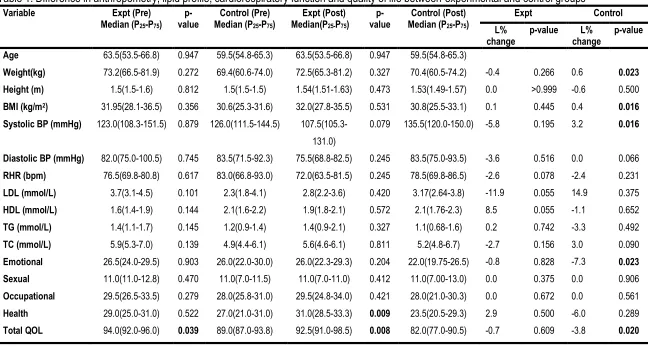
Postmenopausal women in the control group had a mean age of 61.3±7.81 years (age range of 51-75 years. 50.0% of the participants had primary level of education, 37.0% had secondary level of education while 13.0% had undergraduate certificates. Marital status analysis show that 70.0% were married and living with their spouses while 30.0% were widowed. The postmenopausal women in the experimental group had a mean age of 61.25±7.45 years (range = 46-70 years). 37.5% had primary school education, 50.0% obtained secondary school certificate, and 12.5% had undergraduate degree certificate. Marital status result indicates that 62.5% were married, 25.0% were widows and 12.5% unmarried. [Table 1: The table employs median and interquartile range to describe cardiorespiratory function, lipid profiles and QoL before and after the eight weeks of aerobic exercise intervention of the study]. Table 1 shows the difference in lipid profile, cardiorespiratory function and QoL between EG and CG of postmenopausal women. There was no significant difference in the parameters assessed between the sedentary and exercise groups of postmenopausal women before the experiment, except for the total QoL which was significantly higher in the exercise group. After the experiment, the emotional and total QoL were significantly higher in the exercise group.
VOLUME 12 | ISSUE 3 | 2017 | 703
Table 1. Difference in anthropometry, lipid profile, cardiorespiratory function and quality of life between experimental and control groups
Variable Expt (Pre)
Median (P25-P75)
p-value Median (PControl (Pre) 25-P75)
Expt (Post) Median(P25-P75)
p-value Median (PControl (Post) 25-P75)
Expt Control
L%
change p-value change L% p-value
Age 63.5(53.5-66.8) 0.947 59.5(54.8-65.3) 63.5(53.5-66.8) 0.947 59.5(54.8-65.3)
Weight(kg) 73.2(66.5-81.9) 0.272 69.4(60.6-74.0) 72.5(65.3-81.2) 0.327 70.4(60.5-74.2) -0.4 0.266 0.6 0.023
Height (m) 1.5(1.5-1.6) 0.812 1.5(1.5-1.5) 1.54(1.51-1.63) 0.473 1.53(1.49-1.57) 0.0 >0.999 -0.6 0.500
BMI (kg/m2) 31.95(28.1-36.5) 0.356 30.6(25.3-31.6) 32.0(27.8-35.5) 0.531 30.8(25.5-33.1) 0.1 0.445 0.4 0.016
Systolic BP (mmHg) 123.0(108.3-151.5) 0.879 126.0(111.5-144.5) 107.5(105.3-131.0)
0.079 135.5(120.0-150.0) -5.8 0.195 3.2 0.016
Diastolic BP (mmHg) 82.0(75.0-100.5) 0.745 83.5(71.5-92.3) 75.5(68.8-82.5) 0.245 83.5(75.0-93.5) -3.6 0.516 0.0 0.066
RHR (bpm) 76.5(69.8-80.8) 0.617 83.0(66.8-93.0) 72.0(63.5-81.5) 0.245 78.5(69.8-86.5) -2.6 0.078 -2.4 0.231
LDL (mmol/L) 3.7(3.1-4.5) 0.101 2.3(1.8-4.1) 2.8(2.2-3.6) 0.420 3.17(2.64-3.8) -11.9 0.055 14.9 0.375
HDL (mmol/L) 1.6(1.4-1.9) 0.144 2.1(1.6-2.2) 1.9(1.8-2.1) 0.572 2.1(1.76-2.3) 8.5 0.055 -1.1 0.652
TG (mmol/L) 1.4(1.1-1.7) 0.145 1.2(0.9-1.4) 1.4(0.9-2.1) 0.327 1.1(0.68-1.6) 0.2 0.742 -3.3 0.492
TC (mmol/L) 5.9(5.3-7.0) 0.139 4.9(4.4-6.1) 5.6(4.6-6.1) 0.811 5.2(4.8-6.7) -2.7 0.156 3.0 0.090
Emotional 26.5(24.0-29.5) 0.903 26.0(22.0-30.0) 26.0(22.3-29.3) 0.204 22.0(19.75-26.5) -0.8 0.828 -7.3 0.023
Sexual 11.0(11.0-12.8) 0.470 11.0(7.0-11.5) 11.0(7.0-11.0) 0.412 11.0(7.00-13.0) 0.0 0.375 0.0 0.906
Occupational 29.5(26.5-33.5) 0.279 28.0(25.8-31.0) 29.5(24.8-34.0) 0.421 28.0(21.0-30.3) 0.0 0.672 0.0 0.561
Health 29.0(25.0-31.0) 0.522 27.0(21.0-31.0) 31.0(28.5-33.3) 0.009 23.5(20.5-29.3) 2.9 0.500 -6.0 0.289
704 | 2017 | ISSUE 3 | VOLUME 12 © 2017 University of Alicante
DISCUSSION
Alterations in sex hormone profiles (particularly the decline in oestrogen levels) acts as a contributory factor in the development of physical and metabolic derangements among postmenopausal women (Atapattu & De, 2015). Aging women, particularly those in the menopausal age bracket of 50 to 70, are mostly sedentary (Villaverde Gutiérrez et al., 2012). Women in this phase have been reported to be susceptible to obesity, metabolic syndrome, cardiovascular diseases, stroke and psychological symptoms independent of the traditional risk factors associated with such health set-backs (Hackney, 2017). The length and quality of life of aging women thus become adversely affected if these health risks are left undiagnosed and untreated
(Stachowiak, Pertyński, & Pertyńska-Marczewska, 2015).
This study assessed the effect of aerobic exercise as a non-pharmacological intervention for preventing and attenuating health risks in postmenopausal Ghanaian women. From the results in table 1, the EG showed non-significant improvement in systolic and diastolic blood pressure (SBP/DBP), and resting heart rate by 5.8L%, 3.6L% and 2.6L% respectively. These are in congruence with other studies that reported significant improvement in blood pressure following aerobic exercise (Ammar, 2015; Pattyn, Cornelissen, Eshghi, & Vanhees, 2013; Perry et al., 2015). A meta-analysis study demonstrated that endurance, isometric and resistance training lowers systolic BP and diastolic BP whereas combined training lowers only diastolic BP in healthy adults over 18 years (Cornelissen & Smart, 2013). The findings of a study in Brazilian menopausal women with metabolic syndrome however indicated that blood pressure is not affected by aerobic exercise (Lima, Couto, Cardoso, Toscano, Lidiane Tavares Silva, & Mota, 2012). Also, two groups of postmenopausal women who exercised for 30 and 45 minutes, 5 days per week over a 12 week period did not show any significant change in pre and post values of systolic and diastolic BP (Dalleck et al., 2009). Nevertheless, cross-sectional studies suggest that aerobic exercise significantly improves cardiorespiratory function even in women experiencing menopause (Adanu et al., 2006; E. W. Freeman et al., 2010; Ellen W. Freeman, Sammel, & Sanders, 2015).
In another study, regular aerobic exercise lasting 12 weeks contributed to significant reductions in resting blood pressure of postmenopausal women (Ellen W. Freeman et al., 2015). In a study to determine the effects of daily walking on lowering blood pressure in postmenopausal women that lasted 24 weeks, there were significant reductions in systolic blood pressure (Freeman et al., 2010). These results are also supported by a study which resulted in significantly reduced resting blood pressure of postmenopausal women after 12 weeks of aerobic exercise (Al-Safi & Polotsky, 2015). All this evidences suggest that 8 weeks aerobic exercise training may not produce statistically significant changes in blood pressure of postmenopausal women. The literatures stated above prove that for aerobic exercise to result in significant improvement of systolic and diastolic blood pressure, the exercise duration must be at least 12 weeks.
VOLUME 12 | ISSUE 3 | 2017 | 705 the EG of this study agrees with other studies (Kelley, Kelley, & Tran, 2005; Pattyn et al., 2013; Trabka et al., 2014).
Total cholesterol to HDL ratio (cardiovascular risk ratio) has a greater predictive capacity than the isolated components of lipid profile which could be a sensitive and specific index of cardiovascular risk. A study concluded after sensitivity analyses that, aerobic exercise only increases HDL-C while decreasing the cardiovascular risk ratio in older adults (Millan et al., 2009). With the exception of HDL-C, our results of a non-significant improvement in other lipid profile parameters with exercise are confirmed in related studies (Dalleck et al., 2009; Jones & Sutton, 2008; Kelley, Kelley, & Tran, 2005). This study did not provide any dietary interventions which could have resulted in greater improvements in the lipoprotein profile as concluded by a study to examine the effect of diet and exercise intervention on blood pressure, insulin, oxidative stress, and nitric oxide availability(Messier et al., 2009). A study (Chen et al., 2010) concluded that blood lipid profiles improve with exercise as a result of an accumulation of effects over time rather than just a result of a recent exercise. Hence, achieving significant increase in HDL-C will require a period of over two years and such changes in HDL-C and TG after exercise training is minimal in individuals with greater BMI, body fat or more central adipose distribution as evident in most postmenopausal women (Deroo et al., 2014; Morgan, Cook, Rapkin, & Leuchter, 2005). These physical characteristics may be indicative of underlying metabolism inadequacies that may be responsible for impeded exercise training induced changes in lipoprotein profiles (Deroo et al., 2014). Considering previous evidences (Dyck & Frisby, 2000; Swift, Earnest, Blair, & Church, 2012), it is safe to conclude that the results of the lipid profile of participants in this study may have shown more statistical significance given exercise training of more than eight weeks.
Although there have been documentations that the undesirable effects of menopause on QoL can be ameliorated with therapeutic exercise programmes (Avis et al., 2015; Chen et al., 2009; Saha et al., 2013; Swift et al., 2012), this study presented no significant changes in the sexual, emotional, occupational and total QoL of the EG as assessed by the Utian quality of life scale (Utian, 2007). There is also no significant difference in the health QoL between EG and CG before the intervention contrary to the significantly higher difference in the EG after 8 weeks when compared to the CG. The significant difference in total QoL between the two groups after the eighth week is explained by the significant decrease in total QoL by 3.8L% in the CG after the 8-week non active period. Emotional QOL also decreased significantly by 3.2L% in the CG group.
These results are in line with studies which conclude that QoL may be associated with geographical location and as such, may differ for people living in different places (Conde, Pinto-Neto, Santos-Sa, Costa-Paiva, & Martinez, 2006). It was affirmed that menopause as a life event has no effect on quality of life but the presence and intensity of climacteric symptoms may have a negative impact on all the aspects of quality of life (Kim et al., 2013). Despite a submission that physical, social and psychological changes that occur during the menopausal stage of women have negative effects on their QoL (Teoman, Özcan, & Acar, 2004), there has been presumption that ethnic diversity may be responsible for differences in quality of life of individuals in different geographical locations (Heringa et al., 2015). Hence, one may tend to conclude that the insignificant difference in quality of life of participants in this study is a result of the inability of the UQoL to consider the ethnic diversity of postmenopausal women in Kumasi.
CONCLUSION
706 | 2017 | ISSUE 3 | VOLUME 12 © 2017 University of Alicante
sponsored aerobic exercise programmes geared towards healthy living of postmenopausal women in Kumasi Ghana are recommended.
CONFLICTS OF INTEREST STATEMENT
Authors declared no conflict of interest.
ACKNOWLEDGMENTS
Authors’ profound gratitude goes to all the women in the Women’s Fellowship at the Christ Congregation
Presbyterian Church, KNUST who volunteered and cheerfully participated in the study. We are also grateful to the staff of Medilab Diagnostics Center especially Mr. Alfred CUDJOE and Mr. John PAUL for their assistance in taking blood samples.
REFERENCES
1. ACSM. (2014). ACSM Guidelines for Exercise Testing and Prescription. Medicine & Science in Sports & Exercise (Vol. 37). http://doi.org/9781609136055
2. Adanu, R. M. K., Hill, a G., Seffah, J. D., Darko, R., Anarfi, J. K., & Duda, R. B. (2006). Secular trends in menarcheal age among Ghanaian women in Accra. Journal of Obstetrics and Gynaecology : The
Journal of the Institute of Obstetrics and Gynaecology, 26(6), 550–4.
http://doi.org/10.1080/01443610600811425
3. Agil, A., Abike, F., Daskapan, A., Alaca, R., & Tuzun, H. (2010). Short-term exercise approaches on menopausal symptoms, psychological health, and quality of life in postmenopausal women. Obstet Gynecol Int, 2010. http://doi.org/10.1155/2010/274261
4. Al-Safi, Z. A., & Polotsky, A. J. (2015). Obesity and Menopause. Best Practice and Research: Clinical Obstetrics and Gynaecology, 29(4), 548–553. http://doi.org/10.1016/j.bpobgyn.2014.12.002
5. Ammar, T. (2015). Effects of aerobic exercise on blood pressure and lipids in overweight hypertensive postmenopausal women. Journal of Exercise Rehabilitation, 11(3), 145–150. http://doi.org/10.12965/jer.150204
6. Arthur, K. N. F., Adu-Frimpong, M., Osei-Yeboah, J., Obu Mensah, F., & Owusu, L. (2013). The prevalence of metabolic syndrome and its predominant components among pre-and postmenopausal Ghanaian women. BMC Research Notes, 6(1), 446. http://doi.org/10.1186/1756-0500-6-446
7. Atapattu, P. M., & De, A. (2015). iMedPub Journals Menopause and Exercise : Linking Pathophysiology to Effects, 1–8.
8. Avis, N. E., Carolina, N., & Crawford, S. L. (2015). Duration of Menopausal Vasomotor Symptoms Over the Menopause Transition. JAMA : The Journal of the American Medical Association, 175(4), 531–539. http://doi.org/10.1001/jamainternmed.2014.8063.Duration
9. Borud, E. K., Alraek, T., White, A., & Grimsgaard, S. (2010). The Acupuncture on Hot Flashes Among Menopausal Women study: observational follow-up results at 6 and 12 months. Menopause (New York, N.Y.), 17, 262–268. http://doi.org/10.1097/gme.0b013e3181c07275
10. Broekmans, F. J., Knauff, E. a H., te Velde, E. R., Macklon, N. S., & Fauser, B. C. (2007). Female reproductive ageing: current knowledge and future trends. Trends in Endocrinology and Metabolism: TEM, 18(2), 58–65. http://doi.org/10.1016/j.tem.2007.01.004
VOLUME 12 | ISSUE 3 | 2017 | 707 women. Chinese Journal of Integrative Medicine, 16(6), 498–503. http://doi.org/10.1007/s11655-010-0574-1
12. Chen, X., Zheng, Y., Zheng, W., Gu, K., Chen, Z., Lu, W., & Shu, X. O. (2009). Effect of Regular Exercise on Quality of Life Among Breast Cancer Survivors _ American Journal of Epidemiology _ Oxford Academic. Am J Epidemiol, 170(7), 854–862.
13. Conde, L. I. O. M., Pinto-Neto, O. M., Santos-Sa, D., Costa-Paiva, L., & Martinez, E. Z. (2006). Factors associated with quality of life in a cohort of postmenopausal women. Gynecological Endocrinology, 22(8), 441–446. http://doi.org/10.1080/09513590600890306
14. Cornelissen, V. A., & Smart, N. A. (2013). Exercise training for blood pressure: a systematic review
and meta-analysis. Journal of the American Heart Association, 2(1).
http://doi.org/10.1161/JAHA.112.004473
15. Dalleck, L. C., Allen, B. A., Hanson, B. A., Borresen, E. C., Erickson, M. E., & De Lap, S. L. (2009). Dose-response relationship between moderate-intensity exercise duration and coronary heart
disease risk factors in postmenopausal women. Journal of Women’s Health, 18(1), 105–113. http://doi.org/10.1089/jwh.2008.0790
16. de Villiers, T. J., Bagratee, J. S., Dalmeyer, J. P., Davey, M. R., Davis, C. P., Guidozzi, F., … van
Waart, J. (2007). South African menopause society council revised consensus position statement on menopausal hormone therapy. South African Medical Journal, 97(5), 354–357. http://doi.org/10.7196/samj.8423
17. De Villiers, T. J., Gass, M. L. S., Haines, C. J., Hall, J. E., Lobo, R. A., Pierroz, D. D., & Rees, M. (2013). Global Consensus Statement on menopausal hormone therapy. Maturitas, 74(4), 391–392. http://doi.org/10.1016/j.maturitas.2013.02.001
18. Deroo, B. J., Korach, K. S., Barros, R. P. a, Gustafsson, J.-A. J.-Å. a, Brzozowski, A. M., Pike, A. C.,
… Stro, A. (2014). Estrogen receptors and human disease. Nature, 116(3), 561–570. http://doi.org/10.1172/JCI27987.Selective
19. Diep, C. H., Daniel, A. R., Mauro, L. J., Knutson, T. P., & Lange, C. A. (2015). Progesterone action in breast, uterine, and ovarian cancers. Journal of Molecular Endocrinology. http://doi.org/10.1530/JME-14-0252
20. Dotlic, J., Gazibara, T., Rancic, B., Radovanovic, S., Milosevic, B., Kurtagic, I., … Utian, W. (2015).
Translation and validation of the Utian Quality of Life Scale in Serbian peri- and postmenopausal women. Menopause: The Journal Of The North American Menopause Society, 22(9), 984–992. http://doi.org/10.1097/gme.0000000000000417
21. Dyck, L., & Frisby, W. (2000). The Health Benefits of Physical Activity for Girls and Women. Canada. Retrieved from www.bccewh.bc.ca
22. Fahlman, M. M., Boardley, D., Lambert, C. P., & Flynn, M. G. (2002). Effects of Endurance Training and Resistance Training on Plasma Lipoprotein Profiles in Elderly Women. Journal of Gerontology: BIOLOGICAL SCIENCES America, 57(2), 54–60.
23. Farahmand, M., Ramezani Tehrani, F., Bahri Khomami, M., Noroozzadeh, M., & Azizi, F. (2015). Surgical menopause versus natural menopause and cardio-metabolic disturbances: A 12-year population-based cohort study. Journal of Endocrinological Investigation, 38(7), 761–767. http://doi.org/10.1007/s40618-015-0253-3
24. Ferdous, T., Jahan, N., Sultana, N., Akhter, H., Islam, M. M., & Alam, M. R. (2011). Physical Exercise is More Effective Than HRT in Improving Lipid Profile Status in Postmenopausal Women. Bangladesh J Physiol Pharmacol, 27(1&2), 9–12.
25. Freeman, E. W., Sammel, M. D., Lin, H., & Garcia, C. R. (2010). Obesity and reproductive hormone
levels in the transition to menopause. Menopause, 17(4), 678–679.
708 | 2017 | ISSUE 3 | VOLUME 12 © 2017 University of Alicante
26. Freeman, E. W., Sammel, M. D., & Sanders, R. J. (2015). Risk of Long Term Hot Flashes After Natural Menopause : Evidence From the Penn Ovarian Aging. Menopause, 21(9), 924–932. http://doi.org/10.1097/GME.0000000000000196.RISK
27. GNDP. (2004). Standard Treatment Guidelines − Ghana. Accra.
28. Hackney, A. C. (2017). Sex Hormones, Exercise and Women. http://doi.org/10.1007/978-3-319-44558-8
29. Heringa, S. M., Begemann, M. J. H., Goverde, A. J., & Sommer, I. E. C. (2015). Sex hormones and oxytocin augmentation strategies in schizophrenia: A quantitative review. Schizophrenia Research, 168(3), 603–613. http://doi.org/10.1016/j.schres.2015.04.002
30. Jones, G. L., & Sutton, a. (2008). Quality of life in obese postmenopausal women. Menopause International, 14(1), 26–32. http://doi.org/10.1258/mi.2007.007034
31. Kelley, G. A., Kelley, K. S., & Tran, Z. V. (2005). Exercise, Lipids, and Lipoproteins in Older Adults:
A Meta‐Analysis. Preventive Cardiology, 8(4), 206–214.
http://doi.org/10.1016/j.surg.2006.10.010.Use
32. Kim, J. J., Kurita, T., & Bulun, S. E. (2013). Progesterone action in endometrial cancer,
endometriosis, uterine fibroids, and breast cancer. Endocrine Reviews.
http://doi.org/10.1210/er.2012-1043
33. Kwawukume, E. Y., Ghosh, T. S., & Wilson, J. B. (1993). Menopausal age of Ghanaian women. International Journal of Gynecology and Obstetrics, 40(2), 151–155. http://doi.org/10.1016/0020-7292(93)90376-8
34. Lima, A. H. R. de A., Couto, H. E., Cardoso, G. A., Toscano, Lidiane Tavares Silva, A. S., & Mota, M. P. G. (2012). Aerobic Training does not Alter Blood Pressure in Menopausal Women with Metabolic Syndrome. Arquivo Da Sociedade Brasileira de Cardiologia, 99(5), 979–987.
35. Martyn-St James, M., & Carroll, S. (2009). A meta-analysis of impact exercise on postmenopausal bone loss: the case for mixed loading exercise programmes. British Journal of Sports Medicine, 43(12), 898–908. http://doi.org/10.1136/bjsm.2008.052704
36. Messier, V., Karelis, A. D., Lavoie, M. E., Brochu, M., Faraj, M., Strychar, I., & Rabasa-Lhoret, R. (2009). Metabolic profile and quality of life in class I sarcopenic overweight and obese postmenopausal women: a MONET study. Applied Physiology, Nutrition, and Metabolism = Physiologie Appliquee, Nutrition et Metabolisme, 34(1), 18–24. http://doi.org/10.1139/H08-135 37. Millan, J., Pinto, X., Munoz, A., Zuniga, M., Rubies-Prat, J., Pallardo, L. F., … Pedro-Botet, J. (2009).
Lipoprotein ratios: Physiological significance and clinical usefulness in cardiovascular prevention. Vascular Health and Risk Management, 5, 757–765. http://doi.org/10.2147/VHRM.S6269
38. Morgan, M. L., Cook, I. A., Rapkin, A. J., & Leuchter, A. F. (2005). Estrogen augmentation of antidepressants in perimenopausal depression: A pilot study. Journal of Clinical Psychiatry, 66(6), 774–780. http://doi.org/10.4088/JCP.v66n0617
39. Nelson, H. D., Walker, M., Zakher, B., & Mitchell, J. (2014). Review Annals of Internal Medicine Menopausal Hormone Therapy for the Primary Prevention of Chronic Services Task Force Recommendations. Ann Intern Med. 2012;157:104-113., 157(2).
40. Nikpour, S., & Haghani, H. (2014). The effect of exercise on quality of life in postmenopausal women referred to the Bone densitometry centers of Iran University of Medical Sciences. Journal of Mid-Life Health, 5(4), 176–179. http://doi.org/10.4103/0976-7800.145156
41. Ohemeng, F. (2009). The Meaning of Menopause among Ghanaian-Canadian Women. Ghana Social Science Journal, 236–258.
VOLUME 12 | ISSUE 3 | 2017 | 709 43. Perry, J. R. B., Murray, A., Day, F. R., & Ong, K. K. (2015). Molecular insights into the aetiology of
female reproductive ageing. Nature Reviews Endocrinology, 11(12), 725–734. http://doi.org/10.1038/nrendo.2015.167
44. Saha, K. R., Rahman, M. M., Paul, A. R., Das, S., Haque, S., Jafrin, W., & Mia, A. R. (2013). Changes in lipid profile of postmenopausal women. Mymensingh Medical Journal : MMJ, 22(4), 706–711. 45. Schwartz, E., Morelli, V., & Holtorf, K. (2011). Hormone Replacement Therapy in the Geriatric
Patient: Current State of the Evidence and Questions for the Future-Estrogen, Progesterone, Testosterone, and Thyroid Hormone Augmentation in Geriatric Clinical Practice: Part 2. Clinics in Geriatric Medicine. http://doi.org/10.1016/j.cger.2011.07.004
46. Stachowiak, G., Pertyński, T., & Pertyńska-Marczewska, M. (2015). Metabolic disorders in menopause. Przeglad Menopauzalny, 14(1), 59–64. http://doi.org/10.5114/pm.2015.50000
47. Staessen, J. A., van der Heijden-Spek, J. J., Safar, M. E., Den Hond, E., Gasowski, J., Fagard, R.
H., … Van Bortel, L. M. (2001). Menopause and the characteristics of the large arteries in a population study. J Hum Hypertens, 15(8), 511–518. http://doi.org/10.1038/sj.jhh.1001226
48. Swift, D. L., Earnest, C. P., Blair, S. N., & Church, T. S. (2012). The effect of different doses of aerobic exercise training on endothelial function in postmenopausal women with elevated blood pressure: results from the DREW study. British Journal of Sports Medicine, 46(10), 753–8. http://doi.org/10.1136/bjsports-2011-090025
49. Te Velde, E. R., & Pearson, P. L. (2002). The variability of female reproductive ageing. Human Reproduction Update. http://doi.org/10.1093/humupd/8.2.141
50. Teoman, N., Özcan, A., & Acar, B. (2004). The effect of exercise on physical fitness and quality of life in postmenopausal women. Maturitas, 47(1), 71–77. http://doi.org/10.1016/S0378-5122(03)00241-X
51. Todd, C. A., Sanchez, A. M., Garcia, A., Denny, T. N., & Sarzotti-Kelsoe, M. (2014). Implementation of Good Clinical Laboratory Practice (GCLP) guidelines within the External Quality Assurance Program Oversight Laboratory (EQAPOL). Journal of Immunological Methods. http://doi.org/10.1016/j.jim.2013.09.012
52. Tornqvist, L., Vartia, P., & Vartia, Y. O. (1985). How Should Relative Changes Be Measured? The American Statistician, 39(1), 43–46. http://doi.org/10.1080/00031305.1985.10479385
53. Trabka, B., Zubrzycki, I. Z., Ossowski, Z., Bojke, O., Clarke, A., Wiacek, M., & Latosik, E. (2014). Effect of a MAST Exercise Program on Anthropometric Parameters, Physical Fitness, and Serum Lipid Levels in Obese Postmenopausal Women. Journal of Human Kinetics, 42(1), 149–155. http://doi.org/10.2478/hukin-2014-0069
54. Utian, W., & Boggs, P. (1999). Postmenopausal Women’s Perceptions about Menopause and
Midlife.pdf. Menopause International, 6(2), 122–128.
55. Utian, W. H. (2007). Quality of life (QOL) in menopause. Maturitas, 57(1), 100–102. http://doi.org/10.1016/j.maturitas.2007.02.021
56. Villaverde Gutiérrez, C., Torres Luque, G., Ábalos Medina, G. M., Argente del Castillo, M. J., Guisado, I. M., Guisado Barrilao, R., & Ramírez Rodrigo, J. (2012). Influence of exercise on mood in postmenopausal women. Journal of Clinical Nursing, 21(7–8), 923–928. http://doi.org/10.1111/j.1365-2702.2011.03972.x
57. Zöllner, Y. F., Acquadro, C., & Schaefer, M. (2005). Literature Review of Instruments to Assess Health-Related Quality of Life during and after Menopause. Quality of Life Research, 14(2), 309–