Protein Structure and Function
in the Post Genomic Era
T
he European Science Foundation (ESF) acts as a catalyst for thedevelopment of science by bringing together leading scientists and funding agencies to debate, plan and implement pan-European scientific and science policy initiatives.
ESF is the European association of 67 major national funding agencies devoted to basic scientific research in 24 countries. It represents all scientific disciplines: physical and engineering sciences, life and environmental sciences, medical sciences, humanities and social sciences. The Foundation assists its Member Organisations in two main ways: by bringing scientists together in its scientific programmes, EUROCORES, forward looks, networks, exploratory workshops and European research conferences, to work on topics of common concern; and through the joint study of issues of strategic importance in European science policy.
It maintains close relations with other scientific institutions within and outside Europe. By its activities, the ESF adds value by cooperation and coordination across national frontiers and endeavours, offers expert scientific advice on strategic issues, and provides the European forum for science.
COPYRIGHT: European Science Foundation
Reproduction, with appropriate acknowledgements, of this report is authorised, except for commercial uses.
An electronic version of the report is available at the ESF’s web site www.esf.org
Cover picture:
Protein Structure and Function
in the Post Genomic Era
Page
Foreword 3
Executive summary 4
Recommendations 6
Major programmes 7
Protein production laboratories 8
Three-dimensional (3D) structure laboratories 8
Proteomics laboratories 9
Bioinformatics 10
Education and training 11
Intellectual Property Rights (IPR) 11
Background: New opportunities for biology 12
Major scientific steps 12
New research modes and requirements 13
Current status of protein research 15
Structural genomics 15
Bioinformatics 17
Proteomics 18
Protein production and engineering 20
Protein folding 20
Membrane proteins 20
Protein-protein interactions and multifunctional protein complexes 21
Glycobiology 22
Integrative biology 22
Revisit of the 1998 SR Review 24
Multidisciplinary working group on Protein Structure and Function 26
Appendices 27
1. Group I Report: Protein Production in the Structure-Function
and Structural Genomics Fields 27
2. Group II Report: Biophysical Chemistry Methods in a European Context 41 3. Group III Report: Macromolecular 3D Structure Analysis in Europe 51
4. Group IV Report: Proteomics 65
In 1997, the European Science Foundation (ESF) was asked by the UK Medical Research Council to look into the prospects for syn-chrotron radiation in the Life Sciences in Europe. This prompted the ESF Board to set up a review of the needs for European synchrotron beam-lines for biological and biomedical research. The review on the Needs for European Synchrotron and Related Beam-Lines for Biological and Biomedical Research, was published as an ESF Study Report in November 1998. It proposed immediate and medium-term actions primarily related to increasing the efficiency of the use of existing national and European facilities, to investing in further development of beam-lines and detectors, and to implementing the existing plans for new synchrotron radiation sources.
As a follow-up to this ESF review, the Foundation invited its Member Organisations to a one-day meeting in London on 17 March 1999, to discuss the review and to agree on possible future steps to be taken in this area. This meeting ended with a general agreement that the priorities for shared attention fall into three broad areas: (1) protein structure and function; (2) proteins in cell function; and (3) informatics.
In the wake of this meeting, the ESF Board came to the conclusion that the ESF should play a leading role in the follow-up to the review and decided to set up a small steering group to consider possibilities for a broadly-based and multidisciplinary action in post-genome research. The steering group met in London on 23 June 1999 and identified several key points that must be strengthened if Europe is to remain competitive with the USA and Japan. In view of the new opportunities opened up by the ongoing developments in genomics and bioinformatics, the steering group proposed to focus on protein structure and function in the biological/biomedical
context, and to set up a multidisciplinary working group in this area with a remit along the following lines:
.
Defining the needs for different methods and technologies;.
Promoting the development of new methods and technologies;.
Identifying the bottlenecks in technologies and infrastructures as well as in human skills;.
Developing exchanges between scientistsof different expertise;
.
Promoting training in various traditional as well as new disciplines;.
Proposing actions to be taken by policy makers at national and European levels.This proposition was discussed and agreed at the ESF Governing Council on 23 and 24 September 1999, and the multidisciplinary working group (see p. 26) met for the first time in London on 7 December 1999. Based on the general principles already identified, five thematic groups1 were set up according to
particular methodologies, each of them chaired by a member of the working group.
The multidisciplinary working group also listed a number of scientific issues for the thematic groups to reflect on, such as: protein identification, protein folding and unfolding, protein dynamics, protein and protein-ligand interactions, protein identification, structure of supra-molecular complexes, membrane proteins, protein engineering, integrative biology, and manpower and training.
The reports of the five thematic groups were generated during the spring and summer of 2000. The chairs of the thematic groups met in Strasbourg on 18 and 19 September 2000, to work out a draft report based on their thematic reports (Appendices 1 to 5). The final report was written after thorough consultation among the members of the multidisciplinary working group and the five thematic groups.
1 Group I:
4
Executive summary
With the new opportunities for biology in the post-genomic era comes a requirement not only for expensive equipment, but also for building stronger European research units and to strengthen scientific collaboration between a range of experts, often beyond the reach of individual European states. Furthermore, the high-throughput approaches initially developed for genome sequencing are now generating an ever-rising tide of information about protein structure and function. It is important to exploit, and develop rapidly, such opportunities in concert with the more classical, problem-oriented research on proteins. In the USA and Japan major investments are already in hand in what is loosely called ‘structural genomics’. It should be remembered that in these two countries there are no national barriers to the funding schemes used to support these activities, and in the USA a number of nation-wide consortia have recently been funded within the rapidly expanding budget of the National Institutes of Health (NIH). In Europe, there is now an urgent need to join national and European forces to reap the benefits on offer and to avoid wasteful duplication of effort. In so doing, it is important that we build on existing strengths in developing and exploiting the new research opportunities. We suggest that the newly established scheme of the European Science Foundation Collaborative Research Programmes (EUROCORES), could provide an effective and efficient need-driven mechanism for collaboration at a multinational level within Europe.
Based on these premises we suggest the following actions:
1 . Establish networks of laboratories based on the best possible equipment and expertise, devoted to the various steps from genome analysis to the identification
and understanding of protein function. In establishing these networks, it is important to ensure not only strong interactions between the use of complementary approaches and methodologies but also to develop and disseminate the use of new technologies.
2. Establish high-throughput research in the area of protein structure and function, based on existing national or European research groups and institutions, at the same time ensuring a proper balance between this novel approach and the different modes of more problem-orientated research on proteins. This will not only include access to expensive research facilities such as synchrotron radiation, Nuclear Magnetic Resonance (NMR) instrumentation and high-throughput mass spectrometry, but also dedicated efforts to solve progress-limiting steps related to the production and functional characterisation of proteins.
3 . Establish both the networks and the high-throughput laboratories on a competitive basis, ensuring that they are efficiently managed and regularly evaluated, judged on performance and scientific needs.
4 . Emphasise the need and take steps to educate and attract trained staff into the field, as exemplified by the pressing shortage of bioinformaticists.
5 . Referring to the 1998 ESF report on the Needs for European synchrotron and related beam-lines for the Life Sciences, the working group notes major
improvements in line with the
but the planned third-generation
synchrotrons with beam-lines dedicated to structural biology remain vital investments for future European competitiveness in the field of protein structure and function.
6. Since most, if not all, Member
Organisations of the ESF are currently taking steps to meet the new challenges in the post-genomic era of the Life Sciences, the working group proposes the establishment of a number of
multinational collaborative research programmes in the field of structure and function of proteins, adopting the variable geometry of, for example, the EUROCORES. Education and training should be organised as part of such activities. Topics for programme collaboration are suggested under Recommendations (page 6).
7. Address the problems regarding the Intellectual Property Rights (IPR) that will arise from the results, before the
EUROCORES or other projects begin.
6
Today, the rapid increase in genomic informa-tion offers a new stepping stone for the Life Sciences, often called ‘functional genomics’. This research is aimed at defining the expres-sion and function of each gene of a genome (in practice, the presence, abundance, loca-tion, temporal regulation and function of a protein), with the purpose ultimately of understanding the integrated function of the intact, living cell or organism.
Knowledge of protein structure and function remains central to an academic understanding of essentially all areas of the Life Sciences, and is crucial to the commercial sector over a whole range of applications from health care to food and agriculture. With the new
opportunities for the Life Sciences in the post-genomic era comes a need not only for expensive equipment and the adoption of new methodological approaches, but also for education, training and scientific collaboration between various experts beyond the reach of most individual European states. There is an urgent need to link national and European capacities to reap the benefits on offer and to avoid unnecessary duplication of effort. In so doing, it is important that we build on existing strengths in developing and exploiting the new research opportunities.
For the European Life Sciences to be internationally competitive in elucidating the structure and function of proteins, the working group identifies a number of specific needs such as:
1 . solving the progress-limiting steps in the production, purification and
crystallisation of proteins;
2 . determining high-resolution 3D structures of these proteins (structural genomics);
3 . exploiting and developing new opportunities to determine the global
protein patterns in cells and organisms (proteomics);
4 . emphasising the need for in-depth studies of the relationship between the structure and function of proteins, including their interactions in supramolecular complexes;
5 . strengthening the field of bioinformatics and ensuring state-of-the-art access for all biologists to bioinformatics and various databases;
6 . establishing and developing high-throughput research technologies for the study of protein structure and function.
While these individual aspects of the field were discussed by separate subgroups, they clearly must be integrated in any real research programme in functional/structural genomics. The expression of soluble protein in a high-throughput manner is presently the rate-limiting step, and determined efforts must urgently be made to overcome this obstacle. However, attacking this in isolation is not appropriate: associated biophysical studies on the state of the proteins produced, bioinformatics assessment of the choice of targets and data-basing of the results of the expression procedures, must be closely linked in, as well as developing methods for NMR and crystallographic analysis. A holistic approach is vital: we do not want methods developed in isolation, but rather an integrated attack on the problems by laboratories with expertise in the relevant areas.
Furthemore, time is of the essence: the USA and Japan have had substantial programmes up and running for some time: the first round of results is already emerging from these teams. The USA through the NIH has funded 7 projects with an overall budget of 150 million dollars over five years for structural genomics alone. Too much delay in Europe with
protracted discussions of how we might proceed is not enough, we must act now if we are not to fall further behind the rest of the world. It is most important that the European States secure strong research programmes in these areas. Special emphasis should be placed on co-ordination and networking at the European level regarding (1) focused research efforts at the highest competitive level; (2) access to instrumentation; and (3) training of personnel.
The working group proposes the following recommendations as central to the success of European efforts:
Major programmes
Major programmes such as the EUROCORES should be undertaken by groups of networked national and European laboratories or
research groups. These would not be limited to structure determination, but should include the development of novel scientific techni-ques for gene expression, protein production, crystallisation, biophysical characterisation, bioinformatics and studies of the various aspects of protein function in the living cell. Each programme should be composed of connected nodes following schemes of variable geometry adapted to fit the needs of particular programmes. Proper management of the programmes is vital, and a strong reviewing system will be essential for the selection of participating nodes and for the follow-up of research progress. The programmes should additionally provide the basis for exchange of staff, for education and training in key areas, such as gene expression and protein produc-tion, and for the development and wider dissemination of high-throughput techni-ques as these become cheaper and more efficient.
We suggest the establishment of programmes such as EUROCORES in the following areas (the need for education and training should be integrated in every programme, and
workshops and seminars should be organised across the borders of interlinked programmes):
.
Protein production and purification.
Structural genomics.
Proteomics.
Structural-functional relationships of proteins and supramolecular protein complexes.
BioinformaticsBefore launching a particular programme within the area of protein structure and function, the working group suggests a series of ESF exploratory workshops be held to develop the topics in detail. These workshops should be organised jointly by the ESF Standing Committees for Biomedical Sciences (EMRC), Life and Environmental Sciences (LESC) and Physical and Engineering Scien-ces (PESC) in order to gather the neScien-cessary expertise. The present study with its annexed reports on subject areas, together with the complementary efforts undertaken by the ESF Standing Committees, should give enough background information for a thorough planning of these workshops. The suggested programmes should aim at building on national and supranational complementary strengths, attracting the leading research groups in Europe.
8
training, but also take the responsibility for developing and running large-scale and high-throughput research on protein structure and function.
We suggest that the establishment of high-throughput research laboratories be based on existing national or European research groups and institutions, but reinforced by the necessary instrumentation and staff, both scientific and technical. These nodes should pursue automated robotic-controlled
approaches and be platforms for the
development of new high-throughput techno-logies. Although the problems may be technical and engineering rather than
scientific in the first instance, we suggest that the establishment of high-throughput operational approaches in association with existing target- or problem-oriented research on proteins will optimally create fruitful interactions between the two modes of research. To this end, we see an urgent need to develop high-throughput research in protein production, structural genomics and proteomics. The high-throughput mode must not be seen as an end in itself: its role is to improve our ability to address relevant biological problems.
Protein production laboratories
The establishment of laboratories in which new, highly efficient high-throughput produc-tion approaches are developed, and in which general and specific expertise and training in the production of proteins is provided, should help to remove one of the most evident bottle-necks in structural genomics. Such
laboratories should ideally be located in active – already built and running – research centres, in order to decrease costs, facilitate a quick implementation, and provide complementary infrastructure. The laboratories should be
Recommendations
financed with the requirement to provide central facilities and training, offer fellowships, organise workshops and practical courses, and to maintain a high quality of research on high-throughput methods for producing proteins. It is also important to organise and keep accessible systematic databases on protein production.
Three-dimensional (3D) structure laboratories
The equipment needed falls under three sub-headings: Macromolecular X-Ray
Crystallography, Nuclear Magnetic Resonance Spectroscopy and Cryogenic Electron Microscopy. All structural techniques rely heavily on automated computer suites for their most effective use. Only a small number of scientists contribute to the development of such software and a key role for the European agencies is to ensure these are strongly networked so as to avoid duplication of effort and provide user-friendly compatible systems. The provision of the necessary new instru-mentation could be considered in the light of the location of the nodes and networks covered by the suggested programmes for structural genomics.
Macromolecular X-ray crystallography
requires availability of, and access to, syn-chrotron beam-lines dedicated to
macromolecular crystallography, funded both nationally and at the European level (see page 24). Although the needs of X-ray
Nuclear Magnetic Resonance (NMR) is the second major structural technique. A small number of national and European centres with 800-900 MHz instruments already exist. Ensuring access to such facilities for all European scientists would require the esta-blishment of a further set, perhaps 5 to 10, of such centres. Any one instrument will probably not produce more than 25 new structures per annum, but the provision of information about non-crystallisable proteins and protein dynamics and interaction are important, sometimes crucial advantages.
Cryogenic Electron Microscopy (CEM) is ideally used for looking at super-large structures and complexes, many of which are likely to resist crystallisation. Again there are already a small number of European centres with state-of-the-art instruments, but a doubling of this number would ensure access for many more scientists.
In addition, Neutron scattering methods also provide unique and important complementary information at different levels of protein structure and dynamics. Europe already has the premier neutron sources in the world; the challenge is to maintain and develop state-of-the-art instrumentation with access for biological studies.
Proteomics laboratories
In addition to the need to determine the structures of proteins selected for high-throughput screening, there should be complementary efforts studying on a global scale the dynamics of gene activities in cells under specific growth conditions, when subjected to external stimuli or during certain stages of development. These studies are collectively referred to as ‘proteomics’.
While protein identification and the quantifi-cation of protein expression levels have so far been a limited approach, mainly due to
technical limitations imposed by the use of 2D gel-electrophoresis, recently reported gel-free differential proteome display methods may start to revolutionise the field. They will stimulate the need for the creation of facilities in which large-scale mass spectrometry of proteins and peptides will become the heart of future proteome centres. The concentration of such instrumentation on this large scale was initiated by a number of specialised companies, and has only recently been recognised at national and international academic levels. It is most important for the European Life Sciences that strong proteome centres be established across Europe. These centres must be closely associated with structural biology laboratories for optimum impact (or vice-versa). Access to technolo-gies for proteomics, such as mass
spectrometry, must be made available throughout Europe, and common database standards for proteins must be worked out.
The challenges in the post-genomic era lie not only in identifying and solving the high-resolution structures of as many proteins as possible, but also in addressing questions to bridge the gaps between molecular and cell biology and between thermodynamics and structure.
10
These new or renewed approaches will generate a vast amount of new information on extremely complex regulatory networks of protein expression, metabolic components and their interlocking activities. For the first time in history, biologists are in the challenging position of being able to see and to measure such events and they can start to discover and to unravel networks that are used by cellular systems. The complete integration of these data into global models of cellular function is possible only with the aid of a new type of bioinformatics, which can accept and store vast amounts of integrated cellular information, and do so in a format adapted to various means of data mining for maximal accessibility (‘system sciences’).
.
predict protein folds and provide homology-based models of protein structures;.
simulate protein dynamics;.
predict protein function based both on theoretical analyses and experimental studies (DNA and protein microarrays);.
analyse the evolution of proteins;.
develop global models of cell function(‘system sciences’).
There is a pressing shortage of trained bioinformaticists in Europe. This shortage is felt in industry and academia alike and is damaging the successful dissemination of the results from genome projects. Unless Europe is able to vitalise very quickly its bioinformatics community, most of the fruits of the large genome sequencing and functional genomics/ proteomics efforts will go to the USA.
There is a great need to promote exchange and collaboration (networks between laboratories, workshops on specific topics, academic-industrial sector interactions), to promote training (PhD studentships, post-doctoral fellowships), and to create a professional website offering lectures, tutorials and practicals.
There is alsoa major need for the establish-ment, maintenance and provision of access to databases in the various key areas central to the study of protein structure and function. Gene sequences and primary structures of proteins are already covered by, among other things, the European Bioinformatics Institute (EBI), whereas there is a pressing need for databases covering: (1) expression systems for cloned genes and protein engineering approaches; (2) purification protocols for expressed proteins, including solution properties such as solubility, stability and aggregation; (3) protein folding;
Recommendations
Bioinformatics
Bioinformatics not only provides the essential databases (DNA and protein sequence databases, 3D structure databases, gene and protein expression databases, metabolic pathway databases), it also supplies the computational tools required to:
.
identify targets for high-throughputprogrammes in structural biology;
(4) crystallisation protocols; and (5) database integration. In this context, it is very impor-tant to put the database activities of EBI on a secure footing.
Education and training
The need for skilled students, post-doctoral fellows and support scientists in all stages of the projects is acute. There is a shortage of suitable people trained to a high-level in practically all sectors, but especially in bioinformatics, protein chemistry and biophysics, protein production and purifica-tion, and the development of methods for structure determination. Europe must take the necessary action to ensure that these fields are attractive to young scientists in the future.
Intellectual Property Rights (IPR)
12
It has been said many times, but that does not make it any less true, that today we are witnessing the beginning of a revolutionary development in biology that is transforming not only our basic understanding of life but also opening up totally new opportunities for society in terms of food production, health care, and a variety of technical advances based on biological concepts. In this process, biology needs and will attract an increasing number of scientists and concepts from other disciplines, for example from the physical and mathematical sciences, to deepen our understanding of biological complexity. Furthermore, new disciplines, such as we see in the growing field of bioinformatics, will develop at the interfaces between old ones, and technology and biology will become more and more interlinked in the use of biology as the technology platform to provide goods and services to society. Research in biology today has an unprecedented level of interdisciplinarity.
Major scientific steps
The beginning of this transformation has been brought about by several major scientific advances. It is over fifty years since it was recognised that DNA is the carrier of the genetic information in the cell while the proteins are the functional components that carry out the host of functions which living organisms are required to perform. These include enzyme catalysis, redox reactions, ligand binding, an extensive range of specific macromolecular recognition processes in immunity and signal transduction, as well as key structural roles. Early studies of proteins were restricted to those that were produced naturally in large amounts and easy to extract. The development of DNA cloning
methodology changed this forever: any protein can, in principle, be obtained in large
amounts once its gene, or for eukaryotes its cDNA, has been cloned and inserted in an appropriate expression vector, and once the folding and solubility problems have been solved.
A second explosion came with the advent of techniques for the sequencing of whole genomes. At present about 40 microbial genomes have been sequenced and another 130 are on the way. The Saccharomyces cerevisiae (yeast), Caenorhabditis elegans (worm), Drosophila melanogaster (fruitfly) and Arabidopsisthaliana (plant) sequences are complete, and the human one has just been completed.
Background:
New opportunities for biology
It was also realised some years ago that the knowledge of the three-dimensional (3D) structure of a protein is essential for a full description and understanding of its function. Protein crystallography and NMR
spectroscopy are the techniques of choice for determining such atomic structures and both have advanced rapidly in recent years in their automation and throughput. Other approaches, like Cryogenic Electron Microscopy and proteomics, are also progressing quickly,
providing very interesting complementary information. However, our ability to determine 3D structures has fallen way behind the speed at which genome sequences at present are being determined. This mainly reflects an inability to express, purify and crystallise the proteins in an efficient and high-throughput manner rather than in intrinsic limitations of X-ray crystallography and NMR spectroscopy as techniques.
Today, the rapid increases in genomic informa-tion offer a new stepping stone for biology, often called ‘functional genomics’. Such research is aimed at defining the expression and function of each gene in a genome (in practice, normally the presence and function of a protein), with the purpose ultimately of understanding the integrated function of the intact, living cell or whole organism. This development is driven not only by the growing accumulation of genomic information, but also by new technologies for gene sequencing and mapping, for studies of gene expression, and for exploring protein function and metabolic interactions. This is supported by new developments in bioinformatics that allow the management of vast experimental databases, integration of various types of information to explore biological complexity, and the creation of unforeseen opportunities to conduct computer-assisted experiments. However, such analyses of the structure and the function of proteins is a much more difficult and time-consuming process than the determination of the DNA sequence of the corresponding genes. Moreover, it requires not only the use of expensive research facilities and instrumen-tation such as access to synchrotron radiation and high field NMR spectrometers, but also very strong efforts in protein over-expression, purification and crystallisation, which, if not achieved, will become an increasingly limiting step in studies of protein structure and function.
New research modes and requirements
The genomic projects of the last decade have introduced a new type of research into biology, based on high-throughput and dedicated research facilities for the purpose of rapidly and accurately producing and storing DNA sequence information. The data are stored in data banks accessible to all researchers, including those more interested in target-oriented research of a basic or applied character aimed at solving particular biological or technological problems. This approach, combined with bioinformatics, has proved to be very effective, not least in developing new technologies and
mathematical algorithms that are becoming accessible to individual researchers at affordable cost. The question now is how the very successful high-throughput research concept of gene sequencing and genomics can be harnessed for the elucidation of how the genome functions, in the selective expres-sion of a multitude of proteins and other macromolecules participating in regulatory processes and in various metabolic pathways characteristic of living cells and organisms. High-throughput approaches are conceptually easy to envisage for determining the structure of small, single-domain proteins and such developments are already aggressively under way in the USA and Japan, but with a few efforts only thus far in Europe. More complicated proteins, their association into complexes, macromolecular interactions in biological processes, the level of protein expression both spatial and temporal, the identification of unknown protein functions, etc., will require more sophisticated solutions and the development of new techniques.
14
important to gather the necessary expertise and to train new generations of young scientists to exploit the existing opportunities and to develop as yet unforeseen new ones. Consequently, we now see a restructuring of biological research internationally into defined national centres (either as single units or as networks between units) where the necessary expertise and technology platforms are gathered. However, there is great concern that this development is too sluggish in Europe and that the political systems at national and European levels are responding too slowly to the needs of modern biology. European competitiveness in biology and, as a result, the exploitation of biological knowledge for the benefit of industry and society, is being jeopardised. Major investments are already in hand in the USA and Japan in what is loosely called ‘structural genomics’. In these two countries it should be remembered that there are no national barriers to the funding schemes used to support these activities, and in the USA a number of nation-wide consortia have recently been funded by the National Institutes of Health (NIH).
The fragmentation of research effort and the lack of co-operation in Europe are inimical to the concentrated dedicated efforts needed in modern biology. European States must now join forces to achieve what is needed to secure the optimal development of competitive biology for the future. It is therefore high-time to define strategies, priorities and plans at national and European levels.
This would include:
.
establishing more effective means of collaboration to secure access to the most appropriate methods and facilities for determining the structure, dynamics and function of proteins;.
meeting the needs for international training and mobility of young researchers;.
developing the networking across Europethat is required to exploit to the full the scientific and commercial opportunities that biology now offers.
Proteins are at the core of biology. Inevitably, perhaps, the massive advances in genomics research over the past few years have now led to a renewed focus on protein structure and function. The immense successes of high-throughput approaches in genomics (DNA sequencing, DNA microarrays) have inspired similar initiatives in protein science, with high-throughput programmes for 3D structure determination as one of the most tangible result so far. However, to capitalise on the genomics revolution, large areas of protein biochemistry, molecular biophysics, structural biology, and theoretical work (bioinformatics) on protein structure and function must rapidly be strengthened. In this section, we discuss the future of protein research from various perspectives.
To facilitate the discussion and eliminate any misunderstandings, the working group agreed the following working definitions based on discussions at various meetings over the last couple of years:
Biotechnology: the use of living organisms, or components of living organisms, to make new products or provide new methods of produc-tion. Relevant techniques include the use of recombinant DNA, cell cloning, cell fusion and bioprocessing.
Genomics: the development of knowledge about the identity, nature and function of the material contained in the genome. This knowledge can be used to identify and manipulate organisms for use in the development of biotechnological processes and products.
Structural genomics: the science of determining the structures of the proteins in an organism.
Functional genomics: the science of
determining the function of a gene; in practice
determining the function of a protein. Functional genomics implies a systematic ‘whole organism approach’ as opposed to genetics, in which a single specific gene is the focus.
Proteomics: the quantitative and qualitative analysis of the global protein pattern of a tissue, a cell, an organelle or a supramolecular protein organisation present or synthesised at a given moment.
Bioinformatics: the use of computational techniques to handle, analyse, and add value to the flood of data coming out of modern genomics and proteomics research.
Structural genomics
In the post-genomic era, we are now in the position of being able to complement studies of protein function, solution interactions and dynamics, with work to define their high-resolution structures (Appendix 3). This creates an enormous incentive for developing high-throughput methods of analysis, from the expression of the cloned DNA sequence to the full 3D structure. It is most important to emphasise that all structural studies will benefit from high-throughput techniques. Thus, while we have usually been restricted to looking at systems integrated on a relatively small scale such as operons, the world would now appear to be our oyster. At first sight it seems that all we have to do is express our target gene and off we go: if only things were so easy!
16
component, has been established. However, especially with this target, there is a catch: only some of the proteins can be expressed in a soluble form and in a homogeneous 3D-fold suitable for crystallisation or NMR
spectroscopy. Smallish, especially single-domain, proteins are clearly viable, whereas others, such as larger multidomain proteins, glycosylated proteins expressed in the “wrong” organism and most membrane proteins, are likely to prove problematical. Using current technologies, high-throughput approaches are proving easy to develop for the first category. Such studies are already aggressively underway in the USA and Japan, but there are only a few comparable efforts to date in Europe (see Appendix 3). This highlights one aspect of the work, turning current easy expression and crystallisation approaches into scaled-up, robotic-controlled systems requiring little user input, with the results being scanned using video devices, the output stored and analysed on disk, and a computer identifying potentially suitable crystals. To emphasise once more, this is the easy part of structural genomics: solving the structures where no problems are encountered, and with only technical scale-up needed. These proteins will provide the first 3D structures from any structural genomics programme, and will start to fill in at least some of the holes in fold space.
The second category of proteins, perhaps the majority at present, are those that prove resistant to this straightforward approach. Clear identification of this set may actually prove to be one of the great gains of structu-ral genomics: it will rapidly become clear just how extensive this set is, and what type of sequences it reflects. This is where novel science starts again, as new techniques will be needed to over-express, solubilise and crystallise these proteins. Assuming
crystallisation can be successfully achieved at
a later date, these proteins can then be passed over to high-throughput with the appropriate factors exploited.
So much for the so-called ‘structural genomics’ projects themselves, let us turn to the structural study of proteins and complexes with targeted function. This is more typical of the type of project that the structural biologist has conventionally addressed: pick a protein with an interesting function, usually relevant in a biological, medical or commercial sense, and carry out extensive studies on its crystal or NMR structure and its function. Such studies are now greatly assisted by our knowledge of genome sequences. If the sequences are known of homologous proteins from one or more sequenced genomes, a whole set of constructs can be produced for high-throughput screening of expression, solubility and crystallisation, rather than the one or two normally used. As an example, the Berlin team is starting from a very rough estimate that only 1 in 25 constructs may lead to a successful 3D structure by crystallography or NMR spectroscopy. The known sequences can come from other species or other related proteins within the genome. In addition, comparison of the conservation and nature of the sequences may suggest appropriate constructs with single domains or omitting potentially flexible linker regions.
Thus the key point of high-resolution structu-ral biology in the post-genomics era is NOT to restrict ourselves solely to structural genomics projects in the strictest sense, but rather to exploit high-throughput for a broad range of structural and targeted function projects which will complement one another to a large extent.
Although crystallography has been referred to almost exclusively as the method of structure determination in this section, the same conclusions essentially apply to NMR
spectroscopy. The latter has the advantage that crystals are not required. However, NMR spectroscopy is at present limited to solving structures of proteins with molecular masses of no more than 30 - 40 kDa. Although technical advances are continuously evolving, and NMR spectroscopy will have a valuable part to play in many structural analyses, it is unlikely that it will replace X-ray crystallography as the high-throughput method of choice.
Bioinformatics
The definition of the term ‘bioinformatics’ adopted in this report is “the use of
computational techniques to handle, analyse, and add value to the flood of data coming out of modern genomics and proteomics research” (Appendix 5). From the point of view of research on protein structure and function in the post-genomic era, bioinformatics
understood in this way not only provides the essential databases (DNA and protein sequence databases, 3D structure databases, gene and protein expression databases, metabolic pathway databases). It also supplies the computational tools required to:
.
identify targets for high-throughput programs in structural biology;.
predict protein folds and providehomology-based models of protein structures;
.
simulate protein dynamics;.
predict protein function based both on theoretical analyses and experimental studies (DNA and protein microarrays);.
analyse the evolution of proteins, and todevelop global models of cell function (‘system sciences’).
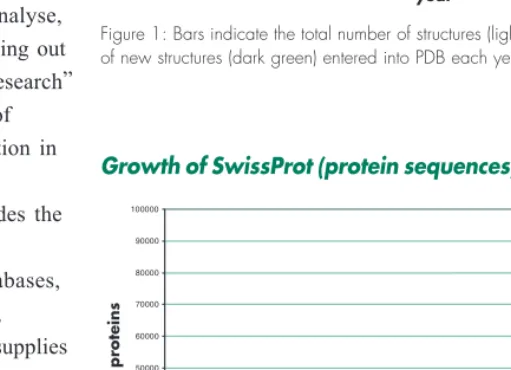
Given the very rapid growth in the amount of sequences – and structure-related information – available to the community [figures 1, 2],
Figure 1: Bars indicate the total number of structures (light green) and the number of new structures (dark green) entered into PDB each year.
Figure 2: The total number of protein sequences in SwissProt is shown for each SwissProt release.
a strong bioinformatics infrastructure is absolutely critical for the many expanding areas of contemporary biology and biomedicine. In this context, we would like to point to the important work on the standardisation and dissemination of databases done by the Inter-Union Bioinformatics Group.
Growth of Protein Data Bank (PDB) (3D protein structures)
Growth of SwissProt (protein sequences)
number of structures
year
SwissProt release
number of proteins
0 2000 4000 6000 8000 10000 12000 14000
1972 1973 1974 1975 1976 1977 1978 1979 1980 1981 1982 1983 1984 1985 1986 1987 1988 1989 1990 1991 1992 1993 1994 1995 1996 1997 1998 1999 2000
0 10000 20000 30000 40000 50000 60000 70000 80000 90000 100000
18
To cite but one example, as of today there are more than 40 publicly available, fully
sequenced microbial genomes, and more than 130 additional ones in progress. The recent publication of the human genome sequence only further underlines the importance of bioinformatics as an enabling technology for future research in protein structure and function.
Generally speaking, Europe is still reasonably competitive in most of the key areas in bioinformatics, especially in the prediction of protein structure and function, protein interaction analysis and database annota-tions. However, given the current increase in the demand for bioinformatics expertise, both from the commercial and academic sectors, Europe is desperately short of skilled people in this field. The continued failure to secure a long-term funding solution for the centrally important database activities at the European Bioinformatics Institute (EBI) is a problem that Europe must solve immediately.
Proteomics
By ‘proteomics’ we understand a “quantitative and qualitative analysis of the global protein pattern of a tissue, a cell, a cell organelle or a supramolecular protein organisation present or synthesised at a given moment” (Appendix 4). This is a very rapidly developing field that promises global views of cellular functions as reflected in the dynamic evolution of the protein complement of a cell (the ‘proteome’) under various conditions. From a technological point of view, proteomics includes both in vivo analyses of protein expression, e.g. by various fluorescence microscopy techniques, as well as high-throughput identification and analysis of the proteome, for example, by 2D-gel electrophoresis and mass spectrometry. Proteomics will be central to the functional genomics efforts, in both the industrial and academic environments.
Current status of protein research
In vivo analysis of the proteome
Many of the most important aspects of cellular function and physiology can only be studied in the intact cell. Techniques now exist to localise proteins within a cell and to follow their movements between different cellular compartments in real time, for example, using fusion proteins incorporating a fluores-cent reporter such as green fluoresfluores-cent protein (GFP) and confocal microscopy. Proteins can also be visualised in fixed cells using immunofluorescence. In both cases, high-throughput approaches are being developed, such as genome-wide libraries of GFP fusions and large-scale generation of specific binding reagents such as antibodies. New nanotechnologies have recently emerged that allow the visualisation of individual protein molecules ‘at work’ in their ‘natural habitat’, the cell.
In vitro analysis of the proteome
methods, and direct analysis of complex mixtures by means of mass spectrometry coupled to liquid chromatography.
The correct identification of a protein is a necessary initial step for all subsequent work, whether the protein is being obtained from natural sources or by recombinant DNA techniques. The information about the state of a mature protein after isolation or in vivo (in terms of post-translational modification, proteolytic processing, mutation, heterogeneity, etc) is crucial if we are to understand its properties, modulate them, or carry out further analysis (for example, the presence of bound carbohydrates makes X-ray crystallography more difficult). The quantification of each expressed protein in its various states is also essential and remains one of the most challenging problems of proteomics.
Like all disciplines in the field, proteomics is also expanding and evolving rapidly at the technological level with recent promising additions of an arsenal of novel techniques.
Quantitative proteome approaches are being developed that compare protein levels in two different samples, based on the measured intensities of two isotopically labelled pepti-des derived from the same protein labels in the two instances. The data output of such studies forms a differential proteome array directly comparable with the DNA microarray outputs.
A more direct version of the protein microarray technology is to use a protein affinity reagent (for example an antibody) which is spotted and covalently attached onto small surfaces of glass or other material. Protein chips may soon become a powerful alternative or complement to the conventional proteome techniques. Undoubtedly they will evolve to become high-throughput methods. Of course, this technology will be restricted to
already identified proteins for which highly specific high-affinity antibodies are available.
Post-translational modifications
Notwithstanding the extreme chemical diversity of proteins due to the 20 different amino acid side-chains, it turns out that many different proteins undergo selective post-translational modifications that are essential to their proper biological functioning. Among these may be listed, to name but a few, the reversible chemical modifications, such as phosphorylation, that underlie signal trans-duction and metabolic control processes, N-terminal acylations and C-N-terminal amidations, the latter often associated with peptide hormones, histone acetylations in the control of gene expression; the attachment of swinging arms such as lipoic acid, biotin and phosphopantetheine to multienzyme systems; and the attachment of carbohydrates. The principal investigative methodologies involved are those of amino acid sequence analysis, most notably the use of mass spectrometry.
Important aspects of these modifications remain to be elucidated, not least the specificity and control of the enzymes that catalyse the post-translational modification reactions. A longer-term aim must be the ability to predict, from the amino acid sequence of a protein inferred from the DNA sequence of a genomic open reading frame, whether, where and in what way an
20
Protein production and engineering
Although for certain purposes (for example functional characterisation), it is not always necessary to have a protein in a pure state and in substantial quantities, this is not true for most structure-function analyses, including structural genomics. In this case, the protein is usually required at the milligram level, and quantities in the range 10-50 mg or higher of pure material need to be produced. Also, quite frequently, proteins are required in trimmed (for example individual domains), modified/engineered (for example to eliminate or introduce post-translational modifications, or increase solubility, or attach tags, etc), or labelled (deuterated, 15N, 13C, Sel-Met, etc)
forms to facilitate structural and functional analysis. This is not always straightforward, particularly for large multidomain or mem-brane-bound proteins and complexes. These require particular and time-consuming approaches to their production, not easily adapted to high-throughput schemes. In fact, recent reports derived from large structural genomics projects seem to indicate that at best only 10-25% of proteins are adapted to such schemes (Appendix 1).
Clearly, new preparative approaches for wild-type and engineered proteins, and selective labelling of sites or regions within them (for example by intein-based strategies) are required, otherwise the databases derived from structu-ral genomics projects might become biased by the acquisition of information from the more easily produced (and structurally solvable) proteins. This is a limitation that must be overcome in such projects. The problem is even more acute when very large membrane proteins, and protein complexes, are considered.
Besides providing tools necessary for the production and labelling of proteins for
Current status of protein research
structural genomics projects, protein enginee-ring is a logical extension of such projects at a more applied level: the elucidation of the three-dimensional structures of many proteins will allow structure-based rational design to be utilised in the production of variants with new specificities, altered stability, resistance to proteinases, altered cellular locations, minimised hybrid or chimeric forms better suited for basic science or industrial purposes, etc. Protein engineering will therefore greatly benefit from the output of structural genomics projects.
Protein folding
Much effort has been expended in the past decade to uncover the rules that govern the processes of folding and unfolding of proteins and, although the problem is still not solved, a reasonable precise view is emerging, at least for the simpler single-domain globular proteins. This goal is very important, not only in developing better procedures to predict three-dimensional structures, a primary goal of structural genomics projects, but also for understanding how proteins pass through membranes and take up their intra- and extracellular positions. Moreover, such knowledge facilitates the development of better strategies to produce, redesign or minimise proteins (creating the smallest protein with a given function is an important goal for some biotechnological or biomedical purposes).
Membrane proteins
proteins, as well as their crystallisation, are much harder than for soluble proteins. Moreover, NMR spectroscopy cannot normally be applied to determine the structure of intact membrane proteins at high resolution, although specialised NMR techniques can produce very useful detailed information about, for example, the structure of bound ligands, and of the region of the protein with which they interact. Because of their hydrophobic nature, membrane proteins are also more difficult to study using standard proteomics tools such as 2D-gel electrophoresis and mass-spectrometry.
Europe has so far been able to match the US and Japan in this field. The major obstacles that need to be overcome in the next five years are mainly related to structure
determination. In particular, high-throughput techniques, specific to membrane proteins, need to be developed for over-expression, purification and crystallisation.
Protein-protein interactions and multifunctional protein complexes
Protein-protein interactions and the assembly of multifunctional protein complexes, some permanent, some only transient, are increasingly recognised as essential to the normal functioning of the cell. In the case of a multi-enzyme complex, for example, it may be possible to determine its full three-dimensional structure by X-ray crystallography or cryo-electron microscopy, either as a single entity or (more likely) by piecing together the structures of its individual component proteins. With transient complexes, on the other hand, a proper understanding of their structure and mechanism will depend on knowledge of the structures of the individual parts and of the kinetics and thermodynamics of their interaction. In both instances,
techni-ques of modelling the three-dimensional docking of protein structures are required. Solution techniques of studying protein-protein interaction are also essential (Appendix 2). New developments of
traditional methodologies, such as small angle X-ray and neutron scattering, ultracentrifuga-tion and microcalorimetry, have emerged, and new approaches, such as surface plasmon resonance, have been devised that enable real-time kinetic and thermodynamic data to be derived. New developments in neutron spectroscopy make it possible to quantify protein dynamics underlying functional flexibility in complex samples, including the situation in vivo.
Much effort is now going into the identifica-tion of the partners in protein-protein interac-tions on which the proper functioning of the cell depends, for example in the signal trans-duction processes that control the cell cycle, apoptosis or hormone stimulation. The identification of such partners is made by a
22
proteome approach or by the yeast two-hybrid screens. Other methodologies, such as fluores-cence resonance energy transfer, can be envisaged to extend the analysis to the interac-tion in vivo. It is the quantitative data obtained in this way on which a proper understanding of, say, a signal transduction process, and its relationship to other signal transduction pathways, must ultimately rest.
Another important area of protein-protein interaction is that of motility, where great strides are being made in the molecular understanding of muscle contraction and cellular transport processes. The investigation of single molecules, made possible by the invention of techniques such as molecular tweezers in the study of actin and myosin, is a notable example. The increasing understanding of molecular motors and of multifunctional protein machi-nes in general, is of value not just in its own right but in the prospect of generating molecular devices based on these newly discovered design principles.
Glycobiology
Many proteins are found as conjugates with bound carbohydrate. Such proteins are always extra-cellular and some of the most important are involved as hormones in signal transduction processes or as cell surface proteins in cell-cell interaction. Indeed, unless the proper carbohydrate moiety is attached, the proteins will not exert their proper biological function at all, since much of the essential specificity resides in the nature and fine structure of the carbohydrate component. The addition of the carbohydrate takes place at the post-translational stage and is brought about by the action of individual enzymes, each capable of catalysing one step of the overall biosynthesis and acting sequentially
Current status of protein research
in different permutations and combinations on different target proteins.
The presence of carbohydrate in glycoproteins can be a major impediment to the determination of the structure of the protein, hindering or even preventing crystallisation and interfering with the NMR analysis if that is the chosen route. Moreover, the generation of
glycoproteins poses major difficulties for the recombinant DNA approach to protein production: bacteria do not normally attach carbohydrates to proteins. Thus one is limited to generating the recombinant protein in an eukaryotic cell, and even then the correct carbohydrate component required for the ultimate biological function may not be added. Considerable progress is being made in the determination of the structures of the carbohydrate components of glycoproteins and in the analysis of the biosynthetic pathways involved. Clearly a major goal of bioinformatics, as with other
post-translational modifications, must be the ability to predict the sites of carbohydrate addition and the nature and structure of the
carbohydrate added. This will impact also on the proteomics field, where it is of course the glycoprotein, with carbohydrate attached, that exerts its biological activity in vivo.
Integrative biology
24
The past three years
In 1997 the European synchrotron facilities were asked to report on the beam-lines and facilities available to biological users and the typical usage for biology at that time. The results were tabulated in the 1998 ESF review of the Needs for European synchrotron and related beam-lines for biological and biomedical research. The synchrotron sites have been asked briefly to update their current facilities and a summary is attached in Appendix 6. The detailed reports are not repeated here.
Two major changes have transformed the situation since 1998. First, the four QUADRIGA beam-lines at the ESRF have been fully commissioned and are now in routine use. This alone has had a massive effect on SR usage for protein crystallography in Europe. In addition, the two new
crystallography wiggler lines are in use at SRS, together with fully commissioned lines at ELLETTRA, MAXLAB and SLS. New lines are under construction at ELETTRA and MAXLAB.
Second, efficient and reliable commercial CCD detectors have been installed on the ESRF beam-lines and at several other sites. This has enormously reduced the read-out time per image from the time-scale of minutes to a few seconds. As a consequence, in particular at the ESRF, the time required to collect a complete data set on a sample has fallen, in some cases, from several hours toless than half an hour.
The throughput of such third-generation beam-lines has shown exactly the type of increase foreshadowed by the 1998 ESF report. It is clearly possible to record 20 complete data sets per day, equivalent to
Revisit of the 1998 SR Review
4000 per annum on a single beam-line. Even allowing for a failure rate of 50%, somewhat pessimistic with present pre-screening and cryogenic skills, this implies that each line should be capable of providing 2000 data sets or more annually.
The future
The pressure on beam-lines has thus been ameliorated in the short term, but it will rise again to unacceptable levels as post-genomic projects lead to increased numbers of crystalline samples. The needs for advances in technology and resources is apparent in several directions:
.
Automated sample changers on the beam-lines. These are already underdevelopment at the ESRF as well as in the USA.
.
Fast and intelligent software for image evaluation and assessment, providing rapid feedback to the user regarding theusefulness of the current crystal.
.
Yet faster and more sensitive detectors.Pixel detectors are likely to be the next generation of X-ray detectors on the beam-lines and funding for their development must be ensured. This will be especially important for handling the weak and sharp data from microcrystals.
.
Provision of more user-friendly and unified graphical user interfaces which control the whole experiment, including beam-line optics, sample alignment and detector, and provide a reliable record of the whole experiment in the image and subsequent data files.appropriate data have been recorded while the samples are still at the synchrotron site.
.
Remote access synchrotron usage. Thisimplies that most of the above-mentioned automation is already in place. Transport of vitrified crystals in Dewar vessels to a synchrotron facility, collection of data by remote user or by a scientist based at the site, will in all probability be essential to handling the numbers of samples anticipated in the future.
.
The planned third-generation synchrotrons with a number of beam-lines dedicated to life sciences, such as DIAMOND, SOLEIL and LLS, are vital in this scenario. The new lines will allow European scientists to maintain their position in structural biology.26
Multidisciplinary working group on Protein
Structure and Function
.
Professor Gunnar Öquist (Chairman)Umea University
Deparment of Plant Physiology Sweden
.
Professor Francesc X. AvilesAutonomous University of Barcelona Department of Biochemistry
Spain
.
Professor Gunnar von HeijneStockholm University
Stockholm Bioinformatics Centre Sweden
.
Dr. Diane McLaren succeeded byDr. Mark Palmer
MRC Head Office
Research Management Group United Kingdom
.
Professor Richard N. PerhamUniversity of Cambridge Department of Biochemistry United Kingdom
.
Professor Reidun SirevagESF/LESC member and University of Oslo Biological Institute Norway
.
Professor Joël VandekerckhoveGhent University
Department of Medical Protein Research Belgium
.
Dr. Keith S. WilsonUniversity of York Protein Structure Group United Kingdom
.
Dr. Giuseppe ZaccaiCentre National de la Recherche Scientifique – Commissariat à l’Energie Atomique
Institut de Biologie Structurale France
and
Institut Laue Langevin France
European Science Foundation:
.
Dr. Marianne MinkowskiGroup I Report
Protein Production in the Structure-Function
and Structural Genomics Fields
20 March 2000, Frankfurt Airport Conference Center (updated in March 2001)
Participants:
Francesc X. Aviles (Univ. Autonoma Barcelona, ES) (Chairman)
Arie Gerlof (EMBL, Heidelberg, DE)