Original Research Article
Healthcare service quality measurement towards successful
implementation of intervention strategies in three Namibian public
healthcares facilities: a deterministic framework
Abner Kukeyinge Shopati
1*, Kabwebwe Honoré Mitonga
2, Lydia Penomuntu Aipinge
3INTRODUCTION
The study is located within the emerging discipline of implementation science. The broad field of this study is implementation strategies. Implementation strategies have incomparable reputation in implementation science, as they establish the „how to‟ factor of altering healthcare
setting.1 The study context is the public health reform in developing countries, in particular public healthcare in low resource settings. Generally, there is a growing concern that in Namibia it has become a norm for public institutions including public healthcare to launch their road maps in the name of strategic planning, and celebrate their new visions with the public but they never
ABSTRACT
Background: Implementation science has advanced towards improved use of theoretical tactics to provide better understanding and explanation of how and why implementation succeeds or fails. The aim of the study is to develop a deterministic framework for the successful measurement of healthcare service quality in public healthcare organisations, focusing on the staff member‟s satisfaction level with 2009 - 2013 strategic decisions implementation in the three Namibian Public healthcares.
Methods: The research utilized quantitative approach, a survey design and questionnaire was employed to collect data. The study used Gaskin‟s CFA/SEM procedure and applies the SPSS 23 AMOS plugins, Pattern Matrix Model Builder”(PMMB), “Master Validity”(MV), “Model fit measures”(MFM) to validate and determine the interrelationships between variables. A quantitative interpretive structural modelling (ISM) approach was used within an action implementation framework (AIF). This study employed three models that complied with the action implementation framework‟s dual roles. The EIS model provided the hands on support to implementing strategy role by retrospectively focusing on the 2009-2013 MoHSS Strategic plan implementations. While, the ISF model and IFF models were used to identify the determinants for its evaluation.
Results: The study found no direct link between PHOs and the public sector institutions in implementing strategic plans. However, there is 1:2 mediation effect facilitated by the MoHSS and the PHOs are responsible for implementing 33% of the mandates of the Ministry of Health and Social Services in Namibia.
Conclusions: This study had demonstrated why strategic plans failed in the public sectors in Namibia in that the objectives in the plans were formulated without determining whether they had an effect or not on the implementation outcome.
Keywords: Implementation science, Implementation strategy, Service quality measurement, Public healthcare, Deterministic framework
1
Namibia Business School, 2School of Public Health, University of Namibia, 3National Institute for Educational Development (NIED), Namibia
Received: 12 December 2017 Revised: 17 January 2018 Accepted: 18 January 2018
*Correspondence:
Mr. Abner Kukeyinge Shopati, E-mail: [email protected]
Copyright: © the author(s), publisher and licensee Medip Academy. This is an open-access article distributed under the terms of the Creative Commons Attribution Non-Commercial License, which permits unrestricted non-commercial use, distribution, and reproduction in any medium, provided the original work is properly cited.
revealed back to the public whether their visions were successes or what were the impediments for effective implementation of such visions then. Despite Public institutions having Strategic plan in place in Namibia there is still public outcry of poor service delivery. The famous usually questions are: how public institutions determine the measurement outcome contributed by each objective in the strategic plan? How effective strategic plan implementation in the service industries such Public healthcare can be measured? It would appear that Namibia does not have a comprehensive development strategy into which effective implementation of strategic plan of Public institutions shall be measured. This leave Public healthcare Organizations in Namibia with no option but to tune the line in adopting a generic strategic plan of public institutions as preferred by political authority. This approach seems to be a headache to public healthcare managers in implementing strategic plan successful. Factors that can determine the success implementation of the strategic plan in one public service department does not always be the same that ascertain the success implementation of strategic plan of public healthcare.
Therefore, public healthcare managers must seize countless hindrances, limitations and meaningfully pay attention to assessing, testing, and successfully engage accomplishment strategies that work in healthcare practice.
It seems that the ever-expanding role players and stakeholders with divergent interests and conflicting agendas had fragmented the global health community.2 The fragmentation along the divergent views is bringing in new paradigms, theories and ways of thinking focused on reforming healthcare. There are clarion calls for effective governance and innovative solutions necessary to achieve the health-related sustainable development goals (SDGs), global health security, and other priorities of the international community. Hoffman further reports of new ideas on better ways to make global health decisions and allocate limited global health resources. He contrasts the calls for total transformation with those calling for the incremental approach of small changes; some rely on existing institutions while others propose new organizations. In seeking solutions, that simplifies and ensures implementation success of intervention strategies in public healthcare organisations, the study draws upon emerging perspectives in strategic management, implementation science, and healthcare reform to come up with a conceptual model for measuring healthcare service quality in public healthcare organisations, using a deterministic framework.
The fear of making the wrong decision is what drives us to utilize a scientific approach.3 The emerging perspectives that use the scientific approach include management science (MS), strategic decision making and implementation science (IS). However,the implementation science comes out of the need to address
challenges associated with the use of research to achieve more evidence-based practice (EBP) in health care and other areas of professional practice.4 Similarly, due to the growing importance of global health governance, all proposals are worthy of consideration, but none deserve implementation without such consideration. As such, the best available research evidence should inform any health future reforms and implementation of strategic decisions.
However, implementation strategies have often not paid attention to the theoretical underpinnings risk becoming expensive trial and error exercises. More recently, Nilsen 2015 developed a taxonomy that outlines and distinguishes the different categories of theories, models and frameworks within implementation science. This taxonomy is important to this study, as it locates the appropriate theoretical framework for the research. He notes that implementation science has progressed towards increased use of theoretical approaches to provide better understanding and explanation of how and why implementation succeeds or fails. The proposed taxonomy, therefore distinguishes between different categories of theories, models and frameworks in implementation science. In order, to facilitate appropriate selection and application of relevant approaches in implementation research and practice. As such, this study is located under the determinant frameworks, which provide generic support for carrying out implementation endeavours.
Determinant frameworks refer to broad-spectrum of determinants that are hypothesised or have been found to influence implementation outcomes. Furthermore, each type of determinant typically comprises a number of individual barriers, hinders or impediments and/or enablers (facilitators), which are seen as independent variables. These determinants will have an impact on implementation outcomes, which will be the dependent variable.
Thus this study makes the following propositions within an active implementation framework,
Proposition 1
Effective strategy implementation in Public healthcare organisations (PHOs) is directly affected by the public sector institutions it interacts with in providing healthcare services. In this study, the PHOs are the Intermediate Public Hospitals that implement the National strategies and mandates of the Ministry of Health and Social Services (MoHSS). As well as, other public sector institutions such as the Ministry of Finance (MoF), Ministry of Works and Transport (MWT) and the Public Service Commission (PSC).
Proposition 2
ministry or department of health. The study determinants refer to the different factors affecting implementation outcomes. These include the content of the strategy, contextual, structural, and operational factors.
Proposition 3
The study uses the staff perceptions to measure and validate the implementation relationships that affecting public healthcare organisation‟s (PHO) service quality and intervention strategies.
Objective
To develop a deterministic framework for the successful measurement of healthcare service quality in public healthcare organisations, focusing on the staff member‟s satisfaction level with 2009 - 2013 strategic decisions implementation in the three Namibian Public healthcares.
METHODS
LibQual rating model questionnaire was used to assess Ministry of Health and Social Services(MoHSS) operational staff and regional management from three intermediate public hospitals with corresponding regions to assess the Satisfaction level with the MoHSSstrategic plan objectives for 2009- 2013 Implementation (Expected implementation satisfaction-EIS). The hospitals are Katutura Intermediate State Hospital (KISH) in Khomas region, the Rundu Intermediate State Hospital (RISH ) in Kavango region and the Oshakati Intermediate State Hospital (OISH) in Oshana region. The study only covered those who have been continuously in the employment of MoHSS for the period February 2009 - February 2013. The population was 453 operational staff and regional management members. Representatives of 290 staff were involve in this research. The study was carried out from May 2016- July 2016.
Dimensions measurements
The study develops constructs with 27 items from the 2009-2013 Strategic plan objectives and five dimensions (themes): service provision, human resource management, a quantitative interpretive structural modelling (ISM) approach was used within an action implementation framework (AIF).5
Analysis
The strength of the relationship among the variables (or items) was tested using the Kaiser-Meyer-Olkin (KMO) test, which must produce a value larger than 0.5. Pallant et al argued that the items within the scales should adequately correlate with a Bartlett‟s test of sphericity that should be significant (p <0.05).6 The study results showed that all the necessary conditions were met and that it was appropriate to conduct an Exploratory Factor Analysis and only items that contained factor loadings
greater than 0.30 were considered to be significant and were thus retained.7 The study further follows Gaskin‟s CFA/SEM procedure and applies the SPSS AMOS plugins, “Pattern Matrix Model Builder” (PMMB), “Master Validity” (MV), “Model fit measures” (MFM) in an iterative process.8 Using the Pattern Matrix Model builder (PMMB) plugin involves copying the SPSS dimension reduction output‟s EFA pattern matrix and pasting in into PMMB and running. This results in a CFA/SEM model whose validity and model fit measures are tested using the MV and MFM plugins.
RESULTS
Expected implementation satisfaction
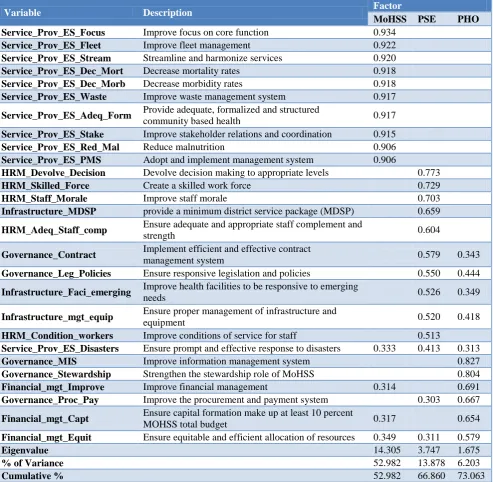
The Expected Implementation Satisfaction (EIS) scale includes 27 items of MoHSS, 2009-2013 strategic plan that consist of 11 items on service provision, 5 items on governance, 3 items on infrastructure development; 5 items on human resource management and 3 items on financial management. EFA is used to group the 27 items into three factors of institutions that have control in ensuring effectiveness of the implementation. The factors include the public healthcare organisation (the state intermediate hospitals), the responsible government ministry (MoHSS) and the public sector effect (MWT, MoF & PSC). Human Resource Management (5 items). Table 1 presents the results.
Table 1, presents the results from the EFA that used Principal Axis Factoring with Direct Oblimin rotation. The 27-item EIS scale is reduced to the three factors of public healthcare organisation (PHO), Ministry of Health and Social Services (MoHSS) and Public Sector Effect (PSE). The results are consistent with previous assessment of the Namibian hospital governance structure, autonomy and management.
This result highlights the organisation structure and bureaucratic processes of healthcare service provision in Namibia in that service provision by both MOHSS and PHO is affected by PSE as their buildings are managed by Ministry of Works and Transport whereas their human resources is managed by the Public Sector Commmission and financial management is effected through the Ministry of Finance 9. This makes it challenging for hospital management teams to effectively implement any strategic interventions. Additionally, health facilities require specialised construction and major renovations to improve patient safety, poor sanitation services and unpredictable water supply that increase risk of hospital acquired infections.
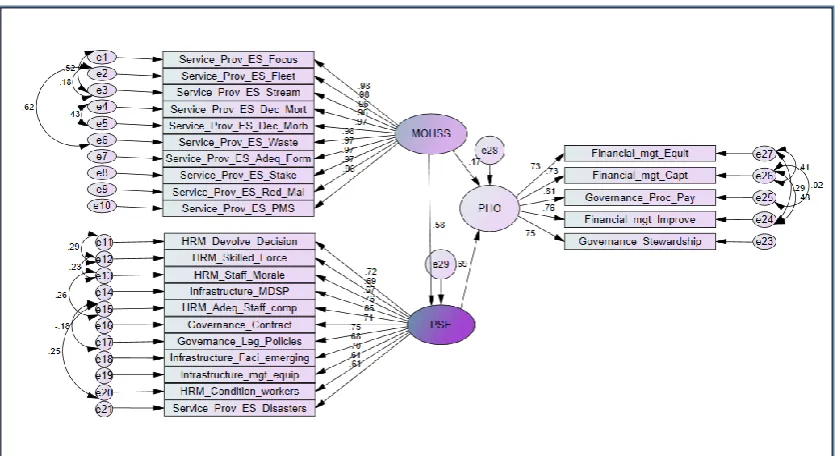
Figure 1, shows that PHO is dependent on PSE and MoHSS for effective implementation of strategic interventions. It also show that PSE is dependent on MoHSS. Table 2, presents the modelfit measures.
Table 2, presents the model fit measures of the final EIS model from numerous iterations guided by the cut off criteria and validity concerns. The EIS model fit was excellent, without any validity concerns.
Table 1: EFA analysis of EIS scale.
Variable Description Factor
MoHSS PSE PHO Service_Prov_ES_Focus Improve focus on core function 0.934 Service_Prov_ES_Fleet Improve fleet management 0.922 Service_Prov_ES_Stream Streamline and harmonize services 0.920 Service_Prov_ES_Dec_Mort Decrease mortality rates 0.918 Service_Prov_ES_Dec_Morb Decrease morbidity rates 0.918 Service_Prov_ES_Waste Improve waste management system 0.917 Service_Prov_ES_Adeq_Form Provide adequate, formalized and structured
community based health 0.917 Service_Prov_ES_Stake Improve stakeholder relations and coordination 0.915 Service_Prov_ES_Red_Mal Reduce malnutrition 0.906 Service_Prov_ES_PMS Adopt and implement management system 0.906 HRM_Devolve_Decision Devolve decision making to appropriate levels 0.773 HRM_Skilled_Force Create a skilled work force 0.729 HRM_Staff_Morale Improve staff morale 0.703 Infrastructure_MDSP provide a minimum district service package (MDSP) 0.659 HRM_Adeq_Staff_comp Ensure adequate and appropriate staff complement and
strength 0.604
Governance_Contract Implement efficient and effective contract
management system 0.579 0.343
Governance_Leg_Policies Ensure responsive legislation and policies 0.550 0.444 Infrastructure_Faci_emerging Improve health facilities to be responsive to emerging
needs 0.526 0.349
Infrastructure_mgt_equip Ensure proper management of infrastructure and
equipment 0.520 0.418
HRM_Condition_workers Improve conditions of service for staff 0.513 Service_Prov_ES_Disasters Ensure prompt and effective response to disasters 0.333 0.413 0.313 Governance_MIS Improve information management system 0.827 Governance_Stewardship Strengthen the stewardship role of MoHSS 0.804 Financial_mgt_Improve Improve financial management 0.314 0.691 Governance_Proc_Pay Improve the procurement and payment system 0.303 0.667 Financial_mgt_Capt Ensure capital formation make up at least 10 percent
MOHSS total budget 0.317 0.654
Financial_mgt_Equit Ensure equitable and efficient allocation of resources 0.349 0.311 0.579
Eigenvalue 14.305 3.747 1.675
% of Variance 52.982 13.878 6.203
Cumulative % 52.982 66.860 73.063
Structural equation modelling (SEM)
SEM is used to test the conceptual model. For this research, three implementation constructs were first validated by conducting CFA. Secondly, the model adequacy was evaluated by means of goodness-of-fit measures for the overall structural model. Maximum likelihood estimation with residual moments and
Factors (IFF) (represented by IFF1, IFF2, IFF3, IFF4). Figure 2, the results.
Table 3, shows that most of the fit indices indicate acceptable to excellent fit, the Comparative Fit Index (CFI), is marginally at the acceptable cut off of 0.9 (0.896). The final model fit was affected by covariance and modification indices were used to improve the model
fit without removing any variables. The logic used in improving the model was that of keeping all the original items for interpretation. The factors and path relationships that do not align with any plausible theory will be omitted.
Figure 1: EIS model fit. Table 2: EIS model fit measures.
Measure
Cut-off Criteria*
Estimate Threshold Terrible Acceptable Excellent Interpretation
CMIN 440.734 -- --
DF 283 -- --
CMIN/DF 1.557 Between 1 and 3 >5 >3 >1 Excellent CFI 0.977 >0.95 <0.90 <0.95 >0.95 Excellent SRMR 0.054 <0.08 >0.10 >0.08 <0.08 Excellent RMSEA 0.052 <0.06 >0.08 >0.06 <0.06 Excellent PClose 0.0346 >0.05 <0.01 <0.05 >0.05 Excellent
Table 3: Final SEM model fit measures.
Measure
Cut-off Criteria*
Estimate Threshold Terrible Acceptable Excellent Interpretation
CMIN 2877.016 -- --
DF 1776 -- --
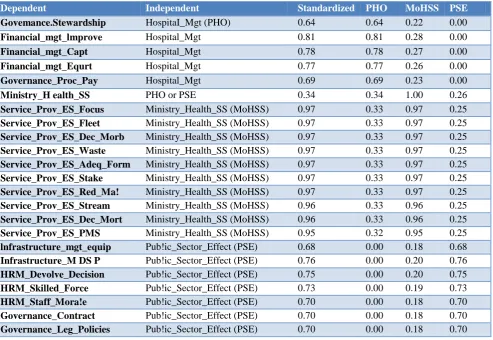
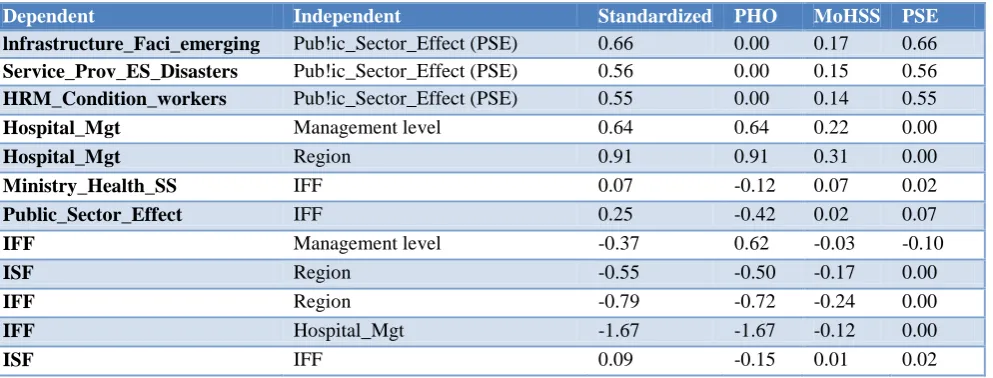
Figure 2: Final SEM model. Table 4: Interpretation of EIS model.
Dependent Independent Standardized PHO MoHSS PSE
Dependent Independent Standardized PHO MoHSS PSE
lnfrastructure_Faci_emerging Pub!ic_Sector_Effect (PSE) 0.66 0.00 0.17 0.66 Service_Prov_ES_Disasters Pub!ic_Sector_Effect (PSE) 0.56 0.00 0.15 0.56 HRM_Condition_workers Pub!ic_Sector_Effect (PSE) 0.55 0.00 0.14 0.55 Hospital_Mgt Management level 0.64 0.64 0.22 0.00 Hospital_Mgt Region 0.91 0.91 0.31 0.00 Ministry_Health_SS IFF 0.07 -0.12 0.07 0.02 Public_Sector_Effect IFF 0.25 -0.42 0.02 0.07
IFF Management level -0.37 0.62 -0.03 -0.10
ISF Region -0.55 -0.50 -0.17 0.00
IFF Region -0.79 -0.72 -0.24 0.00
IFF Hospital_Mgt -1.67 -1.67 -0.12 0.00
ISF IFF 0.09 -0.15 0.01 0.02
Table 4, shows that the PSE does not have a direct effect on the PHOs. Therefore, the MoHSS acts as mediator in the relationship. This implies that the PSE institutions like MWT who own the hospital infrastructure do not have any direct interactions with the hospitals. This could explain the poor state of Hospital infrastructure in the country. The human resources and financial management functions are also affected by the no effect relations with PSE institution like PSC and MoF. There is need for shared accountability with respect to hospital service quality, as the underlying factor affecting effective implementation involves a number of public sector players. The results also show a 1:2 mediation effect from the MoHSS. This implies that PHOs carry out a third (33%) of the MoHSS mandates such as reduce malnutrition, decrease mortality and morbidity.
The results also show that region or organisational name (0.91) had a very strong effect on the satisfaction perceptions of the staff. Management level (0.64) had moderate positive effects on the staff satisfaction with implementation.
DISCUSSION
The research sought to interpret the CFA and SEM model in the context of the research, as well as highlight some contributions and discoveries made in the study. The standardized regression weights of the fitted models were arranged to reflect the overall regression weight values of the model fit paths. The revised regression weights were then sorted in descending order. The factors were then categorised to strategy formulation success factors and strategy implementation success factors.
The active implementation frameworks play the dual role of providing hands-on support to implement strategy and identifying determinants for its evaluation.10 As such, this study employed three models that complied with the action implementation framework‟s dual roles. The EIS model provided the hands on support to implementing
strategy role by retrospectively focusing on the 2009-2013 MoHSS strategic plan implementations. While, the ISF model and IFF models were used to identify the determinants for its evaluation.
Proposition 1
The research proposed that effective strategy implementation in Public healthcare organisations (PHOs) is directly affected by the public sector institutions it interacts with in providing healthcare services. In this study, the PHOs are the Intermediate Hospitals that implement the National strategies and mandates of the Ministry of Health and Social Services (MoHSS). As well as, other public sector institutions such as the Ministry of Finance (MoF), Ministry of Works and Transport (MWT) and the Public Service Commission (PSC).
The study found no direct link between PHOs and the public sector institutions such as the Ministry of Finance (MoF), Ministry of Works and Transport (MWT) and the Public Service Commission (PSC). However, there is 1:2 mediation effect facilitated by the MoHSSand the PHOs are responsible for implementing 33% of the mandates of the Ministry of Health and Social Services (MoHSS).
Proposition 2
The study proposed that several determinants exist, which mediates the implementation relationships between PHOs and the ministry or department of health. The study determinants refer to the different factors affecting implementation outcomes. These include the content of the strategy, contextual, structural, and operational factors.
factors on implementation effectiveness, as well as the effect of structural factors on strategy formulation. However, they could not agree on the effects of context and content factors on either strategy formulation or strategy implementation.
Proposition 3
The study used the staff perceptions to measure and validate the implementation relationships that affecting public healthcare organisation‟s (PHO) service quality and intervention strategies. Using interpretive structural modelling (ISM) approach, the study was to develop a
map of the complex relationships between many elements involved in complex decision situation such as in PHOs.13 ISM is often used to provide fundamental understanding of complex situations, as well as to put together a course of action for solving a problem. The ISM process transforms unclear, poorly articulated mental models of systems into visible, well-defined models useful for many purposes.
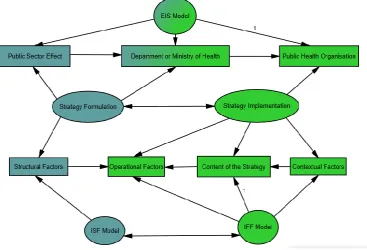
The study used an integrated structural modelling (ISM) to simplify the three CFA/SEM models and interpret the Final SEM model. As such, Figure 3, presents the simplified version of the Final SEM model.
Figure 3: Research model.
The research presents the above formulated research model for the successful measurement of healthcare service quality in public healthcare organisation based the perceptions of healthcare staff.
CONCLUSION
The study concludes that content and context factors are interdependent such that the content of the strategy depends on the strategic context. At the same time, effective implementation depends on the operational factors which are also influenced by structural factors during strategy formulation stage. The study determined that overall objectives of MoHSS strategic plan 2009-2013, the PHOs were only responsible for implementing 33% of the mandates of the Ministry of Health and Social Services (MoHSS) while the intention of the strategic plan was for PHOs to implement such mandates 100%. This further explain why strategic plans failed in the public sectors in Namibia in that the objectives in the
plans were formulated without determining whether they had an effect or not on the implementation outcome.
Funding: This work was supported by a grant from the National Commission on Research, Science and Technology (NCRST) Namibia, 2016
Conflict of interest: None declared
Ethical approval: The study was approved by the Institutional Ethics Committee
REFERENCES
1. Proctor EK, Powell BJ, McMillen JC. Implementation strategies: recommendations for specifying and reporting. Implementation Science. 2013;8:139.
2. Hoffman S. Student Voices 2: Assessing Proposals for Global Health Governance Reform. Hamilton: McMaster Health Forum, 2011.
Business Management and Strategy. 2014;5(1):78-114.
4. Nilsen P. Making sense of implementation theories, models and frameworks. Implementation Science. 2015;10(53):1-13.
5. Ministry of Health and Social Services. MoHSS 2009 - 2013 Strategic Plan, Windhoek, 2009. 6. Pallant J. SPSS survival manual: A step by step
guide to data analysis using SPSS. England: Open University Press, 2010.
7. Gaskin JE. Confirmatory Factor Analysis:Validity and Reliability, 2017. Available at: http://statwiki. kolobkreations.com/index.php?title. Accessed 20 March 2017.
8. Gaskin J, Lim J. Model Fit Measures, AMOS Plugin, 2016. Available at: https://drive.google. com/drive/folders/0B3T1TGdHG9aEbFg1eEpqOWt rR3c. Accessed
20 March 2017.
9. Myers L. Feasibility Assessment of Merging Windhoek Central and Katutura Intermediate Hospitals to Create a National Academic and Referral Hospital in Namibia. Bethesda, MD: Health Systems 20/20 Namibia Project, Abt As, 2013.
10. Rycroft-Malone J. Promoting Action on Research Implementation in Health Services (PARIHS). In: Models and Frameworks for Implementing Evidence-Based Practice: Linking Evidence to Action. Oxford: Wiley-Blackwell; 2010: 109-136. 11. Kalali NS, Anvari MRA, Dastjerdi AAPDK. Why
does strategic plans implementation fail? A study in the health service sector of Iran. African Journal of Business Management. 2011;5(23):9831.
12. Farzin MR, Kahreh MS, Hesan M, Khalouei A. Knowledge, A survey of Critical Success Factors for Strategic Management implementation: applications for Service Sector; 2014: 595-599.
13. Meena K, Thakkar J. Development of Balanced Scorecard for healthcare using Interpretive Structural Modeling and Analytic Network Process. J Advances Management Research. 2014;11(3):232-56.