Sensitivity Analysis of Coulomb and HK Friction Models in
2D AFM-Based Nano-Manipulation: Sobol Method
M. H. Korayem*, M. Taheri, A. H. Korayem and Z. Rastegar
Robotic Research Laboratory, Center of Excellence in Experimental Solid Mechanics and Dynamics, School of Mechanical Engineering, Iran University of Science and Technology, Tehran, I. R. Iran
(*) Corresponding author: [email protected]
(Received: 01 May 2014 and Accepted: 22 Feb. 2015)
Abstract:
Nanotechnology involves the ability to see and control individual atoms and molecules which are about 100 nanometer or smaller. One of the major tools used in this field is atomic force microscopy which uses a wealth of techniques to measure the topography and investigates the surface forces in nanoscale. Friction force is the representation of the surface interaction between two surfaces and surface topology. In order to have more precise nano-manipulation, friction models must be developed. In this study a sensitivity analysis has been conducted for nano-manipulation of nanoparticles toward dimensional and environmental parameters based on Coulomb and Hurtado and Kim (HK) friction models using Sobol method. Previously graphical sensitivity analysis has been used for this target in which the percentage of importance of parameters is not taken into account. But in Sobol method as a statistical model this problem is solved. Results show that cantilever thickness is the most effective dimensional parameter on critical force value while cantilever length and width are of less importance. Environmental parameters such as cantilever elasticity modulus, substrate velocity and adhesion, respectively, take next orders.
Keywords: Atomic Force Microscope, Coulomb friction model, HK friction model, Nano-manipulation,
Sensitivity analysis, Sobol method
1. INTRODUCTION
Sensitivity analysis (SA) is the study of how the uncertainty in the output of a model (numerical or otherwise) can be apportioned to different sources of uncertainty in the model input [1]. A related practice is 'uncertainty analysis' which focuses rather on quantifying uncertainty in model output. Ideally, uncertainty and sensitivity analysis must be run in tandem. Sensitivity analysis can be used to simplify models and investigate the robustness of the model [2]. Despite the benefits of SA its application has been rarely studied for friction models in the case of nano-manipulation (Figure 1). The SA results are extremely important for adjusting the critical force in nano-manipulation and particle movement. They also determine which instrument is appropriate for the accurate planning of fabrication and assembly of nano-objects.
Figure 1. Ideal scheme of a possibly sampling-based
sensitivity analysis [2]
Nano-manipulation is an emerging area which enables to modify, interact and control at Nano scale and has received enormous attention in previous years [22]. Atomic force microscope (AFM) as a useful instrument for direct measurements of intermolecular forces can be employed in broad spectrum of applications. AFM can also be used for imaging, indenting, moving the sample and etc. The AFM probe as a
nano-Int. J. Nanosci. Nanotechnol., Vol. 11, No. 1, March 2015, pp. 23-31
Korayem et al.
manipulation tool enables precise particle positioning for micro/nano-assembly [4], which is the base of accurate control of nano-particles positioning and assembling. The most important part of nano-manipulation is the contact moment in which pushing force leads to deformation in nano-particle.
Sitti contemplated surface forces using Johnson-Kendall-Roberts (JKR) theory and propounded a new model for tele-operated nanoparticle pushing [5]. More comprehensive pushing dynamic model was proposed by Taffazzoli and Sitti [6]. Static and free vibration analysis of carbon nano wires with rectangular cross section based on Timoshenko beam theory was studied by Janghorban [7].
Since in nano-scale the ratio of area to volume increases, contact forces such as friction become more important and cannot be ignored [8]. Accordingly various friction models have been developed to predict frictional behavior in nano-scale. Precise prediction of friction condition will result in more accurate nano-manipulation modeling, because friction force as a part of contact forces can affect the critical force applied by AFM tip. Therefore use of appropriate friction model plays an important role in nano-manipulation and its accuracy. Continuum mechanics models are usually considered for pure adhesion but in order to include both static and sliding friction Johnson put much effort in extension of these models [9]. In a review by Falvo and Superfine, methods for experiments are introduced basically in which nano-manipulation is used as a mean of uncovering the intrinsic response and dynamical behavior of small objects [10].
Lateral force microscopy has been used by Sumer and Sitti to study adhesion and friction characterization at micro/ nano-scale [11]. Selection of an appropriate friction model has a great influence on nano-manipulation. Therefore Korayem et al. have compared and analyzed different friction models [12]. In their study the effects of different dimensional and environmental parameters on critical force and time of nano-manipulation movement for three friction models, Coulomb, HK and LuGre model have been investigated. The graphical results of their analysis did not indicate the percentage of importance of the dimensional and environmental parameters [13]. Korayem and Taheri have been modeled and compared various contact theories for the
biomanipulation of biological micro/nanoparticles in different biological environments for the first time [23].
In this article Coulomb and HK friction models and their application in nano-manipulation of nano-particles are studied. Based on importance of critical force in manipulation of nano-particles, different dimensional and environmental parameters have been chosen to further their influence on this force be analyzed statistically. Regarding to this fact Sobol method has been used to investigate the effect of variation of parameters on critical force for Coulomb and HK models. The results are presented in percentages of the effects to make it easier to compare.
2. METHODS
In recent years AFM as a fundamental tool for moving, manufacturing and assembling nano-particles has attracted scientists. Nano-manipulation modeling is a basic instrument for having a precise and controlled displacement of particles in micro/nano scale. Transitions from macro to nano world results in increasing of area to volume ratio and consequently contact forces such as adhesion and friction become more important. Hence the manipulation modeling is fundamentally dependant on friction. In fact, having success in nano-manipulation modeling to predict the experimental results is greatly related to accuracy of friction modeling.
2.1. Nano-particle manipulation modeling
In general, nano-manipulation process includes imaging of substrate and the particles on it, locating of probe tip on target nano-particle and to start manipulation substrate or tool base moves with constant velocity. For accurate nano-manipulation by AFM, the probe tip is brought to contact with the particle. To make sure of initial contact, a deformation equal to ZP0 (Equation 12) is applied.
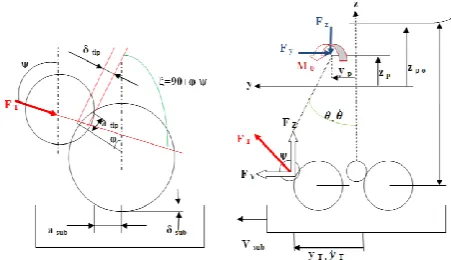
According to the initial movement of the substrate with the constant velocity, Vsub, the particle and consequently the manipulating probe tip start moving with the same velocity (Figure 2). As a result, the applied load on the particle and the reaction force on the tip including bending and twisting in the cantilever will increase. The exerted force by the manipulator, FT, increases to a critical
International Journal of Nanoscience and Nanotechnology
value in order to overcome the adhesion forces including contact and friction forces between the tip and substrate.
Figure 2. Modeling contact pushing of a nanoparticle
using an AFM probe: nano-scale surface and contact forces between the tip, particle, and substrate [12]
Accurate modeling of the cantilever deformation and the adhesion forces between contacting surfaces plays an important role in dynamic modeling of pushing based on AFM. The most important forces in this process are the spring forces (Fy, Fz), the cantilever moment (Mө), vertical and horizontal forces of the probe tip (FY, FZ), and the applied force of the tip FT. The forces are normal to the torsion angle, ө, (zp and ө are interdependent) and the horizontal deformation of the cantilever, yp (Figure. 3).
Figure 3. particle Driving forces on the nanoparticle by
the AFM probe tip modeled as a sphere [12]
Considering the contact deformation between particle-probe tip, δtip, and particle substrate, δsub, the kinematic equations of the probe tip are given by:
) cos s + ) + cos( t + 2 H ( cos m
-cos sin y K -cos z K + sin ) H
M + I ( = F
2
p y 2 p z P
Z
ub
ip
(1)
(- cos+ sin) - sin
2 H m F =
FY y 2 tip
(2)
2 2 T
F FY FZ (3)
) ( tan1
Z Y
F F
(4)
where ψ and φ, are the force angle of the probe and the contact angle of the probe tip-particle, respectively. m, is the constant parameter depending on the tip geometry. Ky and Kz are Lateral spring constant of the cantilever and Normal spring constant of the cantilever, respectively [12].
A dynamic modeling algorithm is shown in Figure 4. Phase one is separated from phase two with a dashed line. According to the figure the input of the problem prior to the movement of the particle on the substrate consists of the position of the particle, and the output is the exerted force, FT, by the probe tip on the particle. At this point, normal bending and twisting of the cantilever are directly measured by the light beam or other methods. As the second phase of the simulation algorithm shows, by increasing the applied force to the critical limit, FT remains constant and the particle starts moving on the substrate. The output of this segment demonstrates the dynamic performance and the amount of displacement of the particle.
Figure 4. Algorithm for dynamic modeling and
displacement of the
To determine the particle displacement during a certain period in which the substrate moves with a defined speed, the starting moment of particle's motion must be known. In previous researches, the kinematic and dynamic equations regarding the movement of probe and particle have been obtained from the free body diagram of the problem. The initial conditions based on the specific and fixed velocity of the substrate, the
Korayem et al.
geometry and material of the cantilever, probe, and particle have also been determined [12].
2.2. Hurtado and Kim (HK) friction model
Equation (5) presents that friction force fT is
proportional to sum of vertical force fN and
adhesion force f0 and there is no dependence on
apparent contact surface of macroscopic bodies [14]. This equation explains macroscopic sliding friction [15].
)
( 0
T f f
f N (5)
Also, for a micro-contact, friction force is considered to be:
A
fT (6)
in which, A, is the real micro-contact area and τ, is the shear strength. Both of these parameters are related to vertical force.
Hurtado and Kim have explained the measurement of micro friction with the silica spheres of 2.5 micrometer radiuses [16]. Due to reduced volume forces and increased effect of contact forces, friction modeling plays an important role in micro/nano electromechanical instruments modeling [17]. The relation between dimensionless frictional stress
G f f
and
dimensionless contact radius b a
a has shown in
Equations 8-10. In these equations, a, is a contact radius, b is a vector domain and G is an effective
shear modulus which can be obtained as follows [16-17]: 2 1 2 1 2 G G G G G (7)
The value of
fis:
2 2 1 1 , log , log , log log 2 1 a a a a a B a M a a f f f (8) where, ) log( ) log( 1 2 2 1 a a M f f (9) ) log( ) log( ) log( ) log( ) log( 1 2 1 2 2 1 a a a a
B f f (10)
Using these equations, friction force can be
obtained as follows:
2 2 2 1 2 1 2 2 * , , 10 , 2 1 a a a a a a a a a a b G F f M Bf f (11)
Maximum shear force in static contact between two asperities can be obtained by HK model (Equation 11).
2.3. Other friction model
There are other friction models defined for different situations some of which are presented here. Armstrong has presented a modified classical model for some of dynamic frictional phenomenon [18].
Dahl model has been established in order to simulate control systems with expanded friction. The start point of Dahl model was some experiments on server systems with ball bearing. Dahl extended an approximately simple model which was used for simulation systems with ball bearing friction [19]. The start point for Dahl model is stress-strain curve of classical solid mechanics. Dahl modeled strain-stress curve with different equations.
Canudas de Wit et al. presented LuGre model in which Dahl model has been combined with frictional features of arbitrary steady state. Stribeck effect has been considered in this model which produces non-constant effect in low velocities. LuGre model consists of a nonlinear state and a frictional force [20].
It was preferred to use HK friction model here because it is the most similar model to the Coulomb model. Besides this model is even more accurate an applicable than Coulomb in nano-scale.
3. SIMULATION
3.1. Simulation of nano-particle manipulation
In this section, firstly, the initial values and then, the necessary initial conditions for the problem to be solved will be presented.
3.2. Initial values of the problem
In the present study, the simulation is verified by using the available results [22]. Then mathematical model development has been done considering mechanical properties according to Table 1. In this
International Journal of Nanoscience and Nanotechnology
simulation, a gold particle of 50 nm radius, Rp, has been pushed on the silicon oxide substrate that moves with constant velocity. The ranges of geometrical properties of the AFM are presented in Table 2 and Environmental parameters ranges are shown in Table 3.
Table 1. AFM mechanical properties ) 3 m / Kg ( G (GPa)
E (GPa) 2330 40.5 0.27 169Table 2. AFM geometrical properties ranges
Height (μm) Thickness (μm) Width (μm) Length (μm) 5-20 0.25-2.5 5-80 200-700
Table 3. Environmental parameters ranges
Adhesion (J/m2)
K (Gpa) E (Gpa) Velocity ( ) 0-3 10-100 120-200 0-800
Contact mechanics and tribological parameters can be obtained experimentally for different materials which are in contact. Surface energy between the nanoparticle and the tip/substrate is ω=0.2 J/m2. The constant friction coefficients for static and dynamic movement of the nanoparticle on the substrate are μs=0.8, and μd=0.7, respectively. Shear strength is assumed to be constant on the both contact surfaces between the particle/substrate and the tip/substrate. The mechanical properties of the AFM are summarized in Table 1. Tip radius and contact angle are Rtip=20nm and ø=60, respectively [22].
3.3. Initial conditions
The substrate velocity is assumed to be 100 nm/s
and tip,sub are negligible. Initial conditions have
been obtained by simplifying the equations at t=0. These initial conditions given in equation 12 have been used during all the analysis [22]. As previously mentioned, a small normal preload Fz0 is exerted by providing normal deflection offset zP0 on the AFM probe. By measuring ø0 in AFM system, zP0 is obtained.
H z z H V z L z P T sub P P 0 0 0 0 2 0 0 ) sin( 7 . 0
,
0 , sub tip sub tip cte ،
0 , , 0 0 H Vsub،
(12) 0 y y 0 y y T P T P0 0
Note that the second derivative of cantilever deformation and contact elastic deformation, are negligible.
4. RESULTS
4.1. Nano-manipulation simulation results
It was previously mentioned that in the first phase of the nano-manipulation, the lateral force of the probe tip on the sample increases due to the lateral displacement and twisting of the probe. Changes resulting from twisting of the probe on the vertical force are minor, and therefore the contact point between the probe tip and particle does not change. The applied force by the instrument on the particle, FT, increases until the critical value, Fcr, is obtained. At this very moment designated tcr, force overcomes friction and the second phase of nano-manipulation begins in which particle starts moving on the substrate. The amount of critical force is obtained through simultaneous solution of dynamic, contact, critical equations, and it is affected by initial values and conditions.
In Figure 5, the applied forces on the particle via the probe, including FY, FZ, and FT have been plotted versus time. The critical force for the onset of particle motion in the HK model is less than the friction model of Coulomb. This could be justified due to the HK model being more precise and the fact that in the Coulomb model, only the apparent surface of contact is considered. The results of Figure 5 have been verified with Ref. [12].
Figure 5. Magnitudes of force versus time for Coulomb
and HK friction models
4.2. Dimensional sensitivity analysis results
Calculation of critical force of movement in
Korayem et al.
particle manipulation is highly important since precise determination of this force causes accurate and controlled movement and manipulation of particle in order to manufacture nano/micro instruments. The most effective factors on values for critical force of movement are cantilever dimensions including length, width, thickness and height. Hence precise investigation of dimensional effect of cantilever on critical force of movement is crucial and affects nano-particle manipulation analysis. In this study cantilever dimensional sensitivity analysis based on Sobol sensitivity analysis method has been done and its effect on manipulating critical force using friction models such as Coulomb and HK has been investigated.
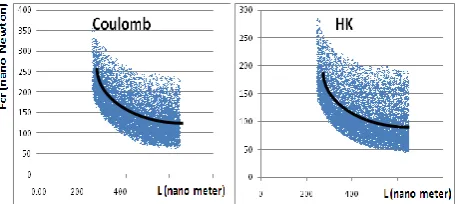
As shown in Figure 6, in both Coulomb and HK models, increasing of cantilever length results in critical force decrease but with further increase of cantilever length the slope become slower. It shows that for the case of increasing length, using different friction models does not affect the simulation results.
Figure 6. Cantilever length effect on critical force of
nano-manipulation
According to Figure 7, increase in cantilever width leads to linear increase in critical force for both models. So use of wider cantilevers needs more accuracy in choosing proper friction model in nano-manipulation process.
Figure 7. Cantilever width effect on critical force of
nano-manipulation
Figure 8 shows that in both Coulomb and HK models increase in cantilever thickness causes increase in critical force magnitude. Growth of
critical force with increase in cantilever thickness is significant hence especially for the case where diameter size of nano-particle is smaller than 50 nm it is not desirable and must be prevented.
Figure 8. Cantilever thickness effect on critical force of
nano-manipulation
According to Figure 9, increasing of cantilever height has no especial effect on critical force and the critical force of movement remains constant with cantilever height variations.
Figure 9. Cantilever height effect on critical force of
nano-manipulation
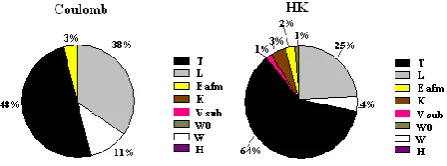
General comparison of dimensional sensitivity analysis in manipulation of nano-particle for Coulomb and HK friction models has been shown in Figure 10. Although in both models the height of cantilever has no effect on movement critical force and can be ignored, cantilever thickness is the most effective parameter on movement critical force and the cantilever length is the second effective parameter.
Figure 10. Cantilever dimensional sensitivity analysis
for HK friction model
International Journal of Nanoscience and Nanotechnology
4.3. Environmental sensitivity analysis
results
In this section contact surface conditions and the effect of their variations on critical force needed to move nano-particles are investigated. Results are shown in Figures 11-15.
As shown in Figure 11, increase in substrate velocity to 600 nm/s has no especial effect on critical force magnitude. Since the applied velocity in manipulation of nano-particles is smaller than this value, it can be concluded that substrate velocity has no significant effect on critical force.
Figure 11. Substrate velocity effect on critical force of
nano-manipulation
Figure 12 shows that increase in cantilever elasticity modulus leads to linear increase in critical force in both Coulomb and HK models and the more the elasticity modulus increases, the more the critical forces in both models diverge from one another. Thus for cantilevers with higher elasticity modulus choosing proper friction model can affect simulation results.
Figure 12. Cantilever elasticity modulus effect on critical
force of nano-manipulation
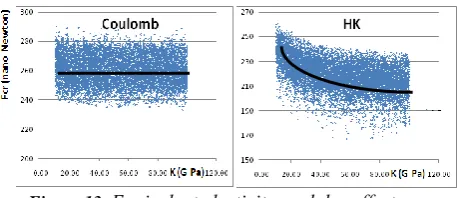
Inconsiderable and ignorable effect of equivalent elasticity modulus on critical force of nano-manipulation for Coulomb friction model has been shown in Figure 13, while for HK friction model increase in equivalent elasticity modulus results in critical force reduction and two Coulomb and HK models diverge from one another.
Figure 13. Equivalent elasticity modulus effect on
critical force of nano-manipulation
An increase of critical force with the increase in surface adhesion parameter in both friction models can be observed (Figure 14). More increase in surface adhesion leads to closer simulation results of Coulomb and HK models.
Figure 14. Adhesion coefficient effect on critical force of
nano-manipulation
Figure 15 shows the general comparison between environmental parameters sensitivity analysis in nano-particle manipulation based on Coulomb and HK friction models. Consequently cantilever elasticity modulus is the most effective parameter on critical force of movement and after that, the substrate velocity and surface adhesion have the most important influence on it.
Figure 15. Environmental sensitivity analysis for
Coulomb and HK friction models
Figure 16 shows the general comparison of sensitivity analysis between dimensional and environmental parameters in manipulation of nano-particle using Coulomb and HK friction models. As shown, in both friction models cantilever thickness- as a dimensional parameter- has the most significant influence on critical force of nano-manipulation. Afterwards cantilever length and
Korayem et al.
width, respectively, play the most important role in critical force magnitude variation. Environmental parameters are less effective but from among them, as mentioned before; elasticity modulus of cantilever has the greatest influence on critical force while substrate velocity and surface adhesion are less important. As expected, dimensional parameters are more effective than environmental parameters.
Figure 16. General sensitivity analysis of dimensional
and environmental parameters for Coulomb and HK friction models
5. CONCLUSION AND DISCUSSION
In recent years AFM as a fundamental tool for moving, manufacturing, and assembling nano-particles has attracted many scientists. Modeling of nano-manipulation process is a basic mean to obtain precise and controlled displacement of particles in micro/nano scale. Movement of probe tip or substrate with the constant velocity of Vsub, leads to increase in applied load, FT, from nano-manipulator on nano-particle to critical value of Fcr in order to overcome adhesion forces such as contact and friction forces between particle and substrate. Hereafter the movement is started.
In this study, critical force for Coulomb and HK friction models have been simulated and its sensitivity to dimensional and environmental parameters has been analyzed using Sobol method to show the importance of these parameters in variation of the nano-manipulation critical force. Results shows that the critical force for the onset of particle motion in the HK model is less than the friction model of Coulomb, and this could be justified because of the HK model being more precise and the fact that in the Coulomb model, only the apparent surface of contact is considered.
In both Coulomb and HK models, increase in cantilever length results in decreasing critical force but with further increase in cantilever length the slope becomes slower which shows that for the case of increasing length, using different friction
models cannot affect the simulation results. Increase in cantilever width leads to linear increase in critical force for both models. Hence using wider cantilevers needs more accuracy in using proper friction model for nano-manipulation process. In both Coulomb and HK models, increase in cantilever thickness causes increase in critical force magnitude. Growth of critical force with increase in cantilever thickness is significant; therefore especially when nano-particle is smaller than 50 nm it is not desirable and should be prevented. Cantilever height increase has no especial effect on critical force. General comparison of dimensional sensitivity analysis in manipulation of nano-particle for Coulomb and HK friction models showed that the cantilever thickness is the most effective parameter on movement critical force, and the cantilever length is the second effective parameter while in both models the height of cantilever has no effect on movement critical force.
Increase in substrate velocity up to 600nm/s has no especial effect on critical force magnitude. Since the applied velocity in nano-manipulation of nano-particles is smaller than this magnitude, it seems that substrate velocity has no significant effect on critical force. Increase in cantilever elasticity modulus leads to linear increase in critical force in both Coulomb and HK models and the more the elasticity modulus increases, the more the critical forces in both models diverge from one another. Consequently for cantilevers with higher elasticity modulus selection of proper friction model can affect results of the simulation. Inconsiderable effect of equivalent elasticity modulus on critical force of nano-manipulation for Coulomb friction model observed while for HK friction model increase in equivalent elasticity modulus results in critical force reduction and diverging Coulomb and HK models from each other. An increase in critical force resultant from increase in surface adhesion parameter in both friction models can be observed. More increase in surface adhesion leads to closer simulation results of Coulomb and HK models. The general comparison between environmental parameters sensitivity analysis in nano-particle manipulation based on Coulomb and HK friction models showed that cantilever elasticity modulus is the most effective parameter on critical force of movement and substrate velocity and surface adhesion, respectively, has the second most important effects on it.
International Journal of Nanoscience and Nanotechnology
The general comparison of sensitivity analysis between dimensional and environmental parameters in nano-manipulation of nano-particle using Coulomb and HK friction models shows that in both friction models cantilever thickness as a dimensional parameter has the most significant effect on critical force of nano-manipulation. After that cantilever length and width play the most important roles in critical force magnitude variation, respectively. Environmental parameters are less effective but as mentioned before; elasticity modulus of cantilever is the most effective parameter while substrate velocity and surface adhesion are less important. As expected, dimensional parameters are more effective than environmental parameters.
REFERENCES
1. A. Satelli, S. Tarantola and F. Campolongo: Sensitivity analysis as an ingredient of modelling, Statistical science, Vol. 15, (2000), pp. 377-395. 2. M.H. Korayem, Z. Rastegar and M. Taheri:
Sensitivity analysis of contact mechanics models in manipulation of biological cells, Nanoscience and Nanotechnology, Vol. 3, (2012), pp. 49-56.
3. N. Jalili and K. Laxminarayana: A review of atomic force microscopy imaging systems: application to molecular metrology and biological sciences, Mechatronics, Vol. 14, (2004), pp. 907-945.
4. M. Sitti: Survey of Nanomanipulation Systems, Proc. of the IEEE-Nanotechnology Conference, (2001), pp.75-80.
5. M. Sitti and H. Hashimoto: Force controlled pushing of nanoparticles: Modeling and experiments, International Conference of Advanced Intelligent Mechatronics, Atlanta, GA, (1999), pp. 13-20. 6. A. Tafazzoli and M. Sitti: Dynamic Behavior And
Simulation Of Nanoparticles Sliding During Nanoprobe-Based Positioning, Proceedings of IMECE’04 2004 ASME International Mechanical Engineering Congress, Anaheim, CA, November 13-19, (2004).
7. M. Janghorban: Static and free vibration analysis of carbon nano wires based on Timoshenko beam theory using differential quadrature method, Latin American Journal of Solids and Structures, Vol. 8, (2011), pp. 463-472.
8. M. Nosonovsky and B. Bhushan: Multiscale friction mechanisms and hierarchical surfaces in nano- and bio-tribology, Materials Science and Engineering, Vol 58, (2007), pp. 162-193.
9. K.L. Johnson: Adhesion and friction between a smooth elastic spherical asperity and a plane surface,
Mathematical, Physical and Engineering Sciences, Vol. 453, (1997), pp. 163-179.
10. M.R. Falvo and R. Superfine: Mechanics and friction at the nanometer scale, Journal of Nanopartcile Research, Vol. 2, (2000), pp. 237-248. 11. B. Sumer and M. Sitti: Rolling and spinning friction
characterization of fine particles using lateral force microscopy based contact pushing, Journal of Adhesion Science and Technology, Vol. 22, (2008), pp. 481-506.
12. M.H. Korayem, M. Taheri and M. Zakeri: Sensitivity analysis of nano-particles manipulation based on different friction models, Applied Surface Science, Vol. 258, (2012), pp. 6713-6722.
13. M.H. Korayem, M. Taheri and Z. Rastegar: Sobol Method Application in Sensitivity Analysis of LuGre Friction Model during 2D Manipulation, Scientia Iranica B, Vol. 21, (2014), pp. 1461-1469.
14. G.G. Adams, S. Muftu and N.M. Azhar: Scale-dependent model for multi-asperity contact and friction, ASME Journals of Tribology, Vol. 125, (2003), pp. 700-708.
15. R. Tykhoniuk, J. Tomas, S. Luding, M. Kappl, L. Heim and H.J. Butt: Ultrafine cohesive powders: From interparticle contacts to continuum behavior, Chemical Engineering Science, Vol. 62, (2007), pp. 2843-2864.
16. J.A. Hurtado and K.S. Kim: Scale effects in friction of single asperity contacts: part1; from concurrent slip to single-dislocation-assisted slip, Proc. R. Soc., Ser. A, A 455, (1999), pp. 3363-3384.
17. J.A. Hurtado and K.S. Kim: Scale effects in friction of single asperity contacts: part 2; multiple-dislocation-cooperated slip, Proc. R. Soc. London, Ser. A, A 455, (1999), pp. 3385-3400.
18. B. Armstrong, P. Dupont and C. Canudas de Wit: A survey of models, analysis tools and compensation methods for the control of machines with friction, Automatica, Vol. 30, (1994), pp. 1083-1138.
19. P. Dahl: A solid friction model, Technical Report TOR-0158 (3107-18)-1, The Aerospace Corporation, El Segundo, CA, (1968), pp. 1-24.
20. C. De Wit, H. Olsson, K.J. Astrom and P. Lischinsky: A new model for control of systems with friction, IEEE Trans. Automation. Control, Vol. 40, (1995), pp. 419-425.
21. I.M. Sobol: Sensitivity estimates for nonlinear
mathematical models, Matematicheskoe
Modelirovanie, Vol. 2, (1990), pp. 112-118.
22. M.H. Korayem and M. Zakeri: Sensitivity Analysis of Nanoparticles Pushing Critical Conditions in 2-D Controlled Nanomanipulation Based on AFM, Journal of Adv. Manuf. Technol. Vol 41, (2009), pp. 714-726. 23. M.H. Korayem and M. Taheri: Modeling of various
contact theories for the manipulation of different biological micro/nanoparticles based on AFM, Journal of nanoparticle research, Vol. 16 (2014), pp. 1-18.
![Figure 1. Ideal scheme of a possibly sampling-based sensitivity analysis [2]](https://thumb-us.123doks.com/thumbv2/123dok_us/1313748.1639084/1.595.315.547.477.614/figure-ideal-scheme-possibly-sampling-based-sensitivity-analysis.webp)
![Figure 5 have been verified with Ref. [12].](https://thumb-us.123doks.com/thumbv2/123dok_us/1313748.1639084/5.595.312.542.555.689/figure-verified-ref.webp)