Original Research Article
Knowledge of antimicrobial resistance among undergraduate medical
students in a medical college of Gujarat: institution
based cross-sectional study
Krutarth R. Brahmbhatt*, Amul B. Patel
INTRODUCTION
Antimicrobial-resistant organisms are spreading worldwide, and the pipeline for new antimicrobials remains meager. The next generation of doctors must be better prepared to use antimicrobials more sparingly and appropriately. According to the World Health Organization, education of healthcare workers and medical students on rational antimicrobial prescribing or ―antimicrobial stewardship‖ is an integral part of all antimicrobial resistance containment activities.1,2 The inclusion of education about appropriate use of antimicrobials in medical school curricula and continuing education on new developments in the field of
antimicrobial therapy have been achieved to varying extents in different countries.3–6
In spite of the severe consequences and global spread of antimicrobial resistance, effective dissemination of information to healthcare professionals about adverse outcomes associated with antimicrobial misuse remains challenging.7 Although it is recognized that skill is required to optimally prescribe antimicrobials, the prescribing decision is often left to junior staff who may or may not receive instruction from their seniors, and who themselves may not have the expertise to optimally prescribe antimicrobials.7 Often, only patients with
ABSTRACT
Background: Antimicrobial-resistant organisms are spreading worldwide, and the pipeline for new antimicrobials
remains meager. The next generation of doctors must be better prepared to use antimicrobials more sparingly and appropriately.
Methods: A cross-sectional study was conducted among undergraduate medical students of GMERS Medical College
Junagadh from January to May 2017. Self-administered structured close ended questionnaire in English was used. Pearson‘s correlation co-efficient, t test and ANOVA were used as tests of significance.
Results: Total 130 students participated in the study. Participation of females (48.5%) and males (51.5%) was almost
equal. Almost 60% participants had adequate knowledge about antimicrobial resistance. The mean antimicrobial resistance knowledge score of participants was 22.7 (SD: ±5.27, min: 8, max: 37).
Conclusions: Important finding of the study was that just one forth of the participants agreed that information they
have received so far in medical course regarding antimicrobial resistance is adequate. The budding doctors should receive correct, adequate information regarding antimicrobial resistance.
Keywords: Antimicrobial resistance, Undergraduate medical students, Junagadh, Gujarat
Department ofCommunity Medicine, GMERS Medical College, Junagadh, Gujarat, India
Received: 12 December 2017
Accepted: 10 January 2018
*Correspondence:
Dr. Krutarth R. Brahmbhatt,
E-mail: [email protected]
Copyright: © the author(s), publisher and licensee Medip Academy. This is an open-access article distributed under
the terms of the Creative Commons Attribution Non-Commercial License, which permits unrestricted non-commercial use, distribution, and reproduction in any medium, provided the original work is properly cited.
complicated or severe infections are referred to infectious diseases consultants.
Unlike many other drugs whose use is generally limited to well-trained specialists (e.g., antipsychotics or chemotherapeutic agents), antimicrobials are prescribed by virtually all doctors and allied healthcare practitioners, regardless of training or knowledge, across a wide spectrum of practice.8–10
To address the development of antimicrobial resistance and to support prescribers in their efforts to treat patients effectively, antimicrobial stewardship programs have been developed worldwide.11–16
Likewise, there are no data on whether medical students believe they receive adequate education on appropriate antimicrobial use, or the degree to which they feel prepared to prescribe these medications appropriately. The study was carried out to find out the proportion of students having adequate knowledge of antimicrobial resistance and to find out factors associated with knowledge of antimicrobial resistance.
METHODS
A cross-sectional study was conducted among undergraduate medical students of GMERS Medical College Junagadh from January to May 2017. Sample size was estimated using formula ―4pq/L2‖ (P=Prevalence
of knowledge of antimicrobial resistance=77 (as per JCDR article), Q=100, p=23, L=allowable error or precision = 10%, Sample size derived was 119.7 Complete enumeration of all 2nd M.B.B.S students (total 133) of the institute was done. Written informed consent was taken from the participants. Any students who were seriously ill or absent in two sequential classes were excluded from the study.
Data collection tool
Self-administered structured close ended questionnaire in English was used. It took approximately 20 minutes to answer all the questions from the questionnaire. The questionnaire had two parts; first part about ―Socio-demographic profile‖ of the participants and second part contained 44 questions about antimicrobial resistance. Scores were given to each question and those who scored 50% and above were considered as ―Having adequate knowledge‖. The questionnaire was validated by doing a pilot study among 30 students. Necessary changes were done and incorporated in the final questionnaire.
Data was entered into Microsoft excel worksheet by validating outcomes of variables and analysis was done using SPSS Inc 16.0 software. Descriptive statistics were calculated in the form of frequencies, percentage, mean and standard deviation. Pearson‘s correlation co-efficient was used to find out correlation of antimicrobial resistance knowledge score with other variables. Student‘s t test and ANOVA was used as test of significance and p<0.05 was considered statistically significant.
RESULTS
Total 130 students participated in the study. Participation of females (48.5%) and males (51.5%) was almost equal. Mean age of study participants was 19 years (Sd: ±0.75); with minimum age 18 years and maximum 22 years. Approximately 60% of participants mentioned that there fathers‘s education level was graduate and above. Forty percent mentioned their fathers were professional workers and 75% mothers were homemakers. Eleven percent students mentioned they had suffered from a communicable disease in last six months.
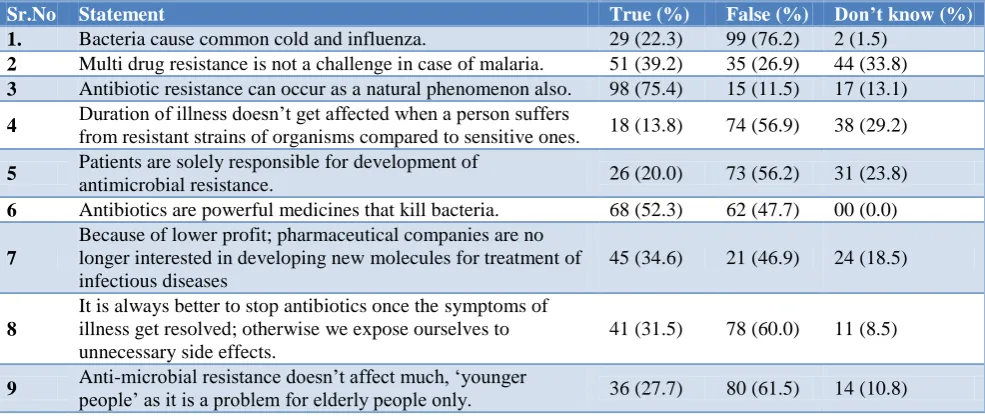
Table 1: Knowledge of antimicrobial resistance questionnaire (n=130).
Sr.No Statement True (%) False (%) Don’t know (%)
1. Bacteria cause common cold and influenza. 29 (22.3) 99 (76.2) 2 (1.5) 2 Multi drug resistance is not a challenge in case of malaria. 51 (39.2) 35 (26.9) 44 (33.8) 3 Antibiotic resistance can occur as a natural phenomenon also. 98 (75.4) 15 (11.5) 17 (13.1) 4 Duration of illness doesn‘t get affected when a person suffers
from resistant strains of organisms compared to sensitive ones. 18 (13.8) 74 (56.9) 38 (29.2) 5 Patients are solely responsible for development of
antimicrobial resistance. 26 (20.0) 73 (56.2) 31 (23.8) 6 Antibiotics are powerful medicines that kill bacteria. 68 (52.3) 62 (47.7) 00 (0.0) 7
Because of lower profit; pharmaceutical companies are no longer interested in developing new molecules for treatment of infectious diseases
45 (34.6) 21 (46.9) 24 (18.5)
8
It is always better to stop antibiotics once the symptoms of illness get resolved; otherwise we expose ourselves to unnecessary side effects.
41 (31.5) 78 (60.0) 11 (8.5)
Sr.No Statement True(%) False(%) Don’t know (%)
10 Antimicrobial resistance emerges because of provision of
substandard antibiotics by pharmaceutical companies also. 76 (58.5) 24 (18.5) 30 (23.1) 11
Empirical management of all episodes of diarrhoea by antibiotics is the need of the hour to prevent antimicrobial resistance.
23 (17.7) 36 (27.7) 71 (54.6)
12 ―Anti-microbial resistance makes treatment of particular infectious disease costlier‖; is a myth. 48 (36.9) 36 (27.5) 46 (35.4) 13 Hand washing in health care set up has got an important role to
play in prevention of anti-microbial resistance. 86 (66.2) 27 (20.8) 17 (13.1) 14 Second line drugs generally used for treatment of resistant
strains; are safer than first line drugs. 43 (33.1) 64 (49.2) 23 (17.7) 15 Prevention of drug resistance is an expensive task. 87 (66.9) 25 (19.2) 18 (13.8) 16 Antimicrobial resistance can lead to prolongation of hospital
stay. 106 (81.5) 21 (16.2) 3 (2.3)
Table 2: Treatment regimens for important public health problems (n=130).
Sr.No Statement Correct
answer (%)
Incorrect answer (%)
Don’t know (%)
1. DOTS Plus for multi-drug resistant tuberculosis 97 (74.6) 14 (10.8) 19 (14.6) 2 ACT (artesunate combination therapy) for Falciparum
malaria 35 (26.9) 20 (15.4) 75 (57.7)
3 MDT (multi-drug therapy) for leprosy 54 (41.5) 53 (40.8) 23 (17.7) 4 Bedaquline is a newer promising drug for treatment of
resistant strains of which disease. 20 (15.4) 51 (39.2) 59 (45.4) 5 Lumefantrine is a newer promising drug for treatment of
resistant strains of which disease. 32 (24.6) 43 (33.1) 55 (42.3)
Table 3: Information received about antimicrobial resistance in medical course so far (n=130).
Information received
No. (%)
Knowledge adequate no. (%)
Knowledge
inadequate no. (%)
Mean score
(±SD) Anova P value
Adequate 38 (29.2) 26 (68.4) 12 (31.6) 23.3 (5.77)
Inadequate 73 (56.2) 46 (63.0) 27 (37.0) 22.9 (5.25) 0.923 0.400
Not sure 19 (14.6) 9 (47.4) 10 (52.6) 21.3 (4.23)
Almost 60% participants had adequate knowledge about antimicrobial resistance. The mean antimicrobial resistance knowledge score of participants was 22.7 (SD: ±5.27, min: 8, max: 37). The mean score of girls was 22.6 (SD: ±4.95) and boys 22.9 (SD: ±5.60). The difference in the mean score of boys and girls was not statistically significant (F: 0.342, P-0.559) (t: 0.296, df: 128, p=0.767).
In response to ―whether antimicrobial resistance is a public health problem‖ 79%, 70% and 71% of participants mentioned that antimicrobial resistance is a public health problem in Gujarat, India and the World respectively.
Participants response to knowledge of anitmicrobial resistance questionnaire are depicted in Table 1 and 2. Pereception regarding information of antimicrobial resistance received so far in medical course is shown in Table 3.
Forty one percent participants mentioned that the information they have received so far in medical course is inadequate while 29% participants mentioned it as adequate. When analyzed further the mean score of participants was 23.3 (SD: ±5.77), 23.2 (SD: ±5.33), 22.0 (SD: ±5.06), 21.3 (4.23) who mentioned the information as adequate while those who described as inadequate. Correlation between percentage obtained in first M.B.B.S university examination and knowledge score of antimicrobial resistance was found highly significant (Pearson‘s correlation coefficient: 0.237, p=0.007).
DISCUSSION
to impart training regarding antimicrobial resistance to undergraduate medical students are needed.
Approximately two third and seventy percent of study participants agreed that antimicrobial resistance is an important public health challenge for India and the whole world. These proportions were slightly lower than those reported by a study conducted in Kerala.17 In a multicentric European study; most students (92%) believed that resistance was a national problem.19 Overall students were aware that antimicrobial resistance is a public health challenge not only for their own country but the whole world.
Fifty six percent students mentioned that the information regarding antimicrobial resistance they have received so far in medical course is inadequate and 15% were unsure. In a study conducted in Malaysia; the majority (88%) of the study participants stated that they would like to receive more training and 8% were unsure.20 In a study conducted in Europe; most students (74%) wanted more education on choosing antibiotic treatments.19 Urgent incorporation of more teaching regarding antimicrobial resistance in undergraduate medical studies is needed across the countries.
In the present study; 66% participants mentioned that hand hygiene plays an important role in prevention of antimicrobial resistance and 21% believed that it has not got an important role to play. In a study conducted in Europe among medical students; 24% participants believed poor hand hygiene was not at all important.19 Undergraduate medical students should be provided more knowledge regarding importance hand hygiene as a simple, cost effective preventive measure for antimicrobial resistance.
Fifty two percent participants knew that antibiotics can kill bacteria only. In a study conducted at Saudi Arabia; 18% students thought that antibiotics could be used for viral infections.21 In a study done at Kerala, India 28% thought that antibiotics can cure even viral infections.17 Incorrect information regarding indications of antibiotics can worsen the problem of antimicrobial resistance. Students should be explained and trained clearly that antibiotics should be used only in case of infections and diseases caused due to bacteria.
Seventy six percent of participants had knowledge that bacteria do not cause common cold and influenza and hence antibiotics should not be used for the treatment of the same. Quite similar findings (77%) were reported by a study done in Kerala.17
Fifty three percent participants agreed that skipping even one or two doses of antibiotics can also lead to development of drug resistance. In a study done in South India, the 47% participants gave similar answers.17
Thirty two percent participants knew that in episodes of cough and sore throat anitibiotics are not the first drugs of choice. In a study done among undergraduate medical students in Nagpur forty percent students gave similar answers.22
As the study was done among undergraduate medical students of one medical college only; the generalization of results should be done with caution.
CONCLUSION
In our study sixty percent undergraduate medical students had adequate knowledge of antimicrobial resistance. Majority of the students were aware that antimicrobial resistance is an important public health challenge not only for India but for the whole world also. Important finding of the study was just one forth of the participants agreed that information they have received so far in medical course regarding antimicrobial resistance is adequate. The budding doctors should receive correct, adequate information regarding antimicrobial resistance. There is further scope for incorporation of teaching regarding antimicrobial resistance and its consequences in undergraduate medical curriculum suitably.
ACKNOWLEDGEMENTS
The authors are thankful to the 2nd year undergraduate medical students of GMERS Medical College, Junagadh for their participation in the study.
Funding: No funding sources Conflict of interest: None declared Ethical approval: Not required
REFERENCES
1. World Health Organization. The evolving threat of antimicrobial resistance. Options for action. Available at: http://www.who.int/patientsafety/ implementation/amr/publication/en/index.html. Accessed on 18th January 2017.
2. Vickers H. International antibiotic resistance crisis. Better training needed to maintain therapeutic arsenal. Student BMJ. 2011;19:3207.
3. Davenport LA, Davey PG, Ker JS. An outcome-based approach for teaching prudent antimicrobial prescribing to undergraduate medical students: report of a Working Party of the British Society for Antimicrobial Chemotherapy. J Antimicrob Chemother. 2005;56:196–203.
4. Heaton A, Webb DJ, Maxwell SR. Undergraduate preparation for prescribing: the views of 2413 UK medical students and recent graduates. Br J Clin Pharmacol. 2008;66:128–34.
medical students. Br J Clin Pharmacol. 2012;74:644–61.
6. O‘Shaughnessy L, Haq I, Maxwell S, Llewelyn M. Teaching of clinical pharmacology and therapeutics in UK medical schools: current status in 2009. Br J Clin Pharmacol. 2010;70:143–8.
7. Charani E, Cooke J, Holmes A. Antibiotic stewardship programmes—what‘s missing? J Antimicrob Chemother. 2010;65:2275–7.
8. Roumie CL, Halasa NB, Edwards KM, Zhu Y, Dittus RS, Griffin MR. Differences in antibiotic prescribing among physicians, residents, and nonphysician clinicians. Am J Med. 2005;118:641– 8.
9. Running A, Kipp C, Mercer V. Prescriptive patterns of nurse practitioners and physicians. J Am Acad Nurse Pract. 2006;18:228–33.
10. Edgar T, Boyd SD, Palame MJ. Sustainability for behaviour change in the fight against antibiotic resistance: a social marketing framework. J Antimicrob Chemother. 2009;63:230–7.
11. Costelloe C, Metcalfe C, Lovering A, Mant D, Hay AD. Effect of antibiotic prescribing in primary care on antimicrobial resistance in individual patients: systematic review and meta-analysis. BMJ. 2010; 340:c2096.
12. Beardsley JR, Williamson JC, Johnson JW, Luther VP, Wrenn RH, Ohl CC. Show me the money: long-term financial impact of an antimicrobial stewardship program. Infect Control Hosp Epidemiol. 2012;33:398–400.
13. European Centre for Disease Prevention and Control. European Antibiotic Awareness Day. Available at: http://ecdc.europa.eu/en/EAAD/ Pages/Home.aspx. Accessed on 22 January 2017. 14. Center for Disease Control and Prevention. CDC‘s
campaign to prevent antimicrobial resistance in health-care settings. MMWR Morb Mortal Wkly Rep. 2002;51:343.
15. Centers for Disease Control and Prevention. Get smart: know when antibiotics work. Available at: http://www.cdc.gov/getsmart/antibiotic-use/
index.html. Accessed on 27th January 2017.
16. Carling P, Fung T, Killion A, Terrin N, Barza M. Favorable impact of a multidisciplinary antibiotic management program conducted during 7 years. Infect Control Hosp Epidemiol. 2003;24:699–706. 17. Khan A, Banu G, Reshma KK. Resistance and
Usage—A Survey on the Knowledge, Attitude, Perceptions and Practices among the Medical Students of a Southern Indian Teaching Hospital. J Clin Diagnos Res. 2013;7(8):1613-6.
18. Sharma K, Jain P, Sharma A. Knowledge, attitude and perception of medical and dental undergraduates about antimicrobial stewardship. Indian J Pharmacol. 2015;47(6):676–9.
19. Dyar OJ, Pulcini C, Howard P, Nathwani D. European medical students: a first multicentre study of knowledge, attitudes and perceptions of antibiotic prescribing and antibiotic resistance. J Antimicrob Chemother. 2014;69:842–6.
20. Haque M, Rahman NIA, Zulkifli Z, Ismail S. Antibiotic prescribing and resistance: knowledge level of medical students of clinical years of University Sultan Zainal Abidin, Malaysia. Therap Clin Risk Mang. 2016:12:413–26.
21. Harakeh S, Almatrafi M, Ungapen H, Hammad R, Olayan F, Hakim R, et al. Perceptions of medical students towards antibiotic prescribing for upper respiratory tract infections in Saudi Arabia. BMJ Open Resp Res. 2015;2 e000078.
22. Mahajan M, Dudhgaonkar S, Deshmukh S. A Questionnaire based Survey on the Knowledge, Attitude and Practises about Antimicrobial Resistance and Usage among the Second year MBBS Students of a Teaching tertiary care Hospital in Central India.
Cite this article as: Brahmbhatt KR, Patel AB.