http://www.ijcmph.com pISSN 2394-6032 | eISSN 2394-6040
Original Research Article
Assessment of knowledge, attitude and practices of risk factors of oral
cancer among the adult population of rural field practice area of
Bangalore Medical College and Research Institute
Sofiya Crastha, Selvi Thangaraj*, Ranganath Thimmanahalli Sobagiah
INTRODUCTION
Cancer is the non-communicable disease of public health importance. It is the second most common cause of mortality in developed countries. The Oro-pharyngeal cancer is highly prevalent in developing countries like India, than in developed countries.1
According to the National Cancer Registry Programme of ICMR, in India, oral cavity cancer is among the top five most common cancers in both sexes.2 Oral cancer
trigone, floor of the mouth, cheek linings, gingiva, palate, tongue and lips are the most common sites of occurrence of the oral cancers.4
The risk factors for the occurrence of the oral cancer can be modifiable or non-modifiable. Habits such as tobacco smoking and chewing, alcohol consumption, spicy diet, poor oral hygiene, infections such as HPV (Human Papilloma Virus), HSV (Herpes Simplex Virus) type 1, candidiasis and other factors like irradiation, dental plaque, sharp teeth, ill-fitting dentures, poor
socio-ABSTRACT
Background: Cancer is the non-communicable disease of public health importance. The oro-pharyngeal cancer is more common in developing than in developed countries. In India, oral cavity cancer is among the top five most common cancers in both sexes. Oral cancer is multi-factorial in nature, most of these risk factors can be prevented. The survival rate in oral cancer is directly related to the stage of diagnosis. Early diagnosis increases the probability of cure and minimizes the deformity. This study intends to find out the knowledge, awareness and practice of risk factors of oral cancer among rural population and to provide them health education about the prevention and early diagnosis.
Methods: The cross sectional descriptive study was conducted in the rural field practice area of BMCRI (Bangalore Medical College and Research Institute), among 311 adults.
Results: Majority, 195 (62.8%) of the population did not know the site of oral cancer, 248 (79.8%) did not know any clinical features of the oral cancer and 117 (37.6%) did not know about any risk factors of oral cancer. About 177 (56.90%) people agreed that there is a need for screening and regular oral examination to detect the lesions early. Only 42 (13.5%) had undergone oral examination done in the last 1 year.
Conclusions: There is a need to generate awareness regarding the risk factors and about the good and harmful practices in the community.
Keywords: Knowledge, Practices, Oral cancer, Risk factors, Early- diagnosis
Department ofCommunity Medicine, Bangalore Medical College and Research Institute, Bengaluru, Karnataka, India
Received: 18 September 2017
Revised: 19 December 2017
Accepted: 20 December 2017
*Correspondence:
Dr. Selvi Thangaraj,
E-mail: [email protected]
Copyright: © the author(s), publisher and licensee Medip Academy. This is an open-access article distributed under the terms of the Creative Commons Attribution Non-Commercial License, which permits unrestricted non-commercial use, distribution, and reproduction in any medium, provided the original work is properly cited.
causes of the oral cancer.5,6 The age more than 40 years, male gender, previous history of oral cancer and family history of oral cancer can also be the pre- disposing factors for the occurrence of the oral cancer. Green leafy vegetables and HPV vaccines are considered to have protective effect on oral cancer.
The survival rate in oral cancer is directly related to the stage at diagnosis. To increase the survival rates and probability of cure, early diagnosis is needed.6 In India, majority (60-80%) of the people with oral cancer are diagnosed at an advanced stage.7,8 Lack of knowledge about early signs and symptoms, lack of regular screening, the limited and inadequate access to trained information providers and limited health services lead to late diagnosis of oral cancer. The increase in disease incidence is mainly due to lack of knowledge about the risk factors.7,8
Hence this study was done to assess the Knowledge, Attitude and Practices regarding oral cancer among the adult population of rural field practice area of Bangalore Medical College and Research Institute (BMCRI) and to provide health education to them regarding the same.
Objectives
To assess the knowledge, attitude and practices regarding oral cancer among the adult population of rural field practice area of Bangalore Medical College and Research Institute
METHODS
Study area and study population
The cross sectional descriptive study was conducted in the rural field practice area of BMCRI, situated in Nelamangala Taluk, Bengaluru, Karnataka, during the period August- October 2016, among the adult population (more than 18 yrs) who were the permanent residents (residing for more than 1 year) of Nelamangala.
Inclusion criteria
Inclusion criteria were adult population (more than 18 yrs) in rural field practice area of Nelmangala; permanent residents (Residing for more than 1 year) of Nelamangala.
Exclusion criteria
Exclusion criteria were adults who did not give consent.
Sample size
By taking 77% as the knowledge about risk factors of oral cancer from Elango et al study, with 5% allowable error and 95% confidence interval, by using the formula
4pq/d2, around 311 people were considered for the study.11
Sampling method
Nelamangala Taluk is divided into 3 hoblis. Kasaba hobli with 10 gram panchayats, Tyamagondlu with 8 gram panchayats and Sompura with 6 gram panchayats. Randomly 2 gram panchayats from Kasaba and 2 from Tyamagondlu and 1 from Sompura was selected. And 1 village was selected from each gram panchayats and by Population probability proportionate sampling method, sample size was achieved in those selected villages.
Data collection
After the Institutional Ethical clearance, data collection was started by house to house visit. Consent was taken from each individual and those who did not give consent were excluded from the study. Interview based pre-tested and semi-structured questionnaire was used. Data regarding Demographic details and the knowledge about the oral cancer and its risk factors, the attitude and practices related to oral cancer was collected.
Data analysis
Data was entered in MS excel sheet and analysed in SPSS version 16 Statistical software by descriptive statistics and is presented in terms of tables and figures.
RESULTS
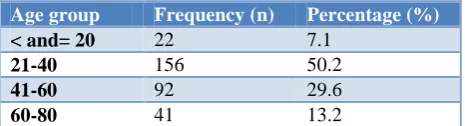
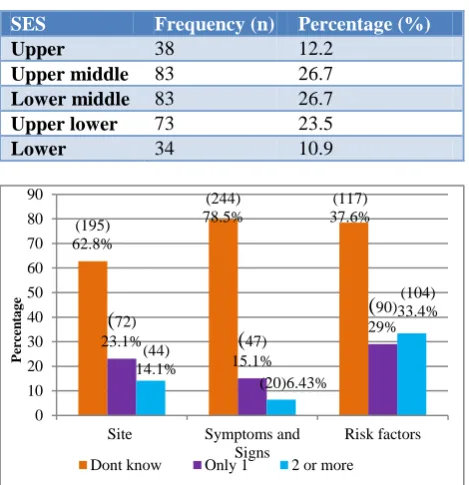
Out of 311 people, 233 (74.9%) were females and 78 (25.1%) were males. Majority 159 (51.1%) belonged to a nuclear family followed by three generation family 118 (38%) and joint family 34 (10.9%). Majority 258 (83%) were literates and 53 (17%) were illiterates. Age distribution of the study participants is given in Table 1. Majority (50.2%) of the population were in the age group of 21-40 years. Modified B G Prasad classification was used to find out the socio-economic status of the study participants (Table 2).
Table 1: Age distribution of study participants (n=311).
Age group Frequency (n) Percentage (%)
< and= 20 22 7.1
21-40 156 50.2
41-60 92 29.6
60-80 41 13.2
Table 2: Modified B G Prasad classification of socio economic status of the study participants. (n=311).
SES Frequency (n) Percentage (%)
Upper 38 12.2
Upper middle 83 26.7
Lower middle 83 26.7
Upper lower 73 23.5
Lower 34 10.9
Figure 1: Knowledge about the site, clinical features and risk factors of oral cancer (n=311).
Table 3: Knowledge about the site of oral cancer known by the study participants (n=311).
Known sites of occurrence of oral cancer
Frequency (n)
Percentage (%)
Buccal mucosa 36 11.6
Molar trigone 19 6.1
Gingival sulcus 12 3.9
Tongue 3 1
Floor of the mouth 2 0.6
Knew two or more sites 44 14.1
Did not know any sites 195 62.7
Table 4: Knowledge about the clinical features of oral cancer among the study participants (n=311).
Known clinical features of occurrence of oral cancer
Frequency (n)
Percentage (%)
Growth if abnormal
tissue 18 5.8
Non-healing wound 21 6.8
White/red spot 6 1.9
Pain 2 0.6
Knew two or more
clinical features 20 6.4
Did not know any
clinical features 244 78.5
Table 5: Knowledge about the risk factors of oral cancer among the study participants (n=311).
Known risk factors of occurrence of oral cancer
Frequency (n)
Percentage (%)
Smoking 4 1.3
Alcohol 5 1.7
Smokeless tobacco 86 27.6
Knew two or more risk
factors 99 31.8
Did not know any risk
factor 117 37.6
Majority, 36 (11.6%) told buccal mucosa as the commonest site of occurrence of the oral cancer (Table 3). None of the participants knew the lesions can arise over palate and lip. Non healing wound was the most common symptom known by 21 (6.8%) by the study participants (Table 4). Smokeless tobacco 86 (27.6%) was considered the most common risk factor (Table 5). Only half of the population, 162 (52.10%) knew that oral cancer is a preventable cancer.
Figure 2: Attitude about the oral cancer among the study participants (n=311).
Majority agreed that oral cancer is non-contagious. About 177 (56.90%) people agreed that there is a need for screening and regular oral examination to detect the lesions early and 240 (77.20%) agreed that early detection and diagnosis will help in better outcome (Figure 2).
239 (77%) told that doctor or dentist were consulted in case of any oral lesions, 59 (19%) told self medication and 10 (3.20%) told they ignore it.
Majority, 237 (76.2%) were willing to participate in the oral cancer screening camp if conducted in the rural field practice area. Among those who were not willing to participate, i.e., 74 (23.8%) of the people, about 42 (13.5%) told they are not at risk of developing cancer, 13 (195) 62.8% (244) 78.5% (117) 37.6%
(
72)23.1%
(
47)15.1%
(
90) 29% (44) 14.1% (20)6.43% (104) 33.4% 0 10 20 30 40 50 60 70 80 90Site Symptoms and Signs
Risk factors
Dont know Only 1 2 or more
29.30% 56.90% 77.20% 48.20% 40.50% 6.80% 22.50% 2.60% 16.10% 0.00% 10.00% 20.00% 30.00% 40.00% 50.00% 60.00% 70.00% 80.00% 90.00% Contagious Regular examination needed Early diagnosis helps in better
outcome
Agree Disagree Dont know
P
er
ce
n
(4.2%) were having fear of examination, 19 (6.1%) told they do not have proper transport to the facility.
Table 6: Reasons for oral examination done in the last one year (n=42=13.5%).
Cause Frequency
(n)
Percentage (%)
Specific oral problems 27 8.6
Follow up of previous
problems 3 1
Part of routine physical
examination 3 1
Part of routine dental
examination 9 2.9
Regarding the practices only 42 (13.5%) had undergone oral examination done in the last 1 year, among them only 12 (4%) had undergone the oral examination as a part of routine health (dental + physical) examination (Table 6).
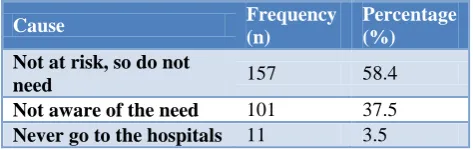
Table 7: Reasons for not having oral examination (n= 269=86.5%).
Cause Frequency
(n)
Percentage (%)
Not at risk, so do not
need 157 58.4
Not aware of the need 101 37.5
Never go to the hospitals 11 3.5
269 people did not undergo any examination of the oral cavity in the past 1 year, majority, 157 (58.4%) told that they are not at risk of development of oral cancer so do not need the screening (Table 7).
Table 8: Practices of risk factors (n=269= 86.5%).
Harmful practices Frequency
(n)
Percentage (%)
Cigarette smoking 31 11.52
Tobacco chewing 85 31.59
Alcohol consumption 27 10.03
Spicy diet 126 46.84
Among the protective practices, 308 (99%) of them were using green leafy vegetables in their diet but none had received HPV vaccination. Among those who had harmful practices, which was followed by 269 individuals, majority 126 (46.84%) were using very spicy diet followed by chewing tobacco among 85 (31.59%) of people (Table 8) and none had sharp tooth or the ill- fitting dentures.
For the better approach in health education, health information seeking pattern of the people was asked and it was found that health professionals and hospitals were
the main source (69.4%) than television, newspapers, radio, and neighbours (Table 9).
Table 9: Health information seeking pattern.
Source of information Percentage (%)
Health professionals and
hospitals 69.4
Television 51.7
Newspaper 28.6
Radio 8.7
Neighbours 9.6
DISCUSSION
In the present study, majority were literates.Knowledge about the site of occurrence of the cancer in mouth, was poor (62.8% did not know) in our study population, as compared with awareness among the rural community in Mandya (50.3% did not know), in a study by Vishma et al.9 But this knowledge was similar to the knowledge of the rural population of Belagavi (60.5% did not know), in a study by Kadammanavar et al.5
In a study by Agrawal et al about the oral cancer awareness among the general public in Gorakhpur city, abnormal tissue growth, non healing oral ulcers/sores and reduced mouth opening were the symptoms known by most (more than 60% respondents) and only 39.8% subjects knew presence of red/ white spots and 23.2% knew undue loss of teeth as an early symptom, as compared to our study, where 79.8% did not know any symptoms of oral cancer.10
In a study by Elango et al, among the high risk population of India, it was found that 77% knew smoking, 64% knew alcohol and 70% knew pan chewing as the risk factors but among them, 21% smoked (82% knew it was a risk factor), 11% used pan with tobacco (71% knew it was a risk factor), 21% used pan without tobacco (75% knew it was a risk factor), 81% used alcohol (66% knew it was a risk factor).11 As compared to this, in our study population, the knowledge was low 60.1% knew tobacco chewing, 34% knew smoking tobacco and 10% knew alcohol as risk factors, but the major risk factor practiced was spicy diet intake in 46.84%, but the knowledge about that was found nil.
By improving the knowledge and changing the attitude and causing the behaviour change especially for tobacco cessation, primary prevention of oral cancer can be achieved.
camps is also crucial. In our study population, around 76.2% were willing to participate in such camps.
CONCLUSION
Knowledge about possible prevention, risk factors and belief of “early diagnosis can cure oral cancer” is essential for primordial, primary and secondary prevention interventions to become successful. If this knowledge is less, further the negligence from the population side will increase and the incidence of the cancer will increase and the stage at diagnosis will also be late. Since people are not aware off and have many obstacles to reach the health facilities for screening, it can be planned at the peripheral levels through conducting regular camps. Health education about the risk factors, early diagnosis, prevention and early detection and screening to make them take initiatives and participate actively and to reduce the burden of the disease and to achieve a better health.
Funding: No funding sources Conflict of interest: None declared
Ethical approval: The study was approved by the Institutional Ethics Committee
REFERENCES
1. World Health Organization. Strengthening the prevention of oral cancer: the WHO perspective. 2005. Available at: http://www.who.int/oral_health/ publications/CDOE05_vol33_397_9/en/. Accessed on 15 August 2017.
2. Park K. Park’s textbook of preventive and social medicine. 23rd ed. Jabalpur: Banarasidas Bhanot Publishers; 2015:1-6, 32-46.
3. Coelho KR. Challenges of the Oral Cancer Burden in India. J Cancer Epidemiol. 2012;2012:1-17. 4. Dhage D, Patil S, Narlwar U, Ughade S, Adikane H.
Case control study for risk factors associated with
oral cancer in central India. Int J Community Med Public Health. 2017;4(4):1022-7.
5. Kadammanavar M, Angolkar M, Hirachand AD, Sah JK, Karkati S. Awareness about Oral Cancer and Its Risk Factors among Rural Adult Population of Belagavi City, India. Int J Health Sci Res. 2015;5(7):295-300.
6. Okoh M, Enabulele J. Knowledge and practices regarding oral cancer among graduating dental students. Indian J Oral Sci. 2015;6(1):14-8.
7. Varshitha A. Prevalence of Oral Cancer in India. J. Pharm Sci & Res. 2015;7(10): 845-8.
8. Thilak GPS, D’leema R, Kamath V. Oral cancer awareness in rural Karnataka - are they aware. Nitte University J Health Sci. 2015;5(3):19-23.
9. Vishma BK, Shashikantha SK, Sheethal MP, Muniyal A. Awareness of oral cancer and its risk factors in a rural community in Mandya, Karnataka, India. Int J Community Med Public Health. 2016;3(1):347-52.
10. Agrawal M, Pandey S, Jain S, Maitin S. Oral Cancer Awareness of the General Public in Gorakhpur City, India. Asian Pac J Cancer 2012;13(10):5195-199. 11. Elango JK, Anandkrishnan N, Suresh A, Iyer S,
RamaIyer S, Kuriakose M. Mouth self-examination to improve oral cancer awareness and early detection in a high-risk population. Oral Oncology. 2011;47(7):620-4.
12. Sridharan G. Epidemiology, control and prevention of tobacco induced oral mucosal lesions in India. Indian J Cancer. 2014;51(1):80.
Cite this article as: Crastha S, Thangaraj S,