Review Article
Implication of pigtail catheter vs chest tube drainage
Alaa Elsayed
1*, Rayan Alkhalifa
2, Muhannad Alodayni
3, Rakan Alanazi
3, Lara Alkhelaiwy
4,
Mohammed Zalah
5, Ghufran Alnaeli
6, Tahani Alorabi
7, Maram Al-Qarni
7, Sarah Al-Otaibi
8INTRODUCTION
Body collections and fluids drainage is a common requirement among various medical specialties. Drains are needed to remove intraabdominal collections (such as bile secretions, pancreatic secretions, bloody collection, urine, or, air), pleural collections (such as pleural effusion, empyema, or pneumothorax), wound fluids, or abscesses. Many drains have been developed, classified, and used.1 Chest drains are of the most common drains utilized among thoracic surgeons, anesthesiologist, and critical care physicians. Indications for chest drains include pleural effusion, empyema, hemothorax, pneumothorax, pleurodesis, parapneumonic effusion, and
post-surgical in certain operations.2 For drainage of pleural collections, two drainage systems are commonly utilized: chest tube drainage and pigtail catheter drainage.3,4 Each of them has its own indications, advantages, and disadvantages. The aim of this article is to provide a review on both systems, and to compare the reported safety, efficacy, and complications of each.
PIGTAIL CATHETER DRAINAGE
Background
Pigtail catheter drainage is a common simple technique for drainage of body fluids or collections. The pigtail
ABSTRACT
Pigtail catheters and chest tubes have long been used for drainage of pleural collections for many years. In thoracic surgery, each technique is preferred in certain conditions. Pigtail catheters have the advantages of being smaller in size, more flexible, less traumatic, easier in insertion, and are associated with lower complication rates. They are particularly effective in draining non-viscid and non-coagulable fluids. The main disadvantages are their ineffectiveness in draining thick fluids, their higher liability to clogging, kinking, and obstruction. Chest tubes, on the other hand, have larger diameters allowing faster and more efficacious drainage of thick fluids and hemothorax. However, they are more painful, more distorting to tissues, and have higher complications rates. The aim of this article is to provide a review on both systems, and to compare the reported safety, efficacy, and complications of each.
Keywords: Drainage, Chest tube, Pig tail
1
Department of General Surgery, Prince Mohammed bin Abdulaziz Hospital, Medina, Saudi Arabia
2
King Saud bin Abdulaziz University for Health Sciences, Riyadh, Saudi Arabia
3
Imam Muhammad ibn Saud Islamic University, Riyadh, Saudi Arabia
4
Ministry of Health, Riyadh, Saudi Arabia
5
Prince Mohammed bin Nasser Hospital, Jizan, Saudi Arabia
6
Taibah University, Medina, Saudi Arabia
7
Taif University, Taif, Saudi Arabia
8
Ibn Sina National College, Jeddah, Saudi Arabia
Received: 20 July 2018
Accepted: 06 August 2018
*Correspondence:
Dr. Alaa Elsayed,
E-mail: [email protected]
Copyright: © the author(s), publisher and licensee Medip Academy. This is an open-access article distributed under the terms of the Creative Commons Attribution Non-Commercial License, which permits unrestricted non-commercial use, distribution, and reproduction in any medium, provided the original work is properly cited.
catheter is a special small sized catheter (12-14 Fr) with holes at the sides of its coiled tip. It is beneficial for drainage of non-viscid non-coagulable collections such as urine, pancreatic secretions, biliary secretions, or even air.4
Pigtail catheter drainage is performed through ultrasound-guided transcutaneous insertion of the catheter into the target fluid collection.5 The catheter is then fixed to the skin with sutures, and the other tip is sometimes put under water seal in certain condition such as drainage of pneumothorax. Pigtail drainage has been used for many indications such as drainage of intraabdominal fluid collection (bile, pancreatic secretions, … etc.), pleural effusion, pneumothorax, nephrostomy, and others.5
Advantages
Pigtail catheter drainage has various advantages. It is an easy and simple to perform technique that does not require many procedures.6 It is less traumatic and disrupts less tissue. It comprises making a small skin incision to insert the catheter, thus produces less pain. It also does not impose ambulatory restrictions and, therefore, is better tolerated by most of the patients. In thoracic surgery, pigtail catheters possess more advantages. The size of the pigtail catheters is generally small (~4 mm) in comparison to the intercostal space (around 9 mm). This
will not impinge on neurovascular structures at the intercostal space and will subsequently produce less pain. The flexibility of the catheter and the small scar size will additionally minimize the pain during and after the drainage procedures.
Disadvantages
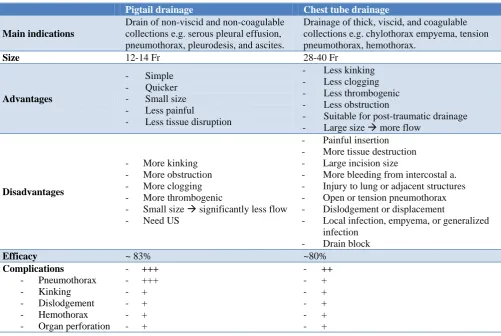
On the other hand, the main disadvantages are that it only can drain non-viscid and non-coagulable collections. It is not suitable for thick fluids. Additionally, the catheters are more likely to obstruct and get kinked in comparison with the rigid chest tubes. Furthermore, it only permits significantly lower flow than that drained by chest tubes due to the small diameter of the pigtail catheter. Finally, it often necessitates the presence of an ultrasonographic machine for US-guided drainage. The advantages and disadvantages of the pigtail drainage are summarized in Table 1.
CHEST TUBE DRAINAGE
Background
Chest tube drainage is another commonly utilized drainage system in thoracic surgery. It implicates the insertion of a slightly large (28-40 Fr) flexible plastic tube in the intercostal spaces to drain pleural collections.
Table 1: Comparison between pigtail drainage and chest tube drainage.
Pigtail drainage Chest tube drainage
Main indications
Drain of non-viscid and non-coagulable collections e.g. serous pleural effusion, pneumothorax, pleurodesis, and ascites.
Drainage of thick, viscid, and coagulable collections e.g. chylothorax empyema, tension pneumothorax, hemothorax.
Size 12-14 Fr 28-40 Fr
Advantages
- Simple
- Quicker
- Small size - Less painful
- Less tissue disruption
- Less kinking - Less clogging - Less thrombogenic - Less obstruction
- Suitable for post-traumatic drainage - Large size more flow
Disadvantages
- More kinking - More obstruction - More clogging - More thrombogenic
- Small size significantly less flow
- Need US
- Painful insertion - More tissue destruction - Large incision size
- More bleeding from intercostal a. - Injury to lung or adjacent structures - Open or tension pneumothorax - Dislodgement or displacement
- Local infection, empyema, or generalized infection
- Drain block
Efficacy ~ 83% ~80%
Complications
- Pneumothorax - Kinking - Dislodgement - Hemothorax - Organ perforation
- +++
- +++
- +
- +
- +
- +
- ++
- +
- +
- +
- +
The usual site of insertion is the fourth intercostal space at mid-axillary line not to restrict patient motility.7 It is of special benefit in draining hemothorax, chylothorax, empyema, pneumothorax, and thick pleural effusion. Chest tube can be inserted via a skin incision (open method) or via a trocar (closed method). Generally, the open method is preferred to avoid internal organ injury or perforation with a strong trocar.8
Advantages
Chest tubes have the advantage of being more rigid than pigtail catheter and, therefore, are associated with less liability to kinking or clogging.9 Additionally, the larger sized available (up to 40 Fr) makes the drainage less likely to obstruct. Furthermore, it can drain thick fluids such as chylothorax or empyema, it can be used with coagulable collections as in cases of hemothorax, and it is suitable for use in post-traumatic pleural collections.10
Disadvantages
Chest tubes, in spite of their common use, have many disadvantages. The large-sized tubal diameter impinges on neurovascular structures in the intercostal space resulting in more pain.11 The incisional insertion is also painful and results in more tissue dissection. Injury to adjacent structures (such as arteries, veins, nerves, or lungs) is very likely. Bleeding from intercostal arteries is more often encountered than in case of using pigtail catheters. Injury to the pleura may result in open or tension pneumothorax.12 Local or generalized infection can also occur. Chest tube have also higher risk for some complications such as malposition, dislodgment or displacement, empyema, and drain block.13 The advantages and disadvantages of chest tube drainage are demonstrated in Table 1.
PIGTAIL CATHETER VERSUS CHEST TUBE DRAINAGE
Many literature studies were conducted to compare the efficacy and complications of pigtail catheter and chest tube in draining pleural collections. Chein-heng et al, in their study comparing the efficacy of pigtail catheter drainage and chest tube drainage of parapneumonic effusion in children, reported that pigtail drainage was more effective and had less complications.14 Children who underwent chest tube drainage were more subjected to drainage failure and pneumothorax.14 Also, Liang et al. reported 100% success rates of pigtail drainage of traumatic hemothorax.15 Similarly, Roberts et al, studying the efficacy of both techniques in pediatric thoracotomy, found that the use of pigtail catheters was more efficacious in draining serous effusion.16 Chest tube drainage was superior in cases of hemothorax, chylous pleural effusion, and empyema.
On the other hand, many researchers discourage the use of pigtail catheter for drainage of empyema. Light et al,
Roberts et al, and Liang et al reported higher efficacy of chest tube in comparison to pigtail catheter for drainage of empyema.15-17 Therefore, it is recommended that chest tubes are to be use at least initially for drainage of empyema, and pigtail catheter can be used after. However, some authors reported that there was no statistically significant difference between the initial use of pigtail catheter and chest tube drainage of pleural empyema, particularly when there was no evidence of loculations.18,19 In contrast, Chein-Heng et al mentioned that the pigtail catheter-treated empyema children had deteriorated.14
As regards the complications, Chein-Heng et al reported that the development of pneumothorax was higher among the children drained with chest tube in comparison to those treated with pigtail catheters.14 The rate of other complications (e.g. kinking, dislodgement, hemothorax, or organ perforation) was comparable between the two groups. Complication rates varied from 5% to 8% among the studies.20 In disagreement with most of the literature studies, Maskell et al reported significant complications among the pigtail catheter drained patients.21 They stated that the technique could also result in organ injury and even death, and they argued the matter of safety or superiority of the pigtail catheter drainage to chest tube drainage.
A recent systemic review, conducted in 2017 on 11 studies and including 875 patients, reported that the success rates among the patients with pneumothorax drained with pigtail catheter was almost similar to the efficacy among the chest tube patients. The success rate was 79.84% and 82.87% among the pigtail catheter group and chest tube group, respectively. Complications were significantly lower among the pigtail group (Odd’s ration=0.49). Furthermore, the hospital stay was significantly shorter (mean difference -2.54, p<0.001) and shorter duration of the drainage (mean difference -1.51, p<0.001).20 Therefore, many authors recommended the use of pigtail catheter for drainage of different types of spontaneous pneumothorax as first line of management.22–25
In conclusion, the choice of the drainage method should largely be decided on basis of the type of collection to be drained. As most of the published studies agree that the efficacy of both pigtail catheter drainage and chest tube drainage is almost comparable in non-thick collections, pigtail catheters are often preferred due to the significantly lower complication rate. In cases of empyema, hemothorax, or chylous pleural effusion, initial drainage with large-bored chest tube is recommended.26,27
CONCLUSION
more flexible, less traumatic, easier in insertion, and are associated with lower complication rates. They are particularly effective in draining viscid and non-coagulable fluids. The main disadvantages are their ineffectiveness in draining thick fluids, their higher liability to clogging, kinking, and obstruction. Chest tubes, on the other hand, have larger diameters allowing faster and more efficacious drainage of thick fluids and hemothorax. However, they are more painful, more distorting to tissues, and have higher complications rates. The choice of the drainage method largely depends of the type of collection to be drained. As most of the published studies agree that the efficacy of both pigtail catheter drainage and chest tube drainage is almost comparable in non-thick collections, pigtail catheters are often preferred due to the significantly lower complication rate. In cases of empyema, hemothorax, or chylous pleural effusion, initial drainage with large-bored chest tube is recommended.
Funding: No funding sources Conflict of interest: None declared Ethical approval: Not required
REFERENCES
1. Robinson JO. Surgical drainage: An historical perspective. Br J Surg. 1986;73(6):422-6.
2. Zisis C, Tsirgogianni K, Lazaridis G, Lampaki S, Baka S, Mpoukovinas I, et al. Chest drainage systems in use. Ann Transl Med. 2015;3(3):43. 3. Durai R, Hoque H, Davies TW. Managing a Chest
Tube and Drainage System. AORN J. 2010;91(2):275-83.
4. Crouch JD, Keagy BA, Delany DJ. “Pigtail” Catheter Drainage in Thoracic Surgery. Am Rev Respir Dis. 1987;136(1):174-5.
5. Plutinsky J, Bitter K, Taligova Z, Libakova I, Petras D, Sabova R. Pigtail catheter drainage-When to use it. Eur Respir J. 2011;38:597.
6. Hingorani AD, Bloomberg TJ. Ultrasound-guided pigtail catheter drainage of malignant pericardial effusions. Clin Radiol. 1995;50(1):15-9.
7. Lin YC, Tu CY, Liang SJ, Chen HJ, Chen W, Hsia TC, et al. Pigtail catheter for the management of pneumothorax in mechanically ventilated patients. Am J Emerg Med. 2010;28(4):466-71.
8. Mahmood K, Wahidi MM. Straightening Out Chest Tubes: What Size, What Type, and When. Clin Chest Med. 2013;34(1):63-71.
9. Benton IJ, Benfield GFA. Comparison of a large and small-calibre tube drain for managing spontaneous pneumothoraces. Respir Med. 2009;103(10):1436-40.
10. Kupfer Y, Seneviratne C, Chawla K, Ramachandran K, Tessler S. Chest tube drainage of transudative pleural effusions hastens liberation from mechanical ventilation. Chest. 2011;139(3):519-23.
11. Inaba K, Lustenberger T, Recinos G, Georgiou C, Velmahos GC, Brown C, et al. Does size matter? A prospective analysis of 28-32 versus 36-40 French
chest tube size in trauma. J Trauma Acute Care Surg. 2012;72(2):422-7.
12. Vedam H, Barnes DJ. Comparison of large- and small-bore intercostal catheters in the management of spontaneous pneumothorax. Intern Med J. 2003;33(11):495-9.
13. Ritchie M, Brown C, Bowling M. Chest tubes: Indications, sizing, placement, and management. Clin Pulm Med. 2017;24(1):37-53.
14. Lin CH, Lin WC, Chang JS. Comparison of pigtail catheter with chest tube for drainage of parapneumonic effusion in children. Pediatr Neonatol. 2011;52(6):337-41.
15. Liang SJ, Tu CY, Chen HJ, Chen CH, Chen W, Shih CM, et al. Application of ultrasound-guided pigtail catheter for drainage of pleural effusions in the ICU. Intensive Care Med. 2009;35(2):350-4. 16. Roberts JS, Bratton SL, Brogan TV. Efficacy and
complications of percutaneous pigtail catheters for thoracostomy in pediatric patients. Chest. 1998;114(4):1116-21.
17. Light RW. The management of parapneumonic effusions and empyema. Curr Opin Pulm Med. 1998;4(4):227-9.
18. Horsley A, Jones L, White J, Henry M. Efficacy and complications of small-bore, wire-guided chest drains. Chest. 2006;130(6):1857-63.
19. Pierrepoint MJ, Evans A, Morris SJ, Harrison SK, Doull IJ. Pigtail catheter drain in the treatment of empyema thoracis. Arch Dis Child. 2002;87(4):331-2.
20. Chang SH, Kang YN, Chiu HY, Chiu YH. A Systematic Review and Meta-Analysis Comparing Pigtail Catheter and Chest Tube as the Initial Treatment for Pneumothorax. Chest. 2018;153(5):1201-12.
21. Maskell NA, Medford A, Gleeson FV. Seldinger chest drain insertion: Simpler but not necessarily safer. Thorax. 2010;65(1):5-6.
22. MacDuff A, Arnold A, Harvey J. BTS Pleural Disease Guideline Group. Management of spontaneous pneumothorax: British Thoracic Society Pleural Disease Guideline 2010. Thorax. 2010;65(2):18-31.
23. Dull KE, Fleisher GR. Pigtail catheters versus large-bore chest tubes for pneumothoraces in children treated in the emergency department. Pediatr Emerg Care. 2002;18(4):265-7.
24. Kulvatunyou N, Erickson L, Vijayasekaran A, Gries L, Joseph B, Friese RF, et al. Randomized clinical trial of pigtail catheter versus chest tube in injured patients with uncomplicated traumatic pneumothorax. Br J Surg. 2014;101(2):17-22. 25. Kuo HC, Lin YJ, Huang CF, Chien SJ, Lin IC, Lo
MH, et al. Small-bore pigtail catheters for the treatment of primary spontaneous pneumothorax in young adolescents. Emerg Med J. 2013;30(3):17. 26. Voisin F, Sohier L, Rochas Y, Kerjouan M3,
27. Baumann MH. What size chest tube? What drainage system is ideal? And other chest tube management questions. Curr Opin Pulm Med. 2003;9(4):276-81.
Cite this article as: Elsayed A, Alkhalifa R, Alodayni M, Alanazi R, Alkhelaiwy L, Zalah M, et al.