ISSN: 2320-4850 [17] www.ajprd.com/AJPRD Available online athttp://ajprd.com
Asian Journal of Pharmaceutical Research and Development
(An International Peer-Reviewed Journal of Pharmaceutical Research and Development)
Open Access to Pharmaceutical and Medical Research
© 2013-18, publisher and licensee AJPRD, This is an Open Access article which permits unrestricted non-commercial use, provided the original work is properly cited
Open
Access Research Article
FORMULATION AND EVALUATION OF ORMELOXIFENE
FAST DISSOLVING TABLETS
Abdul Hasan Sathali. A*, Ramanathan. M
Department of Pharmaceutics, College of Pharmacy, Madurai Medical College, Madurai- 625 020, Tamil Nadu, India
ABSTRACT
The objectives of the present work were to enhancedissolution and solubility of slightly water soluble ormeloxifene hydrochloride and formulate fast dissolving tablets. The research work was two-phase process; the first phase was to enhance the solubility and dissolution of ormeloxifene. For this object drug was processed with different solid dispersion techniques like kneading, co precipitation, melting and solvent evaporation technique with 𝛽-cyclodextrin and PEG 6000 carrier. The second phase approach was, to formulate as fast dissolving tablet by using the resulted solid dispersion product by direct compression method by using various superdisintagrents. Solid dispersion mixtures were characterized by differential scanning calorimetry, x-ray diffraction studies, and Fourier transform infrared spectroscopy. The solubility and dissolution rate of Ormeloxifene HCl was remarkably increased in the above methods. It was concluded that, Kneading method has produce best increase in solubility and dissolution for Ormeloxifene then other methods. The overall results showed that ormeloxifene fast dissolving tablet formula (F8) using crospovidone ,croscarmillose sodium and sodium starch glycolate (combined superdisintegrants) showed shortest disintegration time, superior drug release profile, high water absorption ratio. In addition the selected formulation had an acceptable hardness and friability and stability,so it was concluded that combined superdisintegrant formula with mannitol diluent was more opt to make Ormeloxifene fast dissolving tablet.
Keywords: Ormeloxifene, superdisintegrants, kneading, dissolution, disintegration time and solid dispersion.
Cite this article as:
Abdul Hasan Sathali. A, Formulation and Evaluation of Ormeloxifene Fast Dissolving Tablets, Asian Journal of Pharmaceutical research and Development.2018;6 (3):17-31 DOI:http://dx.doi.org/10.22270/ajprd.v6.i3.373
*Address for Correspondence
Abdul Hasan Sathali. A, Professor and Head, Department of Pharmaceutics, College of Pharmacy, Madurai Medical College, Madurai- 625 020, Tamil Nadu, India
INTRODUCTION
ast dissolving tablet form is very popular because of ease of self-administration, compact in nature, easy to manufacture and it can be delivered in accurate dose. Some drugs having poor bioavailability due to poor aqueous solubility and thus results slow dissolution rate in the biological fluids. Dissolution is rate limiting step for oral bioavailability of products. Solubility is the major challenges in pharmaceutical tablet formulations; all drugs must possess some degree of
aqueous solubility. For pharmacological response
solubility is one of the important parameter to achieve desired concentration of drug in systemic circulation. Poorly water-soluble drug candidates often emerge from
contemporary drug discovery programme1
Solubility enhancement of various poorly soluble compounds is a challenging task for researchers and pharmaceutical scientists. There are many techniques which are used to enhance the aqueous solubility. The
ability to increase aqueous solubility can thus be a valuable aid to increase efficiency and reduce side effects for certain drugs. Therapeutic effectiveness of a drug depends upon the bioavailability and solubility. Due to advanced research &development, there are varieties of new drugs and their derivatives are available, but most of the drug candidates fail to reach market due to poor bioavailability, even though these drugs might exhibit potential pharmacodynamic activities. The basic aim of the further formulation and development section is to make that drug available at proper site of action within optimum dose.
Fast dissolving tablets are those, when put on tongue, disintegrate rapidly releasing the drug which dissolve or disperses in the saliva. The faster the drug dissolves into solution, quicker the absorption and onset of clinical effect. Some drugs are absorbed from the mouth, pharynx and esophagus as the saliva passes down into the stomach. In such cases, bioavailability of drug is significantly
ISSN: 2320-4850 [18] www.ajprd.com/AJPRD
greater than those observed from conventional tablets dosage form. The European pharmacopoeia adopted the term “Orodispersible tablet” as a tablet that to be placed in the mouth where it disperses rapidly before swallowing. According to European pharmacopoeia, the ODT should
disperse/disintegrate in less than 3minutes.2
Ormeloxifene hydrochloride indicated for emergency contraceptive and dysfunctional uterine bleeding, making fast dissolving tablet is most opt for these indications. The basic approach in the development of fast dissolving tablet by use of superdisintegrants like cross linked carboxymethyl cellulose (croscarmellose), sodium starch glycolate, polyvinyl pyrollidone etc, which provide instantaneous disintegration of tablet after putting on tongue, there by release the drug in saliva.
MATERIALS AND METHODS
Ormeloxifene hydrochloride was obtained as a gift sample from HLL Life care Ltd, Belgaum, (KA). Crospovidone, Croscarmellose sodium, sodium starch glycolate and Micro Crystalline Cellulose was obtained from High Purity Laboratory Chemicals Pvt Ltd, Mumbai. β-cyclodextrin was obtained from Hi Media Laboratories Pvt Ltd, Mumbai. PEG 6000was obtained from S.D Fine Chemicals Ltd, Mumbai. All other chemicals used were of analytical grade and were used without further purification.
Determination of λ max for ormeloxifene in distilled water and phosphate buffer pH (6.8)
Ormeloxifene hydrochloride solution 10 µg/ml in distilled water and phosphate buffer pH 6.8 solutions are prepared, then scanned by a UV spectrophotometer at wavelengths ranging from 400nm to 200nm, the λmax for solution was
determined.3
Calibration of ormeloxifene in distilled water and phosphate buffer pH (6.8)
An accurately weighed quantity (100mg) of pure drug Ormeloxifene HCl was dissolved in sufficient amount of methanol and made up to 100ml with Distilled water and phosphate buffer pH 6.8 respectively to produce 1mg/ml solution. From this 10ml of the solution is pipette-out and made up to 100ml with distilled water and phosphate buffer pH 6.8 respectively. From this 5 to 25ml ispipette-out and diluted to 100ml with distilled water and phosphate buffer pH 6.8 respectively. The solutions are scan within the range of 200nm-400nm in UV-Spectrophotometer. The absorbance of the solutions was measured at 278nm by using UV spectrophotometer and distilled water and phosphate buffer pH 6.8 was used as blank solution respectively. The calibration graph is drawn by taking concentration in X-axis and respective absorbance in Y-axis to get a straight line as per Beers law.
COMPATIBILITY STUDIES FOR DRUG AND EXCIPIENTS
Compatibility studies were carried out to check the interactions between the drug and excipients. This information was needed for selection of excipients with the drug for the formulation of solid dispersion. Infrared spectrophotometry and Differential scanning calorimetry studies are the two techniques used to check the compatibility studies between drug and polymers.
Fourier Transform-Infra Red (FT-IR) Studies
Ormeloxifene hydrochloride and β-cyclodextrin,
ormeloxifene hydrochloride and PEG-6000 are subjected to Fourier Transform Infra-Red Spectroscopy studies (Shimadzu, Japan).Samples are prepared using KBr disc method and spectra are recorded over the range 600-4500 per cm. Spectra are analyzed for drug-carrier interaction and functional groups involved in the
complexation process.4
Differential Scanning Colorimetric (DSC) studies:
The possibility of drug and carrier / polymer interaction was investigated by Differential scanning calorimetry (DSC 200 TA Instruments, USA). The DSC thermograms of pure drug and the polymers were recorded to study the interactions between drug and polymers. The samples were separately sealed in aluminium cells and set in a
thermal analyzer.5The thermal analysis was performed at a
scanning rate of 100C per minute over a temperature range
of 500-2000.
FORMULATION AND EVALUATION OF SOLID DISPERSIONS
Solid dispersion of Ormeloxifene hydrochloride is prepared by following methods
Kneading method
Melting method
Co precipitation method
Solvent evaporation method
Kneading method
β-cyclodextrin was placed as per formula ratio in a mortar, a small quantity of methanol was added to it while triturating to get slurry like consistency. Then the drug was slowly incorporated into the slurry and trituration was further continued for one hour. Slurry was then air dried at 25°C for 24 hours, pulverized, passed through sieve and stored in desiccators over fused silica gel5.
Melting method
The carriers PEG 6000 were taken in a china dish and heated upto 60ºC in a water bath, until the mixture melts completely. The drug (Ormeloxifene hydrochloride) was added to the molten carrier and mixed thoroughly. The dispersion is cooled to ambient condition. Solidified mass was crushed, pulverized and passed through sieve and stored in desiccators5.
Co precipitation method
As per the formula ratio the carrier ß-cyclodextrin 20% w/w solution was prepared purified water at 75°C.An
appropriate molar ratio of drug (ormeloxifene
hydrochloride) was added to the solution, which was cooled down to room temperature while continuously stirring and shaking. During the cooling, the solid drug
ß-cyclodextrin complex precipitated.7
Solvent evaporation method
ISSN: 2320-4850 [19] www.ajprd.com/AJPRD
resulting residue was dried for 2 hour and stored overnight in desiccators. After drying the residue was ground in a mortar and sieved through a mesh. The
resultant solid dispersions were stored in desiccators until further investigation8. All solid dispersion technique
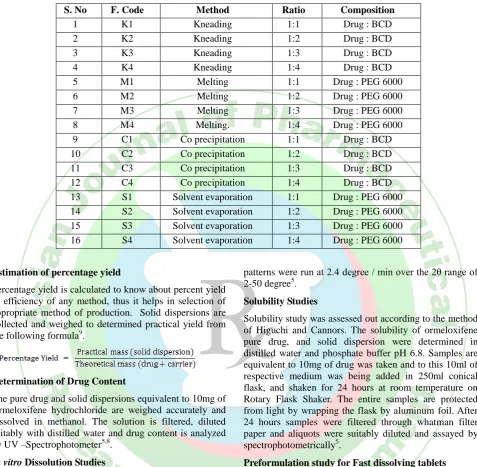
formula was shown in table.1.The
Table 1. Solid dispersion formula
S. No F. Code Method Ratio Composition
1 K1 Kneading 1:1 Drug : BCD
2 K2 Kneading 1:2 Drug : BCD
3 K3 Kneading 1:3 Drug : BCD
4 K4 Kneading 1:4 Drug : BCD
5 M1 Melting 1:1 Drug : PEG 6000
6 M2 Melting 1:2 Drug : PEG 6000
7 M3 Melting 1:3 Drug : PEG 6000
8 M4 Melting. 1:4 Drug : PEG 6000
9 C1 Co precipitation 1:1 Drug : BCD
10 C2 Co precipitation 1:2 Drug : BCD
11 C3 Co precipitation 1:3 Drug : BCD
12 C4 Co precipitation 1:4 Drug : BCD
13 S1 Solvent evaporation 1:1 Drug : PEG 6000
14 S2 Solvent evaporation 1:2 Drug : PEG 6000
15 S3 Solvent evaporation 1:3 Drug : PEG 6000
16 S4 Solvent evaporation 1:4 Drug : PEG 6000
Estimation of percentage yield
Percentage yield is calculated to know about percent yield or efficiency of any method, thus it helps in selection of appropriate method of production. Solid dispersions are collected and weighed to determined practical yield from
the following formula9.
Determination of Drug Content
The pure drug and solid dispersions equivalent to 10mg of Ormeloxifene hydrochloride are weighed accurately and dissolved in methanol. The solution is filtered, diluted suitably with distilled water and drug content is analyzed
by UV –Spectrophotometer5,8.
In vitro Dissolution Studies
Invitro dissolution studies of pure drug Ormeloxifene hydrochloride, and solid dispersions (SDs) are performed by using dissolution test apparatus (USP type II) at the paddle rotation speed of 50 rpm in 900ml of distilled water and temperature was maintained at 37°C ± 0.5°C. Samples equivalent to 10mg of Ormeloxifene solid dispersion product was filled in hard gelatin capsules for dissolution studies. Samples were collected at regular interval of time (10, 20, 30, 40, 50, 60 minutes). The absorbance of the samples was measured at 278 nm after suitable dilution using appropriate blank. The dissolution
experiments were conducted in triplicate13.
Powder X Ray Diffraction Studies (PXRD)
Powder x-ray diffraction patterns (XRD) of the pure drug, and solid dispersion was recorded with an x-ray diffractometer (XD, Shimadzu, Japan) using copper as x-ray target, a voltage of 40 KV, a current of 30mA and within1.5404 angstrom wavelength.. The diffraction
patterns were run at 2.4 degree / min over the 2θ range of 2-50 degree5.
Solubility Studies
Solubility study was assessed out according to the method of Higuchi and Cannors. The solubility of ormeloxifene pure drug, and solid dispersion were determined in distilled water and phosphate buffer pH 6.8. Samples are equivalent to 10mg of drug was taken and to this 10ml of respective medium was being added in 250ml conical flask, and shaken for 24 hours at room temperature on Rotary Flask Shaker. The entire samples are protected from light by wrapping the flask by aluminum foil. After 24 hours samples were filtered through whatman filter paper and aliquots were suitably diluted and assayed by
spectrophotometrically5.
Preformulation study for Fast dissolving tablets
Fourier Transform-Infra Red (FT-IR) Studies
Spectra were analyzed for drug-carrier interaction and
functional groups involved in the complexation process4.
Angle of Repose
The friction forces in a loose powder can be measured by the angle of repose (θ) by funnel method. It is an
indicative of the flow properties of the powder2.
Bulk Density
ISSN: 2320-4850 [20] www.ajprd.com/AJPRD
Tapped Density
It is the ratio of total mass of the powder to the tapped volume of the powder. Volume was measured by tapping the powder for 750 times and the tapped volume was noted if the difference between these two volumes should be less than 2%. If it is more than 2%, tapping is continued for 1250 times and tapped volume should be noted. Tapping was continued until the difference between successive volumes is less than 2 % in a bulk density apparatus2.
Percentage of compressibility (or)Carr’s index
It indicates powder flow properties. It is expressed in percentage. It should be below 16% which indicates a powder having good flow property.
Hausner ratio
Hausner ratio is an indirect index of ease of powder flow2.
Lower hausner ratio (<1.25) indicates better flow properties than higher ones.
Precompression drug Content
10mg equivalent of Ormeloxifene solid dispersion drug complex was dissolved in sufficient amount of methanol and made up to 100ml of phosphate buffer pH 6.8. From this solution 10ml was pipette out into 100ml volumetric standard flask and volume was made to 100ml with buffer. The absorbance of the solution was measured at 278nm using buffer as blank and the content of
ormeloxifene was estimated10.
Formulation of ormeloxifene fast dissolving tablets
An accurately weighed quantity (equivalent to 30 mg ormeloxifene) of solid dispersion complex was mixed
with superdisintegrant (Sodium starch glycolate,
Crospovidone, Croscarmellose Sodium), microcrystalline cellulose, PVP K-30 and Mannitol, in geometrical dilution method as per formula in the table 2(a) and 2(b). Then Magnesium streate and Talc are added, mixed thoroughly and compressed into tablets by using single punching tablet machine to produce flat faced tablets. The average
tablet weight is 250mg, with 8mm diameter11.
Ormeloxifene fast dissolving tablet formula was shown in table 2(a &b).
Table 2(a): Ormeloxifene FDT formula
Ingredients [mg] F 1 F 2 F 3 F 4 F 5 F 6 F 7 F 8 F 9 F 10
Ormeloxifene SD complex Eq. to 30mg
150 150 150 150 150 150 150 150 150 150
MCC - - - 25 25 25 - - 25 -
SSG 12.5 25 37.5 12.5 25 37.5 12.5 12.5 12.5 -
Croscarmellose - - - 12.5 12.5 12.5 12.5
Crospovidone - - - 12.5 12.5 -
PVP K-30 7.5 7.5 7.5 7.5 7.5 7.5 7.5 7.5 7.5 7.5
Magnesium stearate 2.5 2.5 2.5 2.5 2.5 2.5 2.5 2.5 2.5 2.5
Talc 2.5 2.5 2.5 2.5 2.5 2.5 2.5 2.5 2.5 2.5
Mannitol 75 62.5 50 50 37.5 25 62.5 50 25 75
Table 2 (b) Ormeloxifene FDT formula
Ingredients [mg] F 11 F 12 F13 F 14 F 15 F 16 F 17 F 18 F 19 F 20
Ormeloxifene SD
complex Eq. to 30mg
150 150 150 150 150 150 150 150 150 150
MCC - - 25 25 25 25 25 - - -
SSG - - - 12.5 - - - -
Croscarmellose 25 37.5 12.5 25 37.5 12.5 12.5 - - -
Crospovidone - - - 12.5 12.5 25 37.5
PVP K-30 7.5 7.5 7.5 7.5 7.5 7.5 7.5 7.5 7.5 7.5
Magnesium stearate 2.5 2.5 2.5 2.5 2.5 2.5 2.5 2.5 2.5 2.5
Talc 2.5 2.5 2.5 2.5 2.5 2.5 2.5 2.5 2.5 2.5
Mannitol 126 100 100 75 50 75 75 150 125 100
Post compression evaluation of fast dissolving tablet
Thickness and diameter
Tablet thickness and diameter can be measured using a simple procedure. Five tablets were taken and their
thickness and diameter was measured using Vernier calipers12.
Hardness
ISSN: 2320-4850 [21] www.ajprd.com/AJPRD
formulation of mouth dissolve tablets because excessive crushing strength significantly reduces the disintegration
time2. Hardness was measured by hardness tester.
Weight variation test
20 tablets were selected randomly from the lot and
weighted individually to check for weight variation2.
Friability test
Friability of the tablet was determined by using Roche friabilator. This device subjects the tablet to the combined effect of abrasion and shock in a plastic chamber revolving at 25 rpm and dropping a tablet at the height of 6 inches in each revolution. Preweighted sample of tablets was placed in the friabilator and were subjected to the 100 revolutions. Tablets were dusted
using a soft muslin cloth and reweighed2.
Uniformity of drug content
Twenty tablets of each formulation were weighed and crushed in mortar and the powder equivalent to 10mg of Ormeloxefine hydrochloride was weighed and dissolved in methanol, the volume was made up to 100ml with pH 6.8 phosphate buffer. From the stock solution 1ml sample was withdrawn and diluted to 10ml with pH 6.8 phosphate buffer, The absorbance was measured at
wavelength 278nm using UV-Visible
spectrophotometer12.
Invitro drug release studies
Dissolution studies of all tablets were performed using dissolution tester (Paddle type, LABINDIA 2000, India). Tablets were added to the 900 ml of Phosphate buffer pH 6.8 at 37°C ± 0.5°C, which was stirred with a rotating paddle at 50 rpm. 5ml samples were withdrawn at the time interval of 5, 10, 15, 20, 25, 30, 40, 50, and 60minutes, by the same time equal volume of fresh medium was replaced in to the dissolution medium after each sampling to maintain its constant volume throughout the test. Assay carried out using UV
spectrophotometer13 (Shimdzu 1700UV-Visible
Spectrophotometer, Japan) at 278nm.
Solubility studies5
Solubility study was assessed out according to the method of Higuchi and Connors. The solubility of Ormeloxifenepure drug and fast dissolving tablets are determined in distilled water and phosphate buffer pH 6.8. Samples equivalent to 10 mg of drug was taken and to this 10 ml of respective medium was being added in 250 ml conical flask, and shaken for 24 hours at room
temperature on rotary flask shaker (Secor, India). The entire samples are protected from light by wrapping the flask by aluminum foil. After 24 hours samples are filtered through whatmann filter paper No. 42 and
aliquots are suitably diluted and assayed by
spectrophotometer at 278 nm.
Disintegration time
The test was carried out on 6 tablets using the apparatus specified in IP 2010 distilled water at 37oC±2oC was used as a disintegration medium and the time in seconds taken for complete disintegration of the tablet with no palable mass remaining in the apparatus was measured in second14.
Water Absorption Ratio
A piece of tissue paper folded twice was placed in a small Petri dish containing 6 ml of water. A tablet was put on the paper & the time required for complete wetting was measured. The wetted tablet was then weighed2.
Wetting Time
Five circular tissue papers of 10 cm diameter were placed in a petridish with a 10 cm diameter. Ten millimeters of water-containing Eosin (water-soluble dye) was added to petridish. A tablet is carefully placed on the surface of the tissue paper. The time required for water to reach upper surface of the tablet is noted as a wetting time2.
Stability study (Temperature Dependent)
The fast dissolving tablet stored under following conditions for a period prescribed by ICH guidelines for accelerated studies. 400±20 C, &RH 75 %± 5 %. The tablets were withdrawn a specified period and analysed for physical characterization such as visual defects, hardness, Friability, disintegration and Dissolution etc14,16.
RESULTS AND DISCUSSION
FT-IR studies for Solid dispersion:
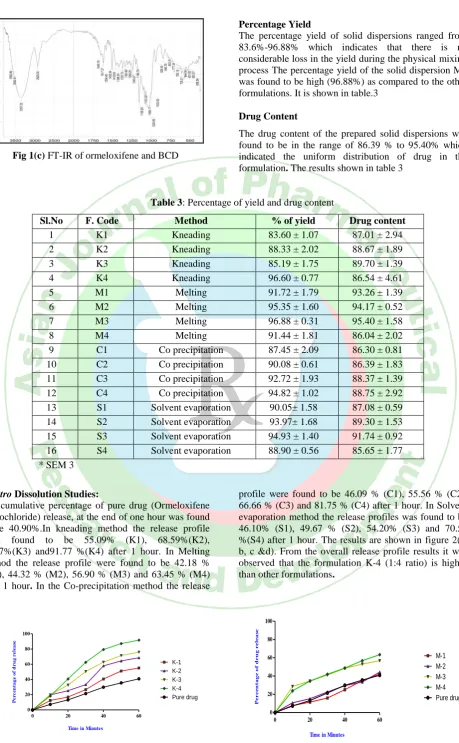
FT-IR spectrum of the pure drug, PEG 6000, Betacyclodextrin and physical mixtures was recorded, it was shown inFigure-1a,b&c Pure Ormeloxifene hydrochloride spectra showed sharp characteristic peaks
at 1619.29, 1507.42, 1157.33, and 608.55 cm-1.All the
above characteristic peaks appear in the IR spectrum of physical mixtures indicates that there is no modification
or interaction between drug and carriers.
ISSN: 2320-4850 [22] www.ajprd.com/AJPRD
Fig 1(c) FT-IR of ormeloxifene and BCD
Percentage Yield
The percentage yield of solid dispersions ranged from 83.6%-96.88% which indicates that there is no considerable loss in the yield during the physical mixing process The percentage yield of the solid dispersion M3 was found to be high (96.88%) as compared to the other formulations. It is shown in table.3
Drug Content
The drug content of the prepared solid dispersions was found to be in the range of 86.39 % to 95.40% which indicated the uniform distribution of drug in the
formulation. The results shown in table 3
Table 3: Percentage of yield and drug content
Sl.No F. Code Method % of yield Drug content
1 K1 Kneading 83.60 ± 1.07 87.01 ± 2.94
2 K2 Kneading 88.33 ± 2.02 88.67 ± 1.89
3 K3 Kneading 85.19 ± 1.75 89.70 ± 1.39
4 K4 Kneading 96.60 ± 0.77 86.54 ± 4.61
5 M1 Melting 91.72 ± 1.79 93.26 ± 1.39
6 M2 Melting 95.35 ± 1.60 94.17 ± 0.52
7 M3 Melting 96.88 ± 0.31 95.40 ± 1.58
8 M4 Melting 91.44 ± 1.81 86.04 ± 2.02
9 C1 Co precipitation 87.45 ± 2.09 86.30 ± 0.81
10 C2 Co precipitation 90.08 ± 0.61 86.39 ± 1.83
11 C3 Co precipitation 92.72 ± 1.93 88.37 ± 1.39
12 C4 Co precipitation 94.82 ± 1.02 88.75 ± 2.92
13 S1 Solvent evaporation 90.05± 1.58 87.08 ± 0.59
14 S2 Solvent evaporation 93.97± 1.68 89.30 ± 1.53
15 S3 Solvent evaporation 94.93 ± 1.40 91.74 ± 0.92
16 S4 Solvent evaporation 88.90 ± 0.56 85.65 ± 1.77
* SEM 3
In vitro Dissolution Studies:
The cumulative percentage of pure drug (Ormeloxifene hydrochloride) release, at the end of one hour was found to be 40.90%.In kneading method the release profile were found to be 55.09% (K1), 68.59%(K2), 75.97%(K3) and91.77 %(K4) after 1 hour. In Melting method the release profile were found to be 42.18 % (M1), 44.32 % (M2), 56.90 % (M3) and 63.45 % (M4) after 1 hour. In the Co-precipitation method the release
profile were found to be 46.09 % (C1), 55.56 % (C2), 66.66 % (C3) and 81.75 % (C4) after 1 hour. In Solvent evaporation method the release profiles was found to be 46.10% (S1), 49.67 % (S2), 54.20% (S3) and 70.57 %(S4) after 1 hour. The results are shown in figure 2(a, b, c &d). From the overall release profile results it was observed that the formulation K-4 (1:4 ratio) is higher
than other formulations.
0 20 40 60
0 20 40 60 80 100
M-1 M-2 M-3 M-4 Pure drug
Time in Minutes
P
e
r
c
e
n
t
a
g
e
o
f
d
r
u
g
r
e
le
a
s
e
Fig 2(a) Dissolution study-Kneadin Fig 2(b) Dissolution study - Melting
0 20 40 60
0 20 40 60 80 100
K-1 K-2 K-3 K-4 Pure drug
Time in Minutes
P
e
r
c
e
n
ta
g
e
o
f
d
r
u
g
r
e
le
a
ISSN: 2320-4850 [23] www.ajprd.com/AJPRD
0 20 40 60
0 20 40 60 80 100
S-1 S-2 S-3 S-4 Pure drug
Time in Minutes
P
e
r
c
e
n
t
a
g
e
o
f
d
r
u
g
r
e
le
a
s
e
2(c) Dissolution study-Co precipitation Fig 2(D) Dissolution study-Solvent evaporation
Best formulation:
The best formulation was selected based on the results
obtained from the drug invitro release studies. From the
result it was observed that, kneading method using beta cyclodextrin carrier was found to have greater dissolution rate of 91.77% (K-4) after 1hour, so it was considered as best formulation. The order of drug release profile is
Pure drug < Physical mixture <Solid dispersion
The drug dissolution was increase in both, physical mixtures and solid dispersion product. It happens because of the enhanced wettability, hydrophilic nature of the carriers and possibility of reduced crystallinity of the drug and conversion of amorphous form of the drug.
Powder X Ray Diffraction Studies (PXRD):
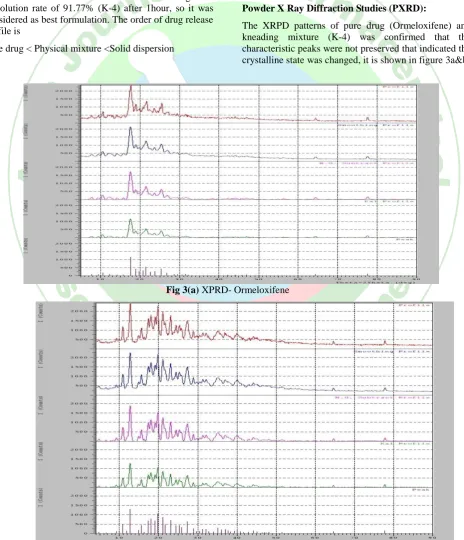
The XRPD patterns of pure drug (Ormeloxifene) and kneading mixture (K-4) was confirmed that the characteristic peaks were not preserved that indicated the crystalline state was changed, it is shown in figure 3a&b
Fig 3(a) XPRD- Ormeloxifene
Fig 3(b) XPRD-Solid dispersion product (K-4)
0 20 40 60
0 20 40 60 80 100
C-1 C-2 C-3 C-4 Pure drug
Time in Minutes
P
e
r
c
e
n
ta
g
e
o
f
d
r
u
g
r
e
le
a
ISSN: 2320-4850 [24] www.ajprd.com/AJPRD
Differential Scanning Calorimetric (DSC) Studies:
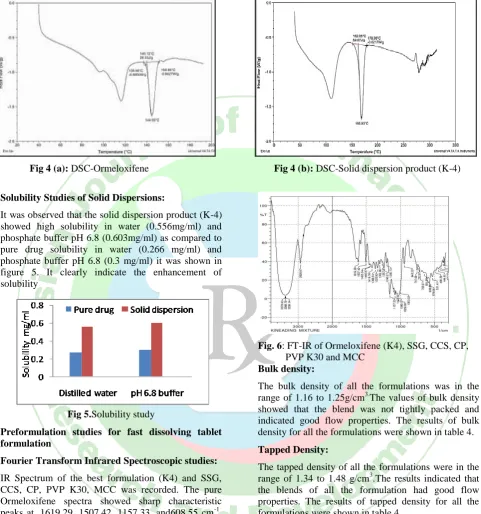
An endothermic peak corresponding to the melting point of pure drug was prominent in best formulation. Which
suggested clearly that there was no interaction between the drug and the polymers and the drug was existed in its unchanged form. It is shown in figure 4(a) & 4(b)
Fig 4 (a): DSC-Ormeloxifene Fig 4 (b): DSC-Solid dispersion product (K-4)
Solubility Studies of Solid Dispersions:
It was observed that the solid dispersion product (K-4) showed high solubility in water (0.556mg/ml) and phosphate buffer pH 6.8 (0.603mg/ml) as compared to pure drug solubility in water (0.266 mg/ml) and phosphate buffer pH 6.8 (0.3 mg/ml) it was shown in figure 5. It clearly indicate the enhancement of solubility
Fig 5.Solubility study
Preformulation studies for fast dissolving tablet formulation
Fourier Transform Infrared Spectroscopic studies:
IR Spectrum of the best formulation (K4) and SSG, CCS, CP, PVP K30, MCC was recorded. The pure Ormeloxifene spectra showed sharp characteristic
peaks at, 1619.29, 1507.42, 1157.33, and608.55 cm-1.
All the above characteristic peaks appear in the IR spectrum which indicates that there was no interaction between drug and carriers.It was shown in figure 6
Angle of Repose:
The angle of repose of all the formulations ranged from 20˚.88’ to 29˚.16’.The results indicated that all the formulations exhibited good flow properties. The results of angle of repose for all the formulations were shown in table 4.
Fig. 6: FT-IR of Ormeloxifene (K4), SSG, CCS, CP,
PVP K30 and MCC
Bulk density:
The bulk density of all the formulations was in the range of 1.16 to 1.25g/cm3.The values of bulk density showed that the blend was not tightly packed and indicated good flow properties. The results of bulk density for all the formulations were shown in table 4.
Tapped Density:
The tapped density of all the formulations were in the range of 1.34 to 1.48 g/cm3.The results indicated that the blends of all the formulation had good flow properties. The results of tapped density for all the formulations were shown in table 4.
Carr’s Compressibility Index:
The compressibility index of all the formulations ranged from 11.34 to 15.8 %.This value below 16% it indicated the powder having good flow property and good propensity of compression. The results of compressibility for all formulations were shown in table 4.
Hausner’s Ratio:
ISSN: 2320-4850 [25] www.ajprd.com/AJPRD
Table 4. Preformulation study for Ormeloxifene fast dissolving tablets
F-Code Angle of repose Bulk Density Tapped Density % of Compressibility Hausner ratio
F-1 24.54 ± 1.84 1.23 ± 0.02 1.45 ± 0.02 14.87 ± 2.85 1.17± 0.03
F-2 25.68 ± 1.66 1.25 ±0.04 1.48 ± 0.02 17.51 ± 0.26 1.19 ± 0.02
F-3 23.09 ± 0.22 1.19 ± 0.01 1.39 ± 0.02 14.08 ± 1.96 1.15 ± 0.03
F-4 24.15 ± 2.30 1.22 ± 0.01 1.41 ± 0.02 13.02 ± 1.53 1.14 ± 0.02
F-5 20.95 ± 0.94 1.17 ± 0.01 1.36 ± 0.01 13.96 ± 0.17 1.15 ± 0.05
F-6 28.64 ± 0.43 1.23 ± 0.02 1.45 ± 0.02 14.90± 0.10 1.17 ±0.04
F-7 29.85 ± 0.71 1.22 ± 0.01 1.38 ± 0.00 11.34 ± 1.66 1.12 ± 0.02
F-8 20.95 ± 0.85 1.19 ± 0.01 1.39 ± 0.02 14.08 ± 1.96 1.16 ± 0.02
F-9 22.55 ± 3.50 1.17 ± 0.01 1.34 ± 0.05 15.21 ± 1.25 1.17 ± 0.01
F-10 29.16 ± 2.73 1.18 ± 0.01 1.36 ± 0.01 13.22 ± 1.20 1.14 ± 0.01
F-11 23.14 ± 0.60 1.19 ± 0.01 1.40 ± 0.02 15.17 ± 1.67 1.17 ± 0.02
F-12 21.64 ± 1.91 1.18 ± 0.01 1.37 ± 0.01 13.85 ± 2.04 1.15 ± 0.02
F-13 20.88 ± 0.61 1.19 ± 0.01 1.40 ± 0.02 14.91 ± 1.22 1.17 ± 0.02
F-14 22.63 ± 1.23 1.18 ± 0.01 1.39 ± 0.02 15.29 ± 1.33 1.17 ± 0.02
F-15 22.39 ± 1.27 1.16 ±0.03 1.37 ± 0.01 15.31 ± 1.07 1.17 ± 0.01
F-16 21.94 ± 0.53 1.18 ± 0.01 1.38 ±0.00 14.48 ± 1.25 1.16 ± 0.01
F-17 21.25 ± 1.56 1.18 ± 0.01 1.37 ± 0.01 13.86 ± 0.17 1.15 ± 0.01
F-18 23.78 ± 1.46 1.21 ± 0.03 1.40 ± 0.02 13.50 ± 1.42 1.15 ± 0.02
F-19 21.70 ± 1.67 1.18 ± 0.01 1.40 ± 0.02 15.80 ± 0.14 1.18 ± 0.00
F-20 22.39 ± 0.20 1.17 ± 0.01 1.38 ± 0.00 14.97 ± 1.10 1.17 ± 0.01
* SEM 3
Thickness and Diameter:
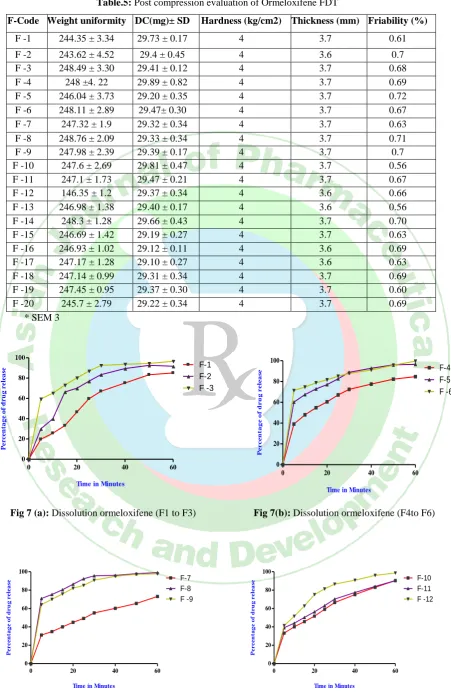
The thickness of the tablet in all formulation was 3.5 to 3.7 mm and the diameter of the tablet in all formulation was 8mm. The results indicate all the formulations had uniform size and shape. The results were shown in table 5.
Hardness:
The hardness of the tablets of all the formulations was found to be 4kg/cm2.The result indicated that all the tablets had a good mechanical strength. The results of the hardness for all the formulations were shown in table 5.
Weight Variation Test:
The weight of all the tablets from each formulation was in the range from 245.7 mg to 248.76 mg. It was found all the tablets passed weight variation test, as the percentage weight variation was within the acceptable limits of 7.5%.The results were shown in table 5.
Friability test:
The results showed that the friability of all the formulation was ranged from 0.56 % to 0.72%.Friability of all the formulation was lesser than 1 % which indicated the tablets had a good mechanical resistance. The results were shown in table 5.
Uniformity of drug Content:
The drug content in the content of all the formulations was found to be in the range of 97.06 % to 99.66 %. The results indicated all the formulations were within the acceptable limits as per USP limits. The results were shown in table 5.
In-vitro drug release Studies:
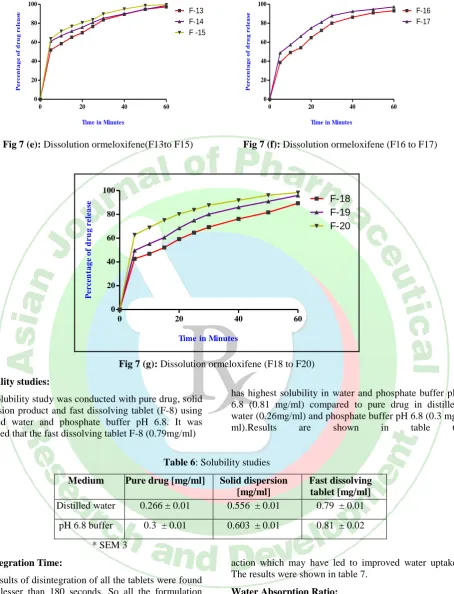
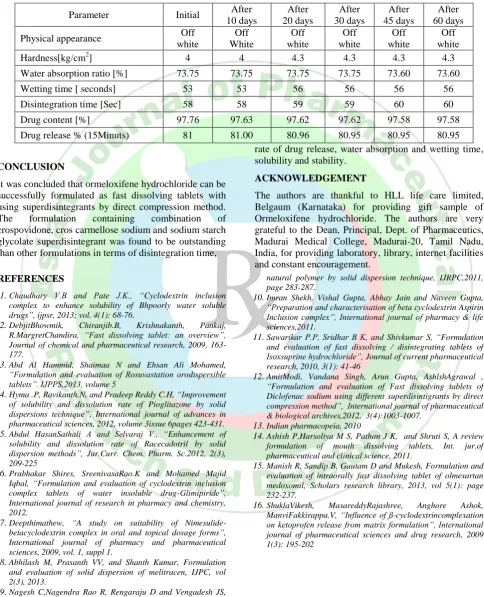
The ormeloxifene fast dissolving tablet dissolution profile range from 33.17 % to 80.49 % at 15 minutes, it was shown in figure 7(a-g). The dissolution drug release rate was found to be comparatively less in formulation containing sodium starch glycolate. The maximum increased in the dissolution drug release rate was observed with the combination of crospovidone, croscarmellose sodium and sodium starch glycolate containing formulation. The order of the dissolution rate with various superdisintegrants was found to be
ISSN: 2320-4850 [26] www.ajprd.com/AJPRD
Table.5: Post compression evaluation of Ormeloxifene FDT
F-Code Weight uniformity DC(mg)± SD Hardness (kg/cm2) Thickness (mm) Friability (%)
F -1 244.35 ± 3.34 29.73 ± 0.17 4 3.7 0.61
F -2 243.62 ± 4.52 29.4 ± 0.45 4 3.6 0.7
F -3 248.49 ± 3.30 29.41 ± 0.12 4 3.7 0.68
F -4 248 ±4. 22 29.89 ± 0.82 4 3.7 0.69
F -5 246.04 ± 3.73 29.20 ± 0.35 4 3.7 0.72
F -6 248.11 ± 2.89 29.47± 0.30 4 3.7 0.67
F -7 247.32 ± 1.9 29.32 ± 0.34 4 3.7 0.63
F -8 248.76 ± 2.09 29.33 ± 0.34 4 3.7 0.71
F -9 247.98 ± 2.39 29.39 ± 0.17 4 3.7 0.7
F -10 247.6 ± 2.69 29.81 ± 0.47 4 3.7 0.56
F -11 247.1 ± 1.73 29.47 ± 0.21 4 3.7 0.67
F -12 146.35 ± 1.2 29.37 ± 0.34 4 3.6 0.66
F -13 246.98 ± 1.38 29.40 ± 0.17 4 3.6 0.56
F -14 248.3 ± 1.28 29.66 ± 0.43 4 3.7 0.70
F -15 246.69 ± 1.42 29.19 ± 0.27 4 3.7 0.63
F -16 246.93 ± 1.02 29.12 ± 0.11 4 3.6 0.69
F -17 247.17 ± 1.28 29.10 ± 0.27 4 3.6 0.63
F -18 247.14 ± 0.99 29.31 ± 0.34 4 3.7 0.69
F -19 247.45 ± 0.95 29.37 ± 0.30 4 3.7 0.60
F -20 245.7 ± 2.79 29.22 ± 0.34 4 3.7 0.69
* SEM 3
0 20 40 60
0 20 40 60 80 100 F-4 F-5 F -6
Time in Minutes
P e r c e n t a g e o f d r u g r e le a s e
Fig 7 (a): Dissolution ormeloxifene (F1 to F3) Fig 7(b): Dissolution ormeloxifene (F4to F6)
0 20 40 60
0 20 40 60 80 100 F-7 F-8 F -9
Time in Minutes
P e r c e n ta g e o f d r u g r e le a se
0 20 40 60
0 20 40 60 80 100 F-10 F-11 F -12
Time in Minutes
P e r c e n ta g e o f d r u g r e le a se
Fig 7 (c): Dissolution ormeloxifene (F7 to F9) Fig 7 (d): Dissolution ormeloxifene (F10 to F12)
0 20 40 60
0 20 40 60 80 100 F-1 F-2 F -3
Time in Minutes
ISSN: 2320-4850 [27] www.ajprd.com/AJPRD
0 20 40 60
0 20 40 60 80 100 F-13 F-14 F -15
Time in Minutes
P e r c e n ta g e o f d r u g r e le a se
0 20 40 60
0 20 40 60 80 100 F-16 F-17
Time in Minutes
P e r c e n ta g e o f d r u g r e le a se
Fig 7 (e): Dissolution ormeloxifene(F13to F15) Fig 7 (f): Dissolution ormeloxifene (F16 to F17)
0 20 40 60
0 20 40 60 80 100 F-18 F-19 F-20
Time in Minutes
P e r c e n ta g e o f d r u g r e le a se
Fig 7 (g): Dissolution ormeloxifene (F18 to F20)
Solubility studies:
The solubility study was conducted with pure drug, solid dispersion product and fast dissolving tablet (F-8) using distilled water and phosphate buffer pH 6.8. It was observed that the fast dissolving tablet F-8 (0.79mg/ml)
has highest solubility in water and phosphate buffer pH 6.8 (0.81 mg/ml) compared to pure drug in distilled water (0.26mg/ml) and phosphate buffer pH 6.8 (0.3 mg/
ml).Results are shown in table 6.
Table 6: Solubility studies
Medium Pure drug [mg/ml] Solid dispersion
[mg/ml]
Fast dissolving tablet [mg/ml]
Distilled water 0.266 ± 0.01 0.556 ± 0.01 0.79 ± 0.01
pH 6.8 buffer 0.3 ± 0.01 0.603 ± 0.01 0.81 ± 0.02
* SEM 3
Disintegration Time:
The results of disintegration of all the tablets were found to be lesser than 180 seconds. So all the formulation satisfied the criteria of fast dissolving tablets. Formulation F8 tablet disintegrate rapidly in shortest time of 58 seconds.
In vitro disintegration study explained that there was decrease in disintegration time with successive addition of superdisintegrant concentration in formulation but comparatively co-processed formulations(combination of superdisintegrants) take least time for disintegration. Such a difference in disintegration time between all these formulations indicates that in combination of superdisintagrant formulation may increase in capillary
action which may have led to improved water uptake. The results were shown in table 7.
Water Absorption Ratio:
The results showed that as concentration of
ISSN: 2320-4850 [28] www.ajprd.com/AJPRD
Wetting Time:
The results indicated that the concentration of
superdisintegrant and type of superdisintegrant
influences wetting time. Formulation F8 shows lesser wetting time than other formulation.
This may be due to fact that superdisintegrant perform
their action of Crospovidone capillary action,
Croscarmellose sodium wicking and swelling action and Sodium starch glycolate disintegrate the tablet by swelling mechanism, on combine effect of these three leading to shorter wetting time. The results of wetting time of all the formulations were shown in table 7.
Table 7: Post compression evaluation studies
F- code Disintegration
Time[Sec]
Water absorption Ratio(%)
Wetting Time[Sec]
F -1 166.33 ±1.52 9.87 ±1.17 228.33 ±2.08
F -2 145.66 ±2.08 18.20 ±1.33 178.33 ±1.52
F -3 88.33 ±1.52 45.25 ±2.04 116.33 ±1.52
F -4 129.66 ±2.08 21.08 ±1.72 153.33 ±2.51
F -5 86.33 ±1.52 40.37 ±1.11 126.33 ±1.15
F -6 72.33 ±2.08 57.61 ±1.34 62.66 ±1.52
F -7 155.66 ±1.52 13.34 ±0.05 181.66 ±1.52
F -8 58.33 ±1.52 73.75 ±2.27 53.66 ±1.52
F -9 70.33 ±2.51 71.59 ±2.66 59.66 ±1.52
F -10 137.66 ±1.52 12.57 ±1.34 159.66 ±1.52
F -11 148.33 ±1.52 20.80 ±0.28 162.66 ±1.52
F -12 127.66 ±1.52 19.28 ±0.76 147.66 ±1.52
F -13 123.33 ±1.52 27.82 ±1.39 141.66 ±1.52
F -14 87.66 ±1.52 49.27 ±0.42 134.66 ±0.57
F -15 86.33 ±2.08 72.94 ±1.97 120.66 ±081
F -16 143.66 ±1.52 26.36 ±0.23 152.33 ±1.15
F -17 126.33 ±1.15 26.93 ±0.25 131.66 ±0.57
F -18 146.33 ±2.08 22.68 ±0.38 155.66 ±1.52
F -19 129.33 ±0.57 32.09 ±0.60 126.33 ±0.57
F -20 87.33 ±2.081 52.00 ±0.13 99.33 ±2.30
*SEM 3
Best formulation selection:
Among twenty formulations, the best was selected on the basis of lowest disintegration time, rapid drug release profile, higher water absorption ratio, short wetting time. Formulation F-8 showed lowest disintegration tine of 58 seconds, faster drug release rate of 80.49 in 15 minutes,
95.63%in 30 minutes, comparatively high water absorption ratio of 73.75%, and shortest wetting time of
53 seconds. In those parameter would drive theF-8 as a best formulation comparatively.
Differential Scanning Calorimetric (DSC) Studies:
DSC thermogram of F-8 formulation was recorded. An endothermic peak corresponding to the melting point of pure drug was prominent in the best formulation. So it suggested clearly that there was no interaction between the drug and the polymers and the drug was existed in its unchanged form, it shown in figure 8.
ISSN: 2320-4850 [29] www.ajprd.com/AJPRD
Powder X Ray Diffraction Studies (PXRD):
These results confirmed that Ormeloxifene was transferred amorphous form. It shown in figure 9.
FIG. 9 (a): XRD of Kneading Mixture
ISSN: 2320-4850 [30] www.ajprd.com/AJPRD
Stability study (Temperature Dependent):
The stability studies of best formulation (F-8) was carried out at an ambient temperature and relative
humidity(40⁰C±2⁰C, RH75%±5%) for a period of 60
days to find out any physicochemical changes in the fast
dissolving tablet as per modified International
Conference On Harmonization (ICH) guidelines. Periodically samples were withdrawn to estimate the drug content. The results was in table 8, which indicates that there is no significant change in quality parameters.
Table 8: Stablity studies
CONCLUSION
It was concluded that ormeloxifene hydrochloride can be successfully formulated as fast dissolving tablets with using superdisintegrants by direct compression method.
The formulation containing combination of
crospovidone, cros carmellose sodium and sodium starch glycolate superdisintegrant was found to be outstanding than other formulations in terms of disintegration time,
rate of drug release, water absorption and wetting time, solubility and stability.
ACKNOWLEDGEMENT
The authors are thankful to HLL life care limited, Belgaum (Karnataka) for providing gift sample of Ormeloxifene hydrochloride. The authors are very grateful to the Dean, Principal, Dept. of Pharmaceutics, Madurai Medical College, Madurai-20, Tamil Nadu, India, for providing laboratory, library, internet facilities and constant encouragement.
REFERENCES
1.Chaudhary V.B and Pate J.K., “Cyclodextrin inclusion
complex to enhance solubility of Bhpoorly water soluble drugs”, ijpsr, 2013; vol. 4(1): 68-76.
2.DebjitBhowmik, Chiranjib.B, Krishnakanth, Pankaj,
R.MargretChandira, “Fast dissolving tablet: an overview”, Journal of chemical and pharmaceutical research, 2009, 163-177.
3.Abd Al Hammid, Shaimaa N and Ehsan Ali Mohamed,
“Formulation and evaluation of Rosuvastation orodispersible tablets”. IJPPS,2013, volume 5
4.Hyma .P, Ravikanth.N, and Pradeep Reddy C.H, “Improvement
of solubility and dissolution rate of Pioglitazone by solid dispersions technique”, International journal of advances in pharmaceutical sciences, 2012, volume 3issue 6pages 423-431.
5.Abdul HasanSathali A and Selvaraj V., “Enhancement of
solubility and dissolution rate of Racecadotril by solid dispersion methods”, Jur.Curr. Chem. Pharm. Sc.2012, 2(3), 209-225
6.Prabhakar Shires, SreenivasaRao.K and Mohamed Majid
Iqbal, “Formulation and evaluation of cyclodextrin inclusion complex tablets of water insoluble drug-Glimipiride”, International journal of research in pharmacy and chemistry, 2012.
7.Deepthimathew, “A study on suitability of
Nimesulide-betacyclodextrin complex in oral and topical dosage forms”, International journal of pharmacy and pharmaceutical sciences, 2009, vol. 1, suppl 1.
8.Abhilash M, Prasanth VV, and Shanth Kumar, Formulation
and evaluation of solid dispersion of melitracen, IJPC, vol 2(3), 2013.
9.Nagesh C,Nagendra Rao R, Rengaraju D and Vengadesh JS,
Solubility and dissolution enhancement of cefixime using
natural polymer by solid dispersion technique, IJRPC,2011, page 283-287.
10.Imran Shekh, Vishal Gupta, Abhay Jain and Naveen Gupta,
“Preparation and characterisation of beta cyclodextrin Aspirin Inclusion complex”, International journal of pharmacy & life sciences,2011.
11.Sawarikar P.P, Sridhar B K, and Shivkumar S, “Formulation
and evaluation of fast dissolving / disintegrating tablets of Isoxsuprine hydrochloride”, Journal of current pharmaceutical research, 2010, 3(1): 41-46
12.AmitModi, Vandana Singh, Arun Gupta, AshlshAgrawal ,
“Formulation and evaluation of Fast dissolving tablets of Diclofenac sodium using different superdisintigrants by direct compression method”, International journal of pharmaceutical & biological archives,2012, 3(4):1003-1007.
13.Indian pharmacopeia, 2010
14.Ashish P,Harsoliya M S, Pathan J K, and Shruti S, A review
formulation of mouth dissolving tablets, Int. jur.of
pharmaceutical and clinical science, 2011.
15.Manish R, Sandip B, Gautam D and Mukesh, Formulation and
evaluation of intraorally fast dissolving tablet of olmesartan medoxomil, Scholars research library, 2013, vol 5(1): page 232-237.
16.ShuklaVikesh, MasareddyRajashree, Anghore Ashok,
ManviFakkirappa.V, “Influence of ß-cyclodextrincomplexation on ketoprofen release from matrix formulation”, International journal of pharmaceutical sciences and drug research, 2009 1(3): 195-202
Parameter Initial After
10 days
After 20 days
After 30 days
After 45 days
After 60 days
Physical appearance Off
white
Off White
Off white
Off white
Off white
Off white
Hardness[kg/cm2] 4 4 4.3 4.3 4.3 4.3
Water absorption ratio [%] 73.75 73.75 73.75 73.75 73.60 73.60
Wetting time [ seconds] 53 53 56 56 56 56
Disintegration time [Sec] 58 58 59 59 60 60
Drug content [%] 97.76 97.63 97.62 97.62 97.58 97.58