GSJ: Volume 7, November 2019, Online: ISSN
2320
-
9186
www.globalscientificjournal.com
S
MART
D
ISTRIBUTION
S
YSTEM
M
ODELING
F
OR
R
ELIABILITY
I
MPROVE-MENT OF
R
ING CONFIGURATION
Usman Ali, Sana Sardar
Usman Ali Department of Electrical Engineering CECOS University,Peshawar, Pakistan. [email protected] Sana Sardar department of Electrical Engineering, Iqra National University, Peshawar, Pakistan. [email protected]
KeyWords
Reliability, SAIFI, SAIDI, DPG, ETAP, RERs, NRERs.
ABSTRACT
1.
I
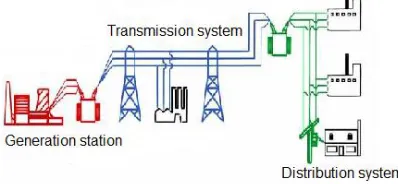
NTRODUCTIONOptimization of renewable energy resources (RERs) (which is mainly used as distributed generation (DG) or distributed power gener-ation (DPG)) is deploying in smart distribution systems. Electricity generating plants are dependable to generate electricity that fulfills user demand [1]. This generated electricity is send to distribution system via transmission lines which terminates in substation. Sub-stations are considered as the joint between transmission system and distribution system where voltage is step-down to required level and enters distribution system [2]. [3, 4] discusses the flow of current control in certain directions. Substations are categorized according to voltage profile that is, distribution substation, step-up substation and step-down substation [5]. A glimpse of power sys-tem is depicted in figure 1.1.
Figure 1.1: Power system.
Power system reliability is main concern for utilities. For reliable power supply to its consumers, various techniques need to be im-plemented. Reliability assessment of electrical system has a vital role in power system plan [6].
In traditional electrical system the continuity of power to load end is affected by various interruptions. These interruptions may be due to failure rate of electrical components caused by overloading [7], or weather conditions that cause outages [8]. For the system reliability, it is better to improve reliability of distribution system where maximum interruptions occur [9]. In [10] few statistical pro-cedures are discusses for power system reliability improvement.
This research contributes to reliability improvement of ring distribution system. The objectives of this paper are:
To model ring distribution systems.
To analyze reliability of modeled system.
To model DPG unit.
Integration of DPG into distribution system.
Analyze reliability of system upon DPG integration.
The arrangement of paper is as follows: section 1 present introduction of electrical system. In section 2 ring distribution system is modeled. The modeled system undergoes reliability assessment in section 3. Section 4 discusses modeling of DPG unit. Section 5 analyzes integration and reliability assessment of distribution system upon DPG integration, respectively. Conclusion is discussed in section 6.
2.
D
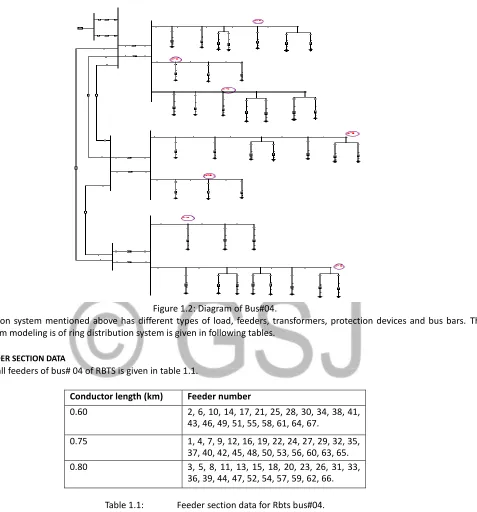
ISTRIBUTION SYSTEM MODELFor the sake of ease and precise calculations electric power systems are modeled through computer programmed softwares. Test feeder introduced by Roy-Billinton in [11] is choosen for this paper. The basic statistics is given in [12]. Statistics of Bus no.4 is taken from [13] and is modeled in figure 1.2.
ISSN 2320-9186
Figure 1.2: Diagram of Bus#04.
The distribution system mentioned above has different types of load, feeders, transformers, protection devices and bus bars. The data for system modeling is of ring distribution system is given in following tables.
2.1
F
EEDER SECTION DATAThe data for all feeders of bus# 04 of RBTS is given in table 1.1.
Table 1.1: Feeder section data for Rbts bus#04.
2.2
L
OAD POINT DATAAs it is mentioned earlier that system is a combination of different loads connected to different feeders. For this purpose load data of ring distribution network is choosen as test system from rbts. The data for residential load is given in table 1.2.
Load end Consumer measured in MVA Total no. of customers
R 01 0.5450 220.00
R 02 0.5450 220.00
R 03 0.5450 220.00
R 04 0.5450 220.00
Conductor length (km) Feeder number
0.60 2, 6, 10, 14, 17, 21, 25, 28, 30, 34, 38, 41, 43, 46, 49, 51, 55, 58, 61, 64, 67.
0.75 1, 4, 7, 9, 12, 16, 19, 22, 24, 27, 29, 32, 35, 37, 40, 42, 45, 48, 50, 53, 56, 60, 63, 65. 0.80 3, 5, 8, 11, 13, 15, 18, 20, 23, 26, 31, 33,
R 05 0.5000 200.00
R 11 0.5450 220.00
R 12 0.5450 220.00
R 13 0.5450 220.00
R 14 0.5000 200.00
R 15 0.5000 200.00
R 18 0.5450 220.00
R 19 0.5450 220.00
R 20 0.5450 220.00
R 21 0.5450 220.00
R 23 0.5000 200.00
R 32 0.5450 220.00
R 33 0.5450 220.00
R 34 0.5450 220.00
R 35 0.5450 220.00
R 36 0.5000 200.00
R 37 0.5000 200.00
Table 1.2: Residential load statistics. Table 1.3 has load statistics for industrial users.
Load end Consumer measured in MVA Total no. of customers
ind 08 01.0000 1.00
ind 09 01.5000 1.00
ind 10 01.0000 1.00
ind 26 01.0000 1.00
ind 27 01.0000 1.00
ind 28 01.0000 1.00
ind 29 01.0000 1.00
ind 30 01.0000 1.00
ind 31 01.5000 1.00
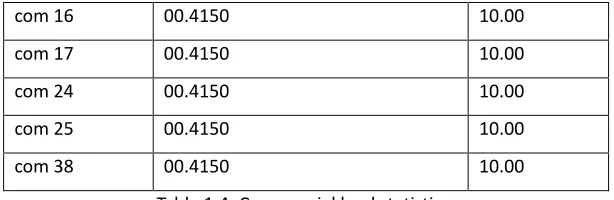
Table 1.3: Load statistics for industrial users Commercial load statistics is given in table 1.4.
Load end Consumer measured in MVA Total no. of
customers
com 06 00.4150 10.00
com 07 00.4150 10.00
ISSN 2320-9186
com 16 00.4150 10.00
com 17 00.4150 10.00
com 24 00.4150 10.00
com 25 00.4150 10.00
com 38 00.4150 10.00
Table 1.4: Commercial load statistics.
The total consumer loads in MVA and total customers connected are given in table 1.5.
Total Consumer Load in MVA Total customers connected
24.58 4779
Table 1.5: Total consumer load.
2.3
C
OMPONENT DATATable 1.6 explains the data for each component used in modeling of ring distribution system.
Name of component Failure rate per year
Time to re-pair (hrs) Switch time (hrs) Transformers 33./11.K V
0.0150 15.00 01.00
11./0.220 KV
0.0150 10.00 01.00
Circuit Breakers
11kv 0.0060 04.00 01.00 33kv 0.0020 04.00 01.00 Feeders 11kv 0.6500 05.00 01.00
Bus bars 11kv 0.0010 02.00 01.00 33kv 0.0010 02.00 01.00
Table 1.6: Statistics of component for ring distribution network.
3
E
VALUATION TECHNIQUEEvaluation of ring distribution system reliability is carried out in ETAP. It has a complete set of electrical power system tool [14].
3.1
A
NALYZING RELIABILITY OF RING DISTRIBUTION SYSTEMThe main features of ETAP are to calculate load point reliability indices and system based reliability indices. System based reliability indices are:
I. Average rate of failure. II. Average duration of outage. III. Outage duration per year.
Load point reliability indexes are:
V. Average Service Unavailability Index i-e ASUI.
A load point index depends upon interruptions that customers experience in a period of time. The load point indexes are mathematical explained in [15].
The ring distribution system undergoes reliability assessment. In this research, reliability indexes are monitored in order to analyze system before and after integration of a DPG unit.
3.1.1 R
ELIABILITY ANALYSIS OF RING DISTRIBUTION SYSTEM FOR BASE CASEIn this section, base case of distribution system is analyzed for reliability. Bus#04 of Rbts is simulated in ETAP. Figure 1.2 is the system modeled.
System indexes are measured in table 1.7.
System indexes For base case
System average interruption frequency index (f/Customer* Year)
2.57490
System average interruption duration index (hr/Customer*Year)
11.79930
Customer average interruption duration index (hr/Customer Interruption)
4.5820
Estimated energy not supplied (MW hr/ customer*Year)
244.5580
AENS (MW hr/Customer*Year) 0.05120
Table 1.7: Reliability indexes for base case.
4
M
ODELING OFDPG
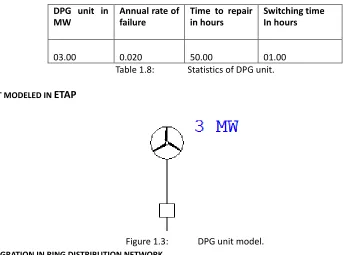
UNITFor the purpose of reliability enhancement different techniques are applied to electrical power system. The best and novel approach is to integrate distributed power generation (DPG) unit in distribution side. [16] Discuss the distributed generation technologies in detail. Table 1.7 shows the reliability indexes for base case however; the impact of DPG injection is compared. Therefore, designing a DPG unit is very important. Wind turbine is considered like a DPG unit and the data is given in table 1.8.
DPG unit in MW
Annual rate of failure
Time to repair in hours
Switching time In hours
03.00 0.020 50.00 01.00
Table 1.8: Statistics of DPG unit.
4.1
DPG
UNIT MODELED INETAP
Figure 1.3: DPG unit model.
5
DPG
INTEGRATION IN RING DISTRIBUTION NETWORKThe modeled system now undergoes a reliability test in the presence of a DPG unit integrated. WTG of 3MW is injected as a DPG unit
ISSN 2320-9186
to ring distribution system at point 4-A, shown in figure 1.4 and figure 1.5 respectively.
Figure 1.4: DPG unit in ring distribution system.
Figure 1.5: Section of ring distribution network at 4-A.
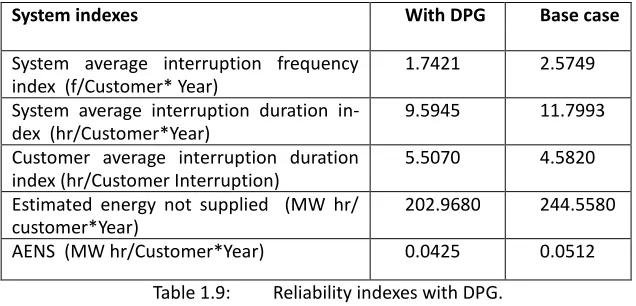
System indexes With DPG Base case
System average interruption frequency index (f/Customer* Year)
1.7421 2.5749
System average interruption duration in-dex (hr/Customer*Year)
9.5945 11.7993
Customer average interruption duration index (hr/Customer Interruption)
5.5070 4.5820
Estimated energy not supplied (MW hr/ customer*Year)
202.9680 244.5580
AENS (MW hr/Customer*Year) 0.0425 0.0512
Table 1.9: Reliability indexes with DPG.
The reliability indexes in Table 1.9 show variation upon DPG unit integration. The values of interruptions are lesser with DPG inte-gration while on other hand the base case show larger interruptions at customer end.
6
Conclusion
From above research, modeling, simulation, analysis and discussion for base case of ring distribution system and DPG unit integration has concluded that reliability is the main focus of power companies. Therefore, introducing DPGs technology to traditional power systems not only enhance the system reliability by lowering the interruptions that end users experience, but also avail renewable energy recourses (RERs) to generate on site energy, conserving depletion of non-renewable energy resources (NRERs).
References
[1] U. Ali , “ Reliability comparison of ring and radial distribution system upon integration of dpg “.
[2] Refaat, S.S., Abu-Rub, H., Sanfilippo, A.P., et al.: ‘Impact of grid-tied largescale photovoltaic system on dynamic voltage stability of electric power grids’, IET Renew. Power Gener., 2017, 12, (2), pp. 157–164.
[3] Knowlton, A.E., Shoop, R.M.: ‘Standard handbook for electrical engineers’ (McGraw-Hill, New York, NY, USA, 1957).
[4] Eremia, M., Liu, C.-C., Edris, A.-A., (Eds.): ‘Advanced solutions in power systems: HVDC, FACTS, and artificial intelligence’ vol. 52. (John Wiley & Sons, New York, NY, USA 2016).
[5] Refaat, S.S., Abu-Rub, H.: ‘Smart grid condition assessment: concepts, benefits, and developments’, Power Electron. Drives, 2016, 1, (2), pp. 147–163.
[6] Ron Allan, Roy Billinton, Probabilistic Assessment of Power systems, Proceeding of the IEEE, Vol. 88, No. 2, February 2000. [7] Y. Sun, H. Wang, L. Cheng and H. Liu, “Operational reliability assessment of power systems considering condition-dependent fail-ure rate” IET Gener. Transm. Distrib., 2010, vol. 4, Issue. 1 pp. 60-72, January 2009.
[8] B. Shen, D. Koval, W. Xu, J. Salmon, S. Shen,” An Analysis of Extreme-Weather-Related Transmission Line Outages”, IEEE Canadian Conference on Electrical and Computer Engineering, 1998.
[9] S. Sardar, S. Ahmad and U. Ali. (2017). Distributed Generation and Reliability of Local Distribution System, LAMBERT.
[10] Ozdemir, A., Bagriyanik, M., Kaypmaz, A., Gul, O., & Ilisu, I. (2015, February). Impact of adverse weather conditions on outage statistics of 154 kV Power Transmission system. In Electronics, Communications and Computers (CONIELECOMP), 2015 International Conference on (pp. 29-34). IEEE.
[11] R. Billinton, S. Kumar, N. Chowdhury, K. Chu, K. Debnat, L. Goel, E. Khan, P. Kos, G. Nourbakhsh, and J. O. Adjei, "A reliability test system for educational purposes-basic data," IEEE Transaction on Power Systems, vol. 4, no. 3, pp. 1238-1244, 1989.
[12] Probability Methods Subcommittee, "IEEE Reliability Test System," IEEE Transaction on Power Apparatus and Systems, Vols. PAS-98, no. 6, pp. 2047-2054, 1979.
[13] A. U. Rehman, A. U. Rehman, and S. Mehmood, "Reliability assessment and cost analysis of over loaded distribution system with Distributed Generation," in 2016 International Conference on computing, Electronic and Electrical Engineering, Quetta, Pakistan, 2016.
[14] ETAP, "Etap," [Online]. Available: http://www.etap.com/. [Accessed 15 7 2016].
[15] S. Ahmad, S. Sardar, A. Asar and F. Karam, "Reliability analysis of distribution system using ETAP," IJCSIS, vol. 15, no. 3, pp. 197-201, 2017.
[16] S. Ahmad, S. Sardar, B. Noor and A. U. Asar, "Impact of Distributed Generation on the Reliability of Local Distribution System," IJACSA, vol. 8, no. 6, pp. 375-382, 2017.
ISSN 2320-9186