Inquiry based learning in science
education and mathematics
for deve loping bilinguals
N
ATALIYAH. P
AVLOVAFaculty of Mathematics and Computer Science, Shumen University, 115 Universitetska Str., 9712 Shumen, Bulgaria.
E-mail address: [email protected]
D
RAGOMIRV. M
ARCHEVFaculty of Natural Sciences, Shumen University, 115 Universitetska Str., 9712 Shumen, Bulgaria.
E-mail adderess: [email protected]
B
ORISLAVS
T. B
ORISOVFaculty of Natural Sciences, Shumen University, 115 Universitetska Str., 9712 Shumen, Bulgaria.
E-mail address: [email protected]
K
RASIMIRV. H
ARIZANOVFaculty of Mathematics and Computer Science, Shumen University, 115 Universitetska Str., 9712 Shumen, Bulgaria.
E-mail: [email protected]
Abstract
This article studies the problem of teaching bilingual children. A deÞ nition of
“deve-loping bilingual” is proposed. The article presents an example of the application of inqu-iry based learning through which students develop not only math skills but also lexical capabilities. This study offers levels of differentiation in different groups of students. The paper determines advantages and disadvantages of the use of Inquiry Based Learning in developing bilingual groups.
Keywords: developing bilinguals, inquiry-based learning, science education, teachers.
Introduction
Globalization in the past years led to a rapid increase of bilinguals in the deve-loping countries. The impressive number of bilinguals in Bulgaria is not a result of the economic progress, but has historical origins. There are many regions with mixed populations and a great share of children of Turkish and Roma origin. In “Teaching Bulgarian Language in Terms of Bilingualism” Margarita Georgieva presents the interaction between Turkish and Bulgarian languages as well as a model of teaching the Bulgarian language as a second language (Georgieva, 2004).
It is a rule that there is no problem with the language barriers in the cities when teaching bilinguals but in the villages the children often do not know Bulgarian and at this stage they cannot be referred to as bilinguals because they speak only
one language – the language in which they communicate with their parents and the people around them. They are to become bilinguals in the process of study. We will refer to these children as developing bilinguals. The training of such students is often carried out by teachers from the same community and hence in the same language. This makes students’ integration more difÞ cult at a later stage and stops
their development as bilinguals.
The object of the presented study are the teachers of developing bilinguals.The subject is the impact of the Inquiry Based Learning on the teaching of developing bilinguals.
The aim of the study is to determine the advantages and disadvantages of the use of Inquiry Based Learning in developing bilingual groups on the basis of expert opinion of teachers who participated in LD-skills workshops.
Methodology of Research
In this paper we focus on the positive and negative side of using Inquiry Based Learning (IBL) in science and maths lessons with developing bilinguals. This task was part of a wider research on teachers’ interest in using IBL in their science and maths classes. The survey and discussions were conducted in 2011 during a gathe-ring of 120 teachers from Bulgaria, Germany, Greece, Turkey and other countries. The problem about using IBL for developing bilinguals was discussed with Bulga-rian teachers during LD-skills workshops. The main conclusions of this study are based on the SWOT analysis of the opinions of Bulgarian teachers. The results are consistent with the members of the project consortium LD-skills.
The chosen LD-skills methodology to conduct the survey containes: • DeÞ nition of survey’s target group.
• DeÞ nition of main criteria and indicators in a form suitable to be analyzed
by using a questionnaire.
• Design of research questions that cover indicators and describe a user proÞ le.
• Detection of workshop discussion themes which could reveal the users training needs set in LD-skills objectives.
• Organization and carrying out of workshops. • Analysis of the ideas raised during the workshops.
• Questionnaire survey with people who attended the seminars and with others via e-mails.
• Data processing with MS Excel. Determining the ratio between the responses.
• Data analysis of all indicators.
• SWOT analysis of the questionnaire results and ideas from workshop discussions.
Research Results
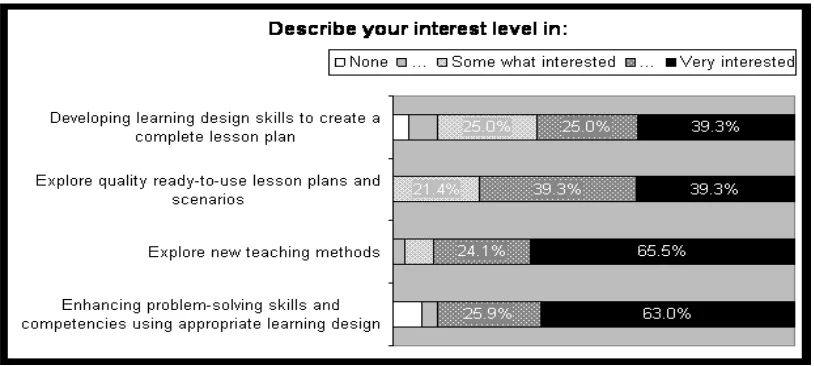
The surveys show that teachers are interested in inquiry based learning but share the opinion that they need training about the ideas of the inquiry and rely on Þ nding examples of similar good practices, created and approved by their colleagues.
Figure 1: Teachers’ interests
Source: Marchev, D., Toncheva, N., Borisov, B., Kyurkchieva, D., Radeva, V., & Ivanova, V. (2013). D2.1 Needs Analysis Report, D2.2 European State of the Art Report, WP2 - LD-skills: Development of learning design skills for enhancing students’ key competencies. Shumen: Shumen University Press.
Figure 1 shows the results about the users’ interests. The survey is conducted among pre-service and in-service European teachers. Sample size is 120 (Marchev, 2013).
In Bulgarian workshops some of the common questions and issues were the following:
• What is the percentage of developing bilinguals in your class?
• Do you think the IBL will contribute to the work with developing bilinguals?
• What problems do you see in implementing IBL with developing bilinguals?
• What advantages do you see in the application of IBL with developing bilinguals?
• Is there any difference in the application of IBL with developing bilinguals and native speakers?
More results of this survey are shown in (Marchev, 2013).
Discussion
There are several deÞ nitions of the term bilingualism. In this work we use
Weiten’s deÞ nition: “It is a skill that requires the “acquisition of two languages
2010, p. 323). In this deÞ nition it is clearly marked the usage of more than one language but the problem that is addressed in the current work is related to the development of bilinguals with the help of school and the multicultural environ-ment in which the students that know more than one language are placed. The case when bilingualism is formed in the family is not an object of this work. Here we focus on the teachers that work with children who do not know or use limited lexical knowledge of the ofÞ cial language, namely the developing bilinguals.
Developing bilinguals we will call people who were born and live in one coun-try but do not speak the ofÞ cial language and they are in the process of learning the ofÞ cial language of the state. This process may be while going to kindergarten, school, university, work, etc. In this paper we mainly consider developing bilin-gualism at school age.
The right transition to normal school work, the achievement of the main educa-tional goals is a hard and very emoeduca-tional process not only for the children but for their teachers as well. This transition is especially difÞ cult in cases when primary school children have been taught wrongly in their mother tongue and have not mastered the ofÞ cial language. When they go to secondary school, they experience
a real shock – in addition to the general difÞ culties in different subjects, they face a
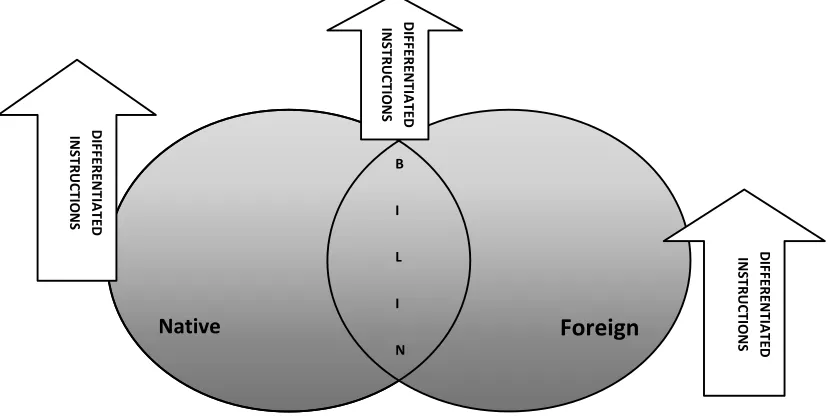
serious language barrier. Teachers are not less affected. In such mixed classes they need to organize various differentiation levels.
Figure 2: Differentiation Levels
Source: Own research
The differentiation on a particular subject is modeled in Figure 2 using dark blue color. Besides the expected differentiations (depending on the motivation to work, the level of knowledge, the speciÞ c skills) there is a need for a division into
three groups - speaking only the ofÞ cial language, speaking only the language of
the given community and bilinguals. Conduct of such training is an extremely demanding process, and teachers share their concerns about its implementation. They understand that the students are developing bilinguals in this situation.
Native Foreign
Hence, the teachers should be active participants in the creation of bilinguals. A methodological system for teaching the Bulgarian language in terms of Tur-kish-Bulgarian bilingualism is shown in (Georgieva, 2004). Language specialists are prepared to cope with this problem to some degree but teachers of mathe-matics and science are facing a real dilemma. Besides achieving the complicated educational goals of theirs subjects and introducing the students to the speciÞ c terminology they have to deal with the language barrier. One solution of this pro-blem is to implement inquiry based teaching in these classes.
The idea to acquire knowledge through inquiry based learning approach is not new but it gained popularity after the report of Rocard (Rocard, 2007). The wide-spread decline in the interest of children towards subjects of natural sciences and mathematics, has challenged methodologists to emphasize the way of learning in which a student is a leading Þ gure and knowledge is largely acquired inde-pendently by the student rather than being presented by the teacher. The teacher plays a new role - a mentor, supplying and verifying knowledge and skills. He/ she becomes a leader and a guide of the students on their way to knowledge.
A number of educational projects undertook the development of a methodo-logy for inquiry based learning, promotion of best practices, creation of repositories of educational resources in addition to the given approach. The excellent results of teaching by inquiry are already established in the project COSMOS (Marchev, 2010). With the help of extensive surveys of teachers related to a number of active methods it is found that training through inquiry is the best method approved by teachers and they give their efforts to use it more often with their students. To date there are a number of portals that offer quality educational resources and can be used free of charge by all teachers and students. Here we mention two of them. They have a proven effect on the implementation of inquiry based learning and are available in several European languages:
• www.osrportal.eu – a portal containing variable materials related mainly to training in natural sciences
• http://www.cosmosportal.eu – a portal containing a large number of images and lessons related mainly to training in physics and astronomy.
Besides learning depositories with educational resources specially designed to be used in the Pan-European area there are a number of portals popular in diffe-rent European countries. In accordance with “European State of the Art Report” (Marchev, 2013) some of the most popular educational portals at local level are as follows:
• www.enseignement.be – It collects curriculum-based news, features teacher training opportunities and provides external links to existing repo-sitories with learning objects in French speaking states.
• http://start.e-edu.bg – Bulgarian National Portal offers to the users – ready didactic materials and pathways, educational documents, forums, list of schools, news, etc. The audience of this portal consists mainly of teachers and students. All subjects and educational levels are included. • http://www.sch.gr – The Greek national school repository is the national
school portal of Greece, maintained and operated by RACTI. The reposi-tory will be further enriched by large national initiative “Digital School”, that is going to populate it with open educational resources, open textbo-oks, teacher-generated materials, cultural content of educational interest, etc. The repository is supported and promoted by the Greek Ministry of Education, Lifelong Learning, and Religious Affairs.
• http://www.e-yliko.gr – This action aims to support the learning commu-nity by providing digital learning resources online.
• www.fenokulu.net – This portal includes science units, experiments, ß ash
animations, exams, pictures, projects and mind maps for 6, 7, 8 grades. At the same time, there are elementary science and technology curricula for the same grades. Students enter this site, watch animations, do expe-riments and exams and teachers can use this site as the beginning and ending of their lessons.
• http://www.fenci.gen.tr – This portal includes exams, science lesson plans, science presentations, science projects, experiments, animations, pictures, videos, teachers’ presentations, simulations, pictures in 3D, e-games about science and science content. There is also member entrance in this portal and members add and share annual plans, exams, videos and animations. 1799 Þ les, 849 documents, 153 news, 406 videos, 969 animations, 437
pictu-res, 143 additional exams are available.
Besides the opportunity to use and share didactical materials with the help of portals teachers also need training. Workshops are held in the framework of educational projects, such as GEOTHiNK (Kavouras, 2013), Pathway (Bogner, & Sotiriou, 2012), LD – skills (Tzikopoulos, 2010) etc.
Example
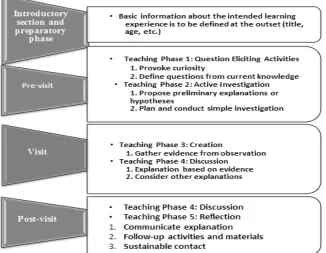
In the example we shall use the structure of the GEOTHiNK project (Figure 3). We will give a short example for a similar training on the topic “Rotating Bodies” for mathematics lessons in the 6th grade. Similar description of the given lesson with a simulation of a science museum visit where the students search for rotating bodies and related help Þ les can be found at: http://www.osrportal.eu/
en/node/96045. A general approach and different options for using Google Sket-chUp are described In “Google SketchUp as a Tool of Computer Assisted Learning in
Figure 3: The educational pathway structure for students
Source: Kavouras, M. (2013). Semantic pathways for building a spatially-thinking society. Athens: Pro-ject proposal.
Students aged 11-13 years experience the so-called by psychologists “second birth”. At this age children look for their self, look for their social group and their place in the group. Children are irritable. They often change their attitudes, prio-rities and interests. Interest in mathematics in this age group is not usually high. As an overlay we can see the problem with the development of bilingualism, and we will understand the challenge that teachers working with these children are facing .
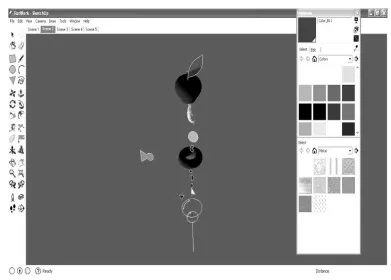
Figure 4: Supporting Þ le for “Rotating Bodies”
Source: Toncheva, N. (2011). Google SketchUp as a Tool of Computer Assisted Learning in Different Subjects, Journal of International ScientiÞ c Publication: Education, Researches & Development, 9 (2), 142-155
The teacher “rotates” the Þ gures using the help Þ le and introduces the term rotating body. All students are placed on an equal footing.
The introduction is followed by the task for Þ nding rotating bodies in eve-ryday life. After several examples are given by their classmates the developing bilinguals can also give their own examples – orally or by demonstration – in these processes the children also learn new words.
Then students create models using the help Þ le. All of them work and there are no language barriers for the given task.
After that each student should create an attractive model by himself/herself to be submitted to a competition. This task can be assigned for homework if all students have computers! Another option is to take time from the lesson to allow all to participate in the competition using school facilities.
The competition – here they reach the most emotional stage where everyone brings his/her model. One student presents his/her model and the other students guess what is depicted in the Þ le. All of them discuss and evaluate the model. For the developing bilinguals this is the place where they must comment on their models and those of their classmates. After the accumulated lexical set of comments from the native language speakers, it will be easier for them to describe their models.
The given lesson is not hard for the teacher to teach – the only requirement is some spare time to master several instruments of Google SketchUp. The lesson timing may vary according to the choice of the teacher to demonstrate only the creation of rotating bodies or to give an opportunity for the students to design and share their models. In most schools there are technologically well equipped facilities and the technical part should not be a problem. But still, if there is no possibility to use a computer labora-tory, it is possible to present the new knowledge with a projector and laptop.
Conclusions
Inquiry-based learning (IBL) in developing bilinguals:
• As shown in Figure 2, the teacher who develops bilinguals faces the lan-guage barrier in addition to the standard didactic task. One way to ease the overcoming of this barrier is precisely learning through the process of inquiry. By participating in an experiment and seeing its results, students understand the concept of a lesson more easily than in the form of a lec-ture. Besides the general beneÞ ts of IBL typical for all students - increased
interest and motivation, longevity of knowledge, we highlight some
speci-Þ c accents to developing bilinguals with the help of IBL. The strengths and
weaknesses typical for the development of bilinguals are described above.
Advantages:
• The students “see” and “do” knowledge without the need of extensive lexical stock.
• If a student does not understand the technical algorithm of the experiment, he/she can work in a team with a native language speaker and repeat his/ her actions.
• During teamwork the students discuss various issues that also stimulate the formation of language skills.
• The experiment and all “visible” objects, outcomes, processes, phenomena are described terminologically and lexically. This approach facilitates the creation of bilinguals.
• The level of knowledge of the speciÞ c terminology of developing
bilingu-als does not differ from the one of the native language speakers, i.e. when children learn new words together (in this case speciÞ c terms) and this
gives positive attitude and motivates bilinguals.
• The emotional power of inquiry based learning stimulates students to share their experiences (attractive chemistry experiments, astronomical observations, etc.) in the family. Thus they make a link between the ofÞ cial
language and the language they use in the family environment.
Disadvantages:
• Not enough native language speakers to form teams in regions with a large number of developing bilinguals.
Despite the globalization of the modern world the problem with the unfor-med bilinguals is more and more widely spread. These children are victims of the lack of interest of the family environment to prepare competitive individuals. The school is the only path for leading them to integration. Teachers in turn are not prepared or motivated enough to deal with this problem. It is important to sup-port them in this difÞ cult task. IBL appears to be a suitable approach to integrate bilinguals. Teachers can acquire and improve it during the workshops held under the framework of educational projects or self-study, using the resources available on the Internet.
Acknowledgements
The research presented in this paper is partially funded by the European Com-mission and more speciÞ cally by the project 510276-LLP-1-2010-1-GR-COME-NIUS-CMP “LD-skills: Development of learning design skills for enhancing
students‘ key competencies” of the Comenius Programme, project 543451-LLP-1-2013-1-GR-KA3-KA3MP, „GEOTHNK: Semantic pathways for building a spa-tially-thinking society”, (2013-2015) and the project of ScientiÞ c Foundation of
Shumen University (2015).
References
Bogner, F., & Sotiriou, S. (2010). Project Proposal: The Pathway to Inquiry Based Science Teaching. Athens: Project proposal.
Georgieva, M. (2004). ǼȏȡȥȓțȖȓȠȜ ȝȜ ȏȨșȑȎȞȟȘȖ ȓȕȖȘ Ȑ ȡȟșȜȐȖȭ țȎ ȏȖșȖțȑȐȖȕȨȚ [Teaching Bulgarian Language in Terms of Bilingualism]. Shumen: Shumen University Press.
Kavouras, M. (2013). Semantic pathways for building a spatially-thinking society. Athens: Project proposal. Marchev, D., Kjurkchieva, D., Borisov, B., & Radeva, V. (2010). Bulgarian Activities in the Project
COSMOS: An Advanced ScientiÞ c Repository for Science Teaching and Learning. PAOB, 90,
213-216.
Marchev, D., Toncheva, N., Borisov, B., Kyurkchieva, D., Radeva, V., & Ivanova, V. (2013). D2.1 Needs Analysis Report, D2.2 European State of the Art Report, WP2 - LD-skills: Development of learning design skills for enhancing students’ key competencies. Shumen: Shumen University Press, ISBN: 978-954-577-658-8.
Rocard, M., Csermely, P., Jorde, D., Lenzen, D., Walberg-Henriksson, H., & Hemmoet, V. (2007). Science Education NOW: A Renewed Pedagogy for the Future of Europe. Luxembourg: OfÞ ce for
OfÞ cial Publications of the European Communities.
Toncheva, N. (2011). Google SketchUp as a Tool of Computer Assisted Learning in Different Subjects, Journal of International ScientiÞ c Publication: Education, Researches & Development, 9 (2), 142-155 Tzikopoulos, A. (2010). Project Proposal: LD-skills: Development of learning design skills for enhancing
stu-dents’ key competencies, Athens: Project proposal.