ATTIC BLACK FIGURE FROM SAMOTHRACE
(PLATES
51-56)
1
RAGMENTS of two large black-figure column-kraters, potted and painted about
j1t the middle of the sixth century, have been recovered during recent excavations
at Samothrace.' Most of these fragments come from an earth fill used for the terrace
east of the Stoa.2 Non-joining fragments found in the area of the Arsinoeion in 1939
and in 1949 belong to one of these vessels.3 A few fragments of each krater show
traces of burning, for either the clay is gray throughout or the glaze has cracked
because of intense heat. The surface of many fragments is scratched and pitted in
places, both inside and outside; the glaze and the accessory colors, especially the white,
have sometimes flaked.
A. Column krater with decoration continuing around the vase.
1. 65.1057 A, 65.1061, 72.5, 72.6, 72.7. P1. 51
P.H. 0.285, Diam. of foot 0.203, Th. at ground line 0.090 m.
Twenty-six joining pieces from the lower portion of the figure zone and the foot with eleven rays above it. The surface is very worn; some missing pieces are restored in plaster and painted. On the left of the fragment is drapery
and the foot of a man to right, then a woman to right facing a man. Next is a man or youtlh in a mantle facing a sphinx similar to one on a nuptial lebes in Houston by the Painter of Louvre F 6 (P1. 53, a).4 Of our sphinx, its forelegs, its haunches articulated by three hori- zontal lines with accessory red between them, and part of its tail are preserved. Between the forelegs and haunches are splashes of black glaze representing an imitation inscription. Back of the sphinx is a large area of black glaze with curving incised lines that may represent the bow of the wing of a bird flying to left.5
1 I wish to thank Dr. James R. McCredie for inviting me to publish these fragments and for
providing me with the facilities to study them properly. I am grateful to Mrs. John Dusenbery, to Dr. Dietrich von Bothmer, to Professor Phyllis Lehmann, to M. A. Littauer, and to Professor Martin Robertson for reading the manuscript and for offering many valuable suggestions for its improvement. In addition, Dr. von Bothmer kindly permitted me to use his photographic archive, and for this privilege I owe him special thanks. The photographs of the Samothrace kraters were taken by Dr. McCredie.
2 Cf. Hesperia, XXXVII, 1968, pp. 203-204 where the character of this fill is briefly described
and discussed. Subsequent excavations in the area revealed a complex system of walls between the East foundation of the Stoa and the terrace wall to the east. The chronology and purpose of these walls are not yet fully understood and further excavation in the area is planned.
3 Cf. below, 17-19.
4 Houston 34.129 (J. D. Beazley, Attic Black-figure Vases, Oxford, 1956 [= ABV], 125, 32;
idemn, Paralipornena, Oxford, 1971 [= Paralipomena], 51, 32; H. Hoffmann, Ten Centuries that Shaped the West [=-= Hoffmann], Houston, 1971, fig. 166, c-d). Beazley references throughout are
to page and catalogue number. Frequently cited: Rome, Vatican 315 (ARB , 124, 9).
5 The bird was probably similar to those on the following vases: Oxford, Ashmolean G 190
(ABV, 124, 16); Athens, N.M. 11706 (ABV, 128, 28), both by the Painter of Louvre F 6.
American School of Classical Studies at Athens is collaborating with JSTOR to digitize, preserve, and extend access to
Hesperia
ATTIC BLACK FIGURE FROM SAMOTHRACE 235
2. 65.1057 B, 68.458, 71.1006, 71.1008,
71.1022. P1. 52, a
P.H. 0.122, P.L. 0.319, Th. at lower left edge 0.070m. Small missing pieces are restored in plaster.
Ten joining pieces preserving parts of six standing figures. Four, each wearing a mantle, stand to right, alternating male and female. Facing them is a hoplite carrying a round shield emblazoned with a whirligig, the seg- ments alternating red, black and white.6 A small amount of black glaze between the rim of the shield and the lower edge of the frag- ment may represent the hoplite's cloak. The sixth figure is a woman to left. Only the front of her mantle remains.
3. 65. 1063. Pl. 52, b
P.H. 0.038, P.L. 0.092 m.
Part of tongue pattern on shoulder at junc- tion of neck, and the hair and fillet of a figure to right. The fillet is drawn in accessory red, the tongues alternate red and black.
4. 71.1010, 71.1096. P1. 52, c
P.H. 0.05 1, P.L. 0.060 m.
Two joining pieces preserving the heads and shoulders of a sphinx 7 and of a man to
right. The sphinx has long hair bound with a red fillet. The pupil of her eye is red; the white of her flesh has flaked. Around her throat is an incised necklace. The man in front of her also has long hair, but it is tied up.
5. 65.1057 C. Pl. 52, d
P.H. 0.055, P.L. 0.051 m.
Two joining pieces preserving the chest of a
man in a mantle to right and the back of a woman in front of him.
6. 65.1057 D.
P.H. 0.046, P.L. 0.076 m.
Parts of two mantles: one with broad diago- nal stripes is worn by a man standing to left, a plain one by the woman facing him. The figures on this fragment may be those standing opposite one another on 1.
7. 65.1057 E.
P.H. 0.032, P.L. 0.054 m.
Upper part of mantle once painted red, worv by a woman to right.
8. 71.1172.
P.H. 0.042, P.L. 0.031 m.
Part of mantle with broad diagonal stripes belonging to a man facing right.
9. 71.1173. P1. 52, f
P.H. 0.054, P.L. 0.057 m.
Part of two feet to right and of the narrow reserved strip (0.005 m. thick) between the figure zone and the black glaze above the rays.
10. 71.1016. Fig. 1, P1. 52, e
P.H. 0.049, P.L. 0.051 m.
Two joining pieces preserving part of the chest and long hair of a sphinx to left. Near the lower edge of the fragment is a diagonally incised line that belongs to the bar of her wing.8
11. 65.1056. P1. 52, g
P.H. 0.056, P.L. 0.106 m.
Two joining pieces preserving part of a wing, some of the body and a bit of the tail of the
6 For the interpretation of the direction in which the warrior faces, cf. note 10 below.
7 Although at first glance the figure appears to be a human female, her long neck suggests a
sphinx. The curved line at the lower edge of the fragment belongs to the bow of her wing, not to the neckline of a mantle (compare the woman on 1). For similar sphinxes, compare those on the shoulder of the Vatican hydria (Vatican 315) by the Painter of Louvre F 6.
8 The position of her hair overlapping the bar of her wing suggests that her head was not
236 MARY B. MOORE
sphinx ( 1 and 10; Fig. 1). Of the wing, there remain some of the bow, part of the bar painted red, and a few flight feathers separated from the bar by a row of white dots between incised lines. The solid area of glaze to the right of the wing represents part of the creature's arched back, the small area of glaze at the far right of the fragment part of the tail.9
12. 69.603. P1. 52, h
P.H. 0.031, P.L. 0.065 m.
Part of wing and tail of bird flying to left. Some of the bar of the wing (painted red) and a few flight feathers, the bar of the tail and the lower portions of two tail feathers remain.
-Ol 00~~~~~~~~~
FIG. 1.
The krater is ample in size with a roughly calculated maximum outside diameter
of 0.44 m. and a circumference of 1.38 m. at the shoulder level of the figures. The
scenes are not set in panels, but instead are separated at the handle zones by a bird
51, 8); Rhodes (ABV, 124, 11); once Coghill (ABV, 124, 14). Compare with these one by the same painter where the sphinx's head is turned around: Boston, M.F.A. 60.1452, here Plate 53, b (Paralipomnena, 51).
ATTIC BLACK FIGURE FROM SAMOTHRACE
237
that occupies the area beneath each handle. Part of one bird, 12, and perhaps another,
1, are preserved.
The figural composition on each side may be reconstructed from the two large
fragments, 1 and 2, but there remain small, non-joining pieces which are difficult to
place without more clues (3, 5, 6-8, and 9). On one side of the krater, probably the
obverse, there is a departure scene with standing men and women seeing off a hoplite
who carries a round shield emblazoned with a whirligig (2). He and the woman
facing him stand in the middle of the composition,10
set slightly apart from the other
figures. Back of her there are three figures, a woman between two men, and back
of the hoplite part of another woman is preserved. Behind this latter figure were
probably two others, a male and a female, to complete the composition.1' On the other
side of the vase parts of four standing figures and two seated sphinxes remain (1, 4
and 10). Three of the figures, a man and a woman to right, then a man to left, occupy
the middle of the composition. On the right of these central figures is a male to right
confronting a seated sphinx. On the left of the composition is another seated sphinx
(4), but there may not have been space enough for a figure facing the sphinx. The
composition is close to that on the obverse of the column-krater in Boston attributed
to the Painter of Louvre F 6 (P1. 53,
b).12Here, however, the composition is sym-
metrical: three central figures flanked by sphinxes.
There is not much variation in dress among the figures painted on our krater.
The women, so-called " penguin-women,"
1wear necklaces and red mantles over long
robes; the men, save for the hoplite, have long mantles with broad diagonal stripes
alternately decorated with thick white circles. Most of the accessory color, especially
the white, has flaked.
The figure style of the krater suggests that of an Attic artist working in the
circle of Lydos. The Samothrace krater is, however, not by this master, but by one
of his lesser contemporaries, the Painter of Louvre F
6,14with whose work our vase
has already been compared."m
The Painter of Louvre F 6 is a conservative artist
who is comfortable painting symmetrical compositions such as standing men and
women bidding farewell to a departing warrior or warriors,1" or a frontal chariot,
10 These two figures are closer to one another than either is to the next figure; thus the warrior
seems more likely to be facing this woman rather than the one on the far right of the fragment. 1 For a similar composition, cf. two by the Painter of Louvre F 6: Florence, M.A. 95316 (ABV, 124, 7; C.V.A., Florence 5 [42], 2 [1866]) and Florence, M.A. 3803 (ABV, 124, 6; C.V.A., Florence 5 [42], 4 [1868], 1).
12 Boston, M.F.A. 60.1452 (Paralipomena, 51).
13 For the term, cf. Beazley, The Development of Attic Black-figure, rev. ed., Berkeley, 1964,
p. 46.
4ABV, 123-129, 685 and 714; Paralipomena, 50-53 and 518.
15 Cf. above, notes 4, 5, 7, 8, 11, and 12.
16 E.g., London, B.M. B 51 (ABV, 123, 4); Rome, Conservatori 17 (ABV, 124, 13; Paralipo-
238 MARY B. MOORE
a horseman or a fight flanked by onlookers,17
but occasionally, as on the reverse of
the Samothrace krater, an extra figure placed at the edge of the composition disrupts
the symmetry.'8 A man confronting a seated sphinx is also a favorite subject of the
Painter of Louvre F
6.19Rarely are this painter's compositions ambitious or com-
plicated, yet, on his better vases, they may be rather elaborate.20 His figures, however,
are usually stiff and somewhat repetitious. Standard dress for males is a mantle with
broad diagonal stripes that slope toward the front and customarily are embellished
by accessory white or red.21 Women frequently wear voluminous mantles over peploi,
with their arms held out stiffly in front, thus earning the name of " penguin-women."
22Warriors are clad in conventional dress and carry the usual weapons, a spear, a round
shield, a sword. Sphinxes by the Painter of Louvre F 6 usually have widely spaced
horizontal lines incised on their hindquarters, a detail used occasionally by two con-
temporaries of this artist, Lydos and the Painter of Vatican,
309.23B. Column krater with the figure decoration set in unframed panels.
Fragments of the rim, neck and shoulder.
Pls. 54, a-c, 55, a
13. 65.1055, 65.1060, 71.1014, 71.1072, 71.1073, 71.1152.24
17 E.g., Oxford, Ashmolean G 190 (AB V, 124, 16); Gingins, Vaud (AB V, 128, 81; Paralipo-
mena, 51, 81); Munich, S.A. 1680 (AB V, 123, 1); Paris, Louvre F 6 (AB V, 123, 3; Paralipo- mena, 51, 3).
18 Cf. Rhodes (ABV, 124, 11) and Tarquinia 618 (ABV, 125, 33) ; also, Houston, M.F.A.
34.129 where there are three figures on the right and two on the left of a frontal chariot (ABV, 125, 32; Paralipomena, 51, 32; Hoffmann, fig. 166, a).
19E.g., Florence, M.A. 94316 (ABV, 124, 7; C.V.A., Florence 5 [42], 2 [1866]); Rome, Vatican 315; Rhodes (ABV, 124, 11).
20E.g. Munich, A.K. 1680 (ABV, 123, 1); Louvre F 6 (ABV, 123, 3; Paralipomena, 51, 3); London, B.M. B 51 (ABV, 123, 4); Houston, M.F.A. 34.129 (ABV, 125, 32; Paralipomena, 51, 32; Hoffmann, fig. 166, a-e).
21 E.g. Florence, M.A. 3808 (ABV, 124, 6; C.V.A., Florence 5 [42], 3, 4 [1867, 1868];
Rome, Vatican 315; Houston, M.F.A. 34.129 (ABV, 125, 32; Paralipomena, 51, 32; Hoffmann, fig. 166, a-e); Harrogate, Kent (ABV, 128, 91).
22E.g., Boston, M.F.A. 60.1452 (Paralipomnena, 51); Rome, Vatican 313 (ABV, 125, 37). For "( penguin-women," cf. note 12 above.
23Lydos: London, B.M. 1948.10-15.1 (ABBV, 108, 8; Paralipomenna, 44, 8); Harvard (Fogg) 1925.30.125 (ABV, 108, 9). Painter of Vatican 309: namepiece (ABV, 121, 7). Painter of Louvre F 6: e.g., Vatican 315; Rhodes (ABV, 124, 11); Oxford, Ashmolean G 190 (ABV, 124, 16); Houston, M.F.A. 34.129 (ABV, 125, 32; Paralipomena, 51, 32; Hoffmann, fig. 166, c-d).
24 The pieces shown on plate 54, b, c were photographed before mending. Plate 54, a (65.1055)
is non-joining.
Bibliography for the most frequently cited vases:
Berlin, S.M. 1732 (ABV, 110, 37; Paraliponmena, 44, 37) Cambridge, Fitzwilliam 59 (ABV, 298, 10)
ATTIC BLACK FIGURE FROM SAMOTHRACE
239
Diam. of mouth at outside 0.56, H. from top of mouth to junction of neck and shoulder
0.108; measurements at junction from outside: Diam. 0.49, Circumference 1.54,
L. of tongue pattern 0.54, distance between tongue patterns at handle zones 0.23
i.2DFour joining pieces of rim and neck (P1. 54, a), and twenty-seven joining pieces
of rim, neck and shoulder from both sides of the vessel. Floral ornament decorates
the top and outside of the rim, except at the handle plates. On top: chain of palmettes
with red cores, the petals separated by incision (P1. 54, a); outside: upright buds
alternating red and black (P1. 54, b, c). The red buds have more tightly curled
tendrils than the black ones. A small portion of the handle plate preserves traces of
figured decoration, the subject thus far unclear. On the shoulder on each side at the
junction of the neck there are tongues alternating red and black, separated by vertical
lines drawn in dilute glaze. On one side of the vase there is a meander pattern below
the tongues; parts of three units remain, and to the right of these the handle root
is preserved (P1. 54, b). On the other side of the vase, the figures begin directly
under the tongue pattern (P1. 54, c). Here only small portions of them remain. At
the left is the top of a head to right with traces of a red fillet. Below this, at the lower
left edge of the fragment, is a small amount of black glaze with traces of accessory
red. Closer to the middle of the panel there is a hand holding the shaft of a spear
which interrupts the tongue pattern above it to the left (a red tongue is shortened).
Next is an unintelligible area of black glaze that looks like part of a bent raised arm,
then comes a man's head to left (P1. 55, a). Round his head is a red fillet. To the
right of him is a solid curved area of black glaze and an incised projection that looks
like a hand holding the shaft of a spear drawn in dilute glaze over the tongue pattern
above. The curved area is probably the crest of a helmet. On the far right of this
fragment, at the break, is a small amount of glaze that is unintelligible. In the field,
just below the tongue pattern in what should be the middle of the composition, is the
potter's signature: IEXEFPEIAE$:EPO0E%EN
(P1. 55, a).
The reading of the fourth and fifth letters of the name presents problems, for,
although they look like
Fand P respectively, this sequence of letters does not exist..
Dietrich von Bothmer has suggested that the fifth letter should be K rather hastily
drawn, the sixth 9. Thus he reads
IEXEKI?EltAE*.Martin Robertson has proposed
that the potter was trying to write a name ending in ...
KAEIAE*,such as Telekleides,
and was not sure of his letters.2"
Paris, Louvre F 217 (ABV, 298, 2) Princeton, A.M. 169 (ABV, 298, 6)
Rome, Villa Giulia 910 (ABV, 298, 9; Paralipomena, 129, 9)
25 This krater is almost as large as the splendid one by Lydos in the Metropolitan Museum,
31.11.1 (ABV, 108, 5; Paralipomena, 43, 5). The diameter of the mouth of the latter vessel is 0.581-0.586 m.; the greatest circumference is 1.93 m. For additional measurements, cf. G. Richter, IMet. Miuls. St., IV, 1932-33, p. 169, note 4.
240 MARY B. MOORE
Fragments of one handle and of the foot.
14. 65.1062. P1. 55, b
H. from top of handle plate to point of attach- ment on inside of top of handle root 0.145 m., L. of handle plate at outside edge 0.126 m.
Fragment of handle and handle plate with a very worn surface. On top of the plate is part of a horse and rider to right. The rider's leg, the shoulder of the horse, its forelegs (the left
Herakles in Combat.
16. 62.895. P1. 55, c
P.H. 0.110, P.L. 0.196, Th. at lower edge 0.012 m.
Four joining pieces from the left side of a panel preserving some of the red line at the vertical edge and parts of a frontal horseman, a woman, and Herakles. The chest of the horse, incised with two pairs of concentric arcs accented with added red, the lower part of its mane, also painted red, and the tip of its muzzle are preserved. A white dot, now flaked, indi- cates a tooth. Of the rider only his legs remain. Next is a woman to right, watching the fight, her arms raised. She wears a belted peplos with a red overfold. A band incised with circles marks part of the lower border of the overfold, a vertical panel with diagonal incision divides the skirt. The back of the skirt is decorated with dot-rosettes (red cores, white dots). In front of her is Herakles to right. Part of his lionskin with widely spaced pairs of short lines, his chiton decorated with an incised band, and the tip of his scabbard with traces of added red are preserved.
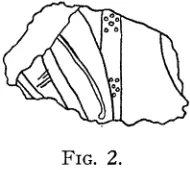
17. 49.689. Fig. 2, P1. 55, d
P.H. 0.059, P.L. 0.070, Th. at lower edge 0.012 m.
On the left is part of a round shield seen in three-quarter view from the inside and embla-
raised, the right down and folded), part of its belly, hindquarters and tail remain.
15. 71.1107.
P.H. 0.083, Th. at lower edge 0.012, Diam. 0.360m.
Fragment of foot. Echinus above a torus which is painted red.
zoned with a tripod (only one leg is preserved) drawn in accessory white which has flaked. The
FIG. 2.
shield overlaps a narrow vertical area orna- mented with white dot-rosettes, the center por- tion of a long chiton that is flanked by the folds on a mantle worn over both shoulders like that worn by Zeus in each of two scenes with Hera- kles and Kyknos on two amphorae by the Painter of Berlin 1686, London, B.M. B 197 (PI. 56, d) and Bologna, M.C. PU 192.27 Ac- cessory red covers the mantle. The curved line on the right represents the outer edge of the rim of the shield on 18 (see below).
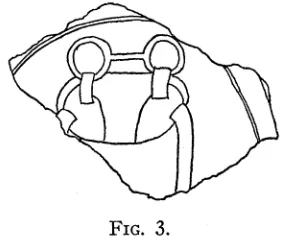
18. 71.1162 (re-accessioned from 1939). Fig. 3, PI. 55, e
P.H. 0.070, P.L. 0.101, Th. at lower edge 0.011 m.
Upper part of round shield emblazoned with a tripod. The leg, shown frontally (which the artist did not continue below the cauldron),
ATTIC BLACK FIGURE FROM SAMOTHRACE 241
and the two handle supports are incised; the cauldron, the handles and the remaining two legs are in added white which has flaked.28
FIG. 3.
The tripod used here as a shield device is like
Athela and Herakles in a chariot.
20. 71.1041, 71.1042, 72.4. P1. 56, aP.H. 0.126, P.L. 0.158, Th. at lower edge 0.012 m.
Five joining pieces from the left side of the panel preserving a small portion of the handle root, some of the red line, and part of Athena and Herakles standing in a chariot. Athena, with Herakles on her left, leans forward slightly to urge on her team. The goddess' head, shoul-
the one being lifted by Hlerakles in a scene painted on an amphora in Munich by the Princeton Painter.29 The narrow band con- necting the two handles of our tripod is diffi- cult to explain.30 Perhaps it is some sort of support, although usually a support appears as a brace between the handle and the rim of the
cauldron.31
19. 71.1160 (re-accessioned from 1939). P1. 55, f P.H. 0.052, P.L. 0.080, Th. at lower edge 0.013 m.
Left leg of warrior to left from the thigh to just below the knee. He wears a short chiton with a decorated border, and greaves.
ders, arms and lower legs are missing. She wears a belted peplos with a red overfold and a skirt that is decorated with painted dot- rosettes and divided by a vertical panel with hatched incision. Her aegis hangs down her back; traces of five snakes with open mouths and red tongues remain. Of Herakles, only part of his chiton (short, red, with an incised bor- der), his belted lionskin and his left thigh are preserved. His quiver is visible between his
28 The combination of incision and paint for a tripod shield emblem deviates from the customary
technique of plain accessory white and instead follows more closely representations of tripods in figured scenes. In the latter, however, the cauldrons are seldom painted white but are either left black or are embellished by accessory red.
23 Munich, S.A. 1378 (ABV, 299, 17). Cf. also Munich, S. A. 1395 (ABV, 305 ,24) and
Brooklyn 68.155.1 (ABV, 307, 61; Paralipomena, 133, 61) by the Swing Painter.
30 The only example known to me that is similar to this occurs on the namuepiece of the Painter
of Tarquinia RC 6847 (ABV, 338, 1; Paralipomena, 150, 1). Here, however, there are two narrow bands.
31 Some examples: two tripod shield devices: Munich, S.A. 1380 (ABV, 135, 34) and Cassel,
242 MARY B. MOORE
belt and Athena's skirt. Part of the chariot rail and of the loops through which the trace lines pass are preserved at the lower edge of the fragment.
21. 65.1054. P1. 56, b
P.H. 0.130, P.Th. at lower edge of panel 0.016, H. of panel 0.220 m.
Eight joining pieces preserving some of the 'meander pattern below the tongues (the glaze has flaked), the head of Herakles with the lion- skin pulled up over it, the hindquarters and tails of the horses, and, on their far side, -a woman to right with arms raised. Since her feet do not touch ground, she can only be flying, and short lines incised closely together in the field between her and Herakles very likely represent feathers of a wing.32 There- fore she is Nike or Iris, probably the former in this context.33 Of the hero, only his fore- head, eye, and moustache remain; of his lion- skin, just the upper jaw with a few incised whiskers, the face with closed eye, and the ear. The glaze for Nike's head has flaked completely, but a small area of accessory red may belong to a fillet. She wears a belted peplos with a red overfold and a skirt decorated with X's. The borders of both the overfold and the skirt are accented by a band similar to that on Hera- kles' chiton (20). The added white on Nike's feet has flaked; there was no white added to
her hands, contrary to the Archaic convention for female flesh. Incision articulates the anato- my of the team and the tails of the right-hand trace and pole horses; the tails of the remaining two were solid (the glaze has flaked in all but a very few places). A red strip, now flaked, was painted between the two long arcs on the hindquarters of the right-hand trace horse. Some harness parts are also visible: the yoke, yoke pad and tip of the chariot pole with its pole stay; reins knotted just over the croups of the horses; the trace line of the right-hand trace horse; the lower portion of the chariot pole bound with lashing. To the left of the tails there is a small amount of black glaze which may represent the breast work of the chariot. At the very bottom of the fragment is a red line separating the black glaze below the panel from the rays above the foot.
22. 71.1005. P1. 56, c
P.H. 0.142, P.L. 0.114, Th. at lower edge 0.014 m.
Four joining pieces preserving the foreparts of the chariot horses and part of the right edge of the panel witlh the red line. The forelegs of the animals are raised indicating rapid motion; the hoofs of the right-hand trace horse extend into the black glaze beyond the panel. On this latter horse, the girth ornamented with white dots and one end of the knot are visible.
Although very little of this column-krater has survived, these few fragments
establish the general character of the vase, they preserve its ornamental patterns, and
they allow us to recognize the subjects of the representations.
The krater has very broad panels: ca. 54 cm. at the top just below the tonguLe
pattern on the signed side. The height of this panel is 24 cm., 2 cm. higher than the
panel on the unsigned side where the figures begin below the meander pattern (21).
On the signed side of the vase, which I take to be the obverse, the potter's signa-
ture occurs about in the middle of the composition. Reconstruction of the combat
32 The surface of the vase is very worn in this area and one must not exclude the possibility
that these lines indicate Herakles' bow held out in front of him.
33 For Nike and Iris in Archaic art, cf. C. Isler-Kerenyi, Nike: der Typus der laufenden
ATTIC BLACK FIGURE FROM SAMOTHRACE 243
presents many difficulties owing to the large gaps between the few fragments pre-
served. One may begin with the frontal horseman at the left side of the panel. The
filleted head and the bit of glaze on the lower edge of 13 belong respectively to the
rider and his mount (16), the small area of glaze being the end of the horse's upright
forelock. The woman stands quietly, probably with arms raised. Since she stands
behind Herakles, who is engaged in combat, she must be Athena, even though no
identifying attribute is preserved. The hand holding the spear is that of Herakles
who thrusts his weapon at a falling or fallen enemy, unfortunately not well preserved.34
The shield seen in three-quarter view (17) belongs to this victim; the shield seen from
the front (18) and the helmet crest and spear on the far right of 13 belong to another
opponent of the hero, probably the one whose left leg is partly preserved (19). The
chiton and mantle visible between the two shields are garments worn by the male
whose head is preserved on the shoulder of the krater between the potter's name and
the verb (13). The thicknesses of these smaller fragments suggest that they belong
in the middle and lower zones of the panel.35 To summarize, the central group is com-
prised of Herakles fighting in close quarters with a falling enemy, a companion of
the latter who rushes in to help, and a man in a long chiton and mantle intervening.
As for the missing right section of the panel, one may conjecture that here, as on the
left, there was another woman and frontal horseman to complete the composition.
Next, one must try to interpret the subject, a mythological representation in
which Herakles fights an enemy in an interrupted battle. Herakles in combat is a
popular subject in Archaic art. Some of his opponents are fierce animals or half-
human, half-animal monsters, but neither of these species suits this scene, for animals
and monsters do not fight with shields, greaves and spears, but instead with teeth,
claws and horns, or with natural weapons such as stones, branches and trees. The
main human combatants of Herakles must then be considered. Geryon may be ruled
34Although the weapons of Herakles are more frequently the club, the sword, and the bow
and arrow, especially after the middle of the sixth century, there are two specific battles in which he uses a spear. In each of them his opponent is fully human. One is his fight with the Amazons (e.g., Bothmer, Amazons in Greek Art, Oxford, 1957, pls. 2, 2; 34, 1; 38, 4; 44, 1; 45, 1; 46, 1, and pp. 16 and 45). The other is his duel with Kyknos (e.g., Berlin, Antiquarium 1732); London, B.M. B 202 (ABV, 284, 1); Paris, Louvre F36 (ABV, 150, 6; Paralipomena, 63, 6); Rome, Vatican 395 (ABV, 277, 18); Munich, S.A. SL 460 (ABV, 331, 4); London, B.M. B 329 (ABV, 334, 1; Paralipomena, 147, 1); Oxford, Ashmolean 1965.131 (ABV, 301; Paralipomena, 131); Paris, Louvre F 301 (ABV, 361, 20); Hesiod, Shield of Herakles, 11. 330-335 and 410-418. For the weapons of Herakles in literature and in art, see most recently, M. Robertson, Class. Quart., XIX, 1969, pp. 212-213.
35 Th2 thickness at the lower edge of the panel is 0.016 m. (21) and the thickness at the belly
244 MARY B. MOORE
out, for the warrior's leg is one, not three
(19).36Amazons also do not fit our scene
for the flesh of the two opponents is black, not white. Furthermore, neither of these
episodes is interrupted at the peak of battle. One adventure of Herakles does, how-
ever, satisfy the necessary requirements. This is the hero's fight with Kyknos, the
aggressive son of Ares.37
In Attic black figure, there are about 100 examples of Herakles and Kyknos.33
Four general compositions may be distinguished: 1) Zeus intervening, with Athena
and Ares present; " 2) Athena intervening instead of Zeus; 3) Zeus not present, no
one intervening; and 4) the two opponents only. The composition on the Samothrace
krater fits the first division which appears most frequently in the third quarter of the
sixth century.40
Although no two representations of this myth duplicate one another, the actions
of the participants are similar. Herakles, usually to right, rushes toward his opponent,
who behaves variously. Sometimes he meets the hero's challenge, at other times he
flees, and occasionally he is shown falling, or fallen, mortally wounded. Ares, fully
armed, moves in to aid his belligerent son, while Athena either stands by or takes part,
depending upon the degree of danger to her favorite hero. Usually the goddess is
armed with helmet, shield and spear; -occasionally she appears even more warlike,
striding forward, the aegis held out over her left arm. Zeus stands between Herakles
and Kyknos with one or both arms raised. He does not fight, but instead acts as medi-
ator.4' Some of the compositions are restricted to these five figures; others, like ours,
are filled out by horsemen, chariots or onlookers.42
3For Geryon, cf. P. Clement, " Geryon and others in Los Angeles," Hesperia, XXIV, 1955, pp. 1-24; also, F. Brommer, Vasenlisten z.iir griechischen HIeldensage,3 Marburg/Lahn, 1973, pp. 58-63.
37 Cf. Hesiod, Shield of Herakles, 11. 57-75 and 325-480; Apollodoros, II, 5, 11; Hyginus, Fab.
31.
38 Brommer, Vasenlisten,3 pp. 102-108 with bibliography; also, D. Buitron, Attic Vase Painting
in New England Private Collections, Cambridge (Mass.), 1972, p. 48.
39A variant of this composition occurs on an amphora type B in the Geneva art market attributed by the author to the Princeton Painter. Here the duel is flanked by standing males only, three on each side (cf. note 52 below). For an example where the thunderbolt only, not Zeus himself, is shown, cf. the neck-amphora in Worcester attributed by Dietrich von Bothmer to the Leagros Group (Buitron, op. cit., pp. 48-49).
40 Cf. Vian, Rev. et. anc., XLVII, 1945, p. 8; S. Karouzou, B.C.H., LXXIX, 1955, pp. 186-191. 41 Compare, also, the following examples: Berlin, S.M. 1732 by Lydos; London, B.M. B 197,
here, P1. 56, d and Bologna, M.C. PU 192 (ABV, 296, 7) by the Painter of Berlin 1686; once Rome Market attributed to the Princeton Painter (ABV, 298, 14).
42 Compare, for example, the scenes of Herakles and Kyknos on an oinochoe attributed to
ATTIC BLACK FIGURE FROM SAMOTHRACE
245
The relative positions of Athena and Herakles may be reconstructed from other
representations of the goddess and hero, for example, one on the amphora in Bologna,
already mentioned,43
and another on an unpublished amphora attributed to the Prince-
ton Painter.44 On the latter vase, Athena, helmeted and holding a spear, encourages
Herakles to hurl the boar at Eurystheus who hides in the pithos. Although our
Athena does not wear the aegis or carry a shield, she surely wore a helmet and she
probably held ready a spear in case her assistance should be required.
The positions of Zeus and Kyknos must now be determined more exactly. In
all of the representations of this myth known to me, save one,45 Zeus strides in the
same direction as Herakles, looking around at the hero, and the standard arrange-
ment shows the god between the two combatants. An exception to this arrangement
of the three occurs on a fragmentary amphora from Cortona where Herakles, striding
forward to plunge his sword into Kyknos, overlaps Zeus." Our krater also presents
an exception to the standard composition, for the center portion of Zeus' chiton is
visible between the two shields (17) which belong to Kyknos and Ares respectively,
thus making clear that he stands between father and son. Although I do not know
a parallel for this placing of Zeus, the figure of Kyknos may offer an explanation.
The low position of his shield indicates that he is falling, or is down on one knee.
Perhaps while fleeing from Herakles Kyknos has stumbled, as he has in a similar
scene painted on the shoulder of a hydria in the Louvre attributed by Beazley to
Painter A of the Leagros Group (P1.
56,
e) ;
47or possibly he is not fleeing at all,
but is falling backward, as is the case with a few representations of Amazons in
combat with Herakles.8 Although it is hazardous to say more about Kyknos from
the small portion of him that is preserved, his falling, or fallen, position: helps to
explain the unusual placing of Zeus who, with Kyknos out of the way, proceeds to
hold back Ares. In summary, the composition may be reconstructed as follows: Hera-
kles to right prepares to deal the final blow to Kyknos who has fallen (or is falling),
unable to protect himself. Zeus, overlapped partly by Kyknos, strides to right to
keep back Ares who charges in to help his son. Back of Herakles is Athena, watching
over the hero, probably with spear and helmet, but without the aegis or a shield, and
behind her, a frontal horseman who looks on. On the right of Ares, I suggest that
43 Cf. note 41 above.
Swiss, private (Paralipomena, 130, 5 bis).
45 Paris, Louvre F 29 by Lydos (ABV, 109, 21). Here, Zeus strides to left and Herakiles,
drawing his sword, moves to right.
46 Paribeni, St. Etr., XL, 1972, p. 391, pl. 66. I am indebted to Martin Robertson for this
reference.
47 Paris, Louvre F 301 (ABV, 361, 20).
246 MARY B. MOORE
there was another woman, perhaps even the mother of Kyknos,j and a complementary
frontal horseman.
The composition on the reverse of the krater may be reconstructed more easily
than the scene with Herakles and Kyknos. Athena and Herakles stand in a chariot
drawn by four horses galloping to right. On the far side of the team, beside the hind-
quarters of the horses, Nike flies to right. Since the horses gallop, the scene surely
does not represent the apotheosis of Herakles, for this episode, as drawn by Attic
black-figure artists, is a solemn, quiet scene in which the goddess and hero are accom-
panied by a procession of dignified figures, frequently Olympians, not just by Nike.50
The horses do not gallop, as in warfare or chariot scenes, but stand quietly or move
forward slowly in keeping with the seriousness of the occasion. Furthermore, the
apotheosis is a subject which is not relegated to the reverse of a vase, but takes instead
the place of greater importance on the obverse. Thus the scene on the Samothrace
krater more likely represents the goddess and hero setting out somewhere accom-
panied by Nike. Perhaps one may go so far as to say that the representations on the
two sides are related, the reverse being the journey to the battle, the obverse the actual
conflict.5"
Although the krater is signed by the potter, no trace of a painter's signature
has been preserved, and there may not have been one. The ornamental patterns and
the figure style suggest a painter active around the middle of the sixth century, or
shortly thereafter, and attention has already been drawn to similarities between the
Samothrace krater and the work of three mid-sixth century painters: Lydos, the
Painter of Berlin 1686, and an artist closely related to the latter, the Princeton
Painter.52
49 For example, London, B.M. B 364 signed by Nikosthenes (ABV, 229) where a woman,
who may be the mother of Kyknos (Vian, Rev. e't. anc., XLVII, 1945, p. 12), appears on the right of the battle and complements the figure of Nike on the left. For other examples that show figures flanking the main scene, cf. note 42 above.
50 The basic study of this episode in the life of Herakles is by P. Mingazzini, " Le rappre-
sentazioni vascolari del mito dell' apoteosi di Herakles," Mem. Acc. Lincei, VI, 1925, pp. 413-490. Here, the variations of the composition are described, compared and contrasted. Cf., also, Brommer, Vasenlisten3, pp. 159-174, and Boardman, Rev. Arch., 1972, pp. 60-62. Mingazzini includes all repre- sentations of Athena and Herakles in a chariot, whether they are accompanied by a procession of figures or not. Also included are scenes where the pair stand in a chariot drawn by galloping horses or in a chariot wheeling around. Representations such as these latter two, however, may very well depi t the goddess and hero setting out for a battle, such as the Gigantomachy or the Amazonomachy.
51 A representation of Nike running alongside the chariot of Herakles on the way to his battle
with Kyknos occurs on the volute-krater signed by Nikosthenes, London, B.M. B 364 (ABIV, 229; Vian, Rev. 6et. anc., XLVII, 1945, pp. 11-12; Isler-Kerenyi, op. cit. [note 33], pp. 33-34 and 46). In this scene Athena has already arrived at the battle and rushes toward Ares. Kyknos, retreating in a cowardly fashion in his chariot, prepares to hurl his spear.
52
ATTIC BLACK FIGURE FROM SAMOTHRACE
247
Compared with these three masters, the style of the Samothrace krater is closest
to that of the Princeton Painter, and an attribution of the krater, based on the frontal
horse and rider (16), has already been suggested orally by Miss Ellen Davis. The
pairs of concentric arcs with a short incised line in the center that articulate the chest
of the frontal horse are known so far only twice in black figure, both times on horses
by the Princeton Painter.53 The curving line incised just inside the edge of the glaze
to accent each contour of the chest also occurs on these latter horses, but the drawing
is less careful than it is on the Samothrace krater. Human knees delineated by two
joining arcs with the third incised below belong to this painter alone.54
Although the new fragments confirm an attribution to the Princeton Painter,
one must keep in mind that many details of drawing used by this painter appear fre-
quently on vases by the Painter of Berlin 1686, thus emphasizing how closely related
in style these two artists are. Since more criteria for attribution of our krater are
furnished by the horses, which are better preserved than the human figures, one may
start with them. The neck of the frontal horse (16) is overbent causing its muzzle
to overlap its neck. Although this unnatural position does not occur on the frontal
horses by the Princeton Painter mentioned above,55 it may be seen on some of his
profile horses and on some of those by the Painter of Berlin 1686.56 Knees and hocks
articulated by a line terminating in a slight arc complemented by one or two short
arcs placed next to it are standard for the Princeton Painter (21 and 22).5 The single
arc incised on the shoulder of the trace horse (22), though not frequent with this
painter, appears on his amphorae in New York and in Tarquinia.58 This detail is
rarely seen elsewhere,59 and it does not appear on horses by the Painter of Berlin
1686: ABV, 296-297 and 692, Paralipomnena, 128. The Princeton Painter: ARBV, 297-299, 692 and 715, Paralipomena, 129-130. Add to the work of the latter painter an unpublished amphora type B in the Geneva art market (above, note 39). One side shows Herakles and Kyknos, the other a departure of warriors in a chariot, with five warriors on foot. Cf. also above, notes 27-29, 39, 41, 42, 44, and 45."Paris, Louvre F 217; Boulogne 4 (ABBV, 298, 3). On each vase the convention is used four times, but not with added red.
54 E.g., London, B.M. B 212; Paris, Louvre F 217; Swiss, private (Paralipomena, 130, 5 bis);
Princeton, A.M. 169; Bonn (University) 365 (ABV, 299, 21). On some vases, this type of knee is incised even on greaves: e.g., Leningrad 162 (Paralipomquena, 130, 1 bis) ; Paris, Louvre F 217; Boulogne 4 (ABV, 298, 3); Cambridge, Fitzwilliam 59.
5 Note 53 above.
56 Princeton Painter: London, B.M. B 212; Rome, Villa Giulia 910; Cambridge, Fitzwilliam
59; Rome, Villa Giulia 20872-3 (ABV, 715); Geneva Market. Painter of Berlin 1686: London, B.M. B 197; Munich, S.A. 1375 (ABV, 297, 15).
57For example: London, B.M. B 212; Princeton, A.M. 169; New York, M.M.A. 56.171.9 (ABV, 299, 15; Paralipomena, 129, 15).
58 New York, M.M.A. 56.171.9 (ABV, 299, 15; Paralipomena, 129, 15) and Tarquinia, M.N. 624 (Paralipomquena, 130, 15 bis).
248 MARY B. MOORE
1686. Closely spaced concentric arcs on the hindquarters, a line incised above the
belly to indicate the lower edge of the rib cage, and a double line incised at the coronet
above the hoof (21 and 22) are standard for the Princeton Painter, but are details
shared by him with the Painter of Berlin
1686.60The double line for the girth of the
trace horse, though used by the Princeton Painter, also occurs in the work of the
Painter of Berlin 1686 and some of the painters of Group E.6" The chariot pole bound
with lashing is, however, a characteristic feature of the Princeton Painter not seen
very often in the work of his contemporaries.62
The human figures, though less complete than the horses, furnish other criteria
for attribution. The scene of Herakles and Kyknos filled out by onlookers, rather
than restricted to just the main participants, has already been compared with the
fuller scene on the shoulder of the neck-amphora in London and on the obverse panel
of the unpublished amphora in the Geneva art market.63 The lionskin of Herakles
provides
twodistinctive features: its vertical eye, and its incision comprised of widely
spaced short lines, single or paired.64 Vertical panels dividing short chitons, ependytai,
and skirts of peploi are favored by the Princeton Painter. Often the panels are left
plain,65 but occasionally, as on the Samothrace krater, they are decoratively incised
and edged by a double line.66 Although the hatched panel of Athena's skirt (20) on
1917.474 A near the Taleides Painter (ABV, 177); Munich, S.A. 1483 by the Antimenes Painter (ABV, 263, 3); Basel Market (Paralipomnena, 134, 26 bis) and London, B.M. 1928.1-17.1 (ABV, 306, 38) both by the Swing Painiter.
60 For example, the Princeton Painter: London, B.M. B 212; Princeton, A.M. 169; Rome, Villa Giulia 910; New York, M.M.A. 56.171.9 (ABV, 299, 15; Paralipomeuca, 129, 15). The Painter of Berlin 1686: London, B.M. B 197; Munich, S.A. 1375 (ABV, 297, 15).
61 For example, the Princeton Painter: Rome, Villa Giulia 910; Cambridge, Fitzwilliam 59;
once Peek (ABV, 298, 12; Paralipomena, 129, 12). The Painter of Berlin 1686: London, B.M. B 197; L,ondon Market (ex Philadelphia Market) (Paralipornenia, 129, 17 ter). Group E: Tar- quinia, IM.N. 621 (AqRV, 133, 10; Paralipomena, 55, 10); Toronto 300 (ABV, 134, 11); Munich, S.A. 1396 (ABV, 135, 39); Athens, Acropolis 821 (ABV 136, 51).
62 Princeton Painter: London, B.M. B 212; Leningrad, Hermitage 162 (Paralipomena, 130,
1 bis); Rome, Villa Giulia 910; Cambridge, Fitzwilliam 59; Geneva Market. The Painter of Berlin 1686: London, B.M. B 197; Orvieto, Faina 73 (ABV, 296, 2). Lydos: Athens, Acropolis 607 (ABV, 107, 1); G6ttingen and Cab. Med. (ABV, 109, 19); Florence, M.A. (ABV, 110, 33); Berlin, S.M. 1732.
63 London, B.M. B 212; Geneva Market.
64 Vertical eyes on the lionskin: London, B.M. B 212; Swiss, private (Paralipomena, 130,
5 bis); Geneva Market; also, Manner of the Princeton Painter: Munich, S.A. 1377 (ABV, 300, 2). Widely spaced incision on the lionskin: Cincinnati (University) 1884.213 (ABV, 692); Swiss, private (Paralipomnena, 130, 5 bis); Munich, S.A. 1378 (ABV, 299, 17); Geneva Market.
65 Cf., e.g., New York, M.M.A. 53.11.1 (AB V, 298, 5; Webster, Potter and Patron in Classical
Athens, London, 1972, pl. 13; C.V.4A., New York 4 [16], 13 [741]; Rhodes 1346 (ABV, 298, 7); Cambridge, Fitzwilliam 59; Naples, M.N. Stg. 144 (ABV, 298, 13).
66 Cf. Madrid, M.A. 10925 (ABV, 298, 11); Geneva, M.A.H. MF 154 (ABV, 299, 18;
ATTIC BLACK FIGURE FROM SAMOTHRACE
249
the reverse of our krater is not repeated in the work of the Princeton Painter,67 its
ornamental character compares with that of paneled skirts on the painter's amphorae
in Geneva and in Madrid.68 The chevron, an unusual garment pattern which decorates
the upper border of Nike's peplos (21), is used for the lower border of Herakles'
chiton on the amphora, in the Geneva art market, and the X's ornamenting the skirt
of this goddess recur on the chiton of a warrior on the amphora in the Villa Giulia
and on Athena's skirt on the amphora in Geneva.69
Special use of ornamental patterns on the Samothrace krater also contributes
evidence for an attribution to the Princeton Painter, for this painter, unlike the
Painter of Berlin 1686, often embellishes standard vase ornaments or uses them in
unusual ways. Here are some examples: 1) the ornament below the figures of two
neck-amphorae: the lotus-palmette frieze and ribbon pattern on London, B.M. B 212
and the upright lotus buds with dots in the interstices above a net pattern on the
Orvieto neck-amphora, instead of the standard lotus-bud frieze above or below a
meander; 2) the chain of lotuses and palmettes separated by double instead of single
links on the necks of the first neck-amphora, of Louvre F 217 and of the namepiece,
Princeton, A. M. 169; 3) the lotus-palmette frieze below figures on this last vase,
a neck-amphora of Panathenaic shape, a shape that customarily has its figured decora-
tion set in panels instead of continuing round the vase as it does here.70 On the Samo-
thrace krater, the upright lotus buds on the vertical surface of the rim and the chain
of palmettes on its top' surface are standard patterns used in non-standard ways. In
Attic black figure, the upright lotus-bud frieze, usually combined with a meander
pattern, is the standard ornament below the figures on neck-amphorae, while the chain
of palmettes, normally alternating with lotuses, is used above the panels of one-piece
amphorae and on the necks of neck-amphorae. A chain of palmettes recurs above
each panel of the unpublished newly attributed amphora type B in the Geneva market
on which the palmettes are more carefully drawn than they are on the Samothrace
krater. Lotus buds with springy tendrils do not occur elsewhere in the known work
of the painter, but their decorative character on our vase compares with that of the
lotus-palmette frieze below the figures on the painter's namepiece and on his neck-
amphora in London.7' The band of meander below the tongue pattern on the reverse
of our krater does not occur on other black-figure column-kraters known to me, but
67 Compare, however, a cross-hatched pattern used as the lower border of a warrior's chiton
in the arming scene on the panel amphora in Basel (Paralipomena, 130, 14 bis).
68 Madrid, M.A. 10925 (ABV, 298, 1 1); Geneva, M.A.H. MF 154 (ABV, 299, 18; Paralipo-
mena, 130, 18).
69 Rome, Villa Giulia 910; Geneva, M.A.H. MF 154 (ABV, 299, 18; Paralipomena, 130, 18).
70 London, B.M. B 212; Orvieto, M.C. (ABBV, 298, 4); Paris, Louvre F 217; Princetonl,
A.M. 169.
250
MARY B. MOORE
this combination of ornament does, however, appear on the shoulder of an unpub-
lished dinos fragment in a New York private collection. The fragment, attributed
to the Antimenes Painter by Dietrich von Bothmer, shows a wedded pair (god and
goddess) in a chariot to right accompanied on the right by Apollo playing the cithara
and on the left by Dionysos. The tongues alternate red and black; below them is a
leftward meander. Elsewhere, two ornamental friezes, one above the other, may be
seen on the shoulder of the dinos by Lydos, and on the shoulders of five neck-amphorae,
one attributed to Group E, one near the Towry Whyte Painter, two by Exekias and
one in his Manner.72
An attribution of the Samothrace krater to the Princeton Painter adds a new
shape to the ones already known to have been painted by him and, still more important,
provides us with a new signature, that of a potter for whom he worked. The pre-
served work of the Princeton Painter belongs to the best period of black figure, the
third quarter of the sixth century, thus making him a contemporary of the greatest
masters of that technique, Lydos, Exekias, the Amasis Painter and some of the better,
yet unnamed, painters of Group E. The Samothrace krater ranks among the finest
works
by the Princeton Painter, belonging with his namepiece, the neck-amphorae
inALondon, Leningrad, New York and Paris, and also the amphora in Bonn.73
MARY
B.
MIOORETHE CITY UNIVERSITY OF NEW YORK, HUNTER COLLEGE
72 Lydos: Athens, Acropolis 607 (ABV, 107, 1), lotus-palmette festoon below the tongue
pattern. Group E: Lugano, private (Paralipomena, 57, 63 bis), same as Lydos. Near the Towry Whyte Painter: Rome, Vatican 359 (ABV, 142, -, 1), below tongue pattern, hanging buds with dots in the interstices. Exekias: Berlin, S.M. 1720 (ABV, 143, 1) and Berlin, S.M. 1718 (ABV, 144, 5), hanging buds below tongue pattern. Manner of Exekias: Heidelberg, Universitat S 178 (ABV, 147, 1), same as Near the Towry Whyte Painter.
~~~~~
- -Black-figure column-krater from Samothrace, attributed to the Painter of Louvre F 6
PLATE 5 2
a
a. Painter of Louvre F 6, Houston 34.129 (Courtesy of the Museum of Fine Arts, Houston)
a. Painter of Louvre F 6, Boston 60.1452 (Courtesy of the Museum of Fine Arts, Boston) t
PLATE 54
a
_ _W_~~~~~~~~~~
_ _ p s e~~~~~~~~~~~~~
a-c. Blc-fgr counkae frmSmtrc,atiuedt_h rneo ane
PLATE 5 5
a
b
E
~~~~~~~~d
a-f. Black-figure column-krater from Samothrace attributed to the Princeton Painter
PLATE 56
a-c. Black-figure column-krater from Samothrace, attributed to the Princeton Painter
d. Painter of Berlin 1686, London B 197 (Courtesy of the Trustees of the British Museum)