382
EFFECTIVENESS OF PRIVATE SPEECH ON PROBLEM
SOLVING PROCESSING IN STUDENTS WITH MATH DISORDER
Abstract Introduction:
The purpose of this study was to investigate the effectiveness of task related private speech on improving the problem-solving skills of students with specific learning disabilities (math disorder).
Method: The design of this research was quasi-experimental, pre-test, post-test with control group. The statistical population of the study consisted of 30 primaries, 3rd, 4th and 5th grade students (15 girls and 15 boys) with special learning math problems in Shahriar and Malard County from Tehran province. Subjects were randomly divided into two experimental and control groups. The experimental group received a 90-minute session instructing the use of the task related private speech before the post-test, and the control group received no intervention. Subjects were matched based on the amount of active memory capacity, intelligence and academic bases in the experimental and control groups. Tower of London have been used to assess problem-solving skills. Data were analyzed with using multivariable covariance analysis.
Findings: The results showed that the subjects in the experimental group after the intervention, in terms of points for completing the Tower of London, the conjecture (mental estimation) the number of disk movements, design time (planning time), were superior to the control group, as well as the number of possible errors During the onset of the task, the experimental group was reduced compared to the control group.
Conclusion: According to the findings of the research, the use of task related private speech in problem-solving skills of students with math disorders is effective.
Key words: Private speech, problem solving, math disorder, working memory, cognitive science.
383 Introduction:
One of the things that the problem solving process is an integral part of Solving the problems of mathematics and computing. Specifically, in this study, the problems of children with special learning disabilities with math disorder (Diagnostic and statistical manual of mental disorders fifth edition, 2013) have been considered. Of course, math disorders often have problems with reading or spelling (writing), it can also occur independently of language-based problems, which is common in young children (Dockrell and McShane, 1993; Ginsburg, 1997; Jordan and Hanich, 2000). In studies conducted by Parmer et al. In 1994, it has been acknowledged that children of the third and fourth bases with mild disabilities have been unable to solve two-step problems. These students are weak in choosing problem-solving strategies (Grey, 1990) and less in retrieval strategies (Jordan and Montani, 1997; Ostad, 1999). In spite of numerical talent, deficits in work-related homework (Byrd and graven, 2004) and executive function assignments (Butler and Sikora, 2002) are observed in children with math disorders.
A team of researchers also reported that these students have some disadvantages in some assignments that deal with different aspects of working memory (McLean, 1999; Wilson and Swanson, 2000). It can be noted with great care in the subject that any action that can improve and develop the various strategies of problem solving in these children is very useful and necessary for implementation. So, in the current research, a step has been tried to take toward this goal. This support can seem to be done in two categories: helping to find problem solving strategies, and the expansion of the working memory capacity mentioned above.
A number of studies have suggested that spatial memory workloads are more commonly used to describe children with mental impairment, while children with mental disorders with reading impairment are more likely to have verbal and linguistic working memory (fetcher, Lyon, Fuchs and Barnes, 2007; vellutino, 2006; vaughn and Fuchs, 2003). Nearly 6% of school-age children have a form of learning disorder (Rourke, 1997; Silva, 1998; fuchs, 2002). There is, of course, no clear evidence of sexual difference for the disorder (fetcher, Lyon, Fuchs and Barnes, 2007).
384
word). verbal suppression seems to be preventing self-regulating speech (private or inner) from optimal performance (Lidstone, Meins, Ferny Hough, 2010).
Speech spontaneously occurs between the ages of three and seven. First, children speak their own ways of controlling their behavior (Vygotsky, 1945). After the age of 7, the child has been working to direct his thinking and behavior in all of his subjective ideals of inner speech Talking silently uses it (Vygotsky, 1945). It has been reported in numerous empirical research that language is not only relevant to the growth of higher levels of executive performance, but also requires it. Research has suggested that verbal comprehension is significantly related to flexibility and working memory (Liebermann and Lurye, 2008; Muller, 2008; Jacques and Shiffman, 2006).
Also, Alderson and Ferny Hough (2015) reported that, despite individual differences, an inner speech emerges to realize significant and important functions in human cognition. Ren et al. (2016), self-criticism, self-empowerment, self-management, and social evaluation are as four interlocutory functions.
Jonson (2004) has reported that private speech, following Vygotsky's as an argumentative growth mechanism, enables children to guide themselves in carrying out a problem solving activity that is around their level of development. lantolf (2006) argued that private speech is also responsible for regulating mental ability in complex tasks and facilitating internalization of mental ability.
Winsler, Ferny Hough and wey (2005) have claimed that the performance of the private speech comes from the possible consequence of informative words that accompany their own behavior.
Cognitive audio memory and problem solving
Generally speaking, cognitive memory is one aspect of the memory system involved in temporary encryption and temporary storage of auditory information in the form of short-term memory or working memory (Bishop, 2003).
Voice cognitive memory is an important factor in the process of solving the mathematical problem (Bull and Scerif, 2001; Furst & Hitch, 2000). Also, in numerous studies, significant correlations have been reported between the measurement of vocal cognitive skills and individual differences in mathematical computing (Swanson et al., 2001; Ashcraft, 2003; Fuchs et al., 2006; Leaf 2008; Raghubar, Barnes and Hatch, 2010).
In addition, many studies have reported that many children with malfunctioning ability to voice memory have a weaker cognitive ability than children with a math ability (Jordan and colleagues, 2003; Swanson et al. 2006; Mabbott and Bisanz, 2008; Cornoldi, 2008; Master, 2013).
In their instructive speech, children ask themselves questions. These questions are, in principle, guidelines that indicate what to do and what not to do and evaluate their performance (Ellis, 2008).
385
Therefore, as it is concluded from previous research, task related private speech is a powerful tool for guidance and self-regulation of individuals, and will be of value to research as a solution for students with special learning disabilities. In fact, this research aims to test the self-learning strategy, which is based on meta-cognitive strategies, in order to gain its effectiveness in the problem-solving process.
In this research, was tried to study the use of students with special learning math problems from private and internal speech as an effective and efficient strategy for problem solving.
Research method:
The research method is semi-experimental with pre-test and post-test design with control group. Independent Variable: Teaching the amount of task related private speech and dependent variables: Tower of London completion score, design time (program time), speculation (guess) about the number of tower of London disk movements and the number of errors committed during the assignment of students with special mathematical learning disorder Are.
Statistical population and sampling method:
1- The statistical population of this study was students with math disorders (diagnosis by means of Iranian Scale of Tehran Stanford Binet) who were studying in the third, fourth and fifth grades of primary schools of Shahriar and Malard in the provinces of Tehran during the academic year of 2017-18. Due to the small number of these students at the level of the two mentioned cities, all students with math disorders of these two cities were invited to do the project. And those who were willing to cooperate were randomly matched in the experimental and control groups (8 sons and 7 daughters in the experimental group and 7 sons and 8 daughters in the control group). First, the scores of the control variables were recorded for all companies. And then for the peer groups to be tried, the members of the experimental and control groups did not significantly differ in the grades of the specific control variables in this study.
Research tools
In the present study, the following tools have been used. 1- Iranian Scale of Tehran Stanford Binet
The Stanford–Binet Intelligence Scales (or more commonly the Stanford–Binet) is an individually administered intelligence test that was revised from the original Binet–Simon Scale by Lewis M. Terman, a psychologist at Stanford University. The Stanford–Binet Intelligence Scale is now in its fifth edition (SB5) and was released in 2003. It is a cognitive ability and intelligence test that is used to diagnose developmental or intellectual deficiencies in young children. The test measures five weighted factors and consists of both verbal and nonverbal subtests. The five factors being tested are knowledge, quantitative reasoning, visual-spatial processing, working memory, and fluid reasoning.
The fifth edition of Stanford-Binet's IQ scales was translated into Farsi in 2005 and after conformance was approved by Dr. Afrooz (head of the Psychology and Consulting Organization of Iran) and Dr. Kamibiz Kamkari in 2007, titled " - Stanford – Binet") is known.
.2- Persian Paper and Pencil Cognitive Assessment Package(PCAP)
386
by Dr. Hamed Ekhtyari in 2014. Of course, only verbal fluency test of this collection is used in this research. Verbal fluency is part of the ability to express speech and is measured in most cognitive tests. In this research, due to the lack of access to Verbal perception tests such as Peabody Picture Vocabulary, as well as another area of speech, it was decided to use verbal fluency test.
3. Video Camera
In order to record the participants', talk in this study, all the moments when the samples were being carried out should be recorded and, at an appropriate time, their talk were analyzed so that the task related private speech of other statements It was like social dialogue. It is captured by a video camera at all times.
4. tower of London
In this study, the puzzle of the tower of London has been used. Tower of London has a lot of use in solving the problem, and the assignment component has a golden standard in planning (Shallice, 1982) and is applicable for use in research. This task has 3 colored discs that are located in a set of 3 bars that are linked to a base and can be placed in arbitrary bars with holes in the center of each disk. Each subject must, by disposing of the discs, based on several simple instructions, arrange the purpose of the discs with the least movements.
How to score a London tower?
There are significant differences in how to perform the London Tower. A model of the arrangement of colored disks as the target is presented to the participant. The subject must, with the minimum movement of the loops, create that arrangement of loops in the package available to him, if he can, based on the number of loops moving from Before it is clear that the puzzle is completed, it will receive a score.
Three types of time are recorded for each problem:
• Latency or design time: The interval between providing a specific puzzle to the subject before the start of the first motion of the loops by him.
• Runtime: Includes all the moments that the subject takes off the first loop, until the puzzle completes itself just like the target pattern.
• Final time: Total design time and runtime.
In this study, eight different patterns of the Tower of London were used in two quadruple groups. Each group included a two-movement puzzle, a three-movement puzzle, a four-movement puzzle, and a five-movement puzzle. Of course, patterns with a common number were completely different. Correct execution of each pattern received its complete score based on the number of movements.
Interventions for the production of the task related private speech:
387 Research findings:
Descriptive statistics provided
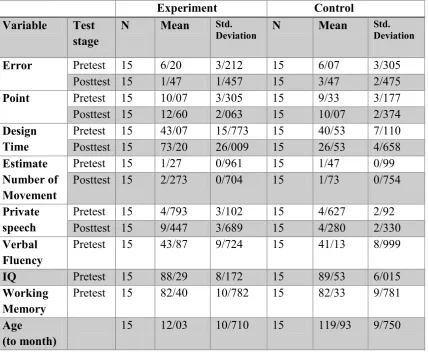
The descriptive indexes of the variables of this study are presented in Table (1).
Table 1). Mean scores of pre-test and post-test independent, dependent variables in groups
Investigating Covariance Assumptions
For analyzing the hypotheses and checking the effectiveness of task related private speech to the problem-solving skills, the multivariate covariance analysis was used after the assumptions were established. The results are presented in Table (2).
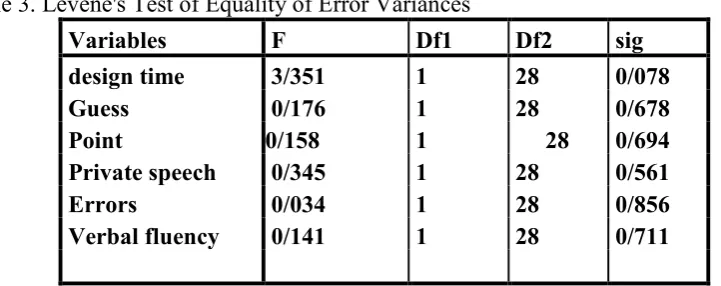
The results of the Levene test are presented in Table (3) for identical analysis of the variables of each of the variables considered. As can be seen, in each of the variables, this assumption has not been violated, and the assumption of homogeneity of variances for all Variables are met.
Table 2. Natural variability test
Variables Kolmogorov- smirnov sig
design time 0/548 0/925
Guess 0/548 0/925
Point 0/365 0/999
Private speech 0/730 0/660
Errors 0/730 0/999
Verbal fluency 0/730 0/660
Working memory 0/365 0/999
Experiment Control Variable Test
stage
N Mean Std.
Deviation N Mean
Std. Deviation
Error Pretest 15 6/20 3/212 15 6/07 3/305
Posttest 15 1/47 1/457 15 3/47 2/475
Point Pretest 15 10/07 3/305 15 9/33 3/177
Posttest 15 12/60 2/063 15 10/07 2/374
Design Time
Pretest 15 43/07 15/773 15 40/53 7/110
Posttest 15 73/20 26/009 15 26/53 4/658 Estimate
Number of Movement
Pretest 15 1/27 0/961 15 1/47 0/99
Posttest 15 2/273 0/704 15 1/73 0/754
Private speech
Pretest 15 4/793 3/102 15 4/627 2/92
Posttest 15 9/447 3/689 15 4/280 2/330
Verbal Fluency
Pretest 15 43/87 9/724 15 41/13 8/999
IQ Pretest 15 88/29 8/172 15 89/53 6/015
Working Memory
Pretest 15 82/40 10/782 15 82/33 9/781
Age
(to month)
388
Table 3. Levene's Test of Equality of Error Variances
Variables F Df1 Df2 sig
design time 3/351 1 28 0/078
Guess 0/176 1 28 0/678
Point 0/158 1 28 0/694
Private speech 0/345 1 28 0/561
Errors 0/034 1 28 0/856
Verbal fluency 0/141 1 28 0/711
The effect of task related private speech on Tower of London completion point If we look at the results of the covariance analysis test presented in Table (4), we will see that the independent variable has affected all four dependent variables, and the size of the positive effect is obtained for all variables. Also, the scores of the two experimental and control groups showed a significant difference between the score of the points of the Tower of London completion points, the production of a task related private speech, the number of ring movements and the error that occurred during the completion of the puzzle in the test. Meanwhile, the size of the effect associated with the London Tower's completion variable is equal (sig= 0/002, 2 =0/34)
Therefore, the intervention in generating task related private speech has been effective in obtaining the Tower of London completion score for most students with special learning disabilities.
The effect of task related private speech on the guessing of the number of disk movements
Estimation score or specification of the number of tower of London disks exchanged before the action is announced by the participant is one of the attractive variables considered in this study. Based on the results shown in Table 4 The task related private speech has significantly influenced on the guessing of the number of disk movements (sig= 0/001, 2 =0/396).
The data indicate that there is a direct and significant correlation between the estimated number of disk movements and the Tower of London completion
score in both the pre-test stages and (r=0/38, p=0/01) and post- test stages (p=0/001, r=0/39) .
Also, there was a direct and significant correlation between the production of task related private speech and the variable of conjecture on the number of Tower of London exchanges in both the pre-test r=0/41, p=0/01 ) and post-test phases (r=0/63, sig=0/001).
The effect of task related private speech on the amount of errors occurred during the completion of the puzzle
Due to the importance of committing errors during the task, in this research, the scores of this variable were also analyzed in the post test of the experimental and control groups. The results are presented in tables (4). As it is seen, the reduction of the number of errors during the post-test of the experimental group is significantly outweighed by the effect of treatment intervention(P=0/001, η2=0/378).
389
The effect of task related private speech on design time
Design time (former researchers used the term reaction time) is another variable that has been influenced by intervention in this study. The results of the analysis of covariance are shown in Table (3). The results of the study prove that the independent variable (task related private speech) had a significant effect on the design time, and the highest volume of effect was obtained in this variable (η2=0/627, sig=0/000).
Verbal fluency and private speech
For the reasons that was explained above, the verbal fluency variable as one of the control variables has been used in this research. Due to the small number of samples and the fact that the rest of the variables were constant, a partial correlation formula was used to obtain Spearman's coefficient.
The results indicated that between the verbal validity and the amount of private interviewing related to the assignment, both at the per-test (r = 0/35, P = 0.02) and in the post-test (r = 0/50, P = 0.002) There is a direct and meaningful relationship.
Table 4. Results of covariance analysis
Source Dependent Variables
Sum of Squares
df Mean Square
F Sig. Partial Eta Squared
Observed Power
Contras t
Posttest
guess 6.545 1 6.545 15.715 .001 .396 .967
Posttest
Point 47.784 1 47.784 12.440 .002 .341 .923
Posttest
errors 33.111 1 33.111 14.581 .001 .378 .956
Posttest design time
14130.835 1 14130.83
5 40.268 .000 .627 1.000
Error
Posttest
guess 9.996 24 .416
Posttest
Point 92.184 24 3.841
Posttest
errors 54.499 24 2.271
Posttest design time
390 Discussion:
The purpose of this study was to investigate the effect of task related private speech on problem-solving skills. In order to find out the effect of the task related private speech (independent variable) on the completing point of the Tower of London and other dependent variables in this study, due to the low number of samples, it was not possible to use regression to allow the role of the task related private speech to the title of the predictor variable is examined for dependent variables. As a result, multivariate covariance analysis was used as a powerful formula to prove the effect of this variable on the dependent variables of this study.
The results of the analysis of covariance showed that (even considering the effect of the pre-test), the intervention involving a task related private speech (with good statistical power) was effective on the success of the problem solving.
Of course, there is no precedent for researchers to use private-speech as an intervention to improve and develop problem-solving skills. However, in most previous studies, the performance of this variable has been confirmed in improving the cognition ability of individuals. Such observations can be made in the study of people such as: Garvin, 1984; Diaz and Berk, 1992; Winsler and Naglieri, 2003; Burke, 1986; Duncan and Cheyne, 1992, 2002; ferny Hough and Faraday, 2005; Winsler, Diaz, McCarthy, Atencio and Adams Chabay, 1999; Lidstone, Meins, ferny Hough, 2010; Al-Namlah, ferny Hough and Meins, 2006; Al-Namlah, Meins and ferny Hough, 2012; Winsler, Manfra and Diaz, 2007; Winsler et al., 2009). Certainly, the number of scholars who have been conducting in-depth discussions on countless research is relatively high, and all of them are honored to consider themselves consistent with the theory of Vygotsky in his private speech.
The results of this study, in line with most of the guiding dialogues, showed that when students think loudly when solving a problem, they are better off for a number of reasons to solve a problem that they have not already been successful in. The reasons for this success are: 1) The student can monitor his or her performance at any moment and find and correct the defect. 2) Better representation of the problem-solving space for other reasons is preferable one of the reasons why students with math problems fail to solve problem is not representation of the problem-solving space by those individuals who, fortunately, are aware of this space when they talk to themselves, and can find the right solution. Faster and often accurately. In order to better understand this, we can point out the design time and the number of estimation movements in the Tower of London that indicate a better understanding of the participants in the problem-solving space. Therefore, it is suggested that mentors and teachers in the field of learning disabilities, and even primary school teachers, use the task related private speech as a powerful tool, along with other ways in which student problem solving skills can be used to improve their education. And students will be more successful in their responses with a better understanding of the issues involved.
References
391
Al-Namlah, A. S., Meins, E., & Fernyhough, C. (2012). Self-regulatory private speech relates to children’s recall and organization of autobiographical memories. Early Childhood Research Quarterly, 27(3), 441–446.
Baddeley, A. (n.d.). Working Memory: Theories, Models, and Controversies.
Baldo, J. V, Dronkers, N. F., Wilkins, D., Ludy, C., Raskin, P., & Kim, J. (2005). Is problem solving dependent on language? q, 92, 240–250.
Bars, B. J., & Gage, N. M. (2010). Cognition, Brain and Consciousness. Cognition, Brain and Consciousness. Fernyhough, C., & Fradley, E. (2005). Private speech on an executive task: Relations with task difficulty and task performance.
Cognitive Development, 20(1), 103–120.
Berk, L. E., & Spuhl, S. T. (1995). Maternal Interaction, Private Speech, and Task Performance. Early Childhood Research Quarterly, 10, 145–169.
Carden, J., & Cline, T. (2015). Problem solving in mathematics: the significance of visualization and related working memory. Educational Psychology in Practice,
31(3), 235–246.
Davis, P. E., Meins, E., & Fernyhough, C. (2013). Journal of Experimental Child Individual differences in children’ s private speech: The role of imaginary companions q. JOURNAL OF EXPERIMENTAL CHILD PSYCHOLOGY,
116(3), 561–571.
Dehn, M. J. (2011). Working Memory and Academic Learning. Dehn, M. J. (2008). Working memory and academic learning - References.pdf (p. 408).
Davis, P. E., Meins, E., & Fernyhough, C. (2013). Journal of Experimental Child Individual differences in children’ s private speech: The role of imaginary companions q. JOURNAL OF EXPERIMENTAL CHILD PSYCHOLOGY,
116(3), 561–571.
Espy, K. A., McDiarmid, M. M., Cwik, M. F., Stalets, M. M., Hamby, A., & Senn, T. E. (2004). The Contribution of Executive Functions to Emergent Mathematic Skills in Preschool Children. Developmental Neuropsychology, 26(1), 465–486.
Emerson, M. J., & Miyake, A. (2003). The role of inner speech in task switching: A dual task investigation. Journal of Memory and Language, 48(1), 148–168.
Fernyhough, C. (2008). Getting Vygotskian about theory of mind: Mediation, dialogue, and the development of social understanding. Developmental Review, 28(2), 225–262.
Fernyhough, C., & Fradley, E. (2005). Private speech on an executive task: Relations with task difficulty and task performance. Cognitive Development, 20(1), 103– 120.
392
Hurlburt, R. T., & Heavey, C. L. (2015). Investigating pristine inner experience: Implications for experience sampling and questionnaires. Consciousness and Cognition, 31, 148–159.
Hurlburt, R. T., Heavey, C. L., & Kelsey, J. M. (2013). Toward a phenomenology of inner speaking. Consciousness and Cognition, 22(4), 1477–1494.
Ismail, K., & Ooi, B. K. (2008). The Intelligence of Children with Reading Difficulties by Cognitive Assessment System (CAS). E-Bangui, 3(3), 1–14. (Persian)
Jones, P. E. (2009). From “external speech” to “inner speech” in Vygotsky: A critical appraisal and fresh perspectives. Language and Communication, 29(2), 166–181.
Khodaee, N. (2011). The effect of working memory and metacognition training on academic function of female students with mathematics learning disabilities,
12(1). (Persian)
Kleinberg, L., Korkman, M., & Lahti-, P. (2010). Developmental Neuropsychology Differential Development of Attention and Executive Functions in 3- to 12-Year-Old Finnish Children, (August 2013).
Lidstone, J., Meins, E., & Fernyhough, C. (2011). Individual differences in children’s private speech: Consistency across tasks, time points, and contexts. Cognitive Development, 26(3), 203–213.
Lidstone, J. S. M., Meins, E., & Fernyhough, C. (2010). Journal of Experimental Child The roles of private speech and inner speech in planning during middle childhood: Evidence from a dual task paradigm, 107, 438–451.
Locke, J. L., & Fehr, F. S. (1970). Young children’s use of the speech code in a recall task. Journal of Experimental Child Psychology, 10(3), 367–373.
McCarthy-jones, S., & Fernyhough, C. (2011). The varieties of inner speech: Links between quality of inner speech and psychopathological variables in a sample of young adults. Consciousness and Cognition, 20(4), 1586–1593.
Manfra, L., Tyler, S. L., & Winsler, A. (2016). Speech monitoring and repairs in preschool children’s social and private speech. Early Childhood Research Quarterly, 37, 94–105.
Miller, D. C., & Ph., D. (2010). How to Report and Interpret the NEPSY-II Scores Within A School Neuropsychological Framework.
Miyake, A., Emerson, M. J., Padilla, F., & Ahn, J. C. (2004). Inner speech as a retrieval aid for task goals: The effects of cue type and articulatory suppression in the random task cuing paradigm. Acta Psychologica, 115(2–3), 123–142.
Nelson, K. (2015). Cognitive Development Making sense with private speech, 36, 171– 179
393
Sternberg Robert J, Sternberg, K., (2009), Cognitive Psychology. Wadsworth, Cengage Learning. 6th Edition
Thousand, A. (2013). PRIVATE SPEECH, EXECUTIVE FUNCTIONING, AND THE DEVELOPMENT OF VERBAL SELF-REGULATION Cambridge Books Online © Cambridge University Press, 2009 (Vol. c).
Vygotsky, L. S. (1999). Vygotsky ’s Sociocultural Theory. Unesco, 26925.
Winsler, A., Abar, B., Feder, M. A., Schunn, C. D., & Rubio, D. A. (2007). Private speech and executive functioning among high-functioning children with autistic spectrum disorders. Journal of Autism and Developmental Disorders, 37(9), 1617–1635.
Winsler, A., De Len, J. R., Wallace, B. a., Carlton, M. P., & Wilson-Quayle, A. (2003). Private speech in preschool children: developmental stability and change, across-task consistency, and relations with classroom behavior. Journal of Child Language, 30(3), 583–608.
Winsler, A., Diaz, R. M., & Montero, I. (1997). The role of private speech in the transition from collaborative to independent task performance in young children.
Early Childhood Research Quarterly, 12(1), 59–79.
Winsler, A., Manfra, L., & Diaz, R. M. (2007). “Should I let them talk?”: Private speech and task performance among preschool children with and without behavior problems. Early Childhood Research Quarterly, 22(2), 215–231.
Zimmerman, B. J. (1989). Models of self-regulated learning and academic achievement.