REVIEW ARTICLE
A REVIEW ON THE INFLUENCE OF E-COMMERCE IN RWANDA
*
Uwasekuru Consolee
Hangzhou Dianzi University, School of Managemen, 2nd Street, Hongzhou Xiasha High Education Zone 310018,
Hogzhou, Zhejiang, China
ARTICLE INFO
ABSTRACT
E-business activities is growing rapidly over the years and adding values to the economy of Rwanda. The internet has developed into a new distribution channel and online transaction is rapidly increasing. This paper is focused and created a need to understand how Ecommerce is fast growing in Rwanda. The purpose of this paper is to examine the particular factors that influence Ecommerce in Rwanda. The government is committed for developing Ecommerce and has put in place measures to protect users of online services by adapting global standards like the property information security standard which is the payment card industry data. It is also providing service to both citizens and businesses through E-government program which is including paying taxes and fees. Some of citizens still use traditional way of physical interaction. Domestic ecommerce is relatively new in Rwanda but the sector is starts up and growing too quickly with online international payers. Cross border ecommerce: China and United Arabe Emirates are the main countries online ordering and ecommerce partners go through Alibaba and Ali Express. Most businesses and citizens use this long term suppliers by ordering and they pay by using money transfer like western union, money gram, Wanda money etc.
Copyright © 2018,Uwasekuru Consolee. This is an open access article distributed under the Creative Commons Attribution License, which permits unrestricted use, distribution, and reproduction in any medium, provided the original work is properly cited.
INTRODUCTION
E-commerce is gradually taking a shape in Rwanda according to (East Africa business, 2015) Ecommerce is playing a significant role especially in entertainment and tourism sector in Rwanda. Most of peoples still using traditional ways of buying and selling goods and services. As well the government of Rwanda is rapidly encouraging citizens to be interested and using technology especially in business with corporation of NGO and volunteers, trainers of IT, Carnegie Mellon University (American university branch located in Rwanda). Some of people in Rwanda they are using worldwide international platform online shopping such as: Alibaba, Amazon and E-Bay. As everyone can see with the help of government of Rwanda in 10 years Rwanda will be on the top of African countries with high technology in business. Online shopping in Rwanda is significantly affected by various demographic factors like gender, sex, material status, family size and income. Life is becoming fast not only in Kigali which is the capital city of Rwanda but also in small cities around in the county. The numbers of nuclear countries has been increasing and still do. And both parents they are busy working for their families as they have no times to go at the markets and purchase goods and services. There is other reason like shortage time, jam traffic, late working hours, etc.
*Corresponding author: Uwasekuru Consolee,
Hangzhou Dianzi University, School of Managemen, 2nd street, Hongzhou Xiasha high education Zone 310018, Hogzhou, Zhejiang, China
Literature review
This section evaluates available literature with a focus on E-commerce currently in Rwanda and its adoption. The study will also provide an update status of internet penetration in Rwanda. The online payment also will be discussed by comparing online payment with currently payment (cash payment). We will also review the e-commerce start-up barriers and challenges. E-commerce consumers’ behaviours will be the result and helpus to know which level of e-commerce in Rwanda. The different type of online will be discussed and an analysis of different customers attributes also will be done. This study will also determine and discuss the new and old methodologies of E-commerce in Rwanda. The future of research will be taken as the result which can help and used to implement in E-commerce in Rwanda. Types of Online Shopping: According to the US embassy abroad (2017) research about Ecommerce in Rwanda postulated that online shopping involves in the behaviours of a buyers and how they buy goods and services online. In the advent of new technology by the same time increasing of internet use in Rwanda this form of shopping is fast growing. According to (Ndegwa 2013) the number of people who find online shopping very helpful and most convenient is increasing every day. Today the government and some organisations are supporting and educating citizens to use the technology in each and every carrier, as well as technology is used to support business process.
ISSN: 0976-3376
Asian Journal of Science and Technology Vol. 09, Issue, 06, pp.8322-8326, June,2018SCIENCE AND TECHNOLOGY
Article History:
Received 14th March, 2018
Received in revised form 21st April, 2018
Accepted 22nd May, 2018
Published online 30th June, 2018
Key words:
Current E-shopping in Rwanda: Inside of Rwanda’s fast growing e commerce industries. There few online shops in Rwanda, this can show anyone that ecommerce in Rwanda is upcoming and booming as well as online consumers are increasing a day by day. Nowadays Rwandan citizens are living everywhere in the world, in different countries, continents and they are exposing their culture at the same time learning the development, culture and technology from other countries. This can be the key of fast growing development and technology of ecommerce in Rwanda.
This means that anyone in Rwanda can easily buy some goods and service from a broad by using the mobile phone which has access to the internet. In fact they are some online shop like” Get it “people they use SMS to order goods and services and they are using other platform like Facebook WhatsApp, emails, phone calls. The system is very convenient because it allow the customer to order in whatever ways is easier for them. In Rwanda the statistical research is has discovered that 5 millions of citizens have access to the internet. The number is rapidly growing progressively over the last five years. Social media nowadays also is playing a great role of ecommerce in Rwanda and some of citizens are using Facebook, WhatsApp, Instagram, twitter and LinkedIn. Many start-ups and small business company use Facebook, Instagram to advertise and sell goods /services.
Internet Penetration in Rwanda: The invention of internet
has created aparadigm shift of traditional shops. Consumer not takes time or specific location. He can use internet and be active at any time, anyplace, and purchase the product and services easily. The internet is relatively new medium for communication and information exchanges have become present in our daily life. The numbers of internet users is increasing day by day which also signify that online purchasing is increasing (joineset, 2003). The internet is more convenient to the consumers than traditional way shopping such as:
Ability of any time view, saving time and money, discussion with others customers, visualise their need with others consumer (joinetal.2003). The primary reason of shopping online was price which has now changed to convenient. The internet has developed into a new distribution channel (hollensen 2004) and the evaluation of channel was ecommerce to be the most significant contribution of information revolution. Shop online by using internet had become one of the most reasons of using internet combining with searching information and finding the products details (joines et al. 2003). As well as other African countries, internet in Rwanda has been ranked in first place in Africa for broad
bond downloads speed and 62nd globally with a speed of7.88
mbits/s in February 2013. The internet has been available for mobiles cellular phones since 2007. But the cost of phones and limited bond with restrained its popularity for years. Internet access is all available in all cities and towns. All mid-range hotels, top hotels and restaurants, banks and famous company in Rwanda have WIFI available in order to offer to their customers. However speeds are fine, sometimes slow and service is often cut off for no reason.
Online Payment in Rwanda: Now consumers can easily buy
and pay for online goods/services available in the country and abroad.
National bank of Rwanda and central bank have further helped to encourage E-payment in the country especially in the area of customer protection from undue levies in the process of paying for goods electronically.
Current Online Payment
Mobile ecommerce payment: where cell phones are used to
pay goods and services for example: electricity bill, water bill, taxes, etc. through the system named as Mobile money or Tigo cash. This is the easy and most convenient way for all citizens because the user doesn’t need to have access to the internet. Mobile ecommerce increase rapidly the number of cell phones in RWANDA and limited access to the internet.
Banking payment: Visa card, master card, and other bank
cards are used for online payments but most people in the country are using Mobile money and Tigo cash which is the popular payment in RWANDA.
Ecommerce Start up Challenges in Rwanda: Ecommerce
market has barriers in entry and local in Rwanda. Some of peoples are willing to start up the business however, they realise some of this challenge are real in Rwanda. Below the author has enlisted a few major challenges:
Relatively Poor Internet Connection: Internet access is
available in small cities of the country and in the capital city which is Kigali. But sometimes there is low internet connection and the speed is very low in some parties of the country, and the service is often cut off for no reason. This barrier is the most of the challenge about ecommerce in Rwanda.
Number of Internet Users: In 2012 the author observes a
drastic increase in the number of internet users in Rwanda, as shown in the table above, during this year Rwanda was the
120th country in the world rating in the number of internet
users, with 8.0% of the country’s population using the internet.
Fixed broadband: 2,806 subscriptions, 167th in the
world; less than 0.05% of population, 181st in the world (2012).
Wireless broadband: 379,331 subscriptions, 99th in
the world; 3.2% of the population, 119th in the world (2012).
Internet hosts: 1,447 hosts, 168th in the world (2012).
IPv4: 195,840 address allocated, 117th in the world,
less than 0.05% of the world total, 16.8 addresses per 1000 people (2012).
Cost of Smart Phones and Laptop: Telecommunications
Mind Set: Some of the people in Rwanda especially in the village they are into traditional market. Some of them they are using the tradition old market because they doesn’t have smart phone or computer and internet access, while others they are not interested about ecommerce because they don’t know the advantage of online market.
Low Purchasing Power: Annual per capita income at USD
697 in 2007 but in 2017 is USD 863
Cost and Availability of Electricity: Rwanda’s electricity cost
at USD 0.24 per kilowatt hour (KwH) far exceeds the rate compare to another African country. And basically the electricity is not everywhere in the country, Just in the capital and small city.
Taxation: Under Rwandan law each and every businesses,
factory should be registered, have licenses, approvals and
procurement. Investors, entrepreneurs and businesses
especially the one for ecommerce have also mentioned that the taxes in Rwanda are high compare to the profit they make. Those are few barriers listed and there is many accordingly to the type of business entrepreneurs are come up with.
E-commerce Consumers’ Behaviours and Attitude:
Consumer’s attitude is directly influenced that affect consumers buying willingness. Fishbein and Ajzen (1975) describe attitude towards behaviour as a person evaluation of a specified behaviour involving on object or outcome. For example: a person may hate to use a mobile telephone to play online games, where using a mobile telephone to play an online game is the behaviour and individual feeling of attitude.
Factors influencing consumer’s online shopping attitude:
Previous studies have discussed and summarised several influence and factors of online shopping such as: usability, security, privacy, after sales services quality, and perceived reputation.
Perceived Usability: Usability refers to extend how a website
is much convenient and facilitate users to use its function easily and in appropriate way. According to the research (calisir, bayraktaroglu, topcu, and multy 2009) online shopping is based on internet and the website is the basic platform of online transaction. Therefore, website usability has a significant impact on online consumer’s perception and e-shop success. The usability of website factors must include of: ease of use, navigation, response time, interaction, design, convenience, learnability, efficiency, site findability and accessibility.
Perceived Security: According to pears on and miller (2001)
have defined perceived security as “the extend of a person believes the world wide web is secure to transmitting information” according to their studies they found that perceived security is positively associated with online purchase intention.
The research of Elliot and Fawell (2000) showed that consumer’s perception security was related to the security of the consumer’s bank card while they are paying. As a result , the security was become one of the most important reason that cause consumers to hesitate of fear using e-purchase out and it has played dominant role of influencing their attitude towards online shopping.
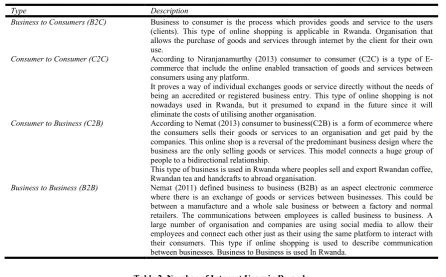
Table 1. The type of online shopping are described in the table below in relation to those applicable to Rwandese consumers
Type Description
Business to Consumers (B2C) Business to consumer is the process which provides goods and service to the users
(clients). This type of online shopping is applicable in Rwanda. Organisation that allows the purchase of goods and services through internet by the client for their own use.
Consumer to Consumer (C2C) According to Niranjanamurthy (2013) consumer to consumer (C2C) is a type of
E-commerce that include the online enabled transaction of goods and services between consumers using any platform.
It proves a way of individual exchanges goods or service directly without the needs of being an accredited or registered business entry. This type of online shopping is not nowadays used in Rwanda, but it presumed to expand in the future since it will eliminate the costs of utilising another organisation.
Consumer to Business (C2B) According to Nemat (2013) consumer to business(C2B) is a form of ecommerce where
the consumers sells their goods or services to an organisation and get paid by the companies. This online shop is a reversal of the predominant business design where the business are the only selling goods or services. This model connects a huge group of people to a bidirectional relationship.
This type of business is used in Rwanda where peoples sell and export Rwandan coffee, Rwandan tea and handcrafts to abroad organisation.
Business to Business (B2B) Nemat (2011) defined business to business (B2B) as an aspect electronic commerce
where there is an exchange of goods or services between businesses. This could be between a manufacture and a whole sale business or between a factory and normal retailers. The communications between employees is called business to business. A large number of organisation and companies are using social media to allow their employees and connect each other just as their using the same platform to interact with their consumers. This type if online shopping is used to describe communication between businesses. Business to Business is used In Rwanda.
Table 2. Number of Internet Users in Rwanda
Rwanda Internet Users Statistics
Year Users
2012 937,964
2009 450,000
Perceived Privacy: A general definition of personal information is “data not available via public sources (Beatty 1996) in respect of definition of privacy, personal information is always the great concern.
(Hatch 2000) and (smith 1996) identified four online factors privacy:
Unauthorised secondary use of personal information
Unauthorised of access personal information digital
stored
Collection of personal information
Errors by collecting personal information
In summary there many factors that are hard to control consumer’s privacy, online privacy is difficult to protect. This is why many consumers refuse to accept and use online shopping.
Perceived After Sales Service Quality: The definition of after
sales services is the delivery service of sending the product to a customer after e-payment. Sparks and Legault (1993) discussed and summarised there two type of services after sales.
Anticipated services are those customers plan for,
such as maintenance, installation, training, upgrading and written information.
Unanticipated services are categorised in maintenance
of sold out products such as: repair, returns, and replacements (sparks and legault 1993).
Perceived Reputation: The role of reputation in ecommerce
environment is very important than the tradition market environment. In ecommerce environment consumers can not directly examine the goods/services before they purchase. They can only obtain the information about the product from the website and trust the products description of vendor.
The reputation of online vendor has become significant that influence consumer’s attitude towards online shopping. According to the research of Houser and Wooder (2000),Deuan and Hsu(2001), have all shown that a seller overall reputation often has a positive and statistically significant impact on the consumer’s willingness to adopt online purchase.
Suggested E-Commerce Approach
Digital Transformation Workshops and Seminars: Digital
transformation workshops and seminars with innovative E-commerce approaches ca help small business in Rwanda is not surprising that mobile phones have become the platform of choice for peoples in Rwanda who engage in E-commerce. It’s important that the growth of digital economy including ecommerce involves a benefits Rwanda’s small and medium business sector, which is acknowledged engine of economic growth in the country. Mercy Mpinganjira (2018). The aim of digital transformation workshop and seminars is to educate and train entrepreneurs to prove and update excellence operation, to have a better customer experience and be the change and the leader of industries.
Workshops and seminars should focus on following topics:
Business innovation: learn how to create a culture of
innovation and how to lead your business to become innovator. The great deal of innovation is one of the most requirements of successful digital businesses transformation.
Digital business ecosystem: learn and understand the
main components strategies of digital business ecosystem.
Understanding and connecting new customer’s
journey: to known what your customers’ needs and
how to align all aspects of your business to deliver customers experience in possible way.
Channel agnosticism: learn how and when to evolve
your business to become a transformation of a true channel agnostic business.
Learn best strategies for driving your business into
digital transformation.
Stable Platform: Stable platform is one of the most important
requirement and suggestion which will lead your business to the success. (2018) Jack Ma According to Alibaba, the world’s largest E-commerce corporation which holds 70% of china online market and defeating eBay and Amazon, Professor Teng Bingsheng searched the factors behind the success and growth of Alibaba and mention that stable platform is very important doe E-business growth. Customer’s interviews and accurate the analysis of customer’s needs has been another strategy as well. Taobao customers spend amount of time on the websites because it has the vast selection of merchandise, and it take quite a bit of time browsing through ,make decision and complete the deal. Jack Ma the CEO in the interview with Teng Bingsheng said vast selection, spent time browsing, make decision those are strategies that make customers to buy more and more.
Taobao and Tmall have Alibaba’s unique shopping spree “single day” or eleven eleven (11/11) which is in November has become recognised by the global world as well. In 2017, the day showed a breaking sales and revenues record and reached over RMB 168.billion on just one day. Stable platforms, good web design which will be easy to the users, facilitate convenient and faster services. As much as Taobao and Amazon platforms are stable and on high level, customers fundamentally see them as tools not identities. This is happening in both US and CHINA markets. The government is committed for developing Ecommerce and has put in place measures to protect users of online services by adapting global standards like the property information security standard which is the payment card industry data.
REFERENCES
Abdi, h., Williams, L., J. and velentin, D., 2013. Multiple factors analysis, principal component analysis for multiple and multiblock data sets. Wiley interdisciplinary review: computational statistics, 5(2), PP.149-179.
Adms, I., Khen, H.T., Roeside, R, and white, D.I. 2007. Research method for graduate business and social science student. SAGE publication India.
Ajzen,I., the theory of planned behaviours, organisation behaviours and human decision process 50(2),PP.179-211. Alibaba stable platforms Seoul 2018, a study of consumer’s
behaviours towards online shopping in Ghana.
Atema V., 2014. E-commerce adaption among small and micro enterprises in Nairobi (doctoral dissertation, university of Nairobi)
Bryanan, A. and Allen, T., 2011 education research methods.
Cheema,U., Rizwan, M., Jala,R., Durrani, F. and
Sohoil,N.,2013. The trend of online shopping in 21st
century: impact of enagment I TAM model. Asian journal
of Empirical Research, 3(2); pp.131-141
China, w.w., 1998 the portal least square approaches to structural modelling. modern methods for business research, 295(2), pp, 295-336.
Davis, F.D., Boggozi, R.P., 1989. User acceptance of computer technology a comparison of two theorical models. Management science, 35(8),pp 282-576.
Graziol, S. and Jarvennpaa, S.L., 2000. Peril of internet fraud: an empirical investigation of deception and trust with experienced internets consumers.
Hair, J., F., Sarstead, M., Ringle, C.M and Mena, J.A., 2012. An assessment of the use of partial least square structural
equation modelling in marketing research. Journal of
Academy and Marketing in Science 40(3), PP.414-433 Henseler J.,Ringle ,C.M and Sinkovics , R.R.,2009. The use of
partial least square, structural equation modelling in
international marketing. Advances in international
marketing, 20(1), P.P.277-391
Humphrey, J., Monsell, R., Pare, D. and Schimitz,H.,2003. Reality of e-commerce in developing countries.
Hzu,M.H. and Chu,C,M.,2004. Predicting electronic service continuance with a decomposed theory of planned
behaviours. Behaviour and Information Technology,
23(5),pp. 359-373.
Jarvenappa, S.L., Tractinsky, N. and Saarinen, L., 1999. Consumer trust in an internet store. A cross –culture validation. Journal of Computer Mediated Communication, 5(2), pp, 123-208.
Kabuba, P.K., 2014. E-commerce and the performance of online business in kenya (doctoral dissertation, university of Nairobi.
Katawetawarks, C. and Cheng. L., W., 2011. Online shopper
behaviour, influence of online shopping decision. Asian
Journal of Business Research 1(2).
Kumar, V. and Mishra, S., 2012. A study of the attitude towards the online shopping: A conceptual model regarding intention formation, the role of perceived risks. Available at SSRN2287643
Leboo, L., 2015. Factors influencing shopper online buying behaviour in a project based company. A case of geothermal E-business activities is growing rapidly over the years and adding values to the economy of Rwanda. The internet has developed into a new distribution channel and online transaction is rapidly increasing. This paper is focused and created a need to understand how Ecommerce is fast growing in Rwanda. The purpose of this paper is to examine the particular factors that influence Ecommerce in Rwanda.
Lee, Y., Kozar, K.A. and Larsen, K.R., 2003. The technology acceptance model: past, present and future communication of association for information system.
Nazir, S., Tayyab, A., Sajid, A., H.U. and Javed, I., 2012. How online shopping is affecting shopper buying behaviours in Packstan. International Journal of Computer Science. Nemat, R., 2011. Taking a look at different types of
ecommerce. World applied programming 1(2), pp, 100-104.
Niranjanamurthy, M. and Chahar, D.D., 2013. The study of
ecommerce security issue and solution. International
Journal of Advanced Research in Computer and Communication Engineering, 2(7).
Russo, B., Sun-Basorum, A. and Van Wamelen, A, 2012. The rise of African shopper. McKinsey Global Institute. Teng Bing Sheng (professor of strategic management Ph.D.
and Jack Ma, CEO and Founder of Alibaba interview (2018)
Torbjon, F. 2015. Information economy report: unlocking the potential of E-commerce for developing country. UNCTAD.
Velarde, V. D. V. 2012. Determination of purchasing behaviour. An empirical investigation using an extension
of the theory of planned behaviours. The Journal of
Business And the Social Science.