Towards hybrid client-side cache management in
network-based file systems
Xiuqiao Li1,2,3, Limin Xiao1,2, Ke Xie2, Bin Dong2, Li Ruan1,2, and Dongmei Liu2
1
State Key Laboratory of Software Development Environment, Beihang University Beijing, China
2
School of Computer Science and Engineering, Beihang University Beijing, China
3 IBM China Systems and Technology Laboratory Beijing, China
[email protected]{xiaolm,kexie,bindong,ruanli,liudm}@buaa.edu.cn
Abstract. Client-side caching is an effective technique to hide network latency and improve I/O performance in network-based file systems. Current methods mainly adopt block-indexed caching structures, which suffer cache inefficiency problems in high concurrency environment. In this paper, we present a hybrid client-side caching scheme (HCCache) to avoid performance degradation caused by the block interleaving problem and increase the cache space efficiency by customizing con-tent addressable levels for files with different sizes. Two new metrics are also pro-posed to accurately evaluate cache efficiency compared with the metrics of hit rate. Extensive simulations show the I/O performance with HCCache can be improved by 34.2 percent and 6.1 percent in average for read requests and 37.8 percent and 27.8 percent in average for write requests in terms of I/O bandwidth and access la-tency, respectively. Meanwhile, HCCache can significantly reduce the lookup times of content addressable data blocks and improve the access latency for small files.
Keywords:client-side caching, small files, network-based file system.
1.
Introduction
Caching technique is one common approach to alleviate the access latency in many appli-cation scenarios, such as web servers [34], storage and file systems [25, 8, 21], databases [38], etc. The rationale is that frequently accessed items have higher probabilities to be served from cache with lower latency than normal accesses. In network-based file systems (such as Lustre [3], PVFS [4]), the functionalities of file system clients and servers are decoupled and interact data among each node over network. Meanwhile, metadata servers (MDSs) in many file systems are also decoupled from data servers (DSs) [40, 42]. Serv-ing an I/O request requires interactions with multiple servers accordServ-ing to complex I/O protocols. Efficient design of client-side caching becomes crucial to hide the I/O latency of both network round-trips and disk accesses.
[17]. Moreover, multicore/manycore processors with hundreds of cores are readily avail-able for computing in near future [30]. Hence, even single file system client can expe-rience high I/O concurrency. To benefit from parallelism, multi-thread/process applica-tions programmed by parallel languages or libraries(such as pthread, MPI/MPI-IO [8], OpenMP [27]) become mainstream in many fields, such as scientific computing, image processing, etc. Many of these applications generates concurrent, burst I/O requests with small inter-arrival times shorter than a millisecond [11, 37].
Designing efficient client-side caching is facing a lot of challenges in high concur-rency environment. One reason is that I/O workloads exhibit various workload charac-teristics [9, 10, 13, 25]. For example, previous studies [9, 15] show that many workloads contain large number of small files with an average size under 1 MB or less. Typical small files include tiny web pictures, text documents and output files generated from sci-entific experiments [9, 32]. Meanwhile, many of them are immutable and dominated with read-exclusive accesses [18]. Hence, the cache performance is critical to serve requests on small files with low latency and high bandwidth. However, current design of client-side caching often employs block-indexed structures to manage cached data. While it is simple and effective for caching data for large files, small files will suffer poor performance in high concurrency environment. With block-indexed structures, the small file data has a high probability of interleaving by the blocks from other files in theleast recently used
(LRU) list. Once a block is evicted, following requests will suffer expensive accesses over the network.
In this paper, we present a hybrid client-side caching scheme (HCCache) to address above issues. HCCache combines the merits of object-indexed and block-indexed struc-tures to distinguish the caching schemes for small and large files. The small file data with HCCache is managed in the LRU list as a whole. Therefore, the probability of partially hit in cache for small files can be significantly reduced. Furthermore, HCCache also can cus-tomize the granularity of content addressable cache data to trade off the memory savings and cache performance. Our main contribution can be summarized as follows.
– HCCache allows customizing the per-file caching behaviors (e.g., selecting cache block sizes, operating blocks in LRU list, selecting data compression granularities). Hence, the performance of small files can be optimized without interfering the caching behaviors of large files.
– We analyze the deficiencies ofhit rates metrics in evaluating cache efficiency for I/O intensive workloads and propose two new metrics to correctly reflect the cache efficiency.
– Extensive simulation results using real-world application traces demonstrate the effi-ciency of HCCache in aspects of I/O bandwidth and access latency.
2.
Problem Statement
In this section, we introduce the performance problems of caching small files with block-indexed structures in detail by motivating simulation results.
2.1. Cache Block Interleaving Problem of Small Files
To guarantee data consistency and fairness, operating the data in a cache shared by mul-tiple clients requires locks to proceed concurrent requests sequentially. When the con-current requests are burst, however, the cache blocks of the same file will be interleaved with other blocks in the LRU list. Fig.1 shows an example of the block interleaving phe-nomenon. Two reasons make this phenomenon to become a common case. The first one lies in the reduction of I/O access size by the file system client. Although applications can specify a large I/O access size with the I/O system call, the file system will split the I/O request into multiple requests with a predefined transfer size. For example, the default transfer size of NFS is 4KB and can be configured up to 32KB [5]. Another rea-son is that setting too large cache block sizes will introducefalse sharingproblem which significantly degrades performance for concurrent writers [29].
1 2 3 4 5 1 3 2 1 2 5
oldest newest
Fig. 1.Example of Cache Block Interleaving phenomenon. The blocks in the LRU list belong to five files. File 1 has 3 blocks in total and interleaved by 6 blocks of other files
To analyze the effect of concurrency on the cache block distribution of small files, we motivate the concept ofaverage block distance(ABD), which is defined as dividing the total number of cache blocks between the first and the last block belongs to the file in the LRU list by the total number of cache blocks of the file. Suppose a fileFhasndata blocks with the storing order in the LRU list. The index number of theith block can be coined as
Di.
Definition 1 (ABD(average block distance)). The ABD of a file F in the client-side cache is defined as:
ABD= (Dn−D1)/(n−1) (1)
, whereD1andDn are the index numbers of the first and last data blocks in LRU list,
respectively.
0 20 40 60 80 100
50 100 150 200 250 300 350 400 450
A B D o f s m a ll f il e s Time(sec)
64C 128C 256C 360C 448C
Fig. 2.ABDs of small files inhttpdtraces with varying client scale
2.2. Performance of Partially Cached Small Files
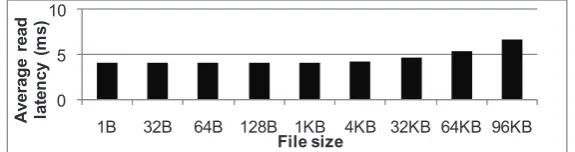
To analyze the effect of block interleaving problem on small files, we measured the read I/O latencies with various transfer sizes. Fig. 3 shows the latency results of performing read requests with the specific size using 100 clients. We can observe that the read latency numbers with the transfer sizes below 64KB are comparable. The performance degrada-tion of partially cached small files is introduced by two reasons. On one hand, the cached blocks of small files bring little performance benefits. Suppose the cache block size is 32KB and the second block of a 33KB file missing in the cache. Although only missing 1KB data in cache, the total latency of reading the file is still about 4 to 5 ms, which is almost the same to the one without cache. Therefore, missing part of blocks of small files in the cache is more expensive than large files. Even worse, on the other hand, the partially cached data is useless to reduce latency and totally wastes the memory, making the cache performance can not be fully exploited.
0 5 10
1B 32B 64B 128B 1KB 4KB 32KB 64KB 96KB
A v e ra g e r e a d la te n c y ( m s ) File size A B D o f s m a ll f il e s
Fig. 3.Average read latency of small files with varying transfer sizes
2.3. Design Goals
3.
HCCache Design
In this section, we present the design of proposed HCCache by introducing the architec-ture overview of our approach and discussing the design details.
3.1. Architecture overview
Network interconnect
… HCCache
…
Core Core
HCCache …
Core Core
Client1 Clientn
HCCache
Cache interface layer
Cache operation layer
Data management layer
(a) HCCache position in a network-based file system (b) HCCache layer architecture
MDS DS1 DS2 … DSm
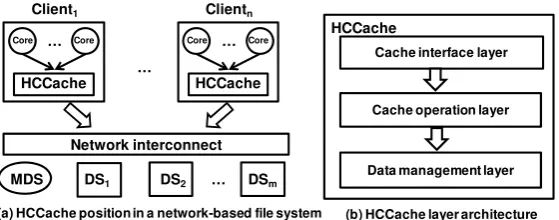
Fig. 4.HCCache architecture in a network-based file system
HCCache is placed on each client to serve I/O requests from memory for frequently accessed files. Requests missed in cache will interact with remote MDSs and DSs over the network. Fig. 4(a) shows the position of HCCache in the network-based file system architecture. All the cores on a client currently share the same HCCache daemon to access data. However, the design can be easily extended to the collective cache, which is shared by multiple clients.
Fig. 4(b) shows the three layers of HCCache to efficiently serve the I/O requests. The functionality of each layer is introduced as follows.
– The cache interface layertranslates the I/O requests and chooses proper cache oper-ations to serve the requests for small and large files.
– The cache operations layeris responsible for managing the cache operations, includ-ing data insertion, lookup and eviction.
– The data management layerexplores the space efficiency by adopting content
ad-dressable storage (CAS) method to avoid storing duplicate blocks. The chosen CAS level and granularity is determined based on the file size.
3.2. Cache Interface and Operations
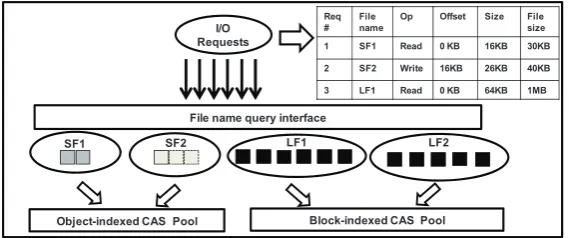
Cache Structure As shown in Fig. 5, HCCache adopts a three level cache structure to operate file data. Similar with block-indexed structures, HCCache requires serval param-eters with I/O requests to operate cache items, such as file name, operation type, access offset and size. The difference is that HCCache needs one more parameter to get the file size of requested file. This information is readily available in practical since the file meta-data needs to be retrieved before issuing I/O requests [7, 28]. HCCache relies on a file size threshold to determine whether it is a small file. The file size threshold for small files can be tunable according to workloads characteristics. We chose 256KB as the small file threshold, which worked fine for our simulations.
The data blocks in HCCache are logically arranged into groups indexed by corre-sponding file names. The top level of cache structure is responsible for indexing these groups and querying the group for specific I/O request. At the second level, the block organizations of each group are versatile for different kinds of files. All the blocks of a small file are treated as a whole in the LRU list when performing cache operations, while the blocks of a large file are processed as individual units to in the LRU list. HCCache maintains the data in different CAS pools at the lowest level to trade off space savings and performance.
Req #
File name
Op Offset Size File size
1 SF1 Read 0 KB 16KB 30KB
2 SF2 Write 16KB 26KB 40KB
3 LF1 Read 0 KB 64KB 1MB
File name query interface
SF1 SF2 LF1 LF2
I/O Requests
Block-indexed CAS Pool Object-indexed CAS Pool
Fig. 5.An example with proposed three-level cache structure
Cache Insertion The data to be inserted may be only part of the small file due to splitting requests or the setting of cache block size smaller than the transfer size. To increase space efficiency, the cache space of a small file is dynamically allocated rather than pre-allocated while inserting data block for the file at the first time. As shown in Fig. 5, although the file size of the file named SF2 is 40KB, the size of cache space for the file is only 16KB before receiving the second request in the table. The blocks withdashed linesare not available and do not occupy any space. Only when processing the second request, the occupied space is enlarged to 40KB in the example. The cache insertion algorithm is described in Algorithm 1.
Algorithm 1Cache insertion algorithm in HCCache
Insertdata block(Fi, j)to LRU listLRU List 1: ifFiis a small filethen
2: ifthere is noDGroup(Fi)then 3: create data groupDGroup(Fi); 4: adddata block(Fi, j)toDGroup(Fi);
5: putDGroup(Fi)as the last element inLRU List; 6: else
7: add or updatedata block(Fi, j)toDGroup(Fi); 8: putDGroup(Fi)as the last element inLRU List; 9: else
10: ifthere is noDGroup(Fi)then 11: create data groupDGroup(Fi); 12: adddata block(Fi, j)toDGroup(Fi)
13: putdata block(Fi, j)as the last element inLRU List;
size. If only part of requested data hit in the cache, the left region should be requested from remote servers. This procedure is the same for looking up the data of both small and large files. However, the difference is that the whole data group of requested small file is moved to the tail of the LRU list. This way avoids possible block interleaving problems induced by accessing part of file blocks. Algorithm 2 shows the details of cache lookup operation.
Algorithm 2Cache lookup algorithm in HCCache
Lookupdata block(Fi, j)from LRU listLRU List 1: ifFiis a small filethen
2: ifthere is no data group ofFiinLRU Listthen 3: returnCACHE M ISS;
4: else
5: ifthere is nodata block(Fi, j)inDGroup(Fi)then 6: returnCACHE M ISS;
7: else
8: putDGroup(Fi)as the last element inLRU List; 9: returndata block(Fi, j);
10: else
11: ifthere is nodata block(Fi, j)inLRU Listthen 12: returnCACHE M ISS;
13: else
14: putdata block(Fi, j)as the last element inLRU List; 15: returndata block(Fi, j);
file, all the small file data will be erased. Therefore, the cache space occupied by partially cached small files can be reused quickly.
Algorithm 3Cache eviction algorithm in HCCache
Evictdata block(Fi, j)from LRU listLRU List 1: ifFiis a small filethen
2: ifthere is no data group ofFiinLRU Listthen 3: returnN ON EXIST;
4: else
5: ifthere is nodata block(Fi, j)inDGroup(Fi)then 6: returnN ON EXIST;
7: else
8: evictdata block(Fi, j)fromDGroup(Fi); 9: ifthere is nodata block(Fi, j)inLRU Listthen 10: removeDGroup(Fi)fromLRU List; 11: returnSU CCESS;
12: else
13: ifthere is nodata block(Fi, j)inLRU Listthen 14: returnN ON EXIST;
15: else
16: evictdata block(Fi, j)fromLRU List;
17: ifthere is nodata block(Fi, j)inLRU Listthen 18: removeDGroup(Fi)fromLRU List; 19: returnSU CCESS;
Cache Operations Runtime Optimization HCCache introduces additional layer to man-age data blocks of the same file in a data group. Hence, there is potential impact on the performance of cache operations. The extra steps of operating data groups are as follows.
– isExist(file name): Query the existence of data group with file name.
– getDGroup(file name): Retrieve the reference of data group with file name.
– createDGroup(file name): Create the data group for specific file.
– add/delBlock2DGroup(data block,DGroup): Add or remove data block from the data
group corresponding to its file name.
3.3. Cache Data Management
Despite the amount of total memory on commodity servers is continued increasing, most of memory space is consumed by applications and the one left for file system caching on client-side is limited [9]. CAS is an effective method to improve the space efficiency for data storage or caching and becomes popular during recent years [14, 16, 26]. The basic idea is that the data is split into small chunks and chunks with duplicate content are only saved one copy. The similarity detection of duplicate chunks is performed using hashing techniques, such as MD5, SHA1. While significant space savings can be achieved, CAS introduces the hash generation cost and the time of looking up chunks.
HCCache takes considerations of workload characteristics into its data management design using CAS methods. Specifically, we choose different CAS levels and granulari-ties for small and large files. As shown in Fig. 5, the small and large file data is stored in the object-indexed and block-indexed CAS pools, respectively. The reasons for this de-sign can be two folds. On one hand, previous studies show that the total data amount of small I/O accesses only accounts for 10 percent of storage space in many applications, although the number of small I/O accesses makes up 90 percent of total accesses[37]. Meanwhile, the access latency is very important for workloads with many small files. For example, the results files of physical experiments or log files recording calls in a telephone company both require to be generated in burst. One the other hand, the data similarity be-tween chunks of different small files is small in many workloads. Take the web workloads contain large number of tiny pictures as an example, these image files are generated and compressed as high-density binary files. The left improvement space of memory space savings is rather small and one practical choice of saving space is by finding completely duplicate images.
4.
Metrics of Cache Efficiency
Currently, hit rate is the de-facto metrics to evaluate the cache efficiency [31, 41]. How-ever, this metrics cannot always reflect the real cache efficiency on improving I/O latency and bandwidth. Fig. 6 shows an example of cache block lists with a block-indexed cache (baseline) and the HCCache. There are three files sharing the cache and file A and B both have one data block missed in the baseline cache, while file B completely misses in HC-Cache. Suppose the cache size is 6 blocks and each block size is 16KB, two I/O requests are issued to request the whole data of file A and B. The hit rate of the baseline cache is 66.7 percent (4 hits in cache and 6 lookup operations), while the one of HCCache is 50 percent (3 hits in cache and 6 lookup operations). However, as both two I/O requests are partially hit in the baseline cache, the file system client with the baseline cache requires to issue two accesses to request data from remote servers. For the case with HCCache, the request on file B completely misses in the cache and needs to retrieve the whole file from server. Although the I/O sizes of two remote accesses with baseline cache are only one cache block size of 16KB, the access latency is similar with the one of accessing the whole file with a file size of 48KB according to the results shown in Section 2. Therefore, the total access latency of the two requests with the baseline cache is appropriate two times larger than the one with HCCache.
Baseline A1 A2 C1 B1 B2 C2 File A A1 A2 A3 File B B1 B2 B3
HCCache
1 2 3 1 2 3
C C
Fil C C
C C C
A A A
HCCache A1 A2 A3 C1 C2 C3 File C C1 C2 C3
(a) LRU-based cache block list (b) Blocks of files
Fig. 6.An example of block lists with different cache schemes
new metrics to evaluate the cache efficiency with HCCache scheme. The definitions of proposed metrics are given as follows.
Definition 2 (ECDAL(Effect of Cache Data Amount on Latency)).The ECDAL of a client-side cache during a period of time is defined as:
ECDAL= 1/(
n
∑
i=1
Li∗ m
∑
j=1
CDAj) (2)
, whereLiis the latency of completing theithI/O request, andCDAjis the data amount
ofjthcache insert operation.
Definition 3 (ECDAB(Effect of Cache Data Amount on Bandwidth)).The ECDAB of a client-side cache during a period of time is defined as:
ECDAB=
n
∑
i=1
DAi/(max k=1(CTk)∗
m
∑
j=1
CDAj) (3)
, whereDAiis the data amount of theithI/O request andCTk is the total I/O time on
thekthclient.
These evaluation metrics establishes the relations between I/O workloads and cache performance. The effect of the cached data amount on the I/O bandwidth and latency of I/O requests can be quantified. The larger value of these metrics, the higher cache efficiency can be achieved. For instance, the HCCache in our example holds smaller I/O request latency and the same cached data amount compared with the case with the baseline cache. Hence, the proposed metrics can correctly evaluate the cache efficiency as the ECDAL of HCCache is better than the one of baseline cache.
5.
Implementation and Simulation Methodology
This section describes the implementation of HCCache on the simulator and the work-loads used to evaluate the effectiveness of our method.
5.1. Simulation framework
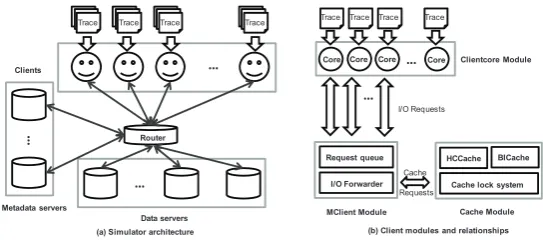
DiskSim [2] to simulate accurate disk response time. As shown in Fig.7(a), there are four kinds of nodes in the simulator, including the client, the data server, the metadata server and the router. These nodes are configured to be connected via networks with specific latency and bandwidth. The simulator is driven by trace files to simulate the process of serving I/O requests and the results are computed and reported by the clients. We made serval modifications on the simulator to support our simulation requirements.
– Multicore support. We support simulating multicore architecture on file system clients. The implementation is mainly motivated from HECIOS simulator [22, 29]. As shown in Fig.7(b), eachclientcoremodule can replay its own trace file and the re-quests are forwarded to themclientmodule, which schedules the requests and sends to the server node via the router node.
– Various trace formats support.PFSsim only supports a self-defined trace format, which is not convenient for traces from various sources, such as MAMBO Suite [6], LANL MPI Trace [1] and HECIOS format [29], etc. We extended the input interface of trace files and allowed to configure different traces running on given range of client and server nodes.
– Better integration of DiskSim.Accurate disk response time is vital to guarantee the correctness of simulating I/O behaviors. PFSsim relies on TCP connections to com-municate between DiskSim and PFSsim. The simulation speed is too slow to make the simulation time intolerable for I/O-intensive workloads. We integrated DiskSim with the simulator more tightly by statically linking DiskSim to the simulator during compilation. The improvement can significantly accelerate simulations while main-taining correctness.
Cache
Requests
Router
…
Metadata servers
…
Data servers
…
Trace Trace Trace Trace
…
Clients
Trace Trace Trace Trace
Clientcore Module Core Core Core Core
Cache Module MClient Module
Request queue
I/O Forwarder
HCCache
Cache lock system BICache
…
I/O Requests
(a) Simulator architecture (b) Client modules and relationships
Fig. 7.Simulator architecture overview and its client-side main modules
5.2. HCCache Implementation
The cache module on a client in the simulator is shared by multiple cores. The read
routed to server nodes along with normal I/O paths. When the client receives the requested data from server nodes, the response message will be forwarded tocachemodule again to update cache status. Finally, the message is forwarded to theclientcoremodule.
The HCCache scheme is implemented in thecachemodule. The most important part of simulating the cache block interleaving phenomenon is the lock mechanisms to gen-erate block insertion sequences for different files. As the simulator is driven by discrete events, each request needs to update the global time and schedule the self event of the
cachemodule to proceed a pending request. After a request got the lock, the request will be proceeded using cache operations in HCCache based on the request type. During this period, all received requests are pending in a queue to wait for owning the lock.
The implementation of cache scheme is modular and easy to add new schemes to substitute HCCache scheme. To evaluate the performance benefits, we also implemented a block-indexed cache in our simulator. By default, the simulator was configured with 32 DSs and 1 MDS, which connected with a 1 Gbps switch among each server. The cache on each client node was configured with the cache size of 32 MB and the cache block size of 32 KB.
5.3. I/O Workloads
To evaluate the efficiency of HCCache under I/O intensive workloads, we chose thehttpd
trace [6] which was collected from NASA Kennedy Space Center’s web server to perform simulations. After removing the uncorrect records in the traces, the trace files used in our simulation record over 21.5GB read accesses on 10,132 files, which consist of over 9,000 files smaller than 256KB. Table 1 shows the statistics of I/O requests inhttpdtrace. The original traces were stored in 7 files. To simulate future I/O systems with hundreds of cores, we used the similar scale-up approaches in [42] to split the original trace files into 448 subtraces and concurrently replayed them using up to 448 cores.
Table 1.Workload statistics ofhttpdtraces
Small files Large files
Trace File number Data amount I/O amount File number Data amount I/O amount httpd 10118 218.84MB 18.92GB 14 21.8MB 2.56GB
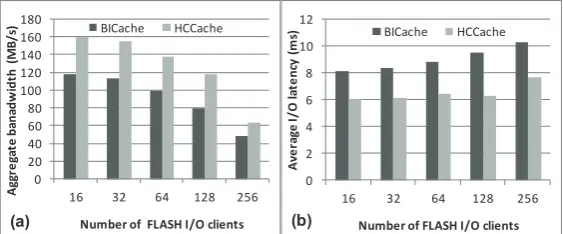
To evaluate the write performance of HCCache, we simulated write-intensive appli-cations with large amount of small and large file accesses. We first generated a synthetic trace to create concurrent requests of writing small files with the request size of 4 KB. The file sizes were varied from 4 KB to 256 KB evenly. Then we simulated the write requests of large files using FLASH I/O traces [29].
6.
Performance Evaluation
performance sensitivity. We focus on analyzing the benefits of HCCache over the block-indexed cache (BICache).
6.1. Evaluation of cache performance
We present and discuss the cache performance results in aspects of the aggregate band-width, the average access latency and the metrics of cache efficiency.
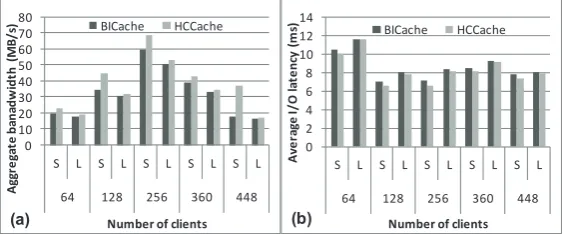
Fig. 8 shows the comparisons of read performance with BICache and HCCache for
httpdtrace. The performance numbers of large files and small files are labeled with “L” and “S”, respectively. The simulations varied the concurrency degrees by replaying dif-ferent numbers of subtraces. We can observe that HCCache performs better than BICache under all simulation settings. The average improvements of bandwidth and latency for small files are 34.2 and 6.1 percent, respectively. The reason is that the data of a small file with HCCache are operated as a whole, avoiding performance degradation caused by partially hit in BICache. To be noticed, the improvement ratios with different number of cores are not consistent or linearly increasing. The amount of trace records and contents replayed each time are not equal and identical due to workload scale-up reasons. For ex-ample, in the case with 256 cores, the tests only use 256 files out of 448 trace files ofhttpd
to reduce the simulation time. Large file performance can also be improved by about 3 to 5 percent with HCCache. The reason is the cache space saved by avoiding partially caching small files can cache more large file blocks. Another observation is that the bandwidth numbers are decreasing when the number of clients increases over 256 for both two cache schemes. This is because the system becomes saturated due to high concurrency. How-ever, even in those cases, HCCache is still superior to BICache due to higher efficiency of space utilization. 0 10 20 30 40 50 60 70 80
S L S L S L S L S L
64 128 256 360 448
A g g re g a te b a n a d w id th (M B / s)
Numberofclients BICache HCCache (a) 0 2 4 6 8 10 12 14
S L S L S L S L S L
64 128 256 360 448
A v e ra g e I/ O la te n cy (m s)
Numberofclients BICache HCCache
(b)
Fig. 8.Read performance forhttpdtrace:(a) aggregate bandwidth,(b) access latency
commit data to disk when the cache block is evicted. The whole small file data is com-mitted using one disk request, while BICache may require more disk requests depending on its data distribution in the evicted cache blocks. The performance impact of HCCache on large files of FLASH I/O traces is not shown in the figure as it is similar to the one we observed forhttpdtrace.
0 20 40 60 80 100 120 140 160 180
16 32 64 128 256
A g g re g a te b a n a d w id th (M B / s)
Numberof FLASHI/Oclients
BICache HCCache (a) 0 2 4 6 8 10 12
16 32 64 128 256
A v e ra g e I/ O la te n cy (m s)
NumberofFLASHI/Oclients
BICache HCCache
(b)
Fig. 9.Write performance for synthetic trace:(a) aggregate bandwidth,(b) access latency
Fig. 10 shows the comparisons of the results of three cache efficiency metrics under above simulations. We can observe that the hit rates with BICache are a little higher than the ones of HCCache. However, the performance results shown in Fig. 8 do not exhibit expected improvements. Instead, both I/O bandwidth and access latency suffers perfor-mance problems. Therefore, the metrics of hit rate fails to evaluate the cache efficiency correctly. In contrast, the results of proposed metrics ECDAL and ECDAB can show the effect of cache efficiency on I/O performance correctly.
6.2. Efficiency of Cache Data Management
HCCache adopts CAS method to improve the memory utilization of cache space. How-ever, selecting proper CAS level and granularity is critical to control the overheads in-herited to the CAS method. Table 2 summarizes the results of CAS block lookup times and impacts on I/O latency for small files. The baseline results are simulated on HCCache with only a block-indexed CAS pool for both small and large files. We can observe that the lookup times of optimized cases can reduce over 96 percent compared with the baseline. The reason is that the optimized HCCache maintains CAS data at an object granularity and each file request only requires one query operation. The reduction of lookup times also induces lower latency for reading small files due to the same reason.
6.3. Sensitivity Study
0 50 100 H it r a t
e BICache HCCache
(a) 0 5 E C D A L (b) E-06 E-06 0 1 2 3
64 128 256 360 448
E
C
D
A
T
Numberofclients
(c) E-03
E-03
E-03
Fig. 10.Results of cache efficiency metrics:(a) Hit rate, (b) ECDAL, (c) ECDAB
Table 2.Comparisons of CAS efficiency of small files inhttpdtrace
# clients 64 128 256 360 448
Baseline lookup times
946592 2075072 3865472 5252608 5952736
Optimized lookup times
29581 64846 112736 164144 186023
Latency im-provement
2.47% 1.82% 4.1% 8.78% 5.42%
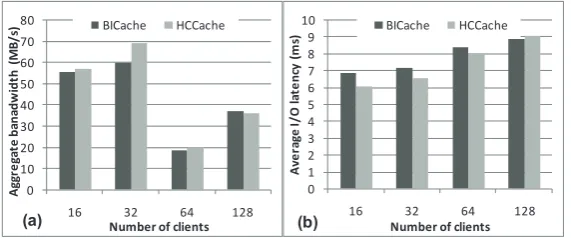
block sizes smaller than 128KB. Although there is a little performance down for HCCache with the cache block size of 128KB, this block size is not suitable for practical use as it makes the effect offalse sharingproblem worse on cache performance.
0 10 20 30 40 50 60 70 80
16 32 64 128
A g g re g a te b a n a d w id th (M B / s)
Numberofclients
BICache HCCache (a) 0 1 2 3 4 5 6 7 8 9 10
16 32 64 128
A v e ra g e I/ O la te n cy (m s)
Numberofclients
BICache HCCache
(b)
7.
Related Work
Client-side caching is a common technique adopted by many network-based file systems to improve I/O performance. NFS4 provides fine-grained file region locks to support con-current cache accesses on the same file. Lustre [3] also uses its distribute lock manager to guarantee cache consistency among concurrent clients. Besides, file systems, such as Ceph [39], PPFS [25], all support client-side caching. However, the existing client-side cache implementations are adopted the block-indexed structures [29]. None of them con-siders the caching performance of small files in the high concurrency environment.
Many studies have been focused on improving cache performance for I/O workloads. Settlemyer, et. al [29] studied client-side caching techniques to alleviate the effect offalse
sharingproblem at costs of time and space. They also motivated a MPI File View
combin-ing for collective I/O operations to improve cache performance for MPI applications with large amount of small I/O calls. Vilayannur, et. al [35] proposed a discretionary caching scheme to allow applications configuring caching parameters at compilation stage. Mad-hyastha, et. al [25] presented two methods to learn access patterns of I/O accesses and utilized the results to make cache policy selection at runtime. Wachs, et. al [36] proposed a workload-aware cache partitioning method to allocate cache space size for concurrent applications on storage server. Frasca, et al. [12] proposed a virtual I/O caching framework to improve the utilizations of cache space by dynamically mapping logical cache pages of each application to physical cache blocks. The main idea is to assign most valued cache blocks higher priority in cache to achieve the same hit rates while consuming a smaller cache size. In contrast, the novelty of our study is to mitigate small files performance degradation induced by block interleaving problem in high concurrency environment. The requests on files with different sizes are operated with different granularities in the client-side cache. Therefore, HCCache scheme can enforce all the data blocks of a small file in the cache at the same time, avoiding the possible performance degradation caused by partially hit in cache. HCCache does not track access information for each cache page and can achieve performance benefits without additional overheads or memory consumptions. Furthermore, we also proposed new metrics to correctly reflect the read cache efficiency.
8.
Conclusion and Future Work
This paper proposed HCCache to improve cache efficiency by distinguishing caching schemes for small and large files. We studied the block interleaving problem and per-formance degradation for partially hit small files. Motivated by the problem, we present a three-level cache structure to serve I/O requests according to the characterizes of files with different size. The data of small files is managed in the LRU list and CAS pools at per-object basis. Two metrics of cache efficiency are also defined to correctly reflect-ing cache performance. The simulation results demonstrate that HCCache can improve the I/O performance of small files in terms of bandwidth and latency compared with the block-indexed cache. In future, we plan to further study HCCache behaviors in the col-lective cache which shared by clients from multiple nodes.
Acknowledgments.This work is supported by the National Natural Science Foundation of China under Grant No.61370059, 61232009, the Doctoral Fund of Ministry of Education of China un-der Grant No. 20101102110018, Beijing Natural Science Foundation unun-der Grant No. 4122042 and the fund of the State Key Laboratory of Software Development Environment under Grant No. SKLSDE-2012ZX-07.
References
1. LANL Trace, http://institute.lanl.gov/data/software/.
2. The DiskSim Simulation Environment (v4.0), http://www.pdl.cmu.edu/DiskSim 3. Lustre File System (2010), http://www.lustre.org
4. The Parallel Virtual File System (2010), http://www.pvfs.org 5. Linux NFS-HOWTO (2012), http://tldp.org/HOWTO/NFS-HOWTO/
6. MAMBO I/O Trace Suite (2012), http://www.cs.umd.edu/projects/hpsl/mambo/index.html 7. Ananth, D., Pete, W.: File Creation Strategies in a Distributed Metadata File System. In: IEEE
IPDPS. pp. 1–10. IEEE Computer Society (2007)
8. Byna, S., Chen, Y., Sun, X.H., et. al: Parallel I/O prefetching using MPI file caching and I/O signatures. In: ACM/IEEE SC’08. pp. 1–12. Piscataway, NJ, USA (2008)
9. Carns, P., Lang, S., Ross, R., Vilayannur, M., Kunkel, J., Ludwig, T.: Small-file access in par-allel file systems. In: IEEE IPDPS. pp. 1–11. Rome, Italy (2009)
10. Chen, J., Roth, P.C., Chen, Y.: Using Pattern-Models to Guide SSD Deployment for Big Data in HPC systems. In: BigData 2013 (2013)
11. Chen, Y., Sun, X.H., Thakur, R., Roth, P.C., Gropp, W.D.: LACIO: A New Collective I/O Strategy for Parallel I/O Systems. In: Proceedings of the 2011 IEEE International Parallel & Distributed Processing Symposium. pp. 794–804. IPDPS ’11, IEEE Computer Society, Wash-ington, DC, USA (2011)
12. Frasca, M., Prabhakar, R., Raghavan, P., Kandemir, M.: Virtual i/o caching: dynamic storage cache management for concurrent workloads. In: Proceedings of 2011 International Conference for High Performance Computing, Networking, Storage and Analysis. pp. 38:1–38:11. SC ’11, ACM, New York, NY, USA (2011)
13. He, J., Bent, J., Torres, A., Grider, G., Gibson, G., Maltzahn, C., Sun, X.H.: I/O acceleration with pattern detection. In: HPDC 2013. pp. 25–36. ACM, New York, NY, USA (2013) 14. Koller, R., Rangaswami, R.: I/o deduplication: Utilizing content similarity to improve i/o
per-formance. Trans. Storage 6(3), 13:1–13:26 (2010)
16. Kulkarni, A., Manzanares, A., Ionkov, L., Lang, M., Lumsdaine, A.: The design and imple-mentation of a multi-level content-addressable checkpoint file system. In: High Performance Computing (HiPC), 2012 19th International Conference on. pp. 1–10 (2012)
17. Lang, S., Carns, P., Latham, R., Ross, R., Harms, K., Allcock, W.: I/O performance challenges at leadership scale. In: ACM/IEEE SC. pp. 1–12. Portland, Oregon, USA (2009)
18. Lensing, P., Meister, D., Brinkmann, A.: hashFS: Applying Hashing to Optimize File Systems for Small File Reads. In: Proceedings of SNAPI 2010. pp. 33–42. IEEE Computer Society (2010)
19. Li, M., Varki, E., Bhatia, S., Merchant, A.: Tap: table-based prefetching for storage caches. In: Proceedings of the 6th USENIX Conference on File and Storage Technologies. pp. 6:1–6:16. FAST’08, USENIX Association, Berkeley, CA, USA (2008)
20. Li, X., Dong, B., Xiao, L., et. al: Cefls: A cost-effective file lookup service in a distributed metadata file system. In: CCGrid’12. pp. 25–32. IEEE Computer Society (2012)
21. Liao, W.k., Coloma, K., Choudhary, A., Ward, L., Russell, E., Tideman, S.: Collective caching: application-aware client-side file caching. In: HPDC ’05. pp. 81–90. IEEE Computer Society, Washington, DC, USA (2005)
22. Limin, X., Ke, X., Guoying, L., Li, R., Xiuqiao, L.: QoSFM: QoS Support for Metadata I/O In Parallel File Systems. In: The 15th IEEE International Conference on High Performance Computing and Communications (HPCC 2013) (2013)
23. Liu, Y., Figueiredo, R., Clavijo, D., Xu, Y., Zhao, M.: Towards simulation of parallel file system scheduling algorithms with PFSsim. In: Proceedings of SNAPI 2011 (2011)
24. Lu, G., Nam, Y.J., Du, D.C.: Bloomstore: Bloom-filter based memory-efficient key-value store for indexing of data deduplication on flash. In: IEEE 28th Symposium on Mass Storage Sys-tems and Technologies (MSST). pp. 1–11 (2012)
25. Madhyastha, T.M., Reed, D.A.: Learning to Classify Parallel Input/Output Access Patterns. IEEE Trans. Parallel Distrib. Syst. 13(8), 802–813 (August 2002)
26. Nath, P., Urgaonkar, B., Sivasubramaniam, A.: Evaluating the usefulness of content addressable storage for high-performance data intensive applications. In: Proceedings of the 17th interna-tional symposium on High performance distributed computing. pp. 35–44. HPDC ’08, ACM, New York, NY, USA (2008)
27. Osthoff, C., Grunmann, P., Boito, F., et. al: Improving performance on atmospheric models through a hybrid openmp/mpi implementation. In: ISPA ’11. pp. 69–74. IEEE Computer Soci-ety, Washington, DC, USA (2011)
28. Sadaf, R.A., Hussein, N.E.H., Kristopher, H., Neil, S., Fabio, V.: Parallel I/O and the Metadata Wall. In: 6th Parallel Data Storage Workshop, SC11 (2011)
29. Settlemyer, B.W.: A study of client-based caching for parallel I/O. Ph.D. thesis, ClemsonUni-versity (2009)
30. Sun, X.H., Chen, Y.: Reevaluating amdahl’s law in the multicore era. J. Parallel Distrib. Com-put. 70(2), 183–188 (Feb 2010)
31. Sun, X.H., Wang, D.: Apc: A performance metric of memory systems. SIGMETRICS Perform. Eval. Rev. 40(2), 125–130 (Oct 2012)
32. Swapnil, P., Garth, G.: Scale and Concurrency of GIGA+: File System Directories with Mil-lions of Files. In: FAST ’11. San Jose, CA (2011)
33. Tarkoma, S., Rothenberg, C., Lagerspetz, E.: Theory and practice of bloom filters for dis-tributed systems. IEEE Communications Surveys Tutorials 14(1), 131–155 (2012)
34. Vakali, A.: Evolutionary techniques for web caching. Distrib. Parallel Databases 11(1), 93–116 (Jan 2002)
35. Vilayannur, M., Sivasubramaniam, A., Kandemir, M., et. al: Discretionary caching for i/o on clusters. Cluster Computing 9(1), 29–44 (Jan 2006)
37. Wang, F., Xin, Q., Hong, B., et. al: File system workload analysis for large scale scientific computing applications. pp. 139–152. MSST’04 (2004)
38. Wang, X., Malik, T., Burns, R., et. al: A workload-driven unit of cache replacement for mid-tier database caching. In: DASFAA’07. pp. 374–385. Springer-Verlag (2007)
39. Weil, S.A., Brandt, S.A., Miller, E.L., et. al: Ceph: a scalable, high-performance distributed file system. In: OSDI ’06. pp. 307–320. USENIX Association (2006)
40. Weil, S.A., Pollack, K.T., Brandt, S.A., Miller, E.L.: Dynamic Metadata Management for Petabyte-Scale File Systems. In: Proceedings of the 2004 ACM/IEEE conference on Super-computing. pp. 4–. IEEE Computer Society (2004)
41. Zhao, T., March, V., Dong, S., See, S.: Evaluation of a performance model of lustre file system. In: 2010 Fifth Annual ChinaGrid Conference. pp. 191–196 (2010)
42. Zhu, Y., Jiang, H., Wang, J., et. al: HBA: Distributed Metadata Management for Large Cluster-Based Storage Systems. IEEE Trans. Parallel Distrib. Syst. 19, 750–763 (2008)
Xiuqiao Lireceived his Ph.D. Degree in Computer Architecture at Beihang University, China in 2013. His research interests include high performance file systems, job sched-ulers and cloud storage.
Limin Xiaois a Professor, Senior membership of China Computer Federation. His main research areas are computer architecture, computer system software, high performance computing, visualization and cloud computing.
Ke Xieis a postgraduate student in Computer Architecture at Beihang University, China. His research mainly focuses on providing I/O QoS in parallel file systems for concurrent metadata-intensive applications.
Bin Dongreceived his Ph.D. Degree in Computer Architecture at Beihang University, China in 2013. His research interests include data layout optimizations, hybrid storage optimizations in parallel file systems.
Li Ruan is a Ph.D., Lecturer, Senior membership of China Computer Federation. Her main research areas are virtualization and cloud computing, computer system software, high performance computer.
Dongmei Liureceived her M.S. Degree in Computer Applications at Beihang Univer-sity, China in 2010. Her research interests focus on network simulations for distributed systems.