© 2016 IJSRSET | Volume 2 | Issue 2 | Print ISSN : 2395-1990 | Online ISSN : 2394-4099 Themed Section: Engineering and Technology
Experimental Study of Process Parameters in Dry Turning of AISI 4340 Alloy
Steel Using PVD Coated Carbide Insert
Krishan Kant A, Umesh Guptab, Naveen Kumar C, Lalit Kumar D
Mechanical Engineering Department, Chandigarh University, Gahuran, Mohali, Punjab, , India
ABSTRACT
CNC Turning is basically a material removal process done to obtain the desired diameter. Even though the machine tool industry has made tremendous progress, the metal cutting industries using various machine tools continue to suffer from major drawback of not utilizing the machine tools at their full potential. A major cause leading to such a situation is thought to be the failure to run the machine tools at their optimum operating conditions. In this paper an attempt is made to investigate the various process parameters like cutting speed (V), feed (F), and depth of cut(D) to reveal their effect on MRR(Material Removal Rate) and Ra(surface Roughness) of AISI 4340 Alloy steel using one variable at a time approach. The optimal set of process parameters has also been predicted to maximize MRR and minimize Ra.
Keywords : CNC Turning, Cutting Parameters, Material Removal Rate, Surface Roughness.
I.
INTRODUCTION
It Has Long Been Recognized That The Cutting Conditions Like Cutting Speed, Feed And Depth Of Cut Turning Process Should Be Selected To Optimize The Economics Of Machining Operations As Assessed By Productivity, Total Manufacturing Cost Per Component Or Some Other Suitable Criterion. High Cost Of Numerically Controlled Machine Tools, Compared To Their Conventional Counterparts, Has Enforced Us To Operate These Machines As Efficiently As Possible In Order To Obtain The Required Payback. The Achievement Of High Quality, In Terms Of Work Piece Dimensional Accuracy, Surface Finish, Less Wear On The Cutting Tools Etc. Including The High Productivity With Least Environmental Impact Is The Most Important Goal In Manufacturing Industry [4]. In This Paper An Attempt Is Made To Obtain High Productive Range Without Compromising With The Environmental Issues And Quality Measures In Terms Of Surface Roughness Using One Factor At A Time Approach.
II.
METHODS AND MATERIAL
A. Work-Piece Material
2.1 Cutting Inserts
In tests, single layer (TiAlN) PVD Coated insert has been employed for experimentation. In this insert top layer is TiN which has a certain characteristic such as tendency to reduce built up edge, a higher coefficient of friction and thermal conductivity? These characteristics results in less thermal cracks and improves surface finish [3] The PVD process has a proven performance of over CVD process due to its low coating temperature deposition [3].
2.2 Cutting Environment
Machining is done under only dry cutting environmental conditions so as to reduce the use of cutting fluid which is widely used for disposal of chips, improvement of tool life improvement of machining accuracy and better surface finish. These days it is required to reduce the use of this cutting fluid for the conservation of global environment. Now a days lot of efforts are also under practice like use of chlorine free cutting fluids. In this paper an attempt is made to test the effects of cutting parameters without the use of cutting fluid.
B. Experimentation
Turning is a widely used material removal process. The use of CNC turning machine has a proven record of better surface quality, precise accuracy, less machining times and high production rate in comparison to the conventional lathe machines. But the major problem being faced by the workers as well as the researchers while performing turning operations on such machines which require high set up costs, is to operate them with their best parameter selection so as to obtain the desired outputs more efficiently. In this paper such attempt is made by using one factor at a time approach in which out of the three selected parameters viz. cutting speed, feed and depth of cut one factor was varied and the other two were kept constant and their effect on the change in MRR and Ra is evaluated. In first set of experiments speed was varied from 40 m/min to 110 m/min and feed (0.24 mm/rev) and depth of cut (0.4 mm) were kept constant. The readings for MRR and Ra were tabulated in table 1.
Table 1: Values of MRR and Ra under varying cutting speed
Sr. No
SPEED
(m/min)
MRR
(g/min.)
Ra.
(microns)
1
40
8.19
2.77
2
50
9.42
2.79
3
60
9.58
2.76
4
70
10.13
2.75
5
80
10.60
2.73
6
90
10.78
2.79
7
100
11.01
2.78
8
110
11.90
2.77
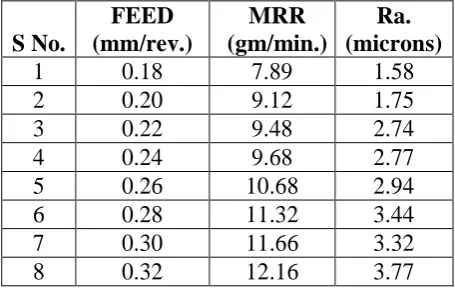
In the second set of experiments feed was varied within the range of 0.18 mm/rev. to 0.32 mm/rev. and the other
input parameters viz. cutting speed (80 m/min) and depth of cut (0.4 mm) were kept constant. The results for
MRR and Surface Roughness were obtained and tabulated as under in table 2.
Table 2 : Values of MRR and Ra under varying feed
S No.
FEED
(mm/rev.)
MRR
(gm/min.)
Ra.
(microns)
1
0.18
7.89
1.58
2
0.20
9.12
1.75
3
0.22
9.48
2.74
4
0.24
9.68
2.77
5
0.26
10.68
2.94
6
0.28
11.32
3.44
7
0.30
11.66
3.32
8
0.32
12.16
3.77
Table 3:
Values of MRR and Ra under varying
depth of cut
S
No.
DEPTH
OF
CUT (mm)
MRR
(gm/min.)
Ra.
(microns)
1
0.10
5.03
2.95
2
0.20
7.75
2.82
3
0.30
9.13
2.71
4
0.40
11.65
2.61
5
0.50
14.20
2.73
6
0.60
15.73
2.81
7
0.70
16.20
2.94
8
0.80
19.27
2.91
III.
RESULTS AND DISCUSSION
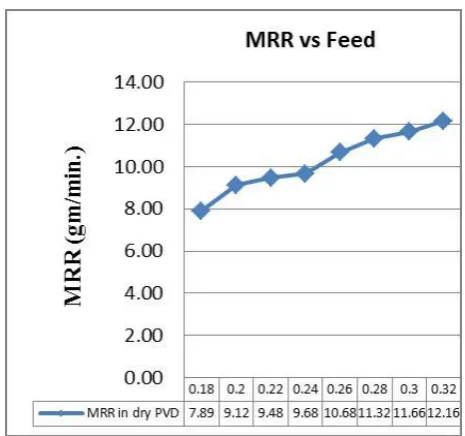
The effects of various process parameters like
varying cutting speed, varying feed and varying
depth of cut on the value of MRR are shown in
fig.1 to fig. 3 respectively.
Figure 1.
Effect of varying cutting speed on MRR
Figure 2.
Effect of varying feed on MRR
Figure 3(2).
Effect of varying depth of cut on MRR
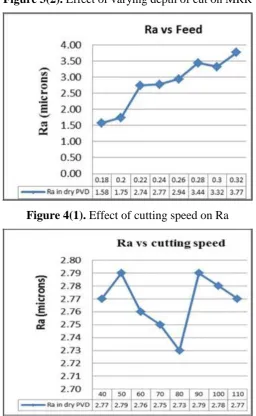
Figure 4(1).
Effect of cutting speed on Ra
Figure 4(2).
Effect of cutting speed on Ra
Fig 4 shows that the value of surface roughness first increases then decreases continuously but it again increases as the cutting speed reaches the value 90
reveals that the value of surface roughness decreases with the increase in cutting speed. The values are high at low speed because at low speeds the temperature at the cutting zone is not sufficient to assist proper cutting of the material but as the cutting speed increases the temperature at the cutting zone reaches the plastic stage of the material and assists in proper and smooth cutting operation [3,4,5].Fig 5 reveals that the increasing values of feed rate increases the surface roughness of the material at a very significant rate [3]. And fig. 6 reveals that the depth of cut also increases the value of surface roughness but the graph also shows that the value of surface roughness decreases with the increasing depth of cut up to some level (0.40 mm). This is due to the reason that when the depth of cut is low, the surface roughness is highly sensitive to cutting speed and higher cutting speeds with increasing depth of cut reduces the value of surface roughness [6] but this trend becomes smaller and smaller with the higher values of depth of cut as is revealed in fig.6.From the above discussion it can be concluded that the surface roughness is highly sensitive to changing feed and cutting speed but less sensitive with changing of depth of cut. The surface roughness has a tendency to reduce with increase in cutting speed and decrease in feed rate. The surface roughness during turning is primarily decided by the amount of thrust force and the rise in temperature during cutting. Increased feed rate increases the thrust force and surface roughness keeps on increasing but with the increasing cutting speed the value of surface roughness decreases with the increasing temperature at the cutting zone which softens the material and assist in proper and smooth cutting operation. Moreover it is common knowledge that the cutting forces decreases with the increased cutting speed which can be related to the increasing cutting temperature in the shear zone that results in the reduction of yield strength of the work material [7].
IV.
CONCLUSION
The following conclusions are drawn from the experimental study
1. MRR increases with increase in the value of cutting speed, feed rate and depth of cut
MRR but in case of surface roughness feed is the most dominating character one followed by cutting speed and then depth of cut which has the least effect on Ra.
4. For maximum MRR the optimal set of parameters are cutting speed (110 m/min), feed rate (0.32 mm/rev) and depth of cut (0.8 mm)
5. For minimum surface roughness the optimal set of parameters are cutting speed (80 m/min), feed rate (0.18 mm/rev) and depth of cut (0.4 mm).
V.
REFERENCES
[1] J. Paulo Davim, V.N. Gaitonde , S.R. Karnik, 2008,
Investigations into the effect of cutting conditions on surface roughness in turning of free machining steel by ANN models, J. Mater. Process. Technol, 205, 16-23
[2] Muammer Nalbant, Hasan Gokkaya, Ihsan Toktas,
Gokhan Sur, 2009, the experimental investigation of the effects of uncoated , PVD- and CVD- coated cemented carbide inserts and cutting parameters on surface roughness in CNC turning and its prediction using artificial neural networks, Robotics and Computer Integrated Manufacturing 25, 211-223
[3] M. Kaladhar, K. Venkata Subbaiah, Ch. Srinivasa
Rao, 2011, Performance evaluation of coated materials and process parameters optimization for surface quality during turning of AISI 304 Austenitic Stainless Steel, International Journal of Engineering Science and Technology, vol 3,No. 4, 89-102
[4] S.R.Das, D. Dhupal, A. Kumar, 2013, Experimental
Study and Modelling of Surface Roughness in Turning of Hardened AISI 4340 Steel Using Coated
Carbide Inserted, International Journal of
Automotive Engineering, vol. 3, 284-292.
[5] Mahendra Korat, Neeraj Agarwal, 2012,
Optimization of Different Machining Parameters of En24 Alloy Steel in CNC Turning by use of Taguchi Method, International Journal of Engineering Research and Applications, Vol. 2, 160-164
[6] P.P. Shirpurkar, S.R.Bobde, V.V.Patil, B.N.Kale,
2012, Optimization of Turning Process Parameters by using Tool Inserts- A Review, International Journal of Engineering and Innovation Technology, Vol. 2, Issue 6, 216-221
[7] Ersan Aslan, Necip Cemuscu, Burak Birgoren,
2007, Design optimization of cutting parameters when turning hardened AISI 4140 steel (63 HRC) with Al2O3 + TiCN mixed ceramic tool, Materials and Design, 28, 1618-1622