Geschke Center
Doctoral Dissertations Theses, Dissertations, Capstones and Projects
Fall 2017
Teaching English to Indian Vernacular Medium
Students Through Technology: A Qualitative
Study of Kolkata Jesuit Juniorate Program
Maria Joseph SavariappanUniversity of San Francisco
Follow this and additional works at:https://repository.usfca.edu/diss
Part of theEducational Leadership Commons
This Dissertation is brought to you for free and open access by the Theses, Dissertations, Capstones and Projects at USF Scholarship: a digital repository @ Gleeson Library | Geschke Center. It has been accepted for inclusion in Doctoral Dissertations by an authorized administrator of USF Scholarship: a digital repository @ Gleeson Library | Geschke Center. For more information, please [email protected].
Recommended Citation
Savariappan, Maria Joseph, "Teaching English to Indian Vernacular Medium Students Through Technology: A Qualitative Study of Kolkata Jesuit Juniorate Program" (2017).Doctoral Dissertations. 407.
The University of San Francisco
TEACHING ENGLISH TO INDIAN VERNACULAR MEDIUM STUDENTS THROUGH
TECHNOLOGY:AQUALITATIVE STUDY OF THE KOLKATA JESUIT JUNIORATE PROGRAM
A Dissertation Presented to
The Faculty of the School of Education Department of Leadership Studies Catholic Educational Leadership Program
In Partial Fulfillment
of the Requirements for the Degree Doctor of Education
by
ii
DISSERTATION ABSTRACT
Teaching English to Indian Vernacular Medium Students Through Technology: A Qualitative Study of the Kolkata Jesuit Juniorate Program
The educational system in India is inadequate to meet the modern needs of the
Indian students (Lall & House, 2005). Each state in India has its own style of educating
its citizens. Primarily two kinds of education coexist: Vernacular medium and English
medium. These styles have pushed many students to a disadvantageous position. The
vernacular medium students, due to lack of English proficiency, are not able to do their
university studies for the medium of instruction in Indian Universities is English only
(Dravid, 2013). It is, therefore, an injustice done to the Indian vernacular medium
students. Promotion of justice has been the teaching of the Catholic Church from the time
of its founder Jesus Christ (Benedict XVI, 2005, 2009; Francis, 2013, 2015; John Paul II,
1981, 1990, 1991, 1994, 1995, 1998, 1999; John XXIII, 1961, 1963; Paul VI, 1964). The
Society of Jesus, a religious congregation of men, has been following the teachings of the
Catholic Church by reinstating “faith that does justice” (GC 31, 1967; GC 32, 1975; GC
33, 1983; GC 34, 1995) and insisting on promoting education for all in particular the poor
and the marginalized.
The Catholic Church has been tirelessly working in order to promote the right of
the poor to a quality and holistic education (John XXIII, 1963; Pius XI, 1929; Francis,
2015; Farrell, 1970). The Catholic Church insisted that the poor and the marginalized
have an inalienable right to quality and holistic education that develops the mind, heart,
body, and soul. This is why the Catholic Church and the Society of Jesus (Second
iii
to train teachers and guide their pedagogical practices in order to provide quality and
holistic education for the poor and the marginalized.
The last two centuries have seen technology rapidly advancing in all spheres of
life and computer technology and the Internet have become easily accessible to mainly
the rich (Jerald, 2009). These modern technologies are being used to instruct students
effectively (Hicks, 2011; Ferrell & Ferrell, 2002; Singhal, 1997) who are able to pay the
exorbitant tuition fees imposed on students (Jerald, 2009). Several studies (Compton &
Compton, 2013; D’Angelo & Wooley, 2007; Frank, 2008) discovered that utilizing
modern technology as an instructional tool was an effective way of teaching English to
speakers of other languages to become proficient in English skills such as: reading,
writing, speaking, and listening.
As a response to the inadequate educational system of India and to be in line with
the teachings of the Catholic Church and the Society of Jesus, Kolkata Jesuit Juniorate
Program from the academic year 2012 – 13, has been extensively using modern
technology to teach English to the Jesuit seminarians. Therefore, the study was conducted
among the seminarians enrolled in Kolkata Jesuit Juniroate Program from the academic
year 2012 – 13 to 2016 – 17. The study collected data that included a
researcher-constructed online survey aiming to gather data that would lead to a more comprehensive
understanding of the research problem (Creswell, 2014). The survey was conducted
among the graduates of Kolkata Jesuit Juniorate Program. The researcher sent out online
surveys to the graduates of Kolkata Jesuit Juniorate Program. The survey was created in
the USF provided Qualtrics and a link was sent to the participants who were able to take
iv
The data collected through the online survey was systematically and statistically
analyzed using Qualitics Software Program. The findings revealed that teaching English
through technology has yielded positive outcomes. On the other hand, the data also
revealed that no standard syllabus existed for all the groups from 2012 to 2017. Because
of this, the responses were different from one group to the other. The overall conclusion
v
SIGNATURE PAGE
This dissertation, written under the direction of the candidate’s dissertation committee
and approved by the members of the committee, has been presented to and accepted by
the Faculty of the School of Education in partial fulfillment of the requirements for the
degree of Doctor of Education. The content and research methodologies presented in this
work represent the work of the candidate alone.
Dissertation Committee
Maria Joseph Savariappan October 26, 2017
Candidate Date
Dr. Michael Duffy October 26, 2017 Chairperson
Dr. Patricia Mitchell October 26, 2017
vi
ACKNOWLEDGMENTS
In my dissertation journey, I have received assistance and help from many
persons and I would like to recognize and acknowledge some of them here. First, I would
like to acknowledge the staunch support of my chairperson, Dr. Michael Duffy. Your
caring, encouraging, and supportive insights have seen me through the whole process.
Your timely and professional feedback ensured that I was on the right track, and your
words always uplifted me when I was tired. I thank you from the bottom of my heart.
Second, I also want to thank the other members of my dissertation committee: Dr.
Patricia Mitchell and Dr. John Bansavich. Your insightful comments have helped me a
great deal to focus on the topic I was covering. Both of you have been a sure support for
me during this entire process. I sincerely thank you for journeying with me.
Third, I would also like to thank several other members of the USF School of
Education: Dr. Doreen Jones for the introduction to the doctoral journey, and for
inspiring me to pursue my doctoral degree. I truly appreciate your interest in my growth.
And last, Ms. Thanh Ly, you were always willing to go out of your way to extend your
helping hand. Your knowledge of the entire process to complete my dissertation was a
great help. I thank you for that.
To my many colleagues and friends who were ever ready to help me, I am
grateful. It has been a long journey, however, worth doing it. And to my mother, father,
brothers, sisters, nieces, and nephews I am grateful for your moral support. You have
vii
TABLE OF CONTENTS
DISSERTATION ABSTRACT ... II
SIGNATUREPAGE ... V
ACKNOWLEDGMENTS ... VI
LISTOFTABLES ... X
LISTOFFIGURES ... xi
CHAPTER I THE RESEARCH PROBLEM ... 1
Statement of the Problem ... 1
Promoting Justice for the Poor and the Marginalized ... 3
Promoting the Right of the Poor to a Quality, Holistic Education ... 4
Promoting the Utilization of Scientific Research to Guide Effective Teaching and Learning ... 5
Background and Need ... 7
The Kolkata Jesuit Juniorate Program ... 7
The Context of the Seminarians ... 9
Purpose of the Study ... 10
Theoretical Rationale ... 10
Research Questions ... 12
Significance ... 12
Limitations ... 13
Definition of Terms ... 14
CHAPTER II REVIEW OF LITERATURE ... 18
Restatement of the Problem ... 18
Overview ... 19
History of Education in India ... 19
Vedic Period (c.1500 – 500 BCE) ... 19
Teaching Methodology of Vedic Period ... 20
Medieval Education System in India (c.1300 – c. 1800) ... 20
Education System During British Period (1800 – 1947) ... 22
Modern Period (1947-till date) ... 24
Problems in Indian Education System ... 24
viii
Promoting the Right of the Poor to a Quality, Holistic Education ... 28
Promoting the Utilization of Scientific Research to Guide Effective Teaching and Learning ... 32
Computer Technology for Teaching ... 34
Internet-based Technologies for ESL Activities ... 37
Specific Computer Software Programs for Teaching English ... 45
Language Lab ... 47
Summary of the Review of Literature ... 50
CHAPTER III METHODOLOGY ... 53
Restatement of the Purpose ... 53
Research Design ... 53
Qualitative Research ... 53
Online Research ... 55
Research Setting ... 55
Population ... 57
Role of the Researcher ... 57
Instrumentation ... 59
Validity and Reliability ... 60
Data Collection ... 62
Data Analysis ... 63
Background of the Researcher ... 65
CHAPTER IV DATA ANALYSIS AND RESULTS ... 68
An Overview of the Chapter ... 68
Response Rate ... 69
Demographic Information ... 69
Finding for Research Questions ... 70
Findings for Research Question 1 ... 70
Findings for Research Question 2 ... 72
Findings for Research Question 3 ... 74
Findings for Research Question 4 ... 77
Findings for Research Question 5 ... 79
Summary of Research Findings ... 101
CHAPTER V SUMMARY, DISCUSSIONS, CONCLUSIONS, IMPLICATIONS, & RECOMMENDATIONS ... 103
Summary of the Study ... 103
Discussions ... 105
Discussions for Research Question 1 ... 105
Discussions for Research Question 2 ... 106
Discussions for Research Question 3 ... 108
ix
Discussions for Research Question 5 ... 112
Implications ... 123
Recommendations ... 124
Recommendations for Future Research ... 124
Recommendations for Future Practice ... 125
Closing Remarks ... 125
REFERENCES ... 128
APPENDICES ... 141
APPENDIX A:INDIAN MAP WITH ITS STATES AND THEIR RESPECTIVE LANGUAGES ... 141
APPENDIX B:KOLKATA JESUIT PROVINCIAL’S LETTER ... 142
APPENDIX C:KOLKATA JESUIT JUNIORATE SURVEY ... 145
x
LIST OF TABLES
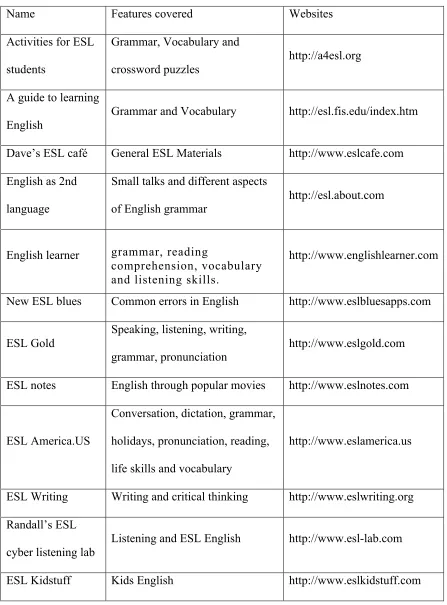
Table 1: List of websites and the English features covered in them ... 46
Table 2: Congruence between research questions and survey questions ... 59
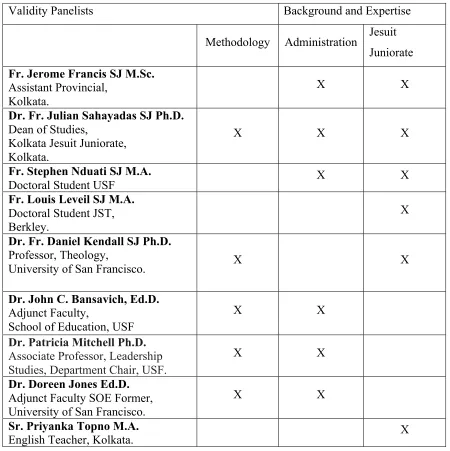
Table 3: List of Validity Panel members and their expertise ... 61
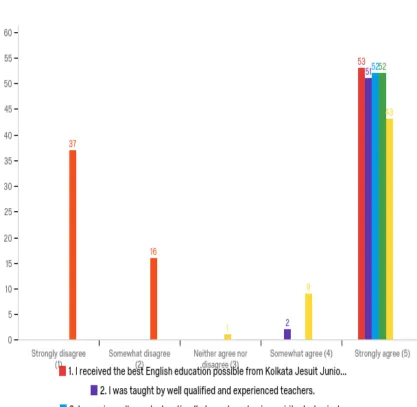
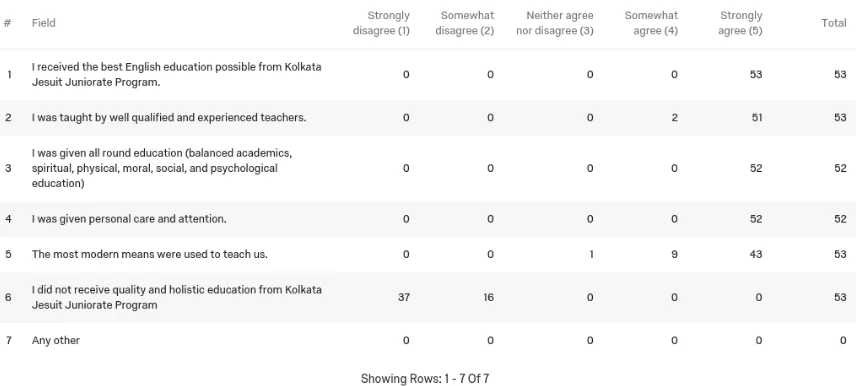
Table 4: The benefits of Kolkata Jesuit Juniorate Program according to the perspectives of its past graduates ... 72
Table 5: Numerical data for research question 3. ... 77
Table 6: Numerical data for research question 4. ... 79
Table 7: Participants’ response regarding the usefulness of Microsoft Power Point ... 81
Table 8: Statistical data of how participants responded on how Microsoft Word helped them to learn English and how they are using it in their undergraduate studies. ... 84
Table 9: Numerical data of participants’ response regarding teaching practice using technology ... 86
Table 10: Numerical representation of the response of the participants regarding how Nuendo and Audacity helped them to learn English. ... 88
Table 11: Numerical data of participants’ response regarding the usefulness of Online English Dictionary in learning English. ... 90
Table 12: Numerical presentation of the responses of the participants for item number 13 ... 94
Table 13: Numerical presentation of the response of the participants regarding the Internet and its usefulness in learning English. ... 97
Table 14: Numerical representation of the Participants’ response regarding Microsoft Publisher and its usefulness in improving their writing style. ... 99
xi
LIST OF FIGURES
Figure 1: Number of participants according to the academic year in the Kolkata Jesuit Juniorate Program. ... 70 Figure 2: The benefits of Kolkata Jesuit Juniorate Program ... 71 Figure 3: shows how many studied in vernacular medium and English medium (Survey
Item 2) ... 74 Figure 4: Perceptions of the graduates of Kolkata Jesuit Juniorate Program as to whether
or not they received a quality and holistic education. ... 76 Figure 5: Response of the participants as to how Kolkata Jesuit Juniorate used scientific
research to teach English. ... 78 Figure 6: Response of the participants as to how Microsoft Power Point helped them to
learn English. ... 81 Figure 7: Shows the response of participants (N=53) to what extent Microsoft Word
helped them to learn English and to what extent they are using Microsoft Word in their undergraduate studies. ... 83 Figure 8: Participants’ response regarding teaching practice using technology ... 85 Figure 9: Participants’ response regarding audio recording programs such as Nuendo and
Audacity and how these helped them to learn English. ... 87 Figure 10: Participants’ response regarding the usefulness of Online English Dictionary
in learning English. ... 89 Figure 11: Participants’ response regarding the ways in which the English movies helped
them to learn English ... 92 Figure 12: Participants’ response regarding the usefulness of LCD projectors ... 93 Figure 13: Participants’ response regarding the usefulness of the Internet ... 95 Figure 14: Participants’ response regarding Microsoft Publisher and its usefulness in
improving their writing style ... 98 Figure 15: Participants’ response regarding how the English plays they performed helped
CHAPTER I
THE RESEARCH PROBLEM Statement of the Problem
The Indian education system is inadequate to meet the modern needs of Indian
students (Lall & House, 2005). Two kinds of medium of instruction in Indian schools
from K-12 exist: Vernacular medium (instruction in local languages of India, See
Appendix A) and English medium (Instruction in English only), however, at the
university level, the medium of instruction is only English. Due to this kind of education
system, the vernacular medium students find it close to impossible to pursue their
university education (Dravid, 2013).
The Educational system in India can be broadly divided into three periods: Vedic
(c. 1500 – 500 BCE), medieval (c. 1300 – 1800 CE) and the British period (c. 1800 –
1947 CE). The Vedic education was characterized by knowledge, awakening, humility,
and modesty (Singh, 2007). According to Singh, the Vedic period education laid stress
on worship of God, religiousness, spirituality, formation of character, development of
personality, culture, nation, and society. The medium of instruction was Sanskrit. (Singh,
2007). In this system, education was limited to high caste Hindu boys only (Lall &
House, 2005).
During the medieval period (c. 1300 – 1800) education was Muslim in character,
namely studying Islam. Arabic and Persian became the medium of instruction. Even the
Hindus had to learn Arabic to secure government jobs. Education was for the purpose of
comment that Muslim education which lasted for 700 years did not make much
impression on the life of the general public.
Basu (1922) asserts that when the British gained power over India, they decided
to abolish both the Vedic style of education and the Muslim style of education and
introduced English medium education. Lord William Bantinck officially declared
English as the medium of education in India in 1835. By 1850, many Indian languages
had been rejuvenated. Many protests were demonstrated to bring in vernacular medium
education instead of English medium education (Singh, 2007). Thus, in rural areas of
India, vernacular medium education was established. However, in 1853 the
socio-political and economic situations changed and demand for English education kept rising
among the Indians. Following the demand of the people, English medium schools and
colleges were instituted on a massive scale. (Singh, 2007).
After the independence in 1947, Lall and House (2005) state that the medium of
instruction in universities has been English. According to Murarka (2013) the medium of
instruction in universities is primarily English while primary, middle and secondary, and
higher secondary schools have either vernacular medium or English medium. This means
that the students who go through the vernacular medium schooling are at a
disadvantageous position when it comes to the university education where the medium of
instruction and the subject matters are all in English only. This problem affects the poor
and the marginalized the most for those who cannot afford English medium schools are
forced to go to vernacular medium schools (Pramod & Kad, 2013).
Therefore, this dissertation, a case study, sought to study this problem under the
Juniorate Program which has tried to address the problem. The first variable centered on
the call to promote justice for the poor and marginalized. The second concentrated on the
call to honor the right of the poor and marginalized to a quality, holistic education. The
third focused on the call to utilize scientific research to guide effective teaching and
learning. Kolkata Jesuit Juniorate is an institution situated in Kolkata, India. It is meant
solely for the formation of young Jesuits who do not know English and who want to
become proficient in English and eventually enter into university level studies in English
medium. More explanation of the Kolkata Jesuit Juniorate program has been provided in
the background and needs section. A brief explanation about the three variables follows.
Promoting Justice for the Poor and the Marginalized
The call to promote justice for the poor and the marginalized flows from the
actions and teachings of Jesus Christ, the Incarnate Word of God, and is revealed in
Sacred Scripture. It is a charge the Apostles embraced, as they went forth to make
disciples of all nations. It is a traditional teaching upheld by the Catholic Church
(Benedict XVI, 2005, 2009; John Paul II, 1981, 1990, 1991, 1994, 1995, 1998, 1999;
John XXIII, 1961, 1963; Paul VI, 1964; Francis, 2013, 2015). It is a central tenet of the
Society of Jesus ((General Congregation of the Society of Jesus, 1995) GC 31, 1967; GC
32, 1975; GC 33, 1983; GC 34, 1995) which makes the fostering of a living “faith that
does justice” worldwide a priority. It is a baptismal responsibility that all Catholic
Christians, the consecrated and the lay faithful, are called to champion (Catechism of the
Catholic Church [CCC], 1992).
In the 21st century, the call to promote justice in the world continues (Francis,
Society of Jesus (General Congregation 32 of the Society of Jesus, 1975), it is inherent
duty that demands the rectification of unjust policies, structures, and systems—social,
political, or economic—that disregard the dignity of humanity, especially the poor and
the marginalized, and which discard their rightful liberties (Ziegler, 2013). Rectification
of social unjust systems and structures is central to the actions and teachings of Pope
Francis (2013, 2014, 2015) whose Jesuit spirituality influences his papacy, and his urging
to all of humanity —believers and non-believers, alike— to join him in combatting the
torrent of misery, injustice, and violence in the world by overcoming all indifference to
the many who are suffering (Francis, 2016). The Pontiff calls for both prayer and action
to combat the multitude of injustices of the world. The Kolkata Jesuit Juniorate
Program, developed and operated by the researcher, is an action in response to the
Pontiff’s call.
Promoting the Right of the Poor to a Quality, Holistic Education
Both the Catholic Church (John XXIII, 1963; Pius XI, 1929; Francis, 2015) and
the Society of Jesus (Farrell, 1970) uphold the principle that all peoples, especially the
poor and the marginalized, have an inalienable right to quality, holistic education. Both
posit that the educational project must be of the highest quality and holistic in nature,
developing the mind, heart, body, and soul, especially of those who are poor and
marginalized (General Congregation of the Society of Jesus 34, 1995; Paul VI, 1965). A
quality, holistic education enlightens the mind to the tenets of universal human rights,
and enkindles the heart to safeguard and honor those principles. It exposes students to
global issues, to the collected body of knowledge and wisdom in all arenas, and to the
and fosters collaborative efforts to discover new solutions to age-old problems. Most
important, it champions the building of a just and humane world for all peoples (General
Congregation of the Society of Jesus 34, 1995). The Kolkata Jesuit Juniorate program,
developed and operated by the researcher, is a deliberate attempt to provide a quality,
holistic education program to the poor.
Promoting the Utilization of Scientific Research to Guide Effective Teaching and
Learning
Historically, the Catholic Church (Congregation for Catholic Education (CCE),
1988, 1997; Pius XI, 1929; Francis, 2014; Second Vatican Council, 1965) has
acknowledged teachers to be central to effective student learning, and to successful
Catholic schools. Consequently, it has maintained that those who teach must be carefully
trained in mind and heart, with a readiness to adapt and be renewed. In Gravissimum
Educationis (Declaration on Christian Education), the Second Vatican Council, (1965)
also urged Catholic school educators to utilize scientific research to guide their
pedagogical practices. Specifically, the Council Fathers declared that students
[M]ust be helped with the aid of the latest advances in psychology and the arts and science of teaching, to develop harmoniously their physical, moral and intellectual endowments so that they may gradually acquire a mature sense of responsibility in striving endlessly to form their own lives properly and in
pursuing true freedom, as they surmount the vicissitudes of life with courage and constancy. (no.1)
In the decades that followed Second Vatican Council, the Catholic Church
(Congregation for Catholic Education [CCE], 1988, 1997) reiterated the importance of
educating students effectively for the rapidly changing scientific and technological
culture in which they lived. It also re-emphasized that, whatever methods teachers were
In the 20th and 21st centuries, technology continued to advance rapidly, and
computers and the Internet became a commonplace mainly for the rich (Jerald, 2009).
Through his survey of American teachers, Reiser (1987, 2002) found that in the 20th
century, computers were rarely used for classroom instruction, but rather for drill and
practice in elementary schools and for word processing in secondary schools. Later
scientific studies (D’Angelo & Wooley, 2007; Hicks, 2011; Ferrell & Ferrell, 2002;
Singhal, 1997) explored the benefits of using technology, as an instructional tool in
education. These explorations found that its use as an instructional tool allowed students
to be more actively engaged in their learning. It permitted them to construct their own
understanding and knowledge of the world, through experiencing and reflecting on those
experiences. It enabled them to become engaged members of a community of learners
that made discoveries and solved problems collaboratively. Using technology as an
instructional tool and completing assignments also increased students’ digital literacy,
while providing them authentic and meaningful learning experiences. Several studies
(Altun, 2015; Compton & Compton, 2013; D’Angelo & Wooley, 2007; Ferrell & Ferrell,
2002; Frank, 2008) also found that using technology as an instructional tool was an
effective means in teaching non-English language learners to become proficient in
English in its many forms: reading, writing, speaking, and listening.
The researcher’s knowledge of teaching English to non-natives, and his
knowledge of the benefits of utilizing technology to achieve this end led to the
development and operation of the Kolkata Jesuit Juniorate Program for the seminarians in
the Kolkata Province of the Society of Jesus. This program has been operational since
English by many of its seminarian-students. It has allowed them to pursue their Jesuit
vocation through graduate studies within India’s English-instructed universities.
However, it has not been evaluated through the lens of the personal experiences of its last
five years of graduates who went through the new methodology of learning English
through technology integrated teaching relative to the three variables it sought to address:
(a) the call to promote justice for the poor and marginalized, (b)the call to honor the right
of the poor and marginalized to a quality, holistic education, and (c) the call to utilize
scientific research to guide effective teaching and learning. This qualitative study sought
to address that void which kept the vernacular medium students at a disadvantage, by
utilizing an online survey to explore the personal experiences of the graduates of the
Kolkata Jesuit Juniorate Programin relation to the three variables mentioned above.
Background and Need
The Kolkata Jesuit Juniorate Program
The Kolkata Jesuit Juniorate Program consisted of seminarians from different
states of India (each state has its own language totally different from the others) which
frequently meant that the seminarians did not know the language of each other. The
language of communication in Kolkata Jesuit Juniorate was English. Vocation promoters
periodically visited different schools located in different states and promoted vocations to
religious life. The candidates who were willing to join the Society of Jesus were gathered
in an appointed place in each state and then the selected candidates (who were willing to
become priests) were brought to the Pre-Novitiate in Kolkata where they were given ten
months of English learning experience. These students were linguistically and culturally
teaching them for ten months, those who passed the English Standardized Test were
promoted to the next stage of formation called the Novitiate. In the Novitiate, they went
through a deep spiritual training journey. This extended to a two-year period. The ones
who passed this stage were promoted to a stage called the Juniorate. The Kolkata Jesuit
Juniorate Program trained these vernacular medium seminarians to learn academic
English and other skills needed to cope with secular university studies. Computer
technology was used to teach them academic English in order to prepare them for a
university level education.
General Congregation of the Society of Jesus 35 (2008) said, “Mediocrity has no
place in Ignatius’ worldview.” The Society of Jesus gives young Jesuits a human,
spiritual, intellectual and ecclesial formation as deep, strong and vibrant as possible to
allow each of them to achieve the Society’s mission in the world with a proper attitude of
service in the Church. The Kolkata Jesuit Juniorate Program had a specific program.
According to the Calendar of the Kolkata Jesuit Juniorate Program (Juniorate Dean,
2012), it focused on the formation of intellectual dimension, spiritual dimension,
affective dimension and socio-cultural dimension. Of the four dimensions, the intellectual
dimension, was given a little more emphasis compared to the other three. Its calendar
indicated that Monday through Friday the seminarians had five classes every day. Each
class was 45 minutes. The subjects that were taught were English Comprehension,
English Grammar, Theology, Public Speaking, English literature, Vocal Music, Bengali
Language Class, English Essay and Paragraph Writing, Art and Aesthetics, Social
Jesus, and Computer Skills. On average, the seminarians spent four hours per day in
personal study.
The Context of the Seminarians
In the past, the seminarians were taught in the traditional way of board and chalk
method. The training was rigorous and monotonous. However, it was not possible to train
contemporary students (age between 21 and 28) in the same way as before (Vise, 2011).
According to Kannan (2009), today’s students are not able to take the same kind of
rigorous training and they show some resistance to learning English. They wanted
something new which could help them learn English faster (Raja & Selvi, 2011). Vatican
II document (Second Vatican Council, 1965) says that the Church should use every
means to perform the task of educating students. It also says that we ought to utilize
methods that are supported by the research to teach our students effectively. Therefore,
the Kolkata Jesuit Juniorate Program was an intervention to address these issues of
promoting justice for the poor and marginalized, honoring the right of the poor and
marginalized to a quality, holistic education, and utilizing scientific research to guide
effective teaching and learning.
According to the Provincial of India (1998) after the completion of the Juniorate
Program, a Jesuit Junior must be intellectually competent and should have the precision
in thought and expression, written and oral skills in English. He ought to possess the
skills of critical thinking to pursue his intellectual curiosity and is expected to possess a
sense of the beautiful in the language of English, literature, art, and music. The Provincial
of India (1998) further emphasizes that a Jesuit Junior should be able to critically look at
love for the poor and suffering. Hence, this was the apt place to do the qulitative study
regarding the three variables mentioned in the problem statement.
Purpose of the Study
The purpose of this study was to identify the benefits and challenges of the
Kolkata Jesuit Juniorate Program from the perspectives of the students who experienced
it and graduated from the program. The study gathered the students’ reflection about their
experiences in relationship to the three interconnected variables that the program sought
to address: (a) the promotion of justice for the poor and marginalized, (b) the honoring of
the right of the poor to a quality, holistic education, and (c) the utilization of modern
research in the area of technology to guide effective teaching and learning. Finally, the
researcher explored what benefit technology played in this entire process.
Theoretical Rationale
This study utilized a constructivist approach of grounded theory which was
established by Glaser and Strauss in 1967. According to Glaser and Strauss, grounded
theory is “the discovery of theory from data systemically obtained from social research”
(p. 2). The aim of grounded theory is: ‘to generate or discover a theory.’ The focus of the
methodology of grounded theory is uncovering basic social processes. For Crooks
(2001), it is ideal for exploring integral social relationships and the behavior of groups
where there has been little exploration of the contextual factors that affect individuals’
lives. For Glaser and Strauss (1967), it can be used to get through and beyond conjecture
and preconception to identify the underlying processes of what is going on, so that
professionals can intervene with confidence to help resolve the participant's main
Constructivist grounded theory (Charmaz, 2000) is explored “by adopting a constructivist
grounded theory approach, the researcher can move grounded theory methods further into
the realm of interpretive social science … without assuming the existence of a
unidimensional external reality” (p. 521).
Charmaz, described by Strauss and Corbin (1997), is an “extremely skilled
researcher who has always used grounded theory in her highly regarded work” (p. 35),
maintained that the work of both Glaser and Strauss and Corbin rested on a foundation of
positivistic objectivism. She contended that these originators of grounded theory assumed
that there is an objective, external reality and that researchers maintain distance from the
reality by accessing it and writing about it as “distant experts” (p. 153). The researcher’s
perspective is not part of the meaning-making process; the researcher does not
necessarily probe for views and values and the multiple meanings and perspectives
underneath what is viewed and heard (Charmaz, 2000, p. 525). On the other hand,
A constructivist grounded theory recognizes that the viewer creates the data and ensuing analysis through interaction with the viewed. Data do not provide a window on reality. Rather, ‘discovered’ reality arises from the interactive process and its temporal, cultural, and structural contexts. Researcher and subjects frame that interaction and confer meaning upon it. The viewer then is part of what is viewed rather than separate from it. What a viewer sees shapes what he or she will define, measure, and analyze. (pp. 523 – 524)
Charmaz (2000) states that grounded theory is flexible enough to include “both
objectivist and constructivist visions” (p. 528). Both Glaser and Strauss (1967) and
Strauss and Corbin (1997) agree that adaptability and flexibility in using the grounded
theory methodology can be applied. Therefore, this study will adopt the constructivist
Research Questions
The following questions guided this study:
1. What benefits do the seminarians get from the Kolkata Jesuit Juniorate Program?
2. In what ways do the seminarians perceive that Kolkata Jesuit Juniorate program
promoted justice for the poor and marginalized?
3. In what ways do the seminarians perceive that the Kolkata Jesuit Juniorate
program, supported the right of the poor and marginalized to a quality, holistic
education?
4. In what ways do the seminarians perceive that the Kolkata Jesuit Juniorate
program utilized scientific research to guide effective teaching and learning?
5. In what ways do the seminarians perceive that technology was of benefit within
the Kolkata Jesuit Juniorate program?
Significance
This study brought out the need for preparing vernacular medium students for
university level education in India. It highlighted the inadequate educational system of
India (the huge gap between the vernacular medium students and the English medium
students) and provided an innovative method to address the issue of the unjust
educational system with regard to the medium of instruction. This research informed
those in authority to promote justice for the poor and marginalized. Through language
proficiency, it further enabled them to draw better educational systems to impart quality
and holistic education for those Indian vernacular medium students.
Furthermore, this study added to the existing knowledge of how to use technology
impoverished vernacular medium background in India. This research unfolded a whole
new way of forming Indian young men and women aspiring to become priests and nuns,
citizens of good will. In addition, this study provided a new platform to educate Indian
vernacular medium students in the English medium which they otherwise had been
deprived of.
Limitations
The first limitation of this study was that it was conducted only among the
seminarians of the Kolkata Jesuit Juniorate Program which had only a small number of
students. In addition, the students were a homogenous group who all had the desire to
become priests and, therefore, they were all highly motivated. Thus, findings from this
study were limited in generalizability to other groups of students in India from other
backgrounds.
A second limitation related to the small number of years studies (i.e., 2012-13 –
2016-17). The participants of this study were from these five academic years. Therefore,
the study’s generalizability to other groups might not apply.
A third limitation was the composition of the populations and the sample size for the
research. The population size was only 53 (N=53). Further, the participants were all male
and were from diverse backgrounds, namely, some from English medium background
and some others from vernacular medium background. Thus, the study’s generalizability
could be limited. Another limitation of this study arose because, as Fowler (2009) pointed
out, respondents could give socially desirable responses rather than the real facts.
Another possibility was that the seminarians were influenced by each other and could
Definition of Terms
The following terms have been operationalized for this study:
Blogging Writing something about an event, person, etc. on a web page
for others to read online.
British period A period (c.1800 – 1947) when the British came to India and
occupied it and eventually colonized and ruled over it.
Buddhism A religion which consists of many traditions, beliefs and
spiritual practices largely considered to be the teachings of
Buddha.
Cannon Law Roman Catholic Church law laid down by papal
pronouncements. The latest is the Code of Cannon Law 1983.
East India Company The name chartered by Queen Elizabeth for trade with Asia.
ESL English as a Second Language. It is a course taught to students
whose mother tongue is not English.
Formation Stages of training for priesthood.
Google chat An instant messaging service which allows both text and
voice to be recorded for communication purposes.
Gurukul Home schooling in India with students living near the guru
(teacher), usually in the house of the guru.
Ignatius of Loyola He is the founder of the Society of Jesus who lived from 1491
to 1556. He was born in Spain.
Jainism A religion that originated in India which teaches that the way
Jesuits Members of the Society of Jesus founded by St. Ignatius of
Loyola. They are known for their education ministry.
Juniorate An early stage of formation in the life of a Jesuit during which
different languages and other humanities are taught.
Juniors Young Jesuit seminarians who are students in the Juniorate
before they go for their university studies.
Language Lab A well-equipped room with audio and visual technology for
students to learn a foreign language.
Medieval period A period (c.1300 – c. 1800) in Indian history during which the
Moguls ruled India.
Missionaries Religious persons who are sent by their congregation
superiors to preach Christianity in a foreign land where Jesus
Christ is not yet known.
Moguls Members of the Muslim dynasty who ruled India from the 14th
to the 19th century.
Novices Young men who are in their initial stage of formation in order
to become priests.
Novitiate A stage of formation where novices receive the initial
religious training and discern their vocation to become priests.
Pedro Arrupe A Spaniard who lived from 1907 to 1991. He was elected as
the 28th Superior General of the Society of Jesus in 1965. He
brought in a tremendous amount of reformation in the Society
Peter-Hans Kolvenbach He was born in Netherlands in 1928 and died in 2016. He was
elected as the 29th General Superior of the Society of Jesus.
He was one of the Generals who was the longest serving
generals of the Society of Jesus. He carried on the legacy of
Pedro Aruppe.
Provincial A leader of the members of his congregation in a specific
geographical area appointed by the Superior General of the
Society of Jesus for a period of six years.
Rediff Bol A web-based Indian program used for instant message service.
Second Vatican Council 1962 - 1965 ecumenical council of the Roman Catholic
Church which was convened by Pope John XXIII. It was an
effort for spiritual renewal for the Christians.
Seminarians Students who are being prepared to become Catholic priests.
Sikhism A religion founded by Guru Nanak. It began in the Indian
state Punjab in the 15th century. The members of this religion
believe in monotheism.
Skype A web-based program which enables persons to have video
conference from anywhere across the globe.
Vedic period A period (c.1500 – c. 500 BCE) in Indian history during
which the Vedas, the oldest Hindu scriptures, were composed.
Sanskrit, one of the oldest languages, was used to compose the
Vernacular A language or dialect spoken by people in a particular country
or region.
Vocation promotion The process of visiting young men of seventeen years old and
above to encourage them to join the religious congregations to
become priests.
Wiki A website where anyone can participate in collaborative
writing and editing of its content.
Windows An operating system in personal computer technology.
Yahoo Instant Messenger A web-based program provided by Yahoo for people to write
CHAPTER II
REVIEW OF LITERATURE
Restatement of the Problem
The Indian educational system is inadequate to meet the needs of the students
from vernacular medium. Each state has its own standards of education (Kumar, 2016).
In India, there are different languages of instruction from K-12 depending upon the state
one lives in. However, when it comes to the university level education, the medium of
instruction is English only. Due to the poor economic conditions, poor students are forced
to go through the vernacular medium education from K-12 because it is funded by the
state government. However, the problem becomes grievous after grade 12, the vernacular
medium students either drop out before entering the university education or struggle to
comprehend the materials taught there because of the English medium education
(Murarka, 2013). The economically well-off students go through English medium
education from K-12 and most of them succeed at the university level education. This
disparity causes very serious problems at different levels (Pramod & Kad, 2013).
Three variables contribute to the problem this dissertation seeks to study. The first
centers on the call to promote justice for the poor and marginalized (Benedict XVI, 2005,
2009; Pope Francis, 2013, 2015, John Paul II, 1981, 1990, 1991, 1994, 1995, 1998, 1999;
John XXIII, 1961, 1963; Paul VI, 1964). It is a central tenet of the Society of Jesus
(General Congregation 32 of the Society of Jesus, 1975; General Congregation of the
Society of Jesus, 1995). The second concentrates on the call to honor the right of the poor
and marginalized to a quality, holistic education. Both the Catholic Church and the
Society of Jesus uphold the principle that all peoples, especially the poor and the
focuses on the call to utilize scientific research to guide effective teaching and learning.
In Gravissimum Educationis, the Second Vatican Council, (1965) urged Catholic school
educators to utilize scientific research to guide their pedagogical practices.
Overview
The literature for this study was divided into three sections. The first section will
describe the history of the education system in India. The second section relates from the
perspectives of the Catholic Church and the Society of Jesus, about promotion of justice
for the poor and the marginalized and about honoring the right of the poor and
marginalized to a quality, holistic education. The final section explains the call to utilize
scientific research to guide effective teaching and learning especially computer
technology to overcome the disparity that exists in the Indian educational system.
History of Education in India
The history of education in India can be divided into four major periods: the
Vedic period, the Medieval period, the British period and the modern period. Each period
has its own characteristic features. The Vedic period mostly had Hindu dominant
features. The Medieval period was characterized by the Mogul kings. The British period
consisted of British colonial era in India. The Modern period is the present period when
different political parties continue to shape the education system in India.
Vedic Period (c.1500 – 500 BCE)
The Vedic education is characterized by knowledge, awakening, humility, and
modesty (Singh, 2007). According to Singh, the Vedic period education laid stress on
personality, culture, nation, and society. It had a Gurukul (teacher and student) system. It
laid emphasis on knowledge and experience (Ramkumar, 2014). There was no
convocation ceremony for distributing degree certificates but students exhibited their
knowledge through discourses and discussions. The objective of education was to
overcome instinctive tendencies and material distractions. It focused on the spiritual
aspects of life. The Vedic education system helped students to develop original thinking
and have a philosophical approach towards life. It helped to live a simple, pious, and
self-controlled life (Gayathri & Meenakshi, 2012).
Teaching methodology of Vedic period
Students lived in the house of the Guru (teacher) for 12 years. They lived a
celibate life. In the earlier days, it was teacher-centered education but later it became
student-centered education. Education was in three stages: Comprehension, meditation,
and memory. Teaching was done orally and independent study was also encouraged
(Scharfe, 2002; Singh, 2007). The education was limited to high caste Hindu males (Lall
& House, 2005).
Medieval Education System in India (c.1300 – c. 1800)
According to Singh (2007), medieval India was ruled by the Moguls who were
Muslims. Muslim education reached its zenith during this period. Although the Hindu
education continued, yet during this time, education was Muslim in character, content
and form. Arabic and Persian became the medium of instruction. Even the Hindus had to
learn these languages to secure government jobs. Education was for the purpose of
searching for knowledge and for religious purpose. Students memorized the Quran.
education focused on manual skills, sculpture, agriculture, medicine. Singh said that
Muslim education resulted in the knowledge of military science, painting, sculpture,
housing construction, manufacture of weapons, etc. He said that this kind of knowledge
was directly given to students by experts through the system of apprenticeship. Due to the
Muslim education, there were both merits and demerits.
According to Singh (2007) the merits of Muslim education were the following:
• A synthesis between materialistic and religious education began. This paved the
way for the emergence of professionalism. Highly educated individuals were
given employment in state services.
• Education became more objective. Both knowledge and practical usefulness of
education was achieved.
• Education was made compulsory for all Muslims.
• The art of writing of history was developed during this period.
• The relationship between teachers and students became strong.
Singh (2007) also lists some of the disadvantages of Muslim education as follows
• More attention was given to material aspects of life and religious education was
not emphasized.
• Only the affluent received education during this period. Education was limited to
towns and villages were left out.
• Women, except the ones from royal families, were not educated.
• Education during this period did not emphasize integral development. More
• Self-discipline of students and teachers deteriorated. No importance was given for
self-study.
In general Muslim education, which lasted for 700 years, did not make much of an
impression on the life of general public (Singh, 2007).
Education System During British Period (1800 – 1947)
Basu (1922) says that when the British came to India in 1600 for trade, they saw
that there was no unity among the local kings. They banked on it and gradually gained
power over the whole nation. They decided to abolish both the Vedic style of education
and the Muslim style of education.
Singh (2007) says that the British were not interested in developing a good
education system in India; however, some missionaries who came along with the
colonizing British, started education in a small scale in English medium without the aid
of the government. With the Charter Act (an act of the parliament of the United Kingdom
which renewed the charter issued to the British East India Company, and continued the
Company's rule in India 1813) in 1833 the East India Company decided to establish
educational institutions in India. However, the issue of medium of instruction haunted
many. With many back and forth arguments, finally they settled upon English as the
medium of instruction. Singh (2007) relates that Macaulay (a British historian) was the
first British to ridicule and criticize the eastern system of education. Macaulay seemed to
have said, “A single shelf of good European library was worth the whole native literature
of India and Arabia.” Macaulay was a great supporter of English language and literature.
to make them interpreters for the British. Based on Macaulay’s minutes, Lord William
Bantinck officially declared English as the medium of education in India in 1835 (Basu,
1922).
By 1850, many Indian languages were rejuvenated. Many protests occurred
during the effort to bring in vernacular medium education instead of English medium
education (Singh, 2007). William Adam, who was a British Baptist missionary, suggested
that educational institutions be established in districts and books in local languages be
published for the training of the locals. However, Macaulay differed on this issue and
William Adam’s suggestion was rejected by the government (Basu, 1922).
In 1842, the North Western Provinces were constituted. In 1843, James
Thompson was appointed as the Governor. He gathered information about the rural
education and found out that it was totally unorganized. He proposed a plan to the
government and for the first-time vernacular medium education was set up in rural areas.
This is why Thompson is known as the father of elementary education in India. Thus, the
history of mass education begins (Singh, 2007).
According to Singh (2007), in 1853 the socio-political and economic situations
changed and demand for English medium education kept rising among the Indians.
Therefore, following Macaulay’s minutes, English medium schools and colleges were
instituted on a massive scale. Until 1853, the education system in India had the following
features: Each state had different education policies. Each province and its governor had
different policies. Secondary education was on the rise. Hindus, Muslims, and Christian
Missionaries ran primary education institutions. All these institutions were not supervised
government run schools and colleges while the standard of English medium education
was high (Singh, 2007).
Modern Period (1947-till date)
Problems in Indian Education System
After the independence in 1947, the government promised to spend 6 per cent of
the Gross Domestic Product (GDP) for the development of the country’s education
systems but the spending always hovered around less than 4 percent (Lall & House,
2005). Lall and House (2005) attributed this to the lack of a common school system.
Children were channeled into private and public schools on the basis of the ability to pay
and social class.
Murarka (2013) states the policy of the Indian government regarding the medium
of education in Indian universities is uncertain. According to Murarka, Mahatma Gandhi,
who is the father of the nation, wanted basic education imparted through the mother
tongue of the individuals in respective states. Murarka further adds that the Indian
constitution provides facilities for primary education in one’s mother toungue. As noted
above, before India gained the independence, many schools had introduced regional
languages in their schools. Murarka argues that studying in one’s mother tongue is
important because it can develop a feeling of love and respect for one’s own mother
tongue. However, English has become a global language (Hammond, 2014). English has
become the lingua franca even in India across the states (Khodorkovksy, 2013). If one
state teaches in its own regional language, students cannot move across the Indian states
The problem of medium of instruction is still deep in universites. Generally, the
medium of instruction in universities was and continues to be in English. In order to
emphasize the regional languages, some states have decided to instruct their students in
regional languages (Gangopadhyay, 2012). If regional languages are implemented, as
mentioned above, the mobility of students across states will be curtailed and the process
of education will be hampered heavily. Therefore, a dilemma exists regarding the
medium of education (Murarka, 2013). Presently, the medium of instruction in Indian
universities is primarily English, while primary, middle and secondary, and higher
secondary schools have either regional language medium schools or English medium
schools (Cheney, Ruzzi, & Muralidharan, 2005). This means that the students who are
going through the regional medium schooling are at a disadvantage when it comes to the
university education (Gangopadhyay, 2012).
Promoting Justice for the Poor and the Marginalized
Christ is the model from whom flows the action of promoting justice for the poor
and the marginalized. It is the traditional teaching of the Catholic Church (John Paul II,
1987). “The mission of the Society of Jesus today is the service of faith, of which the
promotion of justice is an absolute requirement” (General Congregation 32 of the Society
of Jesus, 1975, Decree 4, no. 2). Promotion of justice for all especially for the poor and
the marginalized is of paramount importance (General Congregation 32 of the Society of
Jesus, 1975; General Congregation of the Society of Jesus, 1995). From the time of the
former Superior General of the Society of Jesus, Fr. Pedro Aruppe, the Jesuits have been
insisting on the service of faith and promotion of justice. Both faith and justice are
The internationally well-known program is the Jesuit Refugee Services (JRS). It is doing
a splendid work in the field of education for the refugee children. It is extending many
other helps such as working on immigration status for immigrants, getting a job for them,
etc. (Gracias, 2013). Promoting faith and justice are a baptismal responsibility that all
Catholic Christians are called to champion (Catechism of the Catholic Church (CCC),
1992). In the present time, it is an urgent need to promote justice in this turbulent world.
It is the responsibility of both the Catholic Church and the Society of Jesus to eradicate
the unjust policies, structures, and systems that disregard the dignity of all human beings
in particular the poor and the marginalized. Pope Francis time and again teaches that
unjust systems and structures have to be uprooted (2013, 2014, 2015). He is inviting all
of us to combat the torrent of misery, injustice, and violence in the world(Francis, 2016).
He calls for both prayer and action to fight against the multitude of injustices of the
world.
Peter-Hans Kolvenbach in his address at Santa Clara University reiterated that the
General Congregation (GC) 34 of the Society of Jesus
Committed the Society to the promotion of justice as a concrete, radical but proportionate response to an unjustly suffering world. Fostering the virtue of justice in people was not enough. Only a substantive justice can bring about the kinds of structural and attitudinal changes that are needed to uproot those sinful oppressive injustices that are a scandal against humanity and God. (2000, p.4)
He invited an action-oriented response to improve the lives of the poor and the needy. He
asserted that GC 32 kept ‘diakonia fidei’ (service of faith) and ‘promotion of justice’ as
inseparable. Therefore, service of faith and promotion of justice must go hand in hand.
Starting with the encyclical Populorum Progressio by Paul VI in 1967, John Paul
1987. He says that the Church should work towards establishing social justice for the
poor and the needy. According to Ziegler (2013) the term “social justice” was coined by
Italian Jesuit priest Luigi Taperelli D’Azeglio in the middle of the nineteenth century.
However, the concept of social justice dates back to an 1894 curial document and a 1904
encyclical by Pope Pius X1 which culminated in the Catechism of the Catholic Church in
1992. Therefore, starting from Jesus to the present time the Church has been insisting on
justice for the poor in general and particularly social justice for the downtrodden.
John Paul II (1999) in Ecclesia in Asia called the church to create changes in
unjust structures and create equal opportunities in education for the people of God. For
him commitment to social justice is important in the evangelizing mission of the Church.
John Paul II (2001) reiterated that
The Church regards the social apostolate as an integral part of her evangelizing mission to speak a word of hope to the world; and her commitment in this regard is seen in her contribution to human
development, her promotion of human rights, the defense of human life and dignity, social justice. (no. 13)
In Ecclesia in Europa, John Paul II (2003) emphasized the promotion of human
dignity through the promotion of social justice. Ziegler (2013) mentions that Pope
Benedict XVI spoke about social justice at least 48 times in his addresses and other
writings. Pope Benedict XVI (2005) promulgated the Compendium of the Catechism of
the Catholic Church which says that the Church “ensures social justice when it respects
the dignity and the rights of the person as the proper end of society itself.” He also
mentions social justice in his Caritas in Veritate (Benedict XVI, 2009) that all human
beings should be treated equally particularly with regard to basic needs such as food,
The Church’s teaching on social justice for the poor has been consistent and
insistent, in particular providing quality education for the poor and the downtrodden as
an integral part of its service to the poor (Leo XIII, 1891; Pope Pius XI, 1931b; John
XXIII, 1961).
Promoting the Right of the Poor to a Quality, Holistic Education
The Code of Canon Law (1983) emphasizes that "The Christian faithful have the
right to a Christian education by which they are to be instructed properly to strive for the
maturity of the human person and at the same time to know and live the mystery of
salvation" (no. 217). Paul VI (1967) brings out the importance of how all should be
treated equally in all areas of life. He quotes St. Ambrose: “You are not making a gift of
your possessions to the poor person. You are handing over to him what is his. For what
has been given in common for the use of all, you have arrogated to yourself. The world is
given to all, and not only to the rich” (no.23). Therefore, the Catholic Church from time
immemorial has stood for the rights of the poor. It has taught its members to promote the
right of the poor to a quality and holistic education. Education is the only way to
eradicate poverty. Therefore, John Paul II (1991) quotes Leo XIII that “Its [the Church’s]
desire is that the poor should rise above poverty and wretchedness, and should better their
condition in life; and for this it strives” (n.28).
Leo XIII (1891), emphasizing the rights of the poor says, “When there is a
question of protecting the rights of individuals, the poor and helpless have a claim to
special consideration. The rich population has many ways of protecting themselves, and
stands less in need of help” (no.29). Thus, the Catholic Church spells out clearly its stand
that all steps must be taken to ensure that people of all social and economic strata have
access to Catholic schools. He further adds that no child should be denied the right to his
or her education.
Paul VI (1965b) is the champion of education for the poor. Gravissimum
Educationis (Declaration on Christian education) was the encyclical of Paul VI that
extensively dealt with the policies of Christian education, particularly for the poor. He
articulates that it is an urgent need to educate young people and adults. The advancement
in technology and scientific investigation and new means of communication offer greater
opportunities to bring in positive changes. Paul VI mentions that while it is the right of all
people to education still a sizable number of children and young people are “deprived of
even rudimentary training and so many others lack a suitable education in which truth
and love are developed together” (paragraph no.3).
Paul VI (1965b) solemnly declares that all people “have an inalienable right to
education… for a true education aims at the formation of the human person in the pursuit
of his ultimate end and of the good of the societies” (no.1). Hence, he mandates that
people be helped to attain quality education “with the aid of the latest advances in
psychology and the arts and science of teaching” (no.1). He is calling on those “who are
in charge of education to see to it that you are never deprived of this sacred right” (no.1).
In his encyclical “Declaration on Christian Education” Paul VI (1965b) says that
Christian schools play a vital role in forming the intellectual faculties, to form the ability
to judge rightly and to prepare for professional life. Education is a birth right and this
education should be used to form men and women to create a better world for everyone to
Christian schools must form human beings with all round development. The Church must
create a special atmosphere animated by the Gospel spirit of freedom and charity for all
people. He advises that all Christian school teachers should be trained with suitable
qualifications “with pedagogical skills that are in keeping with the findings of the
contemporary world” (no.8). This implies that all modern means of technology and other
latest inventions that enhance effective teaching must be employed in imparting
education.
In his encyclical Divini Illius Magistri on Christian education, Pius XI (1929)
declares that many methods and means are “devised, proposed and debated, not merely to
facilitate education, but to create a new system infallibly efficacious, and capable of
preparing the present generations for that earthly happiness which they so ardently
desire” (no.5). Such is the importance given to imparting holistic education. He ardently
declares that true education should enable all to attain the sublime end for which they are
created. He quotes St. John Chrysostom who said, “What greater work is there than
training the mind and forming the habits of the young?” (no.8). Therefore, imparting
quality and holistic education is indeed a vocation called by God. It is the mission of the
Church to give education to all without exception because Christ taught us: “Teach all
nations” (Mathew 28:19).
Pius XI (1929) makes this point that the Church has been involving herself in
educating all people because “her mission to educate extends equally to those outside the
fold, seeing that all men are called to enter the kingdom of God and reach eternal
salvation” (no.26). He mandates its members to create conducive conditions in order to
impart quality and holistic education. Among the conducive environment, the Pope
mentions family as the first place. Family must be the first place of education. Therefore,
parents play a vital role in this regard. He advises that the younger generations be trained
in the arts and sciences in order to live a decent life. For this, both the family and the
Church must work together. The State must support the work of the parents and the
Church. In order to give holistic education, “greater stress must be laid on… apt and solid
methods of teaching” (Pius XI, 1929, no. 87). Pius XI advocates that teachers be
thoroughly trained to use methods that are effective and research supported. For him,
Christian education takes “the whole aggregate of human life, physical and spiritual,
intellectual and moral, individual, domestic and social… in order to elevate, regulate and
perfect it, in accordance with the example and teaching of Christ” (no.95).
The Congregation for Catholic Education (2014) brings out the fundamental
characteristics of the Catholic schools and universities in Instrumentum Laboris giving
guidance to the Catholic educational institutions as to how to impart holistic educations
to its members. This document bases itself on two documents, namely, Gravissium
Educationis and Ex Corde Ecclesia which extensively deal with Catholic universities’
identity and mission. These documents give paramount significance to impart holistic
education to its members. They insist that the members should be educated for life. The
education the Catholic institutions give should prepare people to live their lives
effectively and meaningfully.
Kurian and Lamport (2015) talk about the holistic education in their book. They
say that the goal of Christian education is different because it not only instructs but also
knowledge along with the knowledge of faith in God the creator. It enables the students
to have a comprehensive knowledge of the world and the self. As indicated above from
Second Vatican Council (1965) to the present time, the Catholic Church continues to lay
its importance on imparting quality education to its members and even non-members.
Promoting the Utilization of Scientific Research to Guide Effective Teaching and
Learning
According to Impedovo and Iaquinta (2013), teaching is “the concerted sharing of
knowledge and experience, which is usually organized within a discipline and, more
generally, the provision of stimulus to the psychological and intellectual growth of a
person by another person or artifact.” It is the organized instruction of students to
stimulate their all-round development. In order to be organized, there should be scientific
researches on different and effective methods of teaching to achieve the all-round
development of students.
The Catholic Church continues to read the signs of the times and teaches its
members to follow its teachings. Through various encyclicals, it has given importance to
education. Due to the modern needs of the times, the Church urges to make our teaching
effective. For maintaining the effectiveness, she highly recommends that teachers be
trained in a formal way for teachers are central to effective student learning.
(Congregation for Catholic Education (CCE), 1988, 1997, 1997; Francis, 2014; Pius XI,
1929; Second Vatican Council A, 1965) In Gravissimum Educationis which is one of the
main documents on Christian education, the Church emphasized that Catholic school
educators utilize scientific research to guide their pedagogical practices. As mentioned in